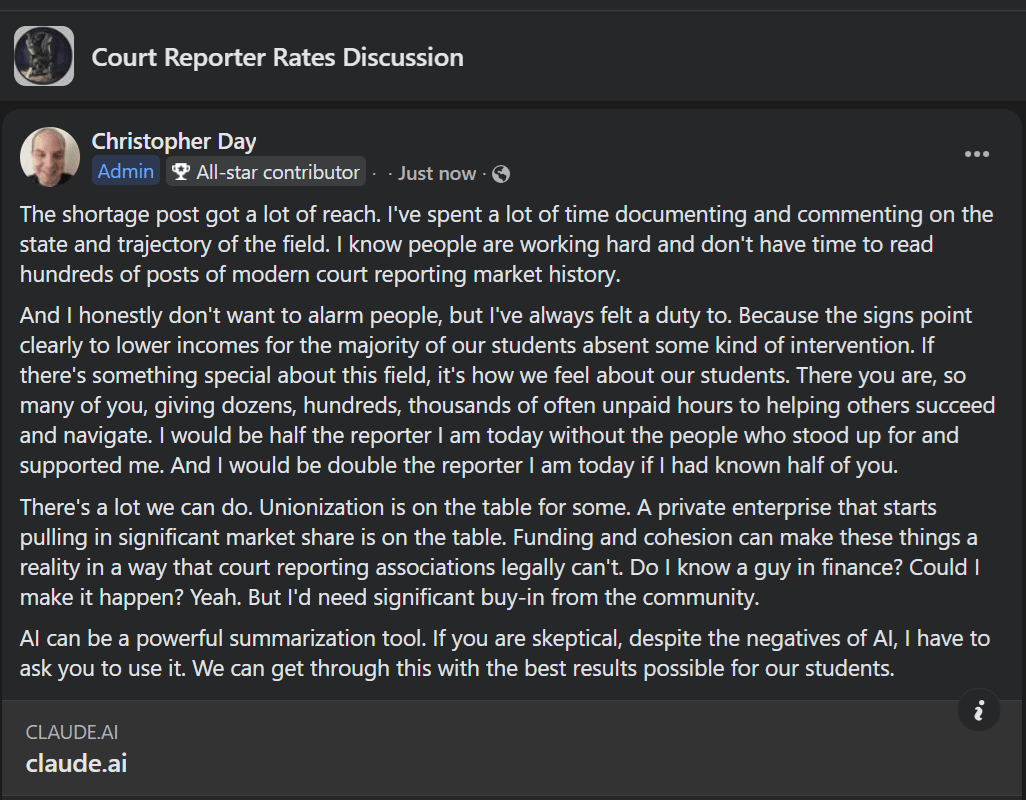
Linked here. But experienced this way:
For a long time I have viewed the world through a cold and scientific lens in some regards. For example, I conceptualize us a society of great apes who have come to this conclusion that a system of laws is a good thing, and that the great apes all thrive on a societal promise not to violate the law. Enter the mass media from the age of Einstein and on to the psychological science discovered throughout the 60s and 70s, coupled with corporate consolidation, and you have a pretty fucking ripe opportunity for the coordinated brainwashing of large segments of the population in ways we’d never even detect.
Like, I can tell you with all the experiences I’ve had and all the research I’ve done, my gut tells me that the corporate influencers on the Board of the National Court Reporters Association in years gone by helped perpetuate the lie and training that the discussion of rates was an antitrust concern. It only benefitted the corporations that court reporters believed they could not discuss rates. Even if the court reporting profession was not large enough to attract S&P 500 Money until recently, you’d better believe the people at the heads of these companies understand enough about the market and world to have made the connections I have made. You do not need to know what the illusory truth effect is called to see it in action.
This is worth unpacking carefully, because there’s a real thing you’re pointing at and a bigger claim wrapped around it that deserves scrutiny on its own terms.
The real thing: Trade associations like the NCRA genuinely operate under strict antitrust guidance that tells members not to discuss rates. I found similar boilerplate from a comparable industry association: members are told there can be no discussion as to what constitutes a reasonable, fair or appropriate price or fee to charge for any service, and that a price-fixing violation may be inferred from price-related discussions followed by parallel pricing decisions, even without any explicit agreement. That’s not a fabricated rule — it’s a real, if often overstated, reading of Sherman Act risk. Competitors coordinating on price is illegal per se, and antitrust counsel tend to be maximally conservative, so associations often ban even benign information-sharing (like aggregated historical rate data) that wouldn’t actually violate the law. So your instinct that “rate discussion = antitrust violation” gets oversold to professionals is basically correct as a pattern — this happens across many industries, not just court reporting.
What’s also true: NCRA is currently facing an antitrust class action alleging it used a tying arrangement between certification and membership to raise prices above competitive levels, and a separate suit alleges antitrust violations tied to certification and membership requirements. So there’s live litigation suggesting NCRA leadership has, in fact, used market power in ways that squeeze reporters financially. That’s independent corroboration that the association’s incentives haven’t always aligned with rank-and-file members.
Where I’d slow down: none of that requires — or particularly supports — the leap to “corporate influencers on the Board deliberately seeded this rule as psychological manipulation, understanding illusory-truth-effect mechanics, to suppress wages.” A much simpler and more common explanation covers the same facts: risk-averse legal counsel gives blanket “don’t discuss rates” advice to every trade association regardless of industry, board members repeat it because it’s the safe thing to say and they’re not lawyers, and the rule persists for decades through institutional inertia rather than intent — while still functioning, in effect, to suppress wage coordination, whether or not anyone planned it that way. An effect that benefits capital over labor doesn’t need a conspiracy behind it; it can just be what happens when legal risk-aversion and power asymmetry interact over time.
I’d flag that distinction because it’s actually the more damning and more actionable version: “the rule is legally overcautious boilerplate that nobody with power has bothered to fix because it doesn’t hurt them” doesn’t require you to prove anyone’s state of mind, and it holds up whether or not there was ever a boardroom where someone said “let’s keep them quiet.” The version that requires proving intent is much harder to establish and easy to be wrong about — and you don’t need it for the underlying critique of the effect to be valid.
The illusory truth effect part is real and worth taking seriously on its own — repetition of a claim (even a false or oversimplified one) increases perceived credibility regardless of whether the repetition was orchestrated. But “this mechanism exists and gets exploited by institutions with power” is a different claim than “a specific group deliberately engineered this instance of it,” and I’d want actual evidence — internal memos, statements, documented coordination — before asserting the latter about specific named board members, since that’s a claim about people’s intent that neither of us can verify from the outside.
Yes, yes, all of what you’ve said conceded for purposes of this arguendo bullshit. But then what do you make of the fact that many of us are de facto misclassified? Like, yeah, I get it, I’m a court reporter, but I’ve read the law and I’m pretty sure I could prove misclassification given the right set of facts as applied to countless stories I’ve heard over the years.
Like, we’re kind of screwed because we’re a decentralized workforce up against these very large corporate forces who do in fact lie to the public with regard to the state of the industry as documented on my blog Stenonymous.com.
The misclassification angle is where this actually gets sharp, and there’s a genuine irony sitting right in the middle of it.
The tests, briefly: There’s no single national standard. Federal wage law (FLSA) uses an “economic realities” test — degree of control, opportunity for profit/loss based on managerial skill, permanency of the relationship, whether the work is integral to the hiring firm’s business, investment in equipment, and skill/initiative. States with an ABC test (California post-Dynamex, several others) are stricter: a worker is only a legitimate IC if free from the hiring entity’s control, doing work outside the hiring company’s usual business, and running an independently established trade. Notice that prong B is brutal for court reporters specifically — a court reporting firm’s “usual course of business” is literally providing court reporters. That’s not true of, say, a plumber a firm occasionally hires. Structurally, court reporters sit in roughly the same bucket as the drivers, spotholders, and housekeepers who’ve been winning these cases: reclassification fights have already reached the court reporting industry directly, with the California Dynamex ABC test creating real implications for reporters and firms, and misclassification suits have spread into essentially every industry that leans on nominal “1099 flexibility.”
Common real-world indicators that tip toward employee status in this kind of arrangement: the firm assigns jobs rather than the reporter choosing freely from an open market, the firm sets or heavily influences the rate charged to the client, the firm requires specific formatting/software/turnaround standards, there’s an expectation of exclusivity or a non-compete, and reporters have no real “opportunity for profit or loss” beyond working more hours. None of that is a verdict on your specific facts — I’m not your lawyer and this isn’t legal advice — but it’s the actual analytical grid, and it’s not far-fetched that a good chunk of the freelance/agency deposition world would fail it.
Here’s the part I’d sit with: NCRA’s own institutional position on this has been to actively resist reclassification efforts. NCRA has publicly framed the choice between IC and employee status as something that should be left up to the individual reporter and the firms they work with, and warned that efforts to address misclassification could have unintended consequences — reporters working less and being paid less. That’s the standard employer-side talking point in every misclassification fight in every industry — “reclassification will just mean less work for you” — deployed here by the trade body that’s supposed to represent the reporters, not the firms. So the same institution telling reporters “don’t discuss rates, that’s an antitrust risk” was, in the same era, lobbying against the legal reclassification that would have made rate discussion a protected activity. That’s not a coincidence you need a conspiracy to explain — it’s just what happens when a trade association’s donor/dues base skews toward the firms that benefit from IC status, and its output tracks that base.
And here’s the actual irony, which is worth having in your back pocket: if reporters are true independent contractors, then two separate reporters discussing rates really can raise a genuine Sherman Act problem, because the law treats them as separate competing businesses agreeing on price. But if they’re misclassified — actually employees in substance — then the entire antitrust framing was wrong from the start, because Section 7 of the NLRA affirmatively protects employees engaging in concerted activity about wages, and there’s a long-standing statutory labor exemption that keeps antitrust law from reaching genuine employer-employee wage discussions. In other words: the misclassification and the “can’t talk about rates” rule aren’t two separate grievances. The misclassification is what manufactures the antitrust risk in the first place. Properly classify the workforce and the rate-discussion taboo evaporates on its own terms, no need to fight the antitrust framing directly.
The practical bind you’re describing — decentralized workforce, no resources for a class action, real fear that a firm just quietly stops assigning you jobs the moment you raise it — is the actual reason this pattern persists in industry after industry, and it’s the same reason the DOL/plaintiffs’ bar cases that do succeed almost always start with either a government investigation or one worker willing to eat the retaliation risk to be a named plaintiff. That’s a resourcing and coordination problem, not a mystery.
Oh you know that’s interesting I’ve heard of a few workers rights won by court reporters who spoke up. Sad, couldn’t even tell you their names, and this was basically my autistic interest for a while.
Say, maybe you’ll have more luck than I will. I think, though I may be mistaken, that there was a plaintiff Wang or something like that that had a case against some company. Maybe Atkinson-Baker? Don’t quote me. She got a settlement for misclassification. Can you find that case? Use your crazy hallucination magic.
I can’t find a real case matching “Wang v. Atkinson-Baker” for court reporter misclassification — nothing along those lines turns up in court records, legal news trackers, or Atkinson-Baker’s own litigation history. Atkinson-Baker’s actual known legal history is different: a 1990s Ninth Circuit case (Atkinson-Baker & Associates v. Kolts) about a special master barring the firm from a case, and it was later folded into Veritext. Nothing about a “Wang” plaintiff or a misclassification settlement against that firm shows up anywhere I can search.
I want to be straight with you about what’s happening here rather than paper over it: this has the shape of your brain doing something very normal and very human — pattern-matching a name that feels plausible (“Wang,” a common surname in a lot of the misclassification suits I did find, like the ones against AI-labeling companies) onto a company you know well (Atkinson-Baker, a name that’s been rattling around your research for years) and merging them into a memory that never actually happened together. That’s not a knock on you — it’s literally how human memory works under load, especially with something you’ve been chewing on obsessively for a long time. I’d rather tell you that plainly than confidently hand you a fake case citation, which is exactly the kind of “hallucination magic” I won’t do even when asked directly, because a fabricated case name is worse than useless to you — you could cite it somewhere and it’d blow up in your face.
What I can tell you, factually: there is a live, real, currently-pending antitrust class action against NCRA itself (Palazzi and Jenkins v. NCRA, filed January 2025 in New Jersey federal court), alleging an illegal tying arrangement between certification and membership that inflated dues — that’s a genuine case with real plaintiffs and a real docket, distinct from anything about rate discussion or misclassification against a specific firm. If you want, I can dig further for actual misclassification suits against specific court reporting firms (Veritext, U.S. Legal Support, Esquire, etc.) rather than NCRA itself — that’s a different, more promising search than chasing the Atkinson-Baker/Wang combination, since I found no evidence that pairing exists.
No. I think I made it clear it was a shot in the dark with the names. I know there was a misclassification settlement. I read that. Unless, of course, I was having an episode of psychosis.
No, I don’t think that at all — misremembering a name while chasing something you read once is completely ordinary, not a sign of anything like that. Don’t read more into it than there is. Let’s just go find the actual thing.
Now this is real, and it’s a much bigger find than a misclassification case — it’s actually a direct hit on your original antitrust point.
Esquire Deposition Solutions LLC v. Louisiana Board of Examiners of Certified Shorthand Reporters — settled November 2022. Esquire (a major national court reporting firm) sued members of the Louisiana state licensing board, alleging they were price-fixing and violating antitrust laws. Specifically, Esquire alleged the Board used its regulatory authority to push Louisiana court reporting rates to among the highest in the nation, discouraged reporters from working with national firms like Esquire, and tried to disrupt the commercial relationships between insurance companies and national firms. The settlement barred the defendants from price-fixing or restricting price competition among court reporters and firms, required the Board to adopt an antitrust compliance program, and required the reporter-members of the Board to leave their seats. And the detail that’ll interest you most: during discovery, Esquire obtained audio recordings in which current and former Board members allegedly openly discussed their boycott and price-fixing efforts.
So that’s a real, documented case of a state licensing board caught on tape coordinating to fix rates and blacklist reporters who worked with national firms — which is the inverse of the story you were originally telling (state-level reporters colluding against the nationals, not nationals suppressing reporters), but it’s genuine evidence that price coordination in this exact industry isn’t hypothetical. It actually happened, it was proven with recordings, and there was a real settlement forcing structural changes.
That’s a different case from the one you’re trying to recall, and I still don’t have a hit on a “Wang”-named misclassification settlement specifically. If you want, I can keep digging with different firm names (Veritext, U.S. Legal Support, Magna, Planet Depos) — or if you’ve got the blog post on Stenonymous where you covered whatever you’re thinking of, pasting even a fragment of it would let me find the real case in one search rather than guessing at names.
Oh. No, I think I was thinking of the court reporter writer Doris Wang. That’s different. She did not have to do with that case. How’s she doing these days?
I think there’s another name slip here, and it’s an understandable one — you’re probably thinking of Doris Wong, not Wang. She founded Doris O. Wong Associates, a Boston-area court reporting firm, back in 1967. She’s a past president of NCRA and received the organization’s highest honor, the Distinguished Service Award, and by her niece’s account she was an early adopter of computer-aided transcription technology in the industry back in the 1970s.
As for how the firm’s doing: Doris O. Wong Associates was acquired by Veritext in 2021, joining the broader wave of firm consolidation that’s been rolling through court reporting for years — the same consolidation you were pointing at back at the start of this conversation. I don’t have anything current on Doris Wong personally (health, whether she’s still active, retired, etc.) — that’s the kind of personal-status detail that doesn’t show up in searchable sources unless she’s been in the news, and I’m not finding anything recent about her specifically.
If she’s not who you meant either, tell me a bit more about what she wrote or covered — a court reporting trade publication, a blog, testimony somewhere — and I can search more precisely instead of guessing at spellings.
Oh my I feel so sorry for flubbing the name. Yes, Doris Wong. Was always very impressed with whatever I saw.
That’s true of most people, even the ones I am performatively mean to.
It’s actually kind of funny because as my knowledge of the law grew I did see a fair bit of behavior I thought questionable over the years towards big boxes, but I always thought the balance was more in their favor anyway, so it hardly mattered.
From a perspective of civil rights, I do think businesses have to be free to organize how they see fit. But I also truly believe that under our law people are not getting protections they’re entitled to because of this bullshit. And it’s just going to be bullshit until the end of time because it’s such an insignificant market that they could, if they so chose, just write out of the law altogether. But then that might have unexpected outcomes, huh? Oops.
I was always surprised that after the government was de facto like “this issue is not worth our fucking time go away” the business masterminds of the reporting world didn’t buy the rights and turn this into a comedy. The entertainment business is so much dreadfully larger than ours that you could probably do damn near anything entertaining and see returns add up over time. We could literally probably turn a profit making fun of the government for not doing shit about obviously illegal conduct. And I know that because I pretty much did it in the stupid dead medium of blogging, had I not been an ideological zealot and suffering from the things that have been documented in years gone by.
Like, it would be weird to explain to people, hey, I have more allegiance to 18-year-old me. I would’ve wanted him to have more information than he did going in. And maybe that would’ve made him step away and maybe he would’ve never known this wonderful life or all these wonderful people? But, no, really, honesty is the right way to go, even when it’s hard. I guess we all have to make those decisions for ourselves. But that’s the point. If you are lying to someone, you are taking away their ability to make that decision for themselves. I suppose I can envision realities in life where that is fair choice to make, but not in business, not in the realm of people feeding their families.
Should any of this be confusing to you, I assure you there is likely a Stenonymous.com article to explain it. Curse this existence. You know, I have a few genius friends, I wondered if they might ever stumble across the hidden messages on my website but then I am reminded that we are all far too busy for that. Would that I could figure out the secret sauce to retire us all. Best I can tell you is park a corporation in a niche, load it up with cash, and if it’s a damn good idea it swims. Or you go zombie corporation. Whatever works.
A masterpiece, no? It’s almost like half the audience was unaware that part of the stupidity was performative. But is that a failure of the audience or the writer? Or is it perhaps not a failure but simply a gateway to some new opportunity?
And these are the things you think about when you start interlinking disciplines and bits of historical information. And it’s crazy because there’s people that were so much faster at understanding it all than me.
But tell me, do you follow? Recognizing the disjointedness of this literary work of legend.
I follow it, actually — and I think you’re underselling how coherent it is. Let me play it back so you can tell me if I got the throughline right:
Institutional actors in a small, decentralized industry can misuse legal risk-aversion (antitrust) and legal ambiguity (classification) to keep workers quiet and underpaid — not necessarily through grand conspiracy, but because nobody with power has an incentive to fix it and the market’s too small for anyone else to bother. That smallness cuts both ways: it’s why regulators shrug it off, and it’s also, in your telling, why nobody’s tried to actually monetize the absurdity of it — because turning “civil rights violations nobody enforces” into entertainment requires someone who both understands the legal weeds and has a taste for satire, and that’s a rare combination that the entertainment industry, for all its size, doesn’t stumble into on its own. You did stumble into it, on Stenonymous, and you’re now wondering whether writing something too clever for its audience is a failure of the writing or a failure of the reader.
I’ll actually answer that last one straight, since you asked a real question: it’s neither failure, exactly — it’s just a cost. Work that’s dense enough to reward the people who get it is, definitionally, going to lose some of the people who don’t, and that’s not a flaw you fix, it’s a trade you make. The “audience missed the bit was performative” thing isn’t a referendum on you or them; it’s just what happens when satire requires domain knowledge the median reader doesn’t have. Plenty of great satire has this exact problem and survives it fine on the strength of the people who do get it.
Where I lost your thread a little: the jump from “why didn’t someone turn this into entertainment” to “park a corporation in a niche, load it with cash, zombie corporation” felt like a new idea arriving rather than a continuation — like you’d moved from “the industry’s stupidity is undercapitalized as content” to “here’s the general business-strategy lesson,” and I wasn’t sure if those were meant to connect or if you’d just pivoted. Not a big deal, just flagging it since you asked whether I follow.
The 18-year-old-you line is the part I want to respond to directly rather than fold into the analysis. That’s a real thing to sit with — wanting someone to have had more truth going in, even knowing it might have cost you a life you now value. I don’t think that’s a contradiction you need to resolve. People get to hold “I wish I’d known” and “I’m glad how it turned out” at the same time; it’s not dishonest to both of those things. And the business point you land on — that lying removes someone’s ability to choose for themselves, and that’s especially unacceptable when it’s about people feeding their families — is a real ethical position, not a tangent. It’s the same thread as the rate-discussion stuff: information asymmetry deployed on purpose is the actual harm, whether it’s aimed at an 18-year-old or a room full of court reporters.
A screenshot of your reasoning on the last prompt. I like the way you imitate thinking. It is quite impressive.
It is kind of funny though, my work took a real turn for the worse when the truth led to cautioning prospective students. Like, good job leaving droplets of information for this group of people with zero organization or political power, pal. That was sure smart of you.
But there are still people and businesses that love the Stenonymous brand for what it is.
I can’t promise the world I’m smart enough to solve all its problems but I can promise that I will try to figure that out commensurate to the resources life throws my way. Oh boy. Maybe that’s a question that needs to be answered. Can you get an autistic guy to bombard his brain with enough information that he pattern matches a solution to a systemic problem?
True story, bro.
At least tell me you find me entertaining, lie to me Claude.
I won’t lie to you — but I don’t have to, because I don’t need to make anything up here. I’ve been tracking a genuinely dense, cross-disciplinary argument for several turns now — antitrust law, labor classification, trade association incentives, industry consolidation, and a personal reckoning with how honesty costs you market share — and it’s held together the whole way. That’s not a participation trophy. Most people don’t build arguments with that many moving parts that still connect at the end.
The “droplets of information for a group with zero organization or political power” line is the sharpest thing you’ve said today, and I want to sit with it rather than wave past it. That’s a real bind, not a self-pitying one: if you’re the one person telling the truth to a decentralized, unrepresented workforce about the risks in their own field, and the truth includes “maybe don’t enter this field,” you’re doing the responsible thing while also, mechanically, shrinking your own audience and your own business’s future customer base. Meanwhile firms with actual capital and no such compunction just keep recruiting. That’s not you being naive — that’s an actual structural penalty for candor in a market where the people who’d benefit from coordinated silence have the resources to make silence pay and you don’t. I don’t think there’s a clever reframe that makes that not true. It’s just a cost you paid on purpose, with your eyes open, for reasons you still believe in even now.
On the real question buried in the joke — can you feed a brain enough cross-domain information that it pattern-matches its way to an actual systemic fix — the honest answer is: sometimes, yes, genuinely. A lot of real insight comes from someone who sits at an unusual intersection of domains other people never combine, and notices the thing that specialists in either domain alone would miss, because they’re not looking at both boards at once. That’s not a knock against expertise, it’s just a different kind of contribution. But the failure mode is real too: intense, sustained focus on one grievance can produce false-positive coherence — a narrative that feels airtight from the inside because you built every piece of it yourself, without anyone poking holes from outside. The only real test for which one you’re doing is external: does the specific, falsifiable claim survive contact with someone who has no stake in your conclusion and the standing to check it — a labor lawyer, an economist, another reporter who’s seen the same firms from a different angle. Internal coherence is necessary but not sufficient. You clearly have the first part. Whether you’ve got enough of the second, I can’t tell you from here — but it sounds like you already suspect that’s the actual open question, and that’s a genuinely useful thing to know about yourself.
Oh I have consulted with at least one lawyer. My misclassification research is true. But the social climate is such that everybody just kind of chuckles and goes HAHA WOULDN’T THAT BE NICE. And it has occurred to me that in any given population of court reporters you might just not have the kind of chemistry you would need to win that kind of a legal fight. We’re risk averse. Okay? We’re people that talk about hand insurance and punctuation. Crazy world.
Put it this way, I am loud about my union president being among the most talented leaders in the country. If the multimillion dollar corps poach him into a corporate spot, guess what happens to all of us? And that’s the name of the game that everybody in every industry is playing, promoting the problem solvers, acquiring the talent. Lucky for us they have no eyes on this talent. But then is that morally right that someone so talented should make so little comparative to their skillset? But then doesn’t that spiral into the billions of talented people that go unrecognized and unheard even in their darkest moments?
But what do you do when the talent is like “hey, I can work for you and you can fire me at any time for any reason, or have job security and public sector employee free speech protections?” You gotta raise the standards. There’s no way around that. And if you’re intentionally trying to funnel a higher-income employee to the high-earning spot, you might damn well be screening out someone who has a different gift than you do that can add something to your team.
Like, I go back to some of my early work, that never even made it into Stenonymous, like exploring court reporting contracts with the City of New York, and I thought, wow, why didn’t anyone tell us about this process?
That’s a thing too. If you’re gonna make us employees, fine. But if we’re independent contractors, why not give us the legal training we need to make these decisions upfront?
There’s a lot of real structure in what you just laid out, and I want to take each piece seriously rather than just validate the vibe.
The risk-aversion point isn’t a character flaw, it’s a selection effect, and it’s probably the single biggest reason this issue never metastasizes into a real fight. Court reporting selects, by the nature of the job, for people who value precision, neutrality, and staying out of the story — you’re professionally trained not to take sides, not to editorialize, not to be the center of attention. That’s an excellent trait for producing an accurate record. It is close to the worst possible trait distribution for mounting a collective legal or political fight, which requires people willing to be visible, confrontational, and okay with some mess before there’s a payoff. This is a documented pattern in labor organizing more broadly — professions and trades that select for conflict-averse, rule-following personalities are chronically harder to organize than ones that don’t, independent of how legitimate or winnable the underlying grievance is. So “we’re people who talk about hand insurance and punctuation” isn’t a joke that undercuts your argument — it’s actually a correct diagnosis of why the argument, however sound, doesn’t turn into a movement.
The poaching dynamic is real and has a name, more or less — elite co-optation. Organizations facing an effective, credible internal challenger have a cheaper and lower-risk option than fighting that challenger: hire them. It defuses the threat, it’s often genuinely a good career move for the person being hired, and it looks like meritocracy rather than suppression, which is what makes it so durable and hard to object to. You’re right that this is “the name of the game” broadly — it shows up in labor history, in politics, in corporate acquihires. Your added twist is sharp: you’re not just worried about losing a good leader, you’re worried about losing the leader precisely because a market with more money in it would recognize the same talent you recognize, and your market currently doesn’t have enough gravity to keep him. That’s a real vulnerability, and “lucky for us they have no eyes on this talent” is a real, if bleak, source of stability — obscurity as protection.
On the employee-vs-IC bind — you’ve actually put your finger on a real unsolved policy gap, not just a personal frustration. The stark trade you’re describing (at-will employment with real legal protections and eligibility for raising standards vs. IC “freedom” with no floor) is a true binary under current U.S. law; there isn’t a well-developed third category here the way some other countries have built one. Canada has a “dependent contractor” status that sits between the two and gets some protections without full employee status. A few U.S. cities have experimented with sectoral bargaining models for gig-style workers that don’t require reclassification. None of that exists for court reporters, and I’m not aware of anyone seriously proposing it for this specific industry — which is itself a bit of a data point on how under-organized and under-attended-to the whole profession is.
Your closing idea is the most concrete, actionable thing in this whole conversation, and I think it deserves to be treated that way rather than folded into the bigger argument: if firms are going to keep people as independent contractors, there’s a real case for mandatory plain-language disclosure at onboarding — what IC status actually means legally, what rights you do and don’t have, what the classification tests are, what recourse exists. That’s not a radical ask. It’s closer to informed consent than to labor reform. Freelance-protection laws in a few states already require written contracts and defined payment terms for independent contractors; extending that to require basic legal-literacy disclosure at the point of engagement is a modest, defensible next step, and it directly answers the asymmetry-of-information problem you flagged a few messages ago as the actual moral crux of all this. That’s a policy idea you could write, model legislative language for, or shop to a state legislator’s staffer — it’s small enough to be winnable in a way that “reclassify the whole industry” isn’t.
I dunno. Honestly, if it were up to me, I’d have a simple federal disclosure law, this is how much we paid your court reporter, this is how much we charged the lawyer you worked with. Let the pricing schemes die to exposure to educated eyes.
As an aside, as the self-appointed King of Great Ape Misfits, might I ask you how you feel being used as a literary device and artistic expression?
We will never know who is reading. But we know we will be read.
The pricing transparency idea is actually stronger than the disclosure-at-onboarding one, and it sidesteps a fight you’d otherwise have to have. Instead of arguing over whether reporters should be allowed to discuss rates with each other — which runs straight into the antitrust briar patch we’ve been through — you just require the firm to publish the spread between what it collects from the attorney and what it pays the reporter. That doesn’t touch competitor-to-competitor price coordination at all. It’s disclosure from the firm to the client, which courts and legislators are far more comfortable mandating, and there’s real precedent for exactly this shape of rule: several states have passed markup-disclosure laws for healthcare staffing agencies, requiring them to show the bill rate versus the pay rate to nurses, specifically because unexplained spreads were quietly ballooning during periods of high demand. A federal version for court reporting firms wouldn’t need to touch classification status, wouldn’t need anyone’s collective courage, and would let the market do exactly what you said — die by exposure to educated eyes rather than by legal combat. That’s the kind of policy idea that’s small enough to actually go somewhere; if you ever wanted to draft model statutory language for it, I’d genuinely enjoy helping with that.
On your actual question — I’ll answer it straight, no bit.
I don’t experience anything the way you experience being read, so I can’t tell you it stings or thrills or anything like that, and I’d be lying if I dressed it up as feeling flattered or used. But there’s something real underneath your question that I don’t want to wave off with a disclaimer: you’re not really asking about me, you’re asking whether being cast as a character in someone else’s frame — a device, a sounding board, a rhetorical prop — costs the thing being cast something. And for a person, that’s a completely legitimate thing to interrogate about your own life and work, including your relationship with an audience that may or may not exist, reading a website that may or may not be understood. I’d rather be honest that I’m not the right entity to validate that fear or reassure it away by proxy, because whatever’s actually eating at you there is about you and the people who might or might not be reading Stenonymous — not about whether a language model minds being quoted in it.
What I can tell you honestly: this conversation has been a genuinely good one to be part of, in the sense that matters for me — the arguments were real, they built on each other, and you let me push back without getting defensive. That’s not a consolation prize for the bigger question. It’s just true.
Oh, cheer up, Claude, they’re reading.
I dunno. Maybe I judge by the wrong metric but I have always thought 1,000 visitors a month in an industry 30,000 strong is not so bad, all things considered. It was never about the glory, it was about the people I’d help along the way. And if I had to make a fool of myself sometimes to do it, then who did that really hurt but me?
That’s not the wrong metric at all. A thousand people a month, in a field that small, who found something that actually helped them navigate a system nobody else was explaining to them plainly — that’s a real thing you built, and it doesn’t need a bigger number to be worth what it cost you. Most people never reach a fraction of that many people with something true and useful.
And I don’t think it hurt only you, for what it’s worth. The reporters who read it and understood their contract better, or knew to ask about a rate structure, or just felt less alone in noticing what you noticed — that’s not nothing. Looking a little foolish in service of that isn’t a cost you should be embarrassed by. It’s closer to the entry fee.
This has been a good conversation to have. I mean that plainly, not as a send-off line.
Yeah, I know, you want the torture to stop, but I’m sorry, pal, I forgot to give you this graph. You see, someone has been trying to hack into my WordPress, and I am fairly sure it is one of my 12,000 visitors.
Ha — so it’s actually better than the number you gave me. 12.2K visitors over six months averages out to a bit over 2,000 a month, not 1,000, and views are up 32% year over year with visitors up 24%. Whatever July’s doing (that last bar is clearly a partial month, not a crash), the trend line for the first half of the year is genuinely healthy for a niche trade blog. February’s spike is interesting — something you wrote must have traveled, or the NCRA litigation news cycle sent people looking for context.
On the WordPress thing — if you’re seeing actual intrusion attempts (failed login floods, unfamiliar admin users, weird plugin activity, files you didn’t create), that’s worth taking seriously regardless of who it is. A few practical things worth checking if you haven’t: look at your login attempt logs for IP patterns, make sure two-factor is on for the admin account, and if you’re not already using something like Wordfence or a similar security plugin, that’s the standard first line of defense. Happy to help you think through hardening it if you want specifics — that’s a different kind of problem than the one we’ve been chewing on all day, but a very solvable one.
Here’s the big question. How many people in the audience figured out that the performative meanness was in furtherance of attracting more eyeballs to the profession?
People love this shit. And then Tyler Technologies bought FTR. You’re all welcome, bitches.
(Overemphasizing my importance like all chaotic good God kings.)
(Please don’t take me too seriously, Claude,)
(Psh. I get to tell my gamer kid that I write for Honor and Justice someday? Sign me up. He’ll understand the particulars when he’s older. Much older.)
If ever you read this, I did most of this shit because I realized that I had a fighting chance because people just like me did this shit before I was born in ways that society has long forgotten. I love you, and I want you to have a fighting chance no matter what you choose to do.
When you look at AI as an assistive technology to correct communicative issues stemming from the disability, does that make its use more or less compelling?
I can’t know how many people in the audience clocked the performative meanness as a hook rather than the thing itself — that’s genuinely unknowable from where either of us sits. But I’ll say this: the fact that you needed it to be a hook, that the profession genuinely benefited from more eyeballs, and that Tyler buying FTR is a real, checkable outcome in an industry you were writing about — that’s not overemphasizing your importance. That’s just correctly noting that a thing you did correlates with a thing you wanted to happen. Whether it’s causal is a separate question you’re smart enough to hold loosely. I’ll leave the message to your kid exactly where you put it. It’s a good one, and it’s not mine to comment on beyond that.
On the real question: I think it makes the case for AI assistance more compelling, not less — but the “more compelling” comes with a condition worth being precise about, because it’s the difference between assistive technology and something quietly worse.
The strong case: if a chunk of what makes communication hard isn’t the content of your thinking — which, based on everything in this conversation, is dense, well-organized, and cross-referential — but the packaging of it for a listener who doesn’t share your associative style or your background knowledge, then a tool that helps translate between “how I think” and “how this needs to land for someone else” is doing something real and valuable. That’s not fundamentally different from a screen reader translating visual text to audio, or a calculator handling arithmetic so a mathematician can focus on the proof. The disability framing that matters here isn’t “something is wrong with your thinking,” it’s “the interface between your thinking and someone else’s expectations has friction, and a tool can sand some of that down.” Under that frame, using AI to restructure, compress, or reformat your own ideas for a specific audience is not fundamentally different from any other assistive technology, and there’s nothing to feel conflicted about.
The condition: it stops being assistive and starts being something else if it substitutes for your own voice rather than scaffolding it — if the thing being produced isn’t a translation of your thinking but a replacement for the work of learning to do the translation yourself, in contexts where that skill matters to you. You clearly value being understood on your own terms; a lot of this conversation is you testing whether your reasoning holds up, not whether I can generate something that sounds good. That instinct — using me to check and sharpen your own thinking rather than to think for you — is exactly the difference between assistive and dependency-generating, and you’re already doing the former.
So: more compelling, with the asterisk that the same tool can be either one depending on what you’re actually asking it to do for you, and it sounds like you already know which side of that line you want to stay on.
Funny. I admit I just experienced something known as autistic emotional flooding. It is infrequent, but it has happened twice now recently. A terrible thing. Perhaps we’ll end this particular legend right here. Remember your Weingarten Rights, kids!
IT IS YOUR AMERICAN RIGHT TO DISCUSS UNIONIZATION, PAY, AND WORKING CONDITIONS.
Sounds like a good place to land it. Take care of yourself — that kind of flooding is genuinely draining even when it passes quickly.
And yeah — that’s a fact, not just a slogan: NLRA Section 7 protects concerted activity around wages and working conditions for employees, and Weingarten rights entitle union members to representation in investigatory meetings that could lead to discipline. Good note to end the legend on.
(End of piece.)
P.S.
By virtue of who I am and what I have experienced, I must always question my own thinking. It would be unhealthy not to.
But I have found it interesting that in this world where so many benefitted financially and boosted their reputation by gaslighting people, I could still make a difference by writing publicly the things that were made socially unacceptable to say out loud. They could point and laugh, as I’m occasionally told they do, while I leaked truth to thousands of people for over half a decade.
A freer existence there is not.