Proof The Court Reporter Shortage is A Digital Court Reporting Advertisement

I was sent this by a contact over social media. It’s labeled as an advertorial. And that alone gives us enough to pick it apart and figure out what it’s selling. It’s written by Christy Pratt, VP of Veritext Canada.

Veritext releases advertorial about the court reporting shortage, strengthening Stenonymous arguments that the court reporter shortage is being exaggerated and exacerbated to artificially increase demand for digital court reporting.

It goes a little into the history of reporting to give the rest of the piece some credibility. I have no problem with that. But then it gets to its main sell: The shortage is real and times are changing! Hey everybody! Did you know times change? You can trust the rest of the advertorial because the author is making perfect sense up to this point.

Veritext advertorial showcasing that the shortage is being used as a selling point for digital court reporting.

Remember, this is posted to Trial Lawyers of BC. It’s clear who the audience is. They don’t want lawyers to complain about the transition from steno to digital, where the author admits steno is still in heavy use. They want to paint digital as the solution. It’s much easier to tell someone what they want is not available instead of telling them you don’t want to give it to them. It’s a lie to limit consumer choice.

It’s worth noting that the shortage isn’t as bad as it was forecasted to be in America and that the Speech-to-Text Institute’s Jim Cudahy left the field when I accused him of fraud for spreading court reporter shortage disinformation. It’s also worth noting that Veritext is represented in the Speech-to-Text Institute’s leadership by Adam Friend, VP of business development, and has not made any attempt to correct the misleading information put out onto the market by STTI. Misleading information that threatens the futures of ourselves and our students, by the way. Does anyone believe that Veritext, a multimillion dollar corporation that benefits financially from the expansion of digital, would not spread the same lies in Canada?

I’ve had people lie to me over $5. When the future direction of an industry is at stake, does anyone believe this isn’t fabricated? And I’m sure I have a detractor or two who would point at me and say the same, but let’s be real, in my wildest dreams Stenonymous makes me maybe a million dollars someday because some rich person realizes how much fun it would be to set me loose on the world or Veritext realizes my creative genius can be bought (in reality, I lose money on my media activities, even with the support of my wonderful audience.) This industry is close to $3 billion annually by estimates I’ve seen. Who has a greater incentive to lie? And it’s not like they can claim they don’t know about my research now. They’re basically using my arguments on AI to make the case for why court reporters won’t be replaced. I’ve basically never had better proof that Veritext execs read the blog and understand at least part of my work.

To make matters worse, a source inside a big box is saying the nickel and diming of stenographers is getting worse despite the alleged demand. If they’re chipping away at the incomes of high-end realtime reporters, the average reporter isn’t going to stand a chance.

Reporters, organize and resist or be ruled by people that don’t care if you have a good life. That’s all there is to it. I know my methods come off as extreme, but it’s an extraordinary case where an entire profession is threatened with extinction based on a lie. It’s a classic what-would-you-do scenario, and I’d like to think that if every reporter had the same statistics and information that I have seen and published, they’d be just as outraged. They’d fight just as hard, and maybe harder.

I’ll continue my quest to slay the windmills. Wish me luck.

Video: Joshua Edwards’s Tribute to Dom Tursi

The passing of Dom Tursi has been rough on all who knew him. The Washington Court Reporters Association held a memorial on April 15, 2023 at the time when Dom had been scheduled to speak. Family and friends of Dom Tursi were allowed to join virtually. I was very honored that my interview with Dom was played for all present and we got to hear his wise words and inspiring insights once more.

Now Joshua Edwards, my best friend and someone who was quite close to Dom, has released a video tribute to Mr. Tursi. It discusses the Cicero Forum and ends with a beautiful musical tribute. This is something that everyone should see.

If you have your own tribute, please feel free to comment here with it. We can all join together and remember him.

Video Released In Memory of Dom Tursi

Dom Tursi, one of New York’s most beloved and well-known court reporters and mastermind behind the Gallery of Shorthand, has passed away. I had the privilege of sitting down to talk to him in 2021 during a recorded interview, but it was never released. I’m now releasing it so that all reporters may get to hear Dom speak and remember this man that loved our field so much.

It’s tough for me. When I was a young reporter and didn’t know anybody, I got taken advantage of. I reached out to a few people for help and guidance, and he was one of the people that helped me forward, helped me maintain hope, and ultimately changed my mind about leaving the field. I am a court reporter today in part because of him. Thank you, Dom. You will be missed.

The video of the interview I have with Dom is hosted on my YouTube.

Song: I’m in Love with the Court Reporter

Funniest song you’ll hear all day, sent to me by a friend and mentor. I later learned it was also posted by the best union president I know.

This is for all the court reporters that have been asked out by somebody on your case. I have to highly recommend it for the laughs and the surprise twist at the end. I find this very creative. Good delivery.

I’m In Love with the Court Reporter by alanmessing YouTube channel.

I’m planning to start a monthly media blast where we all share the different things we’re watching/listening to related to the field. So keep eyes out for that at the beginning of March. Enjoy!

Addendum:

I was sent this song by a reader. It’s from Stenoholics!!! A must listen!

Finally, Another Song About Stenography

After I was given permission to mirror Andy Bajaña’s song, things dried up for a while on my end. I’m pleased to announce a new stenographer song by Anonymous, commissioned by Stenonymous.com.

The song’s available for download at $1.00. The song’s already free on YouTube and easy to share, but I know there will be those of you that want the wav file or to show support.

It’s thanks to this community that I’m able to do things like this. It’s like I keep saying, more resources give me more power to advance our interests.

Perhaps that makes it a good time to lay out some of my long-term goals. I’d like to grow big enough to begin to centralize our stenographic media, get some of our best influencers on a payroll or contract basis, and really begin extending our reach using several different entertainment styles. It’ll take me a long while to do it alone. Not so with the help of my fellow court reporters.

Regardless of what you think of that plan, enjoy the song, and have a great day!

Veritext Seeking Videos to Promote Steno

Veritext announced that it is accepting videos promoting steno. Film a video of yourself with your machine and say “I am a court reporter.” Sample ideas are available.

Veritext calls for videos to promote steno

The “get started” button leads here.

I don’t want to be too disparaging. One of my primary gripes has been the very lopsided promotion of digital, and if they’re doing something positive for us, it should go forward. No doubt, good job, Veritext. Thanks for spending the time and money to do this. I mean that.

I must remind reporters, though, that this is a clear indication that the Speech-to-Text Institute, associated with Veritext’s Adam Friend, lied when it said the stenographer shortage was impossible to solve. If our shortage was impossible to solve, Veritext would have zero incentive to continue to attract anyone to the field. It would, in fact, be heartless to lure people into a dying field. This supports my claim that our field is not dying, and that any decline is reversible. The numbers support this to the extent they exist.

I am ecstatic that Veritext is doing something positive. It doesn’t really negate the fact that they have been advertising for digital reporters on LinkedIn for over a year that I’ve been monitoring it. That means every day spamming jobseekers with digital, digital, digital. So to make a video and release that and share it is nice, but it’s not quite the same impact on the market in my estimation. Maybe I will be wrong. Hopefully I will be wrong. Advertising stenography now gives us the people we’ll need later. Timing and enthusiasm matters. And the timing of this is a little odd. We’re being deleted in Indiana. Has Veritext made a comment to the court about that like many of us have?

If I were Veritext, I’d claim that this video initiative helped solve the shortage and throw Cudahy’s math under the bus. It’d be a smart move for them. They get to be the heroes and cast doubt on Stenonymous in one swift move.

I’ll be submitting a video. I encourage others to if they have the time. While I am suspicious of Veritext’s motives at the top of their corporate structure, most of the people that work below them are going to be decent people. When I submitted something to their reporter corner years ago, it got featured. This is to say I don’t believe videos will be misused in any way. I really believe they’ll do exactly what they’re proposing to do here, and I think it’ll be great.

I just hope there’s more, and that this is not a one-off before they return to burying us.

Propaganda Guide for the Smart Steno Consumer

For those of you that haven’t read up on propaganda and persuasion techniques, you still probably won’t be too surprised to know that leaders, corporations, and all manner of people try to exert control. This usually isn’t done by direct threat or force, but by persuasion. Advertising, to some extent, can be propaganda. Networks of influencers are the modern machine that keep people scrolling. There are innumerable ways that forces we don’t even think about are trying to get in our heads. I confess that I, too, use some of the techniques I’m about to talk about. But that’s the point, if the consumer is aware, then they can make better choices. I am going to be stepping up my media game this year. You’ve all got to be ready.

Types of Propaganda:

Bandwagon Propaganda.

As humans we generally have a desire or drive to fit in. We’re interested in what’s trending for these reasons. When someone is trying to convince you that everyone else is doing it, they might be propagandizing you. In court reporting this is fairly common, software vendors will try to convince you to get on the new thing because everyone is getting on the new thing, but really they just need you buying equipment to feed the economic engines.

Card Stacking Propaganda.

This is about mentioning the positives without the negatives. Stacking all those positive cards on top of each other so that you don’t look at the negatives underneath. To be fair, this is actually a presentation technique and life tip, and I use it often, so I can’t knock it.

Plain Folk Propaganda.

This form of propaganda deals with displaying regular, relatable people and faces in advertising. It can kind of tie into the idea that “normal people” use a product or service being pitched.

Testimonial Propaganda.

This is about getting popular or famous people to pitch a product or service and is viewed as the opposite of plain folk propaganda. This tries to display people you look up to using a product or service so that you use it too.

Glittering Generality Propaganda.

This is when they use corporate speak that doesn’t really mean anything. Things like “we’ll be there for you” or “on your side.” Things that make you feel good, but don’t really convey a message or promise.

Name Calling Propaganda.

This is pretty rare in the corporate world, which is why I use it. This is exactly what it sounds like. Characterizing people. Calling people names. A fraud, a fake, a liar. It’s nasty stuff. I think my first use of this was when I called Frank N Sense a monster. Still kind of a monster. They posted that the NCRA board should resign. I honestly can’t agree. The NCRA board has the profession’s best interests at heart. Everybody has to follow through with what they know and believe in their hearts. It’s going to be just a little different for each of us. But I think they’re doing a damn good job this year and last. But anyway, name calling, yeah.

Transfer Propaganda.

This is when the propagandist uses something they believe will resonate with you in their messaging. Things like using a person’s religion to sell them things, or as I’ve said from our field, the “democratization of technology.” Most people like democracy, right? Transfer propaganda! If they’re using a vague concept related to something you love, it might be a flag.

Ad Nauseam Propaganda.

This is about messaging. Constant messaging so that you remember the brand. When I’m feeling healthy, I’m a little guilty of this, because I can write a lot more.

Stereotyping & Appeal to Prejudice Propaganda.

This is a big one. Pretty much every major player on the field is using this one against court reporters right now. We all have certain beliefs about digital reporters. We saw it when Verbit called them low skill. We see it when it’s used as a motivator to get people engaging with associations. We see corporations using it to eradicate us, pretending we’re obsolete because that’s our stereotype. The bottom line is that these players understand you. They understand how you think and what you like and don’t like. They understand how you feel about yourself. They’re going to be thinking about how to extract more money from you using that information. This was also effectively used to divide reporters, because for the last decade we were all on this “realtime is the future, everyone must tech up” drive, getting down on people who didn’t play the tech consumer game, and then when everybody sold enough equipment and training there, they packed up and went digital. This is why I have identified group think as dangerous to the profession. If they know us too well, they can manipulate more dollars out of us without giving us enough benefit.

Appeal to Fear Propaganda.

This is about using fear to get people to do things. It can be a product meant to alleviate a fear built up through advertising or it can be, in my opinion, putting you in a position of fear. On the topic of fear build up through advertising, Stenograph did this when it did its keyless drive. Gotta go keyless! Gotta buy the next thing! Gotta buy the new machine! We can all respect making money, but at a certain point, it’s just unnecessary oversaturation of the market. In terms of putting you in a position of fear, companies are doing it right now every day. They’re showing that they’re resolved to expand and switch to digital. They’re pressuring reporters to go digital, and conveniently buy their training and equipment. I think I’ve said this before, but if someone is scaring you, you might be getting propagandized.

Now You Know

When you start looking for these things, you will find them. We will all, one time or another, fall victim to propaganda. Sometimes it’s for a cause we really believe in. Sometimes it’s something we don’t really need in our lives. Sometimes it is the more comforting thing to allow ourselves to be propagandized.

Now, I should clarify, when I use these techniques, I do so for advancing truth and knowledge. All I have documented has been my honest perspective and recording. But in the end, people read and donate because it’s interesting, not because it’s honest. So if you catch me using some media tricks, it’s about keeping it interesting.

I’ve got some ideas in the oven! Get all your friends subscribed!

NCRA Town Hall: A to Z, Public & Government Relations

I attended the National Court Reporters Association Town Hall today with President Jason Meadors, and boy, am I glad I did. It gave me confidence that the association and its leaders are pushing hard to represent the interests of members. The entire session was almost exactly an hour, so there’s a lot to unpack.

Present at the meeting were, as stated, NCRA President Jason Meadors, Executive Director Dave Wenhold, Max Curry, a Past President and Chair of the A to Z committee, Annemarie Roketenetz, Director of Communications & PR, and Jocelynn Moore, Director of Government Relations. The meeting started off with a lengthy discussion from Max Curry about the A to Z program, and he took the time to explain where the program started and how it was completely revamped. According to Mr. Curry, A to Z began with about 50 boots-on-the-ground programs in the states. That fell away when the pandemic happened, and most programs closed. Programs in Texas, Tennessee, Minnesota, and California all went remote, which showed that the program could be done remotely. A new vision has come into place where the program can be done remotely and all of the resources can be centralized behind the program, with fewer boots-on-the-ground programs. Eight programs will be done a year, four asynchronous and four live. This is to capture the different kinds of learners — ones that can learn on their own AND people that need interactivity to succeed.

One of the truly exciting plans was for a landing page that can be centralized that brings people back to A to Z. NCRA is planning to reach out to organizations and associations to have them host a button or link to the landing page, creating a spiderweb or net that helps catch all the people that might be interested in this wonderful career and bring them back to the NCRA’s A to Z to give steno a try. They may ask firms to donate $5 to $10 of their Search Engine Optimization budget to help bring people to the landing page. NCRA President-Elect Kristin Anderson’s Houston President’s Party will act as a fundraiser for SEO dollars to ramp up advertising about court reporting and captioning as careers.

Lisa Dennison also spoke and informed us that 15 A to Z scholarships were given out at $750 per award. NCRA interacted with ASCA, the American School Counselor Association, getting school counselors’ contact information, adding them to a contact list, and getting them information about court reporting. It was mentioned that the communications team has been working on Instagram, QR Codes, and other ways to spread the message. Reliance donated money for student memberships for previous A to Z graduates, which helped grow association membership as well.

It was mentioned that NCRA continues to work with vendors such as Advantage, ProCAT, and Stenograph. The StenoCAT iPad app, iStenoPad, was also described as a way to simplify the logistics of getting stenotypes to participants.

It was explained that last year 295 students were picked up by A to Z. Max Curry clarified that some local programs do not coordinate with headquarters, so numbers from those programs are unavailable. Ms. Dennison asked that participant lists be sent to the NCRA so that better data can be compiled.

A quote by Brianna Coppola was shared. “I have never seen or heard of another ‘career test drive’ course. It really spotlights the encouragement within the community of reporters and their love for their jobs and dedication to the field.”

Dineen Squillante asked about the possibility of reaching out to departments of labor in each state. Lisa Dennison responded that it was something that could be looked into.

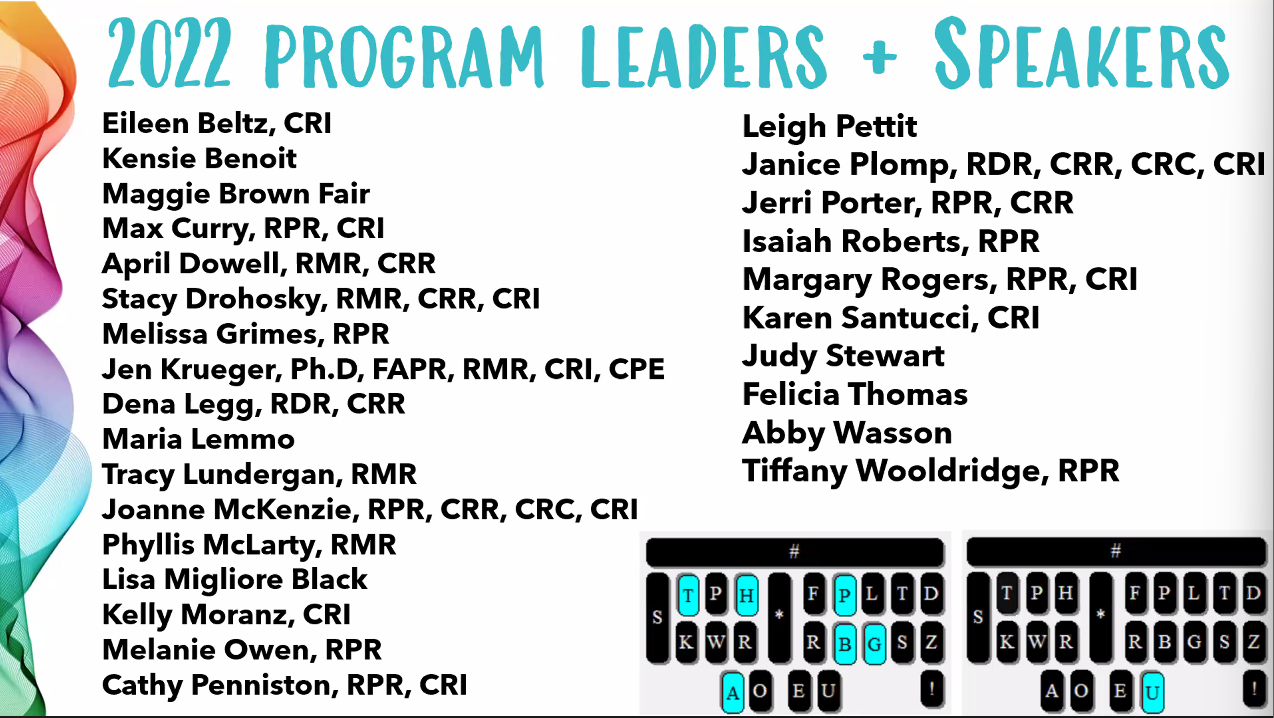
2022 Program Leaders and Speakers were thanked. It’s an extensive list, and I feel they deserve the recognition.
Ms. Dennison made it clear that the door was open to anyone that wanted to reach out on A to Z.
Annemarie Roketenetz talked a little bit about plants for Court Reporting & Captioning week, and a lot about the many endeavors of NCRA. She also mentioned that a number of press releases would be made, leading up to a larger press release that will link back to all the smaller ones. This is in line with dispatching our news and events regularly, and a very smart move on NCRA’s part. Several events were mentioned. Review the Town Hall recording at the Learning Center for more, I cannot do it justice in print. Our PR and communications are in good hands.

Mr. Meadors noted that Legislative Bootcamp has been called a “money grab.” He stated NCRA does not make money on bootcamp and reiterated what an important program it really is.

Jocelynn Moore expounded on bootcamp, explaining that it is extremely immersive training on how to be effective grassroots lobbyists. She stated that the training is “going to give you all of the tools necessary to go in front of a legislator, oppose legislation that doesn’t agree with the profession, or advocate for a bill coming through. Some of the topics covered will be “politics 101,” how associations work, and how you can mobilize with other members in your state to move forward on a particular issue.

The Training for Realtime Writers Act was mentioned. It was also mentioned that it will be difficult to reintroduce this under a Congress attempting to cut spending. More information will be provided on that at bootcamp, but also more on the situation from Indiana. Participants will learn how to advocate in front of different parties and teach members to speak to legislators, because legislators do not always have all of the information we have about our field.

Ms. Moore continued on to talk about the Indiana issue. The proposed prohibition of stenographers from Indiana courts was revealed. We learned that NCRA began a grassroots campaign to find out what happened and why the proposed change was introduced. The organization has found difficulty getting information about the change, but finds the language to be discriminatory and mandatory, robbing judges of their discretion and forcing them not to use a stenographer.

It was a packed hour. My only criticism of the event would be that they ran out of time for questions. But you know what? It happens. President Meadors directed that efforts should be made to record questions asked and that efforts would be made to have them answered. Everything wrapped up with Dave Wenhold thanking the participants for coming out on a Saturday. He said that if you get any information on Indiana, you can pass it to him or Ms. Moore. President Meadors noted that just showing up and asking questions meant participants were dedicated to the profession. The meeting subsequently came to a close.

Refinement of the programs we have is going to seize the day here. Leadership is doing something very impressive. My opinion may not count for much, but I’d thank each of them for the hard work that they do and continuing to fight for this profession. It’s inspiring, and I hope reading a little about it has inspired all of you.

The Learning Center can be used to locate and view past Town Halls.

Justice for Craig Saunders Seeks Court Reporter Experts

Recently I was contacted by a LinkedIn profile named Craig Saunders. This led to contact from JusticeForCraigSaunders.com, which redirects here. As I understand it, Mr. Saunders and/or people seeking justice on his behalf are saying that there are different versions of the same transcript, all with variations among them. He’s seeking to answer several questions. Some of the questions, like how to prove something, are really meant for a lawyer. But some of the questions do seem answerable by court reporters.

Full disclosure, I think he’s trying to say the court reporter did wrong here, but then that’s sort of why I was interested to begin with, because my expert opinion very well may have been everything made sense. I don’t know. I haven’t reviewed the materials. But honestly, not all court reporter mistakes are malicious, and sometimes litigants truly believe that they are. It’s a risk that comes with the job. I know I could be called to testify about any transcript I put out. Will it ever happen?

Anyway, based on the representation that it would be about 200 pages of review/work, I put forward an estimate of $500, a deposit of $250, and basically said I’d only look at the stuff after I got a deposit. Also said if I thought I couldn’t answer the questions after a cursory glance I’d let him know and refund the money. Didn’t discuss anything about travel in the event of testifying. At this time, they’re not going to use my services. But they did ask me to share this with my court reporter audience to see if anybody might put together a better proposal.

So if you’re interested in answering some of these questions, feel free to contact justiceforcraigsaunders@gmail.com. Be reasonably cautious. I haven’t vetted this cause, I’m only passing it along because there might be court reporters out there that want to try their hand at being somebody’s expert. I’ve been given the go ahead to share the materials publicly, so you will be able to make your own judgment call on whether you can help and to what extent. The first few pages detail the objectives of the project and the questions that need answering. Personally, I think my $500 offer was as low as it gets, but if you prove me wrong, feel free to brag about it in the comments.

What I think we need here, in this case, are the stenographic notes. We should definitely start telling defense attorneys to question transcripts more often and even inspect stenographic notes. I know you all hate the harassment, but if they’re thinking about us, we’re in business. Sad reality is that we are where we are today because we became too invisible. We need to be seen as integral. They don’t even know how to challenge our transcripts because we’ve done so excellently for so long. Challenges would also probably create more private sector work, especially if there was a healthy supply of people questioning transcripts and court reporters reviewing stenographic notes. Tell me that Veritext wouldn’t capitalize on a market like that. The shortage would disappear overnight. Maybe that’s where they’re headed with digital. Audio forensic experts and fighting over missing or altered testimony. Just a little bit of playful speculation.

As an aside, it’s been an interesting start to the year. Two litigants have found this blog already. It’s likely to begin attracting more pro se and court-involved members of the public that are interested in court reporting, are looking for court reporters, or are seeking to publish about their case. People feel powerless in the system. Maybe some will see the work I’m doing and throw a dollar down on my Stenonymous.com front page. After all, I’m taking swipes at powerful people while those powerful people are looking to degrade court record accuracy with their recklessness and scheming. Nobody I spoke to last Sunday thinks court record accuracy should go down. Pretty much everybody that hears about what stenographers are being put through and takes the time to understand it sides with us. Not everybody’s got the time, and that’s okay.

Anyway, here’s Mr. Saunders’s materials. TKPWHRUBG.

NCRA STRONG: The Demise of the Ducker Report…

On Monday NCRA published “From NCRA Strong: The Demise of the Ducker Report: lessons learned and successes celebrated.” This was a personal favorite of mine because it skillfully and articulately takes many of the issues we have been discussing as professionals for the last few years, wraps them up, and puts them to rest. In summary, the article lines up that Ducker is outdated and that despite some organizations stating the shortage is impossible to solve, there have been a multitude of developments in the field that have helped us along, such as NCRA A to Z, Open Steno, and Allie Hall’s creation of court reporting programs around the country. It’s an excellent read, go check it out.

Special thanks to:

Elizabeth Harvey, FAPR, RPR

Sue Terry, FAPR, RPR, CRR, CRC

Lilian Freiler, FAPR, RMR, CMRS

Michelle Kirkpatrick, RDR, CRR, CRC

P.S. I had some inspiring words for NYSCRA group members that I’d like to share with everyone.

Christopher Day’s remarks on the Demise of Ducker post by NCRA Strong