Why Failing to Raise the Debt Ceiling is Bad — Government Shutdown Threat 2024

I’m not going to get too into why a government shutdown is bad. There’s no reasoning with any anti-government goon that thinks it’s good. Critical funding to law enforcement and other initiatives stops and workers potentially go unpaid, maybe even deciding to walk off the job for an employer that will pay them steadily.

But there’s a major threat to your wallet.

When the U.S. government takes on debt by issuing bonds, it’s putting the full force of our country’s credit and credibility behind those bonds. To put this in really simple terms think of it like a credit card. You have a credit limit. The United States as a sovereign government has the power to raise its own credit limit and lenders are willing to lend more and more money because the United States is a safe bet with a strong dollar — they will get their money back with interest. Some of those lenders are Americans. Some are foreigners. All are relying on the United States to pay its debt. The faucet will pretty much never turn off as long as we keep telling people we’ll borrow some more money — or at least it’ll be a damn long time before the faucet turns off because people believe in our country’s ability to pay its debts.

Now, if we choose not to raise our credit limit and borrow more money to pay off the interest on our current debt, we default pretty quick, because the government simply doesn’t have the cash on hand. I suppose it could print money, which would cause inflation and make every dollar you own less valuable — but that’s not a great idea. So what happens when we default and stop paying the interest on United States debt?

Lenders get nervous. Interest rates go up. And again, we get inflation that makes every dollar you own less valuable — and prices go up to reflect this new reality of decreased purchasing power around the world.

So this is really a no brainer. The fact that it’s used as a political weapon is the single greatest failure of modern government. Theres no end game where failing to raise that debt ceiling is good for Americans.

Oh, and if you own a United States bond and they stop paying your interest, that’s bad too. There are many seniors that rely on the fixed income from bond interest to survive, and I don’t think I need to get into what happens when you turn older folk’s income off and potentially crash their investments. There’s just no good reason to do that. It’s evil.

If we go this route the world may no longer see us as a safe place to invest. A weak dollar means Americans lose.

It’s my sincere hope we don’t go there and that there are some adults in the room. But for the time being I’ve got all my money in brokered Certificates of Deposit because it seems like the ultra rich are trying to crash everything so they can buy cheap, cheap, cheap.

Addendum:

I just saw this. Needless to say I agree.

1 in 4 Court Reporting Companies May Be Unprofitable

In my Collective Power of Stenographers post, we explored how court reporters collectively out-earn every company in business today. In Aggressive Marketing — Growth or Flailing, we took a look at VIQ Solutions, parent of Net Transcripts, and saw how a transcription company could be making millions in revenue but be unprofitable. This all set me down a path of learning about zombie companies, companies that are not making enough to meet debt obligations, or just barely enough to make interest payments. You can watch Kerry Grinkmeyer describe how that happens here. This isn’t very rare. A Bloomberg analysis of 3,000 publicly-traded companies found one in five were zombies. The main takeaway? Companies can make lots of money and still be taking losses.

I had the pleasure of looking through the Kentley Insights June 2019 Court Reporting and Stenotype Services market research report. I do want to be upfront about it: I have some reservations about the methodologies and some of the reporting. Very much like the Ducker Report, as best I can tell, it’s based off a sampling of respondents from in or around the field. There are parts of the report that are arguably a little incomplete or unclear. For example, being industry experts, we all know the vast majority of the work is done by independent contractors. Independent contractor isn’t a term that appears in the report. Unsurprisingly, when we reach the job pay bands and employment section, it says there isn’t detailed data on the industry and compares us to the telephone call centers industry. So this report is not a must-have for court reporters, but it does have some interesting insights.

Those remarks aside, when we get to the profitability section of the report, we get to see something pretty striking. Based on their data, more than 1 in 4 court reporting companies are not profitable. Average net income as a percent of revenue for the ones that are profitable? About 9.3 percent. For the ones that are not profitable, a loss of about 9.6 percent. And a pretty chart that says as much.

I never want to see the term capital benchmarks again.

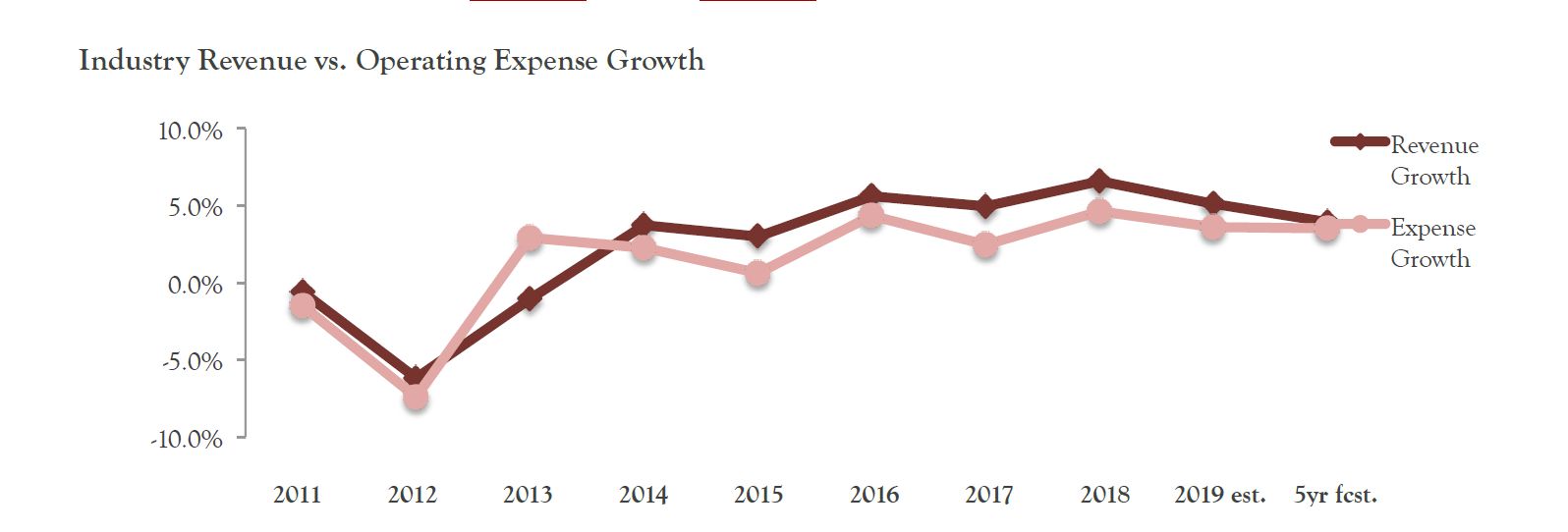
On the following page, there’s a forecast for operating expenses and industry revenue. That’s summed up in another pretty chart.

This was pre-pandemic, by the way.

If we look at the trends here, it’s pretty clear that the forecast is for expense growth to eclipse and outpace revenue growth. If that keeps up, the unprofitable companies are going to be looking at bigger losses year after year. Given all the information I have today, I surmise that the smaller court reporting companies are the more profitable ones and the bigger ones are the ones struggling. There are sure to be some outliers, like small court reporting shops that go bankrupt and leave their independent contractors unpaid. But overall, the smaller companies can’t afford to remain unprofitable for very long, so it’s probably the “big dogs” eating that 10 percent loss. If I’m right, that may also mean the push to go digital is the dying breath of companies that can’t figure out any other way forward. In February, I wrote “…we only lose if we do not compete.” That is becoming more evident with time and data. It is a great time for the stenographic reporter to open up shop and be a part of the 74%.

Speaking of data, if everybody that read this blog donated $1.50, we’d have enough money to stay ad-free for the next two decades. To all donors we’ve had to date, thank you so much, put your wallets away. To everybody else, check out this cool song from M.I.A. about taking your money.

For Students Saddled With Unpayable Student Loan Debt

We often highlight the success stories of our industry. I think this is very important because it keeps current students open to the idea that they can succeed. Like every industry, we will have people that make colossal gains, start businesses, and create a great life with lots of opportunities and experiences. On the other hand, there may be individuals out there who, for whatever reason, cannot finish school or do not land very lucrative work at the start of their journey. I had a rough time starting off. I didn’t have a lot of life experience and most of the work I got was from being a reliable and steady “yes man” instead of having strong negotiation skills or even strong steno skills. Things worked out great for me with time and effort, but it’s time to acknowledge that not everybody is going to have that same experience, and let you in on America’s best-kept secret.

Student Loans Are Dischargeable
For over a decade America has sunk deeply into the myth that student loans are never dischargeable. I heard this as a student. I was told this by my mother and countless role model figures in my life. This myth is so prevalent that I never once bothered to fact check it. These days, you can find resources online to explain to you that they are forgivable, dischargeable, and under what circumstances. There are even United States government sites with that information. For easy access, I’m going to repeat some of the highlights here. Student loans can be…

1. …forgiven with certain public service work and/or work as a teacher.
2. …discharged in the event of school closure.
3. …discharged in the event of total and permanent disability.
4. …discharged or not required to be paid in some circumstances where a school falsely certified your eligibility, you withdrew, or you have a repayment defense.
5. …discharged via bankruptcy.

The courts must decide if repaying the loan would cause you undue hardship. Undue hardship was not defined by the Congress, and so the courts look at whether you would be able to maintain a minimum standard of living if forced to repay the loan, whether there is evidence the hardship will continue for a significant portion of the repayment period, and whether you made a good-faith effort to repay the loan prior to filing for bankruptcy. A court may order the loan fully discharged, partially discharged, or the court may order you to repay the loan. In the event the court orders you to repay the loan, the repayment may be structured differently. It is notable that this is not a magic fix-everything button. There are significant hurdles and it is harder to discharge student loans through bankruptcy. But if you’re stuck in debt and can’t seem to claw out, it just might make sense to put together some money for a lawyer to help you navigate your way out of tens of thousands of dollars of debt.

This is really important to get out there because compound interest works both ways. When you have a savings account or certificate of deposit, every accrual period means more interest added to your money, which means more interest on future accrual periods. When you take out a loan or take on credit card debt, it works the other way, where your minimum payments are meant to pay the interest and pay a small part of the principal. Many people fall into a trap where they make partial repayments that do not cover the interest, and the debt begins to grow instead of shrink despite making consistent good-faith payments. This is how you come across nightmare stories where a person pays for years and yet their loan amount never goes down or doesn’t go down much. Unfortunately, it’s perfectly legal for people to sign agreements that they do not fully understand and incomes in any industry or with any education are not guaranteed. So when things go wrong, it seems like the right thing to do to let people know they do not have to suffer with lifelong debt that they genuinely cannot repay. Rights don’t matter if they go unspoken and unasserted, so if you know somebody stuck in the debt spiral, let them know there’s a way out.

Addendum:

On August 23, 2021, I was contacted by someone representing themselves as a Bankrate employee. They shared this link with me about buying a house while saddled with student loans and the article does have good general concepts to learn, such as trying to keep your debt-to-income ratio low. Please check it out if you’re looking for more information on finance. I’ve received no money for sharing this link.

When An Agency Won’t Collect

Often agencies that are not paid by a lawyer give up on collecting the debt. Stenographers often have contracts with agencies as opposed to lawyers directly. This opens up a world where lawyer doesn’t pay agency, agency doesn’t pay reporter, agency writes off the debt. This is a vicious cycle where the stenographer is ultimately saddled with 0 despite it being the stenographer’s time that’s used up. The response? I think we should start looking into writing off debt too. It’s time to start breaking out those 1099s and sending them right along to agencies. Financially it is always better to make a dollar than to write a dollar off, but it is better to write a dollar off than not make a dollar.

And I’m going to come right on out and say the agency that began this post was Veritext. I saw the story of another reporter online, and this was the agency’s grand solution. Mind you, it’s actually a really good solution, but in my opinion, they should not be writing off debt and then not paying the reporter immediately. It’s disgraceful. And I hope in the future should a representative of Veritext come across this site, you’ll either report to us that you’ve changed your policy to pay your reporter in the event of bad debt, or you’re considering altering the policy.

Regardless, it’s time to take a stand on this issue as individuals. The very least we can do is make writing off the bad debt of agencies ubiquitous so that we are not left with zero. In an ideal world, perhaps we would press agencies and collect from them, but the time spent and financial expense of even the smallest lawsuit or claim is too great for many stenographers.