Bulletin: FTC: Independent Contractors Shielded From Antitrust Liability

I don’t know what’ll happen under the new administration, but this was issued on January 14, 2025. (Alt link)

It’s almost as if… someone… who blogs a lot…. figured this out…. a long time ago…. and made a page called court reporter rates discussion.

I’m copying the plain text so that when Emperor Donald Trump wipes away the pro-worker link, we have some memory of what it said.

FTC Issues Policy Statement Clarifying that Independent Contractors, Gig Workers’ Organizing Activities Are Shielded from Antitrust Liability

The Federal Trade Commission today issued a policy statement clarifying that independent contractors, including gig workers, are shielded from antitrust liability when engaging in protected bargaining and organizing activities—such as seeking better compensation and job conditions.

According to the FTC’s policy statement, the Commission will not challenge collective action by independent contractors and gig workers, which include rideshare and food delivery drivers, that provide labor services and are seeking better compensation and job conditions because such activities are exempted under the antitrust statutes.

“Companies increasingly rely on gig workers and independent contractors. As more of these workers consider unionizing to secure better pay and conditions, the FTC is making clear that the antitrust laws do not stand in the way of their efforts to collectively organize or bargain,” said FTC Chair Lina M. Khan.

“Gig workers shouldn’t be forced to accept low wages or poor working conditions just because they’re independent contractors,” said Hannah Garden-Monheit, Director of the FTC’s Office of Policy Planning. “The FTC’s policy statement today makes clear that the antitrust laws do not prevent gig workers from collectively organizing to fight for a better living.”

Under the Clayton and Norris-LaGuardia Acts, the ability of workers to organize and collectively bargain over wages and labor conditions is protected from antitrust liability. However, as more workers are increasingly classified as independent contractors and gig workers, they face a patchwork of cases regarding the potential application of the labor exemption.

The FTC’s policy statement makes clear that workers engaged in protected bargaining or organizing activity are not categorically excluded from the antitrust exemption simply because they do not have a formal employer-employee relationship with the firm with which they are negotiating regarding compensation or working conditions. According to the policy statement, the protection of all workers from antitrust liability when they are engaged in protected labor activities is firmly grounded in the statutory text, consistent with existing case law, and reflective of the original meaning of the labor exemption.

Categorically excluding all independent contractors from the protections of the labor exemption would give employers both the incentive and opportunity to exploit asymmetries in antitrust liability protection between workers, according to the policy statement. For example, businesses would have an opportunity and incentive to classify (or misclassify) their workers as independent contractors to suppress wages and to gain an unfair advantage against competitors who provide better compensation and job conditions to workers.

The Commission voted 3-2 to approve the policy statement with Commissioners Andrew N. Ferguson and Melissa Holyoak voting no. Commissioner Ferguson issued a dissenting statement joined by Commissioner Holyoak.

The Federal Trade Commission develops policy initiatives on issues that affect competition, consumers, and the U.S. economy. The FTC will never demand money, make threats, tell you to transfer money, or promise you a prize. Follow the FTC on social media, read consumer alerts and the business blog, and sign up to get the latest FTC news and alerts.

Tell The FTC How Mergers Have Harmed Competition in Court Reporting Today!

As sent to me by a valued court reporter. Let me know if you want your name here!

I am preserving my public comment below. You can comment here, I believe. My comment tracking number is lzh-8ij7-4wuf. Feel free to comment yours!

“In the court reporting industry several large companies, including the biggest player, Veritext, have been buying up smaller firms at an alarming rate. The result is chaos. Consumers don’t know if they’re buying from a Veritext company or not. “Independent contractors” don’t know if they’re working for a Veritext company or not. Small businesses don’t know if they’re networking with a Veritext company or not. Repeat that for the four or five national companies, and you have a complex network of companies where it can be hard to find quality service at an affordable price.

The problems with this are well-documented. Companies like Veritext add outrageous charges to consumers’ bills in the hopes that they won’t dispute it. Where a court reporter might be sourced for $4.00 per page or thereabout, a final bill to a client might be worth the equivalent of $37 per page.

Worse yet, these companies are all able to openly work together without any interference from law enforcement. Several large companies, including Veritext, U.S. Legal Support, and Stenograph, got together under the fraud nonprofit, the Speech-to-Text Institute, to propagandize the market and make the stenographer shortage seem larger than it actually was. Using their subsidiaries and purchasing power, they systematically deleted information that consumers would’ve found helpful and promulgated information that was misleading at best. This was documented on my blog Stenonymous, and reported to the FTC and NYS Attorney General, but the situation is apparently too small for law enforcement to care about, since the industry is only $3 billion annually. The Speech-to-Text Institute, after being called out for fraud, was sued and shut down its website. It has yet to defend itself in court and has defaulted. Succinctly, called out for their illegal conduct by a hobbyist blog, they’re in full retreat and will never answer for the misinformation they spread.

But this has grave impacts on consumers, workers, jobseekers, and students. These companies are able to work together to box out anyone that disagrees with their egregious behavior using their market power. Consumers are paying higher prices than ever. Workers live in fear that they will be blacklisted. Jobseekers are left not knowing what path to take in terms of acquiring court reporting work. Students are sinking money into promising stenographic education while the companies work together to create an influx of workers and systematically reduce rates/wages.

Worse yet, there is a rampant misclassification problem in the business. These businesses could not exist without their “independent contractor” court reporters, and yet still somehow they are able to get away with not withholding taxes as required by law.

This has also impacted buyers of court reporting businesses. In a conversation with one businessman, I was told that the overvaluation of court reporting businesses due to the purchasing strategies of the so-called “big box” corporations left it impossible to buy into the business. So again, people are boxed out of competition by inflated values.

Even supposed bastions of ethical conduct in court reporting such as the National Court Reporters Association are terrified to speak out against the illegal conduct occurring in our field. Given the collapse of the STTI and its propaganda network, it would be easy pickings for the organization to capitalize on its mission of promoting lawful and proper professional ethics, as stated in its bylaws. It instead has pointed toward potential legal liability as the reason for its “deafening silence.”

Again, it cannot be understated how consumers, jobseekers, workers and small businesses have been failed by law enforcement. The conduct of these corporations has undoubtedly steered investors away from investing in stenographic education and caused massive disruptions to the hiring practices of courts, who have long trusted stenographers, stenographic education, and stenographic services.

It’s with sincere optimism that I comment and make a plea for law enforcement to come up with something to address smaller industries. This impacts the lives of at least 30,000 workers and innumerable consumer law firms, courts, etc. Veritext parent company Leonard Green was allowed to loot hospitals for poor people. Do not let that happen to the legal records in the United States.”

I Diverge From NCRA on Independent Contractor Classification

NCRA has set up a campaign to oppose a rule change around independent contractors. We are all entitled to make public comments via the little comment bubble on this page.

Welcome to the little comment bubble.

Sadly, I have to take the complete opposite stance on this. I’ve written about misclassification in many articles. My public comment will reflect as much, and I’d like to share it here.

“The proposed rule change is exactly what my industry needs. I am in the court reporting industry, and though our national association, the National Court Reporters Association, stands against this change, I feel it is of paramount importance. Many stenographers today are treated as common law employees. The agencies/companies control the customer. They decide the prices. They have the advertising. We do the work, and despite being the mainstay of the business, many of us are labeled independent contractors. All of the ‘benefits’ of being labeled an independent contractor could be secured through unionization and adequate employment contracts.

I suspect there are many industries like mine where people will be rallied against change by the powers that be because the powers that be benefit the most from the status quo and the people cannot take the time to read through and understand your wall of text.

The true independent contractors of my field would be unaffected by this change whether or not they are willing to acknowledge it. Please go forward, do the right thing, and consider the economic dependence of workers when deciding whether they are independent contractors or employees. It will secure a lot more rights for a lot more people.”

Why? For better or worse, I have decided to be an advocate of the working reporter. We have been conditioned to think “independent contracting good.” It has been used to systematically rob us of rights we should have as working people. Rights against illegal discrimination, something that probably saved my career after my mental health episode. Rights to compensation when injured on the job. Rights to unionize. Even our most basic right of free speech is destroyed by the independent contractor label under the cloud of “we can’t discuss rates.” As an employee, the working reporter would have the absolute right to discuss pay and working conditions.

To the extent that trade associations are groups of independent contractors, this kind of thing probably seems threatening to NCRA. If there are fewer independent contractors, they may have fewer members, fewer dollars, and less power. But this is a shortsighted observation. My publications stating that the New York market is 30 years behind inflation have gone undisputed. Many of you in many markets across the country are feeling a pinch in the wallet thanks to stagnating pay and rising inflation. That’s while the agencies charge consumers sky-high prices and blame us for them. If associations want to survive, they need to understand that court reporters at the bottom end of the pay gap need to make more money. We can’t afford to rally against things that are good for the overall long-term health of our profession, and in my estimation, this is such a moment.

Note that the big box agencies will likely be really quiet about this and let the NCRA handle it. They wouldn’t be quiet if it wasn’t in their interest to be so. They benefit from the status quo more than NCRA or any other player on the field. If they come out in opposition to the rule change, it’s a dead giveaway that it’s bad news for the working reporter.

I understand these ideas may be unpopular, but I am a believer in the power of one. This is an issue that, from my research and experience, touches my soul so deeply I’m willing to speak out against an organization I’ve been a member of for over a decade. Ask yourself what you would do if you found yourself in such a position, and you’ll know exactly how I feel today.

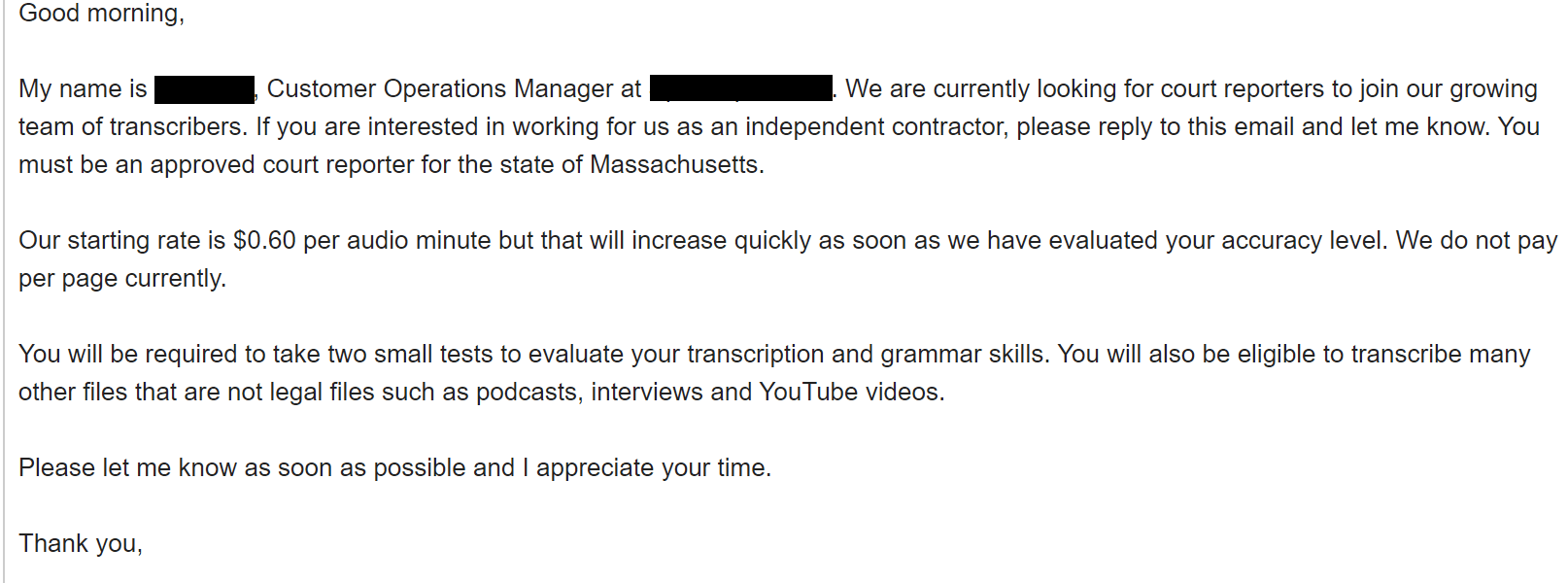
What to Say When Offered $0.60 Per Audio Minute

A member of our court reporting community was sent an e-mail soliciting work at $0.60 per audio minute. For contrast, I have heard of reporters working for $100 an audio hour or more, or the equivalent of $1.67 per audio minute, and that was over 10 years ago. It would be about $2.25 per audio minute today, or about $135 per hour, adjusted for inflation.

Independent contractors offered $0.60 per audio minute, less than half the going rate.

Many of us would take issue with that kind of an offer, but this stenographer took the opportunity to educate.

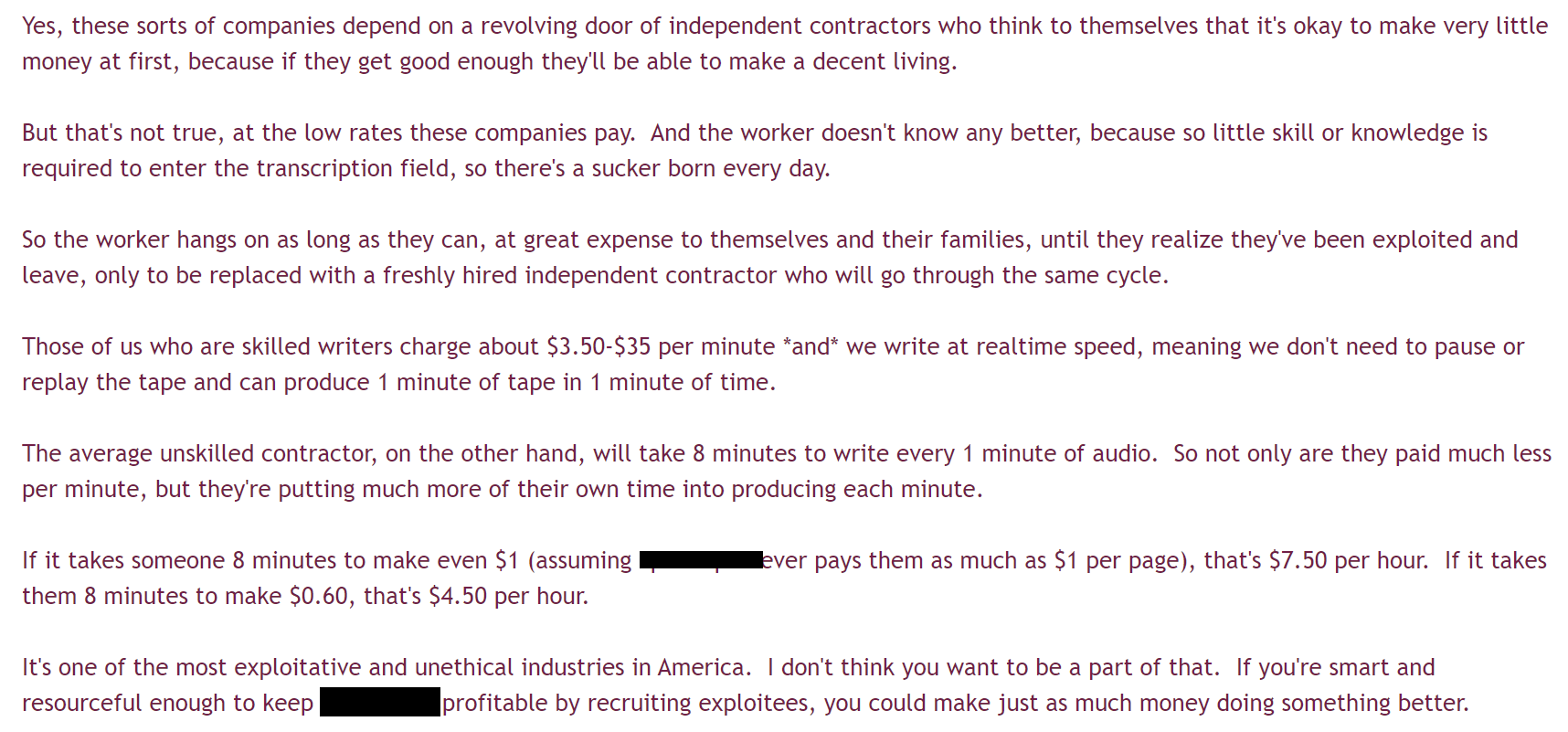
Response to independent contractors being offered $0.60 per audio minute, less than half the going rate.

The company rep apologized and explained that she was not aware. But the stenographer in question kept educating and advocating. I will note that, based on my knowledge of the industry, I believe there’s a typo here, $35 per minute should likely be $35 per page. For anyone not in the field, typically 40 to 60 pages an hour can be expected, meaning 0.66 to 1 page per minute.

Stenographer explains the exploitation of the transcription industry in America.

The corporate rep replied honestly. She had no idea about the earning potential of court reporters.

Response to the earning potential of stenographic court reporters.

Our brave friend continued to educate on the state of the industry.

Stenographer writing about the exploitation of private equity firms in transcription and stenographic court reporting.

To which our company rep closed with:

Company representative on the efficacy of AI in legal transcription.

There are a number of takeaways here. Taking everything at face value, we’re now opened to the possibility that at least some of these company reps are not adequately trained or briefed on the earning potential of court reporters. But it is interesting to note that a company representative is completely aware that AI is not adequate for transcription. It points to a world where we can be drivers of change by simply describing the truth.

It is very unfortunate that companies are diving into the space without an adequate plan to reimburse independently contracted transcribers. But if we can all respond with the above tact and facts when dealing with company reps and transcribers, we can create a shield of information where no one is unknowingly taken advantage of. Not only is speaking up the right thing to do; it will have the desirable effect of increasing job security for stenographic court reporters.

A big thank you for sharing these messages with all of us on Stenonymous.

Addendum:

A reader shared that if one is on the Massachusetts ACT list, they’re paid $3 per page, meaning $0.60 per minute would be a serious reduction in that rate. Even at a highly skilled level, one audio hour can equal one or two transcription hours, meaning that $0.60 a minute is the equivalent of $0.20 a minute or $12 an hour. Unskilled transcribers can take much longer, particularly if the audio quality is bad, meaning their true hourly rate is even lower.