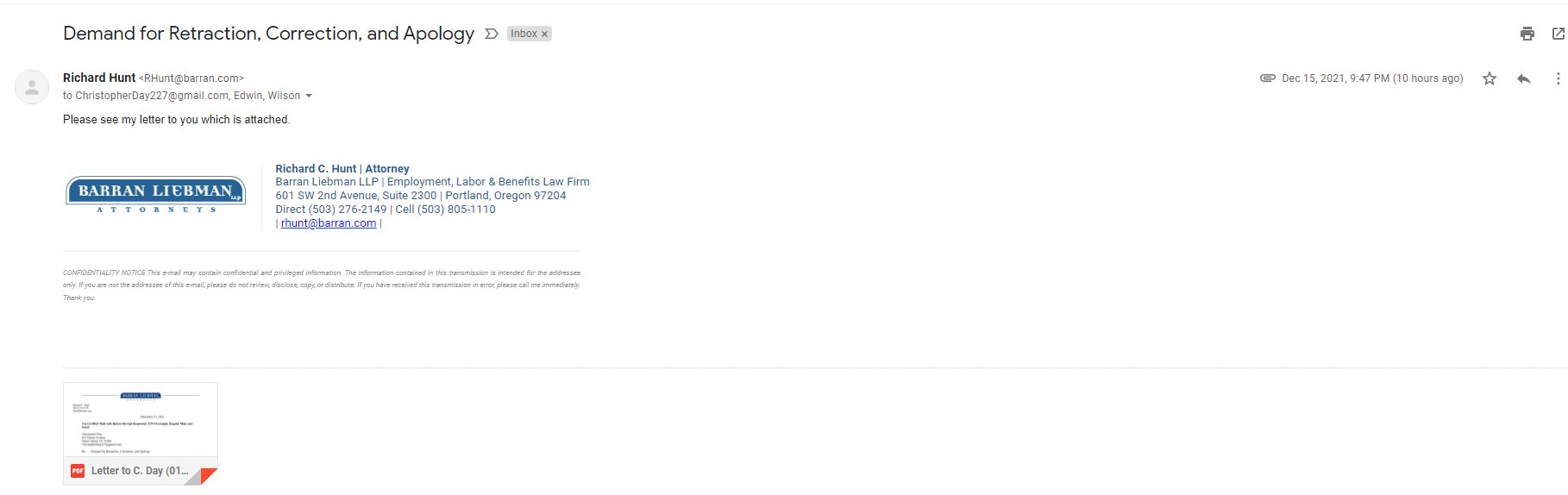
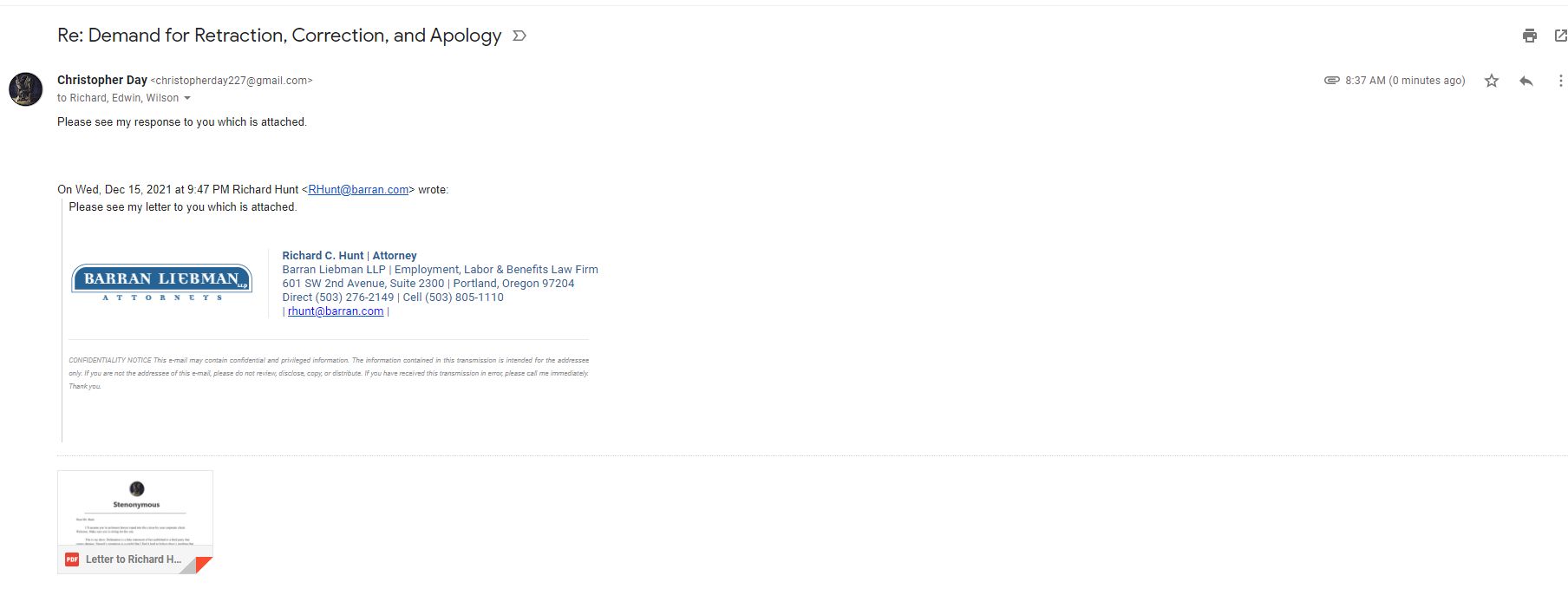
I’m suspending most internet ops broadcasting the court reporter shortage fraud. It was a good year. My publications reached tens of thousands. Yet I can’t help but feel my energy is better spent elsewhere. I’m hopeful that, in time, the community comes to understand why I chose this method of telling the story and this iteration of the Stenonymous character. But I have to face certain realities. We’re in a period in history where companies can call fraud free speech and claim that the government should be barred from pursuing lies that have gone on for a long time. There are probably millions of scandals like ours or worse than ours, and not enough journalists in this country to cover even a healthy fraction of them.
As the multimillion dollar corporations let the one-year statute of limitations on defamation pass, I hope people start to question a bit. I was willing to put in print allegations of consumer fraud & name names in my own name without the privilege of anonymity. I retract nothing. This stuff will be searchable online pretty much forever. There’s certainly a cost to me. But what are consumers to think about a firm that can’t even do the bare minimum brand defense of dropping a comment to say “these allegations are false?”
I’ll still work on the community publicizing and publishing. I’ve got ideas. You’ve got ideas. Let’s put them in print!
First up, NYC “Freelancers,” if you’re interested in unionization, leave a contact email here. What I’ll do is I’ll collect these “pledges,” and at the point where we have a hundred or so we could pool money on real legal advice for implementing a deposition reporter union. My proposal would be to secure a contract that works out some kind of points system for refusing work and pay structure to stay by the page as we’ve always known it. Basic idea is that most of you wouldn’t be able to talk about this out of fear of blacklisting, so we use me as a go-between until the group is large enough to do what has to be done. Could take years, but let’s face it, I might be around another 30 years, so I’ve got time.
If you’re totally lost, let’s just say there are good arguments to be made that many of us meet the definition of common law employees, either commission-based or per diem. That means a whole heap of us are misclassified employees. That means that whatever you’re making now, there’s a good chance you could work out a better deal via collective bargaining. Similar to the concept of bulk buying power. Very pro-capitalism. All about charging what the market will bear. Bonus points if we get contractual provisions for the use of digital reporting, like a stenographer-to-digital ratio, which would guarantee, with the force of law behind it, that companies cannot just replace stenographers willy nilly.
And before somebody jumps in with “my skills earn me the top of the top, I don’t need no union, nope,” it’s cool, really. I get it. Some of you make hundreds of thousands of dollars a year. I would think I’m a nut too. But then you meet reporters who are like “my agency doesn’t want to give me more than $3.25 in 2022 during a time of unprecedented shortage,” when everyone and their mom knows some reporters were getting $3.25 in 1990, and you start to realize that maybe something is not quite right here.
I was never quite able to verify the truth, but I was told by another reporter that one of the killers of the Federation of Shorthand was Diamond Reporting. “You don’t need a union, we’ll pay you your rates.” How poetic if that’s true. That was the company that said no copy sales for New York “freelancers” prior to the Veritext takeover. That was the company that was paying many of you $3.25, a 1990 rate, in 2010. So I sure don’t know if they helped kill the union, but I know for a fact that they capitalized big time on its death. Great anecdote for how companies will actively push for things that hurt your wallet. And something you should keep in mind the next time someone is insisting that you don’t need a union, often using their age and presumed “wiseness” to give weight to halfhearted reasons for why something that’s not really been tried won’t work. “Ah yes, here was a thing so ineffective that companies campaigned against it, sued it, and did everything in their power to bring it down.” In reality, the knowledge that we are underpaid came from historical documents left behind by that union. How twisted is that? It defends us even in death. Sounds like a fantasy novel.
Imagine holding in your hand a tool that, on average, raises your pay, and that you have evidence that it raised pay for people that came before you. You look at the tool, snarl up your face, and go “I don’t like this tool because I feel like the work I do with my bare hands is more fulfilling!” You throw away the tool. The people that would’ve had to pay you more cheer and tell you what a good, hard worker you are, and everyone is happy. Especially you, the hard worker. This is pretty much what I envision every time someone gives me an anti-union excuse, and I have heard pretty much all of them:
“The top reporters get the top pay and jobs!” Not true. There was a certain point in my career where I was the second-most qualified of about a half dozen friends and making the least money — and we’re talking up to 25% less. One agency wouldn’t work with me because I wasn’t in the field long enough at the time. But they worked with someone I knew who just so happened to have less time in the field than I did. I later went on to place 14th in the state’s court reporter civil service exam. Most of us want to believe in meritocracy. I saw for myself things are anything but.
“The harder you work, the more your reward.” Nope. I busted my ass as a 20-something running around New York City. Yeah, I work hard. Pretty much everybody in this city works hard. But you know what? I work a whole lot less hard and make a whole lot more money than I ever did. And I know for a fact there are people out there busting their ass harder than I ever will that make less money than I do. So hard work doesn’t have a damn thing to do with it either. I can self-justify and say my hard work then is what laid the foundation for my success now, but it’s just not true. I gained no professional advantage from being underpaid. Saying otherwise would be delusional self-aggrandizement. I reject telling 20-somethings that hard work is the deciding factor in success. It is one of many.
“Unions are corrupt.” Oh, conceded, some are. Bad leadership can make union membership unbearable. Unthinkable. But in the end you have to decide whether it is better to reform the institution that is supposed to be protecting you, and that you can sue if it fails in its duty of equal representation, or do away with it completely. Think about it this way. The threat is that eventually the person paying you will come swinging the (1d20) axe of “I just need to lower your pay or adversely affect your working conditions.” Could be any reason. Maybe they just want to move their cousin into your seat. Would you prefer no shield or a busted shield that you have some time to fix up and make work for you if that threat comes your way?
“Unions only protect bad employees!” Bad management protects bad employees. Unions typically set up a disciplinary procedure. Managers typically don’t want to follow that disciplinary procedure. The result is non-performers get to endlessly offload their responsibilities on performers while the union takes the blame for “protecting bad employees.” And at the end of the day, this is a great deal for management, because if you get frustrated and dissolve your union because it only protects bad employees, management now has no impediment to firing any of you for any reason whenever they want. Any of you ever had the work from your agency mysteriously dry up after you did something minor to displease them? We could make that never happen again.
“Unions are only for people that benefit from the lowest common denominator.” I’ve taken classes in and done a lot of reading on unionization. You don’t have to structure a union where everyone gets paid the same. You can create tiers, or points, or basically anything you can dream up, put into words, and get people to agree to. Funny that the people that think they’re so far above everyone else can’t imagine improving the models of the past.
“Unions don’t do anything!” Unions are a legal vehicle that, through legal and/or social pressure, encapsulate the terms and conditions of employment in a contract and defend the interests of its members. If there’s something more that you want it to do, you put it into words, you run it by union leadership, and if you don’t like the response you get from leadership, you band together with more union members to push the change or even vote union leadership out. Put it this way, if you do not care enough about your idea to do that stuff, can you really blame leadership for not doing it? It’s like when people get upset with me for not covering every topic. I’m one guy and the community won’t fund me enough to hire help. My effectiveness is limited by the support I get. So too are your union leaders. (Corporate leaders too, but money buys a lot of support, as it turns out.)
In a rare, perhaps unforgivable moment, I’m going to betray my union a bit and put in print that there’s a faction that has an issue it wants addressed. There’s been plenty of haranguing and handwringing over it, but there hasn’t been a single serious attempt by the faction to address the issue. I’ve had hours of my time wasted listening to people talk about an issue that they don’t care enough about to formally address in any substantial manner and gotten a front row seat to the “unions don’t do anything” people complaining about matters they’ll lift not a finger to solve. But, who knows, maybe one of them reads the blog and will ask me how I’d handle it if I wanted them to win. Point is that initiative drives outcomes. If you have no initiative, your outcome is decided by people that do.
“Union dues are a drain on your wallet!” I guess? But it’s been shown that on average unionized workers make more than their non-union counterparts, even factoring in union dues. Specifically in our field, we can study non-union deposition reporters with unionized officials, and we can see that, even going 20 years without a substantial change, the page rates are still higher than private sector rates on average. Meanwhile attorneys say their bills have never been higher. Where is all that extra money going if not to you? The agencies. What do you think would’ve been more of a drain on your wallet, union dues, or literally and demonstrably all of the price increases from 1990 to now going directly to the corporate owner’s pocket? We have this funny habit of considering union dues “our money,” and price increases the “employer’s money,” but y’know, if your “employer” is raising prices and never giving you a raise, you’re effectively paying dues to your employer for the privilege of working for them. You just don’t get to see those dues come out of your paycheck, so it feels much better and you don’t have the urge to complain or do anything about it.
“If it was possible someone would’ve done it already to collect all those union dues!” Someone I genuinely love — in fact, one of the people that saved my career — loves this line. And it cuts me deep every time because I’ll never really know if they’ve fooled themselves into accepting this fallacy as truth or if they know damn well it’s a fallacy and choose to publish anti-union rhetoric again and again anyway. I’m too chicken to ask and I don’t even know if the answer I’d get would be the truth. Sad day for me.
Why is it a fallacy? Union structures, in my lived experience, are less about expanding the power and profitability of the union and more about safeguarding and managing what they have already. It would genuinely surprise me if, at any point in the last 50 years, any of the New York City unions seriously considered a campaign to bring the deposition reporters into the fold. It would surprise me if they even conceived that such a thing might be possible. To make the connection or assertion you’d have to read the highlights of various labor laws and apply them to the way the job is done in modern times. And even then, you’ll probably still get a patchwork of realities where some people would qualify and some would not.
There’s also the potential political cost of current union members taking offense and deciding to vote out a leader that spends too much time on such a campaign, even if it would ultimately strengthen the union. Add the fact that you would likely have to modify union constitutions to support and allow it. So it’s not a matter of “if there was money in it, they would do it.” It’s a matter of looking at all the obstacles and saying “yeah, this isn’t my fight, and my union doesn’t pay me more money to fight it, so good luck with that.” But if it happened in reverse, where a large group of “freelancers” established a union, or deposition reporters unionized several agencies and then asked to be folded in under —- whoever, let’s say the legal support workers union — I think the results would be quite different. That’s just assuming they’d want the protection of a larger, more-established entity.
“Skilled jobs don’t need a union.” The iron workers, carpenters, and all manner of construction people seem pretty skilled to me. And I just told you there’s a legal services staff association, LSSA 2320, and they represent paralegals, social workers, and others. ASSCR, Local 1070, and several CSEA branches represent court reporters. The whole skilled/unskilled thing feels like a rumor that got started to keep workers divided. And it works really well. We squabble with each other about why Joe burger flipper shouldn’t make $xx.xx per hour while the people paying us get away with murder against everyone right up to and including some of the most educated people out there.
All this is to say that the road ahead is difficult. But if we do not even try, then we’re just going to continue this game where the corporations reduce stenographer positions in favor of digital, get them to fight each other for the work, causing even more of a rates freeze (or effective drop). Then this’ll force more people out of the market, particularly the smart ones that don’t want to work for peanuts. And ultimately the pool of stenographers from which the courts recruit will fall to a place of no return, leaving the private sector to pick up the pieces via recording and transcribing. Game, set, match. That’s competition, baby, and it’s on a level that most of us in the “accuracy and ethics” crowd don’t think about. It’s time to flip the script and win the competition.
So let’s take a crack at it. Leave your contact info. Best case scenario, we do something historic and create a model that leaders in every state can follow, as well as upping your paycheck and giving you more worker rights than you currently enjoy. Worst case scenario, it doesn’t work out and everyone has a big laugh at my expense.
If you’re tired of being underpaid during a time of “unprecedented” shortage, it’s time to take a stand!
Addendum:
Even doctors are unionizing due to the corporate consolidation of America. I’m willing to put down at least $1,000 to help all of you with the legal fees.
There’s also the “unfortunate” truth that if we make an active effort to do this, agencies might raise rates just to avoid having to deal with a union for the rest of their existence.
1/11/24 update: