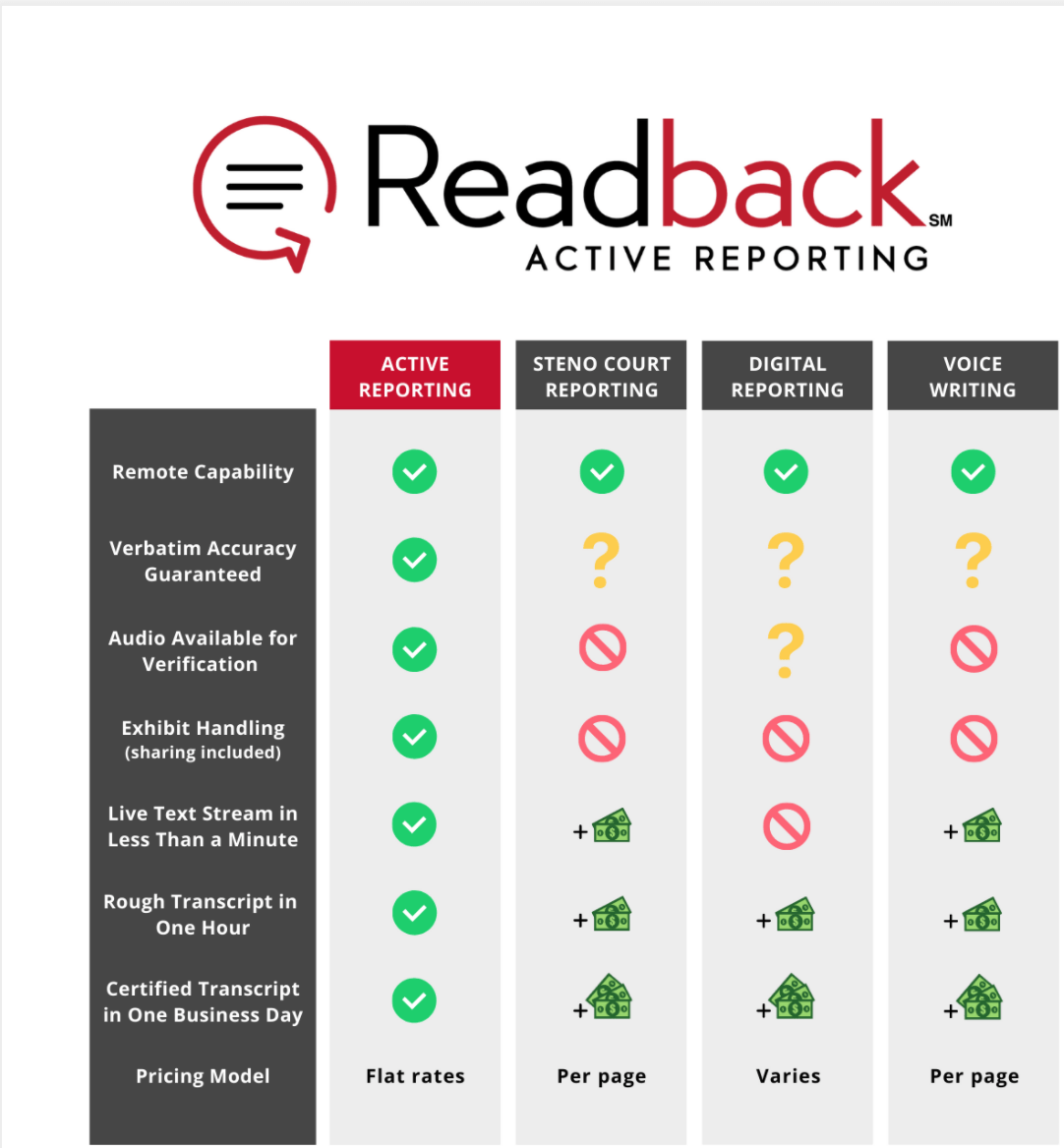
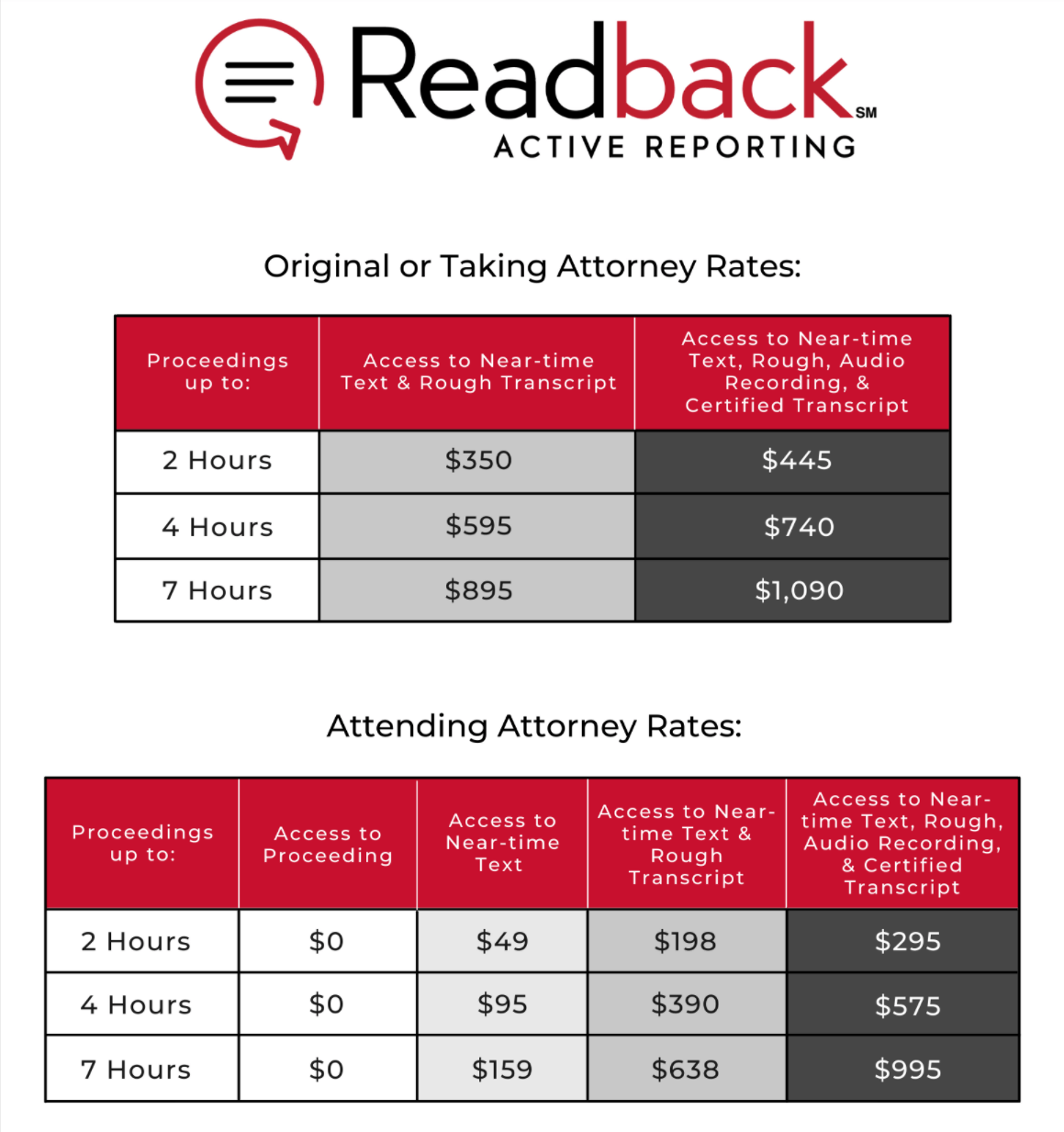
In the past I wrote about how the Active Readback guy was wrong. Medical transcription wasn’t necessarily improved by technology, and I felt that that was a rallying cry for us to realize that businesspeople do not have the health of industries in their hearts. They care only about extracting wealth.
Last night, Sue Terry, Past President of the National Court Reporters Association and someone I admire very much, sent this writing by Dale Kivi. It talks a lot about medical transcription, the shell game of fast vs. quality vs. cheap, and the changes they were seeing around March 2017. There are some major points I’d like to comment on.
The first major point is an argument we can adopt. One methodology was having physicians do the documentation themselves with assistive technology. Perhaps unsurprisingly, this costs time, and in a physician’s world, that’s money — up to $80,000. If any attempt is made to shift record creation to an automatic lawyer-assisted process, this is our first line of defense. It’s going to cost them time, and that’s going to cost them money. We know that because we already have an industry that tried it out. The argument can be augmented a bit. The time spent on reconstruction hearings for missing recordings, and/or the time spent remediating transcript issues, is time and money burned.

Transcription Shell Game by Dale Kivi excerpt for Stenonymous commentary.
“Traditional transcription was summarily dismissed as old school,” writes Kivi. This is word-for-word what’s being done to us. The perception that we are outdated is being used to peddle tech to lawyers. And even worse, as it says at the end, organizations then don’t admit errors because of the sunk cost fallacy. So where there are problems, organizations don’t admit them. Cough, cough, here’s talking to you, court administrators who have adopted electronic or digital recordings that mysteriously go missing with no oversight or public awareness of the problem. Perhaps a winning move in our fight is to point at the non-existent accountability of courts to the public. I’ve personally had conversations with court reporters that couldn’t speak out about missing audio because it would threaten their job or make their judge look bad. But you know what? Maybe these people should look bad, because their refusal to track problems or even admit there are problems threaten innumerable future court records and the lives of people those records impact. They’re trying to delete us state by state anyway. What do we have to lose?

Transcription Shell Game by Dale Kivi excerpt for Stenonymous commentary.
The next paragraph I’ve cut out shows you just how similar our fields really are. There are three associations, presumably with competing interests and methodologies, and word games are used to secure contracts. For example, Kivi writes about 98% accuracy versus a 98 in their scoring system. Elsewhere in the article it mentions these documents could be around 300 words. 98% means 6 words could be missing. Meanwhile, in the scoring system, missing a word that impacts care is an automatic fail. This is very similar to how automatic speech recognition makes big claims about word error rate, and that’s used to make the case for accuracy. But in reality a 5% word error rate is not a stenographer’s 95% accuracy because we count a lot of minutia in our errors. That’s not even addressing that we’ve seen word error rates as high as 75%.
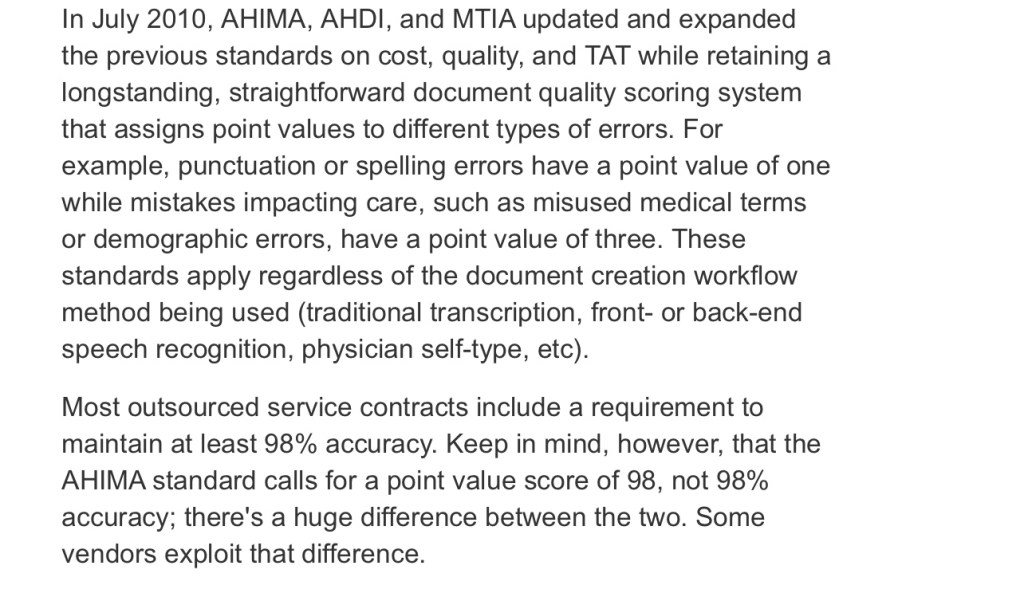
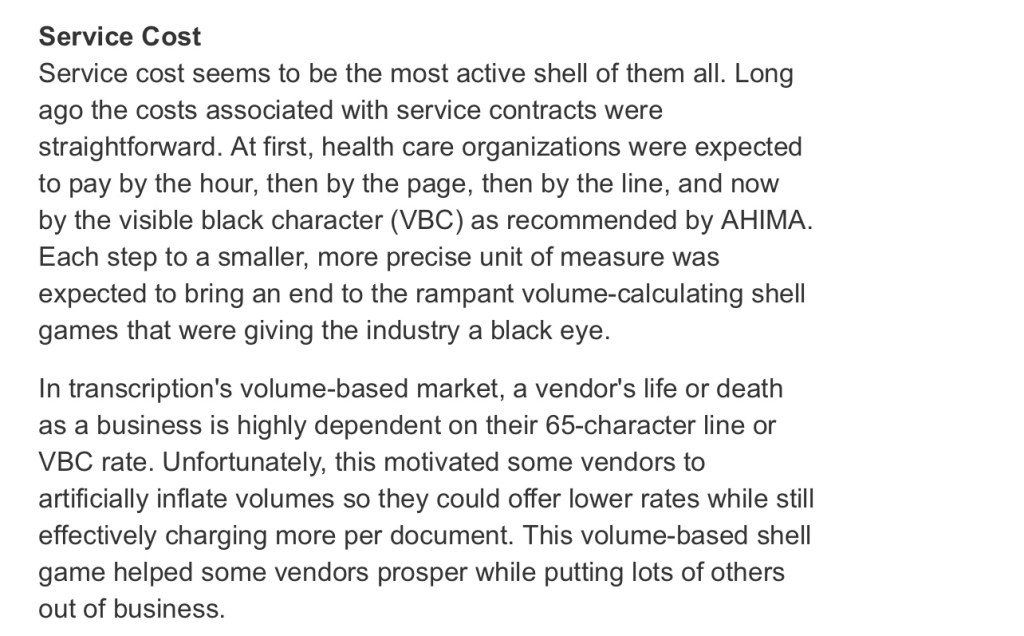
Transcription Shell Game by Dale Kivi excerpt for Stenonymous commentary.
The next part is mind boggling. It talks about a shell game in service cost, and presents that some vendors would inflate volume to make up for offering lower rates that secured them contracts. This happens in our industry too. For years, there have been social media reports™️ of agencies taking the reporter’s work and changing the format to add pages, effectively cutting the reporter out of extra income created by the deceit. Funny how a price can go down but revenue can go up, isn’t it?
The next part is simple. It talks about how vendors claim they are using the industry standard when no such standard exists or is encouraged by the associations of medical transcription. This is what we are experiencing now in court reporting. Somehow, everybody in the game has the newest, most cutting-edge technology and promotes high standards. Does that seem like it makes sense? Somehow, for the past 20 years, automatic speech recognition usable for the legal field has eluded the largest companies in the world, as per the Racial Disparities in Automatic Speech Recognition 2020 study. Yet all these little companies in a minuscule industry have it? As I wrote on social media, it is my belief that in actuality what occurred was that OpenAI’s Whisper and things like it went open source, companies took it and tweaked it a bit, and now it’s theirs™️. Is it better than voice writing? Doubtful.

The next paragraph should be read by every lawyer in the country that utilizes court reporters. Summarized: After a big market fight over methodologies and pricing, “organizations are catching their breath, many are left with empty pockets, unhappy physicians, questionable quality issues, and shady pricing.” After the dust settles in the market war with stenography, voice writing, and digital, organizations (law firms) will be left with all of that too, in my estimation. If you follow my work, you’ll know I’ve said outright that I believe there’s a kind of antitrust predatory pricing mindset built into the digital side of the market. Strangle out the stenographer competition, the number of competitors goes down, prices likely go up in sneaky ways that lawyers won’t catch unless they’re looking, and voices for quality like ours fade away, effectively ceding the market to the most conniving competitors and the court reporting oligopoly I call STTI Bloc. More on that later in this post.

Transcription Shell Game by Dale Kivi excerpt for Stenonymous commentary.
The last bit really impressed me. Kivi openly admits he’ll be chairing the AHIMA Foundation, AHIMA being one of the associations written about. Our field is a bit spotty on that. Sometimes people reveal their allegiances and commitments, and sometimes they conveniently leave it out. The honesty, in my view, lends Kivi’s writing credibility.
But more than that, he writes, in pertinent part, “It’s time for HIM…” (health information management) “…to take the lead…” “…if vendors do not follow the AHIMA guidelines for…” “…best practices…” “…someone must be prepared to call them out.” What is he saying there? It is incumbent on the customer to demand better from vendors. Again, this is the situation in our field. We are doing everything in our power to alert lawyers to the realities of the field, some of which they haven’t had to deal with for decades. People that point at our self-interest never seem to address the elephant in the room: Whatever our interest, it is tiny compared to the interests of the big box firms, who have millions of dollars at stake and may be zombie corporations (zombie video).

There is another issue to consider when it comes to medical transcription technology versus court reporting. In medical transcription there is typically one speaker, so software can be trained to that one speaker. Continuous dialogue and Q&A is quite a bit different from medical dictation, and likely makes it harder to train “AI” systems.
I would like to note, though it’s not explicitly said, we look to associations to set guidelines and standards. The curious person might ask why these associations are not the ones calling vendors out on their shady, shoddy practices. Associations are limited by antitrust laws because they can be seen as, and to some extent factually are, competitor collectives. Under antitrust laws, competitors cannot band together to force another competitor out of the market or collude to set prices. When I spoke to a lawyer about antitrust, I was told there needs to be 1) Monopoly power, 2) An anti-competitive act, 3) Damage. Monopoly power usually refers to a high market share, but the sway associations have on industries would likely count. The anti-competitive act would be competitors banding together to hurt a vendor’s reputation. The damage component is what it is. So, perhaps humorously, we live in a world where a large corporation could sue an association that called them out for bad practices by using antitrust laws even if the corporation had much more revenue than the association. Worse than that, the corporation would probably have better lawyers, because they have the money to spend on them.
It’s my belief that the STTI Bloc and the oligopoly plot would fit the mold too, which is why I’ve referred to their activity as an antitrust conspiracy. It’s very clear that the companies under the Speech-to-Text Institute, such as Veritext, US Legal, and Stenograph, are using their high market share and favorable positions in the field to strangle out smaller steno competitors. USL bought and killed StenoTrain and turned Patricia Falls into a digital shill. Veritext is buying everybody out while conditioning future consumers to view stenography as obsolete. Stenograph’s using its dominance in sten-tech to shift from “everyone must go realtime” to “all the technologies we provide are realtime, honest.” Unfortunately, the government is inert. Only consumers damaged by the deceit can bring a claim. And who is going to bring a claim when they’re unaware they’ve been defrauded?
This is why my strategy is independent publishing. I’m a guy with a blog. People donate if they like what I’m “selling.” Most of that money goes toward trying to raise consumer awareness. Again, consumers are the people with the most power to stop what’s occurring. This strategy eliminates the antitrust issues because my donors are not a competitor collective, they’re just giving me money in the hopes I’ll use it for good, which isn’t illegal. Any frivolous lawsuit would get tied up in the backlogged court system for somewhere between 2 and 6+ years, all the while giving the media time to pick up on the court filings and blow the fraud wide open Streisand Effect style. It would also open the doorway for misled lawyer and student consumers to bring their own deceptive business practice or other claims as word spread. That’s why Veritext harasses people for their posts on Facebook and leaves me alone even though I’m the one that comes up when you Google search Veritext. With enough funding, we could get the fraud in front of millions of eyes, and there’d be no running from it then.

It’s actually pretty phenomenal that they’ve allowed me to do what I’m doing without any resistance. The smart consumer is going to look at my claims, look at the years-long non-response of the larger corps, realize they’re outside the statute of limitations on defamation, and realize that the officers have a fiduciary duty to uphold the best interest of the company and shareholders. That means if someone is trashing your company in such a way that it could impact the value of that company, you’re obligated to do something. The only world where you let someone do what I’ve done is a world where it’s all true and there’s nothing you can do but hope the world doesn’t find out. Maybe a litigious shareholder will sue company officers for an alleged breach of fiduciary duty. Who knows?
So that’s my take on what we can learn from our sister industry along with the parallels and differences I saw. It’s also my take on why Stenonymous, at this point in the history of court reporting, is an effective performance for stopping corporate fraud.
If anybody from Veritext is reading, we’re coming for ya!