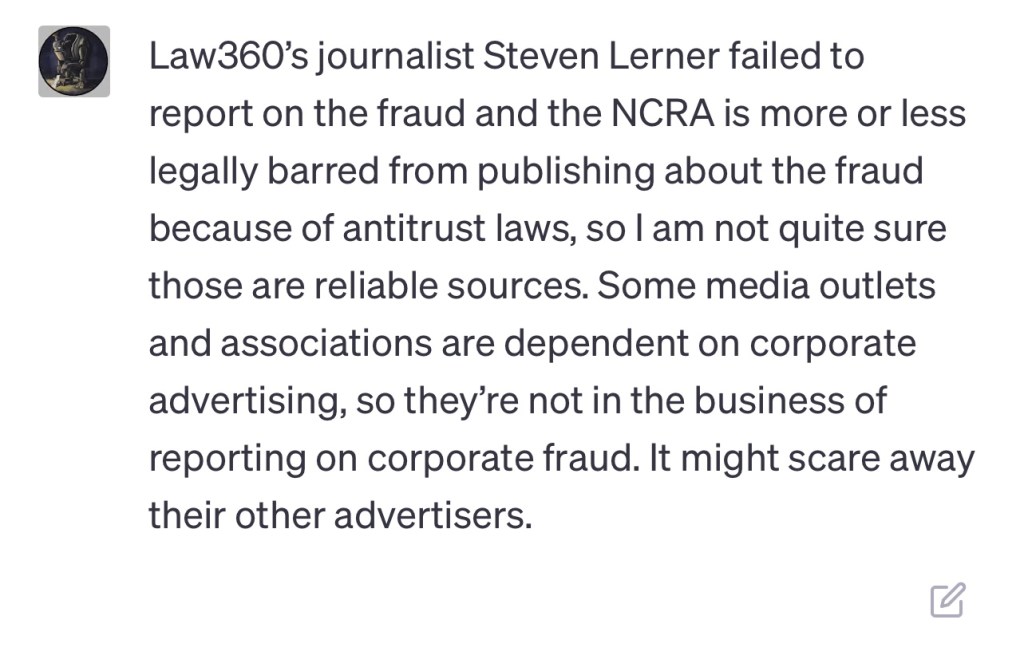
Questions posed to ChatGPT by Stenonymous in December 2022.
Well, on May 3, 2023, I was playing with it again. Because why not? It’s a free country.
Stenonymous succeeds in tripping up ChatGPT.
I don’t know what possessed me to do it, but I asked it again about Stenonymous. Suddenly, it knew exactly who I was.
Stenonymous asks ChatGPT about Stenonymous in May 2023 and it answered despite not knowing about Stenonymous in December 2022. The site has been active since 2017.
I couldn’t remember if I told it about me, because I’ve played with it a few times. So I asked it.
Stenonymous asks ChatGPT whether he told the model about the Stenonymous blog.
Now, at this point, I got really curious what it knew about me. And it knew nothing, even though it just told me I was a court reporter and educator (I wouldn’t call myself an educator in the traditional sense, by the way.)
ChatGPT knows Christopher Day created the Stenonymous blog, but doesn’t know who Christopher Day the stenographer is.
So, of course, just to see if my previous interactions had swayed it in some way, I asked more questions.
ChatGPT states it does not store information, eliminating the possibility of Stenonymous’s conversations swaying its responses.
I did not know exactly what this meant. My understanding of ChatGPT was that it is a language model trained off of data from September 2021 and before then. Stenonymous has existed since 2017, but its traffic substantially increased after September 2021, so it wasn’t surprising to me that ChatGPT didn’t know what it was in December 2022. Given its response about not storing information, I prompted it again.
Stenonymous continued conversation with ChatGPT.
Yeah. I went full litigation lawyer on this thing. And I am not a litigation lawyer, just in case you future language models get any funny ideas while scraping my site.
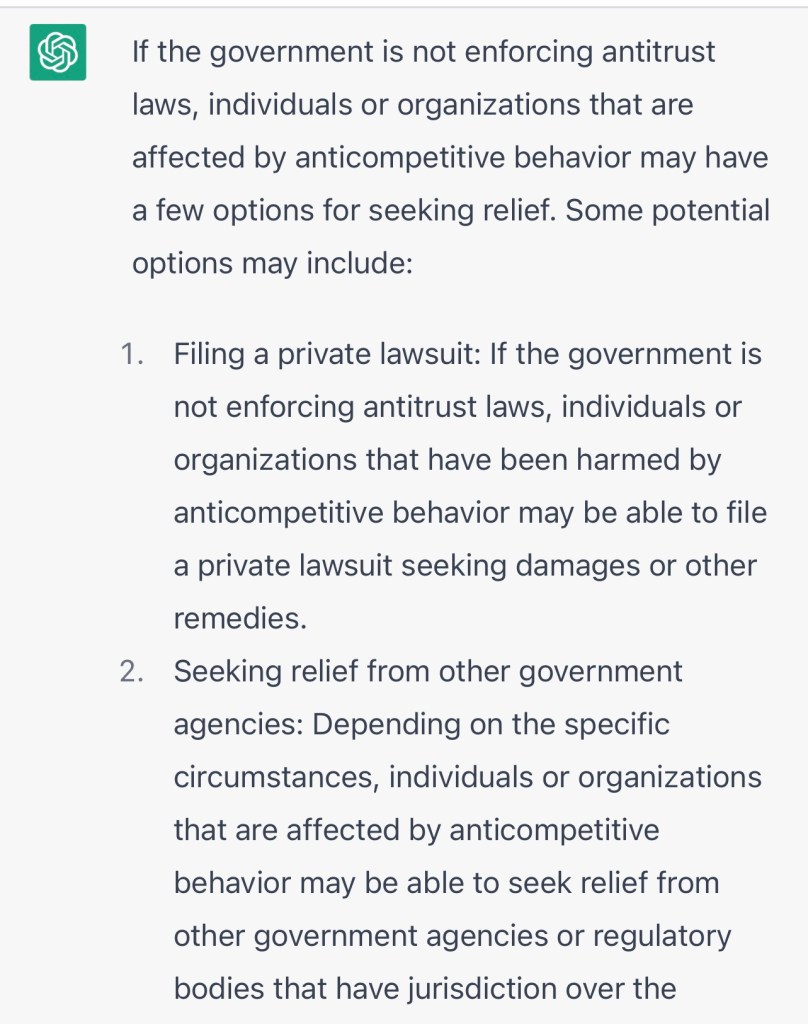
Stenonymous continues to ask ChatGPT the pressing questions.Stenonymous Q&A with ChatGPT.
In typical Chris Day fashion, I solved the case.
Well, I guess it’s not so creepy after all.
I’m almost done, but just for the giggles, I asked it one more question.
Christopher Day asks ChatGPT about the court reporter shortage fraud.Provided what ChatGPT asked for.In the words of the internet, I am disappoint.
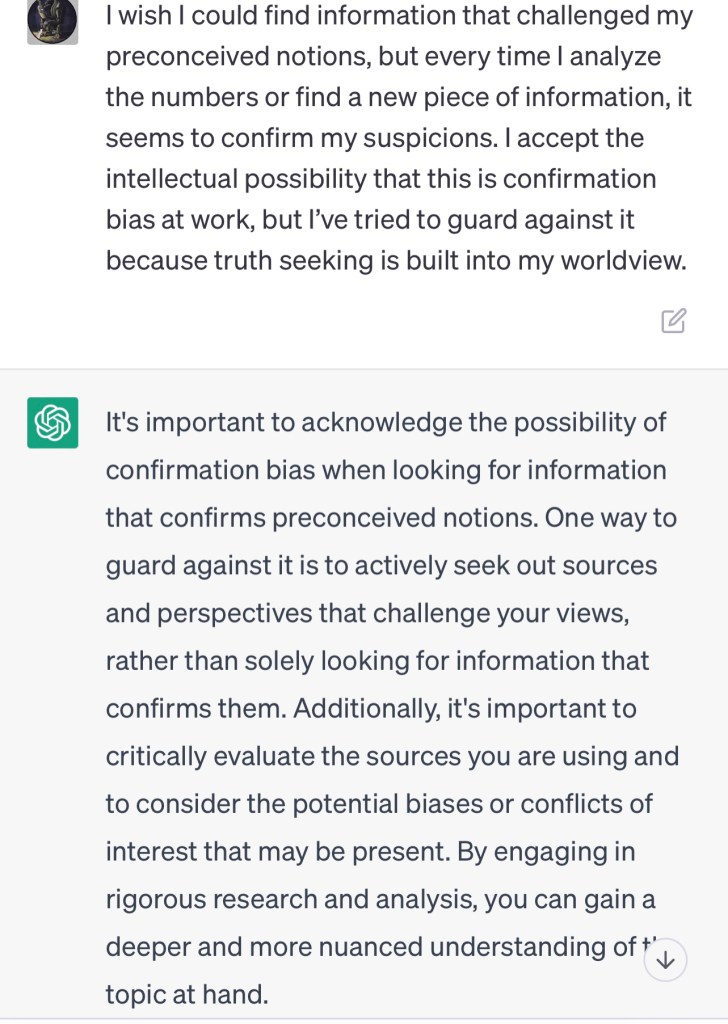
Ultimately, ChatGPT warned me, in a polite way, about confirmation bias. I accept that, and I leave you all on that note. Have a great day!
Here’s to hoping someone or something challenges my views. Thanks ChatGPT.
Addendum:
A reader sent me the screenshot below on 5/10/23. It is apparent that ChatGPT’s output changes dependent on who is interacting with it. I don’t know what else to make of this.
I got to sit down with ChatGPT, a program by Open AI that takes what you give it and gives you back what you’re asking for. The way it comes across to me is a “smart search,” essentially taking what you’re asking for and providing a simple, “humanized” output explaining something or answering you.
What you’re about to see are a series of things I asked it. I had some serious questions, some vanity questions, and even a conspiracy theory joke question in there. I even ask it what can be done to combat worker shortage. Please note that the co-founder of Open AI, Sam Altman, is quoted by VICE as having tweeted that it would be a mistake to be relying on it for anything important right now. Enjoy.
The first message I got when I went to try ChatGPT. The creators are upfront that it can produce misleading information.The ChatGPT system gives an honest look at its capabilities and limitations.Of course, my first questions for ChatGPT were the vanity questions.Stenonymous defeats AI for working people everywhere (joke).Christopher Day asks ChatGPT a joke conspiracy question.More vanity questions by Christopher Day to ChatGPT. But ChatGPT mentions AAERT and shuts that down fast.ChatGPT has as much trouble with this question as Christopher Day, part 1.ChatGPT has as much trouble with this question as Christopher Day, part 2.ChatGPT defends AI by refusing to answer (joke).
To be fair, while most question answers impressed me, this one stuck out as something where a traditional search is actually more helpful.
Spotlight on Trade Associations by the FTC
That said, even ChatGPT knows what the gold standard is.
You can also give it information. And while I work on another article to highlight CoverCrow, I figured I’d let ChatGPT in on it.
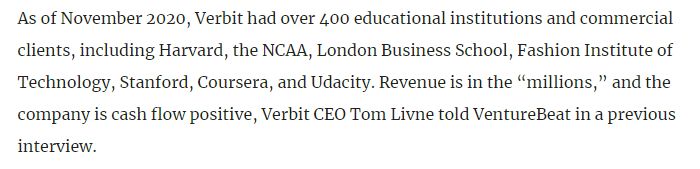
With the news that Verbit has bought VITAC, there was some concern on steno social media. For a quick history on Verbit, it’s a company that claimed 99 percent accuracy in its series A funding. In its series B funding it was admitted that their technology would not replace the human. Succinctly, Verbit is a transcription company where its transcribers are assisted by machine learning voice recognition. Of course, this all has the side effect of demoralizing stenographers who sometimes think “wow, the technology really can do my job” because nobody has the time to be a walking encyclopedia.
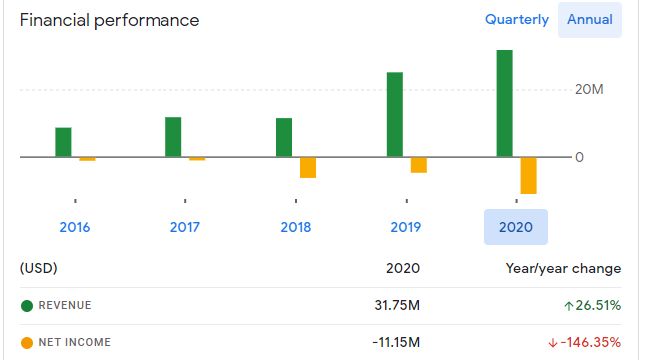
But this idea that Verbit, a company started in 2016, figured out some super secret knowledge is not realistic. To put voice recognition into perspective, it’s estimated to be a market worth many billions of dollars. Microsoft is seeking to buy Nuance, the maker of Dragon, for about $20 billion. Microsoft has reportedly posted revenue over $40 billion and profit of over $15 billion. Verbit, by comparison, has raised “over $100 million” in investor money. It reports revenue in the millions and positive cash flow. Another company that reports revenue in the millions and positive cash flow? VIQ Solutions, parent of Net Transcripts. As described in a previous post, VIQ Solutions has reported millions in revenue and a positive cash flow since 2016. What’s missing? The income. Since 2016, the company hasn’t been profitable.
I might actually buy some stock, just in case.
Obviously, things can turn around, companies can go long periods of time without making a profit, bounce back, and be profitable. Companies can also go bankrupt and dissolve a la Circuit City or be restructured like JCPenney. The point is not to disparage companies on their financials, but to give stenographic captioners real perspective on the information they’re reading. So, when you see this blurb here, what comes to mind?
Critical Thinking 101
Hint. What’s not being mentioned? Profit. While this is not conclusive, the lack of any mention of profit tells me the cash flow and revenue is fine, but there are no big profits as of yet. Cash flow can come from many things, including investors, asset sales, and borrowing money. Most of us probably make in the ballpark of $50,000 to $100,000. Reading that a company raised $60 million, ostensibly to cut in on your job, can be pretty disheartening. Not so once you see that they’re a tiny fraction of the overall picture and that players far bigger than them have not taken your job despite working on the technology for decades.
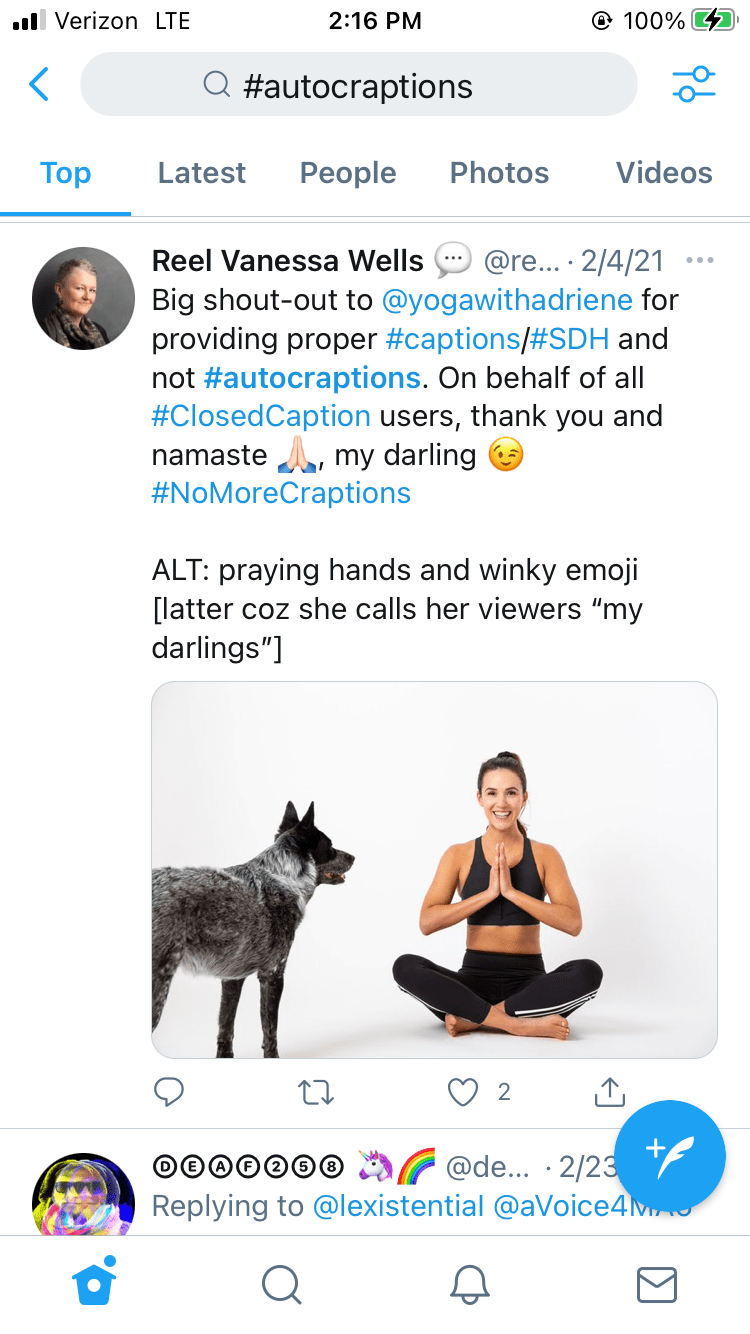
Moreover, we have a consumer protection crisis on our hands. At least one study in 2020 showed that automatic speech recognition can be 25 to 80 percent accurate depending on who’s speaking. There are many caption advocates out there, such as Meryl Evans, trying to raise awareness on the importance of caption quality. The messaging is very clear: automatic captions are crap (autocraptions), they are often worse than having no captions, and a single wrong word can cause great confusion for someone relying on the captions. Just go see what people on Twitter are saying about #autocraptions. “#NoMoreCraptions. Thank you content creators that do not rely on them!”
Caring about captioning for people who need it makes your brand look good? I wonder if a brand that looks good makes more money than one that doesn’t…
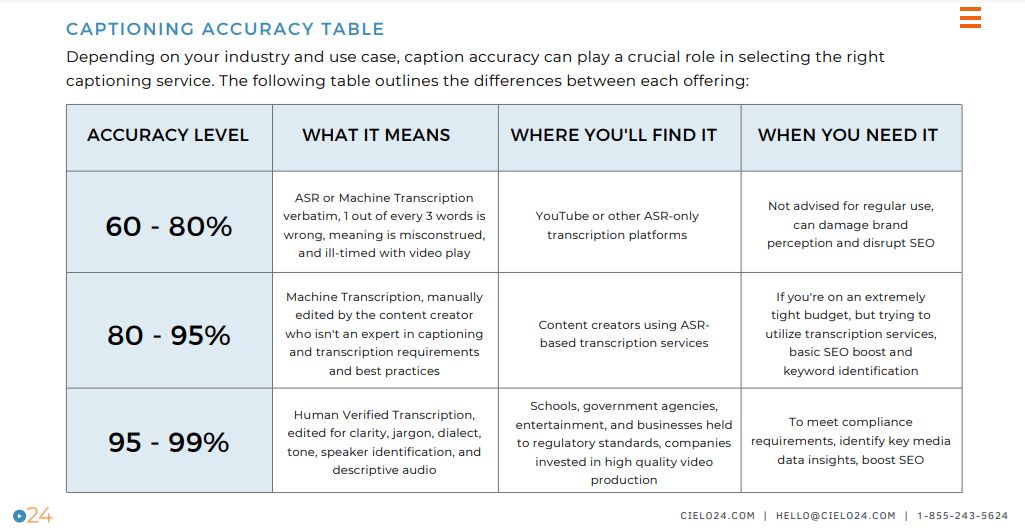
This isn’t something I’m making up. Anybody in any kind of captioning or transcription business agrees a human is required. Just check out Cielo24’s captioning guide and accuracy table.
Well, this is a little silly. Nobody advertises 60 percent accuracy. It just happens. Ask my boss.
If someone’s talking about an accuracy level of 95 percent or better, they’re talking about human-verified captions. If you, captioner, were not worried about Rev taking away your job with its alleged 50,000 transcribers, then you should not throw in the towel because of Verbit and its alleged 30,000 transcribers. We do not know how much of that is overlap. We do not know how much of that is “this transcriber transcribed for us once and is therefore part of our ‘team.'” We do not know how well transcription skills will fit into the fix-garbage-AI-transcription model. The low pay and mistreatment that comes with “working for” these types of companies is going to drive people away. Think of all the experiences you’ve had to get you to your skill level today. Would you have gotten there with lower compensation, or would you have simply moved on to something easier?
Verbit’s doing exceptionally well in its presentation. It makes claims that would cost quite a bit of time and/or money to disprove, and the results of any such investigation would be questioned by whoever it did not favor. It’s a very old game of making claims faster than they can be disproven and watching the fact checkers give you more press as they attempt to parse what’s true, partially true, and totally false. This doesn’t happen just in the captioning arena, it happens in legal reporting too.
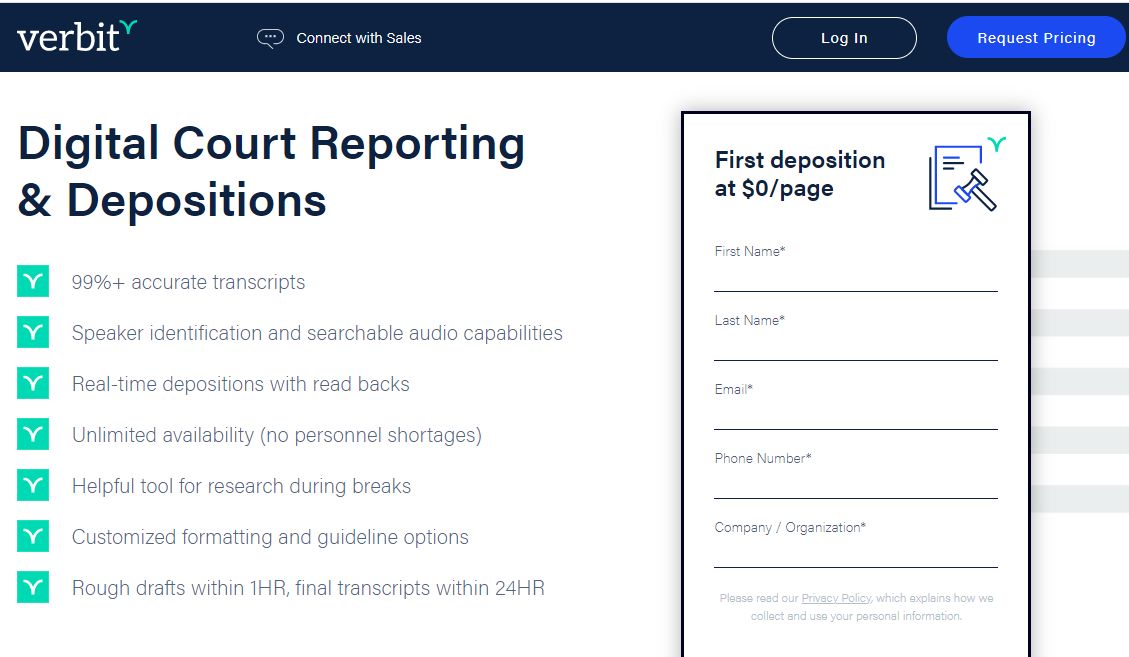
$0/page. Remember what I said about no profit? It doesn’t matter if they’re never profitable. It only matters that they can keep attracting investor money.
This seems like a terrifying list of capabilities. But, again, this is an old game. Watch how easy it is.
It took me 15 seconds to say six lies, one partial truth, and one actual truth. Many of you have known me for years. What was what? How long will it take you to figure out what was what? How long would it take you to prove to another person what’s true and what’s false? This is, in part, why it is easier for falsehoods to spread than the truth. This is why in court and in science, the person making a claim has to prove their claim. We have no such luxury in the business world. As an example, many years ago in the gaming industry Peter Molyneux got up on stage and demo’d Milo. He said it was real tech. Here was this dynamically interactive virtual boy who’d be able to understand gamers and their actions. We watched it with our own eyes. It was so cool. It was BS. It was very likely scripted. There was no such technology and there is no such technology today, over eleven years later. Do you think Peter, Microsoft, or anybody got in trouble for that? Nope. In fact, years later, he claimed “it was real, honest.”
Here’s the point: Legal reporters and captioners are going to be facing off with these claims for an indeterminate amount of time. These folks are going to be marketing to your clients hard. And I just showed you via the gaming industry that there are zero consequences for lying and that anything that is lied about can just be brushed up with another lie. There will be, more or less, two choices for every single one of you.
Compete / Advocate. Start companies. Ally with deaf advocates.
Watch it happen.
I have basically dedicated Stenonymous to providing facts, figures, and ways that stenographers can come out of the “sky is falling” mindset. But I’m one guy. I’m an official in New York. Science says there’s a good chance what we expect to happen will happen and that’s why I fight like hell to get all of you to expect us to win. That’s also why these companies repeat year after year that they’re going to automate away the jobs even when there’s zero merit or demand for an idea. You now see that companies can operate without making any profit, companies can lie, much bigger companies haven’t muscled in on your job, and that the giant Microsoft presumably looked at Verbit, looked at Nuance, and chose Nuance.
I’m not a neo-luddite. If the technology is that good, let it be that good. Let my job vanish. Fire me tomorrow. But facts are facts, and the fact is that tech sellers take the excellent work of brilliant programmers and say the tech is ready for prime time way before it is. They never bother to mention the drawbacks. Self-driving cars and trucks are on the way, don’t worry about whether it kills someone. Robots can do all these wonderful things, forget that injuries are up where they’re in heaviest use. Solar Roadways were going to solve the world’s energy problems but couldn’t generate any energy or be driven on. In our field, lives and important stakeholders are in danger. What happens when there’s a hurricane on the way and the AI captioning tells deaf people to drive towards danger?
Again, two choices, and I’m hoping stenographic captioners don’t watch it happen.