Attorney: Huseby, your $4.20 Per Page Copy Fee Was Unreasonable

A source has provided a letter purportedly from Bobby Thompson from the Thompson Law Offices. Just like the other Huseby post, I’ll let everybody see the letter and then dive in with my commentary.

Letter to Huseby by Bobby Thompson, Esq.

First thing’s first, it’s surprising to me that there’s $200 in fees and none of them say “appearance fee.”

Then there’s the part about the $4.20 copy fee after original counsel paid almost $6.00. New York City reporters would probably explode if their copy rate was anything close to $4.00. When I was a young reporter, Diamond told some reporters it didn’t pay copies, and copies were about $0.25 a page here. Since I started publishing up a storm about the unfair treatment of reporters, people have seen raises as high as $1.00 a copy. These guys are looking to pull in 4x that. And I bet they all tell lawyers we’re the reason everything is so expensive.

As for not paying anything but the testimony, that’s debatable. I would demand full payment for a caption page and exhibits index, but it’s understandable why someone might not want to pay full-price pages for a word index, which can be provided at the click of a button (kind of like that thing we disparage digitals for.)

But the heart of what I’m getting at is this: Look at that initial $1,000 charge. The attorney re-evaluates the charges and thinks a more reasonable number would be in the ballpark of $700 cheaper. Some of this we could conceivably wave away by saying “attorneys want everything for free,” but I think we need to come to terms with the idea that the billing game has changed. It appears that attorneys are being billed far more than we’re charging, and we’re not in a great position to tell them “it’s not us, really.” There’s case law on this, so that tells me it’s a lot more widespread than we acknowledge in our circles.

Reached out to Mr. Thompson by email and never heard back.

For those of you reading, it’s not us, really.
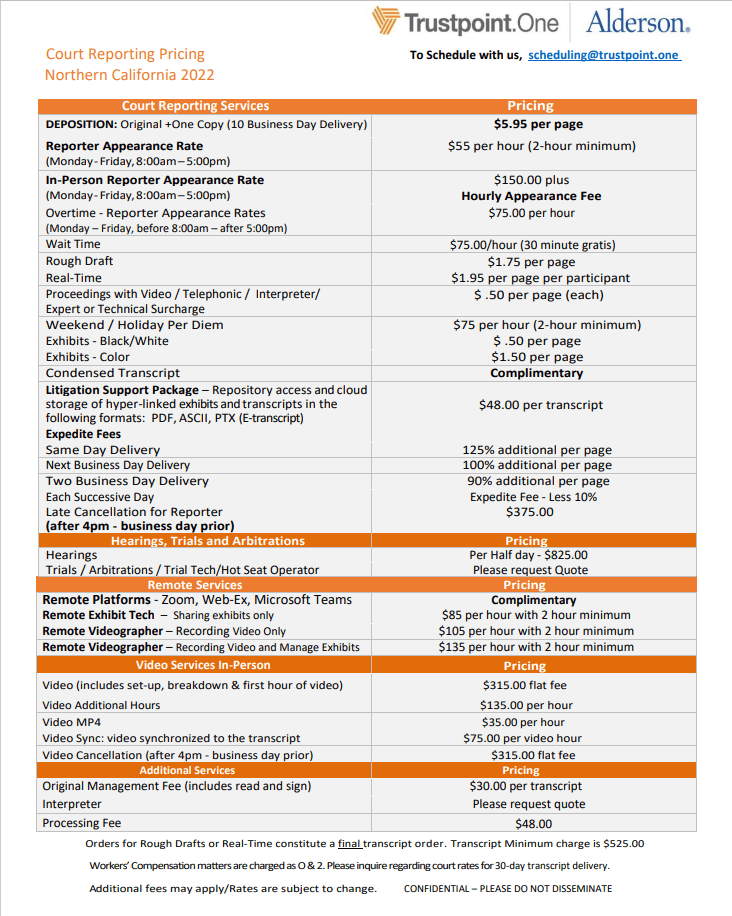
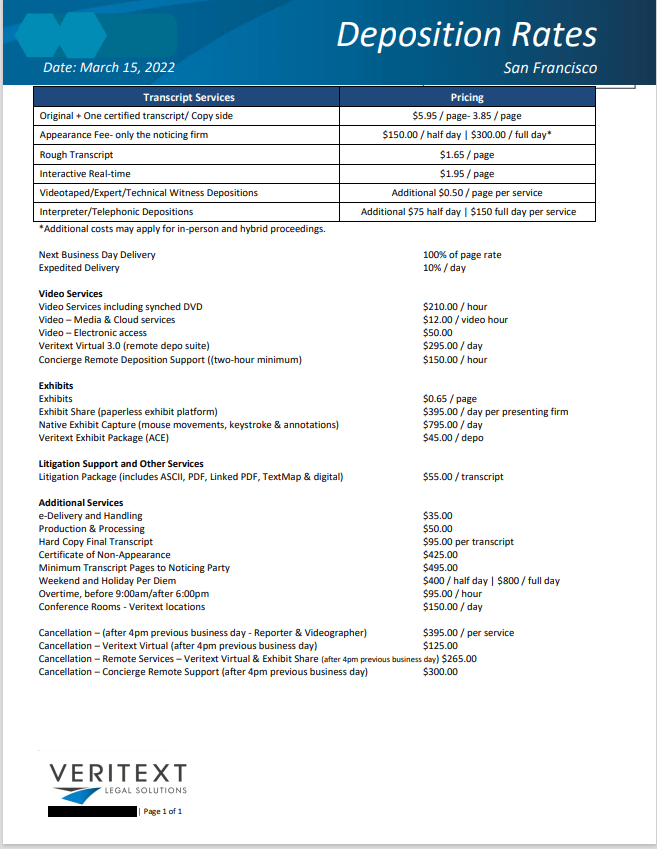
CA: Esquire, Trustpoint One, Veritext 2022 Court Reporting Page Rates…

A Stenonymous source comes through for the stenographic legion again. Sorry for the double post tonight, but I know this is bound to get some New York reporters flying west.

I bet there are thousands of stenographers that could beat those rates. We have some people here working for like $3.00 – $4.00 a page on an O+2. $4.50 is considered a good rate. The loss of that copy in NY kills the income just enough to put the squeeze on people.

Hey, attorneys, up to a 30% discount on contracting directly with your court reporters. 50% if you meet an idiot kid like I was. Probably a nice break on the copies too.

Anyway, this is a win for market transparency, competition, and free speech. Anybody from CA in the audience, feel free to weigh in and give me the perspective of an actual reporter on the ground.

Trustpoint One CA Court Reporting Page Rates
Veritext CA Court Reporting Page Rates
Esquire CA Court Reporting Page Rates

PUBLIC NOTICE: Posts will no longer auto-post to Twitter. Apparently the Twitter API has shut its access.

Veritext Apparently Charged the Equivalent of $37 Per Page in Texas

I was passed a transcript excerpt by a source that wishes to remain anonymous. As a note, the redactions weren’t done by me. It was a short deposition, and looked like any other.

Nothing weird about this, literally.

There were three parties and a videographer.

Still nothing weird about this.

Now, maybe some of my Texas audience can fill me in on this, but apparently there’s a certificate in Texas that tells us how much the deposition officer gets. I do not know for sure if the deposition officer is verbiage for the reporting company, the reporter, or something else. I tried to connect to the court reporter on LinkedIn, but she didn’t respond. This certificate listed, on a 39-page transcript, a grand total of $1,457.31. That’s about $37.37 a page. Even if we assume the videographer took half, that’s about $18.69 a page.

I’m in a state where my mentee was told “you don’t deserve more” after asking for far less.

I can’t figure out how the cost gets that high. I have to look at New York officials for comparison. Assuming a daily of $6.50 and two copies of $1.25, they’d be looking at $9 per page. Freelancers out here have been doing about a dollar a hookup, so even if we assume there were three hookups, we’re still talking about $12 a page — and there’s no evidence to suggest any of that is true. I’m just trying to add calculations to get to $37 a page.

If nothing else, I hope this annihilates the argument that court reporters are in danger of pricing ourselves out of the market. Such a thing is often said to break our newbies into accepting very little money for the important work that they do. It’s a disgusting corporate tactic to make the bottom line look better. Maybe the middleman model has outlived its usefulness to our profession.

Notably, Veritext also seems to be normalizing adding a kind of corporate certificate that doesn’t actually certify anything. What’s the point of this?

Veritext Legal Solutions promises that Veritext Legal Solutions is Veritext Legal Solutions. -Parody

I’m done chasing people and companies for answers. If they care to comment on the blog, I don’t censor comments. But good luck explaining $37 a page to a field of stenographers that are often told lawyers won’t pay more than the measly $4 or $5 we pull in.

Audio Transcription, Pricing, And You

First and foremost, happy Thanksgiving. As with most great writers, I’m going to take the time away from preparing to the holiday to write about something I know everybody will want to read about: Audio transcription and pricing. As stenographers, we tend to get very focused on a per-page pricing structure. This often leaves us trying to measure our time by pages, and is not always the most ineffective way of being paid.

For purposes of this post, let’s talk a little about CART, audio transcription, and pricing generally. CART and audio transcription are not the same thing, but they have similarities. One key similarity is that they tend to charge by the hour. For CART it’s per hour of writing, usually with a set minimum, and for audio transcription it’s money per hour of audio, sometimes prorated for audio that doesn’t last a whole hour or end exactly on an hour.

Succinctly, for CART, captioning, and audio transcription, despite having different prerequisite skills, the pricing for all of them must take into account the amount of work we’re doing, the quality of the work we’re doing, and ultimately the time it will take us to do the work. So speaking strictly for transcription: I’ve guesstimated that it takes me approximately one to two hours for every hour on the machine to transcribe with pretty close to 100% accuracy. That means for every hour of audio, there are about three hours of actual work involved. So, for me, honestly, working for less than $30/hr becomes painful, so the transcription deal isn’t sweet until maybe the $100-something range. The bottom line of this story? We must examine our time and really decide what it’s worth.

In examining our time, we can also consider other factors. For example, what are other people charging for the same work? As we can see from this Google search here, there are companies that boast a $1/minute transcription fee. So if we do an independent assessment of our time, and we come to the conclusion our time is worth $2/minute, that’s perfect, but just bear in mind that we may lose a couple of customers to the person who is half our price. A potential solution? Split the difference and charge $1.50 per minute.

There’s a lot that goes into economics, buying, selling, demand, supply, and no one blog post could ever impart all of that knowledge on anyone. Even top economists who have devoted their lives to understanding value and money disagree with each other. The best we can do is urge every reporter, where applicable, to look at what they charge, whether charging an agency, lawyer, or outside consumer, and consider how our pricing practices affect all different areas of the field. There’s tons of literature and articles on price matching and how it can help consumers, hurt consumers, help businesses, and hurt businesses, and the cold truth is that it’s up to us to take the time out and learn about these things, because many of us are our own business, and our business rises or falls on our willingness to learn beyond the machine.