How To Spot More Better Marketing

Count out how many times in your life you’ve seen a product in advertising that was similar to something you already do, have, or want. Did the advertiser tell you it would do more stuff? Did the advertiser tell you it was better at doing stuff than its competitors? Did the advertiser try to make you feel good and confident about a purchase in this product? February of last year, I touched on the magic of marketing. Today, we explore marketing that takes aim at us, how to identify it, and how to tell our students not to be swayed by it.

The genesis of this post is actually a marketing blitz by Transcription Outsourcing, LLC. Their ad boldly starts off “Tired of waiting for your court reporter?” They claim their prices are “up to” 50 percent less expensive than a court reporter. Guaranteed accuracy, 3 to 5 day turnaround. Among their many claims are reporters won’t format your documents, send back errors, have overseas teams that are hard to contact, take weeks. For most of us in the business, this is laughable, but we have to take ourselves out of our skin and hop into the skin of a potential client or a stenography student that has zero experience in sitting at a stenotype or desk transcribing legal proceedings. As far as identifying and helping students identify “more better marketing” I’d propose watching out for four red flags:

  1. It’s cheaper than you.
  2. It’s faster than you.
  3. You still have a job.
  4. It promises.

One, if it’s cheaper, why isn’t everybody using it? For this, you can look into your own life experience. Why don’t you buy cheaper food or a less expensive product? Usually doing something cheaper means sacrificing quality or training somewhere in the process. Two, if it’s faster, again, why isn’t everybody on it? Are there problems scaling the product, does the service provider not deliver, or are the costs of being faster too high? Three, you still have a job? Look, Company XYZ says they’re cheaper, faster, better, more better, amazing, and yet the clients are still using stenographic court reporters. This is not to say these types of services could not, through their marketing, supplant reporters. But flag three is all about acknowledging that at least some what they’re selling is hype and hope to customers. Four, it promises. That’s probably the biggest red flag you can get in this type of marketing. We saw it with Theranos, Project Natal, Solar Roadways, Waterseer, Hyperloop. People love to sell things whether they’re possible or not. They promise their solution is the solution. Theranos was going to test extraordinarily small amounts of blood and administer treatments through patches. It had a $9 billion valuation. Didn’t exist. Project Natal and Milo were going to revolutionize gaming. There were videos advertising it! Didn’t exist. Solar Roadways was going to solve America’s energy crisis by throwing out everything we know about efficient solar power generation. It raised millions of dollars. Didn’t work. Waterseer was going to solve the world’s water crisis and forgot to mention that dehumidifiers have the same basic function. The Hyperloop routinely ignores that a single break in the loop or tunnel could implode the entire thing and kill everyone in it. Promises are part of human interaction, but buying into them without reservation is dangerous and expensive. If it promises but doesn’t deliver, take note.

That’s identification in a nutshell. And at this point many are probably saying, “Chris, you’re just picking on these guys because they’re taking a swipe at court reporting. You don’t actually have anything that shows their promises aren’t the real deal!” This is where experience as a court reporter comes in. Take a look, again, at the things they said about court reporters.

  1. They won’t format your documents. Well, in some jurisdictions, we have a prescribed transcript format. Even here in New York City, where there’s virtually no such mandate for freelancers, I know many freelancers who do or have worked for agencies that work with the New York City Law Department or MTA, and both like transcripts formatted a certain way by contract. Bottom line is if you can’t find a court reporter that’ll format your document, it’s either not proper in your jurisdiction or there’s some other stenographic court reporting company that will do it.
  2. They send you back errors. I consider myself an extremely average reporter. I’m so average it took me ten years to finish off my RPR. In that ten years, I can recall exactly once that an error so egregious made its way in that it needed to be corrected and was serious. Humans make errors. News articles make errors every day. I’ve hired a lawyer that made an error. Guess what happens? It gets corrected. The world keeps turning. But, these people guarantee accuracy. I’m sure that means if a client find an error, they get the whole transcription for free, right? Right?! It promises, but there’s nothing really backing that promise. Students, ask your mentor how many mistakes they’ve made in their career. Ask them how many were serious. Mistakes are a non-issue in the context of a larger career if you learn from them.
  3. Their overseas teams are hard to contact. With the majority of court reporting firms I know and have worked with being US-based or having US-based management, I find this an odd claim. Even Israel-based Verbit, to the extent you can consider them court reporters, never came off as particularly hard to contact. Even the smallest firms I’ve ever worked with have a dialing service that makes sure the customer can get in touch with someone or leave questions or comments for the owner.
  4. They aren’t secure. I’ve found the word security to be kind of a red herring in our business. What kind of security are we talking about? SSL Certificates? Haven’t seen a reporting firm without them. Secure repositories? If you spend about sixty seconds Googling reporting firms, you’ll find security. It’s a comfort word at this point.
  5. They take weeks. Six-hour service is available. Interesting. I wonder if Transcription Outsourcing provides six-hour service on eight-hour depositions like many of my colleagues do with their dailies and their immediates. For those not in the business, for a reasonable cost, a properly trained and skilled stenographic reporter can work with their team or scopist to deliver a transcript immediately at the conclusion of a deposition. I am sure that once time travel is developed, court reporters will be the pioneers in producing transcripts before proceedings actually occur, too.

The point is to look at the millions and millions of dollars that have went into ideas that had little chance of succeeding. Look how long it takes to verify that these ideas are scams or false hope. How many people do you think are fact checking transcription and court reporting companies? Even this idea that the service is cheaper is knocked right out of reality by their own rates. Between $1.50 and $5.00 per minute. When I was in the business of freelance court reporting and transcribed audio, I charged somewhere in the realm of $100 an hour, which is about $1.67 a minute. If you take their best rate, by their own advertising, they’re at best 10 percent cheaper. They had no problem making that 10 into a 50 in their advertising. Looking at some of their other rates, you can save yourself 30 percent by switching to steno. If any of this “better, cheaper” stuff was true, why would reporters use scopists? Sorry scopists. We can just send our work into Transcription Outsourcing, LLC, take our 30 percent, and let them do all the work. Doesn’t happen. They don’t care about burning an entire bridge of potential customers because there’s no savings to be had there. They want what our clients are paying today in their pockets, and they’re hoping lawyers fall for it.

The bottom line is we’re going to be seeing more and more puffery and opinion enter our field masquerading as fact. We will be inundated with it. It’s much easier to make up falsehoods or questionable claims than it is to fact check those same claims. So when you see, for example, Protect Your Record Project fighting to raise awareness about our services, it’s a win. When you see state associations fighting to raise awareness about our services, it’s a win. When you see professionals donating their time to help encourage students and mentoring new reporters, it’s a win. When you see Open Steno, NCRA, and Project Steno advertising this field and ways to get in, it’s a win. Our strength is that there are thousands of us in the field practicing today, and so one minute from each of us amounts to a lot more time and effort than companies can spend on making up BS. Keep taking advantage of that and working together to educate. Keep hitting up social media platforms and making sure people aren’t misled about who we are and what we do. The last ten years have built an impressive online community of reporters. The next ten will be a test of getting that community’s knowledge out to clients and potential stenographers.
August Asterisks 2020 (Jobs)

One thing I’ve learned in this business is never be too predictable, and that’s why I completely skipped July. Before we get to actual jobs posts that have popped up in the last two months, we’ll get down to something for our freelance friends. and people looking to make a difference in this field. NYSCRA is promoting no fewer than three online sessions that should have a little something for everybody. First, on August 16, there will be a session with Jason Wisdom on freelance success. On August 24, Jessie Gorry and Joshua Edwards are presenting Zoom for Freelance Reporters and will be talking, as I understand it, about best practices and hardware stuff you can do to make your life easier. Finally, for those of you seeking to build some skills and confidence in making a difference, Project Steno will be hosting courses on clean writing, developing a high school program, and conducting a training course. Even more for people looking to make a difference, you should see NYSCRA President Joshua Edwards’s message in the Summer 2020 Transcript. Without further delay, in steno, if we want to change something, we hit the asterisk, right? So change the job up with August Asterisks.

Onto the jobs. First, a very special posting. Eric Allen, President of ASSCR, was kind enough to post this excerpt from what I believe to be the Chief last month. In my very first post about finding a job in New York City, I talked a little bit about Workers Compensation and how they no longer seemed to be hiring even though the application was up. So to see these very recent, current postings for Verbatim Reporter 1 in New York State is very comforting. It should be a clear message to every jobseeker and our employers that what we do has a lot of value. We will rise to the challenge of filling these positions, but we need the shotcallers to keep the demand for court reporting steady so that people are not scrambling in and out of jobs. Every former Verbatim Reporter 1 that I have ever spoken to has told me that it was an amazing job that they really liked. If you’re a reporter looking for change, this just might be your sign. Also, if any legislation comes up regarding that position, as it had in the past, I urge every reporter to support it, because you are supporting the stability and sustainability of your field. Thank you, Eric Allen, for bringing this job post to everyone’s attention.

For the first time in a while, there do not seem to be any grand jury reporter jobs open in New York City. I’m actually happy to say that because it shows that we can absolutely fill vacancies. We can beat the reporter shortage. Please, take my advice seriously when I say if you want a grand jury job with New York City, check the district attorney sites of every borough every single month, including the SNP, and check DCAS. It is very easy to miss these postings. If you need the links, they’re under the grand jury section of Get A Real Job.

The statewide provisional posting for court reporter is still up. This should surprise no one. We need stenographic court reporters. If you’re waiting for the civil service exam to come out so that you can get a permanent position, make sure you’re checking the exams page every month. You don’t want to miss out on a test that, by law, can only be held every 1 to 4 years. If you’re interested but want more information, why not reach out to Michael DeVito? His contact information is at the bottom of the posting, and it just might help you make your decision.

For the reporters out there looking for a spot in the federal judiciary, there’s plenty for you. We are looking at open spots in New York, Tennessee, Massachusetts, Illinois, Arkansas, and California. The federal judiciary jobs page remains a great resource for finding these job postings, and every reporter out there should take the time share it and familiarize themselves with it.

For those looking for a little more, NCRA’s got a jobs page too. As of today there are 87 results to flip through. Alternatively, if you’re looking to put down the machine for a little while but stay employed “in the field,” you could apply to become an NCRA Content Specialist. I’ve had the pleasure of interacting with NCRA staff before, and it’s always been really positive. I can only hope whoever fills that spot is just as positive, dedicated, and wonderful as the rest of the team. I have a lot of faith in Dave Wenhold and the current Board of Directors. There’s good leadership. There’s good staff. There are good committee volunteers. There are great general members. There’s a real chance for stenographic reporting to prove its adaptability, superiority, and technological advancement despite all the world has gone through in the last six months. Humans have known for a long, long time that when there’s a chance of something happening, it can happen. There’s even a latin phrase for it, a posse ad esse, which translates roughly to “from possibility to actuality.” So let’s take that chance, hold onto it, and make sure that our markets know stenographic reporting is here and ready to do the job.

How Organizations & Associations Work

Our lives are built on perception. The perception that someone must do more, or that someone does too much, or that someone is doing something wrongly or rightly can be very powerful. Perceptions can change outcomes. We see it in social movements. We see it in the Pygmalion effect. Think of the power of your own opinion. If you do not like a store, you do not shop there, and that store effectively loses the money it would have made off of you. Some voice that opinion, some vote silently with their wallet, and others buy away. All of these contribute to the reality of that store’s situation. While you read, continue to keep in mind the power of your opinion.

When I was younger, I viewed associations, unions, and groups of people, collectives, as inherently powerful. In that perception, I also expected them to be wise and knowing. “They should be able to fix this. They should be able to fix that. They should know what to do.” Perhaps others believe as I once did, that the association and members work together to create things. Perhaps some believe the members support a group and therefore the group should be able to do everything by itself. There is probably not a simple graphic to perfectly illustrate how everything works. Again, though, there is one overarching truth, the power of your opinion.

Think of something in your life that you wanted and you now have. Did it magically appear in your lap? It’s likely that there were steps you had to take to get what you wanted. It’s likely that there were “vehicles” you drove to get there. Maybe the “vehicle” to something you bought with money was a good job. Maybe the “vehicle” you drove to a good relationship was a dating service, or a night at a bar, or walking down the street in a squid hat. Maybe the “vehicle” you drove to being a successful person was forming good habits, strengthening weaknesses, or playing off strengths. In the context of this discussion, associations, unions, and organizations are all vehicles to get where we want to go.

One jab that large organizations and corporations get is their usually slower reaction. This has to do with organizational structure. When a group is formed with one decision maker or very few decision makers, that group can respond to things at the will of that sole decision maker. A great example is this blog. Not a single person needs to be consulted before something is posted. However, in order to ensure that budgets are spent wisely, many organizations are built up from a board structure. The nonprofit “sector” runs heavily off of volunteer boards. A board of directors is typically a group of people that oversee the management of the entity. Think of them as the manager’s boss. In the case of our stenographic associations, these tend to be professionals from our stenographic community. Larger associations can afford to pay a management team under the board’s direction to deal with legal obligations, filings, and member questions. Even in larger organizations, the team may be very large, with an executive director and many people under him or her, or it may be a very small one-warrior management team. Smaller organizations may have a board that has to devote their own time to doing these things and act as both board and management. Ultimately, think of a board of directors as a group of people coming together to vote on the best way to direct an organization and its funding.

How do you fit in? Maybe you’re not a board member. Maybe you have no desire to be a board member. Maybe you’re “just” a member. You don’t control management, so where does a guy like me come off telling you your opinion has power?  In the association and union structure of an organization, the members give the board and management power and resources to act. Very often there is a constitution and/or bylaws that dictate how someone can run for a board position, how someone can propose an amendment to the constitution and bylaws, or how someone can participate with management and the board as a volunteer. Any member can contribute a great deal to the organization as a whole. If members dislike the way something is being run in an association structure, they have the power to replace the board by running against them. If members do not feel the mission of an organization is being accurately carried out by management, they have the power to submit changes. Association management generally has a duty to follow the law of their country and the bylaws of an organization. This all amounts to a great deal of power being given to members of large organizations. The importance of the association structure is in its ability to be “owned” by the members. Again, for example, let’s say that you log onto the Stenonymous Facebook group and you want to post an article about birds. Let’s say I say “I would prefer not to have posts like this on my group.” There’s no mechanism for you to take over and make it okay to post about birds. In an association structure, if the members want posts about birds, there’s a mechanism to override management and post about birds.

How can one enhance their pull as a member? In many organizational structures, there are groups of volunteer members dedicated to a task handed down by the board and/or management. These are often called committees and/or subcommittees. Committees do not have a direct vote in what the association does or what the board decides, but they are charged with giving input and/or creating things that can be used by the association for its mission. Committee work also helps teach members to work together constructively in a team so that if they ever do decide to run for board membership, they are used to working cohesively with others that may have very different opinions on the “right thing to do.”

Now we get down to the greatest power members have. We are the boots on the ground. We see what is occurring in our workplaces, out in the streets, and on our social media. I’ve been a proud union member of two different unions in the last 5 years. Occasionally, when I hear or see something strange, I’ll let a union person know, or I’ll ask a union person a question. Why? It’s not about getting people in trouble. It’s not about being more friendly with my union leader. It’s not about being a busybody or a know-it-all. It’s not about scoring points at the workplace. It’s about realizing that these management and director teams are human beings. They are not omnipotent giant floating brains.  Often, they have not heard about what we are sharing with them, or they have not thought about it in the way we have presented. Imagine you are now John or Jane Doe, CEO of Your Corporation. Your boots on the ground are your employees and your customers. If someone’s lying about your company behind your back, do you expect your boots on the ground to mention it to you? We are a community. Like any community, we each have great power in protecting and growing the community.

Over the last decade, I have seen something startling in the way that we view our leaders, and sometimes how our leaders view us. For a time, I know people in power were dismissive.  I have friends and colleagues whose concerns and opinions fell on deaf ears, whether that was management or board members. Those friends and colleagues voted with their wallet and they backed away from the association structure. Those deaf ears are long gone or have gone on to support associations that work against our community’s best interest, and yet still there is a pervasive attitude of “what have you done for me lately?” There is a disowning of the community’s triumphs when they come from people who aren’t in our tribe. There is a strong push towards factionalism. This divides our house. This forces us to spend time and energy fighting each other. With the inherent power of members of a community described, and the reasons for an association structure described, it’s my hope that we’ll spend less time beating up on our allies and their organizational structures. There has been a great push to platform each other in recent months. This pandemic showed us that unity is achievable. So if there’s somebody out there that doesn’t get it; if there’s someone that has no clue how powerful they are or why certain things operate the way they do, it’s up to us all to let them know, and in that order. You got this, now go get it.

May Machinations 2020 (Jobs Post)

Plot your course into the future with some of these May 2020 job openings. Of course, this is all with the caveat that things are still closed and that hiring probably won’t happen immediately. That said, this is a good look at the demand for the stenographic reporter in New York and nationwide.

NCRA’s got 93 listings up as of writing. Some of these same listings can be found via the federal judiciary job page and the USCRA job page.  Here in New York, our Southern District and Eastern District Courts both have jobs posted.

DANY’s got a grand jury stenographer job going on in New York County.  Remember, if you’re looking for grand jury work in New York City, check in with the HR people at each of the five district attorneys and the Special Narcotics Prosecutor. It might seem like a lot of work, but you might get tipped off to a job before somebody who waits for it to get posted. The DCAS Reporter/Stenographer Exam has not yet been rescheduled. The New York State Unified Court System maintains its statewide posting for court reporters, but it’s my understanding that there is no hiring going on right now.

Assuming all goes well in terms of the state’s reopening, now is the time to be planning, filling applications, or looking up information about certifications available if the job of your dreams requires a test or certification. If you’ve already got your dream job, be a mentor, do what you can to point others in the right direction. For example, one thing a lot of people come to me and ask about is what the heck to study for the Written Knowledge Test of the RPR. They can’t afford the study guide or they want to self-study.  We can’t give them the answers on the test, but we can point at the RPR Job Analysis, and how that breaks down what you should learn about before you walk into the exam room. If it gets somebody one percent higher, and that one percent passes them, it’s worth it. Finally, as a habitual procrastinator, I can tell everyone interested, don’t wait. I waited to apply for a job opportunity ten years ago. Thanks to my “smart decisions,”  I waited four years for another opportunity at that same job.  It’s not always who you know. Sometimes it’s who you are. If you’re the type of person that waits, that’s okay, but you also have got to acknowledge that that can hold you back. You’ve got to make a personal decision whether you want that to hold you back. Everybody reading this has agency. Everyone has some control over their destiny. Embrace that and make yourself shine.

April Applications 2020 (Jobs Post)

Obviously, this goes up during the COVID-19 outbreak, and many of my colleagues or their families are impacted health-wise or economically. It’s serious stuff. Some of us have lost people or been in danger of losing people. This is a time when mostly everything has slowed down, and for many it may not feel like there is an end in sight. That said, I assure you there is an end in sight, and when this is all over, we’re going to need to pick up the pieces, move forward, and help each other move forward.

There’s a lot of fear and a disruption in our normal lives. So to keep with some semblance of normality, I’m going to move forward with a jobs post. Keep in mind that with this outbreak, many places are running on a skeleton crew, so they may not be actually hiring right now, but when things start to speed up again, stenographic reporters are needed all over the city, state, and country. They’re needed outside the country too, but I’ll let the experts handle that. Remember that if you’re a student or a newer reporter, there are also programs out there designed to find you a mentor. Mentors are no doubt having difficulties too, but they may be able to offer advice or ideas nonetheless.

Running along, NCRA has a good number of job listings up for reporters. They’re also looking for a certification & testing program manager. I know here in New York we have some reporters who are extremely gifted and passionate about certification and testing, so if that’s something you think you’d put down the machine for, take a look. Looking at the federal judiciary jobs page, there are openings in New York, Nevada, Washington, Oregon, Iowa, Missouri, Massachusetts, West Virginia, Florida, Pennsylvania, and Texas. Federal courts all over the country want stenographic court reporters.

The NYS statewide provisional court reporter application remains open to anyone with the guts to step up and give reporting for the state judiciary a chance. The courts in this state need people that care about the record and want to do a good job. If you’re looking for a steady job with paid time off, this is a first foot in the door while we wait for the civil service exam together. Before this outbreak and mess, I had a brief e-mail exchange with Michael DeVito, whose contact information is on the bottom of that application. Paraphrasing what he said, any employment prospects are encouraged to contact him. You have someone in the system to reach out to in addition to the unions that represent New York City court reporters and senior court reporters.

Last, but certainly not least, the Bronx DA has a posted position for grand jury stenographer. The DCAS Reporter/Stenographer test remains postponed.

Try to remain positive. I know there has been a marked drop in freelance work.  You are not alone. At the beginning of this, several of NYSCRA’s officers and board members, Joshua Edwards, Diane Salters, Karen Santucci, and Dominick Tursi, got together to show our community an example of a remote deposition. The full video is available. Many members asked additional questions, which I tried to address via this video, and wrote some more information in the description box. If you’re a NYSCRA member or a potential member, don’t be afraid to send e-mails to board members. We can’t wave a magic wand and make everything better, but we can try to use the association’s resources that we all pay into in a responsible way. Remember that you are integral to those resources, and that even if you can’t get a membership right now, you can still throw in support later when work starts booming again. And we are not alone. Many state associations, and the NCRA, have been promoting ways to get reporters back to earning a living for themselves and their family. Many reporters have independently taken the time to host webinars or put up videos to help each other. Many CAT trainers are scheduling remote appointments to help people with their software. As an example, I personally follow Dineen Squillante and Anthony Frisolone. Some help is free, some help is for fee, and the bottom line is that we’re going to get through this together.


Steno Shortage Stats March 2020

Before I begin, let me just say that I have no problem with transcribers. I do have a serious problem with companies pushing the record and transcribe method as innovation when stenography was doing that and stopped doing it because it was inefficient and costly. Digital reporters and transcribers come to steno because it is the better method for the consumer, the worker, and their hands!

We face a public relations blitz on us disguised as the “field changing.” As best I can tell, this is mostly to discourage us from recruiting for and promoting stenography. Nobody else is reading that. The easiest way to win is to get the other side to not fight, or to get it to fight itself. I’ve written about nearly all of this before, but it is nice to have in one spot. Here are some truths and concepts you should know before you buy the hype that we’re a dead field.

Conclusion: There is no reason stenographers cannot fill the stenographic reporter gap if we try.

  1. Self-reported, transcribers can take up to six hours to transcribe one hour of testimony compared to an average via steno of one to two hours. Regular transcription can take up to six times as long or require six times as many people to produce the same work.
  2. Simple math, stenographers input words 3 to 4 times faster.
  3. Assuming a stenographer workforce of 15,000 and a projected 2030 court reporter shortage of 11,000, it’ll take 78,000 to 156,000 transcribers to replace stenographic court reporters.
  4. The dropout rate before NCRA A to Z, Project Steno, Open Steno, Steno Key, and other steno initiatives was about 80 to 90%. If we are looking at recruiting 100,000 transcribers, we can certainly fill a gap of 10,000 even using the terrible dropout rate from years prior to 2015.
  5. The Ducker Report, which forecasted the shortage, is about 7 years old, and predates the initiatives in point 4. To my knowledge, nearly all court reporter shortage numbers are extrapolated from that report, and there has not been a new study since.
  6. The Ducker report predates layoffs that occurred in Massachusetts and elsewhere, and happened at about the same time as a major change in New York’s Workers Comp reporting. There are likely fewer jobs and a smaller gap than forecasted, as those reporters moved to fill slots that would otherwise be empty.
  7. The Ducker Report showed California, by far, as being the state with the largest shortage. If we win in California, we can win anywhere.
  8. 70 percent of reporters are likely to retire by 2033 as of the 2013 report. This means that if the field is still ticking in 2033, it’s unlikely to go anywhere for the next 30 or 40 years while those new people move towards retirement. This means reporters today have a unique opportunity to make or break the next generation of reporters by recruiting.
  9. Stenographers are ten times more organized and equipped to handle the shortage. NCRA’s 2017 revenue was 5,926,647. AAERT’s 2017 revenue was 195,652. For the sake of comparison, if we divide that revenue by the cost of a membership, NCRA would have 19,755 members at a $300 membership. AAERT would have 1,565 members at a $125 membership. Obviously, these do not reflect true membership levels, but they give us an estimate of the relative strength and support of the two organizations, as well as the support we give to our continuing education culture.
  10. There are four AAERT-approved schools listed as of 2020. There are 25 NCRA-approved schools listed as of 2020. If we judge by approved schools, stenographers are six times more likely to close the gap.
  11. The turnover rates of digital reporters and transcribers are poorly documented. Ducker acknowledges that stenographic reporters tend to stay in the workforce longer. Proponents of transcription and digital reporting look to the faster training time, but a faster training time means nothing if you’re constantly having to train the 100,000 people mentioned in point 3.
  12. Rates for digital vary wildly, between $15 and $45 an hour. This is not so different from stenography, but we have a culture of mentorship and showing people the ropes so that they can make wise decisions. Going by the numbers in point 9, there’s just no way for them to match the infrastructure and guide new people the same way we do, and ensure that there is a balance between the worker not getting screwed and the customer getting the best value possible.
  13. Using the “guesstimate” of membership and support in point 9, there are simply more of us to recruit and promote this field.
  14. Automatic speech recognition outfits like Verbit have gone from claims of 99% accuracy in Series A funding to statements akin to “we will not get rid of the human element” in Series B funding. Automated speech proponents, time and again, have made claims they simply cannot support.
  15. Expectations can impact reality. How we perceive the situation can directly impact the situation. This is the major hope of digital proponents. They want you to expect your associations and field to fail. They want you to expect to be replaced.They don’t want you to fight. We’ve seen this from Veritext’s love letters and Cudahy’s constant droning about the shortage. By alternating between messages of “good court reporters will always have jobs,” and “it’s impossible to close the stenographic reporter gap,” people who want change in this field are hoping that you will see the change as not impacting you or inevitable, and therefore pull your support from associations and grassroots efforts to protect our field. Conversely, you can expect to win. Expect that if you put in your membership dues, or a little volunteer time, you’re setting us up on the path to remain a stable profession and a viable career.


Trust Issues, Brought To You By Veritext

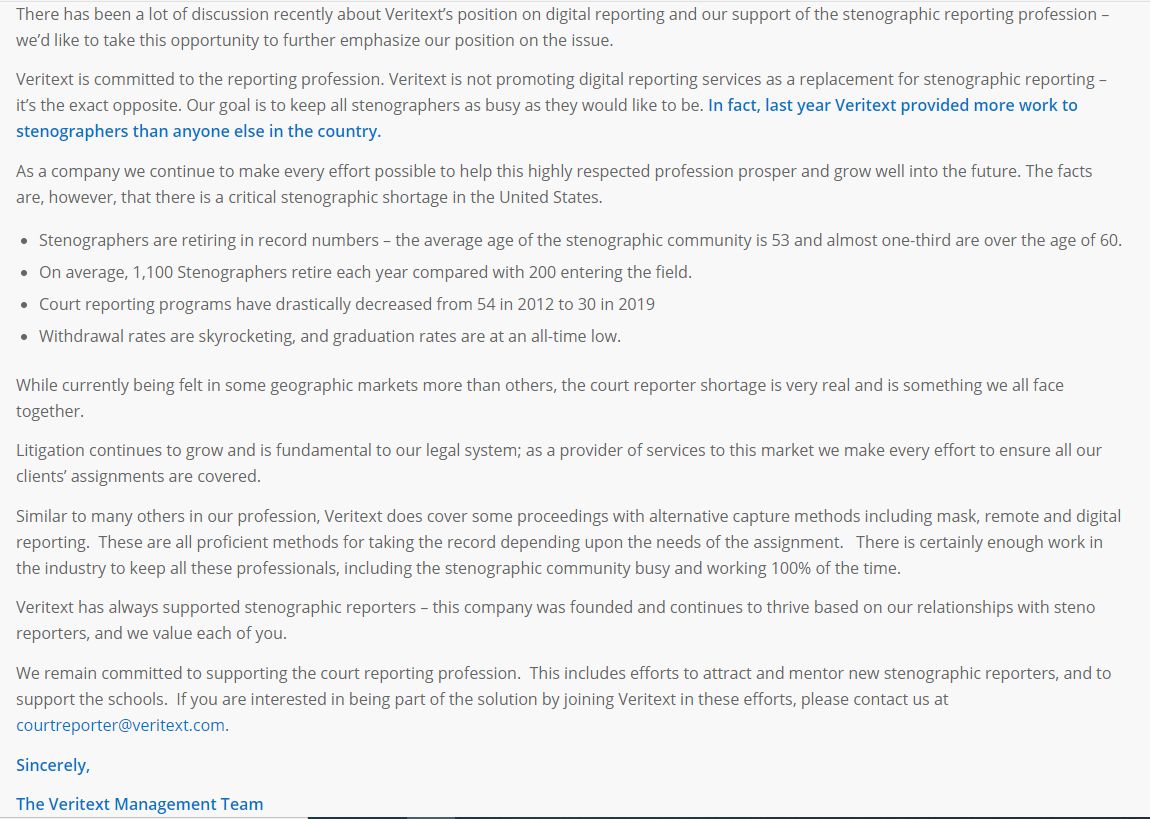
There was a pretty serious open letter posted by Veritext this month. It basically goes into their stance on digital reporting. I try to be fair in all things, but looking at Veritext’s history, and the general direction of the field, I don’t really find the letter reliable. I’ve reported on the good that Veritext has done with offering scholarships, and I hope that continues. I hope it doesn’t turn out like US Legal and Stenotrain, where it was apparently bought, paraded around for a bit, and mothballed.

Given all I know, I can only assume that there are people at the company with different directions or management styles. Beginning of last year, Veritext stood proud for steno and wouldn’t cross the picket lines in California. That was followed by the revelation that they were coaching clients to amend their deposition notices to allow for digital reporters. Almost immediately after that, their then VP of Sales wrote a very pro digital article that got shared wildly on social media before its deletion, and Veritext response was, more or less, that it was done by a “former employee.” I think it’s infinitely more likely that the culture at Veritext at the time was looking at digital. Realizing that they can’t compete with tens of thousands of stenographers, they backed down.

I view Veritext through a lens of cynicism for all the above reasons. For a long time in this field it was rumored that digitals were being sent instead of reporters by various companies, and that was often denied. Then we started to have hard evidence of it, and the message pivoted to the shortage and how companies can do nothing about it, they just have to use digital. When grassroots groups of stenographers can start putting together things I could only dream of, and they can do that ostensibly faster than the million-dollar companies, there’s a willpower problem, not a resources problem.

Let’s push into the specifics of the Veritext letter for why it screams BS to me. When someone wants something from you, they play good cop, bad cop. The good cop starts out in the Veritext letter by saying how committed to court reporters they are and going on about how they provide more work to stenographers than blah, blah, blah. It’s very disarming language. The letter then pivots to the bad cop. Remember, stenographers, we have a shortage problem in the thousands! Disarmed, you, the reader, is then hit over the head with some purported factoids to fill you with a sense of hopelessness.

As best I can tell, most of what they state is extrapolated from the Ducker Report from 2013 or 2014 data. They don’t cite any sources at all, so the accuracy of the bad cop statements is tough to gauge. Yes, stenographers are looking at a bit of a battle. Over the next 13 years, a large percentage of this field will retire. Yes, there was a forecasted supply problem for court reporting. But let’s set the record straight. By far, the largest supply gap was California, which is also a state where the stenographers are best positioned to deal with the heavy burden of recruiting new talent. There are several reporting associations and independents who are going to fight the good fight to close the gap. Additionally, Ducker came before we had Project Steno, Open Steno was far smaller, NCRA’s A to Z didn’t exist yet, Katiana Walton’s Steno Key wasn’t being tried yet. Ducker was a good warning bell, and we listened.

This idea that our schools closing is a problem is laughable. I think it opens up the possibility for entrepreneurs to jump in and start schools or present new ideas. I also think it’s really shortsighted and maybe willfully ignorant to talk about steno schools without again mentioning that AAERT only has 4 or 5 approved schools. Said another way, if we want to only look at approved schools, we have six times the chance at filling the reporter shortage. Any gamblers in the audience? If your payout was roughly the same, would you bet on something that has a 1 out of 7 chance of winning or a 6 out of 7 chance of winning? Bet sten, people. Stenographers, be encouraged to recruit people and tell them about our work, that is how this field will survive and thrive. What we do today will change the outcome 13 years from today. Our action or inaction writes this story.

I have no idea if Veritext reads my work, but if I could give them one piece of advice it would be to stop waffling around this issue, look at the numbers as they are and not as they want them to be, and see that as long as stenographers don’t completely drop the ball our prevalence and resurgence is borderline inexorable. Take advantage of that. If you’re seen to be a company that is actually on our side and not just hedging, you’ve got thousands who probably wouldn’t mind taking their work through you. If you keep down this road of dishonesty and lack of commitment, you’ve got tens of thousands of heavy hitter competitors. Stop trying to convince us with “there’s nothing we can do” while throwing resources into building digital reporting. Nobody’s fooled. Even your most loyal stenographer resources don’t buy that there’s nothing you can do. The famous cliche is the people you step on going up the ladder are the same faces you see when you take a fall. Anything less than commitment to the stenographic court reporting community is going to lead to a fall, we won’t catch you, and it’ll cost the shareholders big time.

Addendum:

This site and its public face as of March 2020 are a good indicator of why stenographers have a hard time trusting. We can get all the open letters in the world about loving stenography, but in the end we really need companies to put down those resources they’re throwing out the window for digital into our field.

For the sake of completeness, I am adding an image of the letter.

And, to be even more fair, they have added stuff from our community to their reporter corner. But that’s different from actively advertising stenography.

Fantastic February 2020

I do my monthly job posts to try to help connect people with their dream steno job and give them ideas on where to look. As always, we’ve got a pretty healthy selection of places to jump to from here. That said, if you’re a newbie or student concerned with finding work, it makes good sense to reach out and get yourself a mentor today. It doesn’t matter if you’ve been doing this five hours or five years, you can find someone out there to help. Mentors can also help you locate many Facebook groups dedicated to official and freelance job openings in addition to your state association groups. Do not suffer in a place where you’re unhappy. Reach out to people and try to find out the opportunities available to you with this wonderful skill.

Bronx DA is still looking for a grand jury stenographer according to their postings. Remember, it’s a City of New York job with good union representation.  There have been rumors that Kings County will hold a test, but nothing solid has been posted. Note that the Queens DA site is under construction, so I have no idea if they’re looking for reporters. The Citywide DCAS test for Reporter/Stenographer is still listed as postponed.

NYSUCS has a statewide court reporter posting still up. My understanding is that the number of passing marks for the civil service exam were not high, so if you want to serve the public as a state employee, this application just might be your shot. Remember that the state court system has two main job titles for stenographers, court reporter and senior court reporter. If you are a permanent court reporter when you apply to become a senior court reporter, you go to the front of the line and pass members of the public who are also applying, a huge competitive edge. So apply today and start accumulating leave time and all sorts of other perquisites.

I count about 20 federal judiciary positions still open across the country. There are openings in West Virginia, North Dakota, Idaho, Massachusetts, Texas, Iowa, Arkansas, Florida, New York, Pennsylvania, South Dakota, Washington, Missouri, D.C., and North Carolina.

Jersey neighbors, the New Jersey Courts have an official court reporter position open. My understanding is they require at least one CRR.

At this time I do not see any postings for US Senate or US House reporters, but that’s probably because the people doing that work are just too good.

Even if none of these are for you, take the time to share. You just might make somebody’s day!


Copyright and Stenography

I created a masterpiece about a week ago. On the left, a very horrifying creature that took about three minutes to create and was instantly copyrighted upon creation. If you took my creation and slapped it on a mug and started selling it, I could probably successfully sue you. On the right, a file snapshot of years worth of transcript work, which could be freely copied by anyone any time, at least ostensibly, as any court that decides this issue seems to decide that transcripts are not expressive work protected under copyright. Sam Glover also wrote about this years ago, but seems to have purged it from his blog. Some courts, like the one in Urban Pacific Equities et al v The Superior Court of Los Angeles County (59 Cal. App. 4th 688, 69 Cal. Rptr. 2d 635), have taken the step of ruling that the transcript does not have to be turned over under a business record subpoena because it is a product of business and not a business record, but this does not necessarily prevent it from being copied if counsel obtains it another way.

Here in New York, we do have guaranteed payment of an original via our General Business Law 399-cc (Transcripts and stenographic services). In that way, I feel the state and legislature has already partially acknowledged the hard work that we do. But it’s no secret that court reporter businesses, for whatever reason, have chosen to make originals cheap, and make their businesses more or less dependent on these copy sales. It’s often reported in social media circles that attorneys at a deposition will openly and in front of the stenographic reporter offer to copy and give the transcript to counsel that would otherwise have to order the transcript from the reporter. Why not? As best anyone can tell, it’s legal! There’s also a darker side to this. If you do not have a clear agreement with your agency stating otherwise, they can probably also legally copy your work and not tell you about it. Again, why not? It’s legal!

The question arises, what do we do about this? Many ideas have been floated over the years. Some say we should change our model to reflect the lost copy sales and consider charging in a different way, like hourly, per diem, or a higher original. Personally, I believe it would not be unfair to create a body of law protecting stenographers’ rights to their work. Transcribers would probably be equally in favor, and it would certainly slow the rate of copying if it were explicitly not legal.

Many ideas have been floated in this regard, including putting it under theft of services. I don’t think anyone supports throwing attorneys in jail over this. That’s unreasonable to me. But I do think it’s fair to create a civil penalty for the copying of transcribed work. Virtually everything else is protected via patents, copyright, or intellectual property laws, and it seems weirdly unfair to have a class of people whose work is wholly unprotected.

I would propose language to the effect of “No person or business entity shall copy, reproduce, publish, or dispose of to another a copy of the transcript of any matter transcribed or stenographically reported. A person or business entity that violates this must pay a copy sale to the stenographer or transcriber that created the original transcript. Such copy sale price shall not exceed the mean average of the stenographer or transcriber’s copy sales for the twelve months preceding the copying, reproduction, publishing, or disposal.”

Now, if we were to propose such law, there’s a strong possibility we would have to make some concessions. Let’s be fair, many of these matters are matters of public domain and importance. I would propose a few important carve outs, such as, “nothing in this law shall be construed to abridge the right of any person to critique, cite, discuss, parody, or utilize a transcript’s content in any expressive matter.” This punches a bit of a hole in the law, but look at fair use in copyright law, and you’ll get what I’m trying to do. Also, “nothing in this law shall prohibit any person from preparing or having prepared by another their own transcript of the same proceeding or matter.”

There are some bigger issues we’d have to deal with. Would this law exclusively cover private transcribers / stenographers and not public employees? That’s a fantastic question. As a stenographer, I’m sure everyone knows where I stand, but as someone who reads a good amount of law, I understand that government work simply works out that way sometimes. I think if we’re serious about a New York City, New York State, or even someday federal law on this, it’s entirely doable. I think the important thing is prohibiting copying while allowing “fair use” type cases that don’t prohibit freedom of speech and expression. Notably, we could always go the way of this proposed Florida rule, which states plainly, “subdivision (g) requires a party to obtain a copy of the deposition from the court reporter unless the court orders otherwise…”

As always, discuss away or email me! It’s always fascinating to see what others have researched. Hopefully, if ever it becomes a serious discussion by our lawmakers, they’ll also get a chance to consult with authorities in our field like NYSCRA, NCRA, or even ASSCR.

Shortage Solutions 12: Stenography

If you haven’t had the time to use my site’s search box for all the shortage solutions available, I recommend giving it a try. Over the last year we’ve covered some phenomenal ideas. Many stenographers across social media have internalized these ideas, talked about them, made them better than I ever could’ve dreamed.

Well, this one’s for all the non-stenographers and a look into why our shortage mathematically requires us and not other methods of capturing the spoken word. May it help some of you educate non-reporters and maybe even reporting companies on who we are, what we really do, and why we are irreplaceable. Really quickly, machine shorthand reporting gets a bad RAP because it’s “old.” The stenotype style we use today originally was invented in 1906 by Ward Stone Ireland. With over a century of usage, it’s easy for other methods to say that the technology is outdated and point to something like digital recording, originally invented in 1970 by James Russell, as a newer, “better” technology.

Objectively, when you look at both methods, they have seen vast improvements. Back in “the day,” stenographers had to painstakingly transcribe paper tape notes or even dictate their notes back to a typist using Dictaphone-type technology, who would transcribe for them while they continued to take other proceedings stenographically. Modern stenography uses advanced word processing techniques to take the input from a stenographic writer and output text. The more skillful someone is at operating a stenography machine or stenotype, the cleaner the output text is. Some reporters, reaching a 99.9% untranslate or accuracy level, can practically hit print at the end of a job and have a ready transcript.

Even those of us without such a level of skill are more efficient than the record and transcribe methodology. The average person types about 50 words per minute (WPM). The average transcriber reaches about 80 WPM. The average stenographer? 225 WPM. So while it may seem paradoxical that this century-old technology is the fastest and most efficient method available to the consumer today, it’s true.

So when we talk about shortage, numbers, and the “impossible” gap stenographers must fill to meet rising demand and replace retiring reporters, let’s talk some real numbers. There are somewhere between 11,000 and 30,000 working reporters in this country depending on whose numbers you want to use. Let’s say a healthy 15,000. If we’re inputting words 2 to 4 times faster, on average, you need 2 to 4 people to replace every stenographer. If you need another person to operate the recording equipment, that means 5 people per stenographer today. It gets tougher. Hard-working transcribers have reported it takes up to six hours for them to transcribe a one-hour depo. I’m a pretty average stenographer. I know from timing my own work that a one-hour depo is about 40 pages, and I can transcribe 40 pages in 1 to 2 hours. On a great day where my input is good, I could even do it in 30 to 45 minutes dependent on page density and subject matter. But let’s stick to average, one hour transcription for one hour of testimony for one stenographer. Now compare that to the record and transcribe method, up to six hours for one hour of testimony. That could be six to seven people to do the work of one stenographer, or it could take six to seven times as long.

What do all these numbers mean? It means whoever’s numbers you want to use, if you want to say the gap is 10,000 people by 2030, or 1,000 people, or 5 people, it means you’re talking about filling a stenographic reporter gap. Companies who are pushing digital as a solution are saying there’s no way to get stenographers, but somehow they can find, organize, train, and utilize teams 4 to 6 times larger than their current stenographic reporting assets. We complain about the lack of stenography schools. How many digital reporting or transcribing schools exist? How long have those existed? AAERT lists four. NCRA lists almost four steno schools in New York alone. Tell us again how that is the future? Seems to me that if you’re scared about filling a gap of 1,000, a gap of 4,000 is pretty terrifying. If we’re talking replacement of 15,000 stenographers, we’re looking at 50,000 people plus the gap. Even with the abominable success rates of the past, pre A to Z, pre NCRA 2.0, 10 to 20 percent, it follows that if you’re introducing tens of thousands of hardworking people to the field of reporting, and you introduce them to stenography, you can overcome any shortage you would otherwise have. Smart transcribers and digital reporters have a head start on this. They’ve switched to steno because it’s better for them, their wallet, and the consumer.

Let’s just touch on AI as it relates to taking down the spoken word. Computer programming is not magic. Despite the claims of some that technology is advancing every day, an objective look at technology shows it hasn’t advanced much at all. How much better has your bank’s voice recognition gotten in the last ten years? It was hit or miss then, and it’s hit or miss now. Look at it in big picture terms instead of the daily claims of “tech news” sources. Improvements have been made, to be sure. Open source programming projects allow virtually anyone with a little time and technical knowhow to integrate voice recognition into their product or website. Promises of a $25 billion market draw new investors every day.

But the fact remains that a lot of the buzz surrounding automatic speech recognition is just that, buzz, smoke, promises of a better tomorrow that no one can guarantee. It’s a new spin on old news. To understand this, it is important to understand what computers really are. Computers are math-solving machines. Anything you can break down into numbers can be represented by a classical computer. Video games? Math. Word processing? Math. Internet search? Math. We are spoiled. We live in a world where you click buttons and have windows. Far gone are the days when programmers had to use punch cards to operate computers. But consider that everything your computer is doing is broken down into two signals, 1 and 0, on and off. How smart do you think someone has to be to figure out an equation to account for every accent, English dialect, or circumstance? Try differentiating four different speakers using math! I’ve said it before. There’s a very real possibility that it can be solved and that perfect voice recognition can be programmed. Could be tomorrow. Could be 100 years away. Might not even happen. We don’t know. But any claim that AI is the future must be met with serious and sustained skepticism, as AI-related companies can burn through half a billion dollars in a year and still have no major profitable product. There’s a reason the public trusts stenographers and not Siri, and that’s why smart investors stick with stenographer platforms.

Companies and organizations should really re-examine their own views on this. Stenography needs all hands on deck, and they’ll have a much easier time building on our education culture and matured technology than trying to switch over the industry to something untried, untested, and less consumer friendly than the personal and proper touch of a qualified stenographic reporter. The years of training and experience we have collectively, as well as the infrastructure of our large associations and institutions, are second to none. Ultimately, it will be up to the buyers in our market to examine that and decide: Do they want to ride the wave, improve the field as it stands today? Do they want to pay the great cost of reinventing the wheel in the hopes that things will someday be better? I suspect the smartest leaders have already crunched some of these numbers and weighed these factors. They know there’s a very real truth that replacing stenography is unlikely to work. It certainly doesn’t make sense mathematically, and that is why they hedge their investments and keep all avenues open.

Maybe this will serve as a wake-up call to companies on the fence. Do not go the way of US Legal, who apparently acquired Stenotrain just to scrub its Internet presence a couple of years later. These numbers are real. The challenges faced in finding coverage are real. These challenges are far from insurmountable. But it will be about four times harder to use non-stenographic transcribers than it would be to address the stenographer shortage. Follow the recent example of companies like Lexitas. Reach out to stenographers and ask them about schools that need your support to keep supplying you with quality reporters. Your investors will thank you. Your customers will have the best service for the lowest cost. You will not be subject to the inconsistency of professional flip-floppers. Your business won’t be broken by people who have no plan for when a transcript is needed for appellate review. Your companies will thrive. You will have a better outcome than you would losing money and clients up against a superior modality like stenography. Shortage solutions? Without a doubt, the resourceful entrepreneur picks steno.