The Ultimate Guide To Officialship (NY)

This one is for the people whose dream job is officialship or becoming an official court reporter. Just to get some quick links out of the way, there are two major Facebook discussion boards that I’m aware of. There’s the Officialship Job Board and the NCRA Officials group. I’m going to talk primarily about New York State Unified Court System officialship here, so if you’re looking for federal employment, please check out and bookmark the federal judicary jobs page. You’ll likely need your RPR for federal employment. As a matter of fact, if you’re looking for employment in New York City generally, you should check out one of my very first posts, Get A Real Job. Just keep in mind that if your dream job is Southern District NY, you’re going to need Eclipse last time I checked.

I’ll be writing most of this from memory, so feel free to correct me if I am factually wrong anywhere. This is not, in any way, a “guide” that is endorsed or published by the New York State Unified Court System (NYSUCS). I am not writing as an employee of NYSUCS. This is me as an individual just retelling my hiring experience in “guide format.” If you get a job with NYSUCS, you listen to your boss or your union over anything you might read or interpret here. If you’re looking for official information about NYSUCS, you should go to the site and ask that question through official channels.

The Tests, Classifications, and Eligible Lists:

Before we go anywhere, let’s just address how you get a court job. There are rarely per diem assignments available. These are court reporters that are hired and paid per day to come in and take the record. Per diems are rarely sought as of writing. Then there are what we refer to as provisional postings and then there are permanent positions. Provisional postings go up whenever there is a spot that needs to be filled and can be found by going to NY courts current opportunities. You can also search for “NY courts careers.” Civil service examinations are posted at “NY courts exams.” Reporters that apply for a provisional position usually must pass an in-house test. The court system may waive the provisional test for NYSCRA or NCRA certified court reporters. Reporters looking for a permanent appointment must pass the civil service test. That test is never waived. By law, civil service tests must be given every one to four years. Provisional employees can be considered temporary in your mind. If a civil service test is given and a provisional employee does not pass it, they may be let go. Provisional appointment should not be underestimated though, since an employee begins to accrue vacation time, sick time, time in the title for raises, and pension time. Many reporters begin their career by obtaining provisional employment and then passing the civil service exam to become permanent employees.

There is a separate civil service test for court reporters and senior court reporters, but they are substantially similar. “The test” consists of a multiple choice written knowledge portion and a skills portion. The written knowledge portion focuses on grammar, spelling, and technical knowledge. The skills test consists of an opening statement, a jury charge, and a four-voice dictation. The dictation is in the ballpark of 200 WPM. Two of the skills tests are transcribed and one is read back from the court reporter’s notes into a tape recorder. The readback portion is only graded for accuracy and not for inflection. If a reporter misreads their notes and corrects that misreading, the error is not counted against them. There is a readback time limit. Generally, court reporters have been expected to bring their own printers, stenotypes, pencils, and other equipment to the testing site. There has been discussion within the system about the possibility of online testing, but no civil service test has been given in that manner as of today. There are two eligible lists created when the civil service examination is graded. One list is a promotional list and one list is an open-competitive list. The promotional list is for anyone that held a court title prior to taking the test. The open-competitive list is for people who are not in the system that take the test. Everyone on the promotional list is scored above everyone on the open-competitive list. For example, let’s say that Mary Sue is a freelancer and scores a 100 on the open-competitive list for the senior court reporter title. John Doe is a court reporter working for the New York State Unified Court System and scores a 96 on the promotional list for the senior court reporter title. John Doe will be considered for a position as a senior court reporter before Mary Sue. When someone accepts a job with the New York State Unified Court System, typically they complete one year of probation. It is easier for the employer to discharge an employee during probation. In addition to provisional and permanent appointments, there are also contingent permanent appointments. Succinctly, every employee in the court system is a “line.” Sometimes there are situations where someone permanent is sick, injured, or not present. Contingent permanent people fill their line until the permanent employee returns, if they return. The most important thing to remember about the civil service examination is that when it is posted there is an orientation guide and accompanying materials posted to the exams page. Test takers must read and follow the orientation guide. Failure to follow the guide can result in an applicant’s disqualification.

Once you’re on the list, you get a preference letter asking you what courts you’re willing to work in. When I got that letter, my brilliant plan was to say I was willing to work in any court and then turn down canvass letters as needed. If you turn down canvass letters, you must make sure that you respond to the canvass letters and remain active on the eligible list. If you get put on inactive status on an eligible list, you can get skipped over for future canvass letters. In summary, fully read every official material you receive.

The Titles and Courts:

With the hard part out of the way, let’s talk titles. there are two major titles in the New York State Unified Court System. There are court reporters and there are senior court reporters. Senior court reporters typically cover Supreme Court. Court reporters typically cover what we refer to colloquially as “lower courts.” In the “lower courts,” of New York City most courthouses are supervised by a court reporter in charge or “CRIC.” These CRICs coordinate with a supervising court reporter and/or chief clerk when necessary. I am informed that in many courthouses, the CRIC title is obsolete and has been replaced with “county supervising court reporter.” The county supervising court reporters report to a “citywide supervising court reporter.” In Supreme Court, the courthouses are overseen by principal court reporters. The principal court reporters coordinate with chief clerks when necessary. Court jobs are all ranked with a judicial grade (JG) number, and that number links to your pay. Court reporters are JG-24. Senior court reporters are JG-27. The Supreme Court of the State of New York is our state’s highest trial court. It deals with the adjudication of felony criminal cases and civil cases with damages over $25,000. Then there are the “lower” courts. In New York City, we have criminal courts that handle criminal arraignments, violations, and misdemeanors. We have civil courts that handle cases under $25,001 in damage. We have family courts where people can file petitions for family matters, including the issuance of orders of protection. A court structure chart is also available. Do not be fooled by the terminology “lower courts.” All of the matters where court reporters and senior court reporters are assigned are extremely important, as are both titles.

The Unions:

In New York City, if you work in the “lower courts,” or grand jury, you are represented in the Local 1070 union. If you work in the Supreme Court, you are represented by ASSCR. Local 1070 is comprised of a number of different titles. Every title has its own chapter leadership, and the chapter leadership works with the main leadership to solve problems. In Local 1070, the chapter leaders generally perform union steward duties when directed by the president or vice president, or whenever necessary. In ASSCR, there are the officers and the executive committee. The officers can be thought of as the decision-making body of the union and the ones who carry out any union-steward-type duties. The executive committee typically assists the officers by keeping apprised of union news. The way one runs for a union office is decided by the organization’s constitution and bylaws. For example, in ASSCR, a nominating committee is formed and nominates a slate. If someone that wants to run is not nominated by the nominating committee, then they have to follow the constitution and bylaws. Generally court reporters and senior court reporters that do not work in New York City are represented by CSEA, a massive conglomerate of titles, workers, and workplaces. My experience with and knowledge of CSEA is too limited to write about its organizational structure. The most important thing to understand about a union is that it negotiates your employment contract for you. If there is something you want in your workplace, you need to let union leadership know. Employment contracts cover a vast number of topics including vacation time, sick time, disciplinary procedures, grievance procedures, employee standards and employer obligations. Raises, increments, and longevity pay are all things that are addressed through your union as well. There are two more important things about union membership. First, your union has a duty to represent every member equally. Second, you generally cannot refuse lawful orders unless compliance would lead to imminent life-threatening danger. Insubordination can cause you disciplinary problems up to and including termination. If you are being questioned by a supervisor, you have Weingarten Rights. You have the right to have a union representative present if a conversation with your employer can adversely impact your employment or working conditions in any way. The employer usually has zero obligation to inform you of these rights, and you must assert them.

The Job:

A lot of stuff is on-the-job training. There are a lot of court-specific quirks that wouldn’t make sense to go into, such as night court and sealed criminal matters. Your first day on the job, you want to ask for common briefs and terms. In addition to our salary, when judges, lawyers, litigants, or members of the public ask for matters to be transcribed, we get transcript money as laid out in Part 108. Those terms, as far as I know, have been the same since 1999, so it’s a real lesson in the value of court reporters. A lot of transcription service firms jack up their rates every few years. By contrast, court reporters are consistent and reliable. We are responsible for maintaining equipment to take down our notes and produce and bind transcripts. We’re talking about a printer, ink, paper, computer, cables, stenotype, and transcript covers. Personally I am a big fan of pre-punched three-hole paper and A6 transcript covers. The drawback to using A6 covers is that you require different covers for differently-sized transcripts. Reporters that use standard transcript covers and separate fasteners do not have this problem.

There are a few things that are universally frowned on or just plain illegal. Stealing time? Bad. Stealing supplies? Bad. Being habitually late? Bad. Be on time and ready to work. Remember when switching over from freelance to employment that you have a boss now. If you have doubts about something, you should ask your boss for guidance. Coworkers can also be a big help. You’re an employee, and you are now covered by all of the employee rights laws, including the New York State Human Rights Law, the Civil Rights Act of 1964’s Title VII, Workers Compensation, and unemployment, et cetera. The most important thing about the job is not to take advice from some guy’s blog if it’s different from your court rules or boss’s instructions.

Interested in a career in the courts? Check out this NY Courts publication.

This concludes the “guide” portion of this post. If you’re interested in a really weird story about why I wrote this post, keep reading. If you don’t really care, feel free to stop reading.

The History of this Post:

Over the last few years I’ve had lots of people write me about various topics. Usually it’s well-meaning or polite people who have a grammar suggestion, topic suggestion, or information. I love those people. I even love the people who come on my blog and disagree with me. Separate from those people, starting maybe two or three years ago, someone sent me about 48 e-mails through an anonymous proxy. The e-mails were usually nonsensical, poorly written, or tried to turn me against other reporters. Sometimes they masqueraded as helpful advice or a hint at a story that didn’t exist. When the e-mail campaign failed to turn me against my best allies, this person began to infiltrate our Facebook groups under the fake name Jared Leno. Jared Leno proceeded to write rude comments to agencies that would come on our job boards to post jobs. At that point, I called him or her out on what they were doing and I alerted Facebook admins of groups where I was a member so that Jared could no longer use that fake identity to harass court reporters. Jared did what all bullies do when they lose, “he” whined and cried.

Jared/Anonymous then turned to Reddit. As some people know, we have the r/stenography subreddit, the r/courtreporting subreddit, and the r/courtreporters subreddit. The admins of r/stenography and r/courtreporting appear to be either absent or squatting, and at one point we had frequent posts from our Mystery Messenger (MM). One intrepid reporter started r/courtreporters so that we could have a space with an active admin, and we began to report the MM for harassment. “They” constantly create new accounts so that they can spread disinformation, avoid bans, and make comments about my blog. One of their favorite “jabs” is that I am an official and I write about freelance often. There are two main strategies when you’re dealing with trolls. The first is to ignore it. Sometimes this works. If someone is doing something to annoy you, and you don’t show that you’re annoyed, sometimes they go away. The problem we face here is that there are people that are going to Reddit to ask legitimate questions about our field. So if we just leave these boards a confusing, spammy mess, we’re going to leave the impression that this is a dead field or that we’re all lunatics spouting nonsensical drivel. Strategy two? Drown the spammy posts out with reality. So if you’re on Reddit, definitely subscribe to those channels. They’re a great way to get information out to the public. If you’re not on Reddit, it’s free, it’s generally anonymous, and it can be fun.

It’s been an interesting relationship. At first I believed that MM was a court reporter in pain. I tried many times to reach out and help. As time went on, I saw that it was much more likely to be someone who hates steno and someone whose IQ is high enough to use the internet but low enough that they have nothing better to do with their life than to get my blog clicks. Maybe it’s Steve Hubbard or Justin “Mr. Stenoless” Higgins. Who knows? All I know is MM is a great case study in being your own worst enemy. Their tirades have helped my blog grow its readership by almost 400% 2018 to 2019 and an additional 40% 2019 to 2020. Without MM’s unassailable genius I never could’ve come up with the work of art that is this blog post. If I could make one plea to MM, please do not find anything better to do with your time than follow me across the internet. Without your 1/31/21 post and unending struggle to get my attention, today would not have happened. Thank you for these wonderful years of service.

It was a tough decision on whether to publish this story. Some in my circle believe that talking about an anonymous “agitator” gives them more power. But perhaps knowing that this situation exists will help others identify MM by their inarticulate, artless writing as they continue to impersonate court reporters and spam court reporting groups. Perhaps others who have been e-mailed anonymously by this person will be able to identify that there is malicious intent there sooner than I was able to. I know at least one other person that received communications from MM. There’s bound to be more, right?

You literally asked for this. LOL. How about that?
Now all of this information will be easier for court reporters to find.

Addendum:

As of January 2024 it seems the court system is reclassifying court reporters (JG-24) as noncompetitive. I’ve also seen remarks that they’ll get no union protection for five years and that the union is fighting this. So please understand that as of 2024, some of this information is now outdated.


Collective Power of Stenographers

One piece of feedback I get back from time to time is “we can’t stand up to XYZ Corporation. They make 100 million in revenue!” I deeply empathize with this reaction because I’ve felt that before. Back in freelance, that feeling was constant. How could I negotiate with a company that was only offering $3.25? They were a big company with lots of work. I was basically a kid just out of college with my extremely shiny AOS. I didn’t even have a squid hat yet.

With this thing on, I became unstoppable.

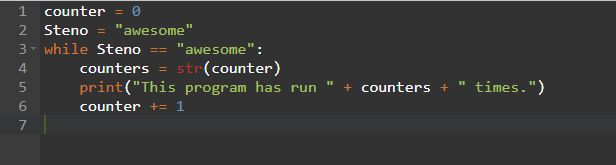
But about 3 years ago I started to teach myself very basic computer programming. I began to learn a little bit more about numbers and math. I had always hated math, and the whole experience completely changed that perception. I started to like math. One the first programs I ever wrote was a simple counter program similar to this one:

This program loops for as long as steno is awesome, and steno never stops being awesome.

In this code, you start with the number 0 and it adds one forever until the computer malfunctions or the program is shut down. What you see happen very quickly is that when you’re adding one several times a second, one quickly becomes 10, 100, 1,000, 1,000,000.

What the hell does that have to do with stenographers? We are the ones that add up in this program called life. For example, let’s say we have XYZ Corporation and it makes $100 million a year in revenue. Now let’s say there are 23,000 reporters, like vTestify said almost three years ago, and let’s assume that reporters ONLY make a median salary of about $60,000 a year. Those reporters make $1.3 billion in revenue annually. You take two percent of that a year and throw it in an advertising pot, and you’re talking a $26 million annual advertising campaign.

5 percent? I said 2 percent. Someone should fix this immediately.

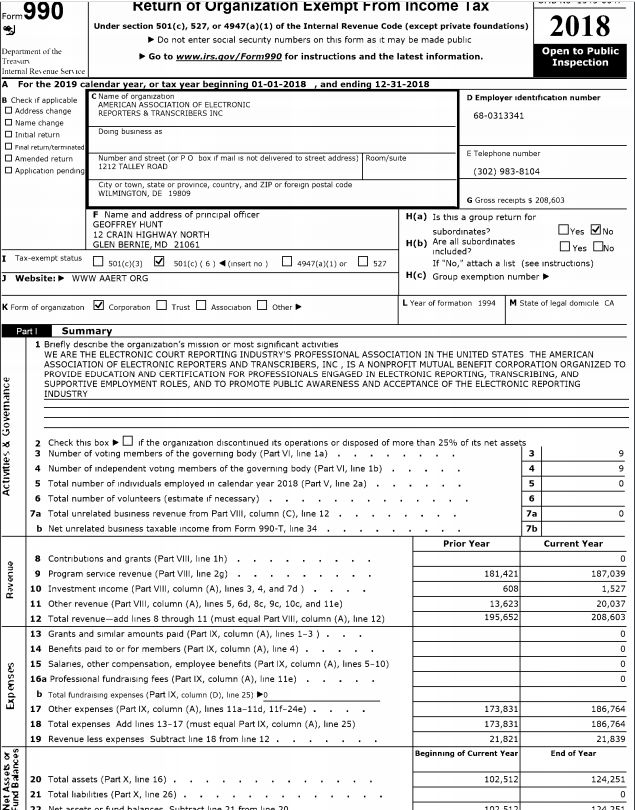
So now to bring this out of theory and into reality, you can see it happening in real life. There’s no group of people that’s going to have a 100 percent contribution rate. But when you look at the numbers, you start to see that overall we put far better funding into our organizations and activities than alternative methods or spinoffs. Take, for example, AAERT, which pulled in about $200,000 in 2018 revenue. For those that don’t know AAERT, they’re primarily engaged with supporting the record-and-transcribe method of capturing the spoken word. As I’ve covered in past blog posts and industry media, it’s an inefficient and undesirable method (page 5), and most digital reporters would do a lot better if they picked up steno.

Published by ProPublica

Then we can look towards the National Verbatim Reporters Association, which seems to focus more on voice writing, but definitely includes and accepts stenographic reporters. We see the 2017 revenue here come in at almost $250,000. Not bad at all.

As far as I’m concerned, every dollar is deserved. I’ve never heard a bad word from an NVRA member.

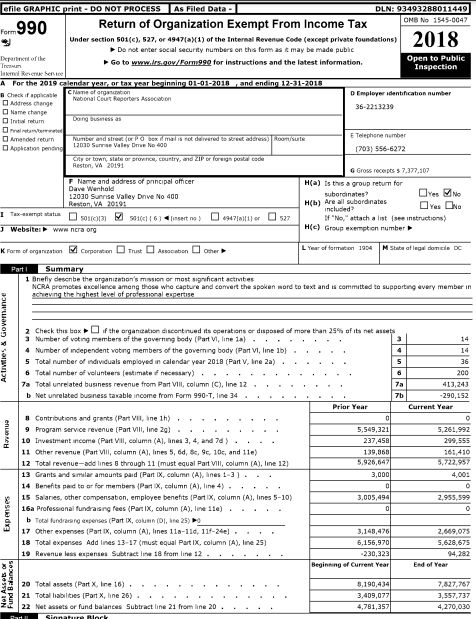
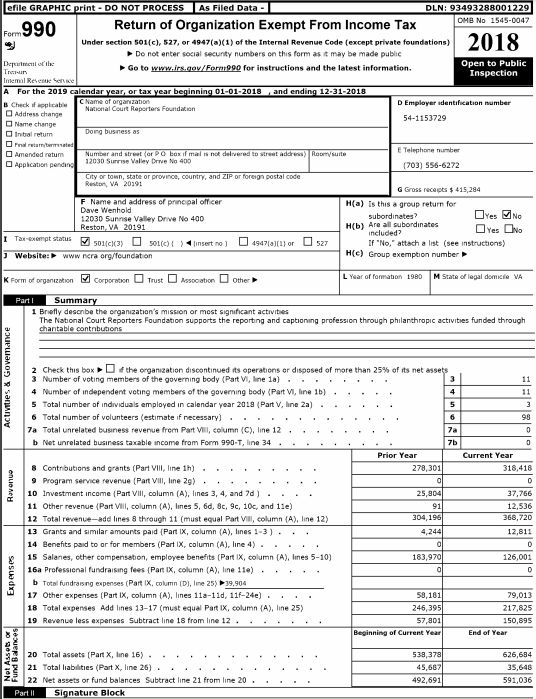
But then we look to our National Court Reporters Association, which is primarily engaged in promoting stenography and increasing the skill of stenographic court reporters. This is where we see the collective power of reporters start to add up in a big way. In 2018, the NCRA saw more than $5.7 million in revenue. The NCRF brought in an additional $368,000. That’s over $6 million down on steno that year.

I think I can see my membership dues somewhere in there.
When I pay off my massive personal debt, I’m going to become an NCRF Angel / Squid.

What conclusions can be drawn here? As much as the anti-steno crowd wants to say the profession’s dead, dying, or defunct, there’s just no evidence to support that. Here you get to see some fraction of every field contributing to nonprofits dedicated to education, training, and educating the public. We know from publicly-available information that our membership dues are not 30x more than these other organizations, so we know that there are a lot more of us, and we know that there are a lot more of us participating in continuing education and sharpening our skills. We’re the preferred method. We’re the superior method. We’re training harder every day to meet the needs of consumers. There are only a few ways this goes badly for stenography.

  1. We lack the organization or confidence to counter false messaging.
  2. We lose trust in our collective power and institutions, stop supporting them, and stop promoting ourselves. Kind of like the Pygmalion effect.
  3. We spend time tearing each other down instead of boosting each other’s stuff.

See the common theme? There’s really nothing external that’s going to hurt this field. It all comes down to our ability to adapt, organize, and play nice with each other. In the past, I equated it with medieval warfare and fiction. The easiest way to win any adversarial situation is to get the other side to give up and go home. It’s an old idea straight out of Sun Tzu’s Art of War. Applied to business, if you can convince people not to compete against you, you win by default. This might be in the form of a buyout. This might be in the form of convincing people that stenography is not a viable field so that there are not enough stenographers to meet demand. This might be in the form of would-be entrepreneurs believing they cannot compete and never starting a business. This might be in the form of convincing consumers that stenographic reporters are not available. This might be in the form of casting doubt on stenographic associations. This might be in the form of buying a steno training program and ostensibly scrubbing it out of existence. These are all actions to avoid competition, because as the numbers just showed you, we only lose if we do not compete. If you do nothing else for Court Reporting & Captioning Week 2021, please take the time to promote at least one positive thing about steno. If a guy in a squid hat could get you to think differently about just one topic today, what kind of potential do you have to make a difference in this world?

I’ll launch us off with an older quote from Marc Russo. “If you are a self-motivated person with a burning desire to improve your skills, this is the field.” This is our field. This is our skill. All we have left to do is stand up to the people that take advantage of our stellar customer service mentality and the public perception that we’re potted plants.

Can a potted plant do this?

PS. That $3.25 I was having trouble negotiating up from? Some of my friends were making $4.00+ with less experience than me. The limitation was me and the way that I was thinking about it. We have all had to deal with hurdles that seemed insurmountable. Max Curry talked a little bit about it in his NCRA Stenopalooza presentation “Fear…Let It Go!” when he talked about his father and introversion. It was an amazing presentation. But here’s my takeaway for those that missed it last year. If you’re having a problem, try looking at it another way.

For The Record Documentary Goes Free

Years ago I attended the New York screening of the For The Record documentary. Didn’t really know who Marc Greenberg was (I think we’d exchanged e-mails exactly once). Didn’t really know about Simply Steno. StenoFest hadn’t happened yet. Well, Marc Greenberg is a phenomenal creator and educator for our field. He’s made more content, websites, and listings than I ever will. He’s a solid support for our students. I purchased the documentary on Vimeo and I believe it’s still available for purchase there. But Marc’s come up with something big that I think nails Court Reporting & Captioning Week’s theme, “all you need is steno & love.” He’s released For The Record free on Stenotube. Tell us how you really, feel, Marc.

It takes a lot of courage and commitment to take such a work of art and effort and offer it for free. Show the love back with some likes and shares. If you’re a new reporter or never got the chance to see the documentary, it’s definitely worth seeing at least once. In the screening version, it dove into topics like vicarious trauma and the captioning of 9/11. For me, as a young reporter, these were new and foreign concepts. Want to see your “tiny” profession on the big screen? Enough from me; go check it out!

NYSCRA’s CRCW 2021 & My Thoughts On The Future

Besides being a full-time PC gamer, I’m also on the board of the New York State Court Reporters Association, patiently waiting for one of our members to run against me and take the seat so I can go back to playing Steno Arcade and Space Court all day.

Space Court is no joke.

Fortunately, I have a window into what the organization is doing to strengthen stenographic reporting and captioning. Historically, some of that had to do with getting brochures out to attorneys and members about reporting and NYSCRA. Some of it had to do with advertising our “Find A Reporter” feature. Some of it had to do with mentoring. Some of it had to do with discounts. For Court Reporting & Captioning Week 2021, we’re embracing NCRA’s theme of “all you need is steno & love.” NYSCRA issued a press release detailing just a few things that are being done to commemorate the week and the importance of all stenographic reporters and captioners. There are some really powerful quotes in there. There’s a quote from ASSCR President Eric Allen reminding us of the general excellence of reporters. There’s a quote from NYSCRA President-Elect Dom Tursi remarking on the tenacity of reporters. There’s one from NYSCRA President Joshua Edwards noting the limitless potential of court reporters coming together. There’s also a major announcement from First Department Director Debra Levinson telling members to look out for more information on the CertifyNow voluntary certification program. Members will be able to schedule tests without waiting for block testing!

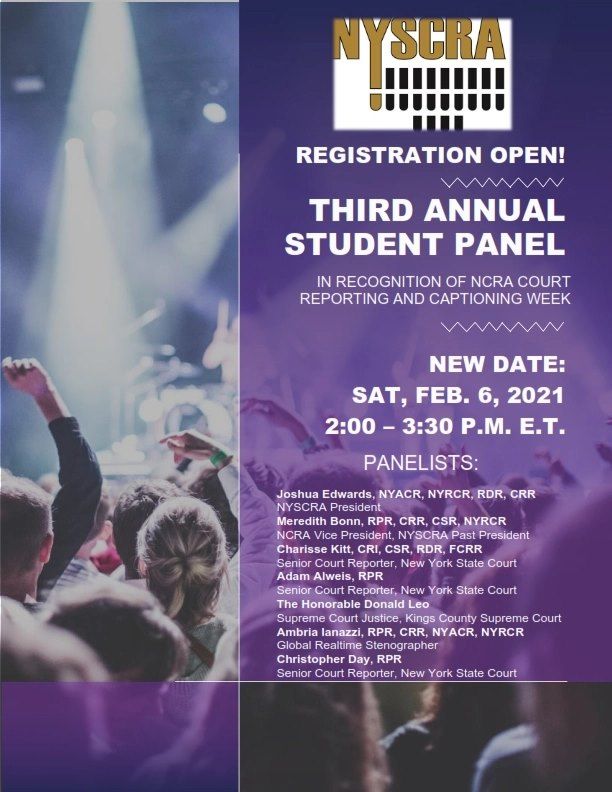
On February 6 there will be a student panel. Often these panels are used to create a forum where students can hear from working reporters or professionals from the legal field. Sometimes students get to ask questions at the event or submit questions after the event. There’s a whole lot to love about student panels. So if you’re a working reporter who wants to get in and speak on the next one, definitely engage with us. For everybody else, check out our wonderful speakers. It may say student panel, but anyone is invited to come listen in as long as they register.

That last guy sounds sus.

After the student panel there will be three member-exclusive free CAT trainings for StenoCAT, Eclipse, and CaseCAT. For any members who use a software that is not represented in our lineup, every single member of the board keeps their contact info up on the association website. Reach out. Let us know what you need. We’re already the best when it comes to taking the record. Additional training just keeps your lead strong. If CAT training is not your thing, we also have a dictation session coming up that you can use to build your dictionary or get some writing time in. We’ll be dictating the United States Constitution on February 12. If using the Friday before Valentine’s Day to practice doesn’t scream steno & love, I don’t know what does. Sign up today!

Also happy to say that a private person sponsored prize memberships for reporters that make a submission to our CRCW 2021 Acrostic Poem Contest. Five lines are all that stand between you and a free NYSCRA membership. One student membership and one working reporter membership is up for grabs. Maybe you’re a member that wants to extend your current membership. Maybe you’re a non-member that just doesn’t want anybody else to have the prize. Whatever your deal is, give it a shot. Submissions must be in by February 8.

On a much more somber note, I rarely mingle my blog with my board service. I never let my opinions drive my decisions as a board member. But let me just say this: NYSCRA is the nonprofit in New York for stenographers. There are a lot of people out there who want to say court reporters are done. They want to say that times are changing, that standards are shifting, and they want to spread the message that court reporters are obsolete. In that article I just linked, they literally depicted the court reporter phasing out into digital static or computer code. We need to answer resolutely: We are here to stay. We are the standard. We need to give our associations ammunition in the form of memberships so that their leaders can go to decision makers and let them know that we’re not relics, we’re real people, and there are thousands of us. We opened up our NYSCRA board meetings to members for the first time on January 21, 2021. Many saw the membership report. I guesstimate that ten percent or less of our New York field has a NYSCRA membership. We need to turn that around so that when these folks start pressing New York the way they pressed Massachusetts, we come out on top. It’s about keeping this field viable, vibrant, and lucrative. When you hold a NYSCRA membership you’re purchasing all that and more. In this next decade a large percentage of the field is forecasted to retire.

There will be a strong push from certain entities to say that there aren’t enough of us. That will happen regardless of the truth. Please join us in the counter-push. Give us the numbers we need to loudly and proudly refute those claims. Defend what we love for the next ten years and we won’t have to worry for the next thirty. If you’re in another part of the country, that’s fine too. Arizona and its fight to educate the legislature. Florida and its work to educate consumers. New Jersey and its move to keep reporters defined as independent contractors. Our National Court Reporters Association and its constant push to highlight individuals, projects, and associations. There are other notable nonprofits dedicated to stenographic court reporting such as Protect Your Record and Project Steno. There are online communities such as Open Steno creating free resources for learners and the public. Wherever you hang your hat and do your business, there are causes worth backing, and every single one plays a part in making sure this career stays here for us and all the reporters that come after.

Can Freelancers Apply For Workers Compensation Benefits? (NY)

There are a lot of professionals in this field who will laugh at the notion that freelancers can be entitled to employee benefits. “Of course we’re not eligible for Workers Compensation! We’re independent contractors!” The idea does seem as preposterous and fanciful as a soul-devouring stenotype.

Souls purchased separately.

To give a brief overview, in New York, to avoid clogging the court system with employee accident cases, Workers Compensation coverage allows employees injured on the job to apply for benefits to cover their medical expenses and/or wages. To many, this would be where the discussion ends. If you’re not an employee, you can’t get benefits. But when we look into exactly what constitutes an employee, and the way this actually works, we find that the answer is more likely “it depends.” Administrative and judicial judges will look at several factors to determine whether someone is an “employee” or an “independent contractor” under the law, and how the “hiring entity” and the “hired entity” classify the relationship is not a major factor listed on their website.

  1. The right to control. Does the hiring entity or employer control the manner in which the work is done? In stenographic freelance circles, and particularly in New York, this can be a mixed bag. They might ask you to use a specific layout, arrive at a specific time, or even bring snacks to a depo. There are varying degrees of control, and if your agency is exercising a lot of control over you, you just might be an employee.
Text from the WCB site.

2. Character of work. If the primary work performed by the hiring entity is performed by the hired entity, that means the hired entity is an employee. Again, this is something you can probably argue both ways in stenographic circles. You can easily make the claim that court reporting agencies are in the business of providing court reporting services and therefore we should be employees. You can also make the argument that court reporting corporations are not in the business of court reporting, but rather acquiring court reporting professionals for lawyers. Just to note, US Legal tried that in an Unfair Competition case in California during the Holly Moose case. It argued that it was not a shorthand reporting corporation. Justice Elia rejected that, stating “such circular reasoning reasoning to evade…” [this state’s laws] “…is, at a minimum, unpersuasive.” Who can say what a judge in New York might say when applying the facts of a case to New York law?

Text from the WCB site.

3. Method of payment. The important bit here is that whether you receive a 1099 or W2 does not matter in determining an employee/employer relationship. Whether you receive regular payments or whether you are paid for a task as a whole is a deciding factor. Again, it can easily be argued either way dependent on the facts of a freelancer’s “employment,” are they taking jobs regularly and getting regular payments? Are they hired for a one-off assignment?

Text from the WCB site.

4. Furnishing equipment. The vast majority of us maintain our own equipment, and if a workers comp claim were ever made against an agency, I imagine the first thing they would do is bring out that fact. But there are other things to consider. Does the agency supply you with business cards or other materials that you’re supposed to hand out? Some do, some don’t, and that makes this a factor worth considering.

Text from WCB.

5. Right to hire/fire. This relates to the right to hire and fire who’s doing the work. For example, when an agency contracts you, a true independent contractor would have full authority to contract that out to someone else. In my time freelancing, I saw worksheets that forbade such behavior. Ultimately, the right to hire and fire is dominated by the agencies, and this makes a good case, on this factor, for reporters as employees.

Text from WCB.

6. Postmates Decision. Court reporters were doing the gig economy before it was popular. Now many states are grappling with how to treat these cases where someone may be called an independent contractor but meets all the definitions of a common law employee. In New York, we had the Postmates decision. That looked at several of these factors including the character of the work, right to control, and the method of payment. Another thing looked at was who controlled the customer and whether the independent contractor was able to go out and build his own customer base. This is something that court reporters are split on. Many of us have our own clients and many of us work exclusively through agencies. The Postmates decision gives us a look at how administrative judges and appellate courts might look at these kinds of issues in New York. If you don’t have any control or interaction with the client beyond the work you’re doing, a court could look at that and say “employee.”

Taking in all the factors above, as intelligent people not trained in law, we can see how we might argue it both ways. We can see that it’s very clear that the law doesn’t care much how the employer and employee classify the relationship. We can see what’s happened in this state and other states, and we can come to an interesting conclusion. Can freelancers claim Workers Comp benefits? It depends. Can the claimant show that they meet the definitions of a common law employee? I can’t answer that for you. But I can say that if you’re someone who’s injured on the job and meets these eligibility factors, it may just be worth consulting an attorney to give you real advice on your specific situation and the facts of your specific case. Independent contractors, on the other hand, generally may, but are not required to, purchase Workers Compensation insurance. This can be done to guard against medical bills or fulfill the terms of a contract.

Finally, as someone who briefly owned a corporation, I can tell agency owners to make sure you have a rider or option on your Workers Compensation insurance that covers you if an independent contractor claims they’re an employee. You don’t want to end up in a situation where you have a misclassified employee without coverage. It can constitute a crime to fail to follow our Workers Comp law. You can try searching other reporting firms and see what insurer they use. You can also engage with NYSIF to see if they offer a better rate than your current provider. Whatever you do, just be aware that this is a possibility, and the more your freelancers fit into those eligibility factors, the more this could end up a problem for you. I don’t want a problem for you. Chances are good an injured reporter doesn’t want a problem for you. But if somebody’s hurt, can’t work, and the medical bills are piling up, chances are good they’re going to take whatever avenue they’ve got to take to survive. The least we can do is keep this open for discussion.

GGU Presentation & Why You Matter

I may not be on the west coast, but I know some fantastic west coast reporters.

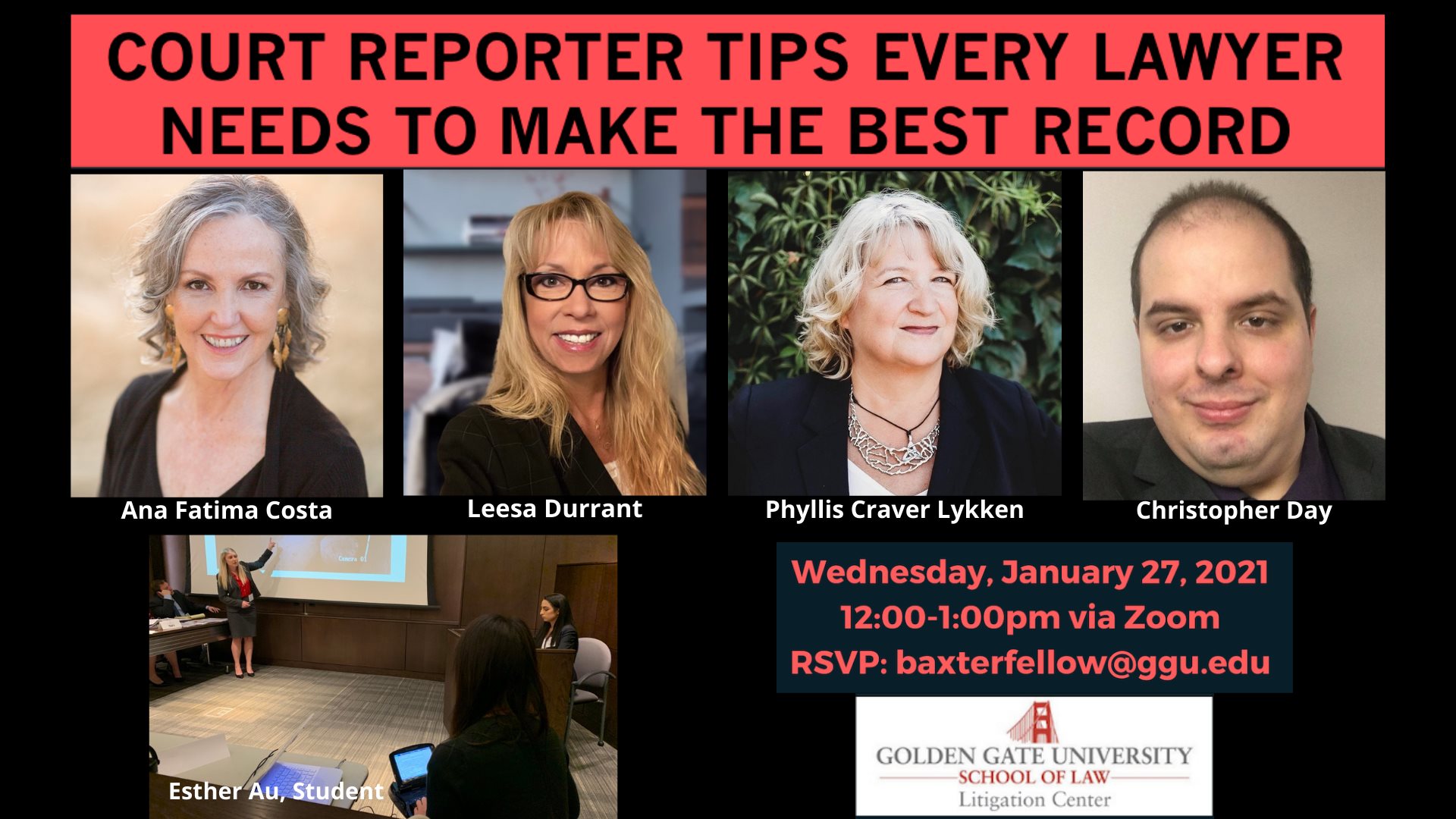
I was invited by Ana Fatima Costa to participate in Golden Gate University’s Court Reporter Tips Every Lawyer Needs To Make The BEST Record. Ana has dedicated a great deal of time to presentations, coaching students, running internship programs. As reporters, we sometimes struggle to make connections with the bench and/or bar. Ana’s great at making those connections and definitely one of the people you want to talk to if you’re interested in bridging the gap between reporters and the bar.

We spent an hour introducing young attorneys and some reporters to core concepts such as speaking one at a time, requiring a stenographic reporter, and how providing case-specific information can assist a reporter in producing their record. Luckily for me, nearly all the heavy lifting was done by the three other panelists and experts in our field, Ana Fatima Costa, Phyllis Craver Lykken, and Leesa Durrant. Ana whipped up great presentation slides and held the whole presentation down. Phyllis talked to them a little bit about realtime conceptually. Leesa drove it all home with a realtime demonstration. It was a fantastic thing for me to be a part of, and I’m grateful I was invited to be a part of it. I’m also grateful to Professor Rachel Brockl and her team, who worked with Ana to make the event a reality. For anyone who’s curious, at some point it should be up on GGU’s Youtube.

My real takeaway is that there is so much potential for our little field to make a big impact on how we are viewed not only by the public, but also by courts, judges, and lawyers. There are thousands of reporters, which means any reporter taking just a few hours of their time per year to make a speech or presentation has incredible cumulative value. The people that we work with every day are the people who wrote to us after this presentation and said “this information really helped me understand how to help court reporters do their job.” Imagine four professionals getting to sit on camera and talk about what we know and love. You can probably imagine yourself doing it, and I hope that writing about this inspires folks to stand up and say “I can do that!” We need you. I need you so that I can stop doing presentations and go back to blogging about your presentations. And if you’re not ready, that’s okay too. But I say seek us out. Seek out any of the court reporters that put out content regularly. We want to help. We want others to meet their potential and develop skills beyond our wonderful skill of reporting.

Addendum:

The presentation may now be viewed here. The first five minutes went unrecorded due to a technical glitch.

What Law Offices Need To Know About A Court Reporter Shortage

There’s been a great deal of marketing and many press releases about “disruptive” technology in my field. I’ve been a stenographic court reporter for a decade. I’ve worked right next to reporters who have been working for three or four decades. All of us concede that technology, on average, is getting better. Computers today can do things that few could have imagined in 1970. Computer programs used to be written on punch cards. Try inserting one of those into your iPhone. It’s no wonder that when people see some of the older stenotypes, they ask where the punch card goes.

You write on a stenotype but type on a typewriter. Can’t explain that!

Of course there’s no punch card. But we end up getting a pretty bad rep because the keyboard layout we use is a hundred years old. It’s easy to look at that and forget there’s a whole arsenal of technology attached to that keyboard layout. By 1963 we were using magnetic tape for computer transcription. By 1987, our stenotypes were rocking floppy disks. Today’s stenotypes are so damn good you can read my notes off the screen without any special training.

You would be able to read the notes off the screen, if I ever took any.

There was no secret that there was a court reporter shortage coming. Our field first learned this shortage was coming towards us in 2013. By 2019, the entire country knew there was a shortage. There is a court reporter association in almost every state, a National Court Reporters Association, and myriad nonprofits and other initiatives aimed at solving the shortage. Since 2013, we’ve seen things like Open Steno, A to Z, and Project Steno all aimed at meeting the demand for stenographers in their own way.

With even a gentle push from the larger corporations in our field, things would have been fine. But we started to see some strange moves in our industry by some companies. Some companies started to ask law offices to change their deposition notices to allow for audio recording. Some companies started saying that reporters were unavailable even when we were all sitting at home on social media chatting away with each other. Some companies started completely fabricating news, saying things like “…this world hasn’t been digitized…” Some companies say AI is making things better even though AI only gets 65 to 80 percent of what’s being said. Some companies started to push “digital” court reporters. Digital reporters, while they are nice people, are just recording your deposition and taking some notes. They are being used by those companies as part of the record and transcribe method. These companies are literally taking people who could fill the stenographic reporter gap and telling them “no, do this instead, it’s newer.” They don’t bother to tell them that stenographic reporting utilized the record-and-transcribe method several decades ago with Dictaphone technology and has since evolved to be far more efficient. Stenography has been digital since before some of us were born.

Eventually, you have to ask yourself, “what’s the deal? If there’s is a shortage, why does Veritext, or Planet Depos, or US Legal advertise that they’re hiring digital court reporter positions in New York, but almost never a single ad for a stenographic reporter?” Well, reporting firms, like just about any other industry, make a good deal of their money being the broker for the buyer and seller. You buy our services, we sell them, and the court reporting companies make money by knowing how low we’ll go and how high you’ll go. I started out as a deposition reporter in 2010 and was offered $2.80 a page. Years later I learned that was almost the exact same rate given to reporters in the 1990s and far lower than the page rates that court reporters working in court got. Court reporting companies told me reporters were a dime a dozen and that law offices wouldn’t pay a penny more. Meanwhile, I was taking depositions where the attorneys were telling me how expensive our services were. On a deposition with a lot of copy sales, I wouldn’t be surprised if I was taking home 20 percent of the total invoice. That’s a lot of money to a company to market and print, bind, and mail a transcript that takes hours of reading, research, and transcription on my part.

Our entire profession is in a state of shock because we placed a great deal of trust in reporting firms to market our skills. This is similar to the trust you put in them to find you a qualified stenographic reporter. Yet we find ourselves compiling state databases, national databases, and nonprofit databases dedicated to helping you find stenographic reporters because some companies can’t be bothered to connect consumers with the service they want. They see the education culture that stenography has as a threat. They see it as an expense to do away with. What happens when you take a field with 60 nonprofits and dozens of schools dedicated to the welfare and training of court reporters and replace it with people that have no such support system? You get workers that are easier to intimidate and lowball in the long run. How do I know? It already happened when the Federation of Shorthand Reporters in New York collapsed. Worker pay stagnated while the invoices to attorneys skyrocketed; this is the same situation on a national scale.

What law offices need to know is that they alone decide what happens next in our industry. Ultimately, law offices set the demand. It’s you, the attorneys, office managers, paralegals, and secretaries. You can trust us to recruit enough to fill any shortage. You can trust us to adopt the latest technology. You can trust us to continue over a hundred years of tradition, value, and service by making sure your record is accurate and turned around quickly at the best cost. We have to trust you to demand a stenographic reporter every time so that steno schools can keep pumping out graduates and promising jobs. We have to trust you to look at claims that a stenographic reporter could not be provided with skepticism. We have to trust you to be smart consumers. We have to trust you to let your colleagues know what’s going on in our tiny industry. Don’t just do it so that I have a job in ten years. Do it for your clients. Do it for your consumers. I guarantee that if the demand for steno slips, you’re going to be looking at some crazy deposition bills and hearing some new excuse.

  • – – – – – – – – – – – – – – – – – – – – –

PS. This article comes after a great satire (image here) was done on this topic by a reporter under the alias DigitalByHumans. In that satire, posted to Craigslist, the writer describes a world where a company does this same sort of thing to attorneys, deciding to use “digital” attorneys, and goes on to note that the company makes a lot of customer comfort moves to hide the fact that they aren’t using actual attorneys. While my post here tries to focus on getting straight to the facts I know and the conclusions I draw, I really think that it was something special and illustrates the frustration a lot of us have on this topic. There are states where we are very heavily regulated and the regulating bodies have, through inaction or inability to enforce the law, allowed people to come in and record as “digital court reporters” without any regulation, whereas a stenographic court reporter doing pretty much the same thing would be fined or reprimanded. It’s not the digital reporters’ fault, it’s the companies’ fault, but until consumers and consumer protection agencies stand up and say “no,” the situation will continue.

Remote Notarial Acts Executive Orders (NY 2020)

This explanation used to be hosted on my Remote Swearing page. It is now hosted here on this page.

On or about March 19, 2020, the governor issued an Executive Order 202.7 allowing all notarial acts to be done over audio-video technology until April 18, 2020.  In 2020, when the New York State Court Reporters Association sought guidance from the Department of State on oaths, the Department of State sent back the Executive Order. From this, I conclude that oaths falls under “all notarial acts.” If a notary is administering an oath under the Executive Order, they should probably follow all the guidelines under 202.7.

Order 202.7 was extended by Executive Order 202.14 until May 7, 2020.

Order 202.14 was extended by Executive Order 202.28 until June 6, 2020.

Order 202.28 was extended by Executive Order 202.38 until July 6, 2020.

Order 202.38 was extended by Executive Order 202.48 until August 5, 2020.

Order 202.48 was extended by Executive Orders 202.55 and 202.55.1 until September 4, 2020.

Order 202.55 and 202.55.1 were extended by Executive Order 202.60 until October 4, 2020.

Order 202.60 was extended by Executive Order 202.67 until November 3, 2020.

Order 202.67 was extended by Executive Order 202.72 until December 3, 2020.

Order 202.72 was extended by Executive Order 202.79 until January 1, 2021.

Order 202.79 was extended by Executive Order 202.87 until January 29, 2021.

Order 202.87 was extended by Executive Order 202.92 until February 26, 2021.

Order 202.92 was extended by Executive Order 202.96 until March 28, 2021.

Order 202.96 was extended by Executive Order 202.100 until April 30, 2021.

Order 202.100 was extended by Executive Order 202.105 until May 27, 2021.

Order 202.105 was extended by Executive Order 202.106 until June 5, 2021.

Order 202.106 was extended by Executive Order 202.110 until July 5, 2021.

The governor announced that the state of emergency would end June 24, 2021. The Notarial Acts Executive Order, by my understanding, is no longer in place as of that date. Remote swearing in state cases may still be allowed under CPLR 3113(d). This page will no longer be updated.

Trolls and You

We try to keep political stuff from being published here unless it’s educational, about court reporting, or about the industry. I’ve been pretty good about this. Commentators have been great about it. The occasional guest writer has been amazing with it. This topic touches with politics, but it’s not strictly political, so it should be fun to learn about.

It’s established that the United Kingdom, United States, China, Russia and several other countries view the internet as, more or less, another theater of war. They’ve had operatives and people hired to create fake posts, false comments, and advance the interests and ideas of the government. The prices reported? Eight dollars for a social media post, $100 for ten comments, and $65 for contacting a media source. In the case of China, they’re reportedly working for less than a dollar. If the host country allows it, you have trolls for hire.

So in the context of stenography and the court reporting industry, seems like whenever we get into the news, there are regular comments from regular people, such as “why not just record it?” Typical question. Anyone would ask this question. There are fun comments like “Christopher Day the stenographer looks like he belongs on an episode of Jeopardy.” Then there are comments that go above and beyond that. They make claims like — well, just take a look.

“…I gonna tell you that in modern technology we can record something like court testimony for hundreds of years back very easily…” “…the technology is smarter every single second…” “…if you store data in the digital format we can use an AI to extract the word from the voice in the data, it will be very accurate so much so the stenographer loses their jobs.” Wow! Lose our jobs? I felt that in my heart! Almost like it was designed to hurt a stenographer’s feelings. Right?

We can store the video for hundreds of years? Maybe. But consider that text files, no matter what way you swing it, are ten times smaller than audio files. They can be thousands of times smaller than video files. Take whatever your local court is paying for storage today and multiply that by 8,000. Unless we want a court system that is funded by advertisements a la Youtube, the taxpayer will be forced to cough up much more money than they are today. That’s just storing stuff.

The technology is getting smarter every second? No, not really. Whenever it’s analyzed by anybody who isn’t selling it, it’s actually pretty dumb and has been that way for a while. Take Wade Roush’s May 2020 article in the Scientific American (pg 24). “But accuracy is another matter. In 2016 a team at Microsoft Research announced that it had trained its machine-learning algorithms to transcribe speech from a standard corpus of recordings with record-high 94 percent accuracy. Professional human transcriptionists performed no better than the program in Microsoft’s tests, which led media outlets to celebrate the arrival of ‘parity’ between humans and software in speech recognition.”

“…And four years after that breakthrough, services such as Temi still claim no better than 95 percent — and then only for recordings of clear, unaccented speech.” Roush concludes, in part, “ASR systems may never reach 100 percent accuracy…” So technology isn’t getting smarter every second. It’s not even getting smarter every half decade at this point.

“…we can use an AI to extract the word from the voice in the data…” This technology exists, kind of, but perfecting it would be like perfecting speech recognition. Nobody’s watching 500 hours of video to see if it accurately returns every instance of a word. Ultimately, you’re paying for the computer’s best guess. Sometimes that’ll be pretty good. Sometimes you won’t find the droid you’re looking for.

Conclusion? This person’s probably not in the media transcoding industry, probably doesn’t know what they’re talking about, and is in all likelihood a troll. Were they paid to make that comment? We don’t know. But I think it’s time to realize that marketplaces are ripe for deception and propaganda. So when you see especially mean, hateful, targeted comments, understand that there’s some chance that the person writing the comment doesn’t live in the same country as you and doesn’t actually care about the topic they’re writing about. There’s some chance that person was paid to spread an opinion or an idea. Realizing this gives us power to question what these folks are saying and be agents of truth in these online communities. Always ignoring trolling leads to trolling leading the conversation. So dropping the occasional polite counterview when you see an obvious troll can make a real impact on perception. The positive perception of consumers and the public is what keeps steno in business.

The best part of all this? You can rest easier knowing some of those hateful things you see online about issues you care about are just hired thugs trying to divide us. If a comment is designed to hurt you, you might just be talking to a Russian operative.

Addendum:

I understand readers will be met with the Scientific American paywall. I would open myself up to copyright problems to display the entire article here. If you’d like to speak out against the abject tyranny of paywalls, give me money! I’m kidding.

Turning Omissions Into Opportunity

We’re in an interesting time. Pretty much anywhere you look there are job postings for digital reporters, articles with headlines talking about our replacement, articles with headlines talking about our angst. Over time, brilliant articles from people like Eric Allen, Ana Fatima Costa, Angie Starbuck (bar version), and Stanley Sakai start to get buried or appear dated when, in actuality, not much has changed at all. They’re super relevant and on point. Unfortunately, at least for the time being, we’re going to have to use our professional sense, think critically, and keep spreading the truth about ourselves and the tech we use.

One way to do that critical thinking is to look squarely at what is presented and notice what goes unmentioned. For example, look back at my first link. Searching for digital reporting work, ambiguous “freelance” postings come up, meaning stenographer jobs are actually branded as “digital” jobs. District courts seeking a stenographer? Labeled as a digital job. News reporters to report news about court? Labeled as a digital job. No wonder there’s a shortage, we’re just labeling everything the same way and expecting people who haven’t spent four decades in this business to figure it out. In this particular instance, Zip Recruiter proudly told me there were about 20 digital court reporter jobs in New York, but in actuality about 90 percent were mislabeled.

Another way to do it is to look at contradictions in a general narrative. For example, we say steno is integrity. So there was an article from Lisa Dees that shot back and said, basically, any method can have integrity. Can’t argue there. Integrity is kind of an individual thing. But to get to the conclusion these things are equal, you have to ignore a lot of stuff that anyone who’s been working in the field a while knows. Stenography has a longer history and a stronger culture. With AAERT pulling in maybe 20 percent of what NCRA does on the regular, who has more money going into ethics education? Most likely stenographers. When you multiply the number of people that have to work on a transcript, you’re multiplying the risk of one of those people not having integrity. We’re also ignoring how digital proponents like US Legal have no problem going into a courtroom and arguing that they shouldn’t be regulated like court reporters because they don’t supply court reporting services. Even further down the road of integrity, we know from other digital proponents that stenography is the gold standard (thanks, Stenograph) and that the master plan for digital proponents is to use a workforce that is not highly trained. I will totally concede that these things are all from “different” sources, but they all point to each other as de facto experts in the field and sit on each other’s boards and panels. It’s very clear there’s mutual interest. So, again, look at the contradictions. “The integrity of every method is equal, but stenography is the gold standard, but we are going to use a workforce with less training.” What?

Let’s get to how to talk about this stuff, and for that, I’m going to leave an example here. I do follow the court reporting stuff that gets published by Legaltech News. There’s one news reporter, Victoria Hudgins, who has touched on steno and court reporting a few times. I feel her information is coming mostly from the digital proponents, so in an effort to provide more information, I wrote:

“Hi Ms. Hudgins. My name’s Christopher Day. I’m a stenographer in New York. I follow with great interest and admiration most of your articles related to court reporting in Legal Tech News [sic]. But I am writing today to let you know that many of the things being represented to you by these companies appear false or misleading. In the August 24 article about Stenograph’s logo, the Stenograph offices that you were given are, as best I can tell, a stock photo. In the September 11 article about court reporter angst, Livne, says our field has not been digitized, but that’s simply not true. Court reporter equipment has been digital for decades. The stenotype picture you got from Mr. Rando is quite an old model and most of us do not use those anymore. I’m happy to send you a picture of a newer model, or share evidence for any of my statements in this communication.

Our position is being misrepresented very much. We are not worried so much about the technology, we are more worried that people will believe the technology is ready for prime time and replace us with it without realizing that it is not. Livne kind of admitted this himself. In his series A funding, he or Verbit stated that the tech was 99 percent accurate. In the series B funding he said Verbit would not get rid of the human element. These two statements don’t seem very compatible.

How come when these companies are selling their ASR, it’s “99 percent” or “ready to disrupt the market,” but when Stanford studied ASR it was, at best, 80 percent accurate?

Ultimately, if the ASR isn’t up to the task, these are transcription companies. They know that if they continue to use the buzzwords, you’ll continue to publish them, and that will draw them more investors.

I am happy to be a resource on stenographic court reporting technology, its efficiency, and at least a few of the things that have been done to address the shortage. Please feel free to reach out.”

To be very fair, because of the limitations of the website submission form, she didn’t get any of the links. But, you know, I think this stands as a decent example of how to address news people when they pick up stories about us. They just don’t know. They only know what they’re told or how things look. There will be some responsibility on our part to share our years of experience and knowledge if we want fair representation in media. It’s the Pygmalion effect at work. Expectations can impact reality. That’s why these narratives exist, and that is why a countering narrative is so important. Think about it. When digital first came it was all about how it was allegedly cheaper. When that turned out not to be true, it became a call for stenographers to just see the writing on the wall and acknowledge there is a shortage and that there is nothing we can do about it. Now that’s turning out not to be true, we’re doing a lot about it, and all we have left is to let those outside the industry know the truth.

Addendum:

A reader reminded me that Eric Allen’s article is now in archive. The text may be found here. For context purposes, it came amid a series of articles by Steve Townsend, and is an excellent example of what I’m talking about in terms of getting the truth out there.