April Applications 2020 (Jobs Post)

Obviously, this goes up during the COVID-19 outbreak, and many of my colleagues or their families are impacted health-wise or economically. It’s serious stuff. Some of us have lost people or been in danger of losing people. This is a time when mostly everything has slowed down, and for many it may not feel like there is an end in sight. That said, I assure you there is an end in sight, and when this is all over, we’re going to need to pick up the pieces, move forward, and help each other move forward.

There’s a lot of fear and a disruption in our normal lives. So to keep with some semblance of normality, I’m going to move forward with a jobs post. Keep in mind that with this outbreak, many places are running on a skeleton crew, so they may not be actually hiring right now, but when things start to speed up again, stenographic reporters are needed all over the city, state, and country. They’re needed outside the country too, but I’ll let the experts handle that. Remember that if you’re a student or a newer reporter, there are also programs out there designed to find you a mentor. Mentors are no doubt having difficulties too, but they may be able to offer advice or ideas nonetheless.

Running along, NCRA has a good number of job listings up for reporters. They’re also looking for a certification & testing program manager. I know here in New York we have some reporters who are extremely gifted and passionate about certification and testing, so if that’s something you think you’d put down the machine for, take a look. Looking at the federal judiciary jobs page, there are openings in New York, Nevada, Washington, Oregon, Iowa, Missouri, Massachusetts, West Virginia, Florida, Pennsylvania, and Texas. Federal courts all over the country want stenographic court reporters.

The NYS statewide provisional court reporter application remains open to anyone with the guts to step up and give reporting for the state judiciary a chance. The courts in this state need people that care about the record and want to do a good job. If you’re looking for a steady job with paid time off, this is a first foot in the door while we wait for the civil service exam together. Before this outbreak and mess, I had a brief e-mail exchange with Michael DeVito, whose contact information is on the bottom of that application. Paraphrasing what he said, any employment prospects are encouraged to contact him. You have someone in the system to reach out to in addition to the unions that represent New York City court reporters and senior court reporters.

Last, but certainly not least, the Bronx DA has a posted position for grand jury stenographer. The DCAS Reporter/Stenographer test remains postponed.

Try to remain positive. I know there has been a marked drop in freelance work.  You are not alone. At the beginning of this, several of NYSCRA’s officers and board members, Joshua Edwards, Diane Salters, Karen Santucci, and Dominick Tursi, got together to show our community an example of a remote deposition. The full video is available. Many members asked additional questions, which I tried to address via this video, and wrote some more information in the description box. If you’re a NYSCRA member or a potential member, don’t be afraid to send e-mails to board members. We can’t wave a magic wand and make everything better, but we can try to use the association’s resources that we all pay into in a responsible way. Remember that you are integral to those resources, and that even if you can’t get a membership right now, you can still throw in support later when work starts booming again. And we are not alone. Many state associations, and the NCRA, have been promoting ways to get reporters back to earning a living for themselves and their family. Many reporters have independently taken the time to host webinars or put up videos to help each other. Many CAT trainers are scheduling remote appointments to help people with their software. As an example, I personally follow Dineen Squillante and Anthony Frisolone. Some help is free, some help is for fee, and the bottom line is that we’re going to get through this together.


Steno Shortage Stats March 2020

Before I begin, let me just say that I have no problem with transcribers. I do have a serious problem with companies pushing the record and transcribe method as innovation when stenography was doing that and stopped doing it because it was inefficient and costly. Digital reporters and transcribers come to steno because it is the better method for the consumer, the worker, and their hands!

We face a public relations blitz on us disguised as the “field changing.” As best I can tell, this is mostly to discourage us from recruiting for and promoting stenography. Nobody else is reading that. The easiest way to win is to get the other side to not fight, or to get it to fight itself. I’ve written about nearly all of this before, but it is nice to have in one spot. Here are some truths and concepts you should know before you buy the hype that we’re a dead field.

Conclusion: There is no reason stenographers cannot fill the stenographic reporter gap if we try.

  1. Self-reported, transcribers can take up to six hours to transcribe one hour of testimony compared to an average via steno of one to two hours. Regular transcription can take up to six times as long or require six times as many people to produce the same work.
  2. Simple math, stenographers input words 3 to 4 times faster.
  3. Assuming a stenographer workforce of 15,000 and a projected 2030 court reporter shortage of 11,000, it’ll take 78,000 to 156,000 transcribers to replace stenographic court reporters.
  4. The dropout rate before NCRA A to Z, Project Steno, Open Steno, Steno Key, and other steno initiatives was about 80 to 90%. If we are looking at recruiting 100,000 transcribers, we can certainly fill a gap of 10,000 even using the terrible dropout rate from years prior to 2015.
  5. The Ducker Report, which forecasted the shortage, is about 7 years old, and predates the initiatives in point 4. To my knowledge, nearly all court reporter shortage numbers are extrapolated from that report, and there has not been a new study since.
  6. The Ducker report predates layoffs that occurred in Massachusetts and elsewhere, and happened at about the same time as a major change in New York’s Workers Comp reporting. There are likely fewer jobs and a smaller gap than forecasted, as those reporters moved to fill slots that would otherwise be empty.
  7. The Ducker Report showed California, by far, as being the state with the largest shortage. If we win in California, we can win anywhere.
  8. 70 percent of reporters are likely to retire by 2033 as of the 2013 report. This means that if the field is still ticking in 2033, it’s unlikely to go anywhere for the next 30 or 40 years while those new people move towards retirement. This means reporters today have a unique opportunity to make or break the next generation of reporters by recruiting.
  9. Stenographers are ten times more organized and equipped to handle the shortage. NCRA’s 2017 revenue was 5,926,647. AAERT’s 2017 revenue was 195,652. For the sake of comparison, if we divide that revenue by the cost of a membership, NCRA would have 19,755 members at a $300 membership. AAERT would have 1,565 members at a $125 membership. Obviously, these do not reflect true membership levels, but they give us an estimate of the relative strength and support of the two organizations, as well as the support we give to our continuing education culture.
  10. There are four AAERT-approved schools listed as of 2020. There are 25 NCRA-approved schools listed as of 2020. If we judge by approved schools, stenographers are six times more likely to close the gap.
  11. The turnover rates of digital reporters and transcribers are poorly documented. Ducker acknowledges that stenographic reporters tend to stay in the workforce longer. Proponents of transcription and digital reporting look to the faster training time, but a faster training time means nothing if you’re constantly having to train the 100,000 people mentioned in point 3.
  12. Rates for digital vary wildly, between $15 and $45 an hour. This is not so different from stenography, but we have a culture of mentorship and showing people the ropes so that they can make wise decisions. Going by the numbers in point 9, there’s just no way for them to match the infrastructure and guide new people the same way we do, and ensure that there is a balance between the worker not getting screwed and the customer getting the best value possible.
  13. Using the “guesstimate” of membership and support in point 9, there are simply more of us to recruit and promote this field.
  14. Automatic speech recognition outfits like Verbit have gone from claims of 99% accuracy in Series A funding to statements akin to “we will not get rid of the human element” in Series B funding. Automated speech proponents, time and again, have made claims they simply cannot support.
  15. Expectations can impact reality. How we perceive the situation can directly impact the situation. This is the major hope of digital proponents. They want you to expect your associations and field to fail. They want you to expect to be replaced.They don’t want you to fight. We’ve seen this from Veritext’s love letters and Cudahy’s constant droning about the shortage. By alternating between messages of “good court reporters will always have jobs,” and “it’s impossible to close the stenographic reporter gap,” people who want change in this field are hoping that you will see the change as not impacting you or inevitable, and therefore pull your support from associations and grassroots efforts to protect our field. Conversely, you can expect to win. Expect that if you put in your membership dues, or a little volunteer time, you’re setting us up on the path to remain a stable profession and a viable career.


What Verbit Investors Need To Know

I had touched pretty gently on Verbit when its series A funding came in at $23 million. The series B funding is in at about $31 million earlier this year. Now Verbit’s announced a strategic partnership with the STI and professional flip flopper, Jim Cudahy. Migliore & Associates already came out with the hard truth of what this means: ASR doesn’t make the cut for the production of legal transcripts without a qualified court reporter no matter what you name it, NLP, ASR, AI, computer magic, automated transcription.

Do I come off as angry? I am angry. I’m angry that investors are being led down a path of burning capital where there’s just not a bright future. When the series A funding was happening, Verbit used words like automated, “save an enormous amount of manual labor.” “Adaptive speech recognition” with over 99 percent accuracy. Series B is out. They “would not take the human transcriber out,” “the AI will enhance the human.” So investors are fundamentally paying millions of dollars so that they can be another Rev. I doubt very much that that’s what was sold to investors. I don’t think anybody would be putting down millions on that.

Then the partnership with STI? A complete joke. I have already gone into how, without any doubt, stenographers and NCRA are by far the best equipped to deal with the court reporter shortage. AAERT and the STI just don’t have the funding, infrastructure, or experience to tackle the problem, and it shows in their data. By their estimates, court reporting companies stand to save $250,000 over the next decade by adopting digital tools. First, I would love to know if this is individual savings or cumulative. We don’t know because there are no sources linked or cited. If this is cumulative, it’s embarrassing that they would even post that. That would mean 25,000 in savings a year across all companies. If that’s the projected individual savings per company, only slightly less embarrassing. That’s less than the average annual salary of a single court reporter. This may come as a shock to Jim Cudahy, but court reporting companies adopted digital tools throughout digital’s birth in the 70s and into the 80s and 90s. Stenographers are already a part of the Information Age, utilize AI, and produce quality records daily. The idea that investors are going to dump $50 million into “technology” expected to save $250,000 over 10 years and expect a return is terrifying. “Most courts are digital,” again, assuming everything they have to say is true, and yet judicial candidates show a preference for stenographic court reporters and returning them to courtrooms. The growth here is in stenographers, stenography jobs, and stenography schools, and Verbit’s current leadership is missing this boat completely.

Let’s just tell it like it is. When a grassroots-funded stenography blog can give you some pretty solid reasons you’re backing the wrong horse, it’s time to give investors nothing less than what they deserve. Open up a Steno Department, throw down some money on us, and we will make sure you’ve got real and steady returns. Verbit, with proper leadership from Tom Livne, can still save the day. Just not with this bait and switch technology-to-transcription model that amounts to little more than a repackaging of old tech. The only other viable alternative I see is buying this blog for a good $8 million and hoping investors don’t see it before then. Not a difficult decision. Come on over to the winning team. Vote for sten!

July 18, 2021 Addendum:

I reread this article for the first time in a while and I feel I did an inadequate job of explaining just how pathetic the cost savings promoted were. I took to social media to spread the word, and I am copying and pasting what I had to say below.

“I’m slowly reconstructing the table of contents on my blog, and I came across an old article I did on Verbit. In that article, it mentioned a blurb by STTI that, using AAERT info, estimated $250,000 in savings over a decade for companies that switched to digital tools.
The reason I’m bringing it up again is this is a time where a lot of court reporters are kind of concerned. “Is this stuff better than I am?” And I pointed out in the article how I think some $50 million was sunk into Verbit at that point. $250,000 over a decade breaks down to $25,000 a year. So even if it’s assumed that that information is completely factual and that the savings is for every individual company in the field and NOT cumulative across the industry, they were advertising savings equivalent to less than the average salary of a single court reporter.
Is this stuff better than you? They need to sink millions of dollars into it to “maybe perhaps” save $25,000 a year. Remember, these are companies that boast millions in revenue. I think you have your answer.
And for anybody that doesn’t, I have a handy chart here.
If they make $1 million, they save 2.50%
If they make $2 million, they save 1.25%
If they make $3 million, they save 0.83%
If they make $4 million, they save 0.63%
If they make $5 million, they save 0.50%
If they make $6 million, they save 0.42%
If they make $7 million, they save 0.36%
If they make $8 million, they save 0.31%
To put this into perspective, a company like VIQ Solutions, parent of Net Transcripts, that posts something like $8 million a quarter (not profitable), would save 0.08%.
A company like Veritext, which Owler claims has revenue in the $400 million ballpark, would save 0.007%
Just to put some more perspective on that, if Stenograph were to offer you 0.007% savings on the purchase of approximately $4,000 CaseCAT, you would save $0.28. ($100 at 2.50%)
Would you pay anyone millions of dollars to “maybe perhaps” save 0.007% to 2.50%?
This situation is very good for us, but we do need more reporters, so in this coming school year, if you can make a visit to your local high school, please do.”

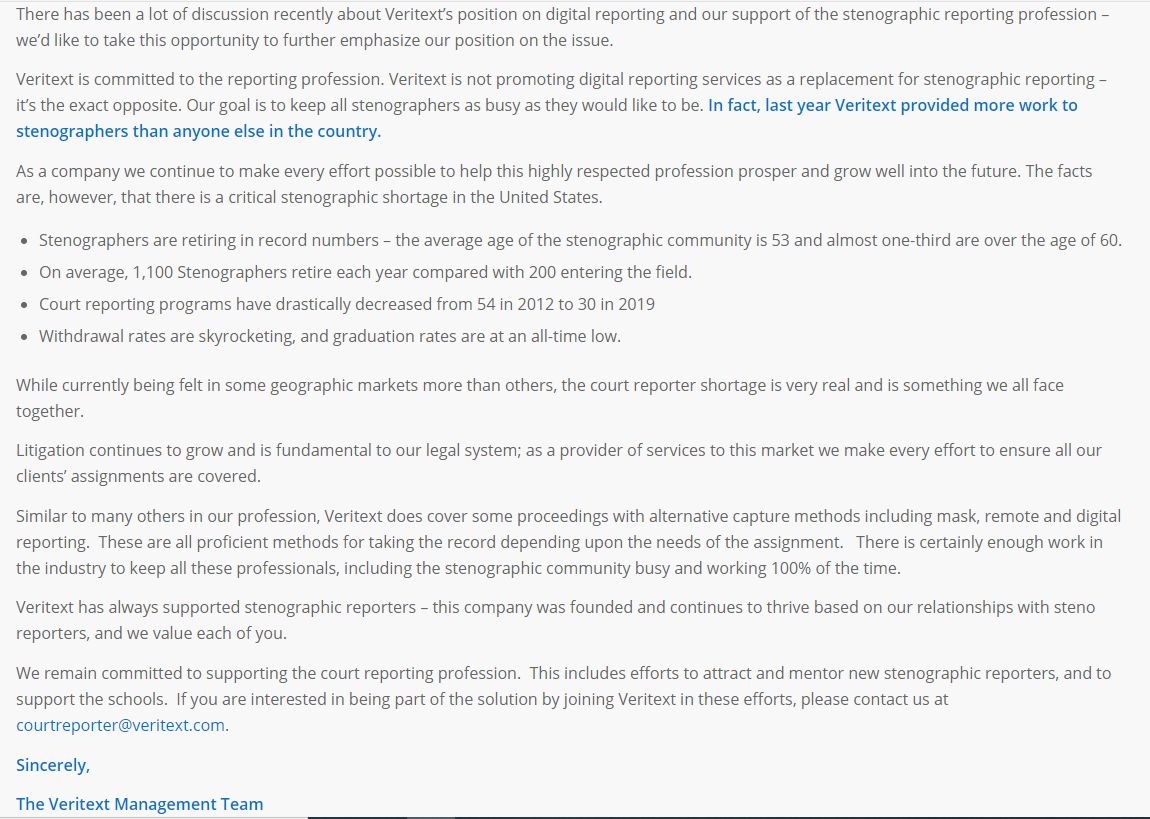
Trust Issues, Brought To You By Veritext

There was a pretty serious open letter posted by Veritext this month. It basically goes into their stance on digital reporting. I try to be fair in all things, but looking at Veritext’s history, and the general direction of the field, I don’t really find the letter reliable. I’ve reported on the good that Veritext has done with offering scholarships, and I hope that continues. I hope it doesn’t turn out like US Legal and Stenotrain, where it was apparently bought, paraded around for a bit, and mothballed.

Given all I know, I can only assume that there are people at the company with different directions or management styles. Beginning of last year, Veritext stood proud for steno and wouldn’t cross the picket lines in California. That was followed by the revelation that they were coaching clients to amend their deposition notices to allow for digital reporters. Almost immediately after that, their then VP of Sales wrote a very pro digital article that got shared wildly on social media before its deletion, and Veritext response was, more or less, that it was done by a “former employee.” I think it’s infinitely more likely that the culture at Veritext at the time was looking at digital. Realizing that they can’t compete with tens of thousands of stenographers, they backed down.

I view Veritext through a lens of cynicism for all the above reasons. For a long time in this field it was rumored that digitals were being sent instead of reporters by various companies, and that was often denied. Then we started to have hard evidence of it, and the message pivoted to the shortage and how companies can do nothing about it, they just have to use digital. When grassroots groups of stenographers can start putting together things I could only dream of, and they can do that ostensibly faster than the million-dollar companies, there’s a willpower problem, not a resources problem.

Let’s push into the specifics of the Veritext letter for why it screams BS to me. When someone wants something from you, they play good cop, bad cop. The good cop starts out in the Veritext letter by saying how committed to court reporters they are and going on about how they provide more work to stenographers than blah, blah, blah. It’s very disarming language. The letter then pivots to the bad cop. Remember, stenographers, we have a shortage problem in the thousands! Disarmed, you, the reader, is then hit over the head with some purported factoids to fill you with a sense of hopelessness.

As best I can tell, most of what they state is extrapolated from the Ducker Report from 2013 or 2014 data. They don’t cite any sources at all, so the accuracy of the bad cop statements is tough to gauge. Yes, stenographers are looking at a bit of a battle. Over the next 13 years, a large percentage of this field will retire. Yes, there was a forecasted supply problem for court reporting. But let’s set the record straight. By far, the largest supply gap was California, which is also a state where the stenographers are best positioned to deal with the heavy burden of recruiting new talent. There are several reporting associations and independents who are going to fight the good fight to close the gap. Additionally, Ducker came before we had Project Steno, Open Steno was far smaller, NCRA’s A to Z didn’t exist yet, Katiana Walton’s Steno Key wasn’t being tried yet. Ducker was a good warning bell, and we listened.

This idea that our schools closing is a problem is laughable. I think it opens up the possibility for entrepreneurs to jump in and start schools or present new ideas. I also think it’s really shortsighted and maybe willfully ignorant to talk about steno schools without again mentioning that AAERT only has 4 or 5 approved schools. Said another way, if we want to only look at approved schools, we have six times the chance at filling the reporter shortage. Any gamblers in the audience? If your payout was roughly the same, would you bet on something that has a 1 out of 7 chance of winning or a 6 out of 7 chance of winning? Bet sten, people. Stenographers, be encouraged to recruit people and tell them about our work, that is how this field will survive and thrive. What we do today will change the outcome 13 years from today. Our action or inaction writes this story.

I have no idea if Veritext reads my work, but if I could give them one piece of advice it would be to stop waffling around this issue, look at the numbers as they are and not as they want them to be, and see that as long as stenographers don’t completely drop the ball our prevalence and resurgence is borderline inexorable. Take advantage of that. If you’re seen to be a company that is actually on our side and not just hedging, you’ve got thousands who probably wouldn’t mind taking their work through you. If you keep down this road of dishonesty and lack of commitment, you’ve got tens of thousands of heavy hitter competitors. Stop trying to convince us with “there’s nothing we can do” while throwing resources into building digital reporting. Nobody’s fooled. Even your most loyal stenographer resources don’t buy that there’s nothing you can do. The famous cliche is the people you step on going up the ladder are the same faces you see when you take a fall. Anything less than commitment to the stenographic court reporting community is going to lead to a fall, we won’t catch you, and it’ll cost the shareholders big time.

Addendum:

This site and its public face as of March 2020 are a good indicator of why stenographers have a hard time trusting. We can get all the open letters in the world about loving stenography, but in the end we really need companies to put down those resources they’re throwing out the window for digital into our field.

For the sake of completeness, I am adding an image of the letter.

And, to be even more fair, they have added stuff from our community to their reporter corner. But that’s different from actively advertising stenography.

Eastern District NY Hiring! 2/13/20

I usually do my job posts in the beginning of the month, but sometimes jobs come along and it’d be a tragedy not to share. I’m told that Eastern District will be hiring. That’s federal court in New York. I know a few past, current, and probably future district court reporters, and let’s just say they’re good people and it’s a good place to work. Especially in the future, when you’re there!

For this one, you’ll need an RPR and you’ll need to reach out to Anthony Frisolone. I do not know if this posting is going up on the federal judiciary jobs page, so don’t wait, write Anthony today!

Fantastic February 2020

I do my monthly job posts to try to help connect people with their dream steno job and give them ideas on where to look. As always, we’ve got a pretty healthy selection of places to jump to from here. That said, if you’re a newbie or student concerned with finding work, it makes good sense to reach out and get yourself a mentor today. It doesn’t matter if you’ve been doing this five hours or five years, you can find someone out there to help. Mentors can also help you locate many Facebook groups dedicated to official and freelance job openings in addition to your state association groups. Do not suffer in a place where you’re unhappy. Reach out to people and try to find out the opportunities available to you with this wonderful skill.

Bronx DA is still looking for a grand jury stenographer according to their postings. Remember, it’s a City of New York job with good union representation.  There have been rumors that Kings County will hold a test, but nothing solid has been posted. Note that the Queens DA site is under construction, so I have no idea if they’re looking for reporters. The Citywide DCAS test for Reporter/Stenographer is still listed as postponed.

NYSUCS has a statewide court reporter posting still up. My understanding is that the number of passing marks for the civil service exam were not high, so if you want to serve the public as a state employee, this application just might be your shot. Remember that the state court system has two main job titles for stenographers, court reporter and senior court reporter. If you are a permanent court reporter when you apply to become a senior court reporter, you go to the front of the line and pass members of the public who are also applying, a huge competitive edge. So apply today and start accumulating leave time and all sorts of other perquisites.

I count about 20 federal judiciary positions still open across the country. There are openings in West Virginia, North Dakota, Idaho, Massachusetts, Texas, Iowa, Arkansas, Florida, New York, Pennsylvania, South Dakota, Washington, Missouri, D.C., and North Carolina.

Jersey neighbors, the New Jersey Courts have an official court reporter position open. My understanding is they require at least one CRR.

At this time I do not see any postings for US Senate or US House reporters, but that’s probably because the people doing that work are just too good.

Even if none of these are for you, take the time to share. You just might make somebody’s day!


The Savior Chimera

Some will have seen the recent article in Legal Tech News where Max Curry, NCRA’s president, told the press straight up that electronic recording by itself is too risky compared to steno in taking the spoken word. Reading the article got me pretty concerned. I felt, as a member, that NCRA’s views weren’t represented well. I didn’t know if that was because of a lack of articulation or because the cards were stacked against Max. I didn’t know if the full breadth of what he was explaining was captured accurately. The words printed just don’t come off as pro-steno as his September 2019 Virtual Town Hall. So I did what anybody familiar with the issues at hand would do, and I wrote the author something super polite. I didn’t get a response, and something tells me I’m not getting a response. Something tells me the cards were stacked against our NCRA when that interview was taken. Hopefully, time proves me wrong, or journalists do a little more digging into this important issue. Just in case they don’t, here we go.

I’ve already gone on at length why I think stenography is the only solution to the court reporter shortage. Let me double down on this because I have the benefit of being self-published. Stenography’s the only solution. There are more stenographic schools than transcriber schools. We are two to four times more efficient than the record-and-transcribe method. AI is going to burn through investors’ money like the Joker in The Dark Knight (2008). When you get down to it, you are dealing with two very different organizations. I have been through several years of tax returns of both NCRA and AAERT. You know what jumps out at me? In NCRA’s weakest year that I reviewed, 2016, AAERT made about 13% of NCRA’s revenue. Let me say that another way. We stenographers fund an organization easily ten times more than the recording-is-the-future crowd funds “the future.” Even with a membership that is about one third the cost, it appears from my review of these returns that AAERT cannot attract even a third of our membership. Be proud that your money is going to funding conventions, a professional journal, and a dedicated staff who are all about what we do and a thousand percent in support of all grassroots stenography efforts.

There’s got to be alarm bells going off in people’s minds. In one corner, we have stenography, NCRA, an education culture of over 10,000 members, with strong support for anyone that wants to promote the profession or recruit. In the other corner, we have a Best Practices Guide that maybe a couple thousand people have read and maybe four schools.  If you’re someone who doesn’t know jack about court reporting in America, and you read this, which would you entrust the future to? Which corner would you be in if your goal was to solve the court reporter shortage of America? Stanley Sakai said it way better than I did, but there’s a reason that so many courts, attorneys, and classrooms pick steno over digital recording every day. There’s a reason that the “court reporting” companies didn’t just swap over to the technology that has been available since 1995. There’s a reason AAERT is not our shortage savior today.

Does all this mean we cannot do better? Does this mean shut up and have no opinion about this organization? Does this mean never dissent? No. The Journal of Court Reporting says in its mission statement that they are seeking out diverse views. Max Curry said himself in the town hall that if you are a member who has ideas, he wants you to bring forward those proposals. This is the time for people to step up and make submissions. This is a time of activism, research, and effort in the field. It’s time for people to submit all of the hard work they are doing and share it with your fellow colleagues so that they are inspired to go out and build on that work. I have one caution. Don’t get suckered into being divided and conquered. That’s frankly the only way for us to lose, and our dear friends in the recording businesses of “the future” are counting on it.

In several places on this site, I made a joke. I called us the Unremarkable But Reliable Stenographic Legion. Joke’s on me, because in the last three years you have all proven me very wrong. Whether you’re Open Steno, Protect Your Record, helping our heroes in their time of need, a superhero at the ACRA conference, or someone I haven’t even gotten to discuss on this blog yet, you are remarkable. We are out there every day proving that the human element means something. There is no existential crisis. It’s settled that we are the best method to capturing the spoken word. We need only continue doing what we do every day, promoting ourselves, promoting each other, improving, and providing excellent service.

Addendum. Special thanks to a reader who corrected my usage of “went” to “gone.”

Copyright and Stenography

I created a masterpiece about a week ago. On the left, a very horrifying creature that took about three minutes to create and was instantly copyrighted upon creation. If you took my creation and slapped it on a mug and started selling it, I could probably successfully sue you. On the right, a file snapshot of years worth of transcript work, which could be freely copied by anyone any time, at least ostensibly, as any court that decides this issue seems to decide that transcripts are not expressive work protected under copyright. Sam Glover also wrote about this years ago, but seems to have purged it from his blog. Some courts, like the one in Urban Pacific Equities et al v The Superior Court of Los Angeles County (59 Cal. App. 4th 688, 69 Cal. Rptr. 2d 635), have taken the step of ruling that the transcript does not have to be turned over under a business record subpoena because it is a product of business and not a business record, but this does not necessarily prevent it from being copied if counsel obtains it another way.

Here in New York, we do have guaranteed payment of an original via our General Business Law 399-cc (Transcripts and stenographic services). In that way, I feel the state and legislature has already partially acknowledged the hard work that we do. But it’s no secret that court reporter businesses, for whatever reason, have chosen to make originals cheap, and make their businesses more or less dependent on these copy sales. It’s often reported in social media circles that attorneys at a deposition will openly and in front of the stenographic reporter offer to copy and give the transcript to counsel that would otherwise have to order the transcript from the reporter. Why not? As best anyone can tell, it’s legal! There’s also a darker side to this. If you do not have a clear agreement with your agency stating otherwise, they can probably also legally copy your work and not tell you about it. Again, why not? It’s legal!

The question arises, what do we do about this? Many ideas have been floated over the years. Some say we should change our model to reflect the lost copy sales and consider charging in a different way, like hourly, per diem, or a higher original. Personally, I believe it would not be unfair to create a body of law protecting stenographers’ rights to their work. Transcribers would probably be equally in favor, and it would certainly slow the rate of copying if it were explicitly not legal.

Many ideas have been floated in this regard, including putting it under theft of services. I don’t think anyone supports throwing attorneys in jail over this. That’s unreasonable to me. But I do think it’s fair to create a civil penalty for the copying of transcribed work. Virtually everything else is protected via patents, copyright, or intellectual property laws, and it seems weirdly unfair to have a class of people whose work is wholly unprotected.

I would propose language to the effect of “No person or business entity shall copy, reproduce, publish, or dispose of to another a copy of the transcript of any matter transcribed or stenographically reported. A person or business entity that violates this must pay a copy sale to the stenographer or transcriber that created the original transcript. Such copy sale price shall not exceed the mean average of the stenographer or transcriber’s copy sales for the twelve months preceding the copying, reproduction, publishing, or disposal.”

Now, if we were to propose such law, there’s a strong possibility we would have to make some concessions. Let’s be fair, many of these matters are matters of public domain and importance. I would propose a few important carve outs, such as, “nothing in this law shall be construed to abridge the right of any person to critique, cite, discuss, parody, or utilize a transcript’s content in any expressive matter.” This punches a bit of a hole in the law, but look at fair use in copyright law, and you’ll get what I’m trying to do. Also, “nothing in this law shall prohibit any person from preparing or having prepared by another their own transcript of the same proceeding or matter.”

There are some bigger issues we’d have to deal with. Would this law exclusively cover private transcribers / stenographers and not public employees? That’s a fantastic question. As a stenographer, I’m sure everyone knows where I stand, but as someone who reads a good amount of law, I understand that government work simply works out that way sometimes. I think if we’re serious about a New York City, New York State, or even someday federal law on this, it’s entirely doable. I think the important thing is prohibiting copying while allowing “fair use” type cases that don’t prohibit freedom of speech and expression. Notably, we could always go the way of this proposed Florida rule, which states plainly, “subdivision (g) requires a party to obtain a copy of the deposition from the court reporter unless the court orders otherwise…”

As always, discuss away or email me! It’s always fascinating to see what others have researched. Hopefully, if ever it becomes a serious discussion by our lawmakers, they’ll also get a chance to consult with authorities in our field like NYSCRA, NCRA, or even ASSCR.

Shortage Solutions 12: Stenography

If you haven’t had the time to use my site’s search box for all the shortage solutions available, I recommend giving it a try. Over the last year we’ve covered some phenomenal ideas. Many stenographers across social media have internalized these ideas, talked about them, made them better than I ever could’ve dreamed.

Well, this one’s for all the non-stenographers and a look into why our shortage mathematically requires us and not other methods of capturing the spoken word. May it help some of you educate non-reporters and maybe even reporting companies on who we are, what we really do, and why we are irreplaceable. Really quickly, machine shorthand reporting gets a bad RAP because it’s “old.” The stenotype style we use today originally was invented in 1906 by Ward Stone Ireland. With over a century of usage, it’s easy for other methods to say that the technology is outdated and point to something like digital recording, originally invented in 1970 by James Russell, as a newer, “better” technology.

Objectively, when you look at both methods, they have seen vast improvements. Back in “the day,” stenographers had to painstakingly transcribe paper tape notes or even dictate their notes back to a typist using Dictaphone-type technology, who would transcribe for them while they continued to take other proceedings stenographically. Modern stenography uses advanced word processing techniques to take the input from a stenographic writer and output text. The more skillful someone is at operating a stenography machine or stenotype, the cleaner the output text is. Some reporters, reaching a 99.9% untranslate or accuracy level, can practically hit print at the end of a job and have a ready transcript.

Even those of us without such a level of skill are more efficient than the record and transcribe methodology. The average person types about 50 words per minute (WPM). The average transcriber reaches about 80 WPM. The average stenographer? 225 WPM. So while it may seem paradoxical that this century-old technology is the fastest and most efficient method available to the consumer today, it’s true.

So when we talk about shortage, numbers, and the “impossible” gap stenographers must fill to meet rising demand and replace retiring reporters, let’s talk some real numbers. There are somewhere between 11,000 and 30,000 working reporters in this country depending on whose numbers you want to use. Let’s say a healthy 15,000. If we’re inputting words 2 to 4 times faster, on average, you need 2 to 4 people to replace every stenographer. If you need another person to operate the recording equipment, that means 5 people per stenographer today. It gets tougher. Hard-working transcribers have reported it takes up to six hours for them to transcribe a one-hour depo. I’m a pretty average stenographer. I know from timing my own work that a one-hour depo is about 40 pages, and I can transcribe 40 pages in 1 to 2 hours. On a great day where my input is good, I could even do it in 30 to 45 minutes dependent on page density and subject matter. But let’s stick to average, one hour transcription for one hour of testimony for one stenographer. Now compare that to the record and transcribe method, up to six hours for one hour of testimony. That could be six to seven people to do the work of one stenographer, or it could take six to seven times as long.

What do all these numbers mean? It means whoever’s numbers you want to use, if you want to say the gap is 10,000 people by 2030, or 1,000 people, or 5 people, it means you’re talking about filling a stenographic reporter gap. Companies who are pushing digital as a solution are saying there’s no way to get stenographers, but somehow they can find, organize, train, and utilize teams 4 to 6 times larger than their current stenographic reporting assets. We complain about the lack of stenography schools. How many digital reporting or transcribing schools exist? How long have those existed? AAERT lists four. NCRA lists almost four steno schools in New York alone. Tell us again how that is the future? Seems to me that if you’re scared about filling a gap of 1,000, a gap of 4,000 is pretty terrifying. If we’re talking replacement of 15,000 stenographers, we’re looking at 50,000 people plus the gap. Even with the abominable success rates of the past, pre A to Z, pre NCRA 2.0, 10 to 20 percent, it follows that if you’re introducing tens of thousands of hardworking people to the field of reporting, and you introduce them to stenography, you can overcome any shortage you would otherwise have. Smart transcribers and digital reporters have a head start on this. They’ve switched to steno because it’s better for them, their wallet, and the consumer.

Let’s just touch on AI as it relates to taking down the spoken word. Computer programming is not magic. Despite the claims of some that technology is advancing every day, an objective look at technology shows it hasn’t advanced much at all. How much better has your bank’s voice recognition gotten in the last ten years? It was hit or miss then, and it’s hit or miss now. Look at it in big picture terms instead of the daily claims of “tech news” sources. Improvements have been made, to be sure. Open source programming projects allow virtually anyone with a little time and technical knowhow to integrate voice recognition into their product or website. Promises of a $25 billion market draw new investors every day.

But the fact remains that a lot of the buzz surrounding automatic speech recognition is just that, buzz, smoke, promises of a better tomorrow that no one can guarantee. It’s a new spin on old news. To understand this, it is important to understand what computers really are. Computers are math-solving machines. Anything you can break down into numbers can be represented by a classical computer. Video games? Math. Word processing? Math. Internet search? Math. We are spoiled. We live in a world where you click buttons and have windows. Far gone are the days when programmers had to use punch cards to operate computers. But consider that everything your computer is doing is broken down into two signals, 1 and 0, on and off. How smart do you think someone has to be to figure out an equation to account for every accent, English dialect, or circumstance? Try differentiating four different speakers using math! I’ve said it before. There’s a very real possibility that it can be solved and that perfect voice recognition can be programmed. Could be tomorrow. Could be 100 years away. Might not even happen. We don’t know. But any claim that AI is the future must be met with serious and sustained skepticism, as AI-related companies can burn through half a billion dollars in a year and still have no major profitable product. There’s a reason the public trusts stenographers and not Siri, and that’s why smart investors stick with stenographer platforms.

Companies and organizations should really re-examine their own views on this. Stenography needs all hands on deck, and they’ll have a much easier time building on our education culture and matured technology than trying to switch over the industry to something untried, untested, and less consumer friendly than the personal and proper touch of a qualified stenographic reporter. The years of training and experience we have collectively, as well as the infrastructure of our large associations and institutions, are second to none. Ultimately, it will be up to the buyers in our market to examine that and decide: Do they want to ride the wave, improve the field as it stands today? Do they want to pay the great cost of reinventing the wheel in the hopes that things will someday be better? I suspect the smartest leaders have already crunched some of these numbers and weighed these factors. They know there’s a very real truth that replacing stenography is unlikely to work. It certainly doesn’t make sense mathematically, and that is why they hedge their investments and keep all avenues open.

Maybe this will serve as a wake-up call to companies on the fence. Do not go the way of US Legal, who apparently acquired Stenotrain just to scrub its Internet presence a couple of years later. These numbers are real. The challenges faced in finding coverage are real. These challenges are far from insurmountable. But it will be about four times harder to use non-stenographic transcribers than it would be to address the stenographer shortage. Follow the recent example of companies like Lexitas. Reach out to stenographers and ask them about schools that need your support to keep supplying you with quality reporters. Your investors will thank you. Your customers will have the best service for the lowest cost. You will not be subject to the inconsistency of professional flip-floppers. Your business won’t be broken by people who have no plan for when a transcript is needed for appellate review. Your companies will thrive. You will have a better outcome than you would losing money and clients up against a superior modality like stenography. Shortage solutions? Without a doubt, the resourceful entrepreneur picks steno.

Shortage Solutions 11: Logistics

One of the highlights of the January 2020 PYRP popup in Brooklyn was talking about the local shortage. One solution mentioned on the freelance side was how stenographers and stenographic reporters can advocate for attorneys to set depositions at different times. It was explained that it can be very difficult to accommodate every deposition at 10 a.m., and how a small change in attorneys’ ordering habits might make it simpler to cover work.

This is a small thing to talk about, but would be no small feat to accomplish. It would be a serious cooperative effort for the buyers and sellers of stenographic services to come together and do something to alleviate the coverage issues faced by all companies.

This also brings to light a truism we don’t talk about often. The winners of this market will be the logisticians. Companies and entrepreneurs that master matching reporters with work are necessary. If a reporter can only work in the afternoons, or close to home, or has some other need, an agency that can satisfy those needs is going to get coverage over an agency that just doesn’t care. This is a time for companies that truly support the stenographic reporter to really shine.

Reporters nationwide are advocating for stenography. I see no reason why scheduling habits can’t be a small part of our efforts at consumer education. If it’s the difference between covered and uncovered work, it’s worth mentioning, and it’s worth getting a stenographer into every proceeding possible. There is a digital reporting proponent named Steven Townsend. He has described an idea he calls the long tail, stating that digital recording can cover matters where transcript demand is not high. So when we talk about matters of coverage and jobs that are “not good enough” for a stenographer, remember that long tail. Remember that’s a core strategy of the companies gunning to replace you. Take enough of the “easy” work, become what lawyers regard as “the reporter” and then muscle in on the so-called valuable work under the idea that stenographers are obsolete. They even tell digital reporters we’re obsolete so that they don’t realize we’re a growing and vibrant career choice. There has already been talk in Veritext-owned companies in New York about digital reporters taking over EUOs, which are insurance jobs that many reporters are hesitant to take or refuse to take. Don’t let that happen. Those jobs fuel new stenographers and stenographers with a lower skill ceiling.

Nobody becomes a USPS or UPS-type master of logistics overnight. There is a lot that goes into getting a stenographer on every job. So let’s make it a part of the discussion and grow it together. Existing companies can adapt these ideas, or stenographers can form new companies that do it better. Either way, stenography and the consumer win.