2022 Year End Report and Looking Forward

Happy New Year everyone! I wanted to provide a statistics update for the blog and some thoughts looking forward.

In 2022 there were 27,671 visitors and 48,649 views. This is a drop from 2021’s 51,423 visitors and 85,117 views. It is, however, still a massive upgrade from 2020, which saw 9,526 visitors and 15,158 views. This is in the context of a field estimated to be about 30,000 members. This was expected because funding for the blog was not as high this year and the advertising I could run for steno or consumer awareness was limited.
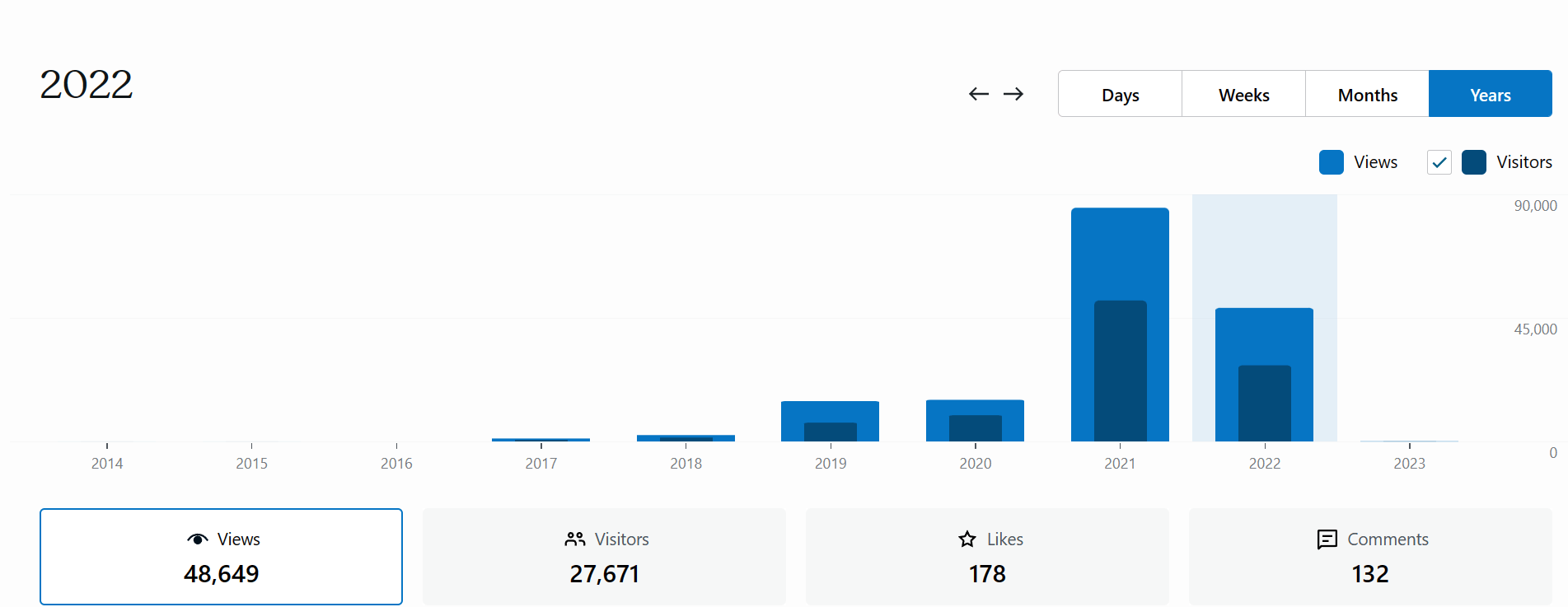
Stenonymous.com 2022 statistics showing about 27,000 visitors in 2022.
Stenonymous.com 2022 visitor stats.

Due to the drop in funding, I’ve been forced to find low-cost ways to spread the message and get attention on our issues.

Christopher Day standing with a Stenonymous.com QR code on a wearable sandwich board.
Christopher Day attracting attention to the stenographic legion and Stenonymous Q4 2022. Times Square.

I even enlisted the help of a cheering crowd. They know what stenographers need, international support. They told us to never give up.

Just kidding. While I was out there promoting Stenonymous, their protest was about the Burmese people, and while I don’t mean to co-opt their movement, I did want to make a point about the importance of my work as an independent body. Everybody has an angle. Big boxes want you working for them cheaply, manufacturers want to sell you stuff, I want people reading my work. The difference between me and a lot of other “influencers” is that my angle is not purely monetary. There is a social and political component to what I do. With your continued support, either through passing me information or monetarily, this movement to defend the interests of working reporters can only grow to have real teeth.

There are indications change is coming. Some of my sources have reported New York City copy sales as high as $1.00 per page and originals upwards of $4.30 per page. This is contrasted against the situation as it was in 2010 and many years thereafter, $0.25 copies and originals as low as $2.80. What’s happened in the last 5 years to make prices quadruple? Documentation and broadcasting of how bad New York freelance reporters are getting screwed. The documentation of events in our field has a value, but media growth will have more value. If we can get it in front of every law practitioner how easy it is to edit audio, they might be less inclined to charge into digital. If we can get it in front of jobseekers that digital court reporting doesn’t have the same career options as steno, they may find their way to steno or another career that treats them better. If we can continue to gather and release data that helps players in the market make informed decisions, it may reinvigorate an industry that some feel is in decline. If we can communicate to the public that the integrity of the appeal system is contingent on the accuracy of these records, we can get more people behind our cause.

Again, have a happy and healthy new year. I’ll be doing what I can to make this one count.


Christopher Day looking forward to the future of Stenonymous

Steno Shortage Stats March 2020

Before I begin, let me just say that I have no problem with transcribers. I do have a serious problem with companies pushing the record and transcribe method as innovation when stenography was doing that and stopped doing it because it was inefficient and costly. Digital reporters and transcribers come to steno because it is the better method for the consumer, the worker, and their hands!

We face a public relations blitz on us disguised as the “field changing.” As best I can tell, this is mostly to discourage us from recruiting for and promoting stenography. Nobody else is reading that. The easiest way to win is to get the other side to not fight, or to get it to fight itself. I’ve written about nearly all of this before, but it is nice to have in one spot. Here are some truths and concepts you should know before you buy the hype that we’re a dead field.

Conclusion: There is no reason stenographers cannot fill the stenographic reporter gap if we try.

  1. Self-reported, transcribers can take up to six hours to transcribe one hour of testimony compared to an average via steno of one to two hours. Regular transcription can take up to six times as long or require six times as many people to produce the same work.
  2. Simple math, stenographers input words 3 to 4 times faster.
  3. Assuming a stenographer workforce of 15,000 and a projected 2030 court reporter shortage of 11,000, it’ll take 78,000 to 156,000 transcribers to replace stenographic court reporters.
  4. The dropout rate before NCRA A to Z, Project Steno, Open Steno, Steno Key, and other steno initiatives was about 80 to 90%. If we are looking at recruiting 100,000 transcribers, we can certainly fill a gap of 10,000 even using the terrible dropout rate from years prior to 2015.
  5. The Ducker Report, which forecasted the shortage, is about 7 years old, and predates the initiatives in point 4. To my knowledge, nearly all court reporter shortage numbers are extrapolated from that report, and there has not been a new study since.
  6. The Ducker report predates layoffs that occurred in Massachusetts and elsewhere, and happened at about the same time as a major change in New York’s Workers Comp reporting. There are likely fewer jobs and a smaller gap than forecasted, as those reporters moved to fill slots that would otherwise be empty.
  7. The Ducker Report showed California, by far, as being the state with the largest shortage. If we win in California, we can win anywhere.
  8. 70 percent of reporters are likely to retire by 2033 as of the 2013 report. This means that if the field is still ticking in 2033, it’s unlikely to go anywhere for the next 30 or 40 years while those new people move towards retirement. This means reporters today have a unique opportunity to make or break the next generation of reporters by recruiting.
  9. Stenographers are ten times more organized and equipped to handle the shortage. NCRA’s 2017 revenue was 5,926,647. AAERT’s 2017 revenue was 195,652. For the sake of comparison, if we divide that revenue by the cost of a membership, NCRA would have 19,755 members at a $300 membership. AAERT would have 1,565 members at a $125 membership. Obviously, these do not reflect true membership levels, but they give us an estimate of the relative strength and support of the two organizations, as well as the support we give to our continuing education culture.
  10. There are four AAERT-approved schools listed as of 2020. There are 25 NCRA-approved schools listed as of 2020. If we judge by approved schools, stenographers are six times more likely to close the gap.
  11. The turnover rates of digital reporters and transcribers are poorly documented. Ducker acknowledges that stenographic reporters tend to stay in the workforce longer. Proponents of transcription and digital reporting look to the faster training time, but a faster training time means nothing if you’re constantly having to train the 100,000 people mentioned in point 3.
  12. Rates for digital vary wildly, between $15 and $45 an hour. This is not so different from stenography, but we have a culture of mentorship and showing people the ropes so that they can make wise decisions. Going by the numbers in point 9, there’s just no way for them to match the infrastructure and guide new people the same way we do, and ensure that there is a balance between the worker not getting screwed and the customer getting the best value possible.
  13. Using the “guesstimate” of membership and support in point 9, there are simply more of us to recruit and promote this field.
  14. Automatic speech recognition outfits like Verbit have gone from claims of 99% accuracy in Series A funding to statements akin to “we will not get rid of the human element” in Series B funding. Automated speech proponents, time and again, have made claims they simply cannot support.
  15. Expectations can impact reality. How we perceive the situation can directly impact the situation. This is the major hope of digital proponents. They want you to expect your associations and field to fail. They want you to expect to be replaced.They don’t want you to fight. We’ve seen this from Veritext’s love letters and Cudahy’s constant droning about the shortage. By alternating between messages of “good court reporters will always have jobs,” and “it’s impossible to close the stenographic reporter gap,” people who want change in this field are hoping that you will see the change as not impacting you or inevitable, and therefore pull your support from associations and grassroots efforts to protect our field. Conversely, you can expect to win. Expect that if you put in your membership dues, or a little volunteer time, you’re setting us up on the path to remain a stable profession and a viable career.