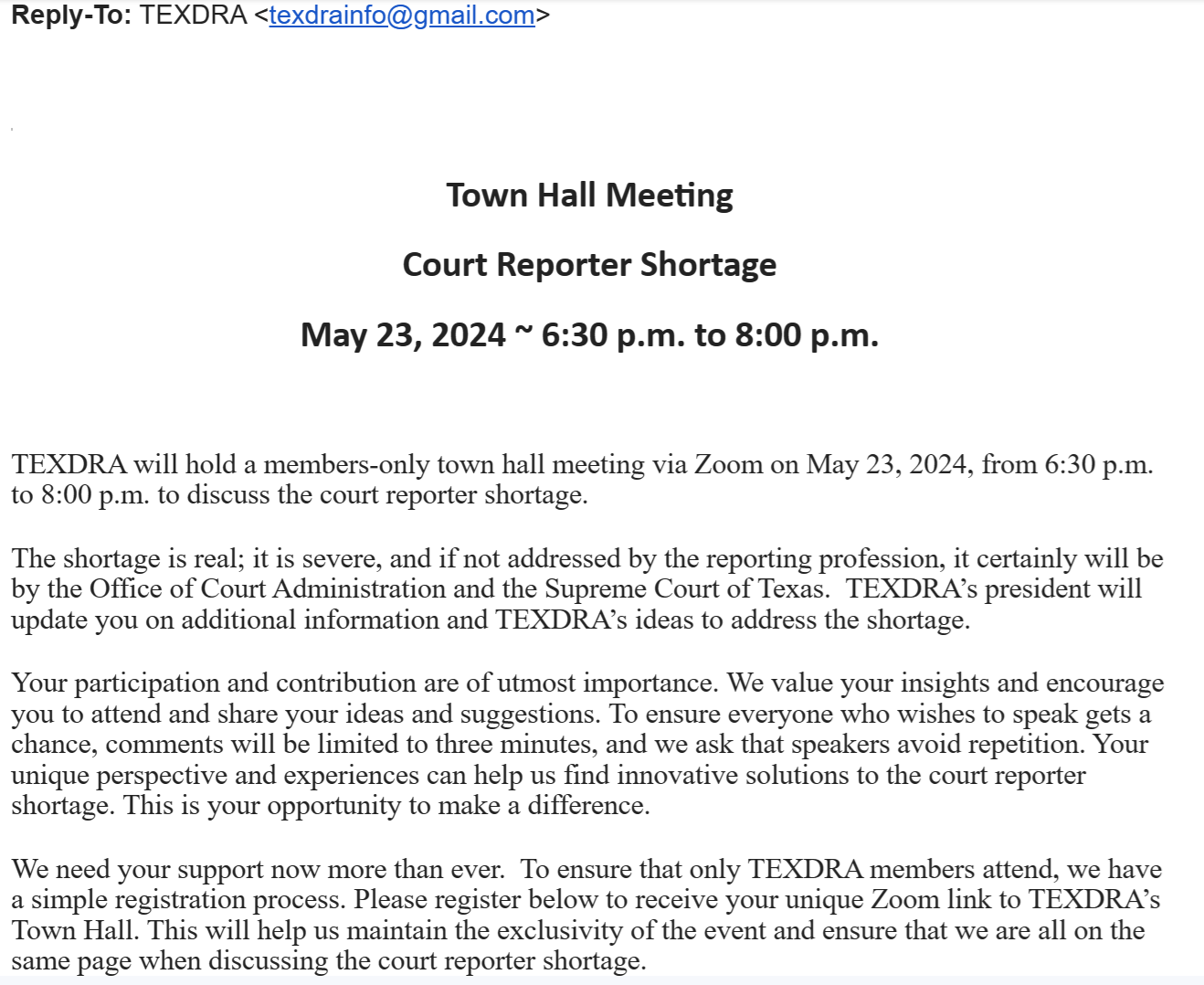
TEXDRA: The Shortage is Real! And That’s Why We Need to Talk About It Behind Closed Doors!

Registration Link

My sources say rural Texas is where the problem is. Might I humbly suggest looking at why people don’t want to cover rural Texas? Wait, here’s one. Pull people from undervalued Philadelphia and New York City. Give them relocation bonuses. In fact, go on my Rates Discussion Page where there are thousands of us and let people know that if their rates are too low, Texas is happy to have them. You can also go to Stenonymous.com, sort by relevance, and type in the words “shortage solutions.” There are 16 of them. The first one was from 2019. So Christopher Fucking Day beat TEXDRA to figuring out this was a thing we should be addressing by about half a decade. I’m not kidding, but this is most certainly a joke.

Also, you can tell this isn’t meant to get people’s ideas. If you wanted people’s ideas, you’d give them your ideas and let them build off them pre-meeting, kind of like what I’ve done pretty much every damn day for the last several years. It’s pretty clear to me that you’re getting people together in order to do what associations have done since time immemorial and tell them how to think rather than actually listening to their concerns. And again, sources say you don’t listen to your members’ concerns, so I have pretty much zero respect for TEXDRA as an organization at this point in history.

And why the need for exclusivity? Wouldn’t you want anyone with ideas to help solve your “problem?” For example, if I was genuinely trying to solve the shortage, I’d take the millions of dollars we waste on NCRA and start a school, or an information campaign, or just about anything that isn’t giving money to associations so that they can corral people into mindsets beneficial to their board members and the companies those board members represent. (This happens in New York too.) Heck, even just putting together some money for educators like Allie Hall who have shown that students can graduate within a year is a route that could be taken. Have her or others like her design a program that expedites the “student to scrivener” pipeline.

I’ll also say this: Company owners, inclusive of reporting firms and schools, have a financial interest in making the shortage seem as large possible so that we recruit more and more people. As the supply of court reporters rises and demand stays pretty much where it is, the rates will fall. This is pretty much indisputable and in the public view since I’ve written about it so many times. Pretty sure that at least one TEXDRA leader is a company owner according to discussions I’ve had with sources in the past. Sources say some on the board might be involved with or take work from big boxes. Big boxes benefit so much from exaggerating the shortage that some of them committed fraud to do it. Not hard to connect the dots screaming to be connected. They want to privatize the remainder of our public sector jobs and enjoy their little oligopoly where you play by their rules or starve.

Sorry if this seems a little angry. It is. These fucking people have the nerve to go on and on about how the shortage is real in their little closed-door meetings but can’t be bothered to do anything that someone actually trying to solve a problem would. Individuals are making more progress on solving localized shortages than entire associations. The whole thing is backwards.

For a fuller picture on why I am angry, NCRA’s pretty much admitted the shortage was not as bad as forecasted. STRONG itself said Ducker was outdated. I personally spent a lot of time and energy documenting that the statistics on our field were wonky and Ducker had holes. There’s also the indisputable fact that our median pay should not be taking a small hit during a time of “unprecedented shortage.” Also the scare tactic of “if you don’t do something, something will happen” is a propaganda technique called “appeal to fear.” I should know. I use propaganda techniques to tell the truth and raise consumer awareness.

Let’s not mention that there’s a meeting that will address this very topic coming up on May 17th. Why were members not encouraged to go there with their ideas?

Oops. I mentioned it.

This smells bad. And quite frankly I hope TEXDRA members are smart enough to see through it and throw your asses out for good. You deserve it.

And that’s the bottom line.

P.S.

You can screen record meetings using OBS software.

Addendum:

5/21/24: I’ve seen a screenshot asking for court reporters to fill out a survey to determine whether the shortage exists and to what extent. I find the questions a bit lacking and am monitoring this situation as much as I can from New York.

Lawsuit Update: Pasqual Perez III v Speech-to-Text Institute, et al. July 2023 Update

ORIGINAL POST HERE.

I recently took a look at Pasqual “Trey” Perez III v Speech-to-Text Institute, et al, lawsuit. I would like to share some notes I wrote as I went through the documents. So far, there have been no formal “Answers” in the case, mostly pre-answer motions to dismiss by defendants and, from the Speech-to-Text Institute, a “response to civil action.” I’m providing documents for download here and my typed notes below:

Amended Complaint – Didn’t really see huge changes, but admittedly only glanced through it.

Southwest Reporting Motion to Dismiss – Basically attacks facial sufficiency of the complaint under the Twombly and Iqbal standards for federal pleadings. They’re saying that the complaint does not allege facts that show a that Southwest conspired with anyone else. Paragraph 8 says the only new facts alleged in the amended complaint were in paragraph 16 of that amended complaint. Paragraph 8 goes on to talk a little about COVID and how that drove down demand for videographers.

Motion for Summary Judgment by Alderson Reporting Company – Alderson basically says “we didn’t make the decision to stop using Trey based on his new product.” They also point to COVID as a reason things changed. Alderson explicitly denies it ever discussed its decision to choose a new vendor with any other third party.

An order granting Dennis Holmgren’s motion to appear pro hac vice is included. Dennis Holmgren was the lawyer that helped bring the writ against the government for failing to enforce the law against StoryCloud.

Lexitas (Deposition Solutions, LLC) motion to dismiss – This makes the claim that Trey attempted to market his speech-to-text product to lawyers during depositions where he was hired to provide video recording services. Lexitas makes the claim that plaintiffs were not entitled to provide rough transcription services because they are not CSRs. It also alleges that the facts in the complaint do not support that Lexitas engaged in any kind of collusion. Lexitas likens Trey’s actions to a house painter trying to conduct electrical work they’re not qualified for and dismissal by a general contractor.

Court Reporters Clearinghouse, Kennedy Reporting, Sherry Fisher, Lorrie Schnoor, Sonia Trevino, and Shelly Tucker motion to dismiss – These movants also challenge the facial sufficiency of the complaint. The motion to dismiss makes the claim that the reference to others blackballing Trey does not rise to the level of sustaining a claim against Defendant Tucker. It further goes on to state that movants are within their right to stop doing business with plaintiffs because plaintiffs were violating court reporting laws. Similar to the Lexitas motion, it makes the point that the government sets the bar for entry and that plaintiffs did not meet that bar, therefore there can be no conspiracy to keep them out of the market. It also makes the claim that the non-certified transcript market talked about in the complaint does not exist. This motion also raises the claim that movants are not competitors and therefore cannot be sued under the antitrust laws.

Response to civil action by the Speech-to-Text Institute – Interestingly, the Speech-to-Text Institute doesn’t seem to file a formal motion to dismiss, but it sends a “response to civil action” by someone named Greg Kohn, Executive Manager of the Speech-to-Text Institute, care of Virtual, Inc. The response features affirmative defenses, such as stating that Steve Townsend was never President of the National Court Reporters Association, among other things. What surprised me about this was that they referenced their website. That website likely went down between 5/19/23 when this document was filed with the court and 5/31/23 when the Stenograph Town Hall occurred.

To be honest, it doesn’t really surprise me that they’re hoping to get out of it based on the bare-bones allegations in the complaint. The complaint never makes reference to any of anticompetitive acts I was accusing the corporations behind the Speech-to-Text Institute of, such as pumping the market with false, outdated, or misleading information designed to expand demand for digital court reporting. Actually, reading this response gives me a bit of a theory. They’re hoping to be blanket released from the case with the other defendants and now with their site gone plaintiff will have a harder time proving their false claims because their website has been dusted. To my knowledge, the only way to peruse that website is to pull snippets off Stenonymous or use the Wayback Machine. If Trey manages to get past pleading stages here, I wonder if it’ll come up that they vaporized their website about 10 days after filing a document with the court referring to that very same website.

The Texas Court Reporters Association also filed a motion to dismiss, but I did not have time to review that prior to launching this post. I can only assume it points out the same issues, but if I get around to reading it and learn I am wrong, I’ll amend this post.

Overall: Reading through the defendants’ filings has made me rethink some of what I thought in my original post. It will be interesting to see how many defendants are able to succeed in extricating themselves from the lawsuit before filing an Answer.

Addendum:

The Speech-to-Text Institute’s response will also be hosted here.