

I had the opportunity to sit down with the transcript and audio of a small claims case and claimant Wayne G. Wilson. Throughout my time with Mr. Wilson, reviewing the audio, there were several areas where he felt colloquy and testimony was missing from the transcript. Using my general court reporting experience, I listened to the audio, and did not hear any cutaways that suggested tampering, but I am not a forensic audio expert, so take that for what it is. There were a number of off-the-record discussions, so it is possible that a situation arose that was believed to be on the record when it was actually off.
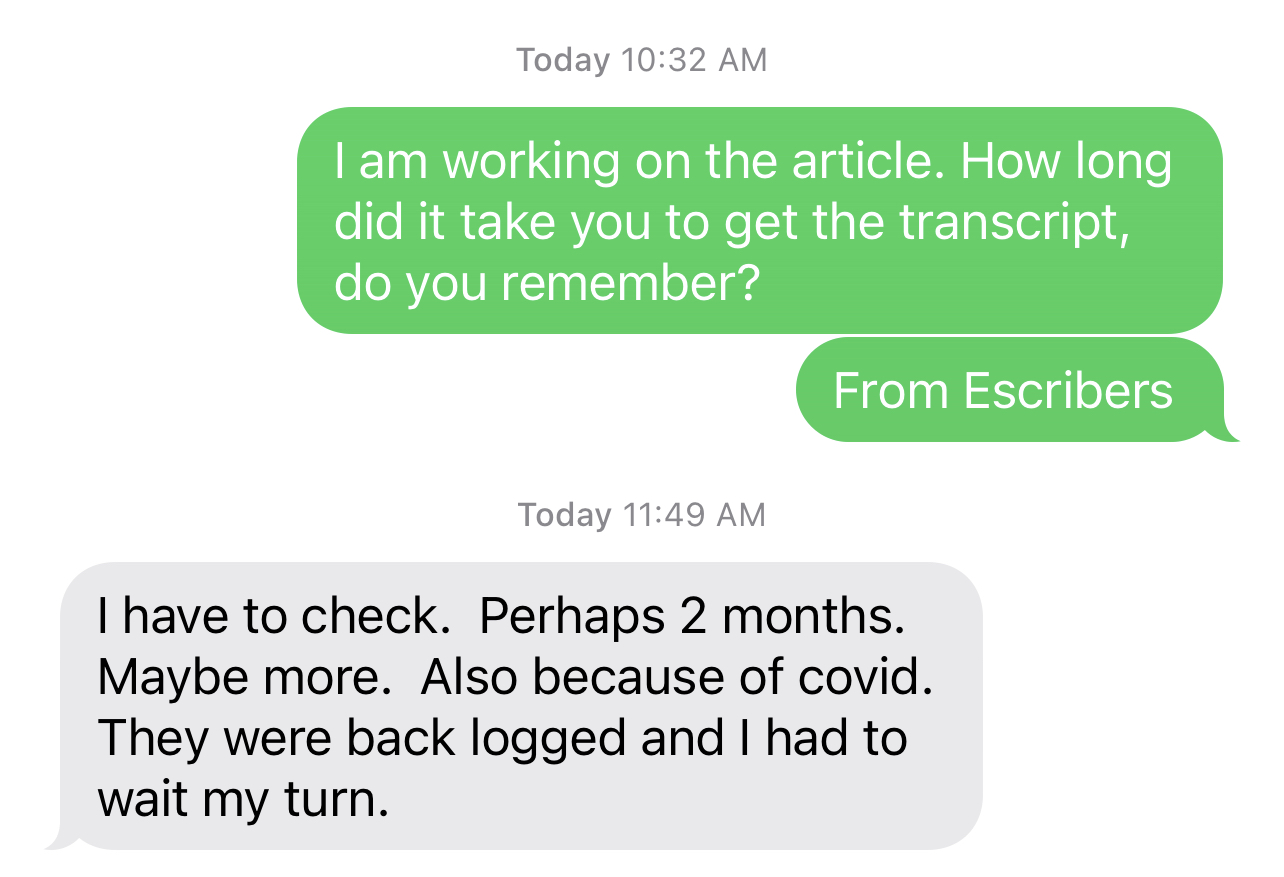
It’s a long small claims trial, 66 pages, so I think the best way to do this is to provide a brief summary, provide extra insight received from Mr. Wilson, reveal video from after the trial, present major errors, present minor errors, and then allow people to download the transcript. Before I begin, I’ll say that this is among the best digital transcripts I’ve seen (eScribers), and it points to the fact that digital can produce acceptable or close-to-acceptable transcripts. We have to grapple with the fact that stenographers make mistakes too, so I’ll try to be as fair as possible, and we’ll get through it. My first notable comment is that the $3.65 per page was charged for a 14-day turnaround according to a bill received by Stenonymous. It is notable that $3.65 is the expedited rate for New York transcripts according to Part 108.2 (b)(2)(ii). That section provides for 5 business days turnaround time. As far as I know from reading about small claims from various sources, and from my own small claims case years ago, the proceedings are recorded without an audio monitor (AAERT standard is to have a monitor) and outside vendors transcribe the matter. Succinctly, right from the start, it appears that litigants could be paying nearly 22% more for what would’ve been a stenographer’s “regular” delivery. But while the bill states 14 days, Wilson states the transcript took months to be prepared, lending credibility to reports that transcription can take much longer than stenographic court reporting.
The case is fairly simple. Mr. Wilson alleges that he brought his car to a body shop or auto business, captioned as Mike’s Roadway Collision Experts, Inc., apparently A/K/A Roadway Towing and Auto Repair. The trial took place on September 23, 2022. He wanted the car painted and serviced. According to the testimony, a verbal estimate of $1,500 or $1,800 was provided and a $500 deposit was paid. From the transcript of the proceedings, the deposit was paid on June 2, 2021, and an agreement was made that the car would be done in two weeks. Events unfolded and the shop allegedly needed more time. Wilson claims that in July he walked into the facility and saw journeymen working on the car, but rubber seals were ripped off or damaged and the interior was ripped “with reckless abandon.” Wilson further explains that he had another car in Nebraska and that he would part it and fix up the car at Roadway Towing. Ultimately, defendant representative Michael Morales states in the transcript that the initial price was $2,500, that extra repairs brought the price up to $4,500, and that the price was subsequently dropped to $3,500 or $3,000. A lien was put on the car and the dispute is ongoing. Wilson has stated he does not know how a lien was put on the car because he was never served.
Wilson has several complaints about missing information in the transcript. He remembers a discussion where the defendant representative, Michael Morales, said he didn’t know anything about the carpet, and remembers an exchange where the judge questioned further about this event, allegedly stating “you said you didn’t know… [about the carpet].” This appears nowhere in the transcript or audio that I reviewed and leads Wilson to believe that there is missing information thanks to the digitally recorded proceeding.
There were some comments on the record about the car being a rust bucket. Claimant says the car wasn’t rusted. Claimant says there was confusion at the proceeding where the car in Nebraska was mistaken for the car in New York, and that it was the car in Nebraska with some rust under the fenders, which were taken off. This goes to show that even where a transcript is decent, there can be unclear points of testimony or colloquy that make litigants question the process. Hopefully it encourages us all to do our best to ensure accurate records and increase litigant confidence.
Wayne Wilson points to page 31 in the transcript as evidence that defendant is being untruthful, stating “there was no insurance. Couldn’t put insurance because I had no license or registration. There was no accident and no reason for insurance to be taken out on the car.”
In videos obtained by Stenonymous, Mr. Wilson and an unidentified cameraman apparently confront Mr. Morales, with Mr. Wilson stating “you said the car is $1800, and I just want my car, to pay whatever I need to pay to get my possessions, bro.” Mr. Morales appears to be calling the police while being filmed, and can be heard stating “…he disturbs my shop every time he comes here. I cannot trust him, I don’t know if he has any weapons…” Mr. Morales makes it clear during the video that the matter is pending in court. Later in the video, Morales states during the event “everything was done on the car…” “…and you don’t want to pay! Now you lost the car.” He continues “you’re not getting the car until you pay me all my fees.” Wilson retorts “what’s the money?” Morales comes back “I’m not discussing anything with you.” When the unidentified cameraman says “so you stole the car,” Morales replies “yes, I stole it. That’s what you say.” Eventually the altercation devolves into Wilson yelling “how much money do you want to claim now?” Both men accuse the other of being a “liar” and “clown.” At the end of the videos, Mr. Morales is seen taking out several pictures, stating “film that, this is the car.” An abrupt end followed.
A copy of the video is viewable here.
Wilson says he’s been “baited” by Morales in the past. Asked for comments by mail, Michael Morales did not respond as of publishing.
Regardless of the merits of the dispute, at the end of the small claims case the judge noted that the case was dismissed without prejudice pending action in the Supreme Court of the State of New York.
Major Errors:
1. Page 33, Line 19, “your” should be “the.” I count this as major to the extent it could be used for impeachment in a future proceeding where the insurance issue becomes relevant. If not, minor error.
2. Page 41, Line 6, “have” should be “had.” To the extent a reader might be confused between the past and present state of the car, this can be nothing or it can be an issue.
3. Page 41, Line 7, there’s an unidentified speaker. This isn’t the transcriber’s fault, but it shows the problem with recordings. There will naturally be responses and designations that are best recorded in person, right there on the spot.
4. Page 48, Line 14, Mr. Wilson is designated but Mr. Morales was speaking. Stenographers can make this error too, but I do consider it to be major in that it can confuse a reader.
5. Page 49, Line 1, Mr. Wilson is designated but Mr. Morales was speaking.
6. Page 55, Line 9 and Line 10, “And then, *if* he — he shipped the car from Ohio. He wants me to pay for that? When I had — that was way before I even — ” Missing the “if” and the question mark does seem to change context here in a way that could matter in the future.
Minor Errors:
1. Page 3, Line 10, the word “right” is missing from “raise your right hands.”
2. Page 6, Line 2, an inaudible where no crucial information appears to be lost.
3. Page 9, Line 2, ’89 Volkswagen Cabriolet is missing its apostrophe.
4. Page 12, Line 20, the judge’s comments are omitted without an “off the record” and there is an inaudible.
5. Page 14, Line 14, an inaudible.
6. Page 15, Line 25, a period is missing between “of” and “minus.”
7. Page 16, Line 24, the word “every” should be “ever.”
8. Page 19, Line 13, the word “my” is omitted before “windshield.”
9. Page 19, Line 15, possible “style difference” rather than error. Quotes can go on what was said, but this is debated in our field.
10. Page 19, Line 16, a question mark is missing after “windshield.”
11. Page 20, Line 24, Morales appears to say “no, no” rather than “no.”
12. Page 21, Line 8. There is a small pause where Wilson believes there may be something missing. I did not hear a significant change in the background noise to indicate a skip.
13. Page 22, Line 19, “brought” should be “bought.” Wilson feels this changes the context of the answer.
14. Page 25, Line 8, “are” should be “care.”
15. Page 27, Line 14, “for” should be “to.”
16. Page 32, Line 2, “would’ve” should be “would.”
17. Page 33, Line 8, I do not believe a comma should go after “and now.”
18. Page 35, Line 2, missing a question mark.
19. Page 38, Line 19, Wilson believes they discussed the exhibits and it does not appear on the record.
20. Page 39, Line 4, “message” should be “messages.”
21. Page 40, Line 17, Wilson claims the judge said “nice picture” or “she’s hot,” and it’s not reflected in the audio or transcript. He points to this as evidence that other things could be missing.
22. Page 41, Line 13, only one “in.”
23. Page 42, Line 19, “under our” should be “under article — “.
24. Page 43, Line 9, it should be “and had shipped.”
25. Page 43, Line 10, it should say “about the car.”
26. Page 45, Line 14, inaudible. It should say “tip.”
27. Page 45, Line 18, inaudible. It should say “change.”
28. Page 46, Line 3, there’s an off-the-record discussion with no indication from the judge that they’re off record, though this may just be standard small claims practice. I don’t know because my experience with small claims is mostly limited to a case I had against State Senator Jesse Hamilton several years ago.
29. Page 46, Line 5, “he bring” should be “he brang.” This is a verbatim nitpick.
30. Page 46, Line 17, there’s a random apostrophe at the end that should be deleted.
31. Page 47, Line 8, missing comma between “Nebraska” and “not.”
32. Page 52, Line 7, missing a question mark.
33. Page 52, Line 16, Wilson recalls the judge stating that Morales “lacks candor.” This does not appear in the transcript or audio.
34. Page 56, Line 15, “judgement” should arguably be “judgment,” but this may be a style choice.
35. Page 59, Line 8, missing a comma between “again” and “whatever.”
36. Page 59, Line 13, missing a period.
37. Page 60, Line 18, inaudible. Likely should’ve been “Maspeth.”
38. Page 62, Line 7, “judgment.” Style choice.
The invoice and transcript are available to download below.
If anybody’s still with me, this is an interesting moment for me. I am 100% for the aggressive expansion of stenography. I believe that given enough time and resources, we could do absolutely phenomenal things with court record access across the country. I will likely spend the rest of my professional career, as a stenographer at least, advocating for working reporters and looking for opportunities to bring investors to steno. But honestly, if every transcript was this good, I wouldn’t have such strong feelings about digital quality degradation from the standpoint of the people transcribing. By my review, this seems like a transcript that got adequate attention from its transcriber and proofreader. But there are inherent problems with digital recording from a time and efficiency standpoint. Two months to get a transcript is too long, excluding jurisdictional exceptions. I’d say the same with stenographers that are excessively late on their work, up to and including the times I’ve been late on my own work. We also lose words to inaudibles by doing it digitally. Luckily, no inaudible here seemed critical. Then on the efficiency angle, we’re inputting stuff at 225 WPM and cleaning it up after. They have to painstakingly transcribe, with transcription speeds generally ranging between 50 and 100 WPM. The stress on the wrists alone points to stenography being better for society.
What does the audience think?
Audio is no substitute for a human court reporter!
44 errors in an approximately 60-page final transcript is considered good quality? My rough drafts have fewer errors.
Perhaps I should clarify. I tried to look at this from the perspective a lawyer. Their question, most of them, is, “is it functional?” So if we dig in our heels and say this transcript is not functional, we look ridiculous.
But is it up to the standards we want in the field? No. It is not. And that’s why I publish.
I’m a lawyer and I’m struggling with this very issue. It’s how I came to your article. Caveat: I’m a public interest lawyer who doesn’t do personal injury, so maybe I have a different perspective. I’m not looking at cost-cutting. I’m looking at appeals.
Most of the district courts in my state appear to use digital court recorders and then farm out to licensed court reporters whenever a transcript is requested.
Right now, I’ve got an 11-page transcript that has more than one error on every page.
It has 17 “(inaudible)” marks throughout it, including at substantive places. It has two sections where the audio was allegedly so hard to decipher, because people were speaking over each other or there was interference, that it was apparently “indecipherable.” And yet the litigants were able to hear each other and decisions were made based on what was said in those over-speaking moments.
The hearing was transcribed by a certified court reporter, but there was no court reporter or stenographer at the hearing. Most of the parties appeared through zoom (so, surely this amplifies the challenges).
The defendants in the case are black Americans in a rural, largely-white county, and in one of the places where there is an issue of indecipherable recording, the blame is placed on the defendant–in bold: “(CAN’T HEAR ATTORNEY OVER MR. [W]’s TALKING)” but with no effort to indicate what Mr. W was saying or the fact that the attorney was also speaking over Mr. W. Vernacular is surely a part of the issue, though the white attorneys also have “(inaudible)” omissions, so it can’t just be a matter of the software not understanding a specific accent. (I mention this, in part, because there is a human element in every transcript, at some level).
There’s apparently ONE court reporter for all of the hearings conducted in this county’s courts. I’ve had seven hearings transcribed by this reporter (over multiple different cases) and *every* one of them has had what you’ve classified in your article as “major” errors–blatant errors on matters of substance, down to and including mis-identifying whether it was a judge speaking.
On the sixth transcript from this court reporter, I was simply unable to use the transcript and ultimately the judge ordered her to re-do it. It seems the court staff was able to distinguish the errors in reviewing the recording of the hearing (as you have done in your article). But here I am at the seventh one–with these 17 inaudible sections on an 11-page transcript–and I’m struggling with what to do: I don’t want to alienate this court reporter (any more than I already have….)–like I said, she’s apparently the only one we have in this county–but the usability (or “functionality,” to use your word) of this transcript is questionable. I’m finding myself debating “is it function? Is it good enough to make my appeal argument?” It’s only 11 pages. How can there be this many errors?
I don’t know if this is a matter of the quality of the court’s digital recorder or audio, or of the certified court reporter taking diligence in reviewing the digital transcription and supplementing it, or of my standards/expectations being too high.
On the other hand, can standards really be too high when we’re talking about justice?
I’m curious what you think, I’m curious what your other readers think. I empathize with this court reporter’s work load. But when barely functional is the norm, something isn’t working right.
It is my belief that the standards cannot be too high when it comes to justice. But there is a reality-meets-dreams scenario where we have our professional culture that we expect everybody to follow, but not everybody does.
I wouldn’t expect so many substantial errors in so few pages. But then again, I’m sure one day someone will find a botched transcript of mine. We do so many, there are bound to be mistakes.
Perhaps you could write to a local decisionmaker about getting another court reporter in there to maybe take the workload off or improve workflow or whatever thing you wanna dress it up as. I could even ask my audience to help you fill the position.
I believe very much like you, that we don’t want to alienate our fellow human. But I’ve also learned that sometimes the only thing people respond to is leverage, and if she knows people have options, she might just improve.
If she is a member of the NCRA the public is allowed to file COPE complaints.
As for a more honey, less vinegar approach, for most of us flattery works. Feed us a few lines about how hard we work and how important what we do is and you’d be surprised how diligent you can get us to be.
Then again, it could genuinely be the audio quality. Sometimes it’s bad. Sometimes it’s really bad. This small claims audio I listened to was CLEAN. CRISP. If every digital recording was like that, stenographers would feel very differently about it.
This is why we’re having it out with the digital reporting side of the field though. They want to take a professional culture and turn it into a side hustle culture — if we’re having these kinds of problems now, what can we expect in the future?
Thank you so much for coming here and commenting. I’ll be thinking of this one for a long time.
Dear Anonymous Attorney,
The situation you are in is going to be the norm and only get worse if we don’t have attorneys speaking up for stenographers and helping us win this fight against the movement to go to ER. If it takes 3-4 times longer for a stenographic transcriptionist to produce a transcript from an audio recording, then it would take 10 times longer for a QWERTY transcriptionist, then you will be looking at very long delays once all of the 58 counties in CA have gone to ER and have permission under the law to just record all of their unlimited civil and family matters (SB 662 is expected to pass in January 2024). If all the courts decide to go to ER, it will be impossible for our stenographers to keep up, and even the gig-economy QWERTY transcriptionists couldn’t keep up. This movement could spell the apocolypse for the legal community. They expect stenographers to become transcriptionist and do their audio recordings, but no, we won’t. That is not something many of us will ever do. I, for one, will NEVER do that. But there are retiring reporters who wouldn’t mind being able to do the transcription work from home or from a new location where the cost of living is lower, but they will only do it part time to supplement their retirement. Don’t count on the full-time workers you have now. And if our numbers drop because we are quitting the profession, then our vendors won’t be able to support us. The stenographers left won’t have anywhere to go for software and hardware. The whole industry could collapse and evaporate overnight. It’s a doomsday scenario, but it’s a very real possibility. And I’ll tell you, what court reporters know is not found in any book. Our body of knowledge is in our minds and we teach each other through mentoring. When we’re gone, our knowledge goes with us. There will be no one to teach the QWERTY transcribers what we know. Trust me; it’s taken 20 years to develop the skills and knowledge I have. The courts and the judicial council are making decisions based on false information from STTI where they did no actual study. They took the Ducker study and just drew the line on the graph out to a fictional spot on the paper to represent their assertion that there would be a worse shortage, with no evidence-based scientific analysis. It’s a hoax. It’s a lie. The courts could be doing a lot more to ensure the survival of stenographers. We need attorneys to start fighting alongside us, because attorneys and litigants will be the true losers in this doomsday scenario. We will be left with a tyrannical system of justice where the court owns the record. The court owning the record is not a good idea. Look at the Christmas massacre in 2021 where the recordings of 3 days of court just conveniently disappeared. Stenographers are the protectors of the record. The court has NEVER had that role, and when they take it, as they are attempting to do now, they won’t care about that role of protecting the record as seriously as stenographers have for hundreds of years.