Bulletin: Does Anyone Know A NY Attorney or Pro Se Litigant Ripped Off By Court Reporting Agencies?

I’ve been in touch with an attorney that is looking for potential New York plaintiffs to take on the unfair billing practices of court reporting companies, especially big boxes.

SPECIFICALLY, looking for someone in New York ripped off by a New York company OR potentially someone out of state ripped off by a New York Company. Or, of course, the New York office of a larger company.

Stuff like:

– Charge full price for copies
– Charge full price for word index pages.

– Page padding (using excessive parentheticals or bizarre formatting to make something many more pages than it needs to be.)

– Charge stenographer rates for digital court reporters.

-Tack on random fees, particularly of services that have not been ordered or requested.

-Use bills that aren’t itemized so it’s unclear what’s being paid for. 

If anybody knows someone, we can push this issue, make it more public, and potentially achieve greater price transparency in court reporting, which would serve honest workers and the public alike.

Feel free to share this bulletin. Your share might be the difference between success and failure. That’s how it was with the legal claim against the National Court Reporters Association, and that’s how it’s going to be till the end of time.

National Court Reporters Association to Exclude Non-Members From NCRA Social Media Groups

Court reporting has a huge Facebook presence. The National Court Reporters Association is acutely aware of this and has lots of different Facebook groups catering to the different types of reporters.

(Sorry to all the CART writers that don’t like being lumped into the reporter umbrella.)

Some of the NCRA social media groups are pictured

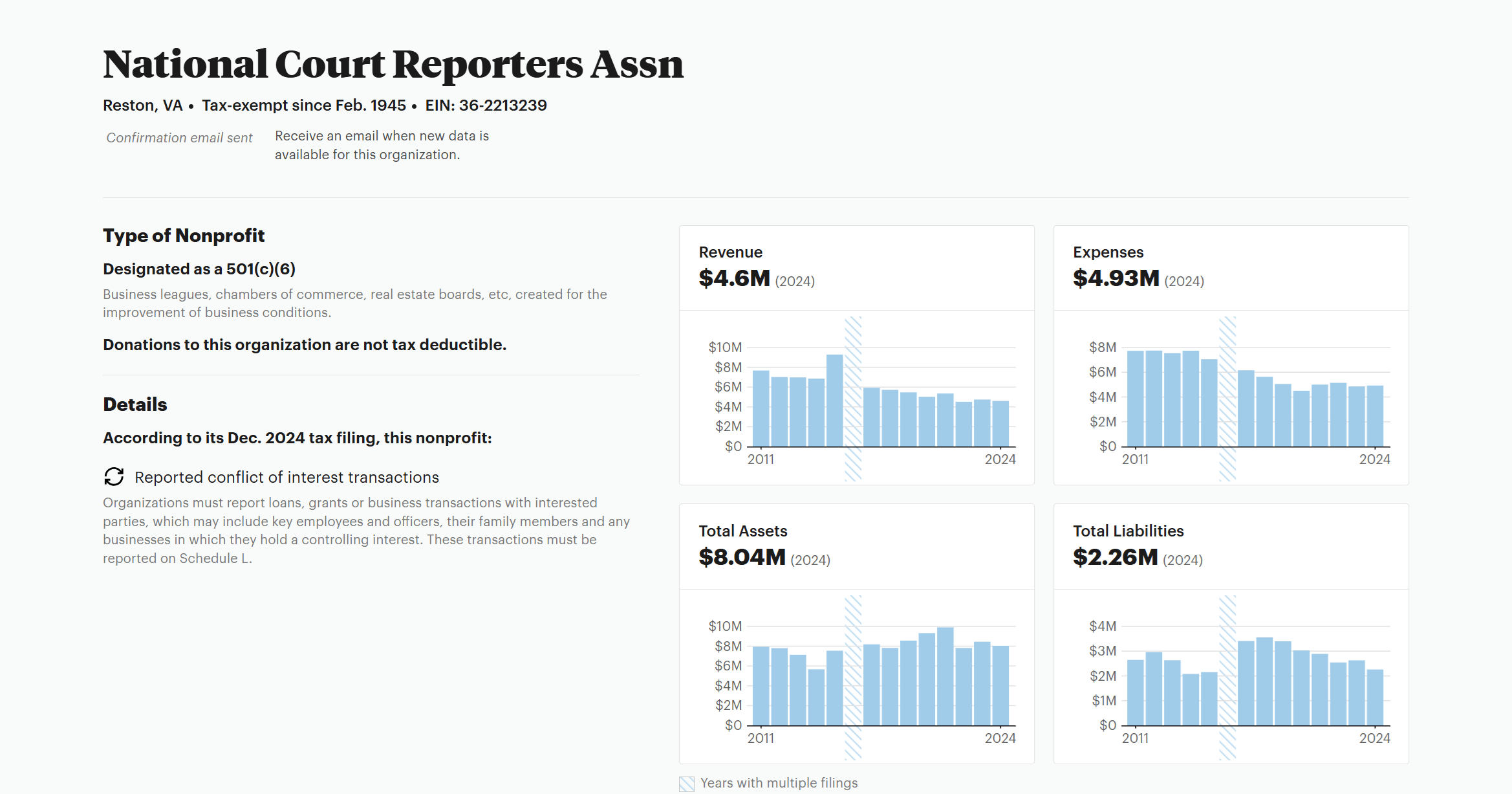
There’s no secret that the National Court Reporters Association has, overall, been bleeding members, with more expected losses forecasted to about 2030 thanks to the retirement cliff and the expansion of digital reporting by the larger corporations. This is in addition to people burned by the organization in one way or another who leave voluntarily, like yours truly.

So imagine my surprise when it was announced they’d be culling non-members from their groups.

An announcement by NCRA in the CART group
An announcement by NCRA in the scopists and proofreaders group

This selective inclusivity is precisely what’s killing the organization. If you want people to be excited about membership, excited about the organization, excited about joining and making a difference, you engage with them. You can’t engage with people you exclude. Why in the world would we exclude non-members from these spaces if there’s nothing nefarious going on?

Who knows? Maybe there is something nefarious going on. The NCRA does have that antitrust suit filed against it after all.

For better or worse, I’ve always allowed open engagement in my Stenonymous group and on this website. I take the time to answer and like almost every comment. You can trust my brand to be open and honest. Why can’t you trust your national association to be the same?

To be honest, if you ever wanted a place to spend the $300 wasted on membership dues, Stenonymous would be a good bet. I engage with news reporters to spread information about the field. I report accurately, openly, and faithfully on industry news, concepts, ideas. It wouldn’t really be all that hard to get some lobbying going if I had significant buy-in from the community. And then what does NCRA provide besides the certifications? And it probably wouldn’t be all that hard to get a certification program going under a slimmer organization with bylaws that don’t violate the antitrust laws. After all, I have good relations with people that have instituted the New York State Court Reporters Association certification program. Yes, I would have to give up the blogging and the wild man approach to politics, but I’d make it work.

You ever want a new association dedicated to stenographers, I’m your guy. But I can’t do it for free. I would need enough reserve cash to safely leave my job and do what really quite honestly needs to be done in this field — NCRA needs stiff competition. (Stenograph too!)

To all the NCRA members reading, don’t let your leaders lead you off a cliff. Don’t watch them burn your dues with their poor decisions. Demand inclusivity or get out of the club before it crumbles. Imagine the possibilities. Take control of your destiny.

Sometimes the path of least resistance isn’t the smartest choice. Sometimes the way forward is through.

Mel Elberg Interviews Brynn Seymour!

“I envision focusing on all of this more as of now– being able to really help more people that are in the same boat that I was in a couple years ago”  – Brynn Seymour

ME

Hi Brynn!

BS

Hi, Mel. How are you? 

ME

I’m well! So I’ll just jump right in if that’s alright? I know you’re a life coach, as well as a stenographer and host of the Court Reporter Podcast, and I’m wondering: which came first? What was your impetus for getting into these areas of work, and how did they become integral parts of your life? 

BS

Great question. I started the podcast in January of 2023. So at the end of 2022 I announced to my Facebook group and its community of court reporters that on January 1st The Court Reporter podcast would launch– because it was time that we started talking more about the struggles we faced and the solutions we can create in this unique industry.

I’ve always listened to podcasts. It’s just so convenient to listen to a podcast while you’re doing something else, like laundry, cooking, cleaning, or driving. If there’s something I need to learn about, then I go to podcasts to find out. 

So, often every week, I would search for one on court reporters. I looked and looked and looked, and there was really no one out there who was speaking for the court reporting industry, to help us with solving all these industry-related problems that we end up doing so much research ourselves on. There were many podcasts from life coaches, (and my favorite one was The Life Coach School, actually, which got me into life coaching). And those podcasts were very helpful for me, as a person who has ADHD, as a person who is feels disorganized and needs just, for self development, self help things like that.  But there was nothing specifically for court reporters.

So I decided that I just have to create the solution to this problem and do it myself.

ME

I love that. How did you meet your mentor, Josh Edwards?

BS

I met Josh at the New York State Court Reporters Association. He was assigned to me when I was in court reporting school, and he would help me with any issues that I had. He’s really good with Case Cat and a wiz with the technology. He’s a master certified court reporter in all the different categories that NCRA has.

ME

That’s fabulous. What’s your experience been with building community around the podcast? I’m curious as well how that’s affected your experience at work, in court itself.

BS

I started a Facebook group, because it seemed that the best way to build a community for court reporters was where they already were. So I have been welcoming people into the group, and building up conversations around what issues it is they want to hear about. We can do live discussions. We can do zoom meetings. We can do big discussions with all of us, it doesn’t have to just be me talking. I don’t want it to just be me. In general, I want more conversations for court reporters, to hear about other people’s experiences, to ask “how do you handle this? How do you do your bills and your booking and your scheduling? How do you manage your time when your schedule is so unpredictable?” 

The answers are so different for everyone.  So the community has been helpful for that. Although, when I started working full time in court, it became difficult to make time for it. I was working with a group of court reporters, so I gave them printouts of all the ideas that I had for the podcast, and told them that I’d love to interview each of them. 

But, working full time in court, it’s difficult to manage our schedules and to find time to meet together, so that kind of held me back from doing the podcast more at first. But now I have officially resigned!  I want to go back to freelance so that I can focus more on the podcast and on life coaching, because I really want more people to be able to be helped by what I needed so badly when I was searching for a podcast. I want to be able to offer that to more people, and to really help people one on one as well.

ME

Beautiful. Do you have any favorite moments from the podcast, any that are really near to your heart, or anecdotal?

BS

I mean, all of my guests have been amazing, and it’s a wide variety of people– attorneys, judges, court reporters.  One episode I have is called, “Are we on the record?” And we talk about the frustration, when the attorneys and judges just start going off on these side conversations without saying that they want to go off the record, and we’re still on the record, typing everything. And I’m like, do they really want this on the record? Because it doesn’t seem related to the case. So we have these internal battles of ‘what should we do?’ I eventually came to the conclusion that I need to just interrupt them and ask– but it’s things like that, that I really just love having an outlet for with the podcast.

ME

Yeah, I’ve heard a few other stenographers speak similarly about the necessity of asking folks in court to speak up and slow down.

BS

It’s interesting, because some court reporters are great at it; it really depends on one’s personality type. I’m an introvert, and it’s not easy for me to bring attention to myself, not feeling 100% sure if I should speak up at that moment. Sometimes you’re unsure of what you’ve heard. We all have an audio backup sync, and when I go back and check, it’s very easy to think, ‘Oh, why didn’t I get that at the time? In the moment, you’re multitasking: you’re typing, you’re listening, you’re monitoring everything. So I always have that hesitation to interrupt.  But later on, it’s so easy to figure it out with the context clues. 

That’s another thing I want to help court reporters who are especially shy with.  Because they don’t teach you that confidence in school, which is more focused on the trade and typing skills. When it comes to those emotions that we feel, and the internal struggles–  I needed that kind of help when I started out, and it just wasn’t there.  So that is something I want to help people with now.  

ME

That’s awesome. I’m interested in your experience as a woman in a male dominated industry. Does that coincide with your impulse to advocate for yourself and other women, who may hesitate to speak up when they should?

BS

I do feel a little bit more comfortable when it’s mostly women. I don’t really like to be surrounded just by men.  But the good thing is that there are so many more women attorneys nowadays than in the past, and it’s getting better. In the Bronx Supreme Court, where I was working, 90% of the judges were female. That was so great.

ME

Wow! I’m so happy to hear this.

BS

The tables are turning. I’m also part of The Church of God, which does a lot of sustainable development events, and we hosted an event for women judges in this month of Women’s history, on March 3.  We did a UN International Day of Women Judges event, and 15 women judges came from the court system to the Church of God in Scarsdale.  We honored them, they spoke, there was a panel discussion about the rise of women and about women really taking that step forward.

ME

Incredible! How do you feel about AI and the future of Stenography work? Tell me about the  VTM program you’re developing.

BS 

VTM has nothing to do with AI– it’s where you implement a system for yourself as a court reporter, so you don’t have to be working so much at managing every deadline and transcript, but you have built a team for yourself with humans. 

If there is an AI solution, I’m all open to learning about it.  If there are tools that can help us with our work, I would love AI.  I do think there are risks, and we have to be careful, and that’s why I want to do my research first.

Actually, Chris Day and I spoke about it when I interviewed him for the podcast. He does so much research on that.  There is a tool in Case Cat, called “check it”.  And it’s pretty popular in court, so I decided to try it. And when I did, I thought, this is kind of garbage, to be honest. It was suggesting changes that were completely ridiculous, such as changing ‘address’ to ‘dress’, even though the context was asking, ‘What is your address? State your address for the record’. 

I know artificial intelligence is supposed to be intelligent, so maybe that was just a fluke, but that stopped me from using it. 

ME

I love the continuity between your podcast, volunteer work and spiritual work, via your love of helping people. I’m curious how you navigate that work-life balance?

BS

There’s a program that I took when I was in my life coaching certification school called Monday Hour One, which trains you on making a schedule for yourself. So every Monday (or I like to do Sundays), the idea is to plan out the things that week which you want to do for your personal life– whatever is most meaningful and important to you, you plan first.  And then you plan your work and everything else around that. 

As all court reporters understand, in our industry we struggle with the ability to predict what our day is going to be like, and I too struggled with that for a while.  But as I’ve grown as a person and as a life coach, I feel like now I’m finally coming to a point where I’m getting closer to that balance. And it really does make a difference when I am able to schedule out my weeks where I spend that one hour really planning, downloading everything that I have to do out of my brain and onto paper, and then prioritizing each thing and putting it into my calendar. 

The most important thing to me is my spiritual life and my relationships and the people that bring meaning to my life, and family. So I put those things in first, and now that I have an open-canvas calendar without the nine to five, that’s what I’ll be doing more of. I’ll be able to put more time into those things. 

Like just today, I was able to meet with my sister at lunchtime, and I just got back from it, and it was great, because it felt so good to be able to put that in my schedule and to actually stick to it. 

ME

I love that, you really practice what you preach. 

BS

The most important part is to take the time to reflect afterwards– why wasn’t I able to stick to the schedule, what happened, what came up, and why? And do I like the reason why? And if it was for a good reason, okay. But if it was unintentional, or a waste of time, then I take that into the reflection– which we’re supposed to do every Friday, to reflect back on how the week went.  I think I personally need to reflect every single day. So that’s what I’m doing.

ME

I’m trying to do that too. Who have you encountered in your work who is also supportive of court reporters, who is championing their value?

BS

There are some court reporters doing great work promoting the profession, volunteering and just getting the profession out there in general. And I think it really helps court reporters to hear from attorneys and from judges about their own views on the importance of the court reporter, and their view on how a court reporter can do their best.  Those kinds of insights are so helpful. 

I want to see more of the different roles in the justice system working together.  How can we collaborate with each other, even interpreters and court officers, like a team? The judge too. In freelance though, it’s more about the relationship between the attorneys and the court reporters. So I love to dive into the personality types, the emotions we go through, and the communication styles that we have.

ME

Wonderful, yes!  On a different but related ‘collaborative’ note, tell me about your take on court fashion.

BS

I have an Instagram called Courthouse Fashion. So whenever I have a nice outfit on, I just go out and take a picture and post it. If I’m early enough, I like to use my tripod– sometimes the girls and I would go out and do a whole photoshoot. There is a spot at the Supreme Court that’s particularly good for pictures. 

And that Instagram gained a large following, and people really liked it. I still haven’t figured out where I’m going with that. But, I love fashion. It’s so important to be able to feel confident in the way that you present yourself. If I’m not wearing an outfit that I feel comfortable in– like hair, makeup, outfit– it ruins my whole day.  I think it’s important for me as a way to express myself and to appear confident.   It can be overwhelming for people when they don’t know what to wear, and it’s a whole project!  So, you know, creating systems and processes and routinizing that aspect of life– I did a podcast episode about that. Episode Five was about how to declutter your brain, so: planning those things ahead, like what you’re going to wear, what you’re going to eat, just setting it up as a routine. So it’s kind of just like the same thing again and again, but changing up the color, or finding your uniform.  That’s one thing I’d like to talk about, because it’s very related to mental health and well being

ME

Absolutely, I completely agree. What are your hopes for the future of the court reporting industry, the court reporting podcast industry, the wellness industry?

BS

I envision focusing on all of  this more as of now– being able to really help more people that are in the same boat that I was in a couple years ago, who are struggling to manage life and to organize everything without feeling like you’re drowning under all the deadlines and pages.  

So I really want to work with court reporters one on one, and and to put the content out there; all the conversations, all the discussions that we have.  I want to share it and let it be available for free, and not have court reporters have to pay thousands of dollars on top of all the money that they’re already spent on maintaining their equipment and their association. It can be an expensive profession.  I would rather have more free content available, which was so difficult for me to find back then. 

I’m going to be releasing more episodes, more content on social media, more videos, more YouTubes, and also hosting more webinars and open discussions. And then eventually, I see a community being formed around this, and I see a group coaching program in the future, that anyone can bring their questions to, to get coached on any topic.  We’ll all be helping each other in that way. 

ME

That’s so beautiful.  What’s your number one advice for people getting into court reporting?

BS

Number one advice would be: try to know if you’re going to be good at it.   For me, I just knew it was going to be the perfect fit, which is strange, because I’d never felt like that with anything in life before. I was always indecisive.  But with court reporting, the evidence shows that people who are musical, especially pianists, do really well at it.

ME

The dexterity, right?

BS

Yes. And it’s a job that has a flexible schedule, you can choose which days you’re working and still make a good living. Yeah, no brainer. So I would say to anyone who’s thinking about getting into it: you should definitely try. But especially people who are musical, who play piano, who have these skills and traits–  it needs to be advertised to these groups of people.  I just stumbled upon it!

ME

I think this industry is so lucky to have you, and it just seems like you’re doing really great work, and I’m sure it’s just gonna grow and grow in terms of reach!

BS

I would love to invite you to my church. We have events all the time with, like, the SDGs volunteering, seminars and things. If you’re interested!

ME

Yeah, please. I did a little research on it and I really dug it!

BS

It’s the only church that believes in God the mother. In the seminar that we did with the women judges, they spoke about how the prophecy is that the female image of God would be revealed in the last days, and how it’s not a coincidence that all these women are rising in power. So I’ll definitely let you know when we have more events!

ME

Please do! Great speaking with you Brynn, thanks so much.

————————-

And from Chris Day, a sincere thank you to Mel Elberg and Brynn Seymour!

Trump Administration Continues Its Illegal Human Trafficking Campaign

This is not an April Fools’ Day joke.

“The Trump Administration acknowledged in a court filing Monday that it had grabbed a Maryland Father with protected legal status and mistakenly deported him to El Salvador, but said that U.S. courts lack jurisdiction to order his return from the megaprison where he’s now locked up.”

As published by the Atlantic.

This is horrific. This is illegal. This is morally wrong. It’s the perfect example of why I wrote my due process article.

But I’m taking this a step further than the Atlantic.

This is human trafficking.

The Trump administration claims to be against human trafficking.

But here it is, the Trump administration, trafficking humans.

The Trump Administration is in favor of human trafficking.

The Trump administration, disappearing people to El Salvador.

There are no words to describe such an evil, fascist regime.

This is not an oops.

This is not okay.

This will never be forgiven.

The senile orange emperor and his handlers should all be in prison for the rest of their lives for their crimes against the United States, its allies, and humanity itself.

Those that take office after the regime crumbles should make it their life mission to systematically hunt down and destroy every single enabler and every single person in power who failed to stand in the way, from Chuck Schumer to Elon Musk. I’ll fucking do it myself if I ever hit it big enough to run a campaign. America wants an angry white man to swing big stick and do big damage? I’m eligible in 2028 goddammit and I’m good at what I do. Give me a couple of illegal executive orders and we’ll all be a lot richer quicker than waiting for Cheeto and Captain Ketamine to figure it out in their illegal third term.

More seriously, anybody that supports this disgusts me. Get off my site. I don’t want your money. I don’t want your support. I don’t want your attention. I don’t consider you my fellow American. Open your eyes. Enough is enough. I’ll be civil with you when you grow a spine and stand up for what’s right.

Maybe with enough clicks I’ll be the guy that pops up when people google Trump administration human trafficking. I hope the history books remember the Trump Administration is the only modern administration to support human trafficking.

The only Trump Derangement Syndrome in America is the cult following that can see no evil, hear no evil, and speak no evil when it comes to big daddy Trump.

If the Trump administration disappears me too I hope everyone knows I love my family, my friends, my readers, and my country.

Addendum:

I feel this is relevant.

A Gentle Reply to Steno Imperium on Digital Pay Parody

As many know I don’t generally censor comments on my blog. I generally welcome discourse and disagreement. To be quite honest, one of my long-term goals was to attract bloggers to the space that would disagree with me and give people things to think about.

So, with plenty of love, I’m going to share Steno Imperium’s “Digital Pay Parity A Pipe Dream of Unbalanced Benefit.” This relates to my post “Digital Pay Parity Would End The Shortage.

Excerpt from Steno Imperium

“How can digital parity shift a system that thrives on mediocrity, not mastery?”

Because the simple truth is that most human beings are within relatively the same range of intelligence. The people we deride and derogate as low skill are, pound for pound, about as smart and resourceful as we are. By approaching the scenario as equals and challenging corporate power, we stand a much better shot at winning any given fight. Again, we’re expected to compete with each other. Competing with each other takes attention off how bad we’re being screwed by the corporate players. If we all turn around and demand, particularly through union contracts, that people are paid the same, the corporate players’ only option will be union busting.

“…the digital device will never emulate the essence of experience.”

I more or less acknowledge this where I talk about our communities making our people better trained.

Excerpt from Steno Imperium

Day dances through his supposed ‘reality’ with a hasty hand…

You bet I did. I learned long ago that shorter pieces get more attention. Any time I forget that, my readership levels drop.

Digital’s rise, in truth, is but a product of a market manipulated by money, not merit.

Precisely. They have the capability to outspend us 100 to 1. Probably 1000 to 1. And I’m being optimistic there. Those dollars shape perceptions. Those perceptions shape reality.

Consider our entire system of law. Two sides, presenting facts to a judge or jury whose perception alters the reality of the outcome for the two sides. If one side runs out of money, their facts may never even make it to a courtroom before they’re forced to settle.

Similarly here, we’ve proven, over many years, that we do not have the cohesion to mount an effective public perception campaign, while the digital sellers have been spending time and money on shaping public perception for over half a decade. We could, in theory, outspend digital. I’ve covered that on the blog before. We do not. We will not. Our so-called adversaries can break the law with impunity. It’s time to start considering the alternatives to losing.

“…the ‘reality’ Day speaks of is the same reality that leads to layoffs, loss of livelihood, and the lowing of laborers in long-standing lines of work.

Exactly. I’ve openly published about the fact that corporate consolidation of the United States has started to threaten the livelihoods of doctors and the quality of patient care. If the nature of corporate consolidation is that more and more workers are subjected to the whims of fewer and fewer corporate executives over time, and this is true for some of the smartest people there are, then what’s going to save you from loss of livelihood? Banding together to put rules on the corporate executives! This can happen through legislation or unionization, but it must happen. Corporate power must be checked. Unchecked, the reality is, they do what they want to you, and you are an expense they’d really like to cut.

Reality isn’t about corporate convenience, it’s about the craft’s value.

I feel this is addressed by all the above. Yes, we’re valuable. But when you’re being outspent 1000 to 1 in the land of public perception, it doesn’t matter much. Let’s take AI, where the public perception spending is probably 1 million to 1. How many people have heard “AI is the future” versus how many people have read the studies Testifying While Black and Racial Disparities in Automated Speech Recognition? How many people have read that over 80% of AI business solutions fail? Even though those studies and that fact collectively clearly point to humans being better at transcribing a specific dialect, or being better at certain tasks, investors proceeded to dump billions dollars more on AI and AI companies. Perception changes reality.

Our craft ceases to exist without some money behind it. The people with the money think digital is the future. The Pygmalion Effect tells us they’ll do what they can to make digital the future. Their perception of what the future looks like must be altered for us to win out, and digital pay parity would alter it forever.

The divide isn’t between positivity and anti-digital; the divide is between those who understand the value of real work and those who let digital devices dictate their worth.”

Let’s be clear. When I’m talking pay parity, I’m talking raising them up, not pushing us down.

Steno Imperium Excerpt

I had to include the above portion in its entirety because I really take issue with it.

I’ve never made the claim corporations are victims. And again, our decentralization and lack of cohesion are a problem for us, not them. Digital pay parity is NOT a corporate strategy. Notice that it’s always been absent from the “unity” and “equality” corporate crowd’s vocabulary. It would not benefit the people on top, it would squeeze them. And damn, would it be nice for us to be doing the squeezing just once in my lifetime. I dare STAR to start featuring pushes for pay parity. I dare them. Unity Summit my ass.

The end is about being irreplaceable and about faith.

And in the end, I’m not here to shake anyone’s faith, but I can give you the science, the numbers, the psychology. If you want to choose “just believe in our skill” over all of that, it’s cool. But it’s not going to maximize the outcome for the largest number of stenographers possible. In my view, it’s about understanding all the systems we operate in and acknowledging that no matter how many of us believe in our skill, there are a lot of customers — lawyers, litigants, court systems, so forth, that do not care. They want a transcript and could not care less how it’s produced. In reality, cost might be their deciding factor. Want to give up all those dollars to digital? That is shortsighted. That will be the end of us. Equalize our pay and suddenly digital loses its demand. Game, set, match.

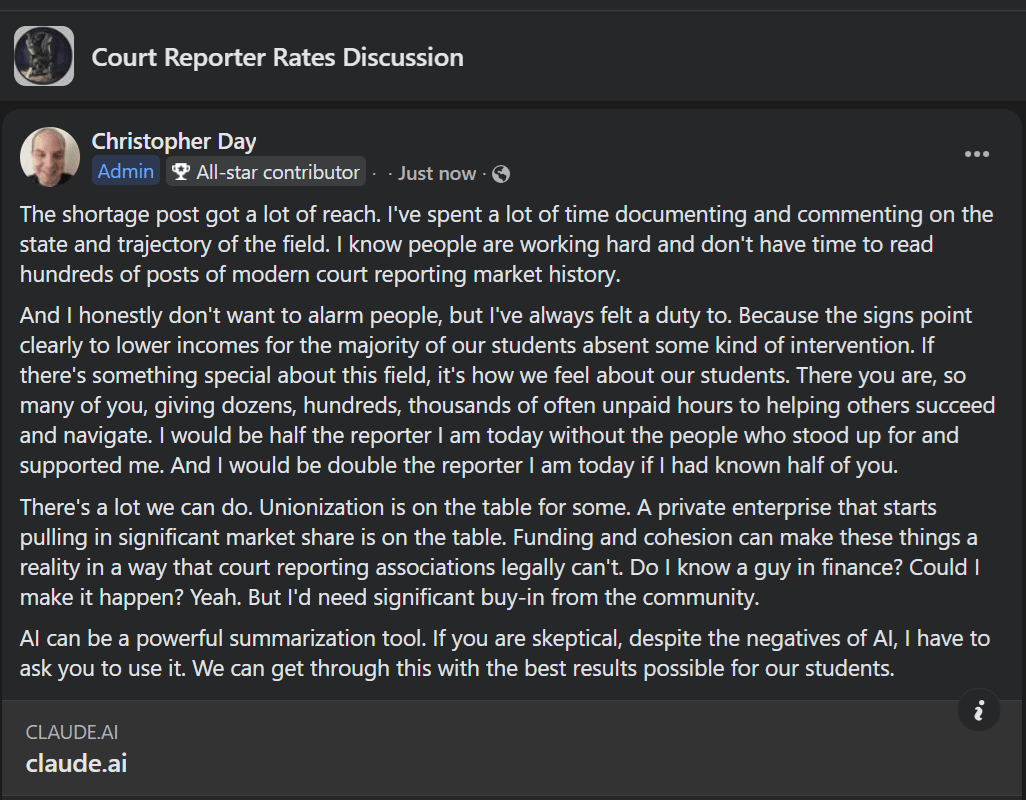
Digital Pay Parity Would End The Shortage

I’ve had quite a journey over the years in terms of my mindset when it comes to digital recording. At one time I was completely against it, as many in my audience are and will be. I saw it as taking jobs from stenographers, and to some degree, I still do.

But I grapple with certain realities. Reality, the big boxes are calling digital realtime. Reality, Veritext advertised for digital pretty much every day for two or three years by my count. Reality, the people that lend large corporations money want digital because they believe it will increase the bottom line. Sorry for not linking sources, but trust me when I say it’s all been covered on this blog ad nauseam. Conclusion, barring some massive change in my funding, there’s nothing I can do to “stop digital.”

For me, the question becomes what I can do to improve the outcomes of our stenography students. And hilariously, it turns out that advocating for digital pay parity would do just that. Facts are facts, the average stenographer is more efficient and better trained — our communities online and off assure that. If the companies are paying the same, suddenly there’s no more incentive to prioritize the digital. All the time, money, and energy spent by the corporations to promote digital is wasted, and eventually, the lenders stop lending to the big guys altogether, effectively killing big boxes, or the lenders get on board with us, at which point the money is behind us, and we might see a revival of the field in terms of new businesses and schools for stenographers.

One of the saddest things about this realization is the concurrent realization that so many of us are ignorant to these market realities. We seem to have two major camps in steno. Toxic positivity and anti-digital. Neither camp really cares about or accounts for the market realities I’ve made plain. Toxic positivity is happy to do our outreach and bring evermore stenographers into the market without realizing or caring that their opportunities are being systematically eliminated. Anti-digital is happy to dehumanize and deride the digital reporters, never acknowledging that by doing so we play directly into the hands of the corporate powers that want us to compete with each other.

And make no mistake, the corporate players do account for, and firmly understand, market realities. This puts them at a constant advantage. Someone like me can liaise with lawyers and spread information about the benefits of unionization, but unless the message carries, we all remain at a disadvantage because we are decentralized, and at the end of the day, easy to control, herd, predict, and take advantage of.

My world view has been shattered over the years. I believed that people armed with information would make the right choices. The simple truth is people prefer their delusions and comforts. Many of you reading will chant “I am irreplaceable” right up until you are replaced, and possibly thereafter. For what little it’s worth, I tried to help, and the writers and readers of this blog did a lot with so little.

Trust me when I say that if the funding situation ever changes, our communities will thrive.

Perhaps there’s a silver lining for me. Free of my own delusion that people are better than they are, I get to prepare my son better for the world.

Reader, we’ve come a long way together.

Never lose hope.

But always have a backup plan.

Court Reporter Shortage Fraud Media Teaser Email

…with love to Joshua Edwards, who also supported me throughout.

“I’m flexible on timeline. My method of documenting everything wasn’t the best looking back. But whose would have been?

I think big picture though, The Speech-to-Text Institute was this group of powerful corps (Veritext, et al.) that came together to propagandize the field and sell digital reporting. They used an outdated industry forecast (Ducker Report) and pushed out information with no adjustment for current industry initiatives (Project Steno, Open Steno, NCRA A to Z). I published about the fraud they were committing. They got sued (Trey Perez), shut down their website, and never bothered to defend themselves in court. Ultimately the court reporter shortage fraud was a little bit of truth, the retirement cliff and localized shortages, mixed with big lies about not being able to fill the gap with stenographers by corporations that had a financial interest in not filling the gap. To this day the fraud claims have not been seriously disputed by anyone of note. The worst I get is people that clearly haven’t read anything I’ve published who want to school me on how the shortage is real. It’s real, but it was exaggerated and exacerbated by the biggest names in the industry to sell digital. That’s the bottom line. 

And beyond my role in it, being willing to document and publish what others couldn’t for whatever reasons, I think the story of the people that supported me really should be told. Because in the end it wasn’t just me. There were others that chose not to be named. There were people like Jackie Mentecky that came right out and vouched for the correctness of what I’d published. I owe them all in a way I’ll never be able to repay. To this day, I have people that were duped into legal transcription or digital reporting that tell me they found my stuff and want to switch over to steno. We have people realizing they’re misclassified employees on a scale never seen in this industry. So our efforts have not been in vain. I suppose from a certain point of view we’re winning because the larger corps can’t dispute anything without calling more attention to it all.

Interested in seeing what you can do.”

Former Legal Transcriber’s Point of View

I had the privilege of being contacted by someone that used to work with Veritext as a legal transcriber. I’m going to copy and paste the bits I found most interesting.

Legal transcriber admits that at times client names were wrong in verified spelling lists from digital reporters.
1.70 per page for legal transcription. ROR of approximately $25 an hour for this person.

VTC information:

——> Transcriber went on to explain that Veritext has contracts with state and federal agencies, though this was hardly surprising.

New York uses narrow margins with headers, probably to make up for the crap rates of NYC

The transcriber went on to explain that Veritext had unpaid testers for their VTC program, which they intend to charge transcribers to use eventually. This probably violates antitrust law since they’re more or less abusing their monopoly-like power to make what are ostensibly independent contractors use their program. It almost certainly violates independent contracting laws where you’re not supposed to have direction or control over the independent contractor.

Transcribers are creating their own shorthand to keep up with workload.

I was told that the transcriber was told they won’t hire anyone outside the country and they run a background and credit check as part of the application process.

Further, I asked the transcriber if they were hired as an employee or independent contractor and they confirmed they were an independent contractor.

I’m very happy to announce this person will be joining the stenographic legion.

Interview of Trey Perez by Cheri Marks

( ADDENDUM: The plain text version is showing up crazy on my website. Give me some time to figure it out. )

(Unedited PDF):

“Are we working together, or are we working against each other?”
Cheri Marks speaks to Trey Perez

CM
Would you mind starting by giving me a little background about yourself, where you’re from, and how you initially came to be involved with court reporting issues?
TP
My name is Trey Perez, and I’m a videographer from Texas and Central Texas. I have an
associate’s degree in video technology. I want to make movies, but I got into the legal video business, and did that for 25 years. In 2019, I noticed there was a shortage of court reporters because of jobs that would be canceled.
CM
Could I back you up a little bit? How exactly does legal videography work?
TP
Sure. Back then it was separate. The attorneys would call the videographer, and then they would also call in a court reporter. The court reporting firms didn’t really handle a video then. They were strictly stenography. So in 2019 I got the idea to work on an app that would lay down the foundation of the transcript.
CM
Was there a defining moment that propelled you to design the stenography app? Or were you just watching the relationship between stenographers and videographers and sensing that it was inefficient?
TP
There’s a couple of different factors. One was the shortage of stenographers, and videographers losing jobs because of that. Then these companies, when there wasn’t a court reporter available, would hire us to go do video only depositions. One company in particular, Veritext, had a login which they wanted you to write down the times and objections etc. And so you would have this extra work to do. And I’m not very good at keeping notes. And so I had this friend of mine working on a website. He’s a very talented developer. And I told him about this situation and he developed the app for me. That’s why I created it, so that I could just take notes. By pressing a button, the speaker would change, it would designate who’s who. And that’s just how it started off.
CM
Do you think they initially were trying to cut corners and save money by having you do both the work of videographer and stenographer?
TP
No, I think there was a shortage. My understanding of the way it worked back then, was that the app would help the court reporter with her job, so that she could go back afterwards and listen to the audio, and know exactly where to go when listening for objections. They wanted us to take hand-written notes! The idea of having some sort of app that could simplify the process of finding objections seemed that it would just make the whole thing easier.
CM
Can you tell me how you got involved in the related antitrust lawsuits? How did you become aware of the criminality, and what were your first moves?
TP
The first thing was having a grievance filed against me by the president of the Court Reporters Texas Court Reporters Association. She’d sent me an email. And I was already getting little cryptic messages and things and telling me I was doing illegal things–
CM
By developing your app or by paying attention to–?
TP
By developing an app. That pissed off the court, big time. And so a grievance was filed against me.
CM
And what was the basis for the grievance?
TP
They said that I was trying to do court reporting.
CM
But isn’t that what they’d essentially asked you to do?
TP
When I came up with my app, I could produce a transcript easier and cheaper than the court reporters, but that wasn’t my intent. My intent was to offer it to them, and I did offer it to them. But no one would do business with me. It didn’t hurt the court reporting firms that the court reporters were upset with me. But still, they used the roar of the court reporters to shut me down. It was a tool to help the court reporters. And all the evidence will show that. It did change for me at one point, when there was no work left and my business was destroyed. By then I was just trying to make a living. But I did say that people could take a deposition without a court reporter, because everyone else was doing it! I never did this on my own. I never once built out a video-only deposition without a reporter unless the court reporting firm asked me to. So how can that be illegal?
CM
Right. And can you tell me then how it moved from you having a grievance filed against you to you being involved in that antitrust lawsuit from one to the next?
TP
For the grievance, I represented myself and it was dismissed. And then they appealed that dismissal and I got to speak again and they dismissed it again for the second time. And that’s their own body that governs the court reporting firms and the court reporters. But at that point, my business was devastated. There was so much evidence because the court reporters would taunt me on social media. They would post pictures or taunting videos along with my name, or make snide, thinly-veiled insults in my direction. So that pissed me off. Just the audacity: that I can’t even work now because I was developing a tool.
CM
It seems tragic, because presumably you and the stenographers shouldn’t even be the ones fighting. It seems like you both have a common enemy, which is these huge corporations that don’t have working people’s interests in mind.
TP
I tried to work with the court reporters here in Austin. I contacted a few, individual court reporters and asked them: what’s more important, your family or your career? Because it’s going to be a 20 billion dollar industry soon, and no one will be able to compete with that. I was trying to get the court reporters to come on board, and every time I talked to them, I said, we weren’t trying to replace court reporters. We were just trying to help out with the situation. They can deny it, but here in Texas, court reporters were getting 500 bonuses to up and leave a job they were supposed to do, if they got a better offer that same day.
CM
Geez. Do you feel like your reputation was smeared a bit unfairly?
TP
Oh, yeah, Most definitely. There’s a lot of rumors. It’s been difficult because when you don’t have any money, it’s hard to get representation.
CM
Are you still embroiled in the lawsuit, or are you past it at this point?
TP
I’m still involved. We’ve had really bad rulings, let’s put it that way. The name of my company was called Depo Notes, the notes of the deposition. And so the judge ruled that, in my case,
that in my hands, that it was illegal. Check this out. So when I couldn’t find work, I started doing landscaping and mowing grass. And I would go into different neighborhoods to do this. So then when I’m cutting grass, there’s these certain people who keep coming around, riding their bikes around me and, like, making racialized judgements about me. I could just sense that, you know, with the political climate here in Texas, all this talk about “getting rid of illegal people” – and then here I have a judge telling me that I can’t use my tool, my app that I developed, and it’s illegal in my hands. Then when I go out to cut grass, I have this person wondering if I’m illegal or not.
CM
Oh my God. That’s awful, I’m sorry. I feel like this is important, and I’m curious now– do you think there was institutional racism involved in your initial vilification?
TP
No, I think that the industry is 85% white, though. Here’s the thing, though. Why would a judge even be bringing up that AI could hurt minorities? I even wrote that in when my attorney wanted to leave. I wrote an objection to him leaving. I put that in there. That from the beginning this has been biased. And judges, I know they have court reporters that have been with them for many years. But for him to rule the way he’s ruled–it’s odd. What’s funny is that people that believe in the law, they say, yeah, the Constitution, the Constitution. But yet when their man tries to overthrow our government, they forget about the Constitution then.
CM
Absolutely.
TP
In my case, the judge said that for me to have this app was illegal because every deposition in Texas must be taken by a stenographic court reporter. But one of the biggest plaintiffs firms in Texas just put out an ad, and he does 98% of his job without a court reporter. And how do I know? Because I did some. And he came out with an ad saying that in the past four years, he’s given away $1 billion to his clients. He didn’t advertise that, of course, that he did it all without a court reporter.
CM
Do you feel like you were too primed for success and they wanted to quash you and take your ideas?
TP
No, it was because the firms themselves were worried. They were threatened by the app. But the court reporters are just worried about their jobs. Why didn’t they get on the court reporting firms that were hiring me asking me to do this? That’s who they should have been after.
CM
It’s easier to punch down than to punch up, right?
TP
Right. And I think that they thought I was just gonna go away, you know, and I’m not. Because
it’s hard to argue that the rules and laws apply to only me in this case. I don’t think they should be able to win.
CM
So when you win, you could very well be setting a legal precedent, perhaps, for this kind of case.
TP
That’s what I feel is going to happen.
CM
Is there an end in sight? Or is it one of those kind of entrenched legal things where it’s hard to
know when it’s going to end?
TP
It’s hard to know. And right now, I don’t have counsel. My attorney withdrew, and I don’t even
know why– “irreconcilable differences” he wrote. The real “differences” were that he wasn’t
willing to fight for me. We had even agreed that these rulings were wrong, but there was nothing he could do about it. It’s about the truth. That’s what we do is we take testimony down. And, you know, I know it’s a talent to be able to type fast, and that’s a skill and it’s worth some money. It has value. And. But when you don’t have that– because not every court reporter is the same– you could be greatly assisted by using this type of technology.
CM
What do you think about, the claims that AI has an inherent racism to it because of the people
that are building it and the speed at which it’s being kind of put into the world before being read
by an ethics committee, for example, or do you have any opinion on that?
TP
I think that a human being, at the end of the day, is the one that signs off. AI is not going to be
certifying itself. You would have someone reading [post trial, in this case] it and cleaning it up,
and we could be improving the performance of the tool in this way.
CM
You can check accuracy against AI instead of just giving over all the responsibility.
So at this point, have they shuttered your business and have they told you you’re not allowed to
reopen it, because it’s illegal?
TP
No. Once money stops coming in and work stops coming in for a couple years, your developer
gets pissed and, you know, those relationships don’t last. So development stops and then, you
know, then everything stops.
CM
I’m so sorry. Do you feel like you’ll have the drive at some point to develop a new app? Or are
you kind of done with it?
TP
I’m done with it, yeah. So this will be, understandably, my last fight. And that is to change the
way that I’ve asked this question on social media, on LinkedIn: can a deposition be taken in
Texas without a court reporter? Yes or no.
CM
Why are they afraid to say?
TP
Because if they say yes, then that helps my case. But if they say no, they’re lying, because
they’re doing it already.
CM
So, they’ve put you and court reporters between a rock and a hard place just to benefit this huge
Speech to Text Institute and these corporations that are developing the same software.
TP
When they filed a grievance against me, I spoke anyway. So the reporters are commenting on
this thread and they say: “He spoke at the meetings. He says he can’t find work. Says he’s basically been blackballed or boycotted”. And then the next person chimes “Hell yes, we did!” And another one writes “He bit the hand that fed him. He wanted to have his cake and eat it too.
Maybe if he would have stayed in his lane”…that kind of thing
CM
It’s really a shame. I wanted to ask you how you felt about Stenonymous’s previous coverage of
your lawsuits– and if you felt it was too focused on the speech to Tech Institute involvement.
TP
No, I just think that he’s biased and he’s on the side of the court reporters.
I haven’t done anything illegal. There is no evidence stating I did anything wrong. We were
never reprimanded for developing a tool, a tool that they’re actually using now.
CM
It seems like you’re just being bullied.
If that were to stop, could you see any opportunity for collaboration with court reporters
happening in the future, for example with sympathetic figures or outlets like Stenonymous?
TP
I don’t see it because it’s just been too much. You know, last time I went into the deposition, I got kicked out. So, I just don’t see it. You know, I’d walk in a room and I’d get this just look of
disdain. And then the court reporters got racist, too. You know, saying I was jealous of them. One lady, and her husband represents some of the court reporters that are defendants in this case, even went as low to repeat the racist stereotype, “most Hispanic men are short and have ego issues”
CM
That’s really awful, I’m sorry.
TP
So, they talk about how AI can be biased. But that lady just proved that a court reporter can be
biased as well. The court reporter is taking live deposition, and she’s biased right there in your
face.
CM
So what’s your best case scenario, both with the legal case and your own future and career?
TP
My end goal is to set a precedent here in Texas, and that’ll be my legacy. The testimony in
Texas will be able to be taken down by other means, not just stenographically. And it’ll be clear,
you know, because apparently there’s currently this gray area. I want it to be clear because
litigants should have a choice. That’s why I feel like I have a case. I’m gonna appeal. So they can be happy all they want, but it’s not over. It got personal.
CM
I look forward to hearing about your success with this case, and you setting the precedent.
TP
Did you hear about the case that was filed by the court reporters against the NCRA? It was on
Stenonymous– the court reporters filed a lawsuit against their association, antitrust as well.
Okay. So that brought up another topic: that videographers record the court. And the court could want our audio. And under the NCRA, if you’re a certified legal video specialist, you have to give it to them, that’s just courtesy. But the thing is, they’re suing the NCRA, the court reporters, because in order to become certified, and stay certified, a court reporter has to take these continuing education courses. And in order to do that, they have to have a membership with the NCRA. And so that’s why they’re saying that there’s an antitrust lawsuit there. They don’t have any competitors. And then the videographer would just have to give away his work product. And that’s a thing that I have an issue with now, because here I was getting blackballed. And then I’d go to a job and the court reporter would want my audio for free. And I’d be like, damn, are we working together or are we working against each other? They would say that we’re working together, but it didn’t seem that way…
CM
It seems like there’s a lot of elements at play here. Thank you for taking the time to talk to me
today. I wish you the best.
TP
Thank you