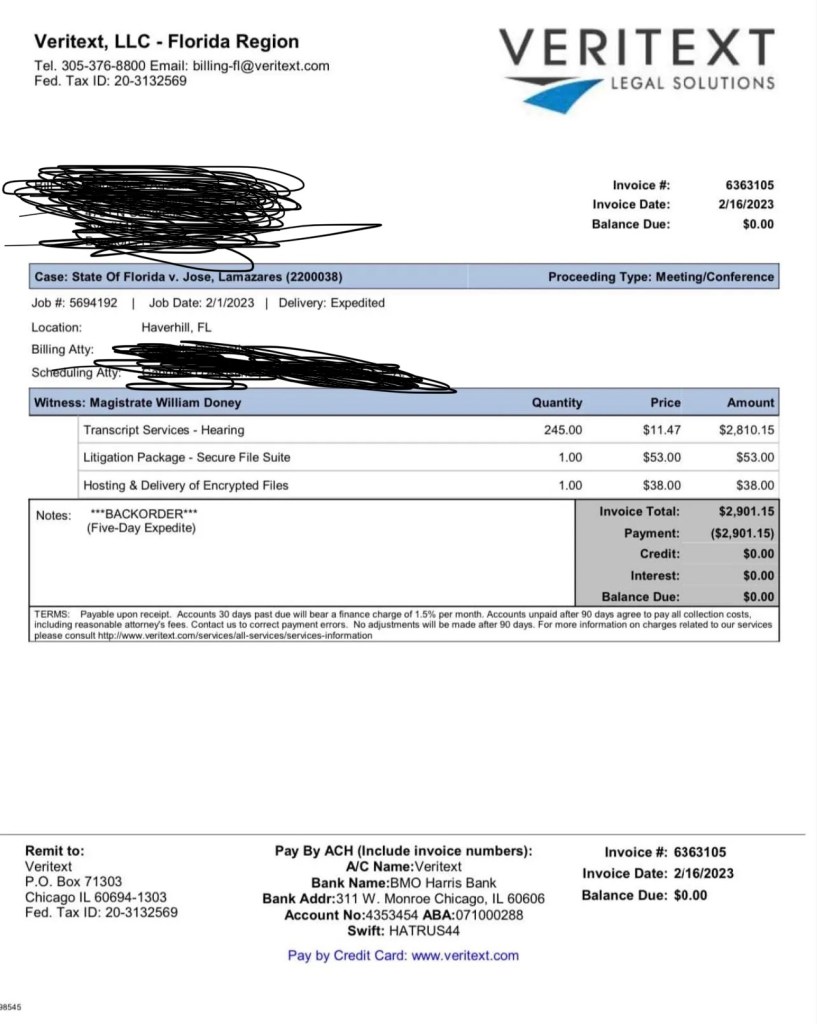
Veritext’s $11.47 Expedite & Agency Billing Practices Generally

Stenonymous source pulls through and gives the scoop on court reporter agency billing practices
Stenonymous source gives the scoop on court reporter agency billing practices

What can I really say? This goes to everything I’ve ever written on this blog about the need for market transparency. There are claims now that sometimes itemized bills aren’t sent unless requested. Lawyers are apparently dishing out $11.47 on expedites. I don’t know Florida all that well, but I have to point to New York State’s documented official rates. $5.50 on an expedite.

To me it really does look like the larger corporations are simply using the shortage as an excuse to raise prices while pinning the expensiveness of their invoices on us. Digital is fraudulently painted as a convenient solution — and at times the only solution — and yet none of my sources, nor the larger corps, have come forward to say that the prices are going down. So we’re literally in a world where these corps lie to consumers, lie to students, lie to workers, make their bills vague and confusing, shift costs to copy orderers to lock their original-ordering clients in — and everybody’s expected to be okay with that. After all, nobody in leadership can be bothered to draw attention to it. Shouldn’t we listen to our authority figures and be silent?

I think we should look back at the history of securities regulation. Sellers were lying, lying, lying. Anything to make a buck. This takes away trust in the system. It makes people not want to do business in the United States, its states, and municipalities when buyers can just be taken for a ride and the government will let it happen. Well let me be the first to suggest that this whole thing needs its own version of the Pecora Commission. Maybe corporate consolidation of the industry that controls court records is inherently dangerous. I’ve already shown using very simply math and logic that the leadership structure of the entire field is highly susceptible to corruption. I do concede that that’s partially my fault, because idiot me was sitting here documenting that the government would not go after the fraudsters. My bad. But seriously, some people in government have said our work is integral to our democracy years after the court system was told that doing away with us could interfere with access to justice. I begin to wonder if these nice things we say about court reporters are just lip service to keep us working hard or if people really believe them — and it’s a question only time will ever actually answer.

But the point I’m trying to make is that if you’re going to dethrone professional court reporting and go from a culture and society of excellence to the side hustle culture, those new “reporters” are going to be highly incentivized to hustle all the other players (lawyers, agencies, witnesses) to make up for most of their would-be income going to corporate players’ bottom lines. You think it’s not true? Deposition reporters in New York City were highly incentivized to narrow their layout because their page rates wouldn’t budge. Nobody sent a memo. Nobody agreed to it. There was no collusion. It just happened. It happened because human beings can only be squeezed so much before they look for an out. And the agencies generally found that acceptable because they just want money. This kind of a market is not a market at all, it’s a hellscape of who can outsmart who and how. Lawyers play the game by skipping out on bills they owe, sometimes outright lying about copy orders. Court reporters and agencies play the game with surcharges, page layout swaps, obfuscatory bills. Some agencies play the game by changing the court reporter’s layout. Some scopists and proofreaders play the game by skimming instead of scoping. Court reporter education plays the game by telling students about all the money they can make, but then doesn’t really teach them anything about how to actually make that money except maybe — maybe — the magic cash cow of realtime, which will no longer be a cash cow once everyone is realtime — and everyone IS now realtime, because everybody can just claim their AI is realtime. At some point, a rational group of people has to come together and say this is crazy, right?

Someone should do something.

Oh, shit. We’re all that someone.

Addendum:

The invoices were swapped with redacted invoices per the request of a Stenonymous reader.

Stenonymous Source: The Actual Per-Page Rate Comes To $9.44…

Stenonymous (anonymous) source provides redacted Imagine Reporting invoice.

Anonymous: “Imagine Reporting in San Diego was recently acquired by Lexitas – one of the latest monopolization/consolidation moves here in CA, hence the Dallas address on the invoice. The result? They bumped up the prices. The actual per page rate comes to $9.44/pp for this 143 page transcript, after factoring in all the add-ons. I wonder how much $/pp they paid the reporter…”

I have to point back to my research about tacit parallelism. Even where competitors are not actively colluding, they see that they can jack up the prices because everybody is jacking up the prices. I don’t believe that Lexitas or Imagine was a part of the Speech-to-Text Institute or the market manipulation there. But we’re seeing how the continued consolidation of the field is leading toward very high prices for attorneys. It seems page rates are being kept artificially low and some of these companies are relying on the add-ons and surcharges to make a buck. It’s pretty smart, since it can almost double revenue.

Just to drive this home — and I get it, I’m in a different state — reporters in New York City are 30 years behind inflation. If their rates had kept up with inflation, the rate would be around $6.00 per page. That’s on our automatic O+2s . Now, to put this into perspective, reporters aren’t generally making $6.00, and though I’m overjoyed when people come out of the woodwork to say they make more than that, I hate to tell you that you’re in the deep minority. When I came out of school I was offered $2.80 (2010). Many of my classmates were offered $3.25 and that was considered a good rate. Last year I had at least one person report that they were still being offered $3.25. Some say they’ve gotten $4.00. Some say they’ve gotten $4.50. Nowhere near $6.00.

And again, with all the add-ons, we’re looking at a charge of $9.44 or $9.46, so it’s basically taking what reporters should be paid, adding 60%, and sending out a bill. That’s in the context of a profession where previously there were 70-30 splits in favor of reporters. Then we look at what reporters are being paid, and just to be nice, we’ll take the $4.50. $9.46 – $4.50. $4.96. That $4.96 is 110% of the $4.50. And now just to complete the thought, $9.46 – $3.25. $6.21. 191% of the $3.25 attorneys might pay if we just cut out the middleman — or at least the middlemen charging high.

The skeptic says: So what? You’re New York. This is California — or Texas — or wherever. To that I say if there was a genuine shortage on the scale that it was advertised as being, agencies would simply be pulling New Yorkers to go certify, license, and work. And this can be mathematically shown. If the rate for New Yorkers should be close to 6 and is actually 4.50 (we’ll cut out the 3.25s and 2.80s and pretend everyone’s getting a decent O+2). 6 – 4.50 = $1.50. We’re talking about a 33% raise for some of the best-paid people and more than doubling the income of kids who get out of school and accept $2.80 a page because they just don’t know any better. And that $6.00 is still a heck of a lot lower than the $9.44. Even if we went back to the 70-30 splits with $6.00 to the reporter, it’d be around $8.58 a page. This also doesn’t account for places where the cost of living is lower than New York City, which would effectively be an even higher raise. Again, these business folks are all about numbers and money. If there was a monumental shortage rather than a desire to depress court reporter incomes, they’d be easily pulling people in with raises or a lower cost of living — unless everywhere in the whole entire country is as underpaid as New York City, which seems unlikely. They were paying us 25 cents on copies while Ohio was getting 2 bucks.

So thank you to my Stenonymous source. You not only helped me show my audience the heavy cost of court reporting add-ons potentially doubling attorney bills, but also help bring out the fact that the shortage that was advertised (70% of the field vanishing by about 2033) is not the shortage we got (coverage issues in the California courts that refused to use money earmarked for enticing court reporters),

The rest is up to the people that share this article and keep attorneys and court reporters informed.