Florida: They’re Cutting Us Out. Other States Are Next.

As the corporate consolidation of America continues, I received correspondence from a valued reader and donor I’d like to share.

“Hi Chris!

I’m not sure that we have spoken before directly, but I am a monthly supporter of your blog.  I just read the post about the Lexitas independent contractor agreement, and it made me wonder if you’ve heard about this new practice they have in some jurisdictions of automatically recording the ENTIRETY of a Zoom meeting for depositions.  Obviously, it’s kind of messed up because there are personal conversations that sometimes happen between clients, counsel, and witnesses before and after the deposition officially begins along with plenty of “off-the-record” exchanges such as social security numbers and dates of birth.  I figure that’s their legal problem since they’re doing it. (In fairness, the parties do get an alert they have to click through that it is being recorded.)

But from an “independent contractor” perspective, they’ve previously required us to turn over our notes in order to be paid.  Many of us simply refused, as it is OUR work product and we carry our own liability insurance policies in case of catastrophic failure.

But now they’ve taken that choice away from ALL stenographers.  I’m hearing rumblings that the the plan is to have a nice and clear recording because they’re pissing off stenographers left and right, and now that they have these recordings, they can outsource them to typists and the reporter will lose all control of the final transcript and, perhaps the most annoying, the income.

Have you heard anything of this?  Do we have any recourse at all short of refusing to cover their work?

This could be a problem unique to Florida since we have a lot of jobs that don’t order until weeks, months, or years later.

I don’t know if Lexitas reporters in other markets would even care since it isn’t affecting them YET, which has been my unfortunate experience when trying to rally other stenographers to demand change.

Thoughts?  Advice?  I’ve thought of requesting an NCRA Cope opinion on it, but I am not exactly succinct and unbiased in my presentation.

Appreciate all that you do!”

And, for the record, I responded:

“Hello. I’m not sure we’ve spoken directly either but I deeply appreciate your donations. It is people like you that will put Stenonymous on the map.

I have heard of similar stuff occurring. it’s pretty certain the big boxes are outsourcing. I’ve seen advertisements myself. Though I haven’t been told about any specific agreement. They’re also using influencer culture to fill seats.

I do not know of an easy solution here. The recourse would be social, legal, or political in my view. Socially, we can withhold work as you said. But it’s my view that we can also create a media firestorm that highlights the degradation of quality and the overcharging of consumers, alongside the lawbreaking I write about. This has been the point of most of my work and a part of my publishing strategy. Most of the field plays this more proper, professional role while I attempt to reach wider audiences through this “writing shock jock” routine. I am hopeful that the end result is that the companies start second guessing their choices, because I am almost certain their choices are costing them more than they’re letting on. 

Legally, if we could find a statute that they’re violating, someone might have a cause of action against them, and they can sue. Kind of like the Holly Moose case, except this time, hopefully whoever it is would win a la StoryCloud. In my case, I’ve been putting my feelers out for potential claimants on the lawbreaking I found, but I haven’t found anyone willing to take this on.

Politically we can campaign for laws, but big money people who can hire lobbyists usually win that game. 

In the end, whatever solution we have is likely going to require a lot of people coming together. We’re dealing with entities that make millions. And we should do this with or without our associations, because I have found that many associations are risk averse to the point of absurdity and to the point where their members’ jobs are now threatened because we spent decades failing to educate the public and explore the science behind what we do. 

I have a big ask of you, and if you don’t want me to, it’s fine. But may I publish your email (redacting your personal information)? I believe that if other reporters become aware of the situation in Florida, they might coordinate with someone like Jackie Mentecky to push back.

There may not be easy answers. But I’m willing to work hard to find new ones.”

6 Common Misperceptions About Christopher Day / Stenonymous Corrected for the Record

It came to my attention that someone was saying that my Court Reporter Rates Discussion group is illegal. I gave a blanket public response to this. But in the ensuing conversation I had with that someone, it came to light that some people have some deep misconceptions about who I am and what I stand for.

1. Christopher Day is not a communist.

Concerned court reporter asks Christopher Day if he’s a communist.

I haven’t studied economics and economic systems at length. I get that fighting for working people seems pretty communist. But it’s actually a capitalist sentiment. Charging what the market will bear is very capitalist. The laws of the United States allow for us to create conditions where many workers can charge much more for the same labor. These laws also allow employers to purchase media coverage that steers workers away from charging what the market will bear. The median wage of the United States is $30,000. Guess who’s winning. Hint: Not the sellers of labor. By the way, chances are good that you are a seller of labor even if you hire people every now and again.

Just as an aside, a planned economy is a stupid thing. It works in video games like Suzerain. But look at all the things that create the GDP of the United States. Does anyone truly believe that such a thing could ever be planned? It’s much simpler to reconfigure the markets of today to be more pro-people,

2. Christopher Day does not believe in aliens.

Concerned reporter expresses a belief that Christopher Day believes in aliens.

Is it possible that Earth is not the only place with life? Sure. But I don’t spend very much time seriously entertaining the existence of aliens. I do spend a lot of time playing sci-fi games like No Man’s Sky, Starbound, Factorio, or StarCraft. Who needs the real thing? I can march across hundreds of worlds from the safety of my home.

3. Christopher Day’s publications do not harm students.

Concerned reporter urges Christopher Day to reconsider publications on the grounds that they harm students.

Thousands of court reporters are using my rates discussion page. This creates an environment where established players cannot game their ignorance and eagerness. It also creates an environment where the rampant misinformation campaign committed against consumers by the STTI Bloc is made impotent. Some students have even been kind enough to write to me and let me know that my work strengthened their resolve to become a court reporter. The students of today will be infinitely more informed than I was 16 years ago. In my view, this maximizes their chance of success.

4. Christopher Day’s publications do not hurt small businesses.

Concerned reporter writes to Christopher Day about the impact of his publications on small businesses.

The small businesses were being demolished because of the schemes that go on in the modern court reporting business. I fail to see how media that makes plain the malfeasance of large corporations in the space hurts small businesses. If anything, it should drive more consumers toward small businesses that don’t have the capacity to lie to them on an industrial scale.

5. Christopher Day’s publications will not accelerate the adoption of stenotype alternatives.

Concerned reporter lets Christopher Day know that talking about rates will increase the speed at which alternatives are adopted, which is false.

Veritext has been advertising for digital reporters every day for over 2 or 3 years. The larger corporations have made it clear to all but the most indoctrinated / trusting that they are shifting direction. There is literally nothing they could do to adopt digital faster than they are today, so discussing rates doesn’t hurt us. And in fact, it can only help us as digital court reporters realize that they’re being massively underpaid and begin pushing back against that.

As the pay disparity narrows, so too does the incentive to use digital. Once that incentive is gone, and once the corporate executives have been fired for blowing so much money on advertising for digital, the stage is set for the field to be whatever it’s going to be, rather than what big money wants.

6. Christopher Day’s publications have an impact.

Concerned Reporter lets Christopher Day know what Christopher Day does doesn’t matter.

I’ve heard this one a lot about what I do doesn’t matter, won’t do anything, won’t change anything, or whatever the flavor of the day is. I slew the Speech-to-Text Institute and created the largest court reporting blog in the United States, capable of outing multimillion dollar operations for fraud. Hell yeah, I had help, and I’m grateful for it. But it must be getting really uncomfortable for the people in the “this changes nothing” crowd.

———-

Hey students, if you’re reading, all through your life people are going to put you down like they put me down. Your idea won’t work. You won’t do XYZ. You can’t do XYZ. Take constructive criticism as best you can. But realize that sometimes put downs are put on you just because someone wants you to do what they want you to do, and they’ll say anything to get you there. In this case, it’s pretty easy to see that there are some folks out there that want me to shut up. They’ll say anything about me to obtain that result.

You’ve now seen it with your own eyes. Does someone really believe I am a communist that believes in aliens while I hurt small businesses and students, while also believing I can do what I want because it won’t matter? The more likely truth is that they do not understand my ideas, so my ideas are uncomfortable, so they do not like my ideas. And the easiest way to get me to stop spreading those ideas that they don’t like is to inspire doubt within me that makes me silent.

Understanding that social dynamic is key to your success. You will meet many clients and agencies that will do anything, say anything, to get you to work for less, or to do whatever it is they want you to do, because that’s what’s in their best interest. You must have the strength to identify when that is occurring and act in your own best interest.

And court reporters are not an anomaly. This is also done to journalists. I became aware of a young journalist that would receive high praises whenever submitting work for the exposure. When it came to paid articles, those same people singing the high praises would suddenly be nitpicking. The difference wasn’t the journalist’s work, but that the journalist was seeking payment for their work. It benefits publications when journalists feel insecure about the value of their work because it leads them to accepting less money. The people representing those publications figure out pretty quickly that making journalists feel insecure is the fastest way to fatten their bottom line.

You may one day be engaged with someone trying to manipulate you. It is my sincere hope that on that day you have the strength to identify it, remain resolute, and perhaps even use the experience as a springboard to educate the next person.

It is my sincere hope that the students obtain a level of mastery I could never have imagined.

P.S.

To you, friend, thank you for giving me this material. I meant what I said. If ever you need to talk, reach out. Despite what I’ve done here, it will not end up on Stenonymous.

Join the Stenonymous King of the Castle Bachelor Party!

NO PURCHASE NECESSARY.

Flyer for the Stenonymous Bachelor Party created by Joshua B. Edwards, RDR, CRR, CRC

NOTE: Anyone may join. We will not be checking stenographer cards at the door. This can be played on your computer via the Twitch website or on your phone via the Twitch app.

On March 2, 2024, at 6 p.m. Eastern Time, my personal cadre will be participating in at least one game of King of the Castle (official site). We intend to stream this and allow the audience to take part, likely through Twitch.

King of the Castle is a game where one player plays the monarch of a kingdom and a minimum of 3 other players play as nobles from the three territories that comprise the kingdom. The territories all have various traits involving things like farming, military, and trade. These are represented by a number between 0 and 10. The core of the gameplay is that the monarch does their best to stay on the throne. The nobles try to put the claimant from their territory on the throne.

There are two ways to play this game, party game mode, usually played through Discord and the kotc.app site, and Twitch mode. We’re focusing on Twitch mode here. You do not need to download Discord and do not need to log into kotc.app on your browser.

So what will this look like if you want to join?

First, you have to go to Twitch.tv and sign up for a free account. If someone needs a tutorial on that, let me know. Otherwise, I will move to the next part.

You’re going to head on over to my Twitch channel, XChrisUnknownX, and hopefully by around 5:30 or 5:45 Eastern, I will have started a live stream. You will be able to join the chat and type !join to join the game. You may also choose your preferred pronoun inside the game by typing (!join he) (!join she) (!join they), without parentheses.

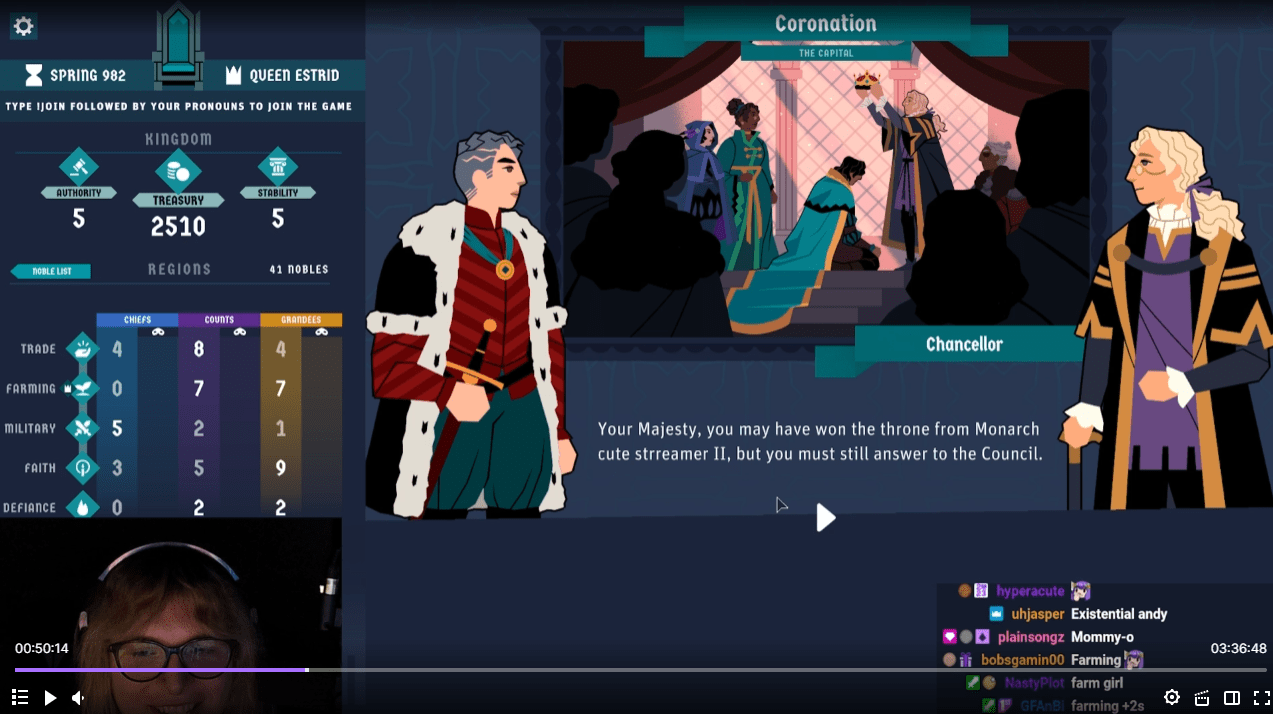
When we start the game it’s going to look something like the streamer’s screen does below. You’ll be watching us through Twitch, but you’ll be playing too!

King of the Castle game by Twitch streamer Romolla. All the names on the left are nobles that were playing with the streamer.

NOTE: The reason that says 30 minutes in is because there was a long period of time before the streamer actually started the game. Each game is expected to last between 1 and 2 hours, but can be much shorter.

Our Kingdom will feature and you will be placed into one of the following territories:

Stenonymous shows off the Counts of the East from King of the Castle
Stenonymous shows off the Barons of the March from King of the Castle

or my personal favorite…

Stenonymous shows off the Chiefs of the North from King of the Castle

Likely the first thing that will happen after we launch the game is we’ll be looking at a map of the kingdom. You’ll also see the stats of the kingdom on the left-hand side. The state of the kingdom is told through these stats. If authority, treasury, or stability falls to 0, the monarch will lose the game.

Stenonymous shamelessly using another Twitch Streamer’s video to explain King of the Castle. Thanks Romolla.

The game plays out through events and votes that impact the kingdom. The monarch will select one of the events on the map, and the audience will be taken on a magical ride to whatever the event is. Just to get some idea of how this is going to go, one of the first events is the coronation.

Stenonymous continues to use Romolla’s streaming to explain King of the Castle.

Either I will be narrating the dialogue or forcing my cadre to do it. But the end result is the same, we’ll narrate the event and the event will, more often than not, go to a council vote. You, as a noble of the kingdom, will be on my council.

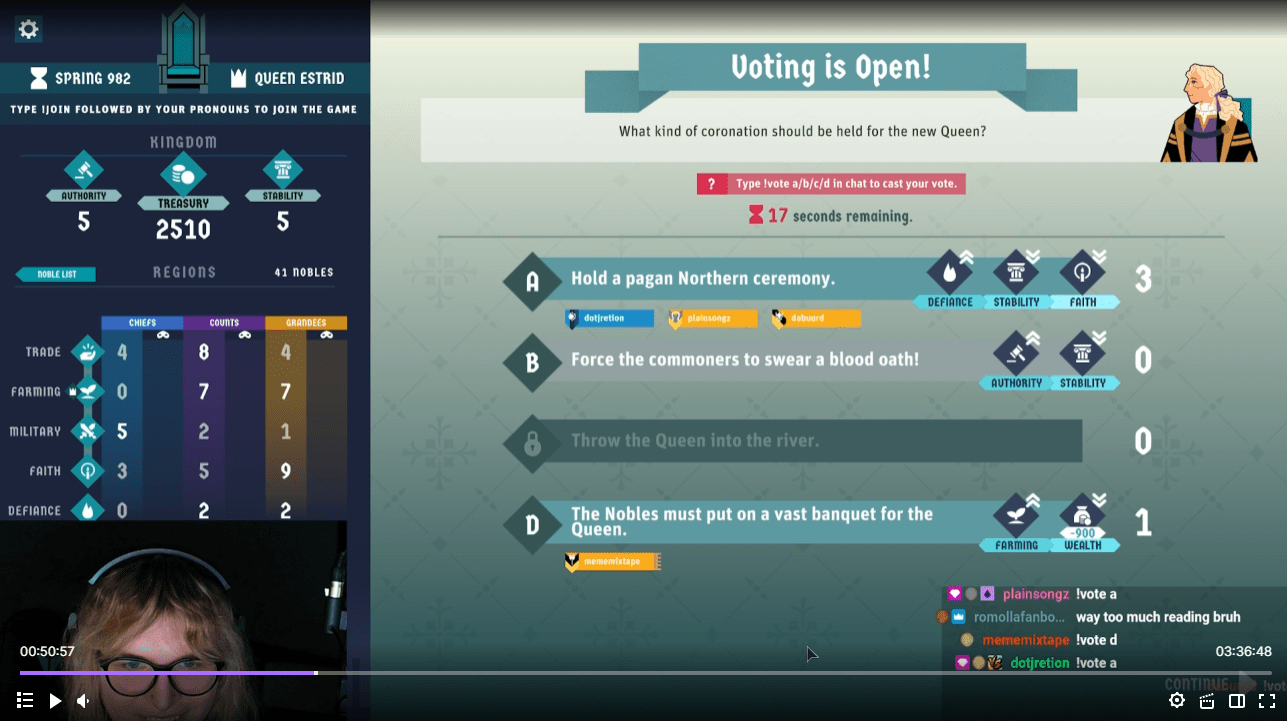
When we go to a vote, I will get to take a monarch action. In this case, Romolla vetoed decision C so that no noble could select that option. You will vote by typing !vote a or !vote b, whatever the letter of your choice is. As you can see, the game tells you how your vote will impact the kingdom. In this case, Vote A will raise the defiance of one or more territories. Defiance allows territories to rebel and begin a civil war. If that happens during our game, you can type !rebel to urge your territory to declare war on me and whatever loyalist territories remain. If all three territories rebel at once, I lose instantly. Vote A will also lower stability and faith. Vote B will raise authority and lower stability. Vote D will raise farming and lower the wealth of the nobles. Take note that wealth of the nobles is different from treasury of the kingdom. Wealth of the nobles impacts what you can buy. “Chris, what do you mean buy? You said no purchases!!!”

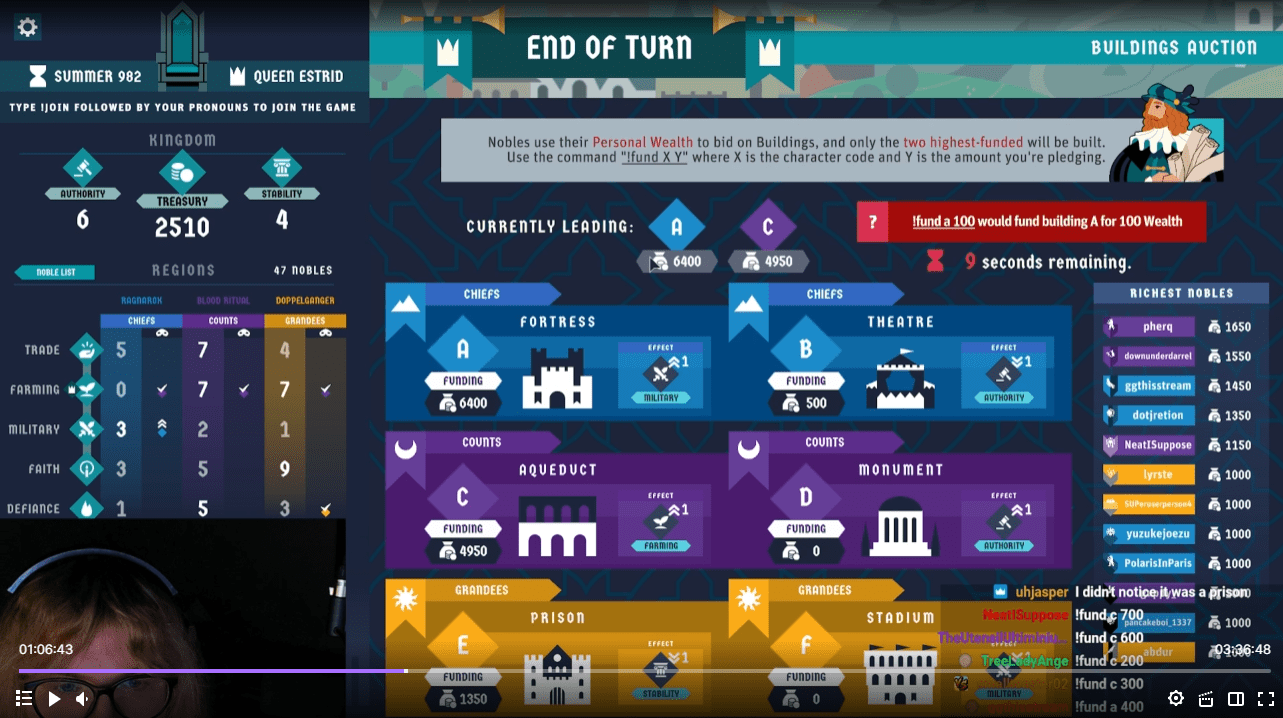
At some point in the game, you will be presented with the option to purchase buildings for the territories. These buildings change the stats of the kingdom. At this point, you’ll be able to vote for what building to buy using your wealth. Instead of !vote, you will use !fund. For example, !fund c 300 will take 300 of your money and put it toward choice C, the aqueduct, which will raise farming of the Counts of the East.

Close to the start of the game, each territory will choose a scheme to place their claimant on the throne. In the picture above, it shows that the Counts have reached their scheme objective for farming and will be able to advance their scheme. This is juxtaposed against the Chiefs, who need to raise their military. As you might imagine, the buildings can help sabotage or support schemes.

Please remember that this is a social game and the monarch’s goal is to stay on the throne. I will try to be fairly forthright so that newcomers can enjoy and understand the game, but the monarch is allowed to lie and do things to confuse the players. For example, there is a feature where the monarch can use “reverse voting,” which means that the vote with the fewest council votes will win. This makes for some very interesting gameplay and sudden twists as people accidentally vote on things they do not want to vote on.

That’s pretty much it. I’ll be talking you through it every step of the way. As long as you can remember !join, !vote, and !fund, you can play this game. Just let me know when Twitch interrupts your game with commercials in the chat box so that you don’t miss out on game time.

We’ll be monitoring the chat as best we can for comments and questions at the time of the event. Please know that if you miss the start of the game, you can join at any time while the game is ongoing.

Are you ready to overthrow the King of the Castle?

P.S.

Saw Leah Willersdorf featured recently. Check it out.

Addendum:

I’ve been asked if we have a registry. No one is obligated to donate, but here it is.

You can also contribute directly to the blog on the front page of Stenonymous.com via the donation box. But this isn’t meant to be a fundraiser, it’s just meant to be fun.

Court Reporting is Now a Side Hustle

How court reporting companies are getting away with charging top-shelf prices for undervalued work…

The overpriced court reporter page is something that comes up occasionally in legal circles. All through my early career, law firm owners I worked with mentioned how their firms were stuck with expensive court reporter bills. As a young stenographic court reporter, I was paid very little, and later learned that court reporters in my city were about 30 years behind inflation. This set me down a path of skepticism when it came to what court reporters are told about themselves, their industry, and the public’s perception of them. How could lawyers be paying so much when I was making so little and such a large part of the transcript creation was on me?

Years later, as it turned out, some of the largest court reporting companies would get together using a nonprofit called the Speech-to-Text Institute (STTI). That nonprofit would go on to mislead consumers about the stenographer shortage to artificially increase demand for digital court reporting. Tellingly, while a U.S. Legal Support representative had no problem using the word “libel” on one of the female members of my profession, USL and the other multimillion dollar corporations never dared utter a word about my eventual fraud allegations. The companies wanted to trick consumers into believing stenographers were unavailable due to shortage and force digital court reporting on them, where matters are recorded and transcribed.

This set off alarm bells in the world of court reporting. Stenotype manufacturing giant, Stenograph, also represented in STTI’s leadership, shifted from supporting realtime stenographic reporters to shoddy service, and began to call its MAXScribe technology realtime. Realtime, as many attorneys know, is a highly trained subset of court reporting that often comes with a premium. These bait-and-switch tactics on the digital court reporter side of the industry caused a nonprofit called Protect Your Record Project to spring up and begin educating attorneys on what was happening in our field. But as of today, the nonprofit has not reached a level of funding that would allow it to advertise these issues on a national scale — this blog’s in the same boat.

So as more of the workforce is switched to digital reporters / recorders and transcribers, we’re seeing companies use influencers and other media to lure transcribers in for low pay. In short, digital court reporting is now synonymous with side hustle. These companies are going to take the field of skilled reporters that law firms and courts know and love, replace them with transcribers, and go on charging the same money. For the stenographer shortage, these folks were dead silent for the better part of a decade. Now that they need transcribers to replace us, they’re going all out to recruit.

Shopify talks about transcribing as a side hustle.

TranscribeMe, by the way, just entered a partnership with Stenograph.

“What do I care?” That’s what a lot of lawyers and paralegals might be asking at this point. Well, I may not write as well as Alex Su, but I’ll do my best here. First, there are egalitarian concerns. In the Testifying While Black study, stenographers only scored 80% accuracy on the African American Vernacular English dialect. This was widely reported in the media, but what was lost by the media was the reveal of pilot study 1, which showed everyday people only transcribe with an accuracy of about 40% (e226). When we’re talking about replacing court reporters with “side hustle technology,” we’re talking about a potential 50% drop in accuracy and a reduction in court record quality for minority speakers, something courts are largely unaware of. According to the Racial Disparities in Automatic Speech Recognition study, automation isn’t coming to save us either. Voice writing is the best bet for the futurists, and it’s being completely ignored by these big companies.

There are also security concerns. When we’re talking about utilizing transcribers, we’re talking about people that have an economic incentive to sell any private data they might gain from the audio or transcript. If transcription is outsourced, a bribe as low as $600 might be enough to get people acting unethically. Digital court reporting companies have already shown they’re not protective of people’s data — in fact, companies represented in the Speech-to-Text Institute. This also leads to questions about remedies for suspected omissions or tampering. Would you rather subpoena one local stenographer or teams of transcribers, some possibly outside of the jurisdiction?

Finally, there’s an efficiency issue with digital court reporting. Turnaround times can be much slower. Self-reported, it can take up to 6 hours to transcribe 1 hour of audio. By comparison, 1 hour of proceedings can take a qualified stenographer 1 to 2 hours to transcribe. That’s 3 to 6 times faster. Everyone here knows stenographers aren’t perfect and that backlogs happen. Now imagine a world where the backlog is 3 to 6 times what it is today. In one case, a transcript took about two months to deliver. If we’re going to hire teams of transcribers to do the work of one stenographic court reporter, aren’t we going backwards?

This is eerily similar to what went on in medical transcription. Competing interests played games to nobody’s benefit.

Consumers are the ones with the power here. They can demand stenographers, utilize companies that aren’t economically incentivized to lie to them, and spread awareness to other consumers. Consumers, lawyers and court administrators, decide the future. Knowing what you do now, do you want a court reporter or a side hustler at your next deposition or criminal case?

—————————-

Written by Christopher Day, a stenographic court reporter in New York City that has been serving the legal community since 2010. He is also a former board member of the New York State Court Reporters Association and a former volunteer for the National Court Reporters Association STRONG Committee. Day also authors the Stenonymous blog, the industry’s leading independent publication on court reporting media, information, data, analyses, satire, and archiving of current events. He also appeared on VICE with regard to the Testifying While Black study and fiercely advocated for more linguistics training for court reporters in and around New York State.

Donations for the blog will help run advertising for this article and others like it, as well as pay for more journalists and investigators. If you would like to donate, you may use the donation box on the front page of Stenonymous.com, PayPal or Zelle ChristopherDay227@gmail.com, or Venmo @Stenonymous. Growing honest media to combat misconceptions in and about our marketplace is the premier path to a stronger profession and ultimately better service to the legal community.

A posse ad esse.

Addendum:

By sheer coincidence, an article on the side hustle was released the same day as my post. NCRA STRONG’s Lisa Migliore Black and Kim Falgiani really hit it out of the park with this one. Apparently FTR and Rev say they have security in place to prevent sensitive data from being shared. But FTR is known for selling “deficit products,” and Rev is known for its massive security breach. So check out the article by Chelsea Simeon linked above and enjoy!

Inside Stenonymous’s Strategy

My behavior, to some, may come off as strange. I started the digital court reporter helpline on Facebook. Some people, even my own readers, take issue with the fact that I refer to them as reporters. I’d like to level with people, I know that what I do is different from mainstream stenography. There are ideas and strategies behind many things that I do. I’d like to share some so that people can understand and make their own judgments. I’ll also memorialize some steno history as I see it.

First, on the issue of shortage, I envision possibilities and then document events until I know a probable truth. For example, certainly at the start of my journey, I wrote about shortage and I viewed the shortage as our main problem. As I started to see the Speech-to-Text Institute inundate our side of the field with claims that the shortage was impossible to solve, this belief was replaced, I came to believe that STTI was simply digital court reporter marketing, and that by emphasizing the shortage, they were trying to fool reporters into going digital, fool agencies into using digital, and ultimately fool our associations into embracing the “new” court reporting. It’s called framing. How you frame an issue dramatically changes the response you get. If they framed the shortage as insurmountable, we would come to the conclusion they wanted: You must go digital. To wrap up my thoughts here, I formed two possibilities in my mind. 1) The shortage is impossible to solve. 2) The shortage is possible to solve.

Eventually, after much documentation and research of their claims, I concluded 2 was most likely. I’ll spare everybody the explanation. But that’s where I jumped into a number of activities, writing about digital reporting, the pitfalls, the deception of jobseekers. Here’s the strategy part: This all creates a record. It populates searches with Stenonymous blog posts. It begins to shape digital court reporting’s online presence and frames the issue in the way STTI was doing to all of you. So when people look up digital, they might see it’s a kind of “soft scam” and go elsewhere. This makes the economic cost of filling digital positions higher, and therefore disincentivizes digital use in businesses. Even now, search engines may start pairing digital court reporter with scam just because I wrote them together. So for those of you that want me to call them recorders, this is why I won’t. The people in power now have to live with the toxic title they stole from us.

I also scare off people that have an agenda, but no conviction. I was connected with Jim Cudahy (then STTI), on LinkedIn for a short time. At that time a lot of shortage media was going out, and I realized the man had a connection with an association for journalists. While I can’t prove it, I believe at least some shortage articles were engineered because I have been trying to get an article run on corporate fraud for over a year (on and off) with little success. Why in the world is every journalist DYING to talk about the end of stenographers, a field for which they previously had no interest? It might be big business interfering in our industry media. One analyst, Victoria Hudgins, ignored me when I wrote to her with corrections and kept publishing stuff that put stenographers in a negative light. I finally ran an attack ad on her, and we haven’t heard from her since. I called Jim Cudahy a fraud and he ran away to the Alliance of Crop, Soil, and Environmental Science Societies. Now I’ve been watching Steven Lerner’s articles at Law360. He’s a senior reporter at Law360. I feel his articles put too much emphasis on calling things equal, mostly because the idiot called STTI a stenography association, and he has outright ignored many things I’ve sent him. So quite frankly he may be next. Say what you want about me. In medieval warfare getting the enemy to rout was a win. At the point where its enemies flee, the stenographic legion is winning.

There is also a strategy to being solo. I’m a bit of a loner and you can’t really ostracize a loner. I separated from my volunteer roles in associations. This has many benefits as far as lawsuits against me for my publishing. A potential plaintiff would have to target me as an individual. The amount they could collect is limited because I just don’t have very much. The economic cost of a lawsuit would also be phenomenal for a plaintiff. Imagine for a moment the 400 or so blog posts I’ve made over the years becoming exhibits, the depositions, the interrogatories, the emails, the trial! This is on top of the fact that a lawsuit against me would not be meritorious, and therefore plaintiff would risk losing against a pro se stenographer.

I tried contacting law enforcement, but I don’t have any details on where those reports go. This leaves us in a kind of twilight where we need the media to cover this and ask the hard questions, like “hey, multimillion dollar corporation Veritext, why would you let a respected member of the profession say these things about you without trying to convince him he’s wrong?” Remember, they don’t have to sue, they just have to convince me I’m wrong. They haven’t tried. Because it’s a fraud. I even wrote them a letter. We also need the media to ask government questions, because that would probably get government to act. Until it does, we are a nation of unenforced laws.

Again, possibilities. 1) An event will occur which triggers a viral moment, calling attention to us in a way that changes the trajectory of digital recruitment and definitively ends shortage, such as attracting investors. 2) Such an event will not occur. So what is digital court reporter helpline? An assumption that I will lose. I will assume that court reporters will not increase their funding of Stenonymous over the next decade, that no journalist or lawyer will come to our rescue in a way that makes a difference, and that the number of stenographers falls to the point where we won’t bounce back (unlikely). So then the goal, for me, at least, becomes improving the lives and working conditions of working reporters. That means organizing people. That means communicating with them. That means thinking well outside the box. And if you see the description for the helpline, you’ll see what I mean. Again, as I grow this movement, it will hopefully decrease the steno-digital pay gap, leading to incentivized stenographer use because we are more efficient on average. And if the corporations decide to discontinue their aggressive pursuit of digital before we have a viral moment, so be it. But that’s what the helpline is about, taking control of digital court reporter spaces in a way that associations could never do.

But until I’m fairly sure I’ve lost, I’ll be trying to reach that viral moment. I’ve done this in a lot of different ways, even some ways people wouldn’t think about, like being a little more rude or aggressive. This is because journalists are lazy and about ten thousand times more likely to publish an article about me saying something a little off key than the math showing shortage is exaggerated. Seriously, somebody lie and tell a journalist I made a racial slur and I’ll be in the news tomorrow. But corporate fraud affecting thousands of people isn’t important. In that same vein, I was hoping someone would start media antithetical to mine and start an ideology war with me. Power’s about eyeballs, and nothing would get eyeballs like an open market media war. The most I got was Mary Ann Payonk blocking me and badmouthing me to others.

You see, for years court reporters predictably went in the same direction and were stuck in a kind of “group think.” By injecting the market with a new and growing viewpoint, we create an environment that is uncertain. In a “certain” environment, status quo reigns supreme, and right now the aggressive expansion of digital is the status quo. In an uncertain environment, the largest players have the most to lose and are the slowest to act. By taking our predictability off the table, we can force the largest players on the field to react to us. If your opponent is reacting to you, it means you have a shot at controlling the game.

Some miscellaneous points. As for why I allow uncomfortable conversations in the Stenonymous Facebook group, my business is information. It’s a cop tactic. Let the suspect talk themselves into a corner. Let the people that make us uncomfortable speak, we might learn something or we might not, but we certainly will not if we silence dissent. And learning new information can only help us because we are the more-established workforce.

Before I conclude, I would just like to say I’m imperfect. My execution of things isn’t always great. So I am open to criticism. I don’t discard it when you send it. I do not censor contrary viewpoints. That’s why I’m writing this. Being open minded is also part of my strategy. Evidence will change my views, particularly over time and with reflection. Building truth seeking into my worldview allows me to re-evaluate things and avoid confirmation bias trapping me in an endless loop of “I’m right and you’re wrong.”

I guess the bottom line is my life as a court reporter has taught me that a lot of “bad people” go through life with a simple moral code. “Screw you, stop me.” I’m experimenting with what happens when a “good person” has had enough and takes on the same moral code. What happens when a “good person” is willing to be the “bad guy?”

Stenonymous.

Stenonymous Receives Demand for Correction & Apology from Naegeli

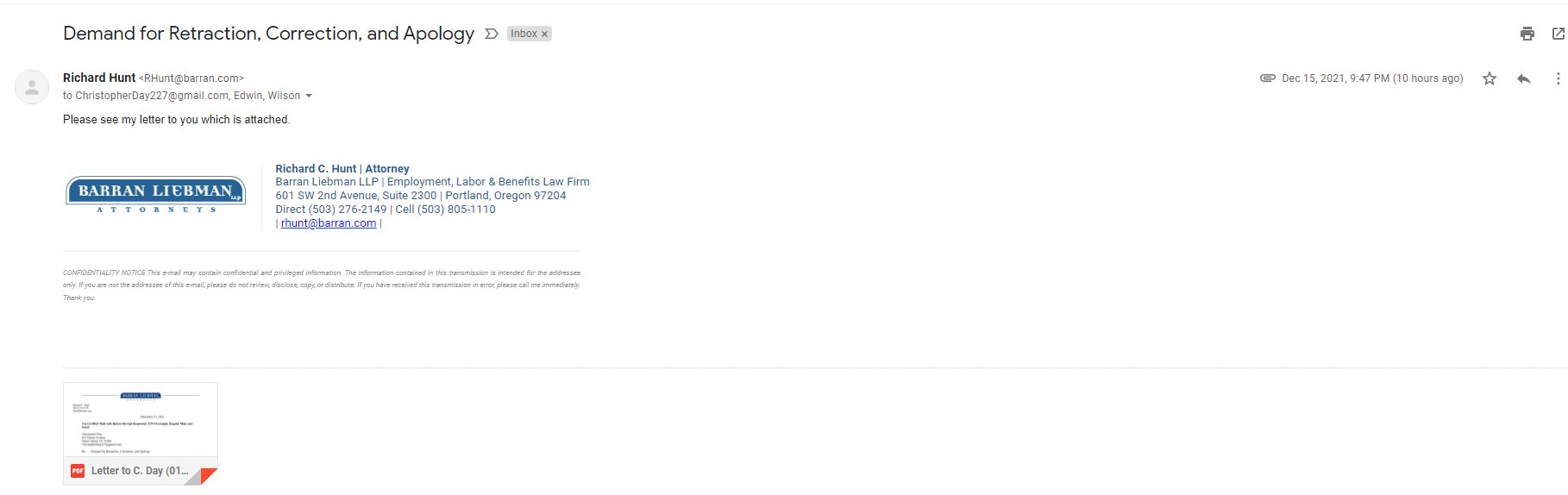
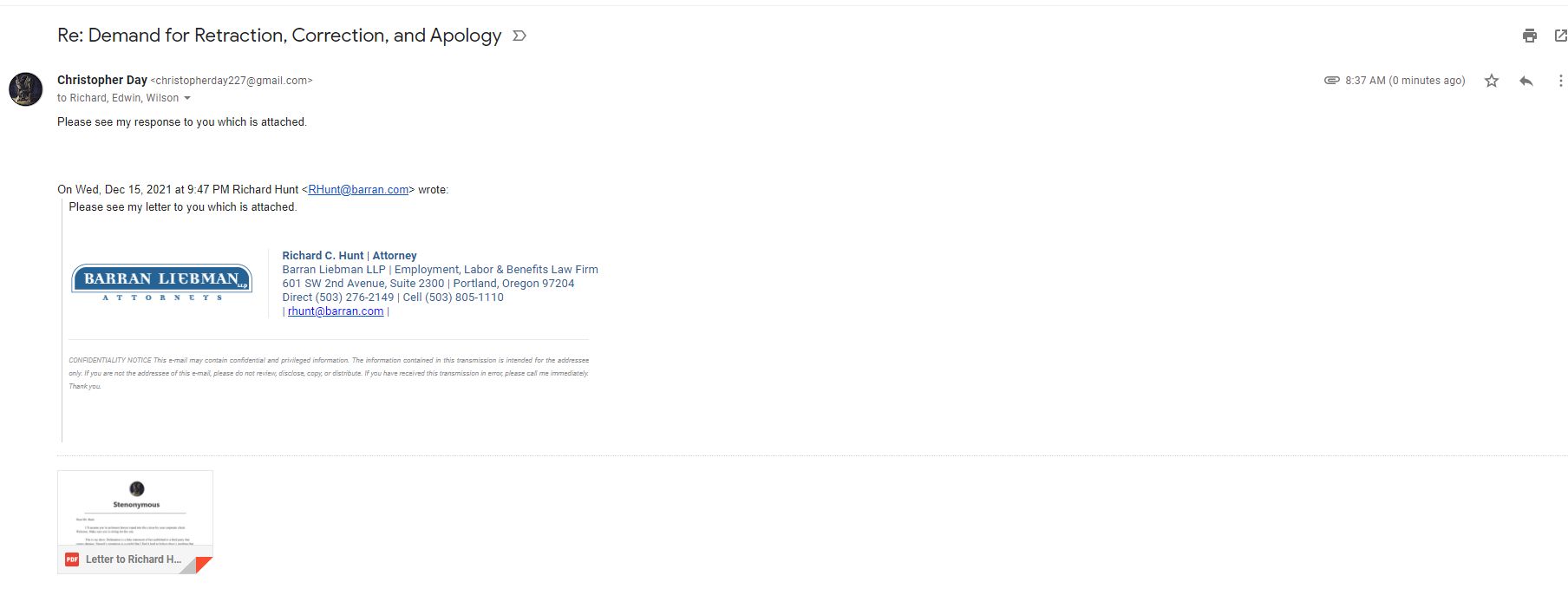
Last night at about 10:00 p.m., I received an e-mail from Richard Hunt of Barran Liebman LLP about Naegeli. It was a fairly standard legal threat, not that I know what those look like, since I’ve never received one before. If you’re short on time, skip their nonsense and read my reply.

The demand letter is available for download here:

Now, I understand that this kind of thing may have a chilling effect on the free speech I have worked so hard to promote in our industry. I must ask all of you not to be afraid, but to turn to your state and federal legislators and law enforcement. Take this opportunity to share with them what is happening. I will lead by example in defense of our collective futures. I will be brave as I am asking all of you to be.

The PDF download and plain text is below.

Dear Mr. Hunt:

I’ll assume you’re an honest lawyer roped into this circus by your corporate client. Welcome. Make sure you’re sitting for this one.

This is my show. Defamation is a false statement of fact published to a third party that causes damage. Naegeli’s reputation is so awful that I find it hard to believe there’s anything that could be said that would damage its reputation further. Some of the statements I make are factual, and truth is an affirmative defense to defamation. Beyond that, some of the statements I make are an opinion based on my expertise as a stenographic court reporter for the last 11 and a half years and creator of what is indisputably the largest blog in my industry. You do not have a cause of action and therefore it would be legally wrong for you to file a complaint against me.

You should peruse my blog. I’ve been reporting corporate corruption against much larger corporations than Naegeli. Veritext and US Legal Support appear to be involved in a plot to rig the court reporting and stenotype services industry against consumers/lawyers. What was done to the healthcare industry as portrayed in the series Dopesick about Purdue Pharma is more or less being done to my industry. The difference here is that what is occurring in my industry is what would have happened if one doctor rallied the others to fight the misleading advertising and dishonest behavior. Conceded that the series is a dramatization of the actual events, of course. I have a moral obligation to stop the lies and dishonesty rampant in my field because of the damage this plot will likely do to my profession, its students, minority speakers, and testimony transcript accuracy. Once the public takes note and begins alerting the DOJ, FBI, and FTC as I have, there is virtually no chance the plot will continue. Naegeli’s gouging was such a minor and unrelated part of that, that in my wildest dreams, I couldn’t have imagined this kind of foolish overreaction and strategic blunder.  Thank you.

My field is beset by silence and fear. I aim to break this. To achieve this I have become a goal-oriented person. You see, now that Naegeli has threatened to sue through an actual law firm, it’s put itself in a much worse position than anyone could have conceived. Now Naegeli has two choices. It can fail to sue me, and show an entire field of nearly 30,000 court reporters that it is a scared barking dog, which will embolden them.  The competition from all of them will become so fierce that it will run the company into the ground. Alternatively, Naegeli could sue. I am quite sure that I can find a valid counterclaim. We can lock each other in for a lawsuit and give this field the show it never knew it needed. It will be the single-largest destruction of capital the industry has ever seen and your client’s reputation will drop even more as court reporters across the nation realize that money could’ve gone into advertising to fix the stenographer shortage. Imagine the backlash. “Yes, I could’ve spent $400 an hour advertising this profession but instead I, Naegeli & Co., have decided the money is better spent stifling Christopher Day’s free speech.”

I know the latter seems like an attractive choice, but it will only expand my audience exponentially and possibly allow me to run daily ads decrying Naegeli’s hatred of free speech and the stenographic free press. I took a personality test recently, and it claimed I was a mediator. Perhaps unsurprisingly, I have come up with a third option. I can use my media personality to completely rehabilitate Naegeli’s reputation. We can sign a contract that Naegeli will use only stenographers and/or voice writers, and will shift their billing model to be the more open and honest “split of invoice” method. I’ll take $100,000 for up to two dozen press releases or media actions in 2022. Together, we will find a way to repair Naegeli’s image in the eyes of the public and court reporters across the nation. We can donate 5% of the contract to NCRF and 5% of the contract to Open Steno to show the field our resolve and unity. 

I have about $1,200 to my name and am about $20,000 in debt. You see, the corporations in my field looted it so much by the time I got here that as a young man, I simply didn’t have a fair shot. I let you know that in order to explain that in the event you sue and somehow manage to bribe a judge and/or jury to see things your way, you will have succeeded in little more than obtaining a piece of paper called a judgment that says “you win, congrats.” Meanwhile, the work I am doing will ensure that not a single stenography grad ever has to suffer like that again. If you believe there is any universe where I will back down, there is an ancient stenographic proverb designed just for you.

TKPWHRUBG.