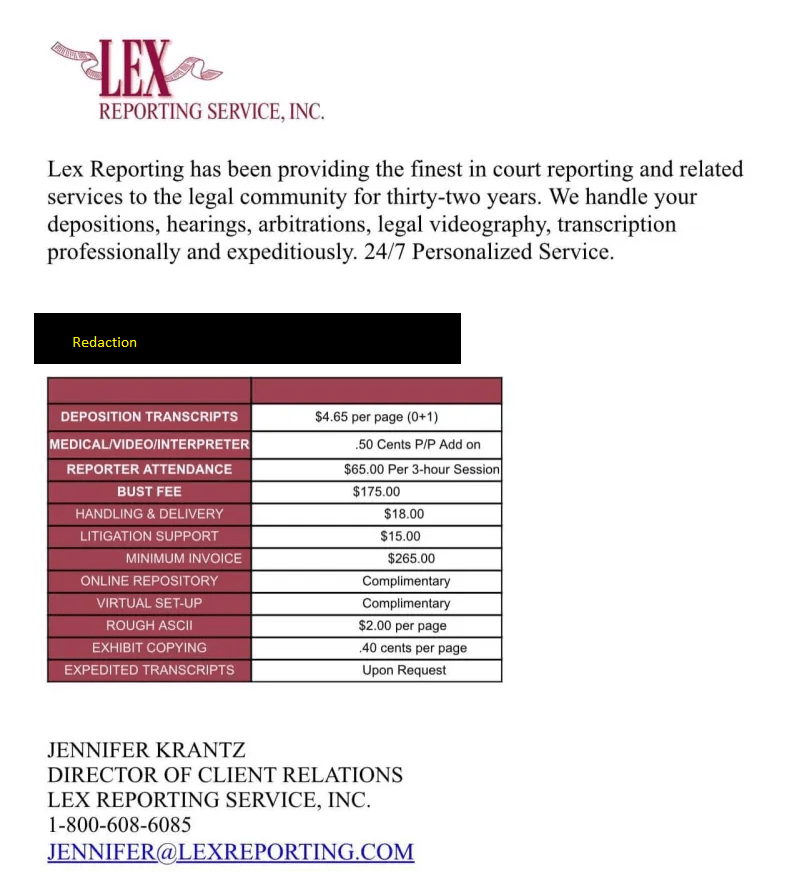
Documents purporting to be US Legal and Lex Reporting rate sheets were passed to me by a source recently.
US Legal New York Rate Sheet sent in by a Stenonymous SourceLex Reporting Rate Sheet Provided by a Stenonymous Source
To be honest, these rates seem very New-York-City competitive. There are some stenographers out there making $4.50 on the originals. I will say that as a young reporter I only got paid $1.00 for roughs, and with the amount of work that goes into those, it would put me off to learn the agency was making exactly what I was for essentially a finder’s fee. The bust I used to make was something like $75. The minimum fee was the bust fee. So there are definitely cost savings to be had for attorneys that go agency or reporter shopping.
But the surprising part of all this was my Stenonymous source stated that copy attorneys were charged the same.
Stenonymous source reports copy charges as high as original charges. In the past (2010), reporter copy charges were as low as 7% of the original in New York City.
Now, the breadth of my information gathering is limited, because I have a full-time job and this citizen journalist stuff is on the side. But it really may be true. Years ago, I staged a call-up to Diamond Reporting (New York City, later bought by Veritext), and they told my caller that they charged the same copy and original.
Not these specific companies listed above, but in general, I have always thought that companies play games with some invoices and the attorneys they don’t regularly do business with. Charge ultra high. No complaint? Payday. Complaint? Cut the bill in half and make out like a bandit while looking like a hero to the client. That said, it’s actually nice to see that not be the case here.
That’s all I have for this one. Feel free to pass it around.
I had an e-mail exchange recently with a New York stenographic court reporter that began taking private clients. With the understanding their identity would remain anonymous, they gave me good insight into how it has increased their profit. I have presented plenty of academic theory on how low our page rates are here in New York and the importance of copies. Today I get to bring reporters a real-world example of just how much a little risk can increase your bottom line. Check out our Q&A below!
Q. How long have you been reporting? A. I’ve been reporting for 10 1/2 years.
Q. We’ve had multiple discussions now where you’ve disclosed you’ve taken up private clients. How is that going for you? A. So far it’s a success. I work with my clients 1-2 times a week, which I expected. They aren’t big firms, so I didn’t expect constant work. In March and September they gave me 15 jobs. One thing I hear people express concern about is collecting money for copies. That is, of course, a concern, and I have had to lean on law firms. But I can say that so far no law firm has stiffed me. And while some have been a little slow to respond, all have. So, fortunately, I haven’t had to chase anyone for payment yet. The best thing is the vastly increased copy rates, which makes this work a whole lot more enjoyable 😉.
Q. Did anybody give you permission to do this or did you just start doing it? A. No one gave me permission. I took it upon myself. It’s all about developing a relationship with the attorney. I should say mostly. A law firm that has used one agency for many years and is happy with the service will not likely change. But still, without developing the relationship, it is unlikely that they will try to work with you. It can take a while, but it doesn’t necessarily have to. I probably worked with my first client four or five times, but we got along very well. I brought up the possibility of his working with me at a time when there was little pressure. I definitely did not bring it up while on a job for someone else. I took a chance and it worked. He said yes. There are other factors that induced him to switch to me. We worked out a good financial arrangement which benefited his law firm, too.
Q. What are your feelings on poaching? A. By poaching, do you mean taking clients? When we use that term, it makes this sound like you’re doing something wrong if you take a client. This is common practice in all industries. Most of the client the agencies have, they probably acquired through “poaching.” The only thing to avoid is unethical practices. As I said, I would never broach the subject while on a job for someone else. And of course don’t lie.
Q. The audience is going to want to know some hard numbers. What kind of differences are you seeing in take-home pay? A. I turned in a job 131 pages long, including the [word index], and got two copies. Total take-home was roughly $1200. That was for a med mal case that might have gone two hours . And by the way, I do not charge high rates. So with a different client with the same factors, the total could have been considerably more. This is not the only one.
Q. Wow. That’s like $9 a page. You charge your clients $9 a page in New York? A. [No], my rate is closer to 4. Again, this is a relatively low rate. But the real profit is in the copy rate. That’s where you’ll make the money. (Just a side note, not one law firm has contested my copy rates. Hopefully that will never be an issue. I’m saying this for those who are concerned about collecting the payment.) So I don’t mind if the law firm wants to negotiate a rate down a little, not too much, as long as I’m aware I can keep the copy rate. On that 131-page job, nearly $800 of my pay was from the copy rate! Keep this in mind, remember this, we’re in business providing a service for law firms. So a) be gracious and patient in dealing with the law firms; b) be open to negotiate rates, just as long as you keep in mind where you’re really earning your money from.
Q. Isn’t it a challenge getting them to pay you? A. Sure. But I’ll take this challenge over the challenge of trying to make money when agencies are charging 4 dollars a page per copy and they’re giving, so generously, 40 cents a copy. Exactly what was said there. No more needs to be said. We have to strive upwards. I accept the challenge of collecting over the challenge of squeezing small incremental rate increases.
Q. Isn’t the cost of printing eating into your money? A. Not really. I had a $1,200 job the other day. When it was all said and done, I paid $90 to have it printed up. How come reporters are willing to blow a third of their money on scopists but not willing to even consider seeking their own clients and spending 10 percent on printing? Compare the costs to that of most industries. The cost here is very small in comparison to that in most fields.
Q. Anything else you’d like to tell reporters generally or New York reporters? A. Look, if someone does want to go out on their own, it’s understandable. For years, I said I would. I made halfhearted attempts, but didn’t really follow up. Even when I got my first client, I almost didn’t expect the attorney to take it seriously. But now that I see the huge difference in what I can earn per job, it’s motivated me to try and get more clients. I will say to those who want to try and do it on their own, just try it. Don’t be afraid of being blackballed by other agencies. You have nothing to lose and so much to gain. I’ve heard people say they don’t want to bother with putting transcripts together. First of all, it takes maybe 10 minutes. That’s it!
Second, it’s a great experience in motivating yourself to be an even better reporter, because you don’t want to turn in an error-filled transcript to your own client! You will be so much more careful and your notes will be so much better! I know because I’ve improved significantly just in the three months since I picked up my first client. If you’re so inclined to strike out on your own, I urge you to trust yourself and go and do it. Develop those relationships. Make business cards. Give them to everyone you know who knows attorneys. It can take time, so don’t get frustrated. Eventually you’ll get a first client. Not every job is big payday, but you will have some jobs where you will see double and maybe even more than what you would’ve earned if it was work for an agency.
In my view, this speaks for itself. Taking private clients can double your money. Collecting can become problematic, but the alternative of allowing certain agencies to continue to push substandard means of reporting on consumers is not a good one.
My girlfriend is very upset that I blew our vacation money on an ad campaign for steno. I’m not allowed to hire graphic designers anymore. Everybody that wants to donate to my vacation fund can do so at paypal.me/stenonymous. (joke)
Addendum:
A reader asked how many copies were charged in the above example. Our anonymous respondent said “2 copies. Keep in mind I give a discount to my client when I have copies. I also only charge 3/copy. I’m pretty sure many agencies, if not all, are charging more.” For more context on this model, it is called a sliding scale. Companies will often decrease the cost to their client when copies are sold so as to be giving them a page rate that cannot be undercut. After all, why would a reporter offer someone $2.60 a page when they could work for an agency for around $4.00? But in New York this continues to hide the value of copies from the working reporter, who up until recently were accepting as little as $0.00 to $0.25 on a copy.
Happy New Year! Just wanted to start off with a fun anecdote on rates. I have written about the importance of negotiation and sharing information before. Recently a friend of mine hit kind of a jackpot and was asked to take on a job with something like 25 attorneys. We’ve all been there. Anyway, he or she was asked to abide by a sliding scale, also known as accepting a lower rate for every copy over the Nth copy. Well my friend did some math and basically said, oh wow, if I do my rates and this job is 100 pages, I make like 2,000 more dollars on this job. Friend refused the sliding scale, and was offered the job in spite of that.
By accepting the sliding scale model, the reporter would’ve made 2,000 dollars less. There’s some merit to the sliding scale model in that it can encourage attorneys that would not have ordered to order, but I think we as reporters should be very clear with ourselves about how it impacts us. First, less money. Okay. But second: Are you guaranteed that that sliding scale is being applied to the job you’re taking? This should be a primary goal for us. If you want us to take a sliding scale, we want to see some proof this is what’s being offered to the clients. We want some assurance that the agency isn’t making tons of money by charging full price on copies and then binding us to a sliding scale. The power of no can be the difference between getting your full rate and being bound to a sliding scale. And remember, the slide is downward!
While we’re on the topic of the power of no, let’s touch up on contracting again. Contracting is the idea that these big box entities make big sweeping contracts with insurers to only use specific agencies for specific insurance work. Very much litigation is funded by insurance money. People who’re against this are basically against it for two reasons: One, if you hand a big box a lot of market share, they can dictate rates easier because they have so much work. Two, it binds people who are not a party to the contract to the contract. Basically defendants protected by their insurer are forced to use the court reporting company at their deposition. This can be an issue because defendants whose insurance do not ultimately cover the full cost of litigation may end up paying the cost of reporting services they didn’t agree to. And here’s a great point: If the big box people can’t fill those jobs, it might force them to raise rates or end any exclusive deal they have with the insurer. That said, it is imperative that stenographer agencies compete for these contracts. More competition in the market means more money off to individual reporters. Think about it. No more concentration of market share equals agencies competing to attract and keep the talent. The power of no can reset the whole damn industry to a place where reporters are winning.
If you’re a freelancer, you’re going to bump into the sliding scale model eventually, or asked to do contract work for a low rate, and you’re going to have to decide what to do. Do yourself a favor, and remember the power of no.