For The Record Acquired By Tyler Technologies for $212 Million. What’s Next?

A cherished friend let me in on an article posted by JackimWoods & Co. it’s made its rounds on Facebook so I don’t expect it’ll be completely surprising to many of you. Let me go on record and say I respect Rich Jackim and the article, but I’d like to do a little bit of commentary on this one.

Right at the top, it’s written, “this transaction marks a decisive shift toward institutional-scale investment in AI-powered court reporting technology, signaling the beginning of a structural transformation that will fundamentally reshape the court reporting and legal support services sector within the next three to five years.” He’s not wrong that this is significant, but let’s not forget that For The Record was one of the companies represented on the Speech-to-Text Institute’s board. Rather than defend the organization or its fraudulent statements, For The Record and all the others let it collapse and flounder in the court case it was named in. And it was only three years ago that a For The Record transcript was called a deficit product in a high-profile case. I’ll just note generally, you have to see the guy has financial interests in the consolidation of the industry, so read it from that point of view.

But the fact remains that if big money is spending this much money consolidating the industry, that means they’ll be using their money to steer it a certain way. They have been using their money to steer it a certain way. That certain way is reducing the number of stenographer positions or pushing us into the role of transcribers, unseen, unheard, quietly correcting and/or certifying the AI’s work behind the scenes for a fraction of what we make today and a whole lot less autonomy.

Let me be really clear: You cannot skill your way out of this. This is economic warfare. This is us spending the next 10 years playing musical chairs while the big money collectively deletes stenographer seats one by one unless we start making moves. Moves like unionization. Our field has always thrived on a kind of survivorship bias. We watch this happen, it’s probably Armageddon. But at least the people who still have jobs at that point will be able to say “I made it.”

I’ll note also that people have been talking about the Veritext CEU webinar last night. Finally Veritext came out and said it, “digital is equal, we get 3,000 applicants a month and we accept 2% of those.” This is what I heard. Do I know the truth? No. Veritext habitually lies and abuses the trust of reporters. Do I blame Andrea Wecker, their current front person? Nope. She’s probably made the same exact calculation, and wants to be able to say “I made it.”

I’m exploring some ideas as to what to do about it all. I’m AI-powered too these days, so we’ve got a shot (joke).

Bulletin: Revealing Stenonymous Bot, Stenonymous’s AI-Powered Chatbot.

Long-time users of the site may have noticed a little change recently. There’s an annoying speech bubble on the bottom right of the site now.

The speech bubble at the bottom right gives you access to Stenonymous bot.

Finally, a place to ask the important questions, like “Is Chris Day a nutjob communist?” I’ve spent a small amount of time training this thing, so it’s ready for the hard questions.

Bonus points if you get it to flip out and say something deluded.

Feel free to copy and paste your chats into the comments or send me funny screenshots via email and social media. I’m sure we can have a laugh at the expense of the environment before it inevitably breaks and I disable it.

I’ll just ask that if it entertains you for any appreciable length of time, please drop a donation on the front page of Stenonymous.com. I know one glorious reader knows, these things don’t come cheap.

Stenonymous Bot debut

Bulletin: ChatGPT Caricature Image Trend 2026

Lots of us have been doing the ChatGPT caricatures on Facebook. On the one hand, for me at least, it’s always interesting to see what the machine puts out. On the other hand, some people point to the waste of resources these AI data centers are or can be. The discussion rolls pretty deep.

I, myself, have come to a point where I’ll use AI for entertainment and, if the chance ever arises, success. Though in its current form I don’t see how AI could boost us on the record beyond what companies like Stenograph and Advantage are already doing. And the results, from what I’ve been hearing, are pretty mixed.

Maybe that makes me unimaginative. I’ll have to think about it.

National Court Reporters Association Loses Approximately 1000 Members in 3 Years.

Posting the corruption article the other day inspired me to review some of the information in it.

I realized I had posted the NCRA stats that were posted as of August 2023, which were stats from December 2022.

I compared that to the most updated stats on its website.

National Court Reporters Association statistics posted as of January 23, 2026

From 11,946 to 11,009 is a loss of 937 overall members.

The loss of court reporter members from 8,980 to 8,113 is a loss of 867.

Some of this is no doubt attributable to the shortage. People are retiring out. That was never in dispute. But even by the bleakest of statistics published by the Speech-to-Text Institute before it was accused of fraud and shut down its website, there are a couple hundred new reporters entering the workforce each year. Where are they in this equation?

Either they lack the knowledge of NCRA, or lack the motivation to join. And in either case, the NCRA should probably be studying why that is.

But this is the organizational issue with NCRA, and a big reason I left. The organization lacks introspection. It is ever focused on blaming the outsider, the other, the people like me that dare criticize the direction we’re headed. In such a culture and environment, it is nearly impossible to examine and ask, “is it something we’re doing wrong? Are we the bad guys?”

And to a degree, this is shouting to the void, hoping the words carry and the winds change. Because it’s not just retirees that left. There’s an entire network of people just like me that gave up their certification and said “goodbye, old friend.” We lost the belief in the organization, and we took our money and effort with us. Not just so-called “checkbook members”, but people willing to donate serious time to the organization, and in some cases, fundraise for it.

I will say in NCRA’s defense that, over 3 or 4 years, a loss of about 200 a year, is far less bleeding than the Speech-to-Text Institute’s forecasting, which was something like a loss of 700 reporters a year in exactly this time frame. So at least there’s that.

Am I the bad guy?”

National Court Reporters Association 2024 990 Filing Now Available

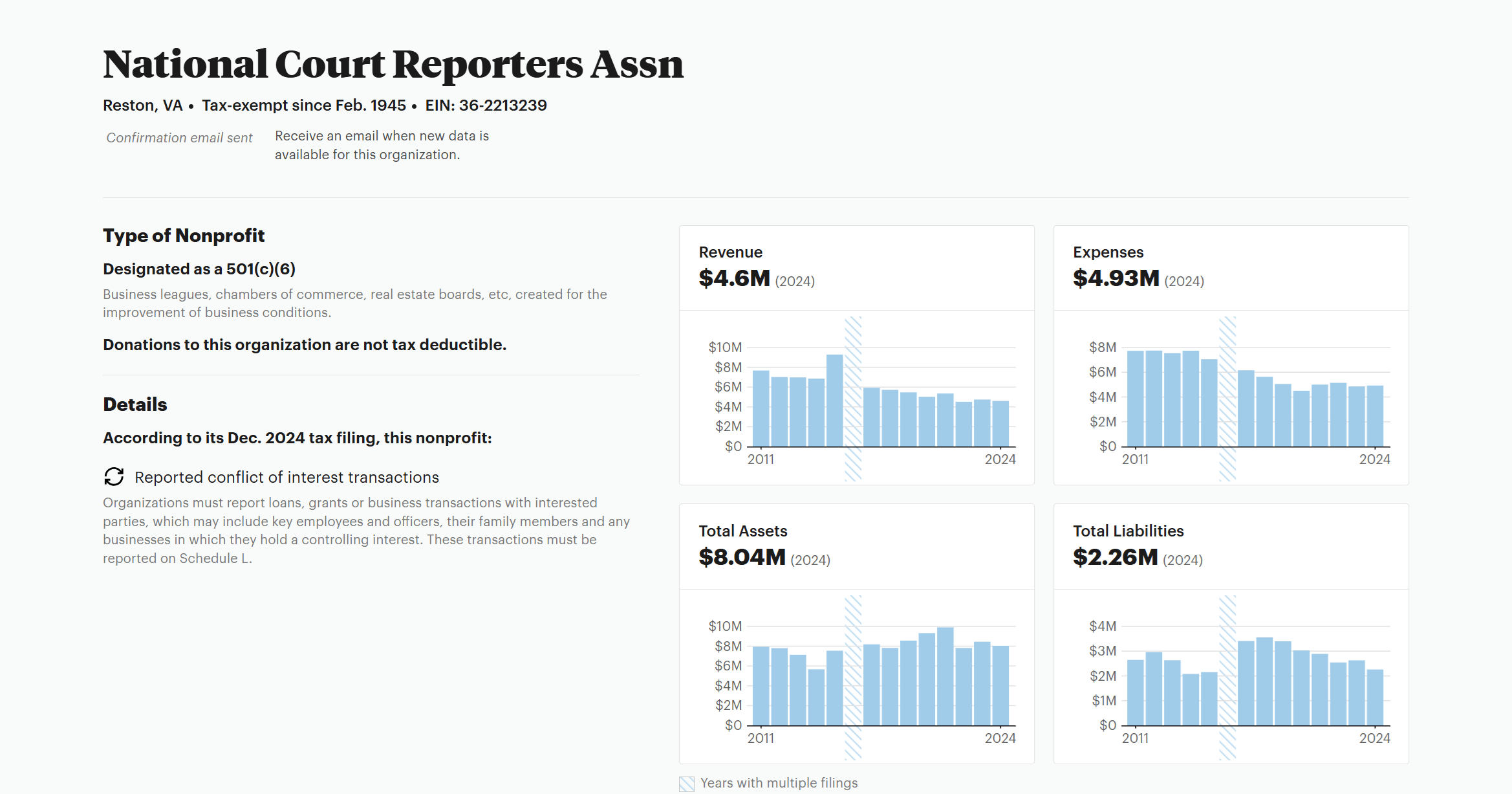
2024 snapshot:

In the past I’ve written about how easy it might be to bribe our leaders.

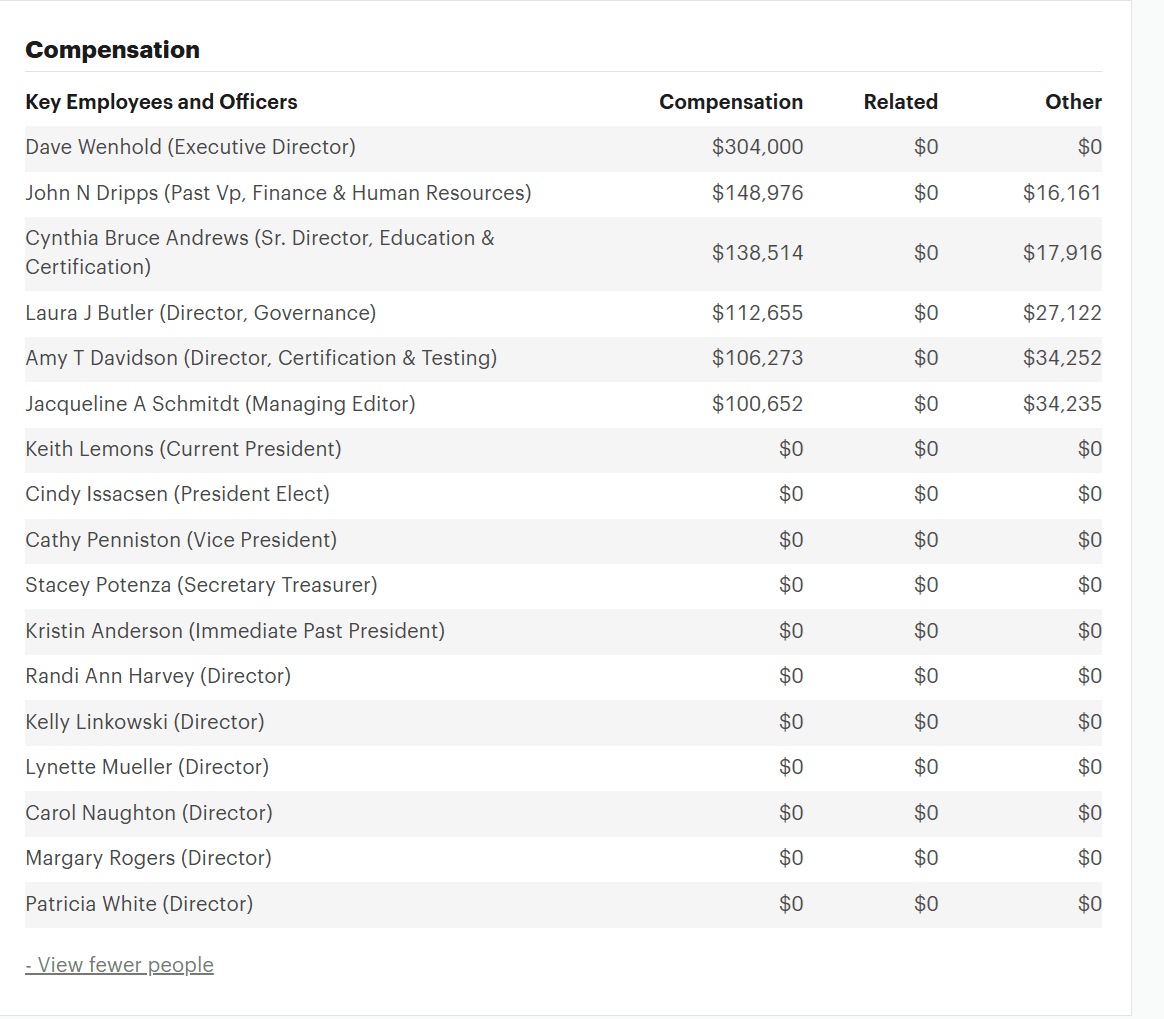
I’ve also noted that, even where there’s no proof of corruption, the current Executive Director of the National Court Reporters Association, Dave Wenhold, either personally or through his management company, runs lots of associations. So many that some might say it could impact the amount of time spent on our national association’s issues.

And so I’ll add today that it’s sort of comical that, at least in 2024, expenses went over revenue by almost exactly what Wenhold’s salary / pay is. 4.93M expenses. 4.6M revenue. And Wenhold’s payment? 0.3M.

And yeah, I get the whole song and dance that this is the guy who can run an association of this size. But, you know, so was Jim Cudahy at one point, and we all saw how that turned out with the Speech-to-Text Institute.

I stand by what I said in the corruption article. We should send our own people to association management training and have one of us steering the ship. The consolidation of too much power in one person is a dangerous thing. We had the good sense to write term limits into NCRA’s constitution and bylaws. Why, then, do we consolidate, year after year, one man’s power over the organization? Don’t get me wrong, I’m not saying we need to flip the seat every year. But after half a decade of frozen/falling revenue and a fairly stagnant membership count, and a man that’s been involved with the court reporting profession for 17 years or more, isn’t it time to try a new approach?

Critical thinking demands the question at least pass through the minds of the Board of Directors.

BlueLedge is an NCRA Qualified Program and Kentuckiana is Allegedly Being Sold to Veritext

Well, first what’s confirmed out of the way, BlueLedge is a qualified vendor right on NCRA’s website. BlueLedge being a leading digital court reporting training outfit famously integrated into Veritext’s pipeline.

I’ll be honest. I told my source I didn’t know about it, but it doesn’t surprise me. The National Court Reporters Association can’t really discriminate against BlueLedge without risking another antitrust lawsuit. And to be honest, the course as advertised by BlueLedge meets CEU requirements.

This being a real reason I support moving a good deal of our overall funding to individuals and companies that can actually speak out against bad business practices — such as BlueLedge gaining a presence on college websites across America through Ed 2 Go — rather than basically be forced to work with them and advertise them. But what do I know? I’m just a guy that documented all this in years gone by.

Moving on, I got a long email from an anonymous source. In short, it alleges that Veritext has “just bought” Kentuckiana Court Reporting, which encompasses Kentuckiana, Churchill Reporting, Kentucky Court Reporters, Pike Court Reporting, TriStar Court Reporting, and Milestone Court Reporting. Veritext itself has not yet advertised this alleged acquisition. The email mentions that there may be a lot of internal turmoil, with digitals preparing to flee if they “lose benefits,” the case apparently being that Kentuckiana keeps digitals as regular employees and that Veritext tends not to.

The main theme: “Students should be warned that Veritext will be headhunting them, and what to expect from them and what their reputation is.”

To be even more frank, students, here’s what to expect from most corporations: When they need you, the relationship is good, even often weighted in some way in your favor. But they are always working on reworking that relationship to a point where they don’t really need you, and as that happens, you can expect rates to freeze/fall or work to be withheld in favor of giving it to others who will do it cheaper. And as corporate consolidation of the court reporting industry continues, we can expect that the pool of satisfied reporters will become smaller.

In summary, you will be told there is a shortage and you are very needed right up until there is a digital reporter and transcriber ready to replace you for less. And if there never is, congratulations, they likely had you doing it cheaper.

Of course, as with all things, the truth is nuanced and layered. But take this as a very direction-of-the-river-absent-other-information type of post. Good luck.

Bulletin: 2026 Arrives. What Will It Bring?

Happy New Year, everyone. Things are going well for me personally. I very much hope the same for all of you reading.

This blog’s had quite a run, from the early posts trying to help new reporters to the shortage investigation stuff. It remains, within my knowledge, the largest independent publication in the industry, with approximately 1,500 visitors per month even when I’m not writing much.

As for what happens next, the interesting thing is that I don’t know. I’ve had some interesting articles fall through the cracks, like Naegeli taking advantage of a witness / pro se litigant. Will it be more sand sifting through my fingers or will I hit something concrete to write about?

That depends, in large part, on the community. The things you send me. The things you comment on this blog. The things you write to me on Facebook. And ultimately juggling all of that with my personal schedule.

Still lots of memories to be made, reader.

Enjoy 2026.

Guest Post: Why We’re Betting on Human Court Reporters in the Age of AI

Why We’re Betting on Human Court Reporters in the Age of AI

By Lindsay Stoker, CA CSR, RDR, CRR, CRC

At Filevine’s recent California webinar on the future of court reporting, I opened with a simple, unapologetic truth: “The record’s integrity is sacred, and reporter excellence is what protects it.”

Court reporters are being pushed out of their own industry by AI tools that are misrepresented and under-regulated. The enemy isn’t the tools themselves, it’s greed: deployed to cut corners and replace professional expertise with cheap inputs and ship the “savings” upstairs. Profit-first; standard-last. The profession I’ve dedicated 20 years to is being quietly strip-mined and resold with a sticker that reads “innovation.”

I joined Filevine as their Court Reporter in Charge to make sure the standards I’ve defended for two decades are built into the next generation.

What Filevine Is (and Isn’t)

Filevine is a software platform used by approximately 6,000 law firms to manage cases and conduct depositions in the same system. It handles scheduling, hosting, exhibits, realtime preview, analysis, and transcript delivery, while a licensed California court reporter owns and certifies the record. That line isn’t blurred; it’s enforced.

At Filevine, compliance comes first and we follow the law every time. Our processes are built to align with California’s Code of Civil Procedure Section §2025 and Business & Professions Code §8051. My role as the Court Reporter in Charge means there’s a single point of accountability for standards and sign-off. If the record is challenged, we answer with certified transcripts, produced under state law, by licensed professionals who were in the proceeding.

(A note on national practices: Filevine operates in states across the U.S., and the rules for court reporting vary widely. In California, we follow strict state law requirements. In states where digital reporting is legal and widely accepted, we offer compliant solutions that meet relentlessly high quality standards, upon stipulation by all parties, and only on prior notice – no steno-to-digital bait-and-switch. The record’s integrity starts with knowing who’s behind it, and our clients always know.)

Greed Is the Threat, Not AI

Christopher Day’s article, “Artificial Intelligence in Court Reporting: An October 2025 White Paper Generated By Artificial Intelligence,” maps the pyramid of the court reporting industry – low-value recordings at the base, bread-and-butter depos in the middle, and high-paying certified realtime at the top. As Day warns, “Somewhere along the line we convinced ourselves it was okay to give up most of the pyramid…Eventually all you have is realtime.”

The play he describes is simple: Hollow out the base by punting recordings and transcription of exhibits to AI tools and legal transcribers, move the goalposts in the middle by normalizing inferior shortcuts, then desperate novice “realtime” providers flood the zone at the top –consumers get duped, and the pros take the pay cut. Margin flows up, standards flow down. Students lose appropriate and viable paid on-ramps, schools close, and the profession gets hollowed out. AI isn’t the enemy; greed is. The “innovation” pitch is the oldest play in the book in a new hoodie: downgrade skill, cheapen inputs, move profits up.


How We Solve The Pyramid Problem


Big-box agencies make their money by capitalizing on your labor, so their incentives push them to swap certified reporters for cheap alternatives. We don’t. We make money selling software and our revenue comes from the platform, not from making money on you. The economics thus run the other way: keep a licensed CSR in the chair, pay market-leading rates with 72-hour payouts, and offer bonuses to reporters for client referrals. Our software-first model gives the pyramid back to reporters: we don’t have to hollow out the middle to hit agency margins, and we never have to pretend a machine can replace you.

We don’t play games with your business. Reporters can always sell certified realtime and rough drafts. Our AI-generated realtime insights and rough draft products are always clearly labeled, and when precision matters, clients upgrade to a certified reporter realtime or rough product. Greed blurs the lines – we re-draw them and pay the reporter for them.


The Stakes


The industry is eating itself from the bottom up. If we let cheap shortcuts replace real training and standards, there won’t be a profession left to fight for, just broken records and court challenges.


We’re not sitting back while that happens. Filevine is rebuilding the pyramid: certified transcripts by licensed CSRs, industry-leading rates, payouts in 72 hours, clearly-labeled AI products, and never, ever using your work to train a model. This isn’t innovation dressed up as disruption: It’s accountability, ownership, and standards backed by actual humans.

You want to fix this? Start by putting professionals back at the center. That’s the only future worth betting on.


Disclaimer: The content of this publication reflects my personal opinions and is provided for informational purposes only. It does not constitute the official position of my employer, clients, or affiliates.


Addendum (by Chris Day):

The original PDF is available for download here:

I look forward to more guest writers! Thank you, Lindsay.

Happy Thanksgiving to all that celebrate.

(As of launch there are some issues with the plain text version of this article I am trying to fix on the website. Please be patient.)

The Other Side of the Coin: The AI Bubble Pop

After my last post launched, I was pleasantly surprised to read about some problems on the horizon for OpenAI.

That, alongside Andrew’s comment on the post (thanks for reading, Andrew!), compel me to explain that though I personally believe AI has some value, and though I believe we will eventually be ousted by attrition barring definitive action on our part (like me raising about $3 million to pour on a school and some media action! Dreamers can dream, can’t they?) — I still acknowledge that the colossal amount of money being spent on AI is likely to result in a big bubble burst and potentially cause another AI Winter.

And though I don’t intend to make a habit of using AI generated stuff on my website, I once again let AI do some googling for me just to see what it might say.

Is there an AI bubble in terms of investing and can it lead to an AI winter?

I’ll search for current information about AI investment trends and concerns about a potential bubble or AI winter. Now let me search for information specifically about AI winter risks: Based on the search results, here’s what the current situation looks like:

Yes, there are significant bubble concerns

AI investment as a share of the economy is nearly a third greater than internet-related investments during the dotcom bubble, and many experts are warning about bubble-like conditions. Even OpenAI CEO Sam Altman has acknowledged that investors as a whole are “overexcited about AI,” though he maintains AI remains fundamentally important.

Key warning signs include:

  • Over 1,300 AI startups now have valuations exceeding $100 million, with 498 “unicorns” valued at $1 billion or more
  • Tech companies are projected to spend about $400 billion this year on AI infrastructure
  • Circular revenue deals between major players like OpenAI, Nvidia, and Microsoft, where these companies are simultaneously investors in and customers of each other
  • OpenAI is losing billions annually while making massive investment commitments, with projected revenues of only $13 billion against deals worth around $1 trillion

Could it lead to an AI winter?

The picture is more nuanced here. The IMF’s chief economist predicts that while a bust is possible, it would be less likely to be a systemic event that would crater the US or global economy, since AI investment is financed by cash-rich tech companies rather than debt.

However, an MIT report revealed that 95% of enterprise generative AI programs are failing or returning no measurable value, which suggests the practical applications aren’t yet living up to the hype.

The key difference from past AI winters: Unlike previous AI winters, companies like Google, Amazon, and Microsoft that survived the dotcom crash are now the primary AI investors, and they’re already profitable with strong fundamentals. This suggests any correction might be less catastrophic than historical AI winters.

While some companies will likely collapse under unsustainable economics, AI itself won’t disappear—it’s evolving toward more practical, specialized systems rather than mega-models. So we might see a market correction and consolidation rather than a complete “winter” where AI research grinds to a halt.

Back to Christopher Day, the author of most posts on Stenonymous.com

In short, it’s not the technology that’s going to kill us. More likely than not it’s the shortage exaggerated and exacerbated by the Speech-to-Text Institute and the large court reporting companies. For example, when U.S. Legal used its money to buy and kill Stenotrain and proceeded to bet everything on digital, or when Veritext built Blue Ledge into its pipeline instead of, say, using its money and power to create a stenographic program and build that into its pipeline. More or less, they saw an opportunity to bump out the “overpaid” stenographers, and they took it. And that’s what I spent the last few years documenting.

With some words on the internet and $10,000 from readers like you, we dismantled the fraudulent STTI, publishing again and again that they were using outdated, unadjusted figures to make their claims. We ended up informing thousands of potential jobseekers that digital was not the best way to get into court reporting. To this day I get emails and comments about various fraudsters in our industry. I’m one guy. There are 17,000 to 30,000 of us. That’s a whole lot of potential and brainpower.

So, I still hold out some hope we’ll do something special and reverse the course. My favorite Latin phrase is, after all, a posse ad esse, “from possibility to actuality.

P.S.

Like Ms. Rachel says, bubble, bubble, bubble, bubble, pop!

Ah! Dad jokes! Guess how many times I’ve heard that one!

Every movement needs its propagandists, right?