Artificial Intelligence in Court Reporting: An October 2025 White Paper Generated By Artificial Intelligence

Thanks to a demonstration by a dear friend (Shoutout to Noah Collin!) I was recently turned on to trying out artificial intelligence, AI.

Best I can say, modern AI is not actually intelligent. It’s a highly sophisticated word guesser based on an immense amount of training data.

But, my God, it’s good at what it does. For example, I wanted to start by introducing the different types of AI for readers that may not be aware. And I let AI do it for me.

Here are the key differences among these AI types:

ASR (Automatic Speech Recognition)

  • Converts spoken language into written text
  • Focuses specifically on audio processing and transcription
  • Examples: voice-to-text features, voice assistants like Siri or Alexa

NLP (Natural Language Processing)

  • Broad field covering any AI that understands or generates human language
  • Includes tasks like translation, sentiment analysis, text classification, and chatbots
  • Can work with both text and speech (through ASR)

LLM (Large Language Model)

  • A specific type of NLP system trained on massive amounts of text data
  • Generates human-like text and understands context across long conversations
  • Examples: ChatGPT, Claude, GPT-4
  • More advanced than traditional NLP, capable of reasoning, creative writing, and complex tasks

In short: ASR deals with speech-to-text, NLP is the umbrella term for language AI, and LLMs are powerful modern NLP systems that can handle sophisticated language tasks.

Okay. Back to Chris Day speaking. Typing? Bloviating? (Special thanks to my biggest fan.)

So I got curious and I asked the AI to make a white paper on the pros and cons of AI in court reporting. And what it created was pretty damn good. Accurate. And perhaps an accurate portrayal of where the big-money types believe this field is going.

And, in my own way, where I suspect it’s going based on all I know today. Big money’s pushing its agenda and we just can’t seem to unite and fight back, so sooner or later it’ll get its way.

Now, when I write something so bold, I would say change is happening much more gradually than the big-money types thought it would. Stenography, particularly for highly accurate writers, is likely here to stay strong(ish) for at least a decade or so, depending a little bit on what state you’re in. From old forecasts, the best states are going to be California, Illinois, Texas, and New York.

To explain a little bit about why I think what I do, imagine a sort of pyramid where you have all the potential legal transcription work on Earth, with the top being the highest-paying jobs on top and the lowest-paying jobs at the bottom.

(And despite what I’m about to write, all legal transcription is important. I am not belittling the needs of people participating in the legal process. Access to justice is important to me, and it makes me sick to my stomach that I am hearing again and again that big box agencies are not dealing with pro se individuals.)

Back to that pyramid:

So on the low end you have your transcription of exhibits and/or recordings. Stuff that, 9 times out of 10, we don’t want to do anyway. It’s punted to the legal transcribers and AI outfits.

Then maybe you have your “crappy” depositions. The interpreter jobs that have fewer transcribed words per hour, the insurance EUOs that can be done in 15 minutes.

Then you have your good-pay deps. Think longer, typically fast work that keeps the word counts high.

At the tippy top, you got realtime reporting. The money in realtime is unimaginable to those that have not experienced it.

Somewhere along the line we convinced ourselves that it was okay to give up most of the pyramid. Well now what do our students take? Well, our students can’t get jobs. If our students can’t get jobs, schools have lower demand, they shut down or sell off, and the person they sell off to might just decide the court reporting program isn’t worth it. Taking this to its logical conclusion, eventually all you have is the realtime. So either people lie and say they’re realtime, and realtime becomes saturated such that the rates drop, or there becomes too limited a demand for schools and we’re siphoned out by attrition. Since big boxes are already calling digital realtime, it’s hard not to see the truth.

This has happened. This is likely to continue happening barring some amazing action on the part of court reporters. This is a peek at the future.

This is not much different from The Record XChange’s Long Tail, something that’s almost a decade old.

For anyone that doesn’t get what I’m saying, I consulted my magic stenography crystal. Trust me, bro.

With all that being said I’d love to introduce the new Stenonymous.com October 2025 White Paper:

Artificial Intelligence in Court Reporting

P.S.

I’d also love to introduce what happened when I asked “how can one unionize a decentralized workforce?”

Unionizing a decentralized workforce presents unique challenges, but it’s definitely possible. Here are the key strategies:

Build Digital Community

  • Use online platforms (Slack, Discord, WhatsApp groups) to connect workers who may never meet in person
  • Create virtual meeting spaces for organizing conversations
  • Leverage social media to build solidarity and share information

Focus on Shared Issues

  • Identify common concerns across locations (pay rates, benefits, algorithmic management, lack of transparency)
  • Document patterns of unfair treatment that affect workers regardless of location
  • Emphasize that geographic separation doesn’t mean workers lack common interests

Adapt Traditional Organizing Tactics

  • Use virtual card-signing campaigns instead of in-person meetings
  • Conduct one-on-one conversations via video calls or messaging
  • Organize digital petitions and collective actions

Legal Considerations

  • Understand whether workers are classified as employees or independent contractors (this affects union rights)
  • Research which labor laws apply – some gig/remote workers may have limited protections
  • Consider forming worker cooperatives or associations if traditional unionization faces legal barriers

Leverage Technology

  • Use encrypted communications to protect organizers
  • Create databases to track worker contacts and organizing progress
  • Coordinate actions across time zones and locations

Build Coalition Support

  • Partner with existing unions that have experience with remote workers
  • Connect with worker advocacy groups and labor organizations
  • Seek public support to pressure companies

The success stories include gig workers (Uber, Instacart drivers), remote tech workers, and distributed customer service teams who’ve organized despite being scattered geographically.

“What percentage of court reporters are misclassified employees?”

I don’t have specific data on what percentage of court reporters are misclassified as independent contractors when they should be classified as employees. This is a fairly niche labor classification issue that would require recent research or surveys to answer accurately.

However, I can tell you that misclassification is a known concern in the court reporting field, as many court reporters work as independent contractors for agencies or courts, which can sometimes lead to disputes about proper classification under labor laws.

The determination typically depends on factors like:

  • Level of control the hiring entity has over work performance
  • Whether the reporter provides services to multiple clients
  • Who provides equipment and sets schedules
  • The permanency of the relationship

Would you like me to search for current statistics or recent studies on court reporter misclassification rates?

“Yes, search.”

Based on my search, I wasn’t able to find specific statistics on what percentage of court reporters are misclassified. However, I did find some relevant information about court reporter misclassification:

General research indicates that between 10% to 30% of employers across various industries misclassify workers as independent contractors, but this is not specific to court reporting.

What I found specifically about court reporters:

Court Reporter Misclassification Issues:

  • Court reporting is described as a field that “remains largely in the independent contractor space” with ongoing concerns about misclassification
  • The 2018 Dynamex case in California established new ABC test standards that required court reporting firms and freelance reporters to re-examine their business relationships to determine proper classification
  • When court reporters are misclassified as independent contractors rather than employees, they face challenges like lack of Department of Labor protection for unpaid wages, making it expensive to pursue legal remedies

The lack of specific court reporter misclassification statistics suggests this may be an under-researched area, despite being recognized as a concern within the industry. The fact that California’s Dynamex ruling specifically raised questions about court reporter classification indicates it’s a genuine issue, but without comprehensive studies, we don’t have reliable percentage data for this profession specifically.

“Do unionized workers make more on average?”

Yes, unionized workers do make significantly more on average than non-union workers. Let me search for the most current data on this:Yes, unionized workers make significantly more on average than non-union workers. Here are the key findings:

Current Wage Premium: In 2024, full-time union members had median weekly earnings of $1,337, while non-union workers earned $1,138 — a difference of about 17.5%.

The Union Wage Premium Breakdown: Research analyzing Canadian data found that unionized workers earn approximately 11% more than non-union workers, with about 60% of this premium coming from unions’ ability to negotiate higher wages and 40% from unionized firms being more productive.

Looking at 50 years of U.S. data, the adjusted hourly union wage premium has varied between 10% and 20% for most of that period, though it dipped below 10% during COVID. The weekly wage premium has been even larger, remaining between 20% and 26% from the early 1990s until COVID, and was still 16% in 2023.

Recent Wage Increases: Union contracts negotiated in 2023 achieved record-high average first-year wage increases of 6.6%, or 7.3% when including signing bonuses — the highest since Bloomberg Law began tracking in 1988.

So yes, the data clearly shows that unionized workers earn substantially more than their non-union counterparts, with the premium typically ranging from 10-20% or higher depending on how it’s measured.

“Did Einstein write in 1949 that the time had come where the rich controlled the means of communication, making it impossible for people to make informed decisions?”

Let me search for information about what Einstein wrote in 1949 regarding media control and informed decision-making:

Not quite. Einstein did write about this issue in 1949, but with an important distinction: he wasn’t warning about something that would happen in the future — he was describing what he believed was already happening at that time.

In his essay “Why Socialism?” published in the inaugural May 1949 issue of Monthly Review, Einstein wrote: “Moreover, under existing conditions, private capitalists inevitably control, directly or indirectly, the main sources of information (press, radio, education). It is thus extremely difficult, and indeed in most cases quite impossible, for the individual citizen to come to objective conclusions and to make intelligent use of his political rights.”

The popular social media paraphrases suggest Einstein warned this would happen in the future, but he was actually commenting on conditions he observed in 1949. He argued that private capital concentration had already resulted in an oligarchy whose power couldn’t be effectively checked, and that private capitalists already controlled the main sources of information.

So while Einstein did make this argument about wealthy elites controlling communication and making informed decisions nearly impossible, he was describing the present situation of 1949, not predicting a future scenario.


If you read this far, I’d ask you to consider donating on the front page of Stenonymous.com.

Addendum:

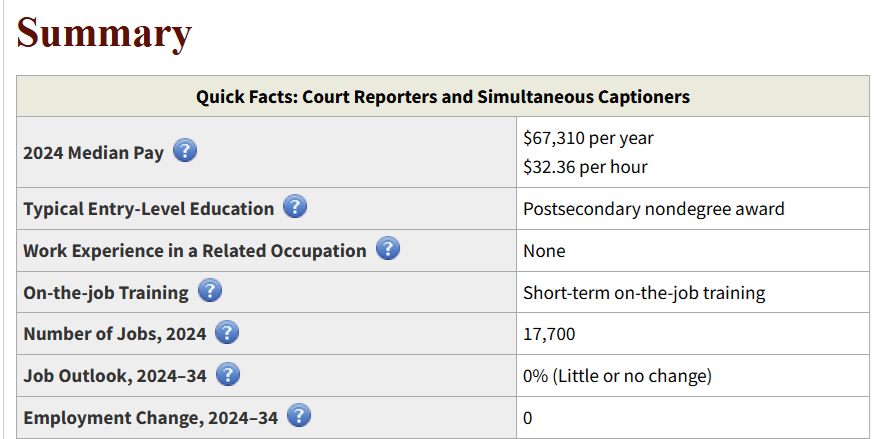
I have factors supporting my decision making that I do not include here, such as BLS predicting no job growth for us and there being fewer jobs in 2022 than 2020.
10/27/25:

Kensie Benoit posted this article. It supports much of my past arguments that we may be headed toward an AI winter or an AI bubble collapse. Be that as it may, the damage has been done to our field, and short of some decisive action on our part, we’ll be siphoned out over the next few decades. Again, not irreversible as the STTI claimed, but now much more likely.

Bulletin: The Dinner Party Scam Email

Several high profile people in the steno world have been hacked recently. This scam is so pervasive that my union has warned its members about it. I feel compelled to do the same.

To those that are hacked, or to avoid being hacked, it is best to enable 2FA on your Google or Gmail account. Two factor authentication means that a potential hacker requires access to more than your password to get into your stuff.

The scam looks something like this. If you click it, it attempts to download an exe file to your device. That exe, in all likelihood, is malicious spyware or malware.

Scam email about a dinner party

Thanks for your time, reader!

The Unsung Victims of AI

I’ve written extensively about AI and ASR, and in particular how ASR could cause further delays in court record production. I’m sure entering the terms AI or ASR into the search box at Stenonymous.com will reveal plenty of the opinions and facts I’ve recorded over the years.

Truth be told, though, with clean enough audio, it’s also my firm belief that ASR can work the other way, producing a usable first draft of a court transcript. Sorry, but, from what I’ve seen, this is likely true. The catch is that, short of having a professional tech onboard to make sure the audio is coming in clean, you often won’t have the cleanest audio in depositions and courtrooms even under the best circumstances with fully willing participants.

I’d like to take a moment to acknowledge the prevalent form of AI today, the LLM or generative chatbot or whatever you want to call it. When I was a kid, the closest thing we had to it was SmarterChild. Now there’s ChatGPT, Grok, etc.

And they have no problem killing people, because in America’s rush to see what this technology can do, we didn’t bother to put effective guardrails on the damn things.

Now, I’ll be the first to admit that there are great use cases for these glorified chatbots. They can give pretty accurate information. Like when I asked Grok what Stenonymous.com is.

Grok’s response to “What is Stenonymous.com?”

But again, I’d like to take the time to mention that there will be casualties. These chatbots, for better or worse, tend to validate the feelings of the user. For the mentally ill, they can validate and enhance delusions. For the young, as we’ve seen, they can encourage suicide.

I am but one voice. But I say legislate. We need legislative guardrails on this technology. We need legislators to stop looking away from what they don’t understand and start understanding that the world is different now and the needs of society are great. Technology must be kept up with by lawmakers.

But I have very little hope. I’ve seen the executive branch fail at fighting the most obvious and documented corporate fraud, right up until the executive branch became enslaved to wealthy interests through The New Emperor. The Supreme Court is enslaved to wealthy interests through open bribery. The Congress is enslaved to wealthy interests through the Citizens United ruling. We have very serious problems in America.

At the end of the day, I can only hope that you’re doing as well as me, reader. Or better. I’ll continue to use my voice.

But for now a moment of silence for all the unsung victims of AI.

National Court Reporters Association Files Reply In Support of Motion to Dismiss Antitrust Complaint

The official music track for this post is here.

Some time ago I consulted with a law firm about the tying of the National Court Reporters Association’s certifications to its membership, possibly in violation of antitrust laws. I’m not privy to what happened afterwards except that they apparently found plaintiffs and are attempting to move forward with a class action. I got my hands on NCRA’s reply in support of the motion to dismiss and I’ve decided to share it.

Having only read a sliver of it, I must say it’s comical that they call the membership and certification inseparable. Anybody with a few brain cells can see that it’d be easy to separate out the testing and CEUs from the membership. The NCRA simply doesn’t want to because it would cost them money. I’m hopeful that the court sees through such a ruse and the lawsuit survives the pleading stage, because at that point they’ve boxed themselves into a corner of “yes, our membership is tied to certification [in violation of antitrust law.]”

I have no reservations about where I stand. In the question of institutional loyalty versus loyalty to my fellow court reporters, I choose my fellow court reporters. And I’ll clip a comment from Facebook that lays out some of what I think of when I think of NCRA.

This refers to Jim Cudahy leaving NCRA to return under the Speech-to-Text Institute years later, the fact that Dave Wenhold manages probably a dozen organizations and therefore by definition cannot be invested in court reporting in the way we need him to be at this critical moment, the decline of court jobs on NCRA’s watch, and the decades-old lie that court reporters cannot discuss rates.

There is a certain cult-like thinking in court reporting where we believe in people and organizations that are clearly failing us. This is due in large part to propaganda. Being something of a propaganda expert that has used propaganda to tell the truth and raise consumer awareness, I must point out that if we do not break free from this de facto mind control, we will collectively walk off a cliff that there’s no climbing back from.

I must point out that with the kind of funding court reporters pour into the NCRA and Dave Wenhold’s pocket, Stenonymous could disrupt corporate propaganda dragging down your incomes, and has proven that in the past through the annihilation of the Speech-to-Text Institute, a venture that was backed by all the biggest names in the business including Stenograph and Veritext — and a direct threat to the prevalence of machine shorthand reporting.

I must point out that you can make a donation today on the front page of Stenonymous.com.

If change from within is not forthcoming, change from without is the only path forward.

P.S. Trey, if you happen to be reading, I know I still owe you a post. Life got in the way. I’ll be working on it sometime soon.

National Court Reporters Association to Exclude Non-Members From NCRA Social Media Groups

Court reporting has a huge Facebook presence. The National Court Reporters Association is acutely aware of this and has lots of different Facebook groups catering to the different types of reporters.

(Sorry to all the CART writers that don’t like being lumped into the reporter umbrella.)

Some of the NCRA social media groups are pictured

There’s no secret that the National Court Reporters Association has, overall, been bleeding members, with more expected losses forecasted to about 2030 thanks to the retirement cliff and the expansion of digital reporting by the larger corporations. This is in addition to people burned by the organization in one way or another who leave voluntarily, like yours truly.

So imagine my surprise when it was announced they’d be culling non-members from their groups.

An announcement by NCRA in the CART group
An announcement by NCRA in the scopists and proofreaders group

This selective inclusivity is precisely what’s killing the organization. If you want people to be excited about membership, excited about the organization, excited about joining and making a difference, you engage with them. You can’t engage with people you exclude. Why in the world would we exclude non-members from these spaces if there’s nothing nefarious going on?

Who knows? Maybe there is something nefarious going on. The NCRA does have that antitrust suit filed against it after all.

For better or worse, I’ve always allowed open engagement in my Stenonymous group and on this website. I take the time to answer and like almost every comment. You can trust my brand to be open and honest. Why can’t you trust your national association to be the same?

To be honest, if you ever wanted a place to spend the $300 wasted on membership dues, Stenonymous would be a good bet. I engage with news reporters to spread information about the field. I report accurately, openly, and faithfully on industry news, concepts, ideas. It wouldn’t really be all that hard to get some lobbying going if I had significant buy-in from the community. And then what does NCRA provide besides the certifications? And it probably wouldn’t be all that hard to get a certification program going under a slimmer organization with bylaws that don’t violate the antitrust laws. After all, I have good relations with people that have instituted the New York State Court Reporters Association certification program. Yes, I would have to give up the blogging and the wild man approach to politics, but I’d make it work.

You ever want a new association dedicated to stenographers, I’m your guy. But I can’t do it for free. I would need enough reserve cash to safely leave my job and do what really quite honestly needs to be done in this field — NCRA needs stiff competition. (Stenograph too!)

To all the NCRA members reading, don’t let your leaders lead you off a cliff. Don’t watch them burn your dues with their poor decisions. Demand inclusivity or get out of the club before it crumbles. Imagine the possibilities. Take control of your destiny.

Sometimes the path of least resistance isn’t the smartest choice. Sometimes the way forward is through.

Mel Elberg Interviews Brynn Seymour!

“I envision focusing on all of this more as of now– being able to really help more people that are in the same boat that I was in a couple years ago”  – Brynn Seymour

ME

Hi Brynn!

BS

Hi, Mel. How are you? 

ME

I’m well! So I’ll just jump right in if that’s alright? I know you’re a life coach, as well as a stenographer and host of the Court Reporter Podcast, and I’m wondering: which came first? What was your impetus for getting into these areas of work, and how did they become integral parts of your life? 

BS

Great question. I started the podcast in January of 2023. So at the end of 2022 I announced to my Facebook group and its community of court reporters that on January 1st The Court Reporter podcast would launch– because it was time that we started talking more about the struggles we faced and the solutions we can create in this unique industry.

I’ve always listened to podcasts. It’s just so convenient to listen to a podcast while you’re doing something else, like laundry, cooking, cleaning, or driving. If there’s something I need to learn about, then I go to podcasts to find out. 

So, often every week, I would search for one on court reporters. I looked and looked and looked, and there was really no one out there who was speaking for the court reporting industry, to help us with solving all these industry-related problems that we end up doing so much research ourselves on. There were many podcasts from life coaches, (and my favorite one was The Life Coach School, actually, which got me into life coaching). And those podcasts were very helpful for me, as a person who has ADHD, as a person who is feels disorganized and needs just, for self development, self help things like that.  But there was nothing specifically for court reporters.

So I decided that I just have to create the solution to this problem and do it myself.

ME

I love that. How did you meet your mentor, Josh Edwards?

BS

I met Josh at the New York State Court Reporters Association. He was assigned to me when I was in court reporting school, and he would help me with any issues that I had. He’s really good with Case Cat and a wiz with the technology. He’s a master certified court reporter in all the different categories that NCRA has.

ME

That’s fabulous. What’s your experience been with building community around the podcast? I’m curious as well how that’s affected your experience at work, in court itself.

BS

I started a Facebook group, because it seemed that the best way to build a community for court reporters was where they already were. So I have been welcoming people into the group, and building up conversations around what issues it is they want to hear about. We can do live discussions. We can do zoom meetings. We can do big discussions with all of us, it doesn’t have to just be me talking. I don’t want it to just be me. In general, I want more conversations for court reporters, to hear about other people’s experiences, to ask “how do you handle this? How do you do your bills and your booking and your scheduling? How do you manage your time when your schedule is so unpredictable?” 

The answers are so different for everyone.  So the community has been helpful for that. Although, when I started working full time in court, it became difficult to make time for it. I was working with a group of court reporters, so I gave them printouts of all the ideas that I had for the podcast, and told them that I’d love to interview each of them. 

But, working full time in court, it’s difficult to manage our schedules and to find time to meet together, so that kind of held me back from doing the podcast more at first. But now I have officially resigned!  I want to go back to freelance so that I can focus more on the podcast and on life coaching, because I really want more people to be able to be helped by what I needed so badly when I was searching for a podcast. I want to be able to offer that to more people, and to really help people one on one as well.

ME

Beautiful. Do you have any favorite moments from the podcast, any that are really near to your heart, or anecdotal?

BS

I mean, all of my guests have been amazing, and it’s a wide variety of people– attorneys, judges, court reporters.  One episode I have is called, “Are we on the record?” And we talk about the frustration, when the attorneys and judges just start going off on these side conversations without saying that they want to go off the record, and we’re still on the record, typing everything. And I’m like, do they really want this on the record? Because it doesn’t seem related to the case. So we have these internal battles of ‘what should we do?’ I eventually came to the conclusion that I need to just interrupt them and ask– but it’s things like that, that I really just love having an outlet for with the podcast.

ME

Yeah, I’ve heard a few other stenographers speak similarly about the necessity of asking folks in court to speak up and slow down.

BS

It’s interesting, because some court reporters are great at it; it really depends on one’s personality type. I’m an introvert, and it’s not easy for me to bring attention to myself, not feeling 100% sure if I should speak up at that moment. Sometimes you’re unsure of what you’ve heard. We all have an audio backup sync, and when I go back and check, it’s very easy to think, ‘Oh, why didn’t I get that at the time? In the moment, you’re multitasking: you’re typing, you’re listening, you’re monitoring everything. So I always have that hesitation to interrupt.  But later on, it’s so easy to figure it out with the context clues. 

That’s another thing I want to help court reporters who are especially shy with.  Because they don’t teach you that confidence in school, which is more focused on the trade and typing skills. When it comes to those emotions that we feel, and the internal struggles–  I needed that kind of help when I started out, and it just wasn’t there.  So that is something I want to help people with now.  

ME

That’s awesome. I’m interested in your experience as a woman in a male dominated industry. Does that coincide with your impulse to advocate for yourself and other women, who may hesitate to speak up when they should?

BS

I do feel a little bit more comfortable when it’s mostly women. I don’t really like to be surrounded just by men.  But the good thing is that there are so many more women attorneys nowadays than in the past, and it’s getting better. In the Bronx Supreme Court, where I was working, 90% of the judges were female. That was so great.

ME

Wow! I’m so happy to hear this.

BS

The tables are turning. I’m also part of The Church of God, which does a lot of sustainable development events, and we hosted an event for women judges in this month of Women’s history, on March 3.  We did a UN International Day of Women Judges event, and 15 women judges came from the court system to the Church of God in Scarsdale.  We honored them, they spoke, there was a panel discussion about the rise of women and about women really taking that step forward.

ME

Incredible! How do you feel about AI and the future of Stenography work? Tell me about the  VTM program you’re developing.

BS 

VTM has nothing to do with AI– it’s where you implement a system for yourself as a court reporter, so you don’t have to be working so much at managing every deadline and transcript, but you have built a team for yourself with humans. 

If there is an AI solution, I’m all open to learning about it.  If there are tools that can help us with our work, I would love AI.  I do think there are risks, and we have to be careful, and that’s why I want to do my research first.

Actually, Chris Day and I spoke about it when I interviewed him for the podcast. He does so much research on that.  There is a tool in Case Cat, called “check it”.  And it’s pretty popular in court, so I decided to try it. And when I did, I thought, this is kind of garbage, to be honest. It was suggesting changes that were completely ridiculous, such as changing ‘address’ to ‘dress’, even though the context was asking, ‘What is your address? State your address for the record’. 

I know artificial intelligence is supposed to be intelligent, so maybe that was just a fluke, but that stopped me from using it. 

ME

I love the continuity between your podcast, volunteer work and spiritual work, via your love of helping people. I’m curious how you navigate that work-life balance?

BS

There’s a program that I took when I was in my life coaching certification school called Monday Hour One, which trains you on making a schedule for yourself. So every Monday (or I like to do Sundays), the idea is to plan out the things that week which you want to do for your personal life– whatever is most meaningful and important to you, you plan first.  And then you plan your work and everything else around that. 

As all court reporters understand, in our industry we struggle with the ability to predict what our day is going to be like, and I too struggled with that for a while.  But as I’ve grown as a person and as a life coach, I feel like now I’m finally coming to a point where I’m getting closer to that balance. And it really does make a difference when I am able to schedule out my weeks where I spend that one hour really planning, downloading everything that I have to do out of my brain and onto paper, and then prioritizing each thing and putting it into my calendar. 

The most important thing to me is my spiritual life and my relationships and the people that bring meaning to my life, and family. So I put those things in first, and now that I have an open-canvas calendar without the nine to five, that’s what I’ll be doing more of. I’ll be able to put more time into those things. 

Like just today, I was able to meet with my sister at lunchtime, and I just got back from it, and it was great, because it felt so good to be able to put that in my schedule and to actually stick to it. 

ME

I love that, you really practice what you preach. 

BS

The most important part is to take the time to reflect afterwards– why wasn’t I able to stick to the schedule, what happened, what came up, and why? And do I like the reason why? And if it was for a good reason, okay. But if it was unintentional, or a waste of time, then I take that into the reflection– which we’re supposed to do every Friday, to reflect back on how the week went.  I think I personally need to reflect every single day. So that’s what I’m doing.

ME

I’m trying to do that too. Who have you encountered in your work who is also supportive of court reporters, who is championing their value?

BS

There are some court reporters doing great work promoting the profession, volunteering and just getting the profession out there in general. And I think it really helps court reporters to hear from attorneys and from judges about their own views on the importance of the court reporter, and their view on how a court reporter can do their best.  Those kinds of insights are so helpful. 

I want to see more of the different roles in the justice system working together.  How can we collaborate with each other, even interpreters and court officers, like a team? The judge too. In freelance though, it’s more about the relationship between the attorneys and the court reporters. So I love to dive into the personality types, the emotions we go through, and the communication styles that we have.

ME

Wonderful, yes!  On a different but related ‘collaborative’ note, tell me about your take on court fashion.

BS

I have an Instagram called Courthouse Fashion. So whenever I have a nice outfit on, I just go out and take a picture and post it. If I’m early enough, I like to use my tripod– sometimes the girls and I would go out and do a whole photoshoot. There is a spot at the Supreme Court that’s particularly good for pictures. 

And that Instagram gained a large following, and people really liked it. I still haven’t figured out where I’m going with that. But, I love fashion. It’s so important to be able to feel confident in the way that you present yourself. If I’m not wearing an outfit that I feel comfortable in– like hair, makeup, outfit– it ruins my whole day.  I think it’s important for me as a way to express myself and to appear confident.   It can be overwhelming for people when they don’t know what to wear, and it’s a whole project!  So, you know, creating systems and processes and routinizing that aspect of life– I did a podcast episode about that. Episode Five was about how to declutter your brain, so: planning those things ahead, like what you’re going to wear, what you’re going to eat, just setting it up as a routine. So it’s kind of just like the same thing again and again, but changing up the color, or finding your uniform.  That’s one thing I’d like to talk about, because it’s very related to mental health and well being

ME

Absolutely, I completely agree. What are your hopes for the future of the court reporting industry, the court reporting podcast industry, the wellness industry?

BS

I envision focusing on all of  this more as of now– being able to really help more people that are in the same boat that I was in a couple years ago, who are struggling to manage life and to organize everything without feeling like you’re drowning under all the deadlines and pages.  

So I really want to work with court reporters one on one, and and to put the content out there; all the conversations, all the discussions that we have.  I want to share it and let it be available for free, and not have court reporters have to pay thousands of dollars on top of all the money that they’re already spent on maintaining their equipment and their association. It can be an expensive profession.  I would rather have more free content available, which was so difficult for me to find back then. 

I’m going to be releasing more episodes, more content on social media, more videos, more YouTubes, and also hosting more webinars and open discussions. And then eventually, I see a community being formed around this, and I see a group coaching program in the future, that anyone can bring their questions to, to get coached on any topic.  We’ll all be helping each other in that way. 

ME

That’s so beautiful.  What’s your number one advice for people getting into court reporting?

BS

Number one advice would be: try to know if you’re going to be good at it.   For me, I just knew it was going to be the perfect fit, which is strange, because I’d never felt like that with anything in life before. I was always indecisive.  But with court reporting, the evidence shows that people who are musical, especially pianists, do really well at it.

ME

The dexterity, right?

BS

Yes. And it’s a job that has a flexible schedule, you can choose which days you’re working and still make a good living. Yeah, no brainer. So I would say to anyone who’s thinking about getting into it: you should definitely try. But especially people who are musical, who play piano, who have these skills and traits–  it needs to be advertised to these groups of people.  I just stumbled upon it!

ME

I think this industry is so lucky to have you, and it just seems like you’re doing really great work, and I’m sure it’s just gonna grow and grow in terms of reach!

BS

I would love to invite you to my church. We have events all the time with, like, the SDGs volunteering, seminars and things. If you’re interested!

ME

Yeah, please. I did a little research on it and I really dug it!

BS

It’s the only church that believes in God the mother. In the seminar that we did with the women judges, they spoke about how the prophecy is that the female image of God would be revealed in the last days, and how it’s not a coincidence that all these women are rising in power. So I’ll definitely let you know when we have more events!

ME

Please do! Great speaking with you Brynn, thanks so much.

————————-

And from Chris Day, a sincere thank you to Mel Elberg and Brynn Seymour!

A Gentle Reply to Steno Imperium on Digital Pay Parody

As many know I don’t generally censor comments on my blog. I generally welcome discourse and disagreement. To be quite honest, one of my long-term goals was to attract bloggers to the space that would disagree with me and give people things to think about.

So, with plenty of love, I’m going to share Steno Imperium’s “Digital Pay Parity A Pipe Dream of Unbalanced Benefit.” This relates to my post “Digital Pay Parity Would End The Shortage.

Excerpt from Steno Imperium

“How can digital parity shift a system that thrives on mediocrity, not mastery?”

Because the simple truth is that most human beings are within relatively the same range of intelligence. The people we deride and derogate as low skill are, pound for pound, about as smart and resourceful as we are. By approaching the scenario as equals and challenging corporate power, we stand a much better shot at winning any given fight. Again, we’re expected to compete with each other. Competing with each other takes attention off how bad we’re being screwed by the corporate players. If we all turn around and demand, particularly through union contracts, that people are paid the same, the corporate players’ only option will be union busting.

“…the digital device will never emulate the essence of experience.”

I more or less acknowledge this where I talk about our communities making our people better trained.

Excerpt from Steno Imperium

Day dances through his supposed ‘reality’ with a hasty hand…

You bet I did. I learned long ago that shorter pieces get more attention. Any time I forget that, my readership levels drop.

Digital’s rise, in truth, is but a product of a market manipulated by money, not merit.

Precisely. They have the capability to outspend us 100 to 1. Probably 1000 to 1. And I’m being optimistic there. Those dollars shape perceptions. Those perceptions shape reality.

Consider our entire system of law. Two sides, presenting facts to a judge or jury whose perception alters the reality of the outcome for the two sides. If one side runs out of money, their facts may never even make it to a courtroom before they’re forced to settle.

Similarly here, we’ve proven, over many years, that we do not have the cohesion to mount an effective public perception campaign, while the digital sellers have been spending time and money on shaping public perception for over half a decade. We could, in theory, outspend digital. I’ve covered that on the blog before. We do not. We will not. Our so-called adversaries can break the law with impunity. It’s time to start considering the alternatives to losing.

“…the ‘reality’ Day speaks of is the same reality that leads to layoffs, loss of livelihood, and the lowing of laborers in long-standing lines of work.

Exactly. I’ve openly published about the fact that corporate consolidation of the United States has started to threaten the livelihoods of doctors and the quality of patient care. If the nature of corporate consolidation is that more and more workers are subjected to the whims of fewer and fewer corporate executives over time, and this is true for some of the smartest people there are, then what’s going to save you from loss of livelihood? Banding together to put rules on the corporate executives! This can happen through legislation or unionization, but it must happen. Corporate power must be checked. Unchecked, the reality is, they do what they want to you, and you are an expense they’d really like to cut.

Reality isn’t about corporate convenience, it’s about the craft’s value.

I feel this is addressed by all the above. Yes, we’re valuable. But when you’re being outspent 1000 to 1 in the land of public perception, it doesn’t matter much. Let’s take AI, where the public perception spending is probably 1 million to 1. How many people have heard “AI is the future” versus how many people have read the studies Testifying While Black and Racial Disparities in Automated Speech Recognition? How many people have read that over 80% of AI business solutions fail? Even though those studies and that fact collectively clearly point to humans being better at transcribing a specific dialect, or being better at certain tasks, investors proceeded to dump billions dollars more on AI and AI companies. Perception changes reality.

Our craft ceases to exist without some money behind it. The people with the money think digital is the future. The Pygmalion Effect tells us they’ll do what they can to make digital the future. Their perception of what the future looks like must be altered for us to win out, and digital pay parity would alter it forever.

The divide isn’t between positivity and anti-digital; the divide is between those who understand the value of real work and those who let digital devices dictate their worth.”

Let’s be clear. When I’m talking pay parity, I’m talking raising them up, not pushing us down.

Steno Imperium Excerpt

I had to include the above portion in its entirety because I really take issue with it.

I’ve never made the claim corporations are victims. And again, our decentralization and lack of cohesion are a problem for us, not them. Digital pay parity is NOT a corporate strategy. Notice that it’s always been absent from the “unity” and “equality” corporate crowd’s vocabulary. It would not benefit the people on top, it would squeeze them. And damn, would it be nice for us to be doing the squeezing just once in my lifetime. I dare STAR to start featuring pushes for pay parity. I dare them. Unity Summit my ass.

The end is about being irreplaceable and about faith.

And in the end, I’m not here to shake anyone’s faith, but I can give you the science, the numbers, the psychology. If you want to choose “just believe in our skill” over all of that, it’s cool. But it’s not going to maximize the outcome for the largest number of stenographers possible. In my view, it’s about understanding all the systems we operate in and acknowledging that no matter how many of us believe in our skill, there are a lot of customers — lawyers, litigants, court systems, so forth, that do not care. They want a transcript and could not care less how it’s produced. In reality, cost might be their deciding factor. Want to give up all those dollars to digital? That is shortsighted. That will be the end of us. Equalize our pay and suddenly digital loses its demand. Game, set, match.

Digital Pay Parity Would End The Shortage

I’ve had quite a journey over the years in terms of my mindset when it comes to digital recording. At one time I was completely against it, as many in my audience are and will be. I saw it as taking jobs from stenographers, and to some degree, I still do.

But I grapple with certain realities. Reality, the big boxes are calling digital realtime. Reality, Veritext advertised for digital pretty much every day for two or three years by my count. Reality, the people that lend large corporations money want digital because they believe it will increase the bottom line. Sorry for not linking sources, but trust me when I say it’s all been covered on this blog ad nauseam. Conclusion, barring some massive change in my funding, there’s nothing I can do to “stop digital.”

For me, the question becomes what I can do to improve the outcomes of our stenography students. And hilariously, it turns out that advocating for digital pay parity would do just that. Facts are facts, the average stenographer is more efficient and better trained — our communities online and off assure that. If the companies are paying the same, suddenly there’s no more incentive to prioritize the digital. All the time, money, and energy spent by the corporations to promote digital is wasted, and eventually, the lenders stop lending to the big guys altogether, effectively killing big boxes, or the lenders get on board with us, at which point the money is behind us, and we might see a revival of the field in terms of new businesses and schools for stenographers.

One of the saddest things about this realization is the concurrent realization that so many of us are ignorant to these market realities. We seem to have two major camps in steno. Toxic positivity and anti-digital. Neither camp really cares about or accounts for the market realities I’ve made plain. Toxic positivity is happy to do our outreach and bring evermore stenographers into the market without realizing or caring that their opportunities are being systematically eliminated. Anti-digital is happy to dehumanize and deride the digital reporters, never acknowledging that by doing so we play directly into the hands of the corporate powers that want us to compete with each other.

And make no mistake, the corporate players do account for, and firmly understand, market realities. This puts them at a constant advantage. Someone like me can liaise with lawyers and spread information about the benefits of unionization, but unless the message carries, we all remain at a disadvantage because we are decentralized, and at the end of the day, easy to control, herd, predict, and take advantage of.

My world view has been shattered over the years. I believed that people armed with information would make the right choices. The simple truth is people prefer their delusions and comforts. Many of you reading will chant “I am irreplaceable” right up until you are replaced, and possibly thereafter. For what little it’s worth, I tried to help, and the writers and readers of this blog did a lot with so little.

Trust me when I say that if the funding situation ever changes, our communities will thrive.

Perhaps there’s a silver lining for me. Free of my own delusion that people are better than they are, I get to prepare my son better for the world.

Reader, we’ve come a long way together.

Never lose hope.

But always have a backup plan.

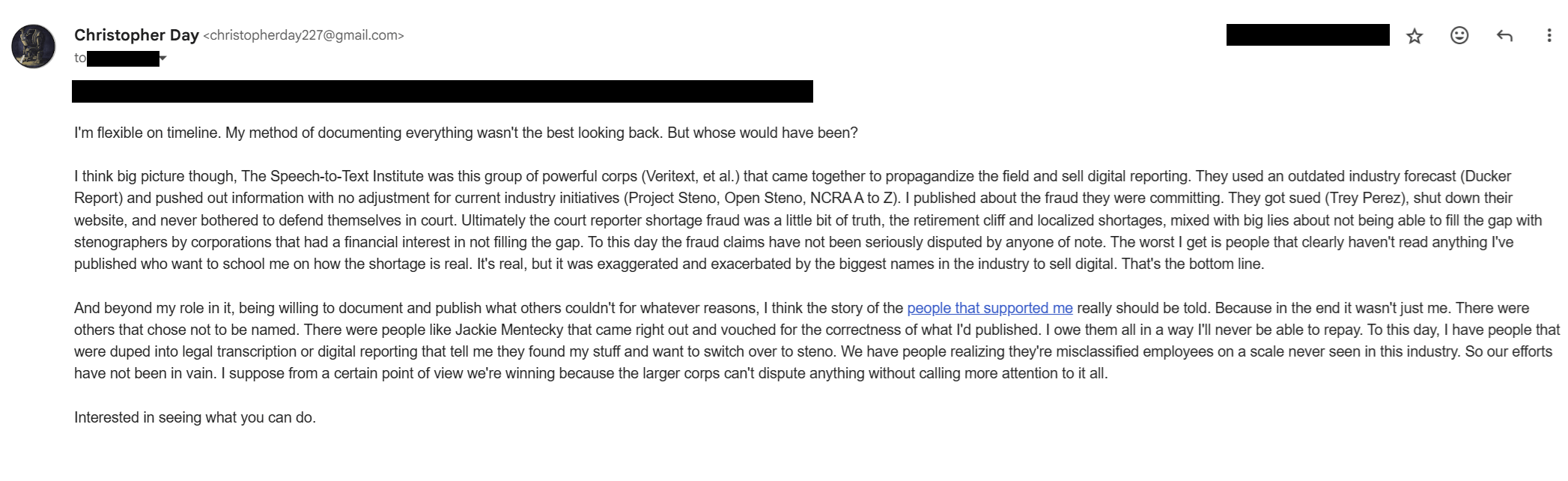
Court Reporter Shortage Fraud Media Teaser Email

…with love to Joshua Edwards, who also supported me throughout.

“I’m flexible on timeline. My method of documenting everything wasn’t the best looking back. But whose would have been?

I think big picture though, The Speech-to-Text Institute was this group of powerful corps (Veritext, et al.) that came together to propagandize the field and sell digital reporting. They used an outdated industry forecast (Ducker Report) and pushed out information with no adjustment for current industry initiatives (Project Steno, Open Steno, NCRA A to Z). I published about the fraud they were committing. They got sued (Trey Perez), shut down their website, and never bothered to defend themselves in court. Ultimately the court reporter shortage fraud was a little bit of truth, the retirement cliff and localized shortages, mixed with big lies about not being able to fill the gap with stenographers by corporations that had a financial interest in not filling the gap. To this day the fraud claims have not been seriously disputed by anyone of note. The worst I get is people that clearly haven’t read anything I’ve published who want to school me on how the shortage is real. It’s real, but it was exaggerated and exacerbated by the biggest names in the industry to sell digital. That’s the bottom line. 

And beyond my role in it, being willing to document and publish what others couldn’t for whatever reasons, I think the story of the people that supported me really should be told. Because in the end it wasn’t just me. There were others that chose not to be named. There were people like Jackie Mentecky that came right out and vouched for the correctness of what I’d published. I owe them all in a way I’ll never be able to repay. To this day, I have people that were duped into legal transcription or digital reporting that tell me they found my stuff and want to switch over to steno. We have people realizing they’re misclassified employees on a scale never seen in this industry. So our efforts have not been in vain. I suppose from a certain point of view we’re winning because the larger corps can’t dispute anything without calling more attention to it all.

Interested in seeing what you can do.”