Allie Hall is a reporter and educator who has made amazing strides in getting schools to pick up court reporting programs and getting students filling those programs. Some months ago, a group of working reporters came together under Allie’s guidance and leadership, and with additional help from co-admin Traci Mertens, the group has managed to donate thousands to new reporters and students in need.
If you are a working reporter or CART writer looking to give back, please reach out about joining the group. There is a fundraiser currently ongoing, and working reporters may donate ten to twenty dollars to help meet students’ needs.
Working reporters may donate via:
Venmo: Allison-Hall-89
PayPal: allie441@gmail.com
Google Pay: allie441@gmail.com
There is truly no contribution too small. If you’ve got an extra ten dollars to put down on a student, consider sending it along to Allie today! I am a contributing member of the group, and I have rarely ever seen such energy and accountability in a grassroots fundraiser. This is something special, it’s something I really support, and I know the money is going to making the road that young professionals have to travel just a little bit less bumpy. Most of us can look back at our student years and say “I wish I had…” Now we get to be a part of making sure the students of tomorrow have!
There’s a lot of conjecture when it comes to automatic speech recognition (ASR) and its ability to replace the stenographic reporter or captioner. You may also see ASR referred to as NLP or natural language processing. An important piece of the puzzle is understanding the basics behind artificial intelligence and how complex problems are solved. This can be confusing for reporters because in any of the literature on the topic, there are words and concepts that we simply have a weak grasp on. I’m going to tackle some of that today. In brief, computer programmers are problem solvers. They utilize datasets and algorithms to solve problems.
What is an algorithm?
An algorithm is a set of instructions that tell a computer what to do. You can also think of it as computer code for this discussion. To keep things simple, computers must have things broken down logically for them. Think of it like a recipe. For example, let’s look at a very simple algorithm written in the Python 3 language:
Do not despair. I’m about to make this so easy for you.
Line one tells the computer to put the words “The stenographer is _.” on the screen. Line two creates something called a Stenographer, and the Stenographer is equal to whatever you type in. If you input the word awesome with a lowercase or uppercase “a” the computer will tell you that you are right. If you input anything else, it will tell you the correct answer was awesome. Again, think of an algorithm like a recipe. The computer is told what to do with the information or ingredients it is given.
What is a dataset?
A dataset is a collection of information. In the context of machine learning, it is a collection that is put into the computer. An algorithm then tells the computer what to do with that information. Datasets will look very different dependent on the problem that a computer programmer is trying to solve. As an example, for enhancing facial recognition, datasets may be comprised of pictures. A dataset may be a wide range of photos labeled “face” or “not face.” The algorithm might tell the computer to compare millions of pictures. After doing that, the computer has a much better idea of what faces “look like.”
What is machine learning?
As demonstrated above, algorithms can be very simple steps that a computer goes through. Algorithms can also be incredibly complex math equations that help a computer analyze datasets and decide what to do with similar data in the future. One issue that comes up with any complex problem is that no dataset is perfect. For example, with regard to facial recognition, there have been situations with almost 100 percent accuracy with lighter male faces and only 80 percent accuracy with darker female faces. There are two major ways this can happen. One, the algorithm may not accurately instruct the computer on how to handle the differences between a “lighter male” face and a “darker female” face. Two, the dataset may not equally represent all faces. If the dataset has more “lighter male” faces in this example, then the computer will get more practice identifying those faces, and will not be as good at identifying other faces, even if the algorithm is perfect.
Artificial intelligence / AI / voice recognition, for purposes of this discussion, are all synonymous with each other and with machine learning. The computer is not making decisions for itself, like you see in the movies, it is being fed lots of data and using that to make future decisions.
Why Voice Recognition Isn’t Perfect and May Never Be
Computers “hear” sound by taking the air pressure from a noise into a microphone and converting that to electronic signals or instructions so that it can be played back through a speaker. A dataset for audio recognition might look something like a clip of someone speaking paired with the words that are spoken. There are many factors that complicate this. Datasets might be focused on speakers that speak in a grammatically correct fashion. Datasets might focus on a specific demographic. Datasets might focus on a specific topic. Datasets might focus on audio that does not have background noises. Creating a dataset that accurately reflects every type of speaker in every environment, and an algorithm that tells the computer what to do with it, is very hard. “Training” the computer on imperfect datasets can result in a word error rate of up to 75 percent.
This technology is not new. There is a patent from 2000 that seems to be a design for audio and stenographic transcription to be fed to a “data center.” That patent was assigned to Nuance Communications, the owner of Dragon, in 2009. From the documents, as I interpret them, it was thought that 20 to 30 hours of training could result in 92 percent accuracy. One thing is clear: as far back as 2000, 92 percent accuracy was in the realm of possibility. As recently as April 2020, the data studied from Apple, IBM, Google, Amazon, and Microsoft was 65 to 80 percent accuracy. Assuming, from Microsoft’s intention to purchase Nuance for $20 billion, that Nuance is the best voice recognition on the market today, there’s still zero reason to believe that Nuance’s technology is comparable to court reporter accuracy. Nuance Communications was founded in 1992. Verbit was founded in 2016. If the new kid on the block seriously believes it has a chance of competing, and it seems to, that’s a pretty good indicator that Nuance’s lead is tenuous, if it exists at all. There’s a list of problems for automation of speech recognition, and even though computer programmers are brilliant people, there’s no guarantee any of them will be “perfectly solved.” Dragon trains to a person’s voice to get its high level of accuracy. It simply would not make economic sense to have hours of training a software to everyone who is going to speak in court forever until the end of time, and the process would be susceptible to sabotage or mistake if it was unmonitored and/or self-guided (AKA cheap).
This is all why legal reporting needs the human element. We are able to understand context and make decisions even when we have no prior experience with a situation. Think of all the times you’ve heard a qualified stenographer, videographer, or voice writer say “in 30 years, I’ve neverseen that.” For us, it’s just something that happens, and we handle whatever the situation is. For a computer that has never been trained with the right dataset, it’s catastrophic. It’s easy, now, to see why even AI proponents like Tom Livne have said that they will not remove the human element.
Why Learning About Machine Learning Is Important For Court Reporters
Machine learning, or applications fueled by machine learning, are very likely to become part of our stenographic software. If you don’t believe me, just read this snippet about Advantage Software’s Eclipse AI Boost.
Don’t get out the pitchforks. Just consider what I have to blog.
If you’ve been following along, you’ve probably figured out, and it pretty much lays it out here, that datasets are needed to train “AI.” There are a few somewhat technical questions that stenographic reporters will probably want answered at some point:
Is this technology really sending your audio up to the Cloud and Google?
Is Google’s transcription reliable?
How securely is the information being sent?
Is the reporter’s transcription also being sent up to the Cloud and Google?
The reasons for answering?
The sensitive nature of some of our work may make it unsuitable for being uploaded. To the extent stuff may be confidential, privileged, or ex parte, court reporters and their clients may simply not want the audio to go anywhere.
Again, as shown in “Racial disparities in automated speech recognition” by Allison Koenecke, et al., Google’s ASR word error rate can be as high as 30 percent. Having to fix 30 percent of a job is a frightening possibility that could be more a hindrance than a help. I’m a pretty average reporter, and if I don’t do any defining on a job, I only have to fix 2 to 10 percent of any given job.
If we assume that everyone is fine with the audio being sent to the cloud, we must still question the security of the information. I assume that the best encryption possible would be in use, so this would be a minor issue.
The reporter’s transcription carries not only all the same confidential information discussed in point 1, but also would provide helpful data to make the AI better. Reporters will have to decide whether they want to help improve this technology for free. If the reporter’s transcription is not sent up with the audio, then the audio would only ostensibly be useful if human transcribers went through the audio, similar to what Facebook was caught doing two years ago. Do we want outside transcribers having access to this data?
Our technological competence changes how well we serve our clients. Nobody reading this needs to become a computer genius, but being generally aware of how these things work and some of the material out there can only benefit reporters. In one of my first posts about AI, I alluded to the fact that just because a problem is solvable does not mean it will be solved. I didn’t have any of the data I have today to assure me that my guess was correct. But I saw how tech news was demoralizing my fellow stenographers, and I called it as I saw it even though I risked looking like an idiot.
It’s my hope that reporters can similarly let go of fear and start to pick apart the truth about what’s being sold to them. Talk to each other about this stuff, pros and cons. My personal view, at this point, is that a lot of these salespeople saw a field with a large percentage of women sitting on a nice chunk of the “$30 billion” transcription industry, and assumed we’d all be too risk averse to speak out on it. Obviously, I’m not a woman, but it makes a lot of sense. Pick on the people that won’t fight back. Pick on the people that will freeze their rates for 20 or 30 years. Keep telling a lie and it will become the truth because people expect it to become the truth. Look how many reporters believe audio recording is cheaper even when that’s not necessarily true.
Here’s my assumption: a little bit of hope and we’ve won. Decades ago, a scientist named Richter did an experiment where rats were placed in the water. It took them a few minutes to drown. Another group of rats were taken out of the water just before they drowned. The next time they were submerged, they swam for hours to survive. We’re not rats, we’re reporters, but I’ve watched this work for humans too. Years ago, doctors estimated a family member would live about six more months. We all rallied around her and said “maybe they’re wrong.” She went another three years. We have a totally different situation here. We know they’re wrong. Every reporter has a choice: sit on the sideline and let other people decide what happens or become advocates for the consumers we’ve been protecting for the last 140 years, before the stenotype design we use today was even invented. People have been telling stenographers that their technology is outdated since before I was born, and it’s only gotten more advanced since that time. Next time somebody makes such a claim, it’s not unreasonable for you to question it, learn what you can, and let your clients know what kind of deal they’re getting with the “new tech.”
Addendum 4/27/21:
Some readers checked in with the Eclipse AI Boost, and as it was relayed to me, the agreement is that Google will not save the audio and will not be taking the stenographic transcriptions. Assuming that this is true, my current understanding of the tech is that stenographers would not be helping improve the technology by utilizing this technology unless there’s some clever wordplay going on, “we’re not saving the audio, we’re just analyzing it.” At this point, I have no reason to suspect that kind of a game. In my view, our software manufacturers tend to be honest because there’s simply no truth worth getting caught in a lie over. The worst I have seen are companies using buzzwords to try to appease everyone, and I have not seen that from Advantage.
Admittedly, I did not reach out to Advantage myself because this was meant to assist reporters with understanding the concepts as opposed to a news story. But I’m very happy people took that to heart and started asking questions.
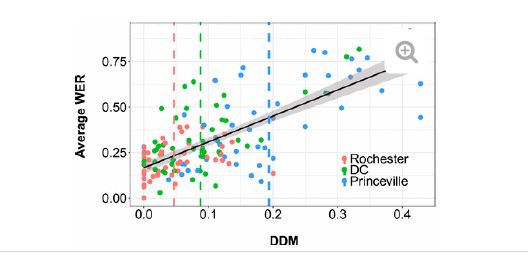
As a stenographic court reporter, I have been amazed by the strides in technology. Around 2016, I, like many of you, saw the first claims that speech recognition was as good as human ears. Automation seemed inevitable, and a few of my most beloved colleagues believed there was not a future for our amazing students. In 2019, the Testifying While Black study was published in the Language Journal, and while the study and its pilot studies showed that court reporters were twice as good at understanding the AAVE dialect as your average person, even though we have no training whatsoever in that dialect, the news media focused on the fact that we certify at 95 percent and yet only had 80 percent accuracy in the study. Some of the people involved with that study, namely Taylor Jones and Christopher Hall, introduced Culture Point, just one provider that could help make that 80 percent so much higher. In 2020, a study from Stanford showed that automatic speech recognition had a word error rate of 19 percent for “white” speakers, 35 percent for “black” speakers, and “worse” for speakers with a high dialect density. How much worse?
The .75 on the left means 75 percent. DDM is the dialect density. Even with fairly low dialect density, we’re looking at over 50 percent word error rate.
75 percent word error rate in a study done three or four years after the first claim that automatic speech recognition had 94 percent accuracy. But in all my research and all that has been written on this topic, I have not seen the following point addressed:
What Is An Error?
NCRA, many years ago, set out guidelines for what constituted an error. Word error guidelines take up about a page. Grammatical error guidelines take up about a page. What this means is that when you sit down for a steno test, you’re not being graded on your word error rate (WER), you’re being graded on your total errors. We have decades of failed certification tests where a period or comma meant a reporter wasn’t ready for the working world yet. Even where speech recognition is amazing on that WER, I’ve almost never seen appreciable grammar, punctuation, Q&A, or anything that we do to make the transcript readable. It’s so bad that advocates for the deaf, like Meryl Evans, refer to automatic speech recognition as “autocraptions.”
Unless the bench, bar, and captioning consumers want word soup to be the standard, the difference in how we describe errors needs to be injected into the discussion. Unless we want to go from a world where one reporter, perhaps paired with a scopist, completes the transcript and is accountable for it, to a world where up to eight transcribers are needed to transcribe a daily, we need to continue to push this as a consumer protection issue. Even where regulations are lacking, this is a serious and systemic issue that could shred access to justice. We have to hit every medium possible and let people know the record — in fact, every record in this country — could be in danger. The data coming out is clear. Anyone selling recording and/or automatic transcription says 90-something percent accuracy. Any time it’s actually studied? Maybe 80 percent accuracy, maybe 25; maybe they hire a real expert transcriber, or maybe they outsource all their transcription to Kenya or Manila. Perception matters; court administrators are making industry-changing decisions based on the lies or ignorance of private sector vendors.
The point is recording equipment sellers are taking a field which has been refined by stenographic court reporters to be a fairly painless process where there are clear guidelines for what happens when something goes wrong, adding lots of extra parts to it, and calling it new. We’ve been comparing our 95 percent total accuracy to their “94 percent” word error rate. In 2016, perhaps there were questions that needed answering. This is April 2021, there’s no contest, and proponents of digital recording and automatic transcription have a moral obligation to look at the facts as they are today and not what they’d like them to be.
If you’re somebody in the United States, United Kingdom, or Canada who’s sold on a career as a digital court reporter, or even if you’re just passing through looking for a new career, I’d like to introduce you to stenographic court reporting in a way that you have not been introduced. Just to get this out of the way, in very general terms, court reporting is taking down the legal record and providing an English transcript for judges, lawyers, litigants, and the public. Stenographic “court reporting,” can also be used to caption live shows and events, or transcribe recorded material when needed. The big difference between “steno” and digital is that digital court reporters record testimony or proceedings, usually on multitrack audio equipment, and take guiding notes as the proceedings go on. The stenographic reporter uses a stenotype to take verbatim notes of what’s being said. In our industry today there are a few big companies aggressively marketing to young people looking for work. Those companies insist that digital court reporting is an opportunity for them. There have even been journalists picking up these misconceptions without realizing they’re being misled. It’s time to dispel those myths, tell you a little bit about who we really are, and get you resources you can use to explore a career as a stenographic court reporter.
We Are Digital! One of the most interesting claims I’ve seen from digital court reporting proponents in the press is that “this world isn’t digitized.” We’re old-fashioned. The implication is that stenographic court reporting is a dying art with very little time left as a viable career. Every time you see a representation of us in the media, you get a stenotype from 1983! The truth is that we’ve been digital for decades. Most working reporters today roll with a stenotype that is more like a minicomputer than a typewriter. There’s software onboard transcribing the machine shorthand stenography as we go. So that’s a big red flag, right? There’s a CEO making a major statement who’s clearly lying or completely ignorant. Don’t bank your future on the words of people who are lying or wrong. Not only are we technologically advanced, we’re extremely adaptable. When the pandemic struck, court reporters were in a jam for a month or so. The field quickly adopted remote reporting and now reporters are talking about having more work than they can handle right from home. If you like tech, steno is for you.
We Are More Efficient! I know that this can come off as a loaded or insulting statement, so let me just get this out of the way. There’s nothing wrong with believing that technology improves efficiency. What’s often ignored in this discussion is that stenographic technology is evolving right alongside audio capture tech. There have been trials of automatic speech recognition in stenographic software. There have been leaps in text-to-text prediction and some software even attempts to guess what we meant when we mess up a stenographic stroke. Recording a proceeding generally entails the front-end recording and the back-end transcription. Machine shorthand stenography, on the other hand, loads the transcription on while the proceedings are going on. The most skilled stenographic court reporters can walk away from a proceeding and press print. The more average ones, like me, are able to reduce the transcription time so much that one person can do the entire job. You can also see this in the numbers. The average court reporter types (we call it writes) at 225 words per minute with a 1.4 syllabic density, so probably about 200 words per minute. The average transcriber types at about 100 words per minute. The average person hovers around 50 words per minute. So just by the numbers, you can see that stenographic reporting can get a job done twice as fast, four times as fast, or with far less manpower. Machine shorthand stenography is also much easier on your hands. We have the capability of getting down very large words or large groups of words with one movement of our hands. As an example, it took me over 18,000 hand motions to get this post down on a QWERTY keyboard. It would have taken about 3,000 hand movements on the stenotype that I was too lazy to plug in. If you’re a transcriber, imagine reducing the stress on your hands to a sixth of what it currently is.
We Have More Support! Some of the court reporting or transcription companies I mentioned before are riding on another misconception regarding our stenographer shortage. About 8 years ago there was an industry outlook and forecast by Ducker Worldwide that told us there would be a higher demand for court reporters than supply. That part is absolutely true. A shortage was forecasted. Some companies were having severe coverage issues. We saw the number of applicants for licenses and civil service jobs plummeting to about half the usual levels. This can lead to the implication that there are not many stenographers left. It’s an easy myth to propagate. How many of us have you seen recently? Unless you’ve been stuck in a lawsuit, been prosecuted, or seen me on TV, you haven’t seen a court reporter. The truth is that we knew the shortage was coming. Many initiatives popped up to begin recruiting stenographers or helping people get into the field. Depending on whose numbers you’re looking at, there are 10,000 to 20,000 of us working. That means that if you have a problem or a question, you have potentially thousands of people around to assist you. You have a nonprofit in almost in every state devoted to stenographic court reporters. Those nonprofits pull in cumulatively millions of dollars a year with the objective of promoting the welfare of stenographic court reporters. To put this into perspective, a popular stenotype manufacturer, Stenograph, recently donated $50,000 to Project Steno. Nobody’s dumping millions of dollars on nonprofits in a career that has no future. Why aren’t some of these “employers” telling you about this vast support network? Because if you join it, you will have sharper skills and better bargaining power.
We Have Options! There are freelance, part-time, and full-time positions available dependent on where you are and what you’re looking to do with this wonderful skill. Maybe you’re someone who needs to work from home and “just” do transcription — I know a mom just like that. Maybe you love the law and want to see the process of law firsthand. Maybe you want to caption live events over the TV, internet, or in person, via stenographic CART & captioning. Maybe you want to travel internationally and take work around the world. There are even reporters who have taken the general skill of stenotype stenography and applied it to computer programming, such as Stanley Sakai. The limiting factor is how much time you put into hunting down the type of work you want!
We Are Equality! If you clicked the link for my TV appearance, you saw that stenographic reporters got some really bad news stories run on them because while our certifications are 95 percent, we only scored about 80 percent in a study where some of us were asked to transcribe a specific English dialect sometimes referred to by linguists as African American English (AAE). VICE News filmed me for about two hours. They cut the part where I talked about the pilot studies. In pilot study 1, everyday people were tested and scored 40 percent. In pilot study 2, lawyers were tested and scored 60 percent. In a completely different study, automatic speech recognition was tested. It got white speech right 80 percent of the time. It got black speech right 65 percent of the time. It did worse when it was tested on AAE! What does this mean? It means that young people that want to ensure equality in the courtroom need to join up and become stenographic court reporters. I’m not gloating about 80 percent. But with no special dialect training, we’re the closest to 100 percent understanding on this dialect, and that was ignored by the media. I am proud to be one of the people fighting to bridge that gap and spread awareness on the issue. Beyond that, in the captioning and CART arena, stenographic court reporters are pushing to bring access to people for live programming and in classrooms. So if you choose this wonderful career you are not “doomed” to sit in legal proceedings for the rest of your life, you can also make a career out of taking down what’s being said and bringing it to the screens of millions of people who need that support. If you’re a person that believes that court records should be 100 percent accurate, someone that believes appeals shouldn’t be thwarted by missing court audio, or someone that believes that deaf people deserve real access, and not “autocraptions,” you’re somebody that needs to join up and be part of the team steno solution.
We Are Waiting For You! Remember that shortage I mentioned and the resources waiting for you? I have an easy list you can use to get a jumpstart, find the right level of training for your financial situation, and get involved with our field. This is not an exhaustive list, so if you find something online that seems better for you, don’t hesitate to give that a chance. To help you understand some jargon in our line of work, “theory” is a method or system of using the stenotype and its letters to take down English, often phonetically. “Speed” is taking everything you learn in theory and learning to do it fast. Speed is by far the longest and hardest part of training. “Briefs” are stenographic outlines or strokes that do not necessarily resemble English words phonetically in theory, but we use them to get down large words fast. “Phrases” are stenographic strokes or outlines that collapse multiple words into one line of letters. Generally you will “learn theory,” then you will start “building speed,” and then you will use briefs and phrases to reach those very high levels of speed that we work at. It is physically possible to write everything out phonetically, but it will be more stressful on your hands.
Try court reporting for free. NCRA A to Z and Project Steno’s Basic Training are both free ways to try out court reporting and learn basic theory at low or no cost. Both are great ways to jump into the field without blowing $2,000 on a student stenotype only to find out you don’t like steno. On the topic of finding stenotypes to practice with, there are vendors such as StenoWorks, Acculaw, Stenograph, Eclipse, and Neutrino. You can also search on eBay for old Stentura models at a discount, but do not go outside eBay’s buyer protection or you will get scammed.
NCRA-approved schools. There are several NCRA-approved schools across the United States and one in Canada. These are worth looking into if you are serious about making court reporting a career because of the quality of the education. Please note that not all NCRA-approved schools are accredited.
Online, self-paced, or programs not approved by NCRA. There are numerous programs for stenographic reporting. There are programs to teach theory like StarTran. There are programs like Simply Steno that focus on building speed after someone has learned the basics of theory, and there are programs like Court Reporting At Home (CRAH). You can also see if the court reporters association of your state has any advice or school listings. All of these things also have a great deal of social media support. There are lots of Facebook groups like Encouraging Court Reporting Students or Studying Court Reporting At Home. There are students and professionals online right now who are there to help with the journey.
Open Steno. I have to put Open Steno in a category by itself because there’s just nothing like it. It is a free, active, and open online community with Google Groups, a free way to learn theory, and its own Discord chat. There are enthusiasts that build stenotype keyboards from scratch. This is the community responsible for Steno Arcade. This is the community responsible for Plover, a free steno-to-English translation software. It was all started by Mirabai Knight, a CART writer in New York. If you’re motivated to teach yourself for free, Open Steno makes it possible in a way that it simply was not a decade ago.
Christopher Day. Chances are high you’re here because you saw an ad on social media. I’ve been a court reporter for almost eleven years. I’ve been funding this blog and keeping it an ad-free experience (with some very appreciated help!) just to help stenographers and people that aspire to be stenographers. I know people that have transitioned from digital (and analogue!) court reporting to stenographic reporting and become real champions of and voices for our field. Every reporter I know is supportive of stenography students and fellow professionals. You’ll rarely hear one of us refer to another one of us as being “low skill.” Compare that to this marketing infographic from Verbit. They said digital solutions do not require a highly-trained workforce. Do you really want to work with people that downplay your work when it’s convenient for them? These folks are setting themselves up to make money off you. I have no such incentive or financial ties. I’m a guy with a squid hat and a blog who fell into this wonderful career by accident, and I’d love for you to be a part of it.
So if you need more guidance, reach out to me at Chris@stenonymous.com. Do yourself the favor of getting involved with stenographic reporting. If sitting there hearing testimony is something you can see yourself doing, you’ve already got a whole lot more in common with us than half the world. Give our profession some consideration. It’s easy to learn, it’s hard to do fast, and though it takes 2 to 4 years of training, it really can be your gateway to an exciting front-row seat to history and a rewarding lifelong career. If that doesn’t sell you, we also have some top-quality memes.
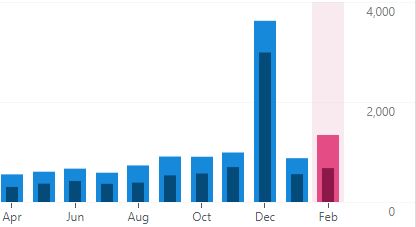
If you’re looking to promote your steno nonprofit or your primary steno business, the numbers don’t lie, marketing is going to bring more eyes to what you’re selling. That’s a common-sense statement, but let’s drive it home. This blog, on average, will get about 500 to 1000 unique visitors a month and about double the views or clicks. That’s just me writing what I write and sharing it on Facebook. In honor of CRCW 2021, I ended up posting a lot this month. I published over a dozen articles, and the “average” did not change much. Now we’ll compare that to December 2020, where I wrote three posts and advertised two on Facebook.
I wrote my heart out and it’s not even close.
About 700 visitors, 14 posts, that’s about 50 visitors a post. That’s compared to nearly 3,000 visitors, three posts, a thousand visitors a post. About $200 gave me 20x the reach.
Yay for me. Why am I writing this? To help you. On Facebook today there are groups and pages. Groups serve, more or less, as discussion boards. Pages are more like ad space. They’re promotional and you generally control the content on there. You can have a page and a group, and you can have a page act as an admin to a group. There’s one major difference between the two. As best I can tell, groups cannot advertise. Pages, on the other hand, have the power to boost posts. So if you’re looking to market, get yourself a page.
What kind of monster doesn’t even like his own page?
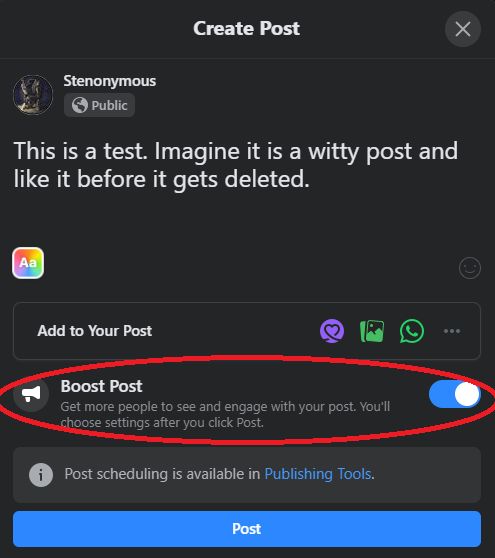
When you create a post on your page, you have the option to boost a post. Check the boost post option before you make your post to get to the “boost” controls.
Nobody liked that.
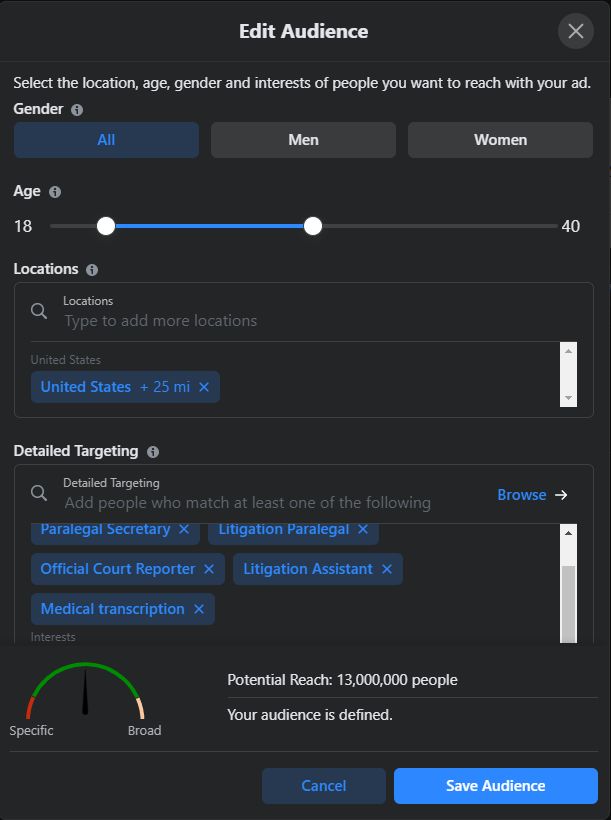
After you click post, you’ll get transported to the magic world of the boost page. That’s going to look like the image below, hopefully, and it’s going to give you options to put in your budget, and more importantly, edit your audience. Generally if you put in more money, they’ll estimate more views per day. If you put in more days, you’ll get fewer views per day, but the ad will run longer. There are some minimums, but you can go as low or as high as you want. Again, in December, I felt comfortable spending in the ballpark of $200 for week-long campaigns. What will you see in the edit audience tab?
You get to target, gender, age, location, and then add specific demographics.
The only thing you should know is your audience has to be broad enough to run the ad. If you’re way too specific, it blocks you. For example, I started clicking demographics for all these things and the potential reach was only about 5,000. I clicked “lawyer” and the potential reach jumped up by millions.
That’s all there is to it! There are a few other options, like whether you want your ad to run in Facebook, Messenger, or both, and whether you want to use Facebook Pixel. My personal preference? I run the ad only Facebook and do nothing with Facebook Pixel. I know a lot of us trust and believe in face-to-face conversations. We want to grow deep connections and be one with our audience. But again, we’re looking at 20x the reach with a small budget.
With that in mind, I’ll be launching and advertising a post on March 1 directed at digital reporters and transcribers. Here’s my thinking: We have this whole group of people who probably like sitting in court proceedings, the companies they work for are not telling them about steno, or maybe even lying to them about steno. It’s time to break that in half and get the good ones over to us. If you support that, or even if you’re just grateful for the information in this post, feel free to donate here. I’m very grateful to people that have donated in the past. Every dollar helps keep this place ad-free. We don’t want to go back to that time.
Alternatively, if you’re tired of my blog, check out Glen Warner’s or Matt Moss’s. There are so many out there, including businesses like Migliore & Associates or MGR. It can be really heartening to see the incredible amount of information and opinions we have out there. Highly suggest checking out any of them.
We often highlight the success stories of our industry. I think this is very important because it keeps current students open to the idea that they can succeed. Like every industry, we will have people that make colossal gains, start businesses, and create a great life with lots of opportunities and experiences. On the other hand, there may be individuals out there who, for whatever reason, cannot finish school or do not land very lucrative work at the start of their journey. I had a rough time starting off. I didn’t have a lot of life experience and most of the work I got was from being a reliable and steady “yes man” instead of having strong negotiation skills or even strong steno skills. Things worked out great for me with time and effort, but it’s time to acknowledge that not everybody is going to have that same experience, and let you in on America’s best-kept secret.
Student Loans Are Dischargeable For over a decade America has sunk deeply into the myth that student loans are never dischargeable. I heard this as a student. I was told this by my mother and countless role model figures in my life. This myth is so prevalent that I never once bothered to fact check it. These days, you can find resources online to explain to you that they are forgivable, dischargeable, and under what circumstances. There are even United States government sites with that information. For easy access, I’m going to repeat some of the highlights here. Student loans can be…
The courts must decide if repaying the loan would cause you undue hardship. Undue hardship was not defined by the Congress, and so the courts look at whether you would be able to maintain a minimum standard of living if forced to repay the loan, whether there is evidence the hardship will continue for a significant portion of the repayment period, and whether you made a good-faith effort to repay the loan prior to filing for bankruptcy. A court may order the loan fully discharged, partially discharged, or the court may order you to repay the loan. In the event the court orders you to repay the loan, the repayment may be structured differently. It is notable that this is not a magic fix-everything button. There are significant hurdles and it is harder to discharge student loans through bankruptcy. But if you’re stuck in debt and can’t seem to claw out, it just might make sense to put together some money for a lawyer to help you navigate your way out of tens of thousands of dollars of debt.
This is really important to get out there because compound interest works both ways. When you have a savings account or certificate of deposit, every accrual period means more interest added to your money, which means more interest on future accrual periods. When you take out a loan or take on credit card debt, it works the other way, where your minimum payments are meant to pay the interest and pay a small part of the principal. Many people fall into a trap where they make partial repayments that do not cover the interest, and the debt begins to grow instead of shrink despite making consistent good-faith payments. This is how you come across nightmare stories where a person pays for years and yet their loan amount never goes down or doesn’t go down much. Unfortunately, it’s perfectly legal for people to sign agreements that they do not fully understand and incomes in any industry or with any education are not guaranteed. So when things go wrong, it seems like the right thing to do to let people know they do not have to suffer with lifelong debt that they genuinely cannot repay. Rights don’t matter if they go unspoken and unasserted, so if you know somebody stuck in the debt spiral, let them know there’s a way out.
Addendum:
On August 23, 2021, I was contacted by someone representing themselves as a Bankrate employee. They shared this link with me about buying a house while saddled with student loans and the article does have good general concepts to learn, such as trying to keep your debt-to-income ratio low. Please check it out if you’re looking for more information on finance. I’ve received no money for sharing this link.
During our Court Reporting & Captioning Week 2021 there were a couple of press releases and some press releases dressed up as journalism all about digital recording, automatic speech recognition, and its accuracy and viability. There’s actually a lesson to be learned from businesses that continually promise without any regard for reality, so that’s what I’ll focus on today. I’ll start with this statement. We have a big, vibrant field of students and professionals where everyone that is actually involved in it, from the smallest one-woman reporting armies to the corporate giants, says technology will not replace the stenographic court reporter. Then we have the tech players who continuously talk about how their tech is 99 percent accurate, but can’t be bothered to sell it to us, and whose brilliant plan is to record and transcribe the testimony, something stenographers figured out how to do decades ago.
Steno students are out there getting a million views and worldwide audiences… And Chris Day? He’s posting memes on the internet.
You know the formula. First we’ll compare this to an exaggerated event outside the industry, and then we’ll tie it right into our world. So let’s breeze briefly over Fyre Festival. To put it in very simple terms, Fyre Festival was an event where the CEO overpromised, underdelivered, and played “hide the ball” until the bitter end. Customers were lied to. Investors were lied to. Staff and construction members were lied to. It was a corporate fiasco propped up by disinformation, investor money, and cash flow games that ended with the CEO in prison and a whole lot of people owed a whole lot of money that they will, in all likelihood, never get paid. It was the story of a relative newcomer to the industry of music festivals saying they’d do it bigger and better. Sound familiar?
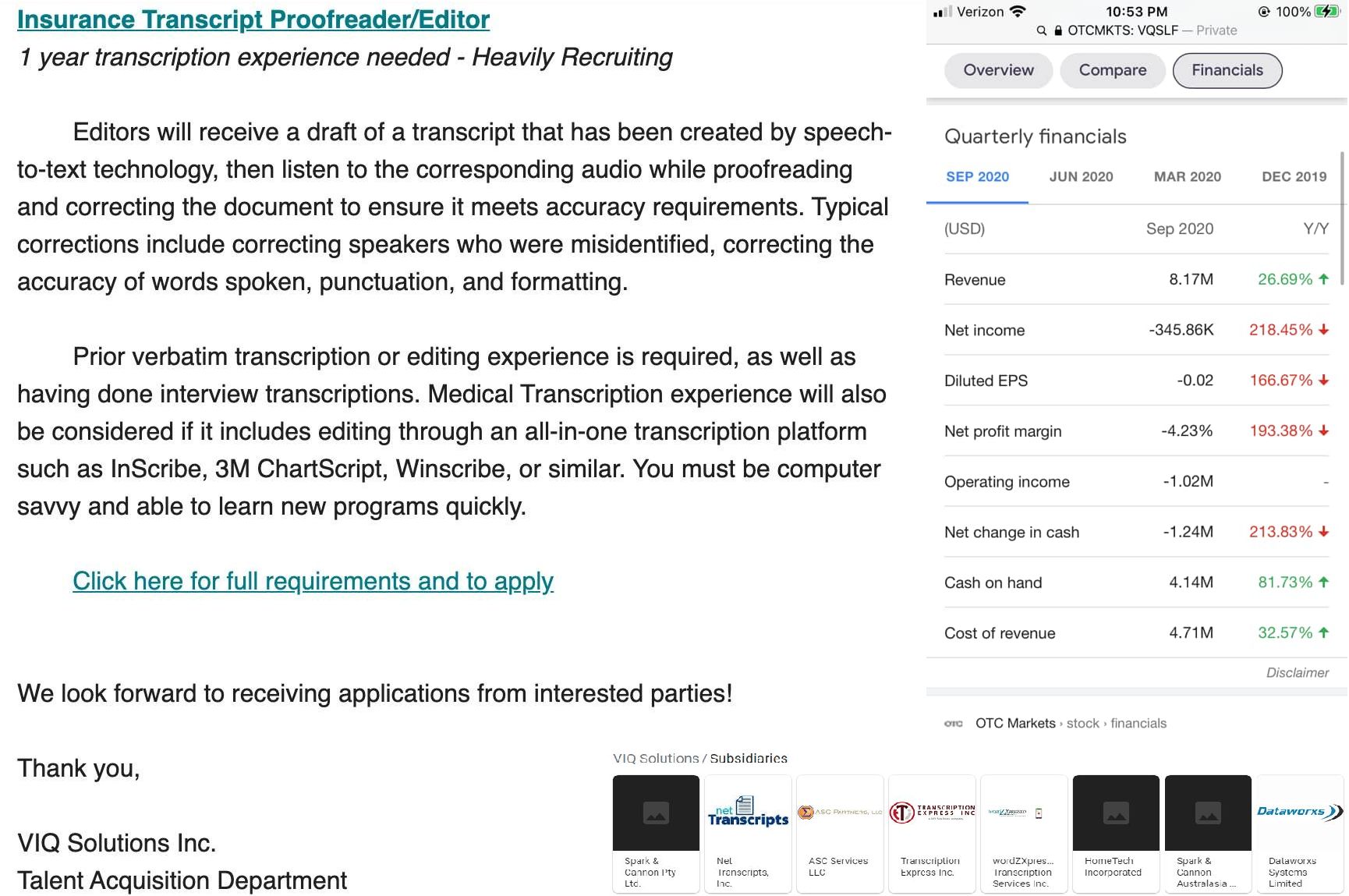
As for relative newcomers in the legal transcription or court reporting business, take your pick. Even ones that have been incorporated for a couple of decades really aren’t that impressive when you start holding up the magnifying glass. Take, for example, VIQ Solutions and its many subsidiaries:
I promise to explain if you promise to keep reading.
VIQ apparently trades OTC so it gives us a rare glimpse of financial information that we don’t get with a lot of private companies. Right off the bat, we can see some interesting stuff. $8 million in revenue with a negative net income and a positive cash flow. Positive cash flow means the money they have on hand is going up. Negative income means the company is losing money. How does a company lose money but continue to have cash on hand grow? Creditors and investors. When you see money coming in while the company is taking losses, it generally means that the company is borrowing the money or getting more cash from investors/shareholders. A company can continue on this way for as long as money keeps coming in. Companies can also use tricks similar to price dumping, and charge one client or project an excessive amount in order to fund losses on other projects. The amazing thing is that most companies won’t light up the same way Fyre did, they’ll just declare bankruptcy and move on. There’s not going to be a big “gotcha” parade or reckoning where anyone admits that stenographic court reporting is by far the superior business model.
This is juxtaposed against a situation where, for the individual stenographic reporter, you’re kind of stuck making whatever you make. If things go badly, bankruptcy is an option, but there’s never really an option to borrow money or receive investor money for decades while you figure it out. Seeing all these ostensible giants enter the field can be a bit intimidating or confusing. But any time you see these staggering tech reveals wrapped up in a paid-for press release, I urge you to remember Fyre, remember VIQ, and remember that no matter what that revenue or cash flow looks like, you may not have access to the information that would tell you how the company is really doing.
This also leads to a very bright future for steno entrepreneurs. As we learn the game, we can pass it along to each other. When Stenovate landed its first big investor, I talked about that. Court reporting and its attached services, in the way we know them and love them, are an extremely stable, winning investment. Think about it. Many of us, when we begin down this road, spend up to $2,000 on a student machine and up to $9,000 on a professional machine and software. That $11,000 sinkhole, coupled with student loan debt, grows into stable, positive income. So what’s stopping any stenographic court reporting firm from getting out there and educating investors on our field? The time and drive to do it. Maybe for some people, they just haven’t had that idea yet. But that’s where we’re headed. I have little doubt that if we compete, we will win. But we have to get people in that mindset. So if you know somebody with that entrepreneurial spirit, maybe pass them this post and get them thinking about whether they’d like to seek investors to grow their firm and reach. Business 101 is that a dollar today is more valuable than a dollar tomorrow. That means our field can be extremely attractive to value investors and be a safe haven from the gambling money being supplied to “tech’s” habitual promisors.
Know a great reporting or captioning firm that needs a spotlight? Feel free to write me or comment about them below. I’ll start us off. Steno Captions, LLC launched off recently without doing the investor dance. That’s the kind of promise this field has. I wish them a lot of luck and success in managing clients and training writers.
Chris DeGrazio is one of the newest professionals on our scene and he’s already making a great impact on the field. You might’ve heard Chris interviewing Anna Mar on Confessions of a Stenographer. You might’ve seen the wonderful collage put together for Court Reporting & Captioning Week 2021. No matter where you’ve heard of Chris, I’d love to boost his next creative idea. In celebration of March 8, International Women’s Day, Chris DeGrazio will be working on a collage for court reporter women and their hobbies. So if you’re somebody that wants to be in that spotlight or help put together more content to showcase our profession, here’s your chance, make sure to reach out to him.
While I’m on the topic of highlighting new or upcoming reporter accomplishments, let me just again promote Shaunise Day and her work with Confessions of a Stenographer. I had the privilege of being able to sponsor the episode where Kimberly Xavier was interviewed by Kristine Utley. I had some time yesterday to sit down and listen to the entire interview, and everything Kimberly said resonated deeply with me. She talked about the diversity of our field, the importance of diversity in leadership, the importance of getting involved, and the nonprofit Stenovator Pathway Solutions (Facebook). Getting to hear from her really made me realize that we could be almost two thousand miles apart and still be thinking so many of the same things.
It’s a fascinating time for reporting. When I was a student the common-sense advice was “settle down, don’t rock the boat, don’t stick out too much.” Let me be one to say that did not work. That did not get us to a good place. As Connie Psaros put it, we need more lions, not lambs. So if you’re a working reporter reading my blog and you’ve got a little extra time on your hands, please take the time out to support students and new reporters. These are our upcoming lions, and we cannot let their passions be tamed in the same way that I know some of ours were. Rock that boat, stick out, and keep doing your best to showcase our field! You’re doing an amazing job.
Beyond the machine, there’s so much creativity and many laughs to be had about our work. A longtime friend had been tagging me in lots of Stenoholics posts, but I’m too boring for Instagram, so I never really paid any attention. Well, when I ran across this coughing video, all that changed. I think I’ve personally experienced almost everything they’ve made a video on, including the traumatic experience of having to take down numbers. Their tribute to Court Reporting & Captioning Week was a sight to behold and admire. Ten out of ten, go give their work some love and attention.
While we’re on the subject of court reporter humor, a best friend sent me this video from Andy Bajaña. Steno students, somebody understands! Andy says on the post he wrote this song when he was in school and didn’t think he’d graduate. So students, if you’re watching and you feel the same, just remember it can be done!
Or if you like to watch people trying to be funny instead of actually being funny, you can check out my very important video on modernizing the administration of the oath.
One of the biggest challenges of any professional’s career is time management. There are so many things we need to find time for. We need to find time for our families, our friends, and ourselves. We need to meet deadlines. We need to remember important events and time-sensitive information. Below are some really basic tips for finding time and staying organized in my words and style. If you want a much more professional look or if you’re a visual learner, you may actually benefit greatly from skipping my blog post and checking out Lauren Lawrence’s Stenovate Time Management Master Class.
Your Calendar:
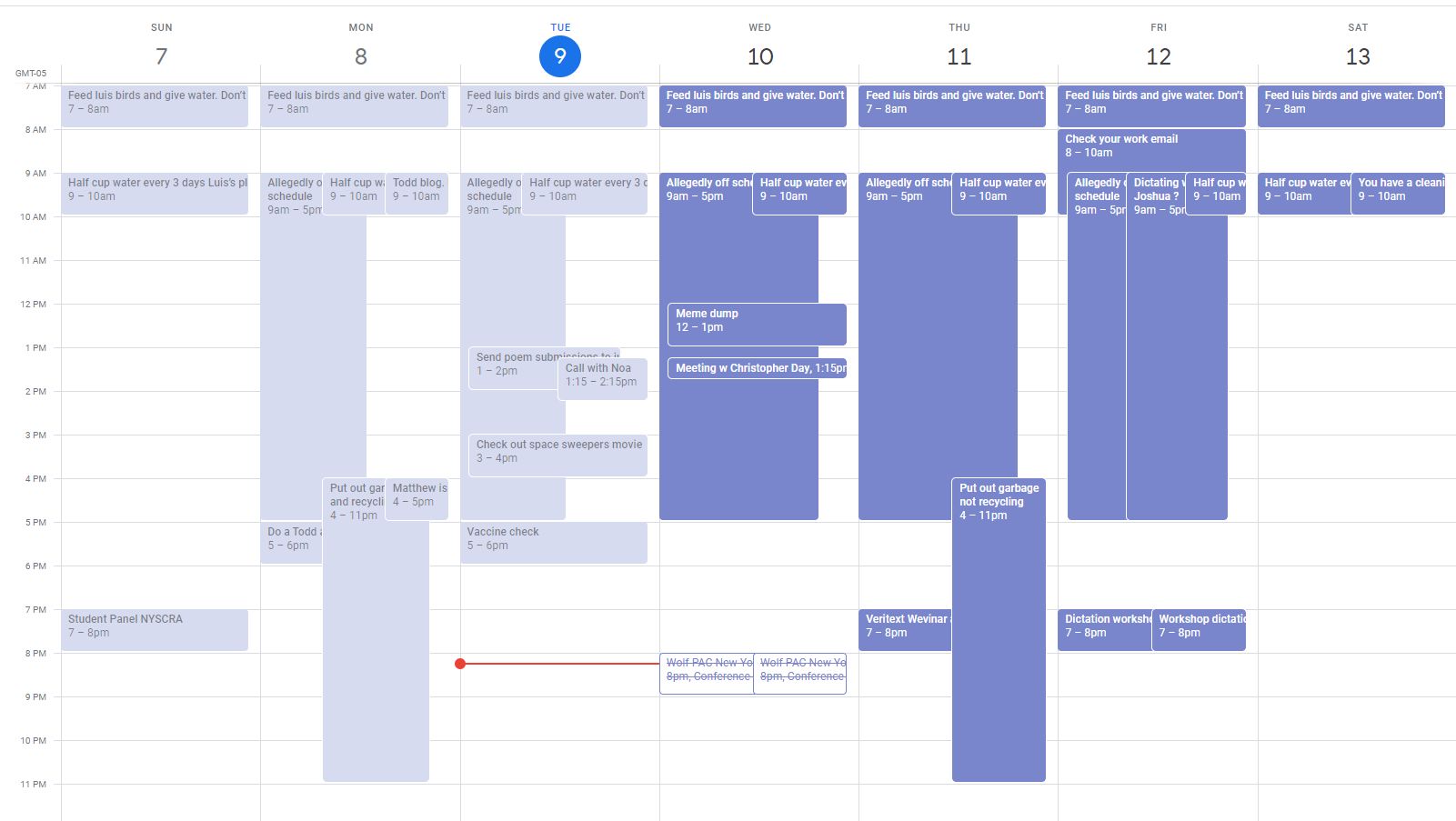
Most of you hold in the palm of your hand a tiny supercomputer capable of wonderful things. Any time you schedule something, stick it in that phone calendar. There have been times where I’ve double-booked friends, work obligations, and life goals because I failed to make a calendar. I failed to take that extra step every time someone said “save the date.” I failed to take scheduling seriously and it bit back hard. If you have Gmail connected to your phone, it’ll even automatically update your phone with Google Calendar invites when you send or receive them. A calendar is a simple extension of your memory and you are ten steps ahead of the game when you start using yours. You can even even stylize it to be as neat or cluttered as you want. For example, my mind works best when it’s in a constant state of chaos:
These aren’t even real things. These are just things I want to remember. Imagine being someone with an actual life!
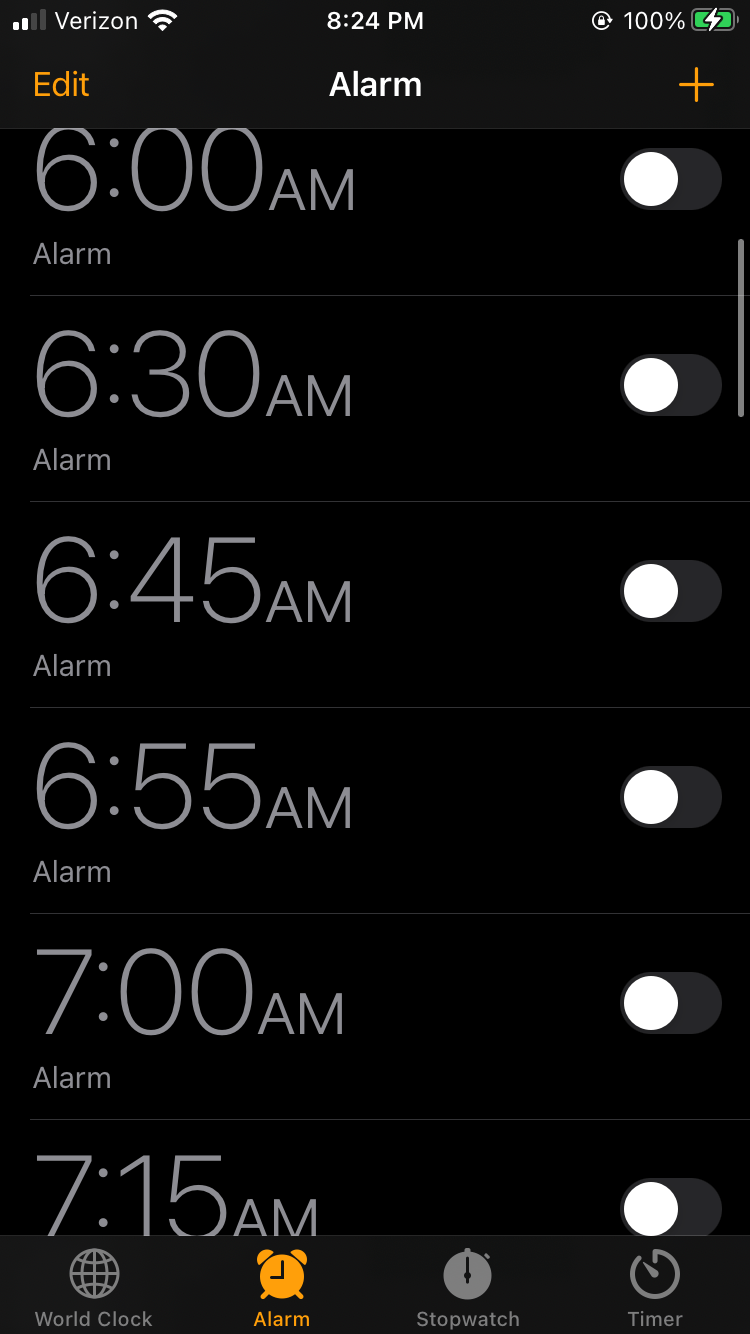
Your Alarm:
Whether you want to take a nap or get a full night of sleep, waking up is pretty important. Getting out the door is pretty important. Hitting whatever goal you want to hit is pretty important. There have been a few times in my life where I’ve suffered a night of bad sleep and had to take a snooze on my lunch hour. This stuff isn’t ideal, but it can help you get through rough days. Whether you use a loud and obnoxious alarm like Online Alarm Clock or select custom alarms by hand in your phone, setting alarms can mean the difference between getting in on time and having to explain to your boss why you’re habitually late.
Ah, yes, because I’m really going to get up the sixth time it rings.
Your Stopwatch:
Long used by fitness enthusiasts as a way to measure time and progress, the stopwatch is an incredible tool for the court reporter. At least once in your career, sit down before you transcribe a job and start running the stopwatch for an hour while you’re transcribing. At the end of an hour, see how many pages you’ve transcribed. In my own career, dependent upon my layout and the subject density, I found I was able to transcribe between 20 to 60 pages an hour. If I had a really bad day, that number could drop to ten pages an hour. This isn’t just useless trivia, it allows you to mentally gauge how much time you need to set aside to complete your work. Let’s say I went to an afternoon deposition and that was 120 pages. I knew that if I got home and sat down at 5 p.m. to do it, it would be done between 7 p.m. and 11 p.m. This helped me schedule stuff around my transcription habits. I was able to avoid scheduling recreational time that conflicted with transcribing time because I knew roughly how long almost every transcript would take.
Your Schedulers:
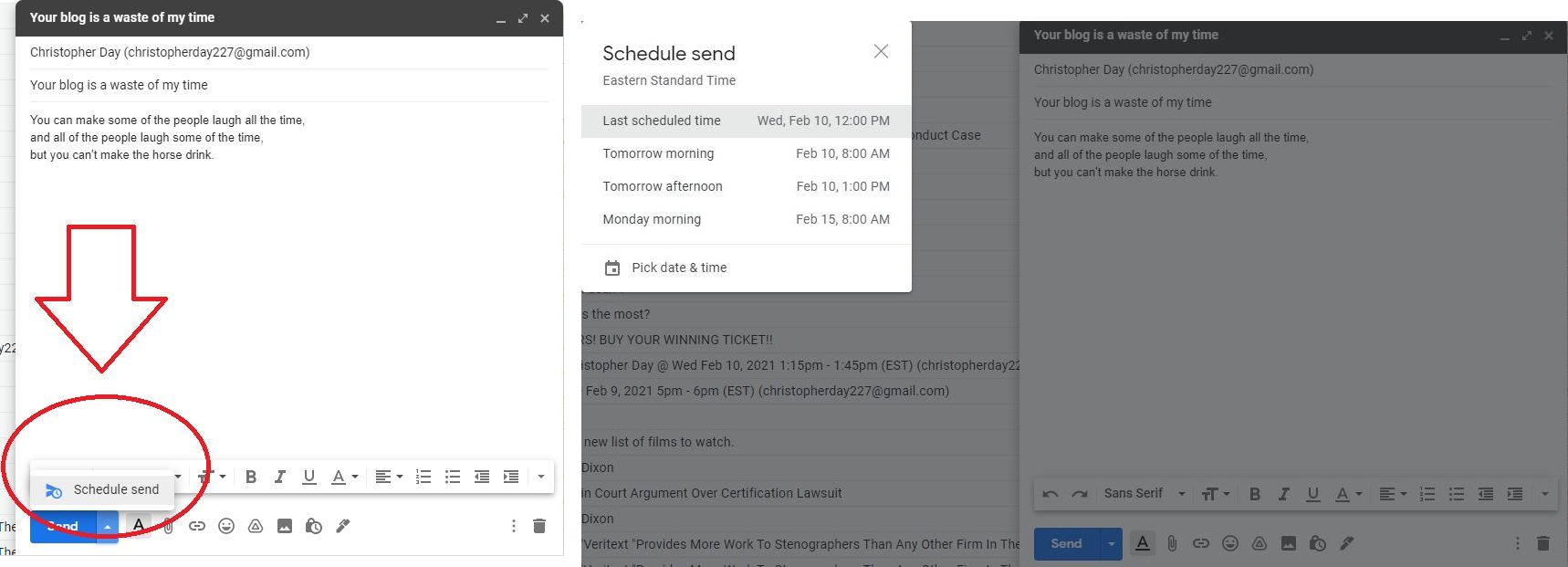
If you use Gmail, you might be surprised to learn you have the option to schedule e-mails. This is helpful if you have a situation where you find time at 1:32 a.m. to draft an e-mail but don’t want to look crazy. You can click the little arrow next to send on the Gmail e-mail on your computer and schedule to send it tomorrow morning, Monday morning, or any time you want. If you’ve ever gotten an e-mail from me at about 8:00 a.m., responded, and then gotten no response from me until about 11:00 a.m., it probably meant that I was unconscious somewhere and had thoughtfully scheduled the e-mail to send to you regardless of what I was doing. I haven’t figured out a way to do this on my phone, but I spend so much time at my desktop / laptop it hardly matters. An additional benefit? The e-mail goes to your “scheduled folder,” so you can cancel it and edit it any time before it sends. If you’ve ever thought “wow, I come up with my best work right after I click send,” e-mail scheduling is for you.
Are you not entertained?
Coincidentally, if you have a WordPress blog or its equivalent, you also have access to a scheduler. Many people have asked me where I find the time to write. Magicians and salespeople don’t reveal their tricks because they want to stay in business. I show you how the magic works and ask you to believe in it anyway. A scheduler will let you do stuff on your time and send it off when it needs to be sent. A two-hour bus commute can turn into a two-hour writing project that launches by itself without any further input from you. Automating broadcasts through a scheduler means productivity gains!
What were you doing Tuesday night? I was writing you.
Your Word Processor & Spreadsheets:
The most famous example of a word processor is Microsoft Word. It helps you type notes, letters, and express yourself in many different ways. Keeping accurate notes on a meeting or situation is vital. It saves you an incredible amount of time and energy trying to remember things. Spreadsheets, like Microsoft Excel, also work this way. You can use spreadsheets as a budget, database, a calculation tool, or even just a list of ideas. The best thing about these tools is that they are so necessary that there are alternatives for people who cannot afford or do not wish to pay for Microsoft products. As of today, I know that Apache Open Office has a Writer and Calc version, which are akin to Word and Excel. Google also offers Google Docs and Google Sheets, also akin to Word and Excel. For the average user, any of these will likely suit your needs, especially if you’re starting from the position of having no word processor or spreadsheets. Personally, I am a fan of Google, because their phone apps allow me to access my documents anywhere with cell service or wi-fi for free.
Your Case Naming Convention:
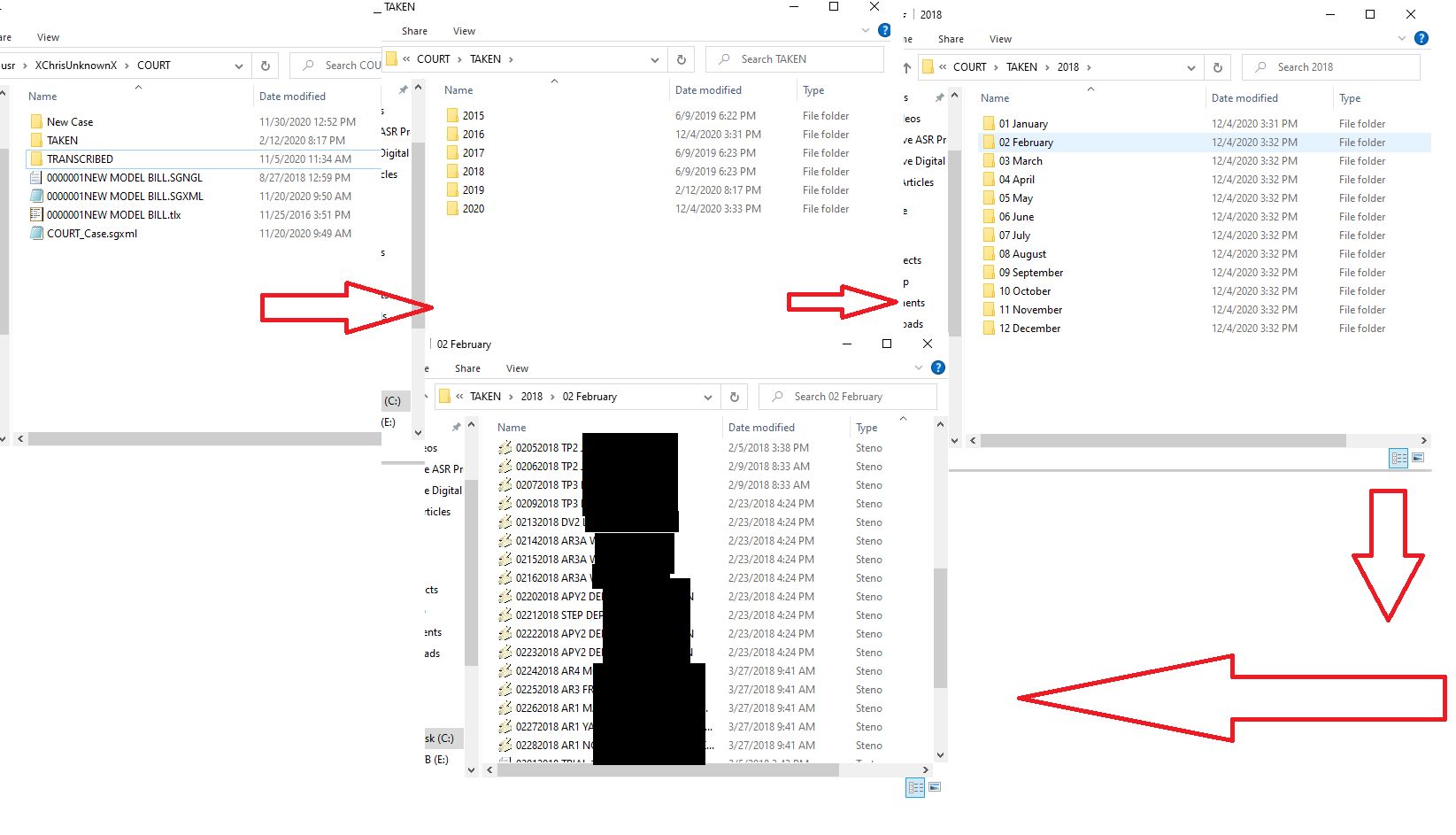
Many reporters today struggle with naming their cases and folders appropriately. You can burn hours of time looking for a case if you are not careful about how you organize cases. My personal suggestion with regard to standard case naming? Use the date. When you use the date to name a case, if someone places an order, you do not need to know anything else about the job except what year, month, and day. I do not disparage reporters who like to name things by last name, location or any other naming scheme, but the date has always been incredibly effective. If you ask me whether I took court notes on any particular day, I can tell you almost instantly, because it’s all neatly sorted by year, month, day.
In my particular case, I have a “COURT” folder. That folder then has two folders inside it named “TAKEN” and “TRANSCRIBED.” “TAKEN” contains all the notes taken and not yet transcribed. “TRANSCRIBED” contains all the finished transcripts ordered by anyone ever. Inside “TAKEN” and “TRANSCRIBED” there are year folders for each year, and inside the year folders are month folders with the number of the month and the name of the month. Inside each month folder is a file named after the date, the courtroom, and the judge. For “TRANSCRIBED” these files also include the defendant’s name so that they are easily identifiable. If you have the date, I know where the notes are, and I know whether the transcript has been transcribed before. If you’re going to use “my” naming scheme, you must put a zero before single-digit numbers because otherwise the computer will not sort them correctly when you sort by name. This is idiot-proof. I know that because I am an idiot.
I am revealing where I was in 2018 so that time travelers can find me.
Your Ability To Stop Fooling With Tooling:
I think I’ve made my case for all the tools that can help you become better at time management. But to echo the work of Euan Williams, beware of busywork. The more time you spend trying to find the perfect tool, develop the perfect routine, or think about how you will manage your time, the more you will watch time slip away without accomplishing much of anything. Your ability to stop fooling with tooling combined with your ability to identify and use the tools at your disposal will find you the time you need to succeed and get to the things that matter most.
Most of you probably thought I meant something important like a kid, spouse, or life event. Nope. I spend all the time I save by being productive on Mount & Blade Warband.