National Court Reporters Association to Exclude Non-Members From NCRA Social Media Groups

Court reporting has a huge Facebook presence. The National Court Reporters Association is acutely aware of this and has lots of different Facebook groups catering to the different types of reporters.

(Sorry to all the CART writers that don’t like being lumped into the reporter umbrella.)

Some of the NCRA social media groups are pictured

There’s no secret that the National Court Reporters Association has, overall, been bleeding members, with more expected losses forecasted to about 2030 thanks to the retirement cliff and the expansion of digital reporting by the larger corporations. This is in addition to people burned by the organization in one way or another who leave voluntarily, like yours truly.

So imagine my surprise when it was announced they’d be culling non-members from their groups.

An announcement by NCRA in the CART group
An announcement by NCRA in the scopists and proofreaders group

This selective inclusivity is precisely what’s killing the organization. If you want people to be excited about membership, excited about the organization, excited about joining and making a difference, you engage with them. You can’t engage with people you exclude. Why in the world would we exclude non-members from these spaces if there’s nothing nefarious going on?

Who knows? Maybe there is something nefarious going on. The NCRA does have that antitrust suit filed against it after all.

For better or worse, I’ve always allowed open engagement in my Stenonymous group and on this website. I take the time to answer and like almost every comment. You can trust my brand to be open and honest. Why can’t you trust your national association to be the same?

To be honest, if you ever wanted a place to spend the $300 wasted on membership dues, Stenonymous would be a good bet. I engage with news reporters to spread information about the field. I report accurately, openly, and faithfully on industry news, concepts, ideas. It wouldn’t really be all that hard to get some lobbying going if I had significant buy-in from the community. And then what does NCRA provide besides the certifications? And it probably wouldn’t be all that hard to get a certification program going under a slimmer organization with bylaws that don’t violate the antitrust laws. After all, I have good relations with people that have instituted the New York State Court Reporters Association certification program. Yes, I would have to give up the blogging and the wild man approach to politics, but I’d make it work.

You ever want a new association dedicated to stenographers, I’m your guy. But I can’t do it for free. I would need enough reserve cash to safely leave my job and do what really quite honestly needs to be done in this field — NCRA needs stiff competition. (Stenograph too!)

To all the NCRA members reading, don’t let your leaders lead you off a cliff. Don’t watch them burn your dues with their poor decisions. Demand inclusivity or get out of the club before it crumbles. Imagine the possibilities. Take control of your destiny.

Sometimes the path of least resistance isn’t the smartest choice. Sometimes the way forward is through.

Court Reporter Rates Discussion Group Allegedly Had 58,000 Views in the Last 28 Days

I’m sure some of it is bot traffic, but it is nice to see something of mine getting a little attention.

Like I said on Facebook, I’m sure some is bot traffic. But I imagine we’ve captured the attention of at least a few consumers.

Comments in the Court Reporter Rates Discussion Group
Views in the Court Reporter Rates Discussion Group

There’s only maybe 20k to 30k court reporters in the United States, so we’ve got company.

I assume at least some consumers are realizing that they’re being taken advantage of. I’m hopeful that’ll give the sole proprietors and small businesses a fighting chance against the larger lawbreaking corporations.

As we wait for the journalists following me to figure out that I use propaganda techniques to tell the truth for strategic reasons, I would urge people to continue to educate students that are being misled. A dear friend of mine recently told me a friend of hers was almost tricked into digital court reporting, thinking it was stenography. This isn’t surprising. The businesses on the digital side have been trying to trick student consumers for years, which the government is happy to let them do. A shame the New York State Education Department ignored my complaint years ago. And which company misdirected my friend’s friend? BlueLedge’s buddy, Ed 2 Go, known for its shady past deals. And BlueLedge? Well, let’s hope everybody realizes it’s basically a scam real, real soon.

In the words of my friend, “she would’ve wasted $1600.”

Stenonymous comments on the corporate scam of BlueLedge digital court reporting in picture form.

If you’re on the fence about becoming a Stenonymous source, just keep in mind I’ve been publishing for years and my best friends can’t name a single one of my sources.

P.S.

I acknowledge that I owe one of those journalists an apology. But that’s the point of my whole performance. Even if something is legal, does that make it a good idea? Does that make it kind? Does that make it just? And if your answer is no, then why do you excuse blatantly illegal things like defrauding consumers and jobseekers? Maybe at the point where it’s not politically correct to rally against people breaking the law, political correctness need not be adhered to or even considered. Maybe your little groupthink world is, just like mine was, wrong.

I do not know if I will ever be ready to give such an apology. The hardening of a heart has its drawbacks.

More on that tomorrow.

Meta Claims Federal Trade Commission Structure is Unconstitutional

Meta respectfully requests that this Court declare that certain fundamental aspects of the Commission’s structure violate the U.S. Constitution, and that these violations render unlawful the FTC Proceeding against Meta.” Reported by AP.

U.S. Senator Edward Markey (D) reportedly stated “In the face of a potentially massive fine, Meta’s adoption of extreme, right-wing legal theories to challenge our country’s premier consumer protection agency reeks of desperation.”

The political bullshit aside, this is a serious problem. We now have mega corporations openly attacking the legitimacy of the agencies meant to regulate them. What fucking nerve. Corporations are people? When was the last time you saw a regular person have the balls to argue in court, through a LAWYER, that an executive agency created 109 years ago is unconstitutional? Who does that? Usually the sovereign citizens. The free men of the land. The people that have no respect for the law, society, or the various mechanisms available to effect change under the current system.

The scary thing is this could fly. Legitimization and power is a tricky thing in human social dynamics. It doesn’t matter if you’re the strongest, the smartest, the bravest, or anything else. All that matters is people’s perception of you. For example, with my wild-man publishing strategy, I made it possible to get all this information out into the public in such a way that it silenced the other side’s lies. After the incident in 2021, I decided to incorporate what had happened to me into the strategy, and decided we could “coin flip” it, and if people accepted what I was writing and pumped me up with support to go fight the fight we really need to fight in our field, I could make real ground very rapidly (math omitted). The alternative was things could go very, very badly and everybody could laugh off the mentally ill man making the “ridiculous,” albeit true, claims. So I set the stage such that if things go well, yay for stenographers and small businesses. If things go poorly, you can all just outcast me so it doesn’t stain you 🤷🏻‍♂️. My strongest supporters, consciously or subconsciously, realized this is the case and threw in money and time to help — still do to this day. But there is a percentage of people who mock and deride me, mostly quietly away from my ears, but sometimes within earshot of my 1,000-person network. I’ve given up on the spitballers. They are too stupid to identify the coin flip or understand how it benefits them. There’s still a pretty huge middle ground that hasn’t heard of me or doesn’t care right now, so who really knows what the future holds?

But the point on legitimacy: Anything could’ve happened. Anything can still happen. And it stops people from opposing me publicly because in the end they’re not sure which way the coin will land. This is a microcosm of our larger political situation in the United States and this Meta situation. It’s a coin flip. If enough people, or the “correct” people (judges), accept Meta’s arguments, we may very well see a crushing blow to the FTC in our lifetime. Alternatively, people could freak on Meta for attacking their country’s legitimacy and Meta would be forced to backpedal to keep its legitimacy, if it even could. Of course, the truth is that a lot of people haven’t heard of this Meta situation or don’t care right now, so who really knows what the future holds?

This is all further complicated by the fact that humans are not persuaded by facts, they are persuaded by propaganda. Something that Martin Luther King, Jr. likely understood. Something that science is beginning to understand. This is just how our brains work. Even mine. You can build truth seeking into your worldview to help diminish susceptibility to propaganda, but in the modern world we’re bombarded with information all day, every day, so if even just 1% of that tricks you because you are very smart, you get tricked at least 3 times a year, and most of us don’t think about it.

I’ve thought a lot about power dynamics over the last few days. Our community’s very own James McAllister, someone that has worked tirelessly to bring steno into more languages and recruit more stenographers, an amazing man, wrote me something last night I’d like to close on and share with all of you, because I believe that all of you should see it:

“We Are Power!

(Inclusive of everyone reading.)

Releasing Stenonymous June 2022 Ad Report

Last year, stenographers funded this blog to the tune of thousands of dollars. I am releasing an ad report that reveals the statistics and nature of the ads launched in the last two years. It is my hope that this will have two impacts. One, I’d like my audience to know how some of the money that flows in is spent, but also see that I was spending money to fight for us well before this blog was pulling in any substantial money. I believe that will increase confidence in the blog. Two, I hope that this will help others that are considering advertising compare costs. I see a world where we all benefit from public data, increased awareness, and increased knowledge.

If you feel this report is valuable, feel free to use the donation box at the bottom of this page to contribute to more Stenonymous activity. During the study period in this report, over half a million people were reached across Facebook and Twitter.

You can download the full report here:

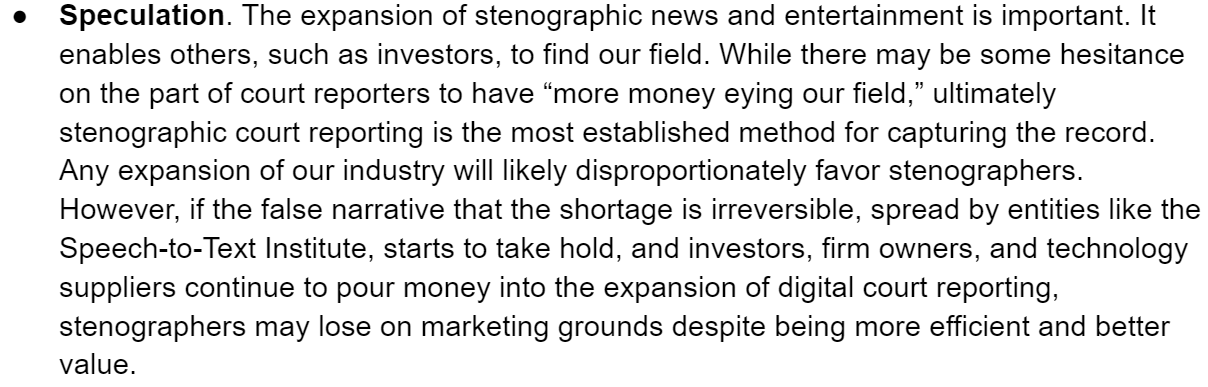
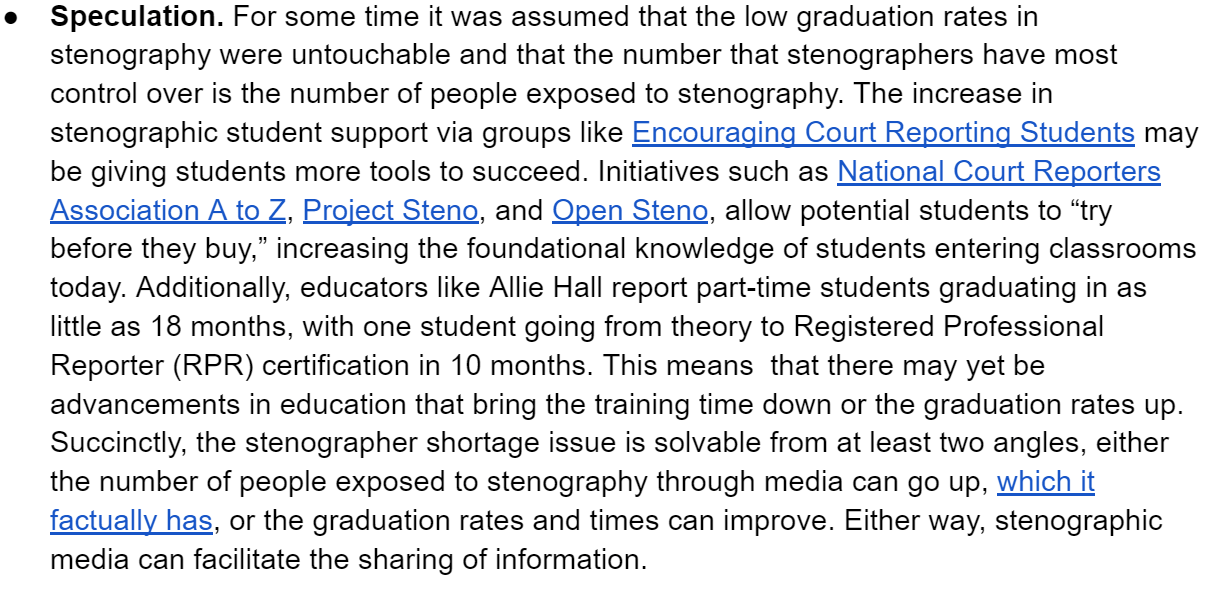
Here are some highlights from the speculations segment of the report:

Here are some highlights from the conclusions segment of the report:

One-Time
Monthly
Yearly

Make a one-time donation

Make a monthly donation

Make a yearly donation

Choose an amount

¤8.00
¤16.00
¤24.00
¤1.00
¤2.00
¤3.00
¤4.00
¤8.00
¤12.00

Or enter a custom amount

¤

Funding the Stenographic Legion.

Funding the Stenographic Legion.

Funding the Stenographic Legion.

DonateDonate monthlyDonate yearly

Be Smart With Social Media

Social media is a powerful tool. Like any tool, it needs to be handled properly. We have had unions, associations, and individual reporters growing their online presence and using it to get details and ideas out to fellow stenographers. All that said, whether you’re posting a joke or creating a professional networking masterpiece, it’s time for some advice on social media.

First, realize that people will see what you post. You’ve got to be pretty comfortable with anyone and everyone seeing it, from your best friend to your worst enemy. What you do on social media is largely not private, no matter the group, setting, or structure. As a new person, this can be intimidating and dissuade you from participating in discussions. We’ll get into why that’s a bad idea, but first let’s run over some quick tips to make your use of social media enjoyable.

    If you are freelancing, posting directly about your agency can bite. In every group, there is a person, persons, or Parsons that will leak your post to your agency to curry favor or because your post offends their sensibilities. If you have a delicate piece of information that you want published, seek out a confidant or method to anonymously publish the information. If it’s newsworthy or going to help stenographers, then it’s worth protecting yourself first.
    If you are freelancing, posting about setting rates or conspiring to fix rates can get you in legal trouble. It’s called price fixing, and it’s a concern because we are not considered workers or employees, but independent contractors on the same level of business as agencies. We all know that the power and reach we have as individuals is different. That doesn’t change antitrust law.
    If you’re working as an employee or even freelancing, posting about a job can hurt you badly. We are supposed to be neutral, and in some states there are ethical rules we can break if we are not careful. There is a line between talking about a political idea or law and talking about an actual case that you reported on. My advice? Don’t cross the line. Imagine screen shots of what you say being printed in news.
    Be kind. The family members or friends of whoever you talk about may be watching. Easy example, I once posted about a stenographer losing their job. Someone who was close to that person reminded us then and there, we all struggle in life, don’t rush to judgment.
    Test your own beliefs. You will see crazy claims out there on the Internet. Rarely should you dismiss what people say out of hand or make final conclusions. Perfect example, I saw a transcript I thought was page padding. I came to learn that that was that state’s mandated page layout. What you think is not always what is true.
    Controls can help. Social media is a tool. Privacy settings can screen out some people from seeing stuff. You can choose who to follow, who to block, and all sorts of other content preferences. Spend just one afternoon reviewing your settings and make sure you’re getting the most relevant info in your feed.

So now we get to the logical end: This stuff is stressful. Why don’t I just delete my social media? You can. There is no law against that. But social media is this amazing tool for staying current and tuned into what the field is doing. We get the great marketplace of ideas, dispatches from agencies, and food for our own thoughts. Life is stressful, but very few of us run off into the wild to live off the grid. Why? Because the benefits of society are greater than the simplicity we’d otherwise have. Similarly, the benefits of social media are greater than the peace gained by never engaging. That said, engage smartly so that your tool never gets used as a weapon against you.

Getting Involved: As Simple As A Like

Got an anonymous e-mail February 16. As best I can interpret it, it’s a little poke to introduce NCRA’s wide range of social media options. If there was supposed to be an attachment, it didn’t send, and I’m sorry. So, I’ll link it all and then we’ll talk about it a little more. NCRA keeps a page about its social media outreach here. They have a page for captioners. They have a page for CART providers. They’ve got a spot for freelance reporters. Legal videographers have a group. Official reporters get a warm welcome too. There’s a scopist and proofreader group. There’s a place devoted to reporting technology, AKA “the technology share.” Finally, there’s a Realtime TRAIN page. States it’s for nonmember and realtime users. Seems related to the TRAIN initiative to get people realtime and marketable.

Now I’ll come to a point about why all this matters. Support comes in different shapes and sizes. Ideas evolve in different ways. When we are all connected, sharing, and spreading information, it becomes easier to organize, learn, and engage in our respective markets. California reporters, as an example, are going to have a somewhat different experience and insight than New York reporters because we are on opposite ends of the country with different laws, licensing requirements, and professional organizations. That said, the NCRA can be a bonding place for all of us in the different areas of the field, and a way for us to get information out faster and with a lot more fanfare. While it is important for people to get involved in whatever way they can, whether that be volunteering, brainstorming, compiling information, or developing free resources for people to learn about steno, there’s a lot to be said about simply tuning in and staying a part of the network.

For example, imagine Reporter A and Reporter B. Reporter A is busy and has a hectic job, but liked NCRA’s facebook page, so NCRA’s stuff pops up in A’s feed. A sees they could use someone to write a JCR article about A’s busy and hectic job, and now A has the power to fill in that need. Reporter B has the same busy and hectic job, but B isn’t connected, never sees it, never hears about it, and never shares the tips and tricks to being good at B’s busy and hectic job.

If we’re linked in, we all have the ability to contribute. Whether or not we choose to contribute is our own business. Simply having the capability to join in a moment or movement is worthwhile and empowering. Tell everyone you know, getting involved can be as simple as a like.