Could The National Court Reporters Association’s Tying of Membership and Credentials Be a Violation of Antitrust Laws?

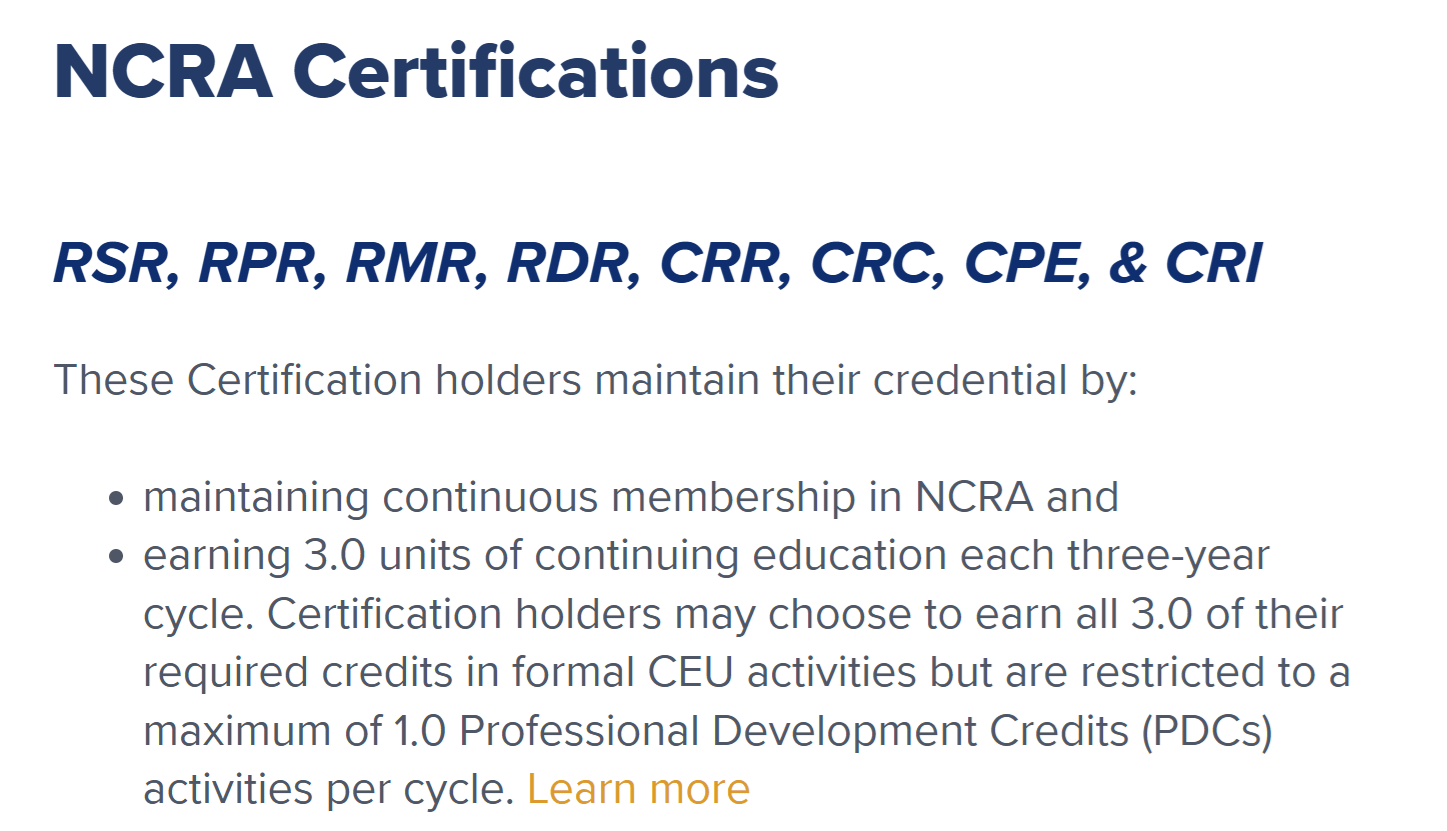
Credentialed members are required by the NCRA to maintain their membership to keep their credentials.

This page talks about a class action that took place against the American Osteopathic Association. Motion to dismiss was denied and the case settled for millions of dollars. The bottom line is we don’t know for sure if it’s illegal yet.

But I think it’s about time to say it out loud: The National Court Reporters Association does so many things in the name of legal liability. They refused to speak out against the fraud nonprofit Speech-to-Text Institute. They refused to entertain a bylaws amendment I proposed in 2021. They rejected an ad I wanted to place in the Journal of Court Reporting in 2022. Anything with any sort of legal liability is taboo at NCRA and it’s a convenient excuse for the board and staff to strike down membership’s desired direction.

So what’s the deal, NCRA? You use legal liability as a crutch when it suits you, but when it lets you screw members out of money, you’re all good with taking on the legal risk? Maybe you really are in bed with the big box brigade. This smells.

I hope people sue. How will your insurance rates do when it becomes public knowledge that this was a totally foreseeable liability that you ran into head first? You want to tell us GC didn’t know about this risk? Maybe it’s time for a new GC. Maybe it’s time for a new board that doesn’t put our national association at extreme risk of being sued. Because I’ve got news for you: If American Osteopathic is settling, you are too!

Even better, this potential violation of law is written right into the bylaws.
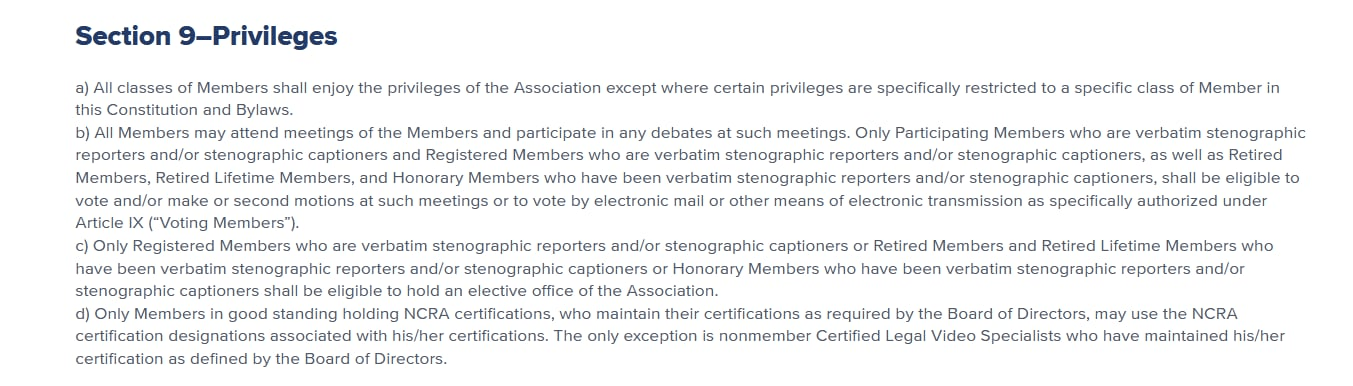
Section 9 on the Constitution and Bylaws Page

I’ve reached out to a lawyer myself. I’ll see where it goes. But from my reading of everything, members would have much more standing than I would. Especially members who require certification to work in their state. Imagine getting back years or decades of dues that you were all paying that you never had to pay in the first place. Isn’t that worth getting together and giving it a shot? You decide.

Because we already know the NCRA’s stance. Pay, pay, pay, and don’t complain!

Do you hear us yet?

NCRA Virtual Town Hall, September 21, 2019

As many know, there was a Virtual Town Hall presented by NCRA on Saturday morning. Uncharacteristically, I did not take detailed notes of the meeting. But I feel it is important for people to be informed, and so for those that could not attend, I wanted to pass along a few important points I got and remember from listening to Max Curry.

One major point was the dues increase. Why did it go up from 270 to 300? Max explained that it had not gone up in five years. He explained the hard work that NCRA is doing in terms of lobbying education and educating state leaders via programs like the Legislative Boot Camp. It follows that all of this work needs funding. More or less, NCRA is not a business, but there are business aspects to it. It has employees. It has expenses. In this way, a dues increase makes sense. I, myself, as he was speaking, quietly plugged our 270 membership into an inflation calculator for 2014, and the value of that membership today is about $296. Succinctly, the value of our membership is about the same even though the dollar cost went up. He didn’t word it this way or even mention inflation, but from my recent post, I realize a lot of people struggle with the concept of inflation like I did once, and I’d like to do my part to make it a more regular part of our business decisions. Every year, every dollar in America has a little less value. Prices must rise in order to have the same buying power. That’s true for me, you, your neighbor, your barber, and NCRA.

One very important thing he did address was the desire many members had to be allowed to vote on the membership increase. Only members at the business meeting got to vote, and they voted for the increase. He explained that there is a process by which such things could be changed, and encouraged members who feel strongly that all of the membership should’ve had a vote, or about any issue, to propose a bylaws change.

Secondly, and a simple clarification, people wanted to know what the difference was between A to Z and Project Steno. He explained that NCRA’s A to Z and Project Steno’s programs can be similar in that they both introduce the concept of steno, but A to Z is NCRA’s program and benefits from NCRA’s infrastructure. So if you are looking to support NCRA’s A to Z efforts, the only way to ensure the money goes there is to donate to NCRA. Donating to other sources, the NCRA doesn’t control what happens to it.

Third, there are many committees dedicated to many different topics and issues. Max encouraged people to get involved. I would also encourage people to get involved. Even if you don’t want to serve on a committee, definitely take the time to write out your thoughts and ask they be submitted to the appropriate committee. It just might make a difference. NCRA’s the largest organization dedicated to machine shorthand stenography, and we all have something to contribute.

I had to leave early. But I was impressed with the meeting. I was grateful that a Saturday morning was spent to update and educate members. I feel it important to dedicate some of my space to preserving these ideas, because for every stenographer educated, a future victory.

Good News About NCRA’s Retention Policy

Well, credit where it’s due. People who had legs outstanding will get to keep them until November 2021. Honestly, I was mad at the change in retention policy and the decision that certification legs would now expire. I felt, I still feel, that it was an unnecessary extra burden in a profession where everything is already pretty hard. I feel like the more barriers added, the worse off we are. We need to be inclusive and help people along. Most of my career I’ve been an advocate for tearing the barriers down, and my feelings on the matter were so strong that I was openly considering walking away from the NCRA. That says a lot. I’ve been an advocate for organization, and I tell any person I mentor that they can get more deeply involved with the profession through state and national association membership. I even wrote them a letter saying I’d give up my RPR legs for them to not do what they were planning to do!

That said, my previous understanding was that the NCRA was having legs expire now, in October 2018. With this new understanding that the expiration is three years off, I find the entire thing much more fair. If I had this misunderstanding, it’s not unreasonable to think others may have, so just let it be known that if you had legs outstanding, you’ve got this email, and you have three years to earn your RPR.