A Gentle Reply to Steno Imperium on Digital Pay Parody

As many know I don’t generally censor comments on my blog. I generally welcome discourse and disagreement. To be quite honest, one of my long-term goals was to attract bloggers to the space that would disagree with me and give people things to think about.

So, with plenty of love, I’m going to share Steno Imperium’s “Digital Pay Parity A Pipe Dream of Unbalanced Benefit.” This relates to my post “Digital Pay Parity Would End The Shortage.

Excerpt from Steno Imperium

“How can digital parity shift a system that thrives on mediocrity, not mastery?”

Because the simple truth is that most human beings are within relatively the same range of intelligence. The people we deride and derogate as low skill are, pound for pound, about as smart and resourceful as we are. By approaching the scenario as equals and challenging corporate power, we stand a much better shot at winning any given fight. Again, we’re expected to compete with each other. Competing with each other takes attention off how bad we’re being screwed by the corporate players. If we all turn around and demand, particularly through union contracts, that people are paid the same, the corporate players’ only option will be union busting.

“…the digital device will never emulate the essence of experience.”

I more or less acknowledge this where I talk about our communities making our people better trained.

Excerpt from Steno Imperium

Day dances through his supposed ‘reality’ with a hasty hand…

You bet I did. I learned long ago that shorter pieces get more attention. Any time I forget that, my readership levels drop.

Digital’s rise, in truth, is but a product of a market manipulated by money, not merit.

Precisely. They have the capability to outspend us 100 to 1. Probably 1000 to 1. And I’m being optimistic there. Those dollars shape perceptions. Those perceptions shape reality.

Consider our entire system of law. Two sides, presenting facts to a judge or jury whose perception alters the reality of the outcome for the two sides. If one side runs out of money, their facts may never even make it to a courtroom before they’re forced to settle.

Similarly here, we’ve proven, over many years, that we do not have the cohesion to mount an effective public perception campaign, while the digital sellers have been spending time and money on shaping public perception for over half a decade. We could, in theory, outspend digital. I’ve covered that on the blog before. We do not. We will not. Our so-called adversaries can break the law with impunity. It’s time to start considering the alternatives to losing.

“…the ‘reality’ Day speaks of is the same reality that leads to layoffs, loss of livelihood, and the lowing of laborers in long-standing lines of work.

Exactly. I’ve openly published about the fact that corporate consolidation of the United States has started to threaten the livelihoods of doctors and the quality of patient care. If the nature of corporate consolidation is that more and more workers are subjected to the whims of fewer and fewer corporate executives over time, and this is true for some of the smartest people there are, then what’s going to save you from loss of livelihood? Banding together to put rules on the corporate executives! This can happen through legislation or unionization, but it must happen. Corporate power must be checked. Unchecked, the reality is, they do what they want to you, and you are an expense they’d really like to cut.

Reality isn’t about corporate convenience, it’s about the craft’s value.

I feel this is addressed by all the above. Yes, we’re valuable. But when you’re being outspent 1000 to 1 in the land of public perception, it doesn’t matter much. Let’s take AI, where the public perception spending is probably 1 million to 1. How many people have heard “AI is the future” versus how many people have read the studies Testifying While Black and Racial Disparities in Automated Speech Recognition? How many people have read that over 80% of AI business solutions fail? Even though those studies and that fact collectively clearly point to humans being better at transcribing a specific dialect, or being better at certain tasks, investors proceeded to dump billions dollars more on AI and AI companies. Perception changes reality.

Our craft ceases to exist without some money behind it. The people with the money think digital is the future. The Pygmalion Effect tells us they’ll do what they can to make digital the future. Their perception of what the future looks like must be altered for us to win out, and digital pay parity would alter it forever.

The divide isn’t between positivity and anti-digital; the divide is between those who understand the value of real work and those who let digital devices dictate their worth.”

Let’s be clear. When I’m talking pay parity, I’m talking raising them up, not pushing us down.

Steno Imperium Excerpt

I had to include the above portion in its entirety because I really take issue with it.

I’ve never made the claim corporations are victims. And again, our decentralization and lack of cohesion are a problem for us, not them. Digital pay parity is NOT a corporate strategy. Notice that it’s always been absent from the “unity” and “equality” corporate crowd’s vocabulary. It would not benefit the people on top, it would squeeze them. And damn, would it be nice for us to be doing the squeezing just once in my lifetime. I dare STAR to start featuring pushes for pay parity. I dare them. Unity Summit my ass.

The end is about being irreplaceable and about faith.

And in the end, I’m not here to shake anyone’s faith, but I can give you the science, the numbers, the psychology. If you want to choose “just believe in our skill” over all of that, it’s cool. But it’s not going to maximize the outcome for the largest number of stenographers possible. In my view, it’s about understanding all the systems we operate in and acknowledging that no matter how many of us believe in our skill, there are a lot of customers — lawyers, litigants, court systems, so forth, that do not care. They want a transcript and could not care less how it’s produced. In reality, cost might be their deciding factor. Want to give up all those dollars to digital? That is shortsighted. That will be the end of us. Equalize our pay and suddenly digital loses its demand. Game, set, match.
Digital Pay Parity Would End The Shortage

I’ve had quite a journey over the years in terms of my mindset when it comes to digital recording. At one time I was completely against it, as many in my audience are and will be. I saw it as taking jobs from stenographers, and to some degree, I still do.

But I grapple with certain realities. Reality, the big boxes are calling digital realtime. Reality, Veritext advertised for digital pretty much every day for two or three years by my count. Reality, the people that lend large corporations money want digital because they believe it will increase the bottom line. Sorry for not linking sources, but trust me when I say it’s all been covered on this blog ad nauseam. Conclusion, barring some massive change in my funding, there’s nothing I can do to “stop digital.”

For me, the question becomes what I can do to improve the outcomes of our stenography students. And hilariously, it turns out that advocating for digital pay parity would do just that. Facts are facts, the average stenographer is more efficient and better trained — our communities online and off assure that. If the companies are paying the same, suddenly there’s no more incentive to prioritize the digital. All the time, money, and energy spent by the corporations to promote digital is wasted, and eventually, the lenders stop lending to the big guys altogether, effectively killing big boxes, or the lenders get on board with us, at which point the money is behind us, and we might see a revival of the field in terms of new businesses and schools for stenographers.

One of the saddest things about this realization is the concurrent realization that so many of us are ignorant to these market realities. We seem to have two major camps in steno. Toxic positivity and anti-digital. Neither camp really cares about or accounts for the market realities I’ve made plain. Toxic positivity is happy to do our outreach and bring evermore stenographers into the market without realizing or caring that their opportunities are being systematically eliminated. Anti-digital is happy to dehumanize and deride the digital reporters, never acknowledging that by doing so we play directly into the hands of the corporate powers that want us to compete with each other.

And make no mistake, the corporate players do account for, and firmly understand, market realities. This puts them at a constant advantage. Someone like me can liaise with lawyers and spread information about the benefits of unionization, but unless the message carries, we all remain at a disadvantage because we are decentralized, and at the end of the day, easy to control, herd, predict, and take advantage of.

My world view has been shattered over the years. I believed that people armed with information would make the right choices. The simple truth is people prefer their delusions and comforts. Many of you reading will chant “I am irreplaceable” right up until you are replaced, and possibly thereafter. For what little it’s worth, I tried to help, and the writers and readers of this blog did a lot with so little.

Trust me when I say that if the funding situation ever changes, our communities will thrive.

Perhaps there’s a silver lining for me. Free of my own delusion that people are better than they are, I get to prepare my son better for the world.

Reader, we’ve come a long way together.

Never lose hope.

But always have a backup plan.

I Asked the Public About Stenography. Here’s What Happened.

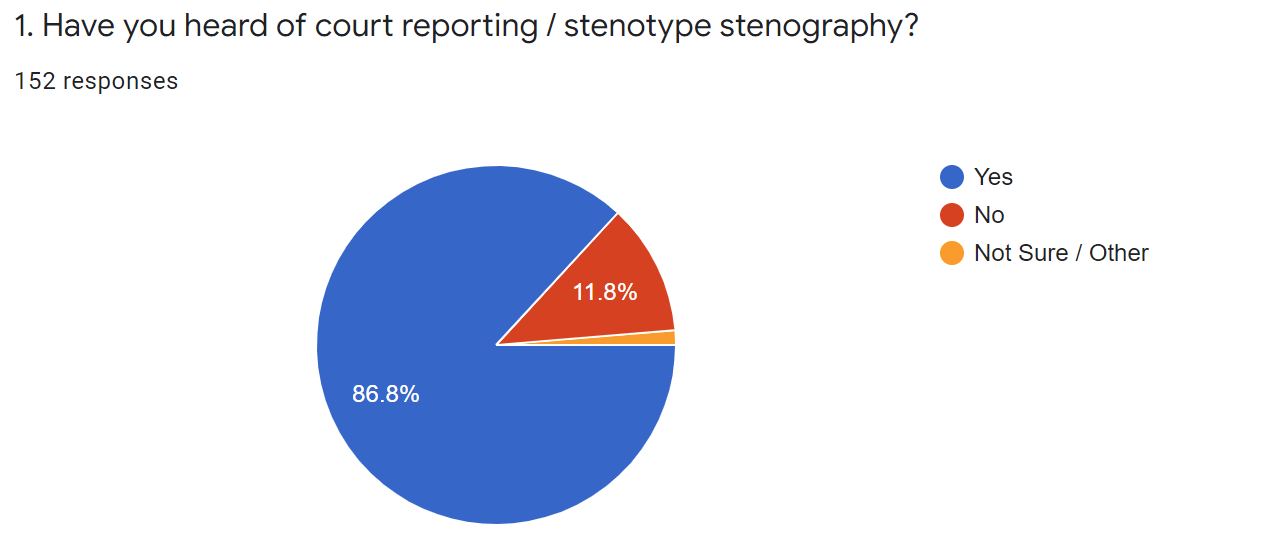
About ten days ago I launched an ad campaign to survey the public about court reporting. Question number one, had they heard about us?

Stenonymous Public Perceptions May-June 2022 Survey Question 1

When asked what terms were associated with court reporting, respondents overwhelmingly selected terms like “fast,” “technological,” and “adaptive,” over words like “old.”

Forms response chart. Question title: 2. Please select all terms you associate with court reporting / stenotype stenography. Number of responses: 152 responses.

Then I asked respondents if they could tell a court reporter anything, what would it be? The majority of responses were positive, with comments like “great job” or “bless you for listening to all the nonsense.” There were about six negative comments, with things like “your days are numbered.” There were a series of questions, like, “how do you like your job?” Finally, there were comments that didn’t fit into a simple “positive,” “negative,” or “question” category. These were comments like “smoke weed” or “I wish I had stayed in my stenography class.” The responses are in Google Sheets (Excel) format here. If you would like a simple PDF where the responses have already been categorized, download below.

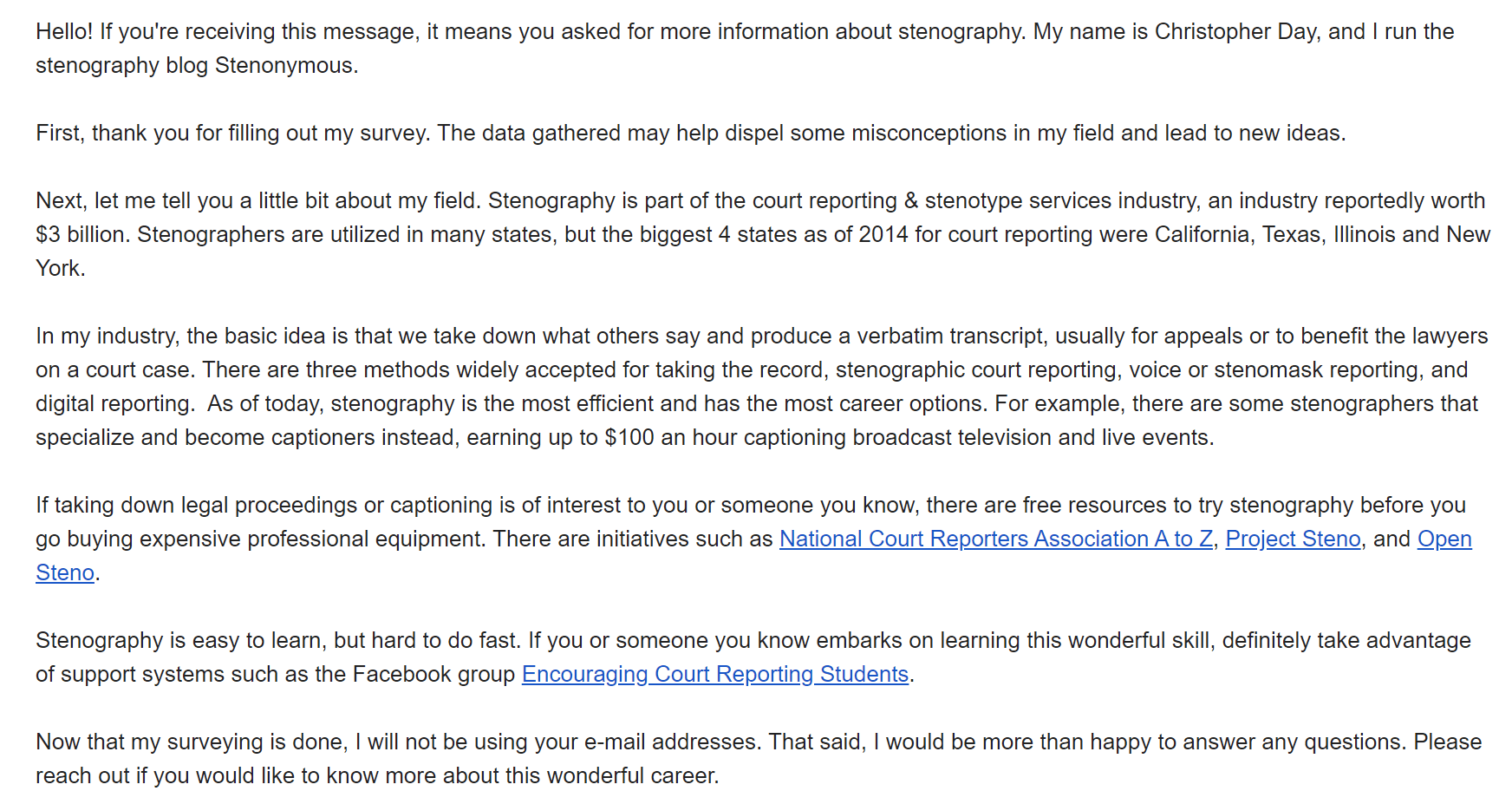
Finally, I asked respondents for their e-mail if they wanted more information about stenography. Nearly 40 people provided their e-mail, and tomorrow morning, will receive the following message:

Message sent to Stenonymous survey takers.

For this advertisement, 20,707 people were reached with 1,668 engagements and 614 link clicks.

What can we learn from this? Well, for starters, the majority of people have heard of what we do. The majority of people do not associate the term “old” with stenography. This is an eye opener, because prior to this survey, I believed our biggest issue was overcoming the view that we are obsolete. The survey results seem to point more toward a public that largely understands this skill is not outdated. This may change how we talk about steno, no longer coming from a place of defense, but pride, and helping others understand why it is a good career.

This may also redefine the way we discuss shortage. If the perception of being “old” is not what is stopping people from getting into this field, what is it? I would submit that the problem, at least partially, goes back to pay. In these times of allegedly insurmountable shortage, I’ve learned that some companies in my hometown of New York City are paying lower than $3.50 per page. That’s simply too low to attract and retain talent, and far below the $5.74 it would be today had the rate kept up with inflation. It’s easy to say, “skill up.” But if we “skill up” a field of people that struggle with knowing their value, all we’re really doing is setting ourselves up to have the realtime rates drop through the floor. Seems to me that marketing and sales training would provide better outcomes than realtime at this point.

Please feel free to spread the results of this survey. Information leads to new ideas, and there are over 27,000 court reporter minds out there that might come up with bigger and better solutions.

Workers Rights

Here on Stenonymous we have explored many different things related to freelancing and stenographic employment. As a quick recap for those that have trouble navigating the site, we’ve discussed turnaround times and how they have gone from 30 days to 5 with no extra money involved. We’ve discussed the Beginner’s Trap and freelance loyalty, which is all about how you must be loyal to yourself to earn a better income. We’ve brought out the need to build skills that make you marketable. We have admitted the power of a contract and thought about what should go into a rate sheet. We’ve gotten into billing, anticontracting, form SS8, and what it means to be an independent contractor. We have explained why we can’t discuss rates, and then we have discussed rates. We even put out other people’s rates.

Now it’s time for something a little different. I would like people to seriously consider a dilemma the field finds itself in. As independent contractors, we are consistently in a bind of being afraid to discuss rates thanks to antitrust concerns. This fear is probably at times a little overblown, but it causes us to be silent and to act very content even when things are not going well. Indeed, our biggest organizations, our NCRAs and NYSCRAs are trapped in the position of being unable to serve as forums for rate discussions due to liability concerns. All this is happening while some of our biggest purchasers are making a push from stenographic reporting to digital recording. I think it is time to ask ourselves what we actually get out of the independent contractor label. It’s out there that employers can save up to 30 percent by labeling employees as independent contractors. It’s out there that about 20 percent of employees are misclassified. Succinctly, the gig economy is bad for workers. Employers are doing their best to eliminate the cost of workers compensation and unemployment. These are serious benefits, worth thousands of dollars, that independent contractors do not get. Independent contractors have little to no federal protection from otherwise illegal discrimination and need to go to small claims instead of Department of Labor if we go unpaid. Employees are also entitled to FMLA leave, and in New York, family leave laws. Employees have the right to unionize and the employer is forced to enter good-faith negotiation with the employee union. Under today’s law in New York, the only way to take any of these benefits, if you are a commission employee misclassified as an independent contractor, is to dispute the issue on a case-by-case basis. How many people have the guts to do that?

We’re not even getting the benefits of being independent contractors, which would be the write-offs, the ability to hire other workers, and the ability to set our own hours. Think about it. How many of us in the freelance sector print our own transcripts or have consistent business write-offs? Yes, it is nice to write-off the occasional mailing fee, but the agencies have largely taken up any function that gets a write-off except for your starting equipment fee. Ironically, I have more write-offs as an employee with the state, thanks to my 1099 income, than I ever did as a freelancer. The ability to hire other workers? Go ahead and try sending someone who isn’t you to a deposition. See how many times you can do that before they stop sending you work. When I call my plumber, I don’t get to choose who he or she sends. Setting your own hours? Don’t know about everyone else, but I know that I got deposition forms that said please arrive early and gave me a start time. My hours were more or less set by the work, which really isn’t that much different from your boss telling you I need you at 10 tomorrow. We live in America, and people are entitled to refuse work any day they feel like, it’s not something we need the mantle of independent contractor for.

From New York to California independent contractors are beginning to challenge their status or realize the raw deal. California came out with a simplified three-part test for independent contractors. Maybe we should have a serious discussion about whether the title is worth keeping for most of us. Maybe we should talk about new laws and enforcement for independent contractors in New York.

It’s absolutely ludicrous to me that we box ourselves into a position where “freelancers” who are meted work, have deadlines dictated to them, are told when to arrive, what to bring, and disciplined via withholding work when deadlines are slipped, defend this model. The numbers don’t lie. Turnaround times are six times faster. Rates haven’t risen with inflation. Independent contractors save employers 30 percent. What could you do with a 30 percent raise? Hell, what could you do with a 10 percent raise? I mean, I have to go back to the article where I calculated out 1000 different rates. If you’re the breadwinner, unless you’re making at least $5.50 a page average, you’re working nights and weekends to make ends meet. The pricing structure doesn’t even need to change. The only thing that would have to change is agencies would have to pay minimum wage if your page rate didn’t give you at least minimum wage. Guess what? That’ll basically never happen. Imagine a world where you go take a deposition for an hour and only make 20 pages. Now imagine you transcribe for one hour. Your page rate is $3.25. $65 for two hours. Not a great rate but realistically what my generation was lowballed with. Way above minimum wage. We’re specialized workers, we deserve it.

Ultimately, I am of the opinion that in this market and under these circumstances the losers are the independent contractors. There are no substantial gains to being independent contractors, and anyone with private clients could just continue their private clients as a separate business entity. My opinion is malleable and I’m open to debate, but beyond the shallow arguments of we have always been independent contractors and we buy our own equipment, I’ve heard precious little that impresses me. You know who else buys their own equipment? Teachers.

Maybe it’s time for a swap. Maybe it’s time for our trade organizations to shift to labor unions. At the very least, it’s time to talk about these issues in public and consider what can be better.

EDIT. On February 11, 2019, I discovered this JCR article which appears to have a different viewpoint than my own but also talks about the issue. I feel it is important, when possible, to give as much information as possible, so please feel free to review that and join the discussion.

When An Agency Won’t Collect

Often agencies that are not paid by a lawyer give up on collecting the debt. Stenographers often have contracts with agencies as opposed to lawyers directly. This opens up a world where lawyer doesn’t pay agency, agency doesn’t pay reporter, agency writes off the debt. This is a vicious cycle where the stenographer is ultimately saddled with 0 despite it being the stenographer’s time that’s used up. The response? I think we should start looking into writing off debt too. It’s time to start breaking out those 1099s and sending them right along to agencies. Financially it is always better to make a dollar than to write a dollar off, but it is better to write a dollar off than not make a dollar.

And I’m going to come right on out and say the agency that began this post was Veritext. I saw the story of another reporter online, and this was the agency’s grand solution. Mind you, it’s actually a really good solution, but in my opinion, they should not be writing off debt and then not paying the reporter immediately. It’s disgraceful. And I hope in the future should a representative of Veritext come across this site, you’ll either report to us that you’ve changed your policy to pay your reporter in the event of bad debt, or you’re considering altering the policy.

Regardless, it’s time to take a stand on this issue as individuals. The very least we can do is make writing off the bad debt of agencies ubiquitous so that we are not left with zero. In an ideal world, perhaps we would press agencies and collect from them, but the time spent and financial expense of even the smallest lawsuit or claim is too great for many stenographers.