I’ve had quite a journey over the years in terms of my mindset when it comes to digital recording. At one time I was completely against it, as many in my audience are and will be. I saw it as taking jobs from stenographers, and to some degree, I still do.
But I grapple with certain realities. Reality, the big boxes are calling digital realtime. Reality, Veritext advertised for digital pretty much every day for two or three years by my count. Reality, the people that lend large corporations money want digital because they believe it will increase the bottom line. Sorry for not linking sources, but trust me when I say it’s all been covered on this blog ad nauseam. Conclusion, barring some massive change in my funding, there’s nothing I can do to “stop digital.”
For me, the question becomes what I can do to improve the outcomes of our stenography students. And hilariously, it turns out that advocating for digital pay parity would do just that. Facts are facts, the average stenographer is more efficient and better trained — our communities online and off assure that. If the companies are paying the same, suddenly there’s no more incentive to prioritize the digital. All the time, money, and energy spent by the corporations to promote digital is wasted, and eventually, the lenders stop lending to the big guys altogether, effectively killing big boxes, or the lenders get on board with us, at which point the money is behind us, and we might see a revival of the field in terms of new businesses and schools for stenographers.
One of the saddest things about this realization is the concurrent realization that so many of us are ignorant to these market realities. We seem to have two major camps in steno. Toxic positivity and anti-digital. Neither camp really cares about or accounts for the market realities I’ve made plain. Toxic positivity is happy to do our outreach and bring evermore stenographers into the market without realizing or caring that their opportunities are being systematically eliminated. Anti-digital is happy to dehumanize and deride the digital reporters, never acknowledging that by doing so we play directly into the hands of the corporate powers that want us to compete with each other.
And make no mistake, the corporate players do account for, and firmly understand, market realities. This puts them at a constant advantage. Someone like me can liaise with lawyers and spread information about the benefits of unionization, but unless the message carries, we all remain at a disadvantage because we are decentralized, and at the end of the day, easy to control, herd, predict, and take advantage of.
My world view has been shattered over the years. I believed that people armed with information would make the right choices. The simple truth is people prefer their delusions and comforts. Many of you reading will chant “I am irreplaceable” right up until you are replaced, and possibly thereafter. For what little it’s worth, I tried to help, and the writers and readers of this blog did a lot with so little.
Trust me when I say that if the funding situation ever changes, our communities will thrive.
Perhaps there’s a silver lining for me. Free of my own delusion that people are better than they are, I get to prepare my son better for the world.
A long time ago I made the Court Reporter Rates Discussion group on Facebook. Anyone can join and we do a bit of group policing to keep the spam low.
For years this wasn’t a thing. Our associations trained us we couldn’t discuss rates because we are independent contractors. And in recent years there have even been a few people who have made the claim what I am facilitating is illegal.
There are two reasons why I’m basically immune to any sort of prosecution in this regard, as best I can tell.
First of all, for the FTC to go after me, they risk bringing to light that they didn’t go after the consortium of businesses that conspired to raise prices under the Speech-to-Text Institute. They’d be arguing Christopher Day is more of a threat to the monopolization of the market than Veritext et al.
Second of all, the indisputable legal truth is that the vast majority of us are misclassified employees with an absolute right to discuss our pay and working conditions. Again, this is something companies would never come after me for, because it would blow up in their face. Imagine a judge confirming what I am saying for all of you.
There are digital court reporters figuring this out and talking about unionization. Change is coming. It may take a decade or more or it could be next year. But we each have a decision to make — lead the charge or watch the battle and hope the winner is benevolent.
Coincidentally it’s the same way fascism has been fought through history.
You were told that to limit associations’ legal liability. In fact you can discuss rates lots and lots. I made a rates discussion group on Facebook, and surprise, it’s been rolling along for over a year. The FTC and big boxes don’t care.
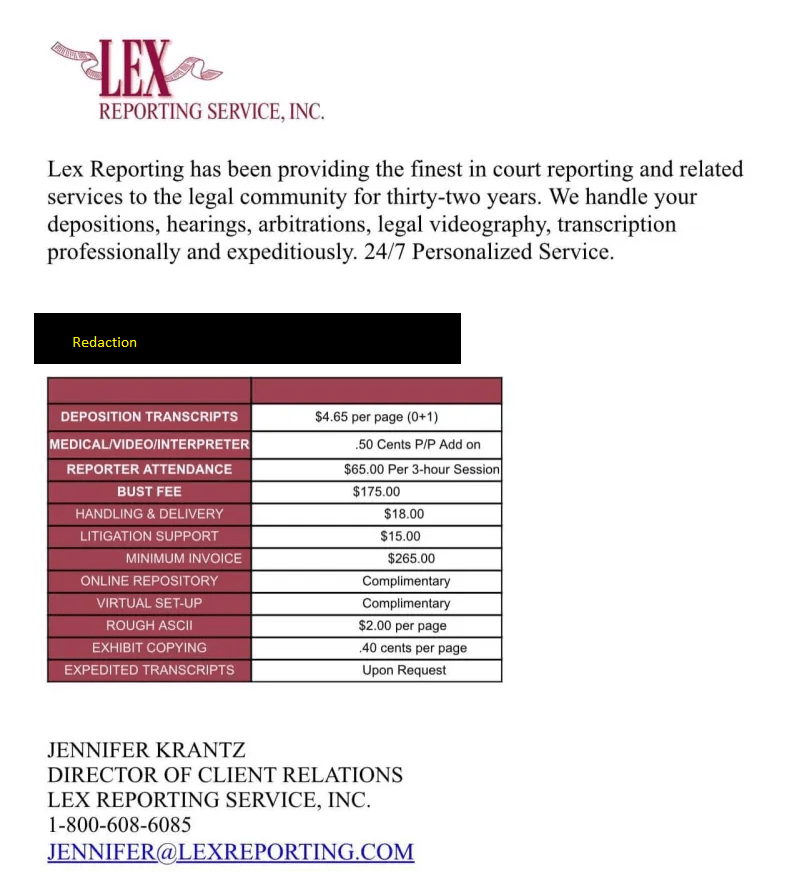
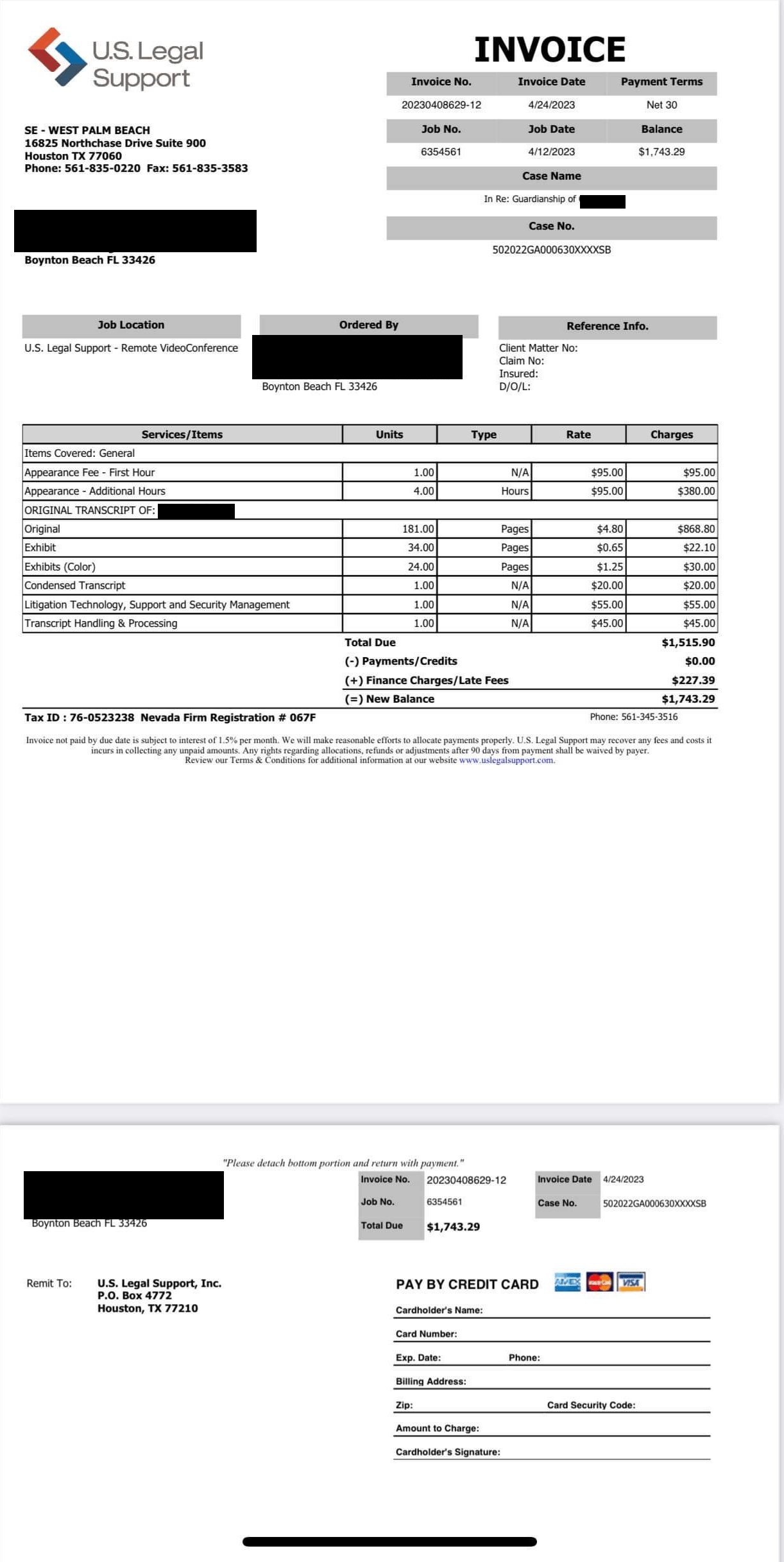
Documents purporting to be US Legal and Lex Reporting rate sheets were passed to me by a source recently.
US Legal New York Rate Sheet sent in by a Stenonymous SourceLex Reporting Rate Sheet Provided by a Stenonymous Source
To be honest, these rates seem very New-York-City competitive. There are some stenographers out there making $4.50 on the originals. I will say that as a young reporter I only got paid $1.00 for roughs, and with the amount of work that goes into those, it would put me off to learn the agency was making exactly what I was for essentially a finder’s fee. The bust I used to make was something like $75. The minimum fee was the bust fee. So there are definitely cost savings to be had for attorneys that go agency or reporter shopping.
But the surprising part of all this was my Stenonymous source stated that copy attorneys were charged the same.
Stenonymous source reports copy charges as high as original charges. In the past (2010), reporter copy charges were as low as 7% of the original in New York City.
Now, the breadth of my information gathering is limited, because I have a full-time job and this citizen journalist stuff is on the side. But it really may be true. Years ago, I staged a call-up to Diamond Reporting (New York City, later bought by Veritext), and they told my caller that they charged the same copy and original.
Not these specific companies listed above, but in general, I have always thought that companies play games with some invoices and the attorneys they don’t regularly do business with. Charge ultra high. No complaint? Payday. Complaint? Cut the bill in half and make out like a bandit while looking like a hero to the client. That said, it’s actually nice to see that not be the case here.
That’s all I have for this one. Feel free to pass it around.
Stenonymous source points out that though court reporting agencies charge full price for word index, court reporters are typically not paid for them.
Given the nature of the action, in my view, it would be wrong for Stenonymous to publish the full transcript. But I have personally reviewed portions of the transcript. The certification, errata, and all that ends at 149, then the word index begins, totaling up to the 181 pages. It kind of goes to what the court was saying in that class action link I just posted. Paraphrasing heavily: “It would not be deceptive business practice if a restaurant did not itemize every item in a cheeseburger.” Basically saying that the word index can be viewed as part of the entire transcript or product and therefore need not be itemized.
But it is really an add-on, isn’t it? My whole career as a freelancer came and went without ever being paid for a word index. Other court reporters report not being paid for their word indices. Word indices are not a required part of the transcript in jurisdictions I’ve read about. It’s a convenience feature. A convenience feature usually added by “the agency.” The agency that is supposed to be a separate and distinct entity without direction and control over “the freelancer.” The agency that is supposed to be a litigation support service and not a court reporting firm, but flip flops whenever it’s convenient for them in court and/or makes them more money. Yeah, that agency.
Certainly, the word index has some value. But is it quite the same value as a caption page that often needs to be filled in manually? Is it quite the same value as a transcribed page? Those can have a 1:1 or 1:2 ratio with time “typing” versus time “transcribing” (typing/writing : transcribing). Said another way, there’s a lot more time and effort going into each page of the rest of the transcript. Not so much with the word index. It’s literally what we accuse the digital reporters of doing, button pushing. In my guesstimate, it takes about as much time to generate an entire word index as it does to produce one page of a transcript. So back to the judge’s cheeseburger statement, it’s more like if the restaurant subcontracted out their cook, and the cook said, “yeah, I’ll make this hamburger for you.” The cook does the laborious work of cooking the hamburger, which in our completely screwed up analogy takes about 5 hours to make on a good day. The agency takes the hamburger, adds a slice of cheese, which takes it a minute or two (0.67% of the time it took to make the hamburger), and charges around 20% more for the now-completed cheeseburger — and that’s on top of their cut from the hamburger itself*.
*Which has me thinking, maybe I could be a judge. Sometimes I read these decisions on the internet and I think to myself, “wow, this can easily be argued both ways and the court just happened to agree with the wealthier side of the equation.”I could do that(joke).
The funny thing about this is court reporters were so paralyzed by fear that none of this would have ever broken if the larger corporations had just been honest. It wasn’t until they started surreptitiously siphoning stenographer work to digital court reporters that people started to feed me information and stand up against the gouging of attorneys/consumers.
If anybody from U.S. Legal Support is reading, your staff asked me not to contact you anymore, so I generally do not, but you’re always free to leave a comment explaining your position. I do not censor unless something is clearly spam, abusive, defamatory, or impersonating someone else. We’re playing an interesting game of incongruence where you all have a lot more money, but I have a growing movement of people — small business owners, court reporters, attorneys, and members of the public — that believe it really does matter if things are done legally and ethically. That’s not even counting the people that follow and support me out of their own self-interest. I’ve seen firsthand how our message resonates with real people. Accountability media matters™️.
God forbid the New York Times figures out that people love this stuff or blog supporters start passing posts to journalists. If you believe in what’s happening here but can’t contribute financially, please consider passing a tip to your favorite news outlet. It’s a free online action you can take to support the cause. My suggestion is to use the post about the court reporter / stenographer shortage fraud. The more people we have standing in unity and saying this is a problem, the less likely we will be ignored.
Stenonymous.com shares August 2023 statistics.
P.S. I have a lot of posts to write and publish over the coming week(s). Please forgive me if something you’ve sent or we’ve spoken about hasn’t been featured yet. Feel free to double check with me that it’s in the pipeline.
The Court Reporter Rates Discussion group boomed in popularity. As members continue to help me catch and delete spam posts, the experience will only get better.
But I would like to release information for all the content creators and merchants out there. When you have court reporters in your audience:
Remember that your audience is majority women. This is why I’m able to publish so much hard-hitting stuff and remain popular. Women are smart.
Statistics from the Court Reporter Rates Discussion group show that the majority of participants are female.
The bulk of your audience is likely between 45 and 64 (today). Though, like all of these statistics, it may be skewed to members of the group or court reporters on Facebook. A lot of young court reporters are on TikTok these days, which is why I post ridiculous videos on there as much as possible.
Statistics from the Court Reporter Rates Discussion group show that the majority of participants are over 44.
If you want to get the most eyes on, post on a Wednesday or Thursday. Avoid Tuesdays and weekends.
Statistics from the Court Reporter Rates Discussion group show the most popular days.
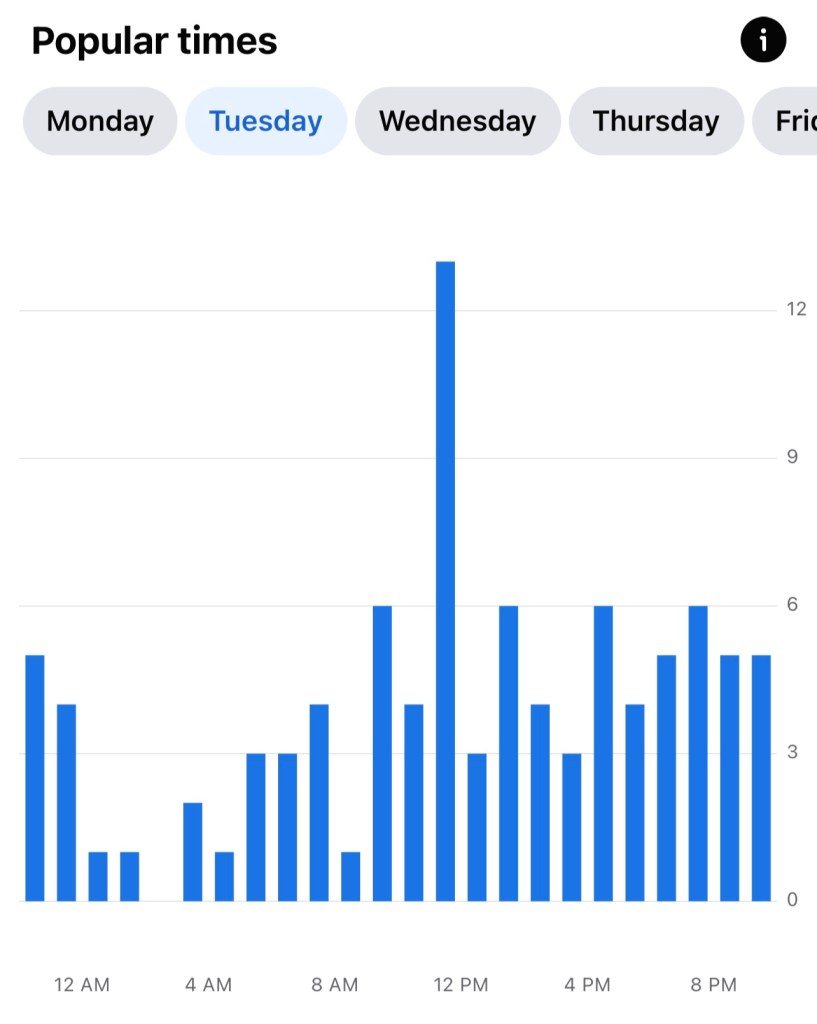
Finally, for the biggest splash, make sure whatever you do is posted by noon, because they’re probably looking at Facebook around noon, and then again in the evening.
Statistics from the Court Reporter Rates Discussion group show the most popular/active times.Statistics from the Court Reporter Rates Discussion group show the most popular/active times.Statistics from the Court Reporter Rates Discussion group show the most popular/active times.Statistics from the Court Reporter Rates Discussion group show the most popular/active times.Statistics from the Court Reporter Rates Discussion group show the most popular/active times.Statistics from the Court Reporter Rates Discussion group show the most popular/active times.Statistics from the Court Reporter Rates Discussion group show the most popular/active times.
We’re in an attention economy. If we’re going to get each other’s attention, then this might be somewhat important for associations, vendors, content creators, and the like. Hopefully it’s helpful. And if not, feel free to comment below about what would be helpful.
PS. Totally goofed this morning and accidentally published today’s article as an article from August 10. So blog posts can officially time travel. Sorry about that!
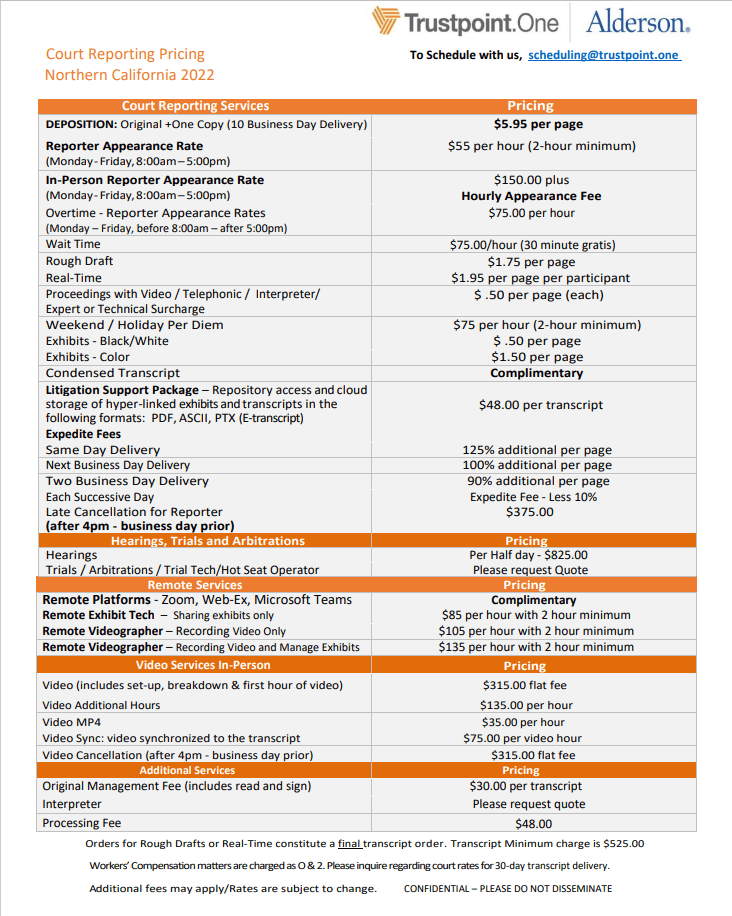
A Stenonymous source comes through for the stenographic legion again. Sorry for the double post tonight, but I know this is bound to get some New York reporters flying west.
I bet there are thousands of stenographers that could beat those rates. We have some people here working for like $3.00 – $4.00 a page on an O+2. $4.50 is considered a good rate. The loss of that copy in NY kills the income just enough to put the squeeze on people.
Hey, attorneys, up to a 30% discount on contracting directly with your court reporters. 50% if you meet an idiot kid like I was. Probably a nice break on the copies too.
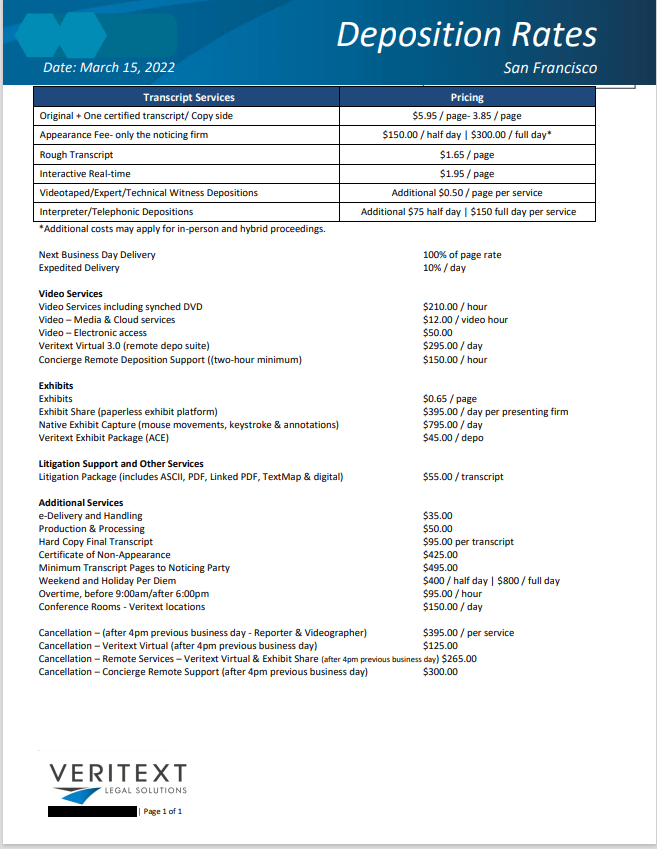
Anyway, this is a win for market transparency, competition, and free speech. Anybody from CA in the audience, feel free to weigh in and give me the perspective of an actual reporter on the ground.
Trustpoint One CA Court Reporting Page RatesVeritext CA Court Reporting Page RatesEsquire CA Court Reporting Page Rates
PUBLIC NOTICE: Posts will no longer auto-post to Twitter. Apparently the Twitter API has shut its access.
The interpretation of statistics is something that fuels plenty of jobs and debates. From serious matters such as crime and the criminal justice system to industry niches such as futures trading, people are always seeking new ways to collect and describe data. The court reporting and stenotype services industry is no different. There are numerous market research reports on our $3 billion industry, along with the publishing of data from sources such as industry associations and the Bureau of Labor Statistics (BLS).
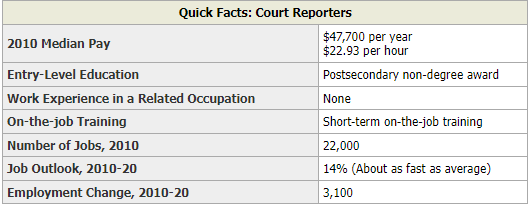
Due to the nature of our field, with over 70% of it being “freelance” according to the Ducker Report, these statistics vary a lot. Take, for example, the BLS’s current count of 21,300 court reporter jobs in 2020, with 500 jobs expected to be added 2020 to 2030.
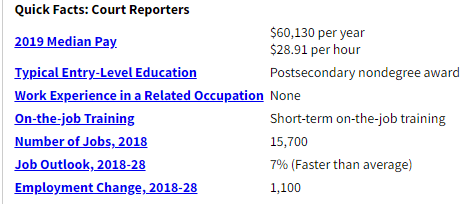
Bureau of Labor Statistics stenographer statistics as of July 1, 2022.
Now compare that to about a year prior.
Bureau of Labor Statistics stenographer statistics as of June 21, 2021.
Does anyone think we had 15,700 jobs in 2021 and that number grew by about 6,000 in 2022? No. We must understand and accept that there’s some inaccuracy or margin of error here, the BLS can’t be 100% correct.
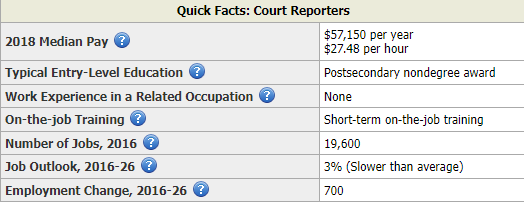
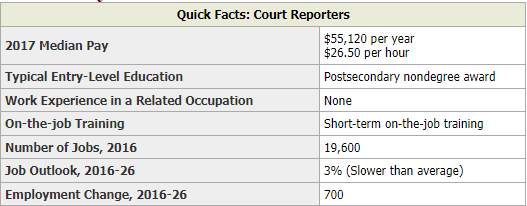
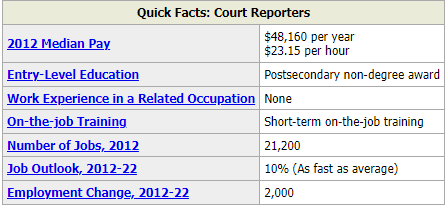
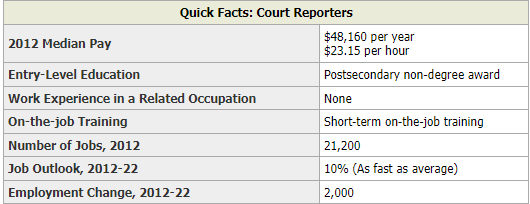
For the sake of completeness, let’s go back about a decade using the wayback machine, which shows past images of websites, and see what kind of changes the entry for court reporters had.
Bureau of Labor Statistics stenographer statistics as of June 20, 2020.
Bureau of Labor Statistics stenographer statistics as of July 3, 2019
Bureau of Labor Statistics stenographer statistics as of October 14, 2018.
Bureau of Labor Statistics stenographer statistics as of July 6, 2017.
Bureau of Labor Statistics stenographer statistics as of June 28, 2016.
Bureau of Labor Statistics stenographer statistics as of July 21, 2015.
Bureau of Labor Statistics stenographer statistics as of July 4, 2014.
Bureau of Labor Statistics stenographer statistics as of July 8, 2013.
Bureau of Labor Statistics stenographer statistics as of June 15, 2012.
The BLS does seem to acknowledge the retirement wave we are expecting in the job outlook portion of its statistics, and mentions a potential 21,000 openings due to retirement.
Job outlook of court reporters from the BLS as of July 6, 2022.
Interestingly, 21,000 is 70% of 30,000. Ducker said 70% of reporters would retire over the next 20 years (2013 to 2033), and predicted a 2018 supply of reporters of 27,700, which is close enough to 30,000 for this comparison. The only issue I have with the numbers here is that they condense the time frame. Ducker predicted 70% of reporters retiring over 20 years, or an average of somewhere around 1,050 a year. This seems to assume all the retirements will take place over the next decade, when the reality is the forecasted retirements were spread over double that period of time.
The Court Reporting Industry Outlook 2013-2014 predicted that about 70 percent of court reporters would retire 2013 to 2033.
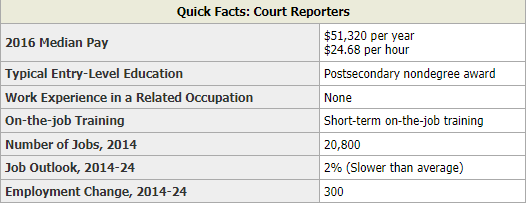
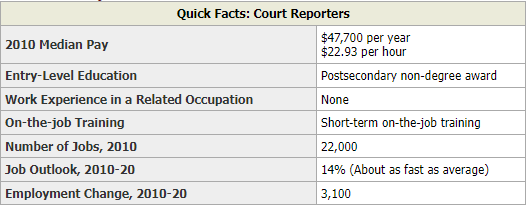
Otherwise, looking at the Bureau of Labor statistics numbers in isolation, they don’t really make sense to me. In 2012 there were 22,000 court reporter jobs and a gain of 3,100 jobs over 10 years (2010-2020). By June 28, 2016, only four years later, it was reported there were 20,800 jobs with a gain of 300 jobs over ten years (2014-2024). Going by the BLS, jobs reported 2012 to 2022, we lost over 28% of the jobs in this field. Our growth rate is far down from what it was in 2012 pre-shortage forecast. The BLS stats are really bleak.
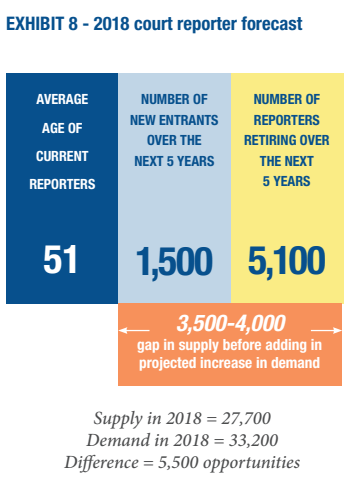
But we cannot look at the BLS statistics in isolation. We must take other available industry statistics. Again, the Ducker Report, commissioned by the National Court Reporters Association in 2013, forecasted a 2018 supply of stenographers of 27,700 and a supply gap of about 4,000 court reporters.
Ducker Worldwide forecasts 2018 supply and demand for stenographers.
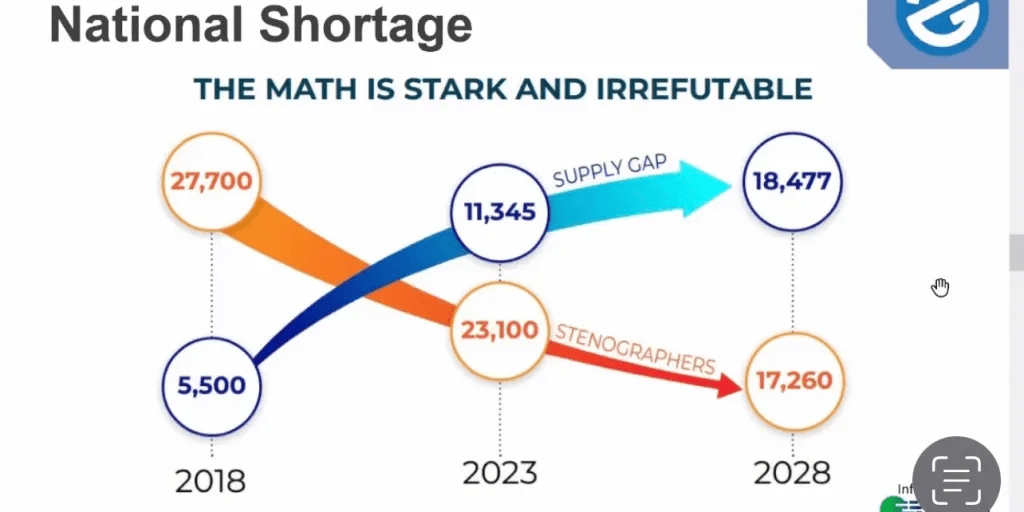
The Speech-to-Text Institute pretty much copied those numbers to make the case for why digital court reporting is required. They say we can’t fill the stenographer demand. That doesn’t appear to be mathematically true.
Illustration of stenographer supply and demand by Speech-to-Text Institute. Notably, the supply gap was not as bad as forecasted.
Reconciling the two sets of data is a nightmare. Are there around 27,000 court reporter jobs or 15,000? Are we adding 1,400 jobs over the next ten years or will there be over 22,000 jobs? Are we in demand or is our median pay falling? Some of this is explained by looking at retirements versus growth. But these things really matter, because ultimately, over-recruiting is going to lead to lower incomes and bad outcomes. There’s already one person out there whose experience with court reporting was so bad, they dedicated a Twitter to it. My goal is to avoid that kind of suffering for people. So I’m opening up an uncomfortable conversation. What if we reach a point where we are recruiting to fill a supply gap that’s on its way to being filled? Unless we start creating more opportunities by branching out and building demand for our services, some of our graduates may end up with nowhere to go. That’s a future that those of us deep into mentorship do not want for the people we guide. We need to start coming up with things that drive up demand if we want the number of stenographers to begin consistently increasing.
If we can’t get a handle on how many of us there are, we’re going to get mowed over every time someone comes out with a new agenda or misleading statistic. We are in a weird place politically because just about every player benefits by pushing the shortage. STTI, U.S. Legal, Veritext, and the digital court reporting brigade get to sell digital by stating the shortage is impossible™️ to solve. NCRA gets the increased volunteering and stenographic fervor that comes with everyone fighting against the digital menace™️ and against the untimely death of stenography™️. Schools get increased enrollment from our stenomania™️-style recruitment. Perhaps this is a pessimist’s point of view, but I’m left with the sense that even if I could show with 100% certainty that the shortage wasn’t as bad as forecasted, it wouldn’t really matter, because all of the major players would ignore it.
I write because I believe that prosperity flows from truth. When we see situations as they are and not as we want them to be, our combined commitment to excellence seizes the day. Our “gold standard” situation doesn’t arise merely from telling ourselves we’re the best, but from our human ability to be problem-solving machines. In order to be effective problem solvers, we must state the problem accurately. I am now of the belief that our falling median pay is a greater threat to our wonderful profession than the shortage, thanks largely to the initiatives that were created to confront the shortage, such as NCRA A to Z, Project Steno, and Open Steno, as well as hundreds of volunteers. I further believe there are steps that can be taken to address the issue, such as the collection and distribution of aggregated rate data, which the FTC says is legal, or an increase in the overall entrepreneurship, sales, and marketing of court reporters through education. Tools to help new reporters understand the business. These things would keep court reporters informed and marketable, help slow the rate at which newer people without ties to the existing market are taken advantage of, and surprise, attack the heart of the issue, pay disparity is killing our field.
If we do nothing, our association numbers will likely tumble as people fail to find the money for their annual membership during a time of soaring inflation and falling wages. Realtime is not a sustainable answer for the majority. There are fewer than 3,000 CRRs and CRCs combined. If we allow ourselves to be boxed into a world where only realtime is treated as valuable, we lose a significant percentage of the market share and field. Those kinds of losses are the true threat to our sustainability, considering they would come atop the loss in jobs and growth reported by the BLS.
This is not a doom-and-gloom scenario though. Recognizing the challenges ahead will allow us to meet them. For my part in it, I have recently started a reporting firm and hired an operations manager to help bring in business. If I am able to bootstrap this operation successfully, I’ll be doing my part to raise those median wages while also saving consumers money. Even in the worst case scenario, I’ll learn lessons I can pass to the next entrepreneur, and this timeless profession will endure.
I’m opening up a 6-question survey to the public, as well as court reporting providers, for court reporting rates.
Associations are allowed to collect and distribute aggregate rate data. I’ve provided information on how newbie court reporters are taken advantage of, sometimes working decades behind inflation, due to the dearth of data about the court reporting & stenotype services industry. It is very clear to me that we must move beyond the fallacy of being unable to discuss rates that has been drilled into court reporters’ collective conscience. We must replace it with a more nuanced truth: Discussions and historical data are fair game. It is collusion and the appearance of collusion among competitors that is problematic for those of us that are true independent contractors and associations. Failing to approach this with some nuance allows our silence to be weaponized against our new people, who are told their skills are worth much less than they actually are. They try to make it work and end up leaving because they’re working too hard for too little money.
Associations also risk falling behind if they do not have this data. A lot of players are scraping up court reporter data today, including Capvision, LEK Consulting, Dialectica, and Guidepoint. I cannot yet say conclusively say how the data is being used, but I can absolutely say that it is not in the hands of court reporters, and therefore we are once again playing “catch up.”
This survey focuses on California, Illinois, New York, and Texas. As of the Ducker Report, those states had the highest court reporting demand (page 13). If you’d like to take part in the survey, please do so. You may also submit your e-mail for a chance to win a $25 Amazon gift card.
I am hopeful that the data collected will be a useful start to understanding the current state of the market. If nothing else, it should provide a base for discussion. Results should be announced sometime in Q3 2022.
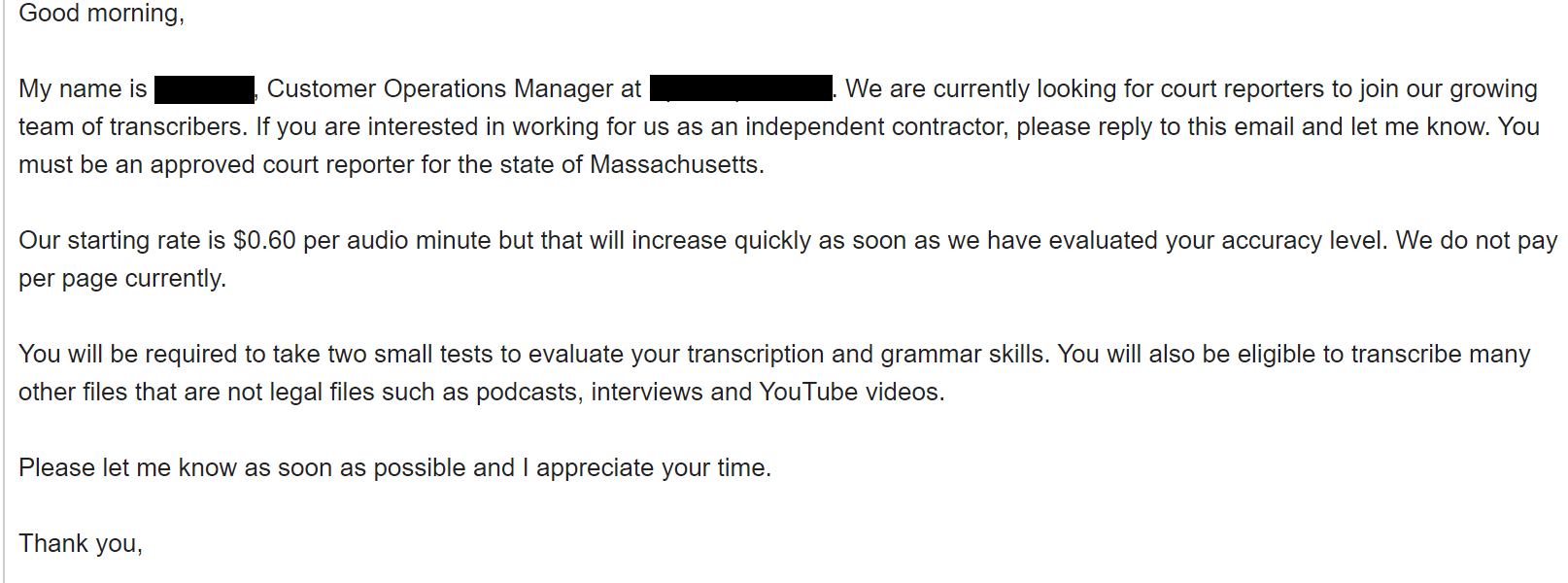
A member of our court reporting community was sent an e-mail soliciting work at $0.60 per audio minute. For contrast, I have heard of reporters working for $100 an audio hour or more, or the equivalent of $1.67 per audio minute, and that was over 10 years ago. It would be about $2.25 per audio minute today, or about $135 per hour, adjusted for inflation.
Independent contractors offered $0.60 per audio minute, less than half the going rate.
Many of us would take issue with that kind of an offer, but this stenographer took the opportunity to educate.
Response to independent contractors being offered $0.60 per audio minute, less than half the going rate.
The company rep apologized and explained that she was not aware. But the stenographer in question kept educating and advocating. I will note that, based on my knowledge of the industry, I believe there’s a typo here, $35 per minute should likely be $35 per page. For anyone not in the field, typically 40 to 60 pages an hour can be expected, meaning 0.66 to 1 page per minute.
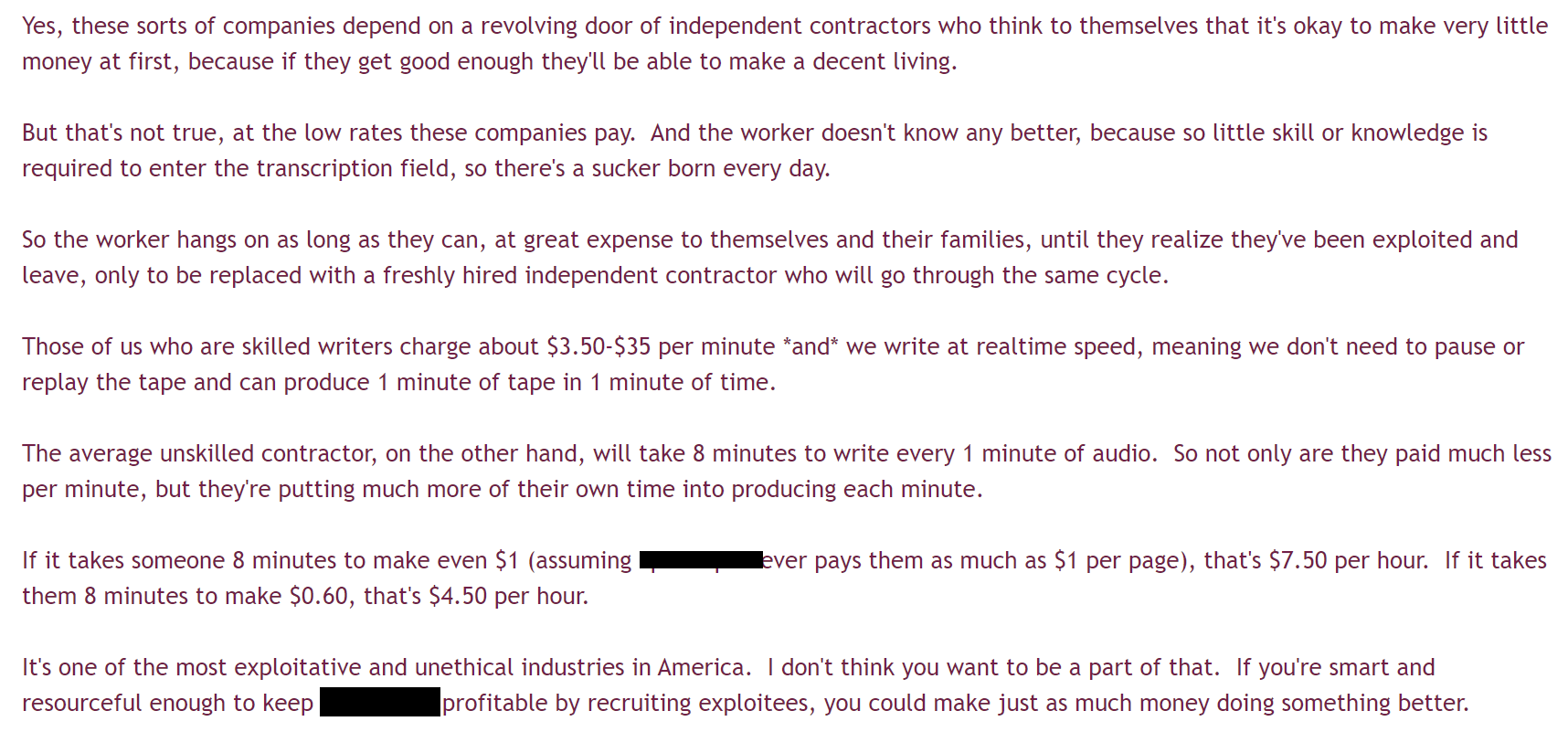
Stenographer explains the exploitation of the transcription industry in America.
The corporate rep replied honestly. She had no idea about the earning potential of court reporters.
Response to the earning potential of stenographic court reporters.
Our brave friend continued to educate on the state of the industry.
Stenographer writing about the exploitation of private equity firms in transcription and stenographic court reporting.
To which our company rep closed with:
Company representative on the efficacy of AI in legal transcription.
There are a number of takeaways here. Taking everything at face value, we’re now opened to the possibility that at least some of these company reps are not adequately trained or briefed on the earning potential of court reporters. But it is interesting to note that a company representative is completely aware that AI is not adequate for transcription. It points to a world where we can be drivers of change by simply describing the truth.
It is very unfortunate that companies are diving into the space without an adequate plan to reimburse independently contracted transcribers. But if we can all respond with the above tact and facts when dealing with company reps and transcribers, we can create a shield of information where no one is unknowingly taken advantage of. Not only is speaking up the right thing to do; it will have the desirable effect of increasing job security for stenographic court reporters.
A big thank you for sharing these messages with all of us on Stenonymous.
Addendum:
A reader shared that if one is on the Massachusetts ACT list, they’re paid $3 per page, meaning $0.60 per minute would be a serious reduction in that rate. Even at a highly skilled level, one audio hour can equal one or two transcription hours, meaning that $0.60 a minute is the equivalent of $0.20 a minute or $12 an hour. Unskilled transcribers can take much longer, particularly if the audio quality is bad, meaning their true hourly rate is even lower.