Virtual Sip & Paint April 2024 for Certification Month

As posted by Chris DeGrazio.

These promotional materials have been provided:

Celebrate Certifications with a virtual Sip & Paint, April 28, 2024.
Virtual Sip & Paint 2024 required items.

“Join us for a virtual Sip & Paint to kick off Certifications Month!
Sunday, April 28th @ 3 p.m. EDT.

Below is a link for the customized Paint by Number canvas. Margary Rogers (co-host of this event) can create some Canva images with all the Certs on them and attendees can download the images that will be emailed to everyone who registers and y’all can choose one and upload it to this Amazon link and pay the $15 to have it mailed to you. Or you can create your own Cert image and take the same steps with Amazon.

We’re also including a link for a paint kit. There are a ton online, but this looks like the best bargain.

Also including the registration link for this event. This is our third time co-hosting this event & we hope to see you there!

You don’t have to sip, paint, or even be in our profession to attend. All are welcome. You can come, sip water, draw, crochet, anything. All are welcome!”

This Amazon link was provided.

This is a second provided Amazon link.

Zoom registration here.

I’d like to thank Chris DeGrazio for sharing this information with me. It’s one of my goals to become a post board for people’s events. One day, I hope to have so many events listed that we’re putting out a monthly calendar.

P.S.

The recent controversy regarding a Stenonymous like on a disturbing post: I hit the like button accidentally from my phone because of the way email is presented on the phone. I was unable to correct this from the phone. I was able to correct it on PC the following morning. I do not control the website that published what was published.

NYSCRA Offering RPR WKT Test Prep September 2021

The National Court Reporters Association opened registration for written knowledge tests on September 1, 2021. In an effort to help reporters succeed, the New York State Court Reporters Association is holding several review sessions, each corresponding to a different part of the RPR WKT. On September 12, a technology and innovation review will be held. On September 19, an industry practices review will be held. On September 26, a professionalism and ethics review will be held. Registration links below!

  1. September 12 – Technology and Innovation.
  2. September 19 – Industry Practices
  3. September 26 – Professionalism and Ethics

Alternatively, a registration link has been provided for all three.

I am going to be working on a much larger article about certification and my journey from believing certification was worthless to believing that it is necessary. But this can’t wait. In brief, certification is necessary because it forces us to engage with each other in the form of classes and CEUs. That engagement creates a community. That community helps us keep each other informed and avoid being taken advantage of. If you have any doubts about whether you should sign up for your WKT, just remember that the more you know, the more you can share with your fellow reporter, and the better all of us become. I have a feeling that NYSCRA’s illustrious current President, Joshua Edwards, and its indefatigable incoming President, Dominick Tursi, would agree with me on that one.

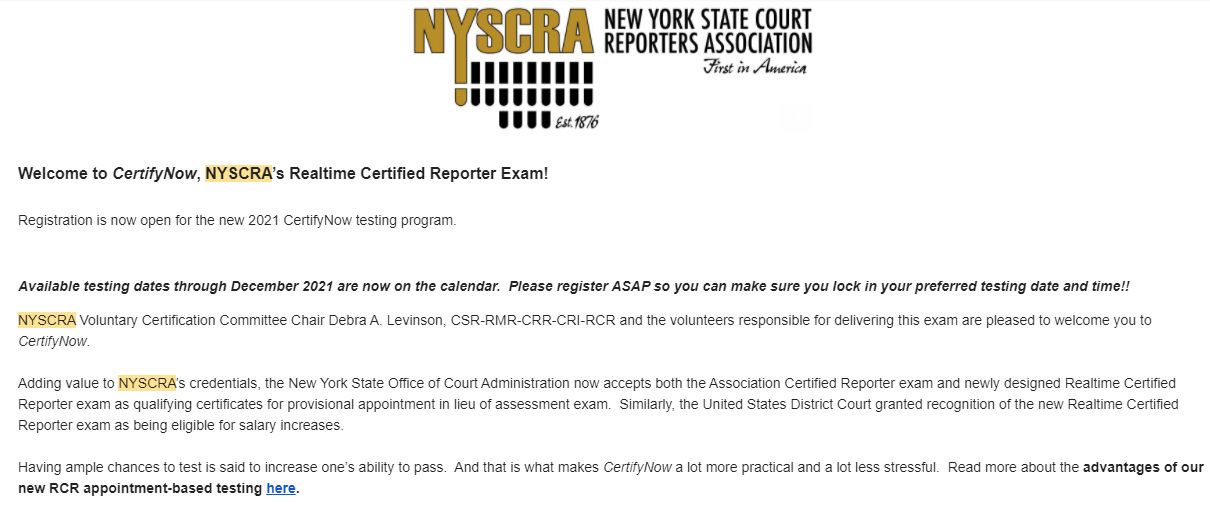
You can also sign up for NYSCRA’s voluntary RCR test pioneered by the founder of DALCO reporting, Debra Levinson, CSR-RMR-CRR-CRI-RCR. Read more below and register here!

Medical Terms Refresher For Test Takers

Occasionally in the testing world, we as court reporters are called upon to take multiple-choice examinations to demonstrate a basic understanding of the words and terms we might hear on the job. There have been a great many debates about whether this is necessary, but for the time being, studying some of these terms and being ready for them can enhance your chance at success and make you a more knowledgeable person. Important note: The next court reporter test for the NY courts is coming up June 29, and it often has a section devoted to medical terminology.

I picked up a quick reference guide, which at the time of writing is $0.99. I have reviewed the guide. It is short. It is a good material to have for anyone seeking to take a test that might have medical terminology on it. Also, as a stopgap measure, if you’re looking for RPR help, I have heard amazing things about Monette Benoit’s Purple Books, but we haven’t gotten a chance to review those on Stenonymous yet. Lastly there’s the Nathaniel Weiss Medical Terms Guide. Pricier than the 99-cent guide but surely more content.

Edit. After posting, Eric Allen found and linked this resource on social media. It is a great resource.

For those that cannot afford the reference guide, a brief reminder on the most common concepts that have come up in testing memory is below in bold. Go ahead and make fun of it, but I know there are test takers that will walk in there, sit down, get to the medical portion, and go completely blank. It’s time to make a stand and help those people get the job or cert of their dreams. Whether or not you buy the reference guide or take a class, make sure you familiarize yourself with the stuff that sounds most alike, because that is the stuff that will jam you up.

Anterior – front or closest in time. (Up the ante — placing a bet before getting cards.)

Posterior – back or further in time. (May help to think after. Postmortem, postscript, after death, after writing.)
Notably dorsal, dorsi, also usually related to the backside or upper side.

Arterio, that’s all about your arteries. angio or angi is all about blood vessels.

Brachio, that’s all about your arms. You don’t want to breaky-yo arm.  Not to be confused with the bronchi in your lungs.

Cephal is head, encephal (in head, en head) or cranio is brain.

Ostomy is an opening. Otomy is an incision.

scope or scopy is an examination. Think microscope to stethoscope, doctor examining you.

aden or adeno has to do with glands. ren, renal, or reno has to do with your kidneys.

gastro is stomach, stoma is mouth.

thromb is talking about a blood clot.

osis is talking about a condition.

sten has to do with narrowing. A stenosis is a narrowing passage or condition in your body.

hist is talking about tissue, hyster is talking about the uterus.

cutane is talking about skin. Subcutaneous, under the skin.

rhino has to do with the nose. Just think of a rhino’s horn nose thing.

myo and muscul has to do with muscles. Myel has to do with spine or bone marrow. myringo has to do with ears, my ringing ears.

phalang has to do with fingers and toes, and pharynx has to do with your throat.

And just in case there’s a little trivia on there, plant cells have cell walls and chloroplasts. Animal cells don’t have those.