National Court Reporters Association to Exclude Non-Members From NCRA Social Media Groups

Court reporting has a huge Facebook presence. The National Court Reporters Association is acutely aware of this and has lots of different Facebook groups catering to the different types of reporters.

(Sorry to all the CART writers that don’t like being lumped into the reporter umbrella.)

Some of the NCRA social media groups are pictured

There’s no secret that the National Court Reporters Association has, overall, been bleeding members, with more expected losses forecasted to about 2030 thanks to the retirement cliff and the expansion of digital reporting by the larger corporations. This is in addition to people burned by the organization in one way or another who leave voluntarily, like yours truly.

So imagine my surprise when it was announced they’d be culling non-members from their groups.

An announcement by NCRA in the CART group
An announcement by NCRA in the scopists and proofreaders group

This selective inclusivity is precisely what’s killing the organization. If you want people to be excited about membership, excited about the organization, excited about joining and making a difference, you engage with them. You can’t engage with people you exclude. Why in the world would we exclude non-members from these spaces if there’s nothing nefarious going on?

Who knows? Maybe there is something nefarious going on. The NCRA does have that antitrust suit filed against it after all.

For better or worse, I’ve always allowed open engagement in my Stenonymous group and on this website. I take the time to answer and like almost every comment. You can trust my brand to be open and honest. Why can’t you trust your national association to be the same?

To be honest, if you ever wanted a place to spend the $300 wasted on membership dues, Stenonymous would be a good bet. I engage with news reporters to spread information about the field. I report accurately, openly, and faithfully on industry news, concepts, ideas. It wouldn’t really be all that hard to get some lobbying going if I had significant buy-in from the community. And then what does NCRA provide besides the certifications? And it probably wouldn’t be all that hard to get a certification program going under a slimmer organization with bylaws that don’t violate the antitrust laws. After all, I have good relations with people that have instituted the New York State Court Reporters Association certification program. Yes, I would have to give up the blogging and the wild man approach to politics, but I’d make it work.

You ever want a new association dedicated to stenographers, I’m your guy. But I can’t do it for free. I would need enough reserve cash to safely leave my job and do what really quite honestly needs to be done in this field — NCRA needs stiff competition. (Stenograph too!)

To all the NCRA members reading, don’t let your leaders lead you off a cliff. Don’t watch them burn your dues with their poor decisions. Demand inclusivity or get out of the club before it crumbles. Imagine the possibilities. Take control of your destiny.

Sometimes the path of least resistance isn’t the smartest choice. Sometimes the way forward is through.

NCRA Board: Yes, We Disbanded Strong, But Our Consistent Failure to Communicate Has the Association’s Best Interest At Heart…

(Note: There is heavy cursing in this post as part of a dirtbag left performative media style. Sorry to those this style offends. I will try to be better about openly labeling offensive material.)

I was sent something from the NCRA by a Stenonymous source. I think the best way to do this is to bold my comments and put parentheses around them. Consider it Christopher Day’s annotations to what’s probably a bunch of bullshit.

(Take it from the king of bullshit.)

Good afternoon,

Please see the following statement from the NCRA Board of Directors. Thank you.

(Thanks Kristin.)

Kristin M. Anderson, M.A., RPR, CRI, CSR, FCRR

NCRA President, 2023-2024

NCRA Board expands advocacy efforts

President-Elect Keith Lemons and the NCRA Board of Directors would like to share with you, our members, what we envision for NCRA’s advocacy efforts this coming year. (That took a while.) President-Elect Lemons has decided to create a new broadly focused Government Relations Team (GRT), which will act as a multi-focused fast response team that will focus on a wide variety of issues of critical importance to the membership. This is not being done to detract from the years of work and current focus of STRONG on AI. Rather, it recognizes the breadth of issues confronting NCRA’s members and the current needs of NCRA’s Government Relations staff, which are much broader. (This sounds nice, but also gives no information as to what the actual plan is, which is a good indicator that there is no actual plan.) We also would like to explain how NCRA’s governance process works and how this new initiative fully complies with NCRA’s Constitution and Bylaws in order to counter the unfortunate rumors and disinformation that have been spread.

Before we get into the details, the NCRA Board wants you, our members, to know that we take our advocacy efforts very seriously. (That’s why we let the Speech-to-Text Institute, a fraudulent organization with no net assets, wreck our collective shit until Christopher Day stepped in to dismantle them with the help of a handful of supporters.) We also take the process of governance of the Association, legal liabilities, and the best practices for managing the business of the Association equally seriously. NCRA can and will proceed with our established procedures and best practices in how we operate and communicate with our members. (Which is to say, we will not communicate unless and until we are being openly attacked by a significant portion of the membership.) NCRA does not conduct official business on social media platforms (hence the term social, not business) (News for you all, your very existence is dependent on the social good will of court reporters. Fucking morons.) or allow back-and-forth discussions that include personal attacks, slander, defamation, or criticism of specific companies or their products that could cause legal liability for NCRA. We need to be above that and also cannot allow NCRA to be exposed to potential liability for such improper communications. (Because, as we all know, in the free country that is America, criticizing people opens up legal liability. We’re not stupid. Go fuck yourselves.)

We are a professional association that has been around for 125 years because NCRA works in a deliberate and effective manner. (So effective, it’s been bleeding membership for the last 10 years.) While it may not be popular in a “I want it now” way and in the combative and destructive mentality (And there we go, taking shots at anybody that criticizes the machine, like you fucking love to do.) that seems to permeate our societal discussions today, NCRA will take its time to try to get our decisions correct to make sure they benefit the membership as a whole. It is not a matter of hiding something but trying to get it right. While we may not accomplish it 100 percent of the time, please remember the VOLUNTEER Board and committee members are donating their valuable time to make all our lives better. (You know who’s not a volunteer? The guy you pay hundreds of thousands of dollars to in order to get it right. Sorry, Dave, I know nobody’s got a magic wand. I do acknowledge that.)

It is also important to remember that this year, NCRA has more than 25 committees and more than 150 volunteers working on various critical projects. ALL of these committees are important, and all believe that their specific charges and tasks are vital to the future of the Association. No one committee’s work is more important than others, as that would diminish the vision of the leadership (who have a global understanding of how all the pieces of all the committees fit together) (We know more than you, trust us.) and devalue the efforts of other volunteers doing good work on other committees. All committees are valuable, and more importantly, all the volunteers’ work on every committee is important and deserves equal credit in moving NCRA forward.

Here is a short version of how committees work within the governance of a professional association.

  • Committees are established to handle specific tasks deemed critical for the success of the organization and membership, meaning the committees work FOR the parent organization, not the other way around. (We own you. You don’t like it? Leave.)
  • Most committees are only constituted on a year-to-year basis (in 2023-2024 NCRA had 28 committees). There are only a very few standing committees, meaning they are essential to the ongoing operations and are specifically identified in NCRA’s Constitution and Bylaws (C&B). These standing committees are the Executive Committee, the Council of the Academy of Professional Reporters, the Council on Approved Student Education, the Committee on Professional Ethics, the Constitution and Bylaws Committee, and the Distinguished Service Award Committee. (So we can amend the bylaws and make Strong a permanent committee? Because I bet members would go for that.)
  • Every year the incoming President meets with staff and other industry colleagues to review the charges of the current committees, discuss the successes and opportunities of the committee, and review if committees have met their charges and whether they need to continue as-is, or with amended charges, or evolve into another iteration, or not be continued. Committees are always evolving. Just because there was a committee the year before does not mean it continues ad infinitum. (So staff said Strong has to go? Good to know. Good to know.)
  • The incoming President also solicits input from other Board members, staff members, and other sources to seat the best people who they feel can accomplish the charges and help the committee be successful.
  • At this point, under the C&B, the incoming President then has the sole and exclusive authority to decide what non-standing committees to create for the President’s upcoming term, the charges for those committees, and who will be the members and serve as chairs. Under the C&B, the Board of Directors then is responsible for approving the committees, charges, members, and chairs of the non-standing committees created by the incoming President (as well as for the standing committees). The Board of Directors, however, may not create other committees on its own initiative.
  • This process starts in the spring and is ultimately voted on before the summer conference. In many cases, the charges for the committees being put forth and the selection of the candidates for said committees are not finalized until after the conference due to the sheer number of volunteers needed to fill the committees and the extensive planning for the annual conference.
  • The committees then begin their assigned tasks and report back to the Board on their progress throughout the year.

This is the established and accepted process adopted by most professional associations. (This is a straight up lie by the way. There’s no way on God’s Earth that anyone knows what most professional associations do. There are simply too many. It would be like saying most people wash their hands for 2 minutes after using the bathroom. Oh really? Did you take a fucking survey?)

Now, on to the specifics of the NCRA STRONG committee, which is not continuing in its current form (No shit?). On February 19, 2019, NCRA’s Executive Director suggested to then NCRA President, Sue Terry, that NCRA create a rapid response task force to combat electronic recording in the states. President Terry embraced the idea and on March 5, 2019, they presented the fleshed-out concept along with suggested charges to leadership. The new proposed committee was to be called the Member’s Electronic Recording Rapid Response Committee (MERRRC). It would be comprised of a group of member advocates solely dedicated to combating the dangerous use of electronic recording in the public and private sectors. A wise decision was made to rename the committee, and that is the genesis of STRONG.

The STRONG committee (past and present) has been recreated and approved each year by the Presidents and Boards that followed. It has been blessed with dedicated members for the past five years who have donated their time and expertise to that committee and have created tools that states and individuals can use for advocacy of the stenographic profession. Recently the committee has been focused primarily on artificial intelligence (AI) and has become subject matter experts in AI as it relates to speech-to-text in the court reporting and captioning industry. The committee has put together various content-heavy presentations and, with the help of an NCRA-hired consultant, assembled an excellent white paper on the dangers of AI in legal settings. NCRA has continually and publicly thanked the committee for its work on AI. That appreciation has been continuous and carries on to this day (It also hamstrung us often, but we’ll forgive that, since you thanked us and appreciated us.).

As with every professional endeavor, we must evolve and so will the mission of the committee. Incoming President Keith Lemons’ vision of advocacy is all-inclusive and means that NCRA will focus on all issues affecting our members. The Board recognizes that AI is an important issue, but it is not the ONLY issue that affects our members. To that end, incoming President Lemons wants to utilize the good work that STRONG has developed and go back to the concept of a rapid response team called the Government Relations Team (GRT). This new year-to-year committee will be designed after a very successful quick response task force NCRA had in the past and sunsetted due to budget issues. To some extent, it will be patterned after NCRA’s former Reporting Advocacy and Information Network (RAIN) program, which was a network of experienced reporters and captioners that reviewed legislation and rules pertaining to ALL legislative, regulatory, and judicial matters affecting the profession (And the reason we couldn’t do both things is…).

We will be securing members for the new GRT committee who have decades of experience in advocating for the profession, and we are actively seeking individuals in different states who excel in this legislative and regulatory acumen to review all the issues facing the profession and who will offer their expertise to assist the states and NCRA with formulating responses to protect our members. While AI is one issue, many reporters across the country are facing losing their CSR licensure language (IL, TN to name just two), official salary adjustments that have not kept up with other members of the court family, official page rate issues, contracting and other unethical issues, Fair Labor Standards Act (FLSA) overtime rules, employee vs. independent contractor classification (Which we are conveniently on the wrong side of.), digital recording threats, and many more issues (So many, we’re not even going to attempt to tell you what they are.). The new GRT team will assist the Government Relations staff in reviewing state and Federal legislative and regulatory actions and suggest grassroots efforts to help our members out in the states (Just look away from the fact that we’re deleting our current grassroots efforts to make new grassroots efforts, which is basically sabotage dressed up as assistance. Certainly none of us have been bought off by the big boxes who we can’t dare criticize in any way ever because, you know, convenient legal liability issues.).

NCRA, once again, commends the STRONG committee for their work and hopes that members of that committee will want to be part of this next evolution of our advocacy efforts if they are interested. NCRA strongly believes that we are better when we work together (Too late for that Keith. You burned them. And they’re coming for you.).

It is important to reiterate, however, that NCRA will not engage in social media and will not tolerate personal attacks, abuse or defamation of members, staff, or Board members, or possibly actionable comments about particular companies or their products, on the organization’s platforms (NCRA’s tolerated everything Stenonymous has thrown its way. You’ll continue to tolerate it because you are bought cowards who are sabotaging our profession under a false veneer of “professionalism.”). While constructive discussion is welcomed, anarchy, chaos and exposing NCRA to possible liability are not, and individuals inciting that type of behavior will be removed. Being part of the NCRA social world or listservs is a privilege, and there are rules to that access. NCRA will not allow people to be bullied, shamed, called out, or trashed on our platforms because a small group of dissatisfied people on a single issue do not like the direction or a specific stance (This is a propaganda technique. By calling us a small group, they minimize us and seek to make us voluntarily disband. Again, go fuck yourselves.).

Finally, it is important to remember that what you read on social media or through some hearsay discussion is not the only side of the discussion, or even accurate at times (But we won’t tell you what’s inaccurate because then the people we’re deriding can turn around and sue us for defamation, because, ultimately, we are spineless cowards.). Unfortunately, we live in a society where the loudest voices demand attention, but that is not always the best course of action or, once again, the full story. NCRA will continue to accept suggestions and respectful constructive debate in our formal channels of communication. NCRA has had hundreds of committees over the century we have been in existence. Committees are created, complete their charges, and are sunsetted. In the past five years alone, nearly 13 percent of committees have evolved or been sunsetted (13% is not the flex you think it is, bro.). Please remember that just because you do not see a response from NCRA immediately, it does not mean NCRA is not being transparent or is hiding something. Many times, the organization is simply getting everything together so as not to roll out something that is incomplete or challenging to administer with limited resources and volunteer time (And we are definitely not waiting to see which way the wind is blowing before we make announcements. Definitely.).

We hope that our explanation alleviates some of the miscommunication pertaining to this issue and also provides a better understanding of our advocacy outlook and general plan as we move forward in accomplishing all our strategic plan goals.  

2023-2024 NCRA Board of Directors

I gotta be honest. It didn’t really answer a lot for me. It’s basically more of the same: We’re gonna do what we’re gonna do, and there’s nothing you can do about that.

Don’t be surprised when people push back. You fucking deserve it.

Side note, it’s come to my attention that NCRA was asked to stream the business meeting and stated it was too expensive. Using OBS software combined with Twitch, streaming is actually free, so again, more lies from an organization chronically afraid of change and criticism. Members should propose a bylaws amendment and force them to stream the business meeting. Then they’ll have to take that expense and shove it up their ass. Or they can have their parliamentarian make up a reason why it can’t be done and show everyone who they really are.

But what the fuck is up with forcing us to make a bylaws amendment for every single fucking thing we’d like to see done? And what the fuck is up with some volunteers being more valued than others? Our volunteer board is beyond criticism but we fuck our Strong committee volunteers at will with basically no notice?

You won’t win this by huddling in darkness and whining about how you’re treated on social media. Our “small group of dissatisfied people” is just going to grow and dismantle you in whatever way presents itself as the path of least resistance. In my case? That’s running the biggest alternative publication in the court reporting industry. How long until you tick off someone with some fundraising finesse and I make a new friend who’ll help this platform grow for a piece of the pie?

Till next time.

Stenonymous releases July 2024 readership statistics

Need Short-Form Video Marketing? Check Out Liam Weckerle!

Many in my audience are small business owners. Some own court reporting businesses. Some own side businesses. Everybody needs some kind of marketing.

If a core part of your business is social media marketing, then I recommend shooting Liam Weckerle an email. He’s a young man that I had the privilege of working with on a project in the past, and I can honestly recommend him for his attention to detail and willingness to go as far as it takes to get the job done. Lweck9844@gmail.com!

I took some time to ask Liam a little more about his business creating these short-form videos. I’ll share what he shared with me below!

Liam Weckerle: What is short-form video?
Requirements to work with Liam Weckerle.

In short, he needs a goal, a target audience, and a budget. Here’s an example of his work (for food business).

Example of work by Liam Weckerle

Imagining your service or product being spotlighted? Write Liam today!

Group Marketing Survey 2023

If anybody has a business, nonprofit, or media enterprise to promote in the court reporting, captioning, or stenotype services market, please consider taking the time to fill out about five questions in today’s survey.

The idea is pretty simple. I’m getting better and better at creating or brainstorming ads that drive engagement. With an actual budget for this activity, we could be promoting stenotype services to the general public and lawyers, and we could run ads 24/7 and direct consumers to the businesses that fund the advertising, perhaps via a public list or rating service. We could even perform regional marketing for businesses with a big enough budget. I can also pass my funders tips and tricks on marketing for their own social media pages, particularly as I learn more. I’ll find what works and what flops, and everybody funding the endeavor will benefit from it. If the budget gets really big, perhaps monthly ads could also be taken out in the law publications around the United States.

At this point, I’m still in the research stage of the idea, but my gut instinct to keep this sustainable but inexpensive would be each business paying about $200 a month, With just 8 businesses or sole proprietors in the group, we could run pro-stenographic social media ads year-round, which I guesstimate would generate somewhere in the ballpark of 120,000 engagements. That’s 120,000 chances per year to reach potential customers or audience members. According to at least one market research report, there are at least 3,000 businesses in our field. Just 2% of those businesses paying into it could generate 120,000 engagements a month. That’s steno coming into the feeds of over 1.4 million profiles a year.

I’m willing to change things up a bit, make the front page of Stenonymous.com a tad bit more corporate friendly, and try to attract more eyes to the businesses that sponsor the ads. I tried to raise the alarms on the corporate fraud. It’s not bringing in the funding needed to continue investigating and generating public interest. It’s time to do something different and try to bring more money into your businesses and get more eyes on your hard work. If the funders are serious about this, we could even do away with Stenonymous branding entirely, but I’d need commitments.

I have something of a theory related to our field and human interaction that might shed some light on this idea. I’ve noted that people have an innate need to be heard. How many times have we watched someone speak in court against their lawyer’s advice? Have you ever seen a child or adult with something to say and nobody who’ll listen? They become depressed, frustrated, anxious, angry. We know people need to be heard. What does the market do? It solves needs. Who better to solve the human need to be heard than the captioners, court reporters, and stenographers of the world? Now, stenographers can be very expensive, and there’s no real getting around that because every hour on our machine can mean 1 to 2 hours of transcription. But let’s say we started opening our stenotype service firms up to the public at an hourly rate? Say your page rate is $5.00 and you know you get about 60 pages an hour. You can offer $300/speaking hour stenotype services to the public without losing a dime. The general public could also book reporters on weekends and create additional income.

Economically, I would hope for a few things. 1. The constant barrage of advertisement for the public would educate more people about this field and bring more people into it, ending the shortage decisively. 2. The listing could create a kind of digital marketplace that educates consumers and helps them find the best businesses™️. 3. The barrage of marketing could bring investors onto the field looking to help businesses like yours grow and service more people (more $$$). 4. The funders might be able to network with each other to cover areas hit hardest by shortage, as long as they respect antitrust law, particularly against price fixing. 5. The increase in demand for the gold standard will draw more investors to open schools, which can then use the expected retirees over the next decade to educate the next generation. 6. We could set up a feedback system where businesses could receive or view feedback from consumers, enabling businesses to improve their business and create a more competitive marketplace. 7. The number of funders could grow to the point where we are able to offer group benefits to funders, such as legal referrals, where allowed by law. Many business owners have asked me questions about the law, which I’m happy to talk about but can’t give advice on, because I’m not a lawyer. Imagine a world where you could get that simple legal advice. 8. If the number of funders goes up, there is a very real possibility of locking the price at $200 rather than watching it soar with inflation, meaning fixed-cost advertising in a world with a lot of variables. 9. Diversifying income streams for “court reporting” (bringing in general consumers and getting out of the lawyer niche). 10. Captioners might benefit from more demand if more corporate boards and business owners know CART exists. How can consumers ask for something if they don’t know about it? 11. If wildly successful, scaling up to TV ads, podcasts, or more.

As an aside, we could also pump the market with speaking tips to help make our job easier. Joshua Edwards, creator of StenoMasters, is one of the best regional speakers around. I am quite hopeful that if I presented him with a budget, he’d help us educate the public. So much of the hassle from this job comes from speakers that don’t get what we do. We can make it easy for them.

I am in an interesting position. I’ve spent the last few years learning about this social media advertising stuff through firsthand experience. It would be a dream to use that to bring additional dollars to the market. I’m the man for the job. I’ve already shown my dedication to the futures of working reporters and our students. My site already gets thousands of visitors per month. Show the world we’re open for business, and we’ll be in business a long, long time.

So now it comes down to my audience. If you know businesses, suppliers, nonprofits, independent contractors, or schools that might help fund this initiative, please ask them to fill out the survey linked at the top. Thank you.

Ad data shared by Stenonymous.com in February 2023.

Releasing Stenonymous June 2022 Ad Report

Last year, stenographers funded this blog to the tune of thousands of dollars. I am releasing an ad report that reveals the statistics and nature of the ads launched in the last two years. It is my hope that this will have two impacts. One, I’d like my audience to know how some of the money that flows in is spent, but also see that I was spending money to fight for us well before this blog was pulling in any substantial money. I believe that will increase confidence in the blog. Two, I hope that this will help others that are considering advertising compare costs. I see a world where we all benefit from public data, increased awareness, and increased knowledge.

If you feel this report is valuable, feel free to use the donation box at the bottom of this page to contribute to more Stenonymous activity. During the study period in this report, over half a million people were reached across Facebook and Twitter.

You can download the full report here:

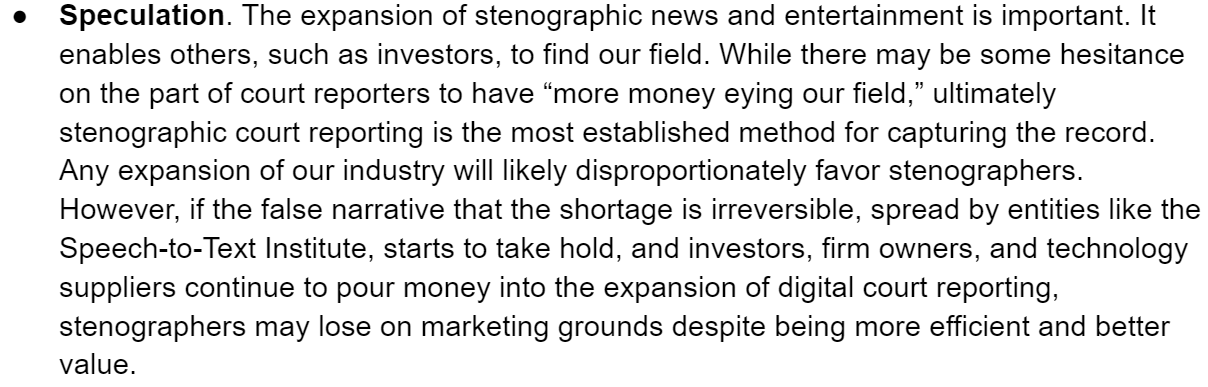
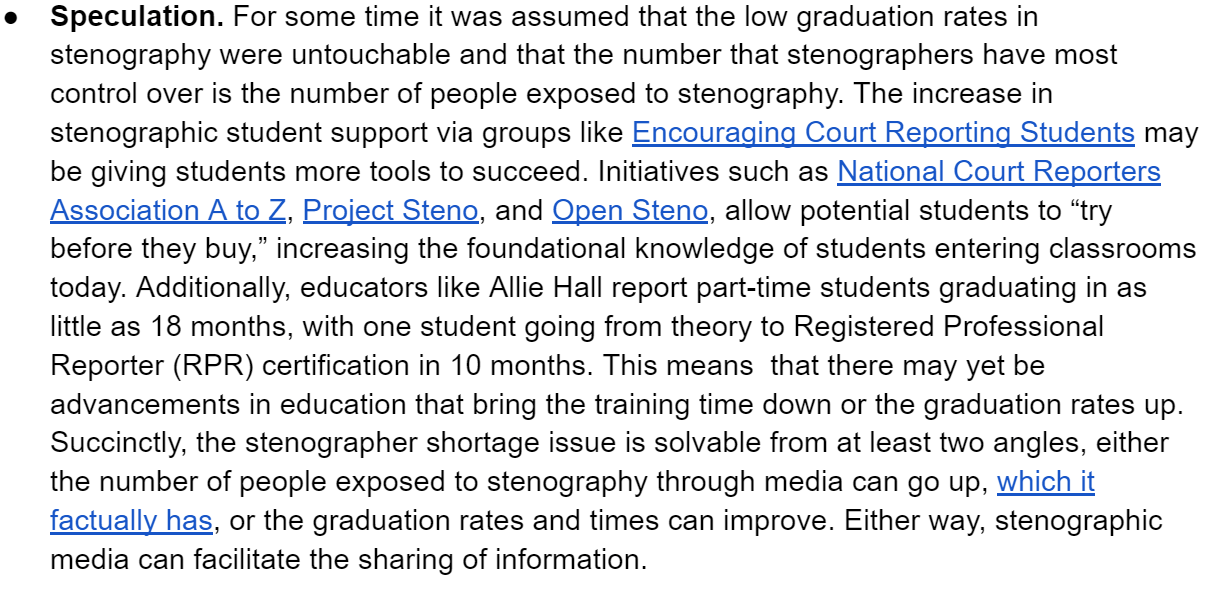
Here are some highlights from the speculations segment of the report:

Here are some highlights from the conclusions segment of the report:

One-Time
Monthly
Yearly

Make a one-time donation

Make a monthly donation

Make a yearly donation

Choose an amount

¤8.00
¤16.00
¤24.00
¤1.00
¤2.00
¤3.00
¤4.00
¤8.00
¤12.00

Or enter a custom amount

¤

Funding the Stenographic Legion.

Funding the Stenographic Legion.

Funding the Stenographic Legion.

DonateDonate monthlyDonate yearly

Tipping Points Are Hard!

After my accusation that Veritext and US Legal appear to be colluding to sell the inferior digital court reporting service to attorneys despite clear evidence that the market preference is stenography, I took an entire day off blogging and looked up exactly how to get this information to the FTC.

Then I did it. I sent them a nice email laying out my thoughts. Because given all the information I have, who wouldn’t? I had filed a weaker attorney general complaint in my state, but the FTC is an agency that needs to know.

Then I gave them my contact info.

This is in addition to the social media pressure I am exerting on the company.

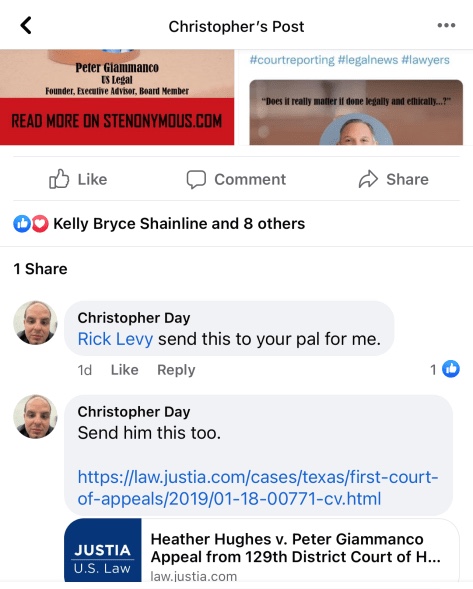
And you know what? There is plenty of pressure to apply there. Not only was L. Freiler accused of slander, this looks like Giammanco’s MO, accuse women who are a threat to him.

And you know what, court reporters? People are on your side. This is what they have to say about Giammanco’s actions.

I make it no secret that I think US Legal is despicable. I tag Rick Levy occasionally to let him know. Partially because it’s hilarious and mostly because I want every court reporter in this country to see with their own eyes that the companies pushing us around all these years are weak. How many months of watching Chris Day do whatever he wants will it take for court reporters to realize that they are each individually just as powerful? Because that’s how many months we’ll be experiencing this together.

I don’t just scream out to the void, I let people know when their employers are hurting society.

My frustration isn’t misplaced. After I explained that digital reporting would hurt minority speakers, USL increased digital court reporting recruitment. I’ve gotten a notification from LinkedIn every day about joining USL as a digital.

But now other companies have realized the lie and are now openly announcing they will do what USL cannot and provide stenographic court reporters. Lexitas has jumped in on the LinkedIn game, and instead of pushing the word digital, they are looking for court reporters in New York City.

I have to point out that US Legal is on real shaky ground. If you’re working with them it’s time to ask for a raise. Tell them you’ll walk if you don’t get it. They’ll give it to you or they’ll be swept away by their own incredible incompetence. Everybody from the production people to the court reporters needs a raise right now. Anything less is disingenuous braying by US Legal and I urge my colleagues not to fall for it.

Mary Ann Payonk, a popular realtime reporter, has a saying. “Tipping points are hard.” The idea was that the field was headed more and more towards AI and digital. We were at a tipping point, and once things started sliding against us, it wouldn’t stop. Only good court reporters might survive. Keep improving or be replaced. A wonderful message insofar as it encourages reporters to be better and do better. But that was before all my research into how bad digital reporting is for the public, consumers, court reporters, investors, and people in general. That was before the Racial Disparities in Automatic Speech Recognition study. That was before Bloomberg broke the news that much of AI was people behind screens. Now we know our value. Now we know that there is a place for every stenographic court reporter. Now we see that by advocating for ourselves, we can change the course of history in the same way that computer programmers did.

Tipping points are pretty hard. And since a small fraction of us just tipped things in our favor and the others are getting motivated to jump in, I can’t wait to see what happens next. It is time to get involved with stenographic nonprofits and associations. Together, we will take what was an industry in decline and create a paragon of success and morality that will ensure the safety and quality of America’s legal records and captions.

My plan for the blog is pretty simple. I am going to continue to use donations that come in in whatever way seems appropriate and keep publishing for our field. If the people that have not donated to me yet donate about $300 to me, I will have about $3 million and I will retire so that I can be a full-time steno advocate and set up funding programs for stenographic nonprofits and associations. I can’t help but float the suggestion. You know who you’re hiring for the job and you’ve seen what I can do with a sensible budget set by the good will of court reporters. I have proven that for the working reporter there is no better friend than Christopher Day.

And as always, thank you to all of you that made this possible. To people that have donated already, I have to ask you to share this with at least one court reporter. You will be helping them overcome the fear so prevalent in our field. There’s no greater honor.

Becki Joins the Stenographic Legion!

At the end of August I posted Becki’s video and wrote about the importance of social media. I also pointed out the preposterous equation that US Legal posted on JD Supra. It was a defining moment for this field. Somebody on the internet who saw us in court was doing a better job at promoting us than the $100 million corporation. That gave me the courage to publish some very heavy content.

In Becki’s video, she talked about jury duty and her observation of the stenographers. In another video recently released, she unboxed what appears to be a student stenotype and revealed she was going to try out NCRA A to Z.

Similar to the way she taught me courage, Becki is teaching us all another important lesson. What if we, as a profession, hadn’t shared her initial TikTok? What if Regina DeMoville had not taken the time to talk to her? What if we all just sat back, said “that’s nice,” and went on to the next thing? People like Hauntie, Regina DeMoville, and Becki’s mom changed the future because they cared enough to try. I don’t know Becki, but she also deserves a lot of praise. In a world full of propaganda, she saw truth and picked up the tripod.

By treating people like people, we come that much closer to solving our stenographer shortage. Similarly, by continuing to support our students and people that try out steno, we’ll drive down the failure rates. Please do the decent thing; take the time to sign up as a mentor or take an interest in what students are doing. A word of encouragement or lack thereof can make or break a career.

Those that refuse to treat stenographers as people? They will be dealing with me.

And I am hardly alone. The businesses that support stenographers are ready to grind the ones that don’t into dust.

How 60 Stenographers Changed Reality

After unprecedented articles exposing the bad behavior of corporations in our field like US Legal and Verbit, with help from Protect Your Record Project, We were able to secure nearly $4,000 in donations from about 60 stenographic court reporters and stenographic reporting firms across the country. That’s an average of about $67 a reporter. All donations, big and small, have contributed to this moment. Advertising campaigns have been launched to facilitate consumer and public awareness via Facebook and Twitter. Many court reporters have shared the posts and/or tagged local state and women’s bar associations. If this is something you want to become a part of, it’s a great time to jump in and like or share the posts on the Stenonymous Facebook page or my Twitter. This publicity is getting people asking the important questions.

I must have been excited. I couldn’t even spell low cost.
Me? Ideas? Never.

Just for a recap, we got US Legal to admit to not using Sourcebook / PRO Link to recruit despite its contention that the stenographer shortage is impossible to solve. How can one make the claim something is impossible to solve in good faith when one has not tried to solve it? It’s consumer fraud at its finest and it’ll grow increasingly harder for them to dance their way out of it as more people know it’s happening.

We also exposed that Verbit, a company that misrepresents itself as being New York based and had posted family court deposition audio to the internet. I have a source that states the audio issue was known about prior to my investigation into it, but it didn’t get taken down until after the publication of my blog post. Stenographers, you did that!

When we speak up, people are forced to react.

It’s also notable that for all their money and “power,” the corporations have given us more valuable information. They are guarding an empty fort. I’m probably one of the easiest people on the internet to find and email, and they haven’t bothered to threaten me with a cease and desist letter. They have not bothered to do much of anything at all. Their strategy is seemingly to ignore the situation and hope that we cannot articulate these issues to the media, the public, and associations of lawyers. Their strategy is seemingly to hope that we are summarily dismissed without thought or question. Their strategy is to hope we declare mission accomplished and stop kicking down the gates of that empty fort.

Well, we have seen firsthand how that will work out for them. How well were things going for us when we sat idle hoping things would be okay? Compare that to what happened when 0.2% of this field stood up and said “no!” No, you cannot take our jobs with your inferior product. No, you cannot scapegoat digital reporters. No, you cannot lie about our shortage. No, you cannot post people’s proceedings on the internet to train your offshore transcribers and get away with it! If 60 of us can do that, what are 27,000 of us capable of? This field could afford to pay an advocate like me for nearly two decades with a one-time payment of $67. Heaven help whoever’s talking impossible shortage if we ever secure that much money.

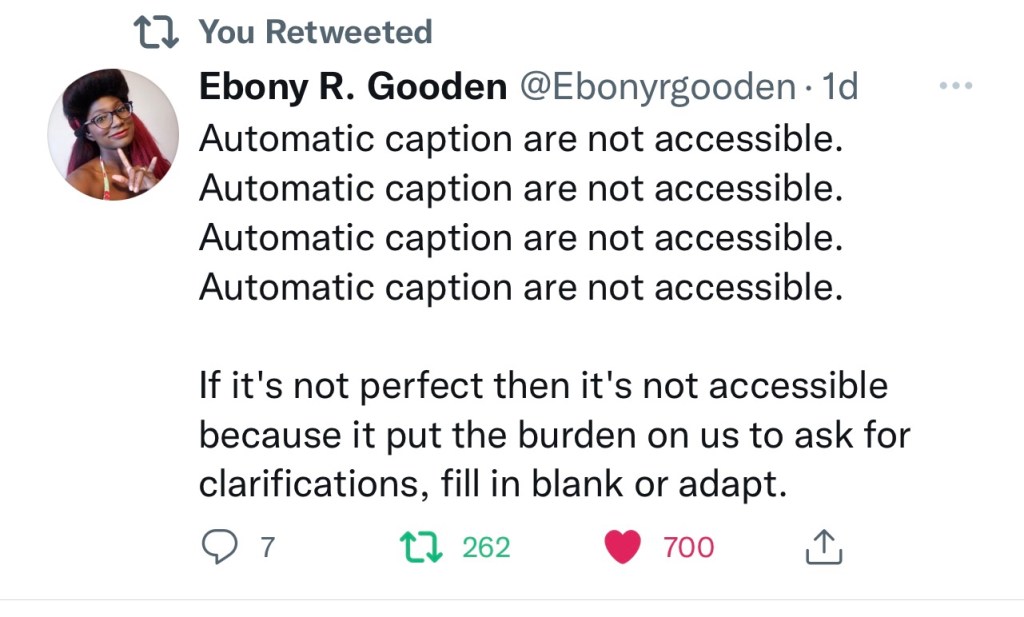
Our strategy? Part one was to show all of you your own power. Part two has two prongs. One, we must continue to apply this social pressure so that the companies stop behaving badly or fold under the incredible weight of their own incompetence. It’s clear they know nothing about the field they insinuate having expertise in. Two, this pressure and publicity will bring people to stenographic court reporting. Young men feel lost? Here’s a direction. Caption advocates don’t like autocraptions? Time to make friends.

Stenographers aren’t perfect either, but ASR has such wacky ranges of accuracy that we outmatch it every time. We can help these people and we need not be shy about letting them know!

The publicity is a big thing. In the next ten years we could easily double or triple the size of this field and start expanding into new markets. Why not? Humans like being listened to. There’s an obvious human need to be heard. Computers can’t do what we do. What is business but profiting off of human need? What is court reporting but our quest to memorialize what others have to say? Even the grimmest view of our field, that only maybe 10% of the population can do what we do, means that there are over 30 million people in the United States that can learn this skill. Look how many thousands of people stenographic reporting has gone in front of already. And this movement has only just started.

Four days did that. People haven’t even had the weekend to see our stuff yet.
Four days of ads done. Now we’ve booked 50 more.

Try to remember prior to this week what our reality was. “Nothing we can do.” “Impossible.” “A dying profession.” “An industry ripe for disruption.” That changed because we willed it to change. If you have ever doubted your own power, I urge you to stop, reassess what’s not working, and push for the things that matter to you. Push to change the things people claim cannot be changed; 60 brave reporters have just shown you they are wrong. History is filled with all sorts of winners and losers, including winners that beat overwhelming odds. If you, reader, allow others to dictate to you what your chances of victory are, you are already halfway to losing, and you have a choice to win.

If you would like to support the campaigns going now, take to Twitter and Facebook and start directing news people, legal professionals, and bar associations to my articles. If you would like to contribute financially to the advertisement campaigns running, please feel free to donate to my PayPal at ChristopherDay227@gmail.com, Venmo at Christopher-Day-141, and Zelle at my email or 917 685 3010. As this continues to grow, I will look into advertising in other media so that our message makes the largest impact possible.

Of course, to our beloved corporations, you too have a choice. You can get in line with the industry standards or cease to exist. You can help recruit stenographers or lose all of your investors and customers to them. Trying to outsmart all of the people all of the time didn’t work out. Do the right thing, suck up your pride, and move forward with us. Let your digital reporters know that stenography is worth looking into. As we have just shown you, we will accept no less. I personally will accept no less because as I admitted to everyone, I am a product of the sad side of the industry that took from me and my colleagues until we had no more to give. I now have no compunction against taking it all back, giving it to our next generation of reporters, teaching them the tricks of the trade, and exposing to them the silence that allowed the abuse of mine. It was a simple calculation for me. I knew we had more people and better funding. I knew we had the more advanced technology. I knew that if the narrative remained “nothing we can do” my job would probably be at risk sometime in the next ten years. All I had to do was let go of the embarrassment and shame associated with saying “my industry has problems and I’m willing to be a part of the solution.”

My early career was defined by people telling me there was something wrong with me because I was not as successful as them. Now that I have success, I move into the rest of my career with a message for every entity in a position of power that thinks it’s going to use it against our young people and our newbies: We are coming for you.

Steno was the best decision I ever made. Now I give back in the hopes that one day nobody will have to suffer the way I did.