In a private group the question was posed. And it ended with “if you want to advocate for this profession, whether as a reporter, a student, or other, please just focus on getting better every day. Everything else is just noise and not helpful in you becoming the solution.”
I am preserving my answer here because I feel it has value.
“I am writing honestly and hope you will take the time to consider what I write.
Economically getting better is not really going to help our situation. It may, for sure, improve individual reporters’ outcomes, and the outcome of individual proceedings/jobs. So I support improvement. But we are facing a very specific situation where the guy who got the shortage forecasted under NCRA went to STTI to push digital using that shortage forecast, and the large corporations behind STTI, including Veritext and Stenograph, put their time and attention into expanding digital offerings, with Stenograph offering realtime digital certificates at one time. Veritext advertised every day for years to get people into digital reporting and BlueLedge through Ed 2 Go got its training on college websites across the country.
So you have a situation where the largest companies in the business took a hard shift toward digital under the excuse of shortage. As they shift digital and continue to buy agencies providing stenographer jobs, the number of jobs that would’ve went to stenographers goes down, and this causes public sector to have trouble finding people, so public sector starts recording and the number of stenographer jobs drops even further, reducing our combined political strength even more.
You can see this in the way they act. Veritext went from firing that lady and saying stenographers were the lifeblood of the company to telling reporters digital reporters are reporters so they’d better get used to it and they have 3,000 digital applications a month. True? Unsure. But think about what they’re signaling.
With our reduced power, companies have more power to set rates. “Take what we offer or we’ll give your job to someone else.”
So you have a situation where you can be as good as you want to be. As they economically outplay us and our numbers go down, we will slowly lose our ability to choose our own destiny so to speak. We will be many people fighting for the shrinking number of jobs not going digital. Today it does not matter to you because you are good at your job and feel secure. By the time your job is on the line, there will probably be too few of us to make a difference.
Perhaps think of the field as a pyramid with the realtime jobs at the top. What happens when the bottom of the pyramid disappears? The top of the pyramid ends up on the floor. And that’s assuming it doesn’t shatter when it hits the floor.
If we do not improve our collective understanding of the wider market and what is happening right now, and what has unfolded over the last 13 years, we risk the next 10 or 20 being a very rough ride for those of us that hopefully still have jobs.
We’re basically asking people to shut their eyes to all this and close the gap between 95% and 100% while they get systematically replaced by people that never did this a day in their lives.”
I’ve already commented, in my own way, that things don’t seem right in California. Here, PYRP makes the astute point that the big box companies likely would’ve opposed the bill if it was not in their best interest, among many other great points.
I’ve called what’s being done to consumers fraud for many reasons, and that’s a word that pops up in this statement too. Ultimately, it’s that kind of bravery and boldness that will seize the day, and is a departure from the positive toxicity that permeates stereotypical corporate cultures, including our own.
All I can really say is that association board members should heed these words and realize that the more advocacy that is shouldered by nonprofits like PYRP or for-profit enterprises like Stenonymous, the more advocacy dollars will flow away from traditional associations. The success or failure of our institutions rides on the motivations and feelings of working reporters. If people feel that associations are not doing enough, or that associations are working against their interest, then wallets will, perhaps rightfully, close, in some cases permanently.
See the full text of PYRP’s statement below.
Protect Your Record Project statement on SB 241Protect Your Record Project statement on SB 241Protect Your Record Project statement on SB 241Protect Your Record Project statement on SB 241Protect Your Record Project statement on SB 241Protect Your Record Project statement on SB 241
I have been in touch with a source that claims to have contacts in government, and based on information available to me, I believe it. There are three issues that myself or my source may have the opportunity to shed some light on and explain to people in positions of power. First, the abysmal state of the New York market’s pay for many deposition stenographers. Second, the fraud concerns, where stenographer shortage is being used as an excuse to sell digital court reporting. Third, the potential for copy protection. There are no guarantees on the table, but I’ve put down a lot of time and money on solving these issues, and my audience has too, so I’ve got to share with the wider Stenonymous audience.
What we have been asked for in order to facilitate a meeting is data, and what we intend to do is show that reporters from other places are pulling in much larger amounts. To this end, a couple of the big box rate sheets to reporters have been acquired, and they show rates that are laughably low when viewed in the light of available historical information. Check them out below.
I already have some data in this regard and intend to share it publicly as soon as possible, but for those of you that would like to assist, please consider sending your rate sheet & info to contact@stenonymous.com and name your state. I anticipate that this round of data collection will not be ending up on Stenonymous.com, so if you help out by sending a rate sheet, rest assured it’s not being shared with the world, but it will be used in averages and advocating for reporters over here.
As for things I’ll share with the world, reporters should keep in mind that both of these companies deviate upward from these rates when they want to. Don’t be discouraged from trying to get more if you take work from either company. It’s about negotiation, and if one can negotiate higher than what one sees here, that’s what one gets. This is how the game is played. This is in stark contrast to how reporting students were told the game was played around 2008. We were told court reporting sells itself, six-figure salary without a BA. This wasn’t a complete lie. I’ll be the first to concede there are a lot of court reporters making a lot of money out there. I’m fighting for the ones that are considering picking up a different field because they don’t make enough. If they leave, our shortage gets worse, digital expansion accelerates, and then digitals will be used as an excuse to keep stenographer rates down, similar to how stenographers were told “if you don’t take it for less, someone else will” all through my early career.
We need to wrap our heads around the fact that corporations and the people representing those corporations will say just about anything to benefit the corporation. An example? When I was a young reporter, I was told by Jaguar Reporting that attorneys see us as a dime a dozen. But when representing at a legal conference with Patricia Bidon and others, attorneys were all about stenographers over alternatives. Perhaps opening up about some of what I’ve seen will expose why I am so passionate. Think of your mentor or mentee. Do you want them to be told they are a dime a dozen? Do you want them to be told they’re less valuable than they are? Do you want to perpetuate that kind of conduct in our field?
A lot of us come from a place of integrity and honesty. A lot of us don’t like to speak out unless we’re “absolutely certain.” But this isn’t how anything happens in reality. As a society we convict people based on what 6 to 12 people believe they heard about an incident. We accept or reject laws based upon the say-so of activists and lobbyists. History goes to who wins and not who is right.
So all I’m saying is we might as well win, and if you send me a rate sheet today, you’ll be helping me do that.
MAGNA NY Rate Sheet Published by Stenonymous.comUS Legal Support NY Rate Sheet Published by Stenonymous.com
Protect Your Record’s Summer 2022 newsletter, The Record Protector, has been released. There’s a lot to read about this issue, including the story of what happened to StoryCloud in Texas with Jo Ann and Dennis Holmgren, a message from PYRP President Kimberly D’Urso, a vocabulary test, an article about Shaunise Day’s Fearless Stenographers conference. Sheri Smargon from the Florida Court Reporters Association wrote about her path through this field, as well as the importance of educating clients on what we do. There is also a California law and legislative update from Kim Kuziora, an update from Allie Hall on the liveliness of steno education, stenotype talk with Victor Nolasco from Personal Touch, and a call for future contributions.
The growth of stenographic media not only helps us communicate important ideas with each other, it helps give recognition to those of us that are going above and beyond to connect, educate, and advocate. I am very impressed by Kimberly D’Urso, Charlotte Mathias, and everyone else that put this together. I sincerely hope all of you will give the newsletter a read!
Quick recap on the issues. Businesses are pushing an automatic speech recognition and digital court reporting solution to the stenographer shortage. All available data says that’s an inadequate solution that will hurt minority speakers. Available data also suggests our shortage has been exaggerated and exacerbated by greedy people. Not one person in the last two months has refuted this in any meaningful way, and I haven’t been shy about letting the world know.
More than that, digital court reporting is likely to be leveraged or at least on borrowed time. Its biggest funders are all private equity owners, and the strategy there is buy, hold, flip. More on private equity next month. For now, know that every court reporter in the country might be more solvent than the big dogs. They’re not interested in holding these companies for 20 or 30 years like some of us and will lose interest as soon as one is a financial loser. If the gamble to exploit digital court reporters fails, our stenography students probably won’t have to deal with this ever again. Digital proponents simply will never again have the funding or support they do today. Digital will only get to fool investors the way they have been fooled once in a lifetime.
The current strategy of digital court reporting proponents is to pretend that I don’t exist. That’s not working very well for them. 1% of this field reads my blog every day and spreads it to the rest.
I have a new strategy. Digital reporters can all come work for me.
The ship’s sinking. Over the next decade this little cottage industry where DR rotates CEOs between digital recording companies and milks court systems and taxpayers on equipment contracts is going to dry up. Some people might even go to jail. Who knows? Who cares? I care about as much as digital proponents cared about me when I was a young court reporter struggling to survive.
In fact, I care as much about digital court reporting’s future as Jane Sackheim of Diamond Reporting in New York cares about court reporters. Here’s a hint, she doesn’t care. On October 24, I urged her to do the right thing. I was met with silence. Though our justice system reveres silence, we all know in our hearts that it is the language of oppression. It is the language of denial and kicking the can down the road.
At least she saw it and ignored it. How many of you have endured suffering unseen?
Now I urge all of you to do the right thing. If you’re on the digital side, come be a guest writer or content creator for me while I build this stenographic media empire. I’ll let you keep 75% of the donations that come in tagged for you. My audience is particularly interested in the seedy side. We want to know the horror stories and the situations you’re thrown into with no training. This audience, my audience, cares about you. As I grow, you grow. Might even pay your way through steno school.
To my allies, I extend the same offer, but your cut can be 99%. I’m growing a movement. Money is a means to an end and not an objective. I’m not kidding. Eat what you kill and benefit from my growing platform.
Easiest way to win is to get the other side not to fight. Offer is open until I beat my holiday blues. Write me at Contact@Stenonymous.com. We’ll get you hooked up as a contributor. You saw my message to Jane. I know that if I fail, many people will be in the terrible place I was in. Consequently, I have decided that I am not failing.
Thank you, donors. To anyone that has not donated:
When people donate to me, they do it with the understanding that I will use the money and power to support the profession in some way. As I grow, so will my support for the small businesses, schools, and the working people of my profession. There’s a ballpark of 30,000 reporters in this field and a median income somewhere above 50,000, a paltry sum of $1.5 billion. If we were to collectively donate about 1% of one year’s income ($500) to a relatively altruistic person, preferably named Christopher Day, that’s $15 million. $15 million placed into an investment, or multiple, with just a 2% return is $300,000 a year. Even if we cut that in half for taxes, that’s enough money to hire a full-time advocate for $100,000 a year and maintain a dedicated advertising/philanthropy budget of $50,000 a year. Even if I fall remarkably short of that goal and all my math is horribly wrong, a million dollars would be enough to advocate full-time for 10 years.
Just for a rough outline of what a full-time stenographic advocate for working people could work on:
-Keeping digital from literally subsuming our industry using their private equity money.
-Ending the shortage. The press alone from an industry making one dude rich so he could go fight for them would attract investors, students, and businesspeople to the field.
-Figure out the insurance problem. Freelancers pay too much for too little.
-Devise group support programs for students and reporters in need. Think about all the students over the years that have had to give up because the financial aid runs dry or all the professionals that have had an equipment failure and needed a loaner. We’re a rich field and can probably solve these things without raking people for hundreds of dollars every year. Let’s start acting like it.
-Devise nonprofit organizations or low-margin for profits to keep the profession’s tech running. Basically divest us from Stenograph. Imagine if a nonprofit could ascertain the bare minimum cost of creating a good stenotype and sell it at cost. We’d solve the captioner shortage real quick and become real champions for accessibility.
-Run for political office. There are laws on the books in many cities, states, and federally meant to deal with many issues in our field and others. The problem we face seems to be that the system is set up to automatically reject singular complaints. There are two ways around that. Either all of you can start writing complaints all the time on every issue, or you can stick a bulldog like me in the fragile political system and see what happens. Writing letters costs an indeterminate amount of time and money. Giving me a platform costs less than $500 but relies on other people to contribute. A government official that works for the people may sound crazy, but I think it would be a big hit. Our shortage would be over pretty quick too thanks to the media attention.
“Dear Mr. Day, we received your complaint but enforcing the law just isn’t that important to the Attorney General of the State of New York.” #NYcares
-Devise a system for intaking and tracking issues in the field. Right now we have an issue, like, say the NCRA testing stuff, it bubbles into outrage, and once the outrage is over the issue is quietly dropped and people go back to business as usual. Transparency and solutions will be the name of the game. Outrage will be a tool used as needed.
-Devise a system for tracking and assisting state and national associations/nonprofits in need. State bill or rule change threatening jobs? Here’s your lobbyist fund. Let’s get serious about that. Veritext and US Legal are. Are you? Let’s give our VOLUNTEER association board members a fighting chance.
-Expand stenotype services into other industries and make them available to the general public. There appears to be a human need to be heard and we are very, very good at hearing people. This also might lead to the USA exporting stenotype services and creating theories in other languages.
This is the future I’m fighting for. Less money coming out of your wallet, more money going into it. And make no mistake that I am ready for a fight. When Naegeli threatened to sue, I stood up for reporters and refused to take down evidence of their gouging. When a corporate rep bullied one of us in an email, I put him on blast. I have two limitations, time and money, and my fellow reporters have the power to erase those limitations.
For years you’ve been told why things can’t be done. You’ve been told things can’t change. Give me a shot and I will change things for the better. That’s my promise. I have given you solid math for why I believe this to be possible. For those of you I’ve already won over, please consider sharing this with your colleagues. As has been said by other reporters, the association model of decentralizing everything and relying on volunteers is nice in theory. It’s not working for us today. It is time to try centralizing our power so that the associations that have advocated for us over the last hundred years survive the next ten and that our quality of life is improved.
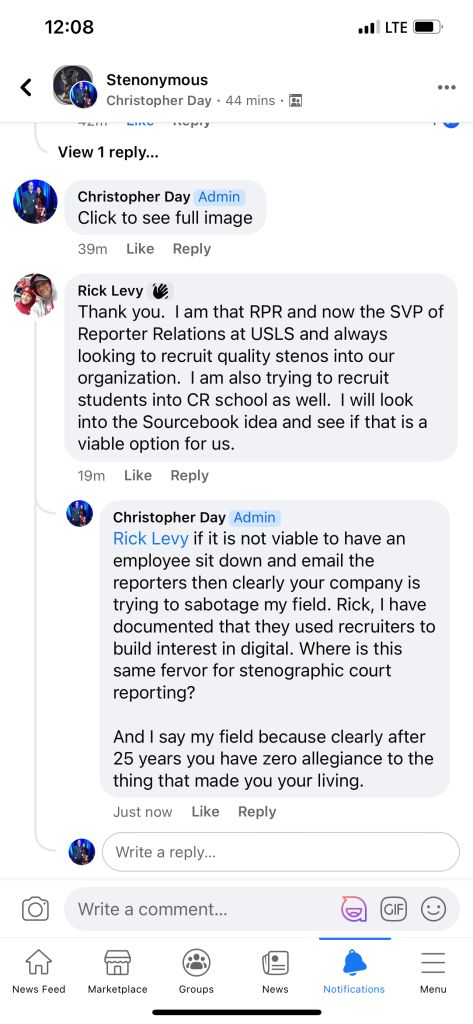
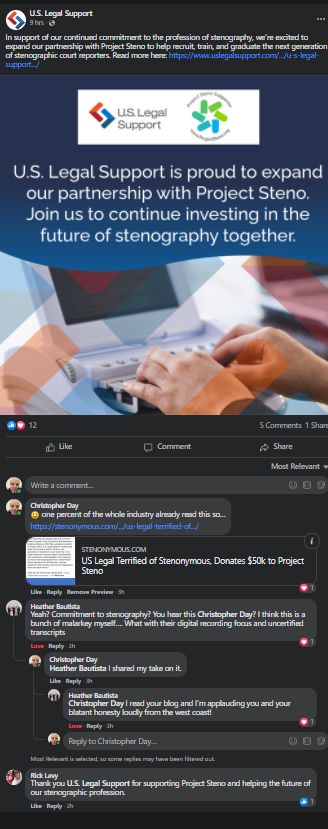
Stenographers across the country should be feeling confident. It’s time to ask for a raise. We were barraged by false claims that the shortage could not be solved. It has been about two months since I first pointed out there was an honesty problem with the company. The company’s response to the social pressure? Run, hide, and hope no law enforcement comes knocking. Prior to my allegations, Rick Levy from US Legal spent a good amount of time trying to convince reporters that the company was on our side.
Image originally posted 9/9/21, Stenonymous.com
What is he doing these days? Pretending that I don’t exist. That’s a perfectly normal thing to do when someone is accusing your outfit of fraud. Right?
It is not my actions alone that are making the difference, but the actions of court reporters across the country. It is all of you educating each other and sharing my posts. It is all of you continuing to supply me with information and monitoring questionable behavior in our industry. It is all of you sending donations so that we can spread word of what’s happening in our field. It is all of you that have filed complaints where appropriate. It is all of you that are bringing my research to attorneys. We are collectively making a difference just like I said we could.
As of today about $6,751 has been spent. Over 260,000 impressions have been made. About $2,800 from donations must still be allocated. Seeing how we are changing the course of a $3 billion industry with less than $10,000, I must ask my colleagues that have not donated to consider doing so. Financial security for me would only free up my time to fight for your financial security and the future of working reporters across the country. In two months you have seen the shortage go from impossible to solve to an expansion of the USL partnership with Project Steno. Trust that every single dollar will make a tremendous impact and that I will not stop until every last one of you has the respect you were robbed of these last two decades.
To my friends in US Legal Supportleadership, you can still start recruiting stenographers and paying them fairly. If you do not, you risk 30,000 court reporters making me a millionaire and a full-time advocate. Abuse thrived in silence and now yours has told us all that we will ever need to know about you.
Then I did it. I sent them a nice email laying out my thoughts. Because given all the information I have, who wouldn’t? I had filed a weaker attorney general complaint in my state, but the FTC is an agency that needs to know.
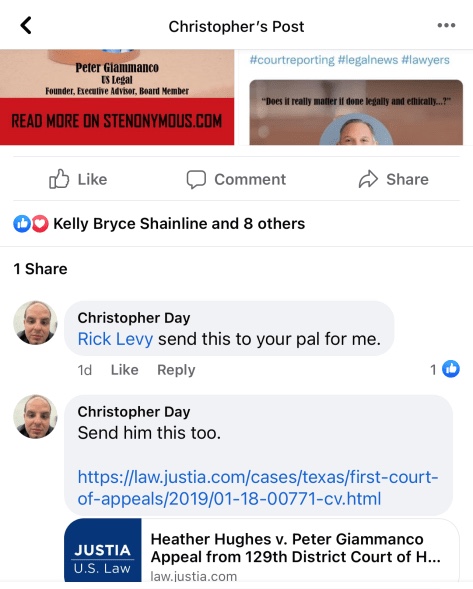
And you know what? There is plenty of pressure to apply there. Not only was L. Freiler accused of slander, this looks like Giammanco’s MO, accuse women who are a threat to him.
And you know what, court reporters? People are on your side. This is what they have to say about Giammanco’s actions.
I make it no secret that I think US Legal is despicable. I tag Rick Levy occasionally to let him know. Partially because it’s hilarious and mostly because I want every court reporter in this country to see with their own eyes that the companies pushing us around all these years are weak. How many months of watching Chris Day do whatever he wants will it take for court reporters to realize that they are each individually just as powerful? Because that’s how many months we’ll be experiencing this together.
I don’t just scream out to the void, I let people know when their employers are hurting society.
My frustration isn’t misplaced. After I explained that digital reporting would hurt minority speakers, USL increased digital court reporting recruitment. I’ve gotten a notification from LinkedIn every day about joining USL as a digital.
But now other companies have realized the lie and are now openly announcing they will do what USL cannot and provide stenographic court reporters. Lexitas has jumped in on the LinkedIn game, and instead of pushing the word digital, they are looking for court reporters in New York City.
I have to point out that US Legal is on real shaky ground. If you’re working with them it’s time to ask for a raise. Tell them you’ll walk if you don’t get it. They’ll give it to you or they’ll be swept away by their own incredible incompetence. Everybody from the production people to the court reporters needs a raise right now. Anything less is disingenuous braying by US Legal and I urge my colleagues not to fall for it.
Mary Ann Payonk, a popular realtime reporter, has a saying. “Tipping points are hard.” The idea was that the field was headed more and more towards AI and digital. We were at a tipping point, and once things started sliding against us, it wouldn’t stop. Only good court reporters might survive. Keep improving or be replaced. A wonderful message insofar as it encourages reporters to be better and do better. But that was before all my research into how bad digital reporting is for the public, consumers, court reporters, investors, and people in general. That was before the Racial Disparities in Automatic Speech Recognition study. That was before Bloomberg broke the news that much of AI was people behind screens. Now we know our value. Now we know that there is a place for every stenographic court reporter. Now we see that by advocating for ourselves, we can change the course of history in the same way that computer programmers did.
Tipping points are pretty hard. And since a small fraction of us just tipped things in our favor and the others are getting motivated to jump in, I can’t wait to see what happens next. It is time to get involved with stenographic nonprofits and associations. Together, we will take what was an industry in decline and create a paragon of success and morality that will ensure the safety and quality of America’s legal records and captions.
My plan for the blog is pretty simple. I am going to continue to use donations that come in in whatever way seems appropriate and keep publishing for our field. If the people that have not donated to me yet donate about $300 to me, I will have about $3 million and I will retire so that I can be a full-time steno advocate and set up funding programs for stenographic nonprofits and associations. I can’t help but float the suggestion. You know who you’re hiring for the job and you’ve seen what I can do with a sensible budget set by the good will of court reporters. I have proven that for the working reporter there is no better friend than Christopher Day.
And as always, thank you to all of you that made this possible. To people that have donated already, I have to ask you to share this with at least one court reporter. You will be helping them overcome the fear so prevalent in our field. There’s no greater honor.