At the end of August I posted Becki’s video and wrote about the importance of social media. I also pointed out the preposterous equation that US Legal posted on JD Supra. It was a defining moment for this field. Somebody on the internet who saw us in court was doing a better job at promoting us than the $100 million corporation. That gave me the courage to publish some very heavy content.
Similar to the way she taught me courage, Becki is teaching us all another important lesson. What if we, as a profession, hadn’t shared her initial TikTok? What if Regina DeMoville had not taken the time to talk to her? What if we all just sat back, said “that’s nice,” and went on to the next thing? People like Hauntie, Regina DeMoville, and Becki’s mom changed the future because they cared enough to try. I don’t know Becki, but she also deserves a lot of praise. In a world full of propaganda, she saw truth and picked up the tripod.
By treating people like people, we come that much closer to solving our stenographer shortage. Similarly, by continuing to support our students and people that try out steno, we’ll drive down the failure rates. Please do the decent thing; take the time to sign up as a mentor or take an interest in what students are doing. A word of encouragement or lack thereof can make or break a career.
Those that refuse to treat stenographers as people? They will be dealing with me.
And I am hardly alone. The businesses that support stenographers are ready to grind the ones that don’t into dust.
Arizona has been, as best I can tell, trying to deal with stenographer shortage. This is not surprising. The 2018 opportunity number from the Ducker Report and forecast was just over 30% of the forecasted supply of stenographers.
Trying to raise our numbers by 30% is impossible, if you ask some dopes in our field.
Of course, the first thing that they think about is electronic recording. This is not surprising either. Many people believe automation of our work is imminent. They don’t work in the field. They haven’t seen my video on the court reporter crisis. They likely haven’t even considered the possibility that modern automation is actually a misnomer and that much automation is carried out by people, as published under this Bloomberg Opinion. They don’t think about the likelihood that electronic recording has existed for decades and that if it were truly cheaper or more efficient, it would’ve beat us a long time ago.
Well, Arizona asked for public comment on this proposal to use electronic recording. I decided that the best thing to do was let them know exactly what they were walking into. Check out the text of my public comment below and check out all the other public comments there. If you’re ready to support Arizona, also consider becoming a member of the association for this year. They need our help right now and holding the line there is step one to recruiting enough people to save our field.
I’ll be renewing for 2022, Arizona.
“OPPOSITION. My name is Christopher Day. I am a court reporter in New York and creator of the Stenonymous blog. I have recently released a video explaining some very nasty things going on in my field. There has been a push by several companies, big national names in our field, such as Veritext and US Legal Support, to build digital court reporting as opposed to stenographic court reporting. Summarily, these companies are telling the legal profession no stenographers are available, but they are generally not making good faith efforts to recruit stenographers. We know that because they have failed to attempt to recruit stenographers from Sourcebook/PRO Link, a national directory of stenographers. Their push towards digital recording is not one of genuine need, but one of agenda. In fact, the chief strategy officer of US Legal, Peter Giammanco, wrote in an email regarding adopting digital reporting versus stenographic reporting, “does it matter if done legally and ethically…?” The legal profession is, without a doubt, being bamboozled, and courts with it. Because images are not allowed, I will link the article containing the image of that email. It is my contention that the court should be very aware that very large and powerful players in our industry could be acting with an intent to deceive. Similarly, there are nonprofits in our field, such as the Speech to Text Institute, which claim to be for all modalities of taking the record, but are a thinly-veiled attempt to give legitimacy to digital reporting, which is, as I will explain, wholly inadequate.
Digital court reporting is often painted as modernization, as this current change proposes. “Modernize the law.” But, in fact, all available data points to digital reporting being an inferior modality to stenographic court reporting. There are studies such as Testifying While Black (2019, pilots 1 and 2), and Racial Disparities In Automatic Speech Recognition (2020) which show that stenographic court reporting can be over three times as accurate as digital reporting with the African American Vernacular English dialect dependent on whether one is using record and transcribe method or automatic speech recognition. One has to wonder what the results might be if similar studies were done on other dialects and accents and how the justice system will be automatically discriminating against minority speakers by adopting digital recording.
Our efficiency lies in the way our system works. Our stenotypes are chorded. When we press on the keys we can take down a word in one or two hand movements. Sometimes an entire statement in one hand movement. The average word being about five characters, the average person needs at least five hand movements and the space bar. Simple math tells us that either 6x the number of transcribers will be needed to fill each court reporter’s seat, or 6x the amount of time will be needed to transcribe. Courts that have moved towards digital recording in the past, such as Massachusetts and New Jersey, have started to recruit stenographers again because they learned what my colleagues and I already know, that they were sold a lie.
Not only that, digital reporting proponents, such as Verbit, have shown an utter disregard for the quality and care standards of the court reporting industry. I recently exposed that they had posted Kentucky family court proceeding audio from Kentucky on the internet, as well as a template transcription that they offered. Thanks to my investigation, the audio was taken down. Because images are not allowed, I will link an article explaining the situation and with an image of the transcription template. The errors are horrifying, numerous, and egregious. Some of the least dangerous ones? “Point” is spelled with a zero (p0int) and “virtually” is spelled with an SH (virshually).
There has also been some evidence that digital reporting companies are dishonest. I recently raised $5,000 for a consumer awareness campaign and one woman claiming to be a digital reporter stated they were not paid enough to care [about the transcript] and trained to obfuscate, presumably by typing tag or guide files during the proceeding. This is not a direction which the courts should allow legal records to go under any circumstance.
Beyond that, there is reason to believe that digital reporting companies are operating beyond their means. I must point to VIQ Solutions, a company which last quarter lost over $10 million despite its $8 million in revenue. It is possible that companies operating in the digital reporting sphere are zombie corporations. Therefore, should they succeed in pushing stenographic competition out of the market, the costs of transcription and digital recording will rise dramatically. And we know from a study done by Justice Served on the Californian and Floridian courts that digital recording and stenographic reporting costs were already close. (https://www.cal-ccra.org/…/Justic…Dec09.pdf)
It is also notable that our stenographer shortage is used as a justification to do away with us. But transcribers are experiencing a similar shortage because they are poorly paid. The situation is so dire that the Association for Healthcare Documentation Integrity noted in its FAQ as recently as 9/24/21 that the shortage of medical transcribers was being compensated for through automatic speech recognition. This means that the transcription will almost certainly be offshored outside the subpoena power of the courts. This is not theoretical. Digital reporting companies have already employed or contracted transcribers from India, the Philippines, and Kenya, and if asked, I would gladly provide evidence collected of that. Again, with this rampant dishonesty perpetrated by digital reporting company owners, do we really want a world where the person that prepares the legal record cannot be brought in to testify if there’s a question or issue?
In the sake of brevity, I will largely skip comments about the audio failing to record or being unclear. But reliance on electronic recording would create a storage issue. Our raw stenographic text files are many times smaller than audio files. Take whatever the court pays for computerized storage of steno notes and multiply that by eight. If the court currently pays nothing and the responsibility of retention is on the court reporter, then imagine how those costs will now be shifted directly to the court.
And finally, this move creates the illusion that the stenographic court reporter is no longer in demand. Instead of broadcasting the need for the reporter, it will be assumed that the reporter is replaced, and make it even harder for my field to recruit via NCRA A to Z, Project Steno, Open Steno, and other initiatives. I have to ask this court not to contribute to the death of my profession. We have served yours for so many decades and spend so much time and energy training young people to take our place. They need confirmation that their hard work and training will provide for them. A rejection of these changes will serve as a broadcast to entrepreneurs across your state: Keep our courts efficient, build steno schools and businesses.
Though I am not from Arizona and though many of the things I point to occurred outside of Arizona, I must ask Arizona to take its blinders off and consider the mountain of evidence that points to recording being an inferior modality for taking down the legal record. The continuing education and ethics first culture of stenography and the National Court Reporters Association is simply unmatched. It is mimicked by digital reporting agencies and organizations so that they might have some of our $3 billion industry. The harm to minority speakers and the potential for runaway costs related to digital recording is too great to ignore. Keep stenographers on as guardians of the record and commit to the training of many more stenographers; the civil and criminal justice systems will only benefit. Your procedural rules, in their current form, defend the integrity of the record far more than the proposed amendments will. Thank you.”
Arizona later passed this despite my public comment, my personal email to Director Byers, and the fact that it had more public comments against it than any other measure by a lot.
I was given a message from Catuogno Reporting regarding their merge with Readback. They don’t like stenographers. I can tell because they’re so loud about it. Check out this image that appears on their website.
Okay. I admit it. I didn’t share the text they wrote under this. Because why should I bother? It‘s dumb.
They talk a good game about technology and experts too. Check it out.
That’s a lot.
Let me break it down. Technology doesn’t just magically pop into existence and there’s no reason to believe they’ve invented better ASR than Microsoft or IBM, which are companies that do not have ASR suitable for court reporting. So, feeling quite confident, I wrote them an email. Enjoy.
By the way, yes, I want people to share and copy my writing everywhere.
“I was recently passed the announcement that your company is rolling Catuogno into itself and intending to create a new category of deposition services called active reporting. The idea that your company can provide faster transcripts consistently is preposterous. It’s already been well-settled by all available data that to match stenographic court reporters you need much larger teams of people or much more time to complete the work. Fluff aside, I can only assume your company intends to follow something like the Verbit model where QWERTY transcribers fix up automatic speech recognition, maybe with more techs or assistants to help, but at its core, it’s just what is done now with more people involved. This is not innovation, it is rebranding of services lawyers receive today. We can tell that by your mockery of the stenotype, the most advanced technology today in speech-to-text transcription. Only an abject moron would mock a thing because of its invention date. The piano was invented hundreds of years ago and yet somehow it is still used to make sweet, sweet music.
I understand that the way to become a leader in the market is to be first on a niche, but you have to understand that stenographic court reporting has been around a long time. There is no emerging niche and creating one artificially isn’t going to happen. Claiming that you have magically come up with something new is fooling no one. The companies that stick with steno will survive. If you have not been following my work on the Stenonymous blog, I suggest you start, because when I am done with it, this industry will be several times larger than it is today, the stenographers will be making companies that stand by them very rich, and competing fiercely with those that didn’t.
Get with the program. In the meantime this open letter will be posted to Stenonymous. Thanks.”
During the course of the ad campaign about US Legal’s dishonesty, an astute commentator mentioned that they believed I was giving people bad life advice by advocating for them to get into court reporting. The reasoning was actually very sound. They said the field is growing much slower than average. In fact, if you look at the Bureau of Labor Statistics page for us, this is ostensibly true, the growth is a slow 3%
But this doesn’t tell us the whole story. What about if we use the WayBack machine to see what the page read in January 2014?
10% growth and an employment change of 2,000 expected by 2022! And when did that data get updated? As far as I can tell, sometime between 2014 and December 2016.
What changed between 2014 and 2016? We started recruiting more. So the idea that we went from a 10% growth to a 2% or 3% growth that then remained mostly stable until October 2021 and somehow that resulted in the addition of only 100 jobs is just ludicrous. Our big retirement shortage crisis was set to start in 2018 and continue through 2033. Ducker was a forecast made before NCRA A to Z, Project Steno, and the growth of Open Steno. The abysmal 3% growth rate is after Ducker. What’s missing? BLS has our numbers all wrong. They think about a third of the field is self-employed.
In actuality, at least according to Ducker’s 2013-2014 outlook, we’re about 70% freelance.
Some small sliver of the freelancers are employees or were in the past, but that’s the exception, not the norm.
So the BLS thinks we’re 34% self-employed. 34% of that 21,000 number is about 7,000, and we’re about 70% self-employed, which is roughly double their estimate. Based on that, I conclude they’re probably not counting about 7,000 freelancers, which puts us just ahead of NCRA’s estimate of 27,000 and gives us about 28,000 court reporters.
In brief, the health of our field may be far better than presently-available BLS statistics show. I would love to get the straight number of graduates between 2013 and 2021 and compare that to the 2018 opportunity forecasted by Ducker, which was about 5,690. The 2018 forecasted supply of stenographers was 27,610, very close to that 27,000 estimate by NCRA or my 28,000 estimate that assumes the BLS is wrong. I do not presently have access to graduate numbers, but if the graduate pool was much higher or much lower than 6,000, it would give us a more accurate picture of where we are, with a higher amount of graduates being very good and a lower amount of graduates being very bad. California would be in the most dire position. Their shortage was forecasted to be 5x to 20x worse than any other state. If California can survive and thrive over the next decade, the rest of us can too.
If we believe the NCRA’s numbers, we have likely recruited just under what we needed to by 2018. If my assessment of the BLS and Ducker data is correct, we recruited just above what we needed in 2018. Either way, it seems we will need to continue this period of heavy recruitment to keep pace with the retirements that are going to happen over the next ten years. Failing to do so would be catastrophic for our field. While I still think it’s very clear that the shortage has been exacerbated by companies like US Legal, Veritext, and Planet Depos, and am horrified by their collective, seemingly intentional, failure to attempt to recruit stenographers, at the end of the day, it’s up to us to make up for their bad behavior and end this shortage the same way we ended the last one. We have to keep building interest in this field, whether that’s through media, press releases, word of mouth, or smoke signal.
Anyone demoralized by the 3% growth number should take comfort in seeing just how fast those stats can change. Our actions greatly impact those numbers. Consider that the 10% estimate came just after a wave of recruitment by schools, the same wave that I was recruited during, and that the 3% estimate came in the middle of a depressed market where court reporters were not recommending this job to anyone because they were working very hard to maintain the quality of life of past reporters. Perhaps if investors were plopping down $200 million on stenographic companies with no future, we’d be growing at 22% too.
That’s not even a joke. Let me lose $10 million in a quarter and I’ll double everyone’s page rates. This field would be about triple its size. The money being dumped on digital reporting is literally the only thing that keeps it competitive with stenography.
If you lost $10 million between March and June, raise your hand.
The only way to get people interested in our field is to broadcast ourselves. To that end, if you or your organization would like help writing and releasing a paid press release, please reach out to me. I can’t do it for free but I’m very serious about boosting the amount of content out there on us. The numbers show that with the slightest effort we will produce more content than digital reporting companies, recruit enough people to take back the rest of the industry, and enjoy much more of our $3 billion field. Sound good? ChristopherDay227@gmail.com.
Much of my writing has been built around a very serious revelation that the belief that automation will take away jobs is killing industries. I focus on court reporting, but it’s happening everywhere. People are scared to become truckers because of Elon Musk’s claims that he will automate trucking. I’ve looked to many other industries to illustrate this. For other examples, take how it was assumed Uber would take over the world but it hasn’t made any profit or how it was assumed Theranos would revolutionize blood testing and it was all a big scam. Their actions had real-world consequences. To this day, the value of taxi medallions in New York City are decimated thanks to Uber even though it is, as of yet, not a sustainable business model. Technological hype can do big damage.
Well, as a proud subscriber to MIT Tech Review, I came across 10/15/2020 article by Will Douglas Heaven, “Artificial general intelligence, are we close, and does it even make sense to try?” This topic is of great interest to me. After all, the perfection of speech recognition automation would probably put me out of a job and I’m one of the many trying to tell people belief in AI is overblown and that ASR really can’t stand in for a stenographer. I have a moral obligation to keep on top of this stuff so that you don’t have to. Most of the article dives into a distinction between the current model of AI, machine learning, versus a concept called artificial general intelligence, or an AI that could colloquially “do it all.”
And you know what I find, reading that article? They have just as much fear as us. Their AI-centered businesses can fail all the same. They can burn through $20 million in late 90s money and still walk away with no real product.
“We are on the verge of a transition…” 1998. Arguably, we were, but we still don’t have digital brains on the internet as described here.
They have the same issue with charismatic figures promising or claiming things that have little or no basis in reality.
“Superhuman AI less than 5 years away” versus “He has no idea what he’s talking about.”
Unrealistic expectations can absolutely destroy their field. In ours, this plays out as people not believing it is a viable job. In theirs, this could play out as investors taking all that money propping them up and going somewhere else with it. This has happened before and is referred to as “AI winter.”
They’ve been dealing with AI interest boom and bust since the 1970s.
There’s a lot to be learned by looking directly at what’s going on in technology today. Perhaps most pressing for us is the realization that there is not some kind of magic unending growth built into technological progress. The last century, and particularly the last couple of decades, changed humanity. Technology exploded from no TV, to black and white TV, to the home entertainment centers we have today. Many of us are under a belief that technology will always grow at that pace. We are encouraged to think that not only due to our collective experience, having lived through the technological leap, but also encouraged by the people who stand to gain the most from people buying into that belief and investing into that belief.
Money and attention.
So what we are left with is the same thing I have been writing about for years. The digital reporting stuff is not about efficiency, technology, or anything particularly new or special. It’s about worker exploitation. It’s about moving the field away from one that has a strong support system to one that has no support system or where the support system is controlled by the business owners. It’s about getting you court reporters to believe “technology magic” is taking away your job so that you don’t fight to keep it. In reality, there was a genuine attempt to shift our NCRA that way with Plan B. That failed. We got NCRA 2.0. NCRA 2.0 balanced the budget and put its members before its corporate sponsors, which only US Legal corporate reps appear to have a problem with. Since the corporate powers that be couldn’t get NCRA to kill our industry for us, they threw a tantrum and started pretending NCRA didn’t exist.
Seems like conspiracy theory territory! Except it’s no theory. Check out Benjamin Jaffe. He writes a whole article this year about how digital is the answer to our shortage. But he’s affiliated with BlueLedge.
BlueLedge… sounds familiar.
And what is BlueLedge? A training provider for digital reporting that is basically pretending stenographers don’t exist.
Today we show appreciation to everyone except the bulk of the field, stenographers and voice writers.
To use the words of Dineen Squillante, we are being “out-marketed” rather than losing by any objective metric. The entire game on the digital reporting side has been exposed “we are going to push our version of the future. We don’t care who this hurts.” Guess what, stenographic reporters? Our nonprofits are better funded. Our social groups and support systems are bigger. Our students pools are larger and more invested. All we have left to do is acknowledge our own collective bigness and put our thumb on the scale. We need to start being very vocal about our industry and the projects we are working on.
To that end, if you have court reporting or captioning industry news and you’d like to get it reprinted, please contact me at ChristopherDay227@gmail.com. We can work out a deal where I can use the skills I have built to get your work some extra exposure, you can get your stuff in circulation, and I can use some of the profit to create more steno advertising rather than rely on the incredible generosity of donations. A price point of $200 to $400 per news event is the target. It’s calculated to keep this venture going strong and beat out the deceptive marketing from the digital camp. Even if your organization cannot meet the $200 cost, please reach out. A lack of publicity pushed our field down to where it is today. We can reverse direction there, but we won’t reverse that without a little time, effort, and togetherness.
I’ve come to realize the blog is a good way to document issues and evidence, but a horrible way to explain them. The message gets lost. For example, some people believe that I do not believe there is a shortage. That is false. My argument is that our shortage is being exaggerated and exacerbated by the companies that stand to gain from our loss. My argument is that consumers are being lied to about the availability of stenographic court reporters. Another part of my argument is that the companies that are most vocal about our shortage are likely zombie companies. What’s that? Give me two minutes of your time and I’ll tell you.
There’s been so many articles that even my closest supporters cannot read them all. In the video below, I try to sum up how I feel about current events in about seven minutes.
I am not looking to shame people for where they work or deny the shortage. If somebody’s told you that’s what I’m about, it’s time to kill that myth too.
Simply put, stenographers have integrated digital recording into their own technology. The option to record and transcribe has been around for 30 to 50 years depending on whether you want to start the clock at digital or analog. We stenographers have not been supplanted, which is an easy argument for our superiority as a modality.
Our detractors scoff and say that has to do with our political power. That’s a lie. We have very little political power. Most of our money seems to flow to our continuing education requirements and not lobbying. Our associations only recently sprang into action when we realized consumers were in danger. Even then, the associations routinely hamstring things that might make associations “too strong,” like abolishing term limits for effective association presidents.
Available data also shows that automatic speech recognition is 25 to 80% accurate and not the 99.999% sold to some people by dishonest companies.
Digital’s not cheaper. It allows the offshoring of very valuable private data to poor people who will have an incentive to sell it. It’s more taxing on the transcribers’ hands. How? It takes over 20 keystrokes to type “beyond a reasonable doubt” on a QWERTY. Steno does that in one.
Digital court reporting companies, groups, and associations talk a good game. This is because investors are burning money on them in the misguided belief that they’ll be first in on a new market. The reality is the modality has been around decades and fails to deliver. Just look at VIQ Solutions and its 2021 loss of over $13 million. Personally, I can’t wait until investors realize that these companies know this and took their money anyway.
For all the people who wonder how positive cash flow with negative income happens, check this out.
In brief, digital reporting and its derivatives such as “active reporting” or “AI-assisted reporting” are not cheaper. They aren’t a good investment. All available data says progress on automation has been mostly stalled for 20 years except where the automated program is configured to a speaker and their microphone. Unless we are going to force every litigant and defendant to train ASR for how they personally speak, we are going to need people to do this job. Since a stenographer is anywhere from 2 to 8 times faster than a transcriber, it makes good sense to invest in the expansion of stenotype services.
The main talking point of some industry hacks, is that we have a low pass rate for stenographic court reporting, about 10 to 20%, and therefore we cannot solve the stenography shortage by recruiting because recruitment will “never” keep up with demand. This is extrapolated from the information that was provided in the Court Reporting Industry Outlook 2013-2014 by Ducker Worldwide. As stated in the beginning of the report, the way that this forecast was created was by interviewing about 120 people from in and around our field, as well as some proprietary data analysis by Ducker.
My main strategy, up to now, has been to explain why these people are extrapolating incorrectly or making bad arguments. I’ve made counter arguments that suggest the shortage is best solved through stenographic reporting that put theirs to shame and have not been refuted. I’ve unapologetically named names on the corporations that are trying to bump us out because this matters to me. This is my field. This is what I want to do. This is where I can help society the most. If they are successful in changing the minds of reporters and consumers, my job is likely to be eliminated someday or the pay is likely to be substantially reduced. People will suffer greater inaccuracies in their court records because ASR is 25 to 80% accurate and non-stenographers transcribe English dialects like African American Vernacular English (AAVE) at a rate half as accurate as court reporters. To me, there is no greater dishonor than to do well and lift the ladder up while others are trying to climb. Not only are companies attempting to lift the ladder, they are indifferent to the fact that they would hurt people in the process.
I tried to be diplomatic about it for four years. I tried to convince colleagues and companies in a more polite, erudite manner. I made a very open warning that if they did not make companies where we were the standard, we would build them. We’re building. Look at the lawyers who started Steno. They put us in the name of their company. Not to mention Steno Captions LLC, a company that not only put Steno in the name, but gave me solid data that helped me show our field that VITAC was offering a disgustingly low amount of money. I’m not prescient, but I just told you that I love my field. I know my field. Humans are literally built to be this way; we get better and more knowledgeable at anything we do a lot. Now I have another open warning: Change direction or we will figuratively burn pathetic digital reporting businesses to the ground. It clearly isn’t as scalable or logistically feasible as it was thought to be and digital proponents look like clowns to anyone paying attention.
In this country, the elements for defamation are that plaintiff must prove defendant published a false statement of fact to a third party that causes damage to plaintiff. It’s been years of publishing information and not a single company has threatened to sue. That’s a clear indicator to me that I am accurate or real close in just about everything I publish, including that big companies may well be facing financial trouble. Sooner or later, the majority of reporters are going to work out that I am publishing truth. They will, as I have, work out that millions of dollars don’t mean much if these companies don’t have a good business model. By trying to force us out of the market, companies are giving themselves 27,000 competitors, a move that should make shareholders physically ill. No longer will we accept the false narrative that “there’s nothing they can do.” They’re bright people. Insist that they figure it out and see how fast they figure it out. Tell them to stop throwing up their little social media posts or reporter corners and calling that support while they put advertisement dollars and training effort down on digital. Nobody who thinks about the situation for more than a minute or two believes that they’re using digital because they can’t find stenographers. We have a national database of stenographers that goes underutilized. How do I know it’s underutilized? Easy. When I was a young reporter, I got inundated with emails from agencies that found me on Sourcebook. Today, after about four years of blogging, out of all the garbage-like companies that were pushing garbage-like product, namely US Legal, Planet Depos, and Veritext, I have received maybe one email looking for reporters, if that. Other companies are writing me and looking for stenographers. We certainly don’t see any recruitment campaigns as we do with digital. One email in four years? Nothing they can do? How about working with the very established industry that they’re operating in instead of trying to outsmart it? Tipping points are hard. Not getting fully behind stenographers is going to be much, much harder for businesses. Look at the news. Watson didn’t work out. Automation is looking less likely every day. Even the poster child for automation, Elon Musk, is having a rough time making good on his big tech promises. What hope does anyone with less fame or money have? We’re not even playing particularly rough and digital proponents can’t make it work. What happens to big firms when reporters start poaching clients, publishing invoices, publishing client lists, and creating marketing firms that could eclipse the annual marketing budget of any court reporting firm in the country? Again, this is not prescience, it’s observation. I am one guy with a blog. I have about as much money as the bear that wasn’t a bear. If I am able to poke holes and publish things that professional news organizations miss, just imagine what any person reading this is capable of, let alone many thousands of court reporters. That TikTok I posted Monday said it best: Do not fuck with stenographers.
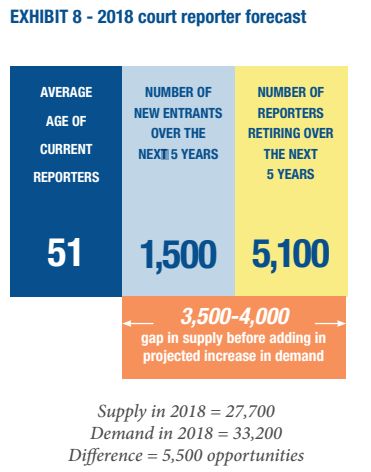
In addition to changing the strategy from diplomacy to Hell March 2, I have to now point out the inherent flaws of relying on Ducker’s 2013 information in 2021. The industry outlook is eight years old at this point. Stenographers had a choice in 2013, go big or go home. After that time, NCRA A to Z, Project Steno, and Open Steno all went big. Plenty of other reporters did too. Kim Xavier began Stenovator Pathway Solutions. Allison Hall set up programs and initiatives to get students in schools and help them find their way, and most recently received an award from the Oklahoma judiciary. Katiana Walton started training people under StenoKey. Shaunise Day started Confessions of a Stenographer. Protect Your Record Project set up strategies to help educate consumers against the pushing of inferior digital reporting products. NCRA Strong created resources for members to help educate consumers. So many people did so many things that I regret ending the list there. The recruitment and content creation efforts of stenographers didn’t double or triple, it exploded exponentially into a runaway train that only keeps accelerating and will only go faster now. Ducker’s top reason for low enrollment was that stenography was relatively unknown. That just isn’t going to be the case anymore. The median age of reporters in 2013 was 51 according to page eight of the report. Today, NCRA statistics state the median age of reporters is 55. It has been eight years. Without any activity whatsoever, the median age should have been 59. We can already see the results of our work.
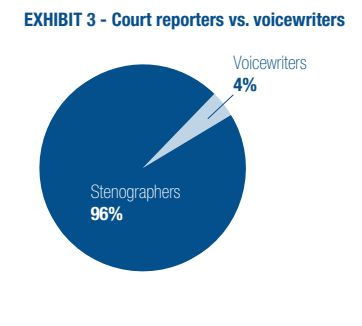
Another “problem” with relying on the forecast or cherry-picking data from it is that focusing directly on the shortage ignores all the nuance and the actual messaging of the report. Let’s go through the report together and see just how much it supported the conclusion that stenographic court reporters were needed. Check out page six, where they published the segmentation of court reporters to voice writers.
Remember, this is 2013 data.
Voice writing is actually a decent product. Yet voice writers still were only 4% of the field. For about five years companies stood silent. When they had the slightest hiccup in scheduling, 2018, they went digital because “stenographers take too long to train and have too high of a failure rate.” If that were true, perhaps they would have built the voice writing side of their business, since it was already far more established as a modality than digital reporting. It is far more likely that some companies’ ultimate goal is to offshore the work, a disastrous result for our justice system in America due to the fact that offshore transcribers will be beyond the subpoena power of local and state courts. Even if it is not the goal, it is the logical consequence of moving reporter transcription from the front end to the back end and taking us away from public view. What school would open to fill a job that nobody sees or knows about?
The number of reporters entering and retiring is touted by know-nothing companies like US Legal as the reason the stenographer shortage cannot be solved by recruiting more reporters. Recently they put out that we have an annual shrinkage of 920, and I explained why, even assuming that was true, they were wrong. The equation they presented would eventually lead to negative stenographers, which is impossible if there are 200 new entrants a year. Ducker also explains why they’re wrong. At the worst of our decline, when the study was commissioned, we had an estimated 1,500 entrants coming into the field from 2013 to 2018, about 300 a year. Are we really to believe that with all of the effort going into training court reporters and bringing attention to the field that the number of annual new entrants fell between now and then?
It took eight years for our median age to rise by four years. That means we’re winning.
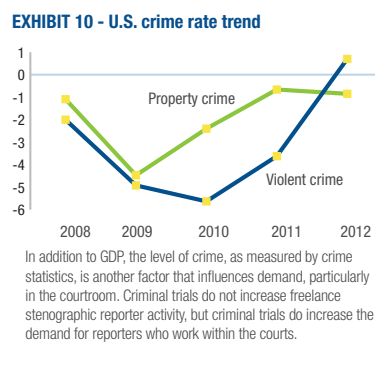
In addition to Ducker’s forecast with regard to the actual number of opportunities, there was data about violent crime which led to them to believe the demand for criminal court reporters would go up. According to them, it was trending up at that moment.
Trending up, but still negative until 2012.
But when we look at sites like Statista, we see that the violent crime did rise for about three years as predicted by Ducker. Then it started falling again. It is hard to say, given the events of 2020 and 2021, where that per capita violent crime rate is going to go in the years to come. But what we can see with clarity is that Ducker’s information became outdated on violent crime as quickly as 2016. That leads us to the question: What other information might be outdated that we simply do not know about?
Fun fact. You can prove violent video games do not cause violence because violent crime went down while violent video games prospered.
The next few pages of the Ducker Report focus on the demand for stenographic court reporters. It’s probably the single greatest marketing piece of its time for us. We needed people, and the forecast told us that. Page 13 of the report gave us some striking infographics that let us know California and the west coast were going to have the hardest time with meeting the demand.
If California survived past its catastrophic 2018 opportunity, I am pretty sure the rest of the country is going to be okay. Their shortage is nearly 20x worse than the rest of the country and they have some of the craziest licensing laws there are.
The rest of the report focuses on state projections. Some states were projected to have a surplus. This means that any state with a surplus could theoretically lose reporters to states with shortage problems and still be fine. This is likely what occurred in 2020 when depositions moved online. The fact that depositions moved online and companies continued to push digital is another clear indication that this was never about the shortage. It was about messaging. Signal to reporters that their job is over and get them repeating that news over and over under the mantra of “nothing else we can do but go digital.” Let me pull a word from Stacey Raikes’s amazing JCR article: Hogwash. It was a sweet lie to ride on. It’s over now. And make no mistake that it is a lie so blatantly obvious that I predicted it would occur back in February, writing “there will be a strong push from certain entities to say there aren’t enough of us. That will happen regardless of the truth.” Let’s repeat this: Stenographic reporting is here to stay. There is a place for every single one of our students as long as they work hard and do good work.
So was Ducker Worldwide wrong? Not by my assessment. They made an accurate forecast based off accurate data that existed when the industry outlook was written. That said, as an industry, we need to stop letting others tell us what the report said, really look at it, and encourage colleagues to look at it. It was a message that stenographers were needed. The shortage was not ever impossible to solve. That was a lie propagated by STTI that the corporations picked up when they saw a chance at pushing our educated and highly trained workforce out so that they could exploit digital reporters. Offshore transcribers are also being exploited, with some of them being paid as little as $0.80 a page or $0.24 a minute. The only way that we get pushed out is if we let it happen. I began documenting these events years ago with hope that we would not. Don’t let me down.
Two years ago. This didn’t age well. About six months later the study “racial disparities in automatic speech recognition” was released and showed us ASR was 25 to 80% accurate depending on who’s speaking. Given old patents that show 92% ASR accuracy was possible in 2000, the idea that growth was exponential became laughable.
Addendum:
An awesome Reddit user pointed out that the way I describe the median age here does not account for retiring reporters and assumes none retired out. To that, I would have to partially agree, but also point out that Ducker conceded that many reporters stay past the retirement age, as shown in purple below. The number of reporters that reached retirement age in the last 8 years was not the retirement cliff we have been anticipating. The next ten years is the retirement cliff. So I see it as I do because the reporters that were not yet retirement age as of the Ducker Report are likely to still be with us in large numbers, with some exceptions, such as our very recently retired and beloved Dominick Tursi. Given the substantial increase in stenographic reporter recruitment in the last 8 years, the logical conclusion is that the reporters staying past retirement age are bringing the median age up. There is no doubt that we need to continue our recruitment efforts, but we should no longer be swayed by the arguments that the situation is “impossible.”
“Taking into account that court reporters tend to stay in the workplace longer than average…”
Remember when the world was supposed to end? Computer programs were going to crash. Massive delays could happen. It was the doomsday that never happened about 21 years ago.
It turns out Y2K was a pretty big problem in the computer programming world. Computer memory used to be incredibly limited. To get around this limitation, many programmers designed programs to save dates using fewer numbers. MM/DD/YY was shorter than MM/DD/YYYY. The result of this design was that in the year 2000, many programs could believe it was the year 1900. Booked a flight? Good luck finding your 100-year old reservation in the system. Clocked in at work? You were going to be 100 years late. Had a bank account? They were going to owe you 100 years of interest. Anything where dates and computers were important was in danger.
That danger came and went because programmers went to the media. Programmers whipped up a frenzy of attention to the issue, and the people that pay them took the issue seriously. Millions of dollars were spent to fix old programs, and the result was that Y2K went down in the public’s mind as a hoax or joke.
There are a few things stenographic reporters can mirror here. We too have a looming crisis. Our reporter shortage is well documented. The average age of NCRA membership is 55. For all the reasons listed in the PCRA article, digital reporting and automatic speech recognition is an inadequate replacement for the stenographic court reporter. Indeed, I’ve even “pontificated” that if we fail, it will cause much more severe delays than courts already experience.
We too have people that need to buy in. Court administrations, private attorneys, captioning purchasers, and educators are all examples of people we need to buy in the same way banks, airports, and others bought in and helped stop Y2K. Ultimately, these are the people injured if we fail to recruit more reporters, and the least we can do is let them know. The schools are not going to survive long with the offshoring of the jobs. The rest of them are going to suffer from a quality issue.
We too have seen this coming in advance. For over 7 years we’ve been pushing out initiatives to recruit reporters. NCRA A to Z, Open Steno, and Project Steno have all grown more robust and organized in that time. We still have a good 7 to 10 years before the majority of reporters cross the retirement threshold and reality tells us whether we’ve won or lost. That’s 7 to 10 years to change the outcome if you think we’re losing or keep the lead if you think we’re winning.
Most importantly, we too can win. Programmers were facing an unprecedented issue and worked to fix it. They did not fix everything perfectly; a nuclear weapons plant had a little hiccup after all, but they fixed everything enough that nothing catastrophic happened. They had a choice, and they chose to be leaders. As I told many students on February 2021, we too have a choice. We are not facing an unprecedented issue. We are facing a labor shortage. We don’t have to do this perfectly. As I explained yesterday, the corporations that are trying to bump us out of the field are far from perfect and their arguments are completely hollow. There are so many of us that with even the slightest effort, we will eclipse whatever anti-steno propaganda is put out there. We just have to do it.