Is VITAC Paying Below Market Rates for Captioners?

About three months ago, after Verbit’s acquisition of VITAC, a well-known captioning provider, I published a strategic overview for captioners and how they can stand up for consumers. Not long ago, a live steno captioner position was posted by VITAC for less than $20 an hour. The position did boast other incentives, such as the potential for health insurance and a 401(k) for full-time captioners. With health insurance being valued by sources like Griffin at $1.52 to $7.42 an hour, it’s fair to say that we can consider a $19.23 hourly rate with benefits a value of about $30 an hour at best and a value of $20.75 at worst.

Remember, the value is slightly higher than the dollar value if benefits are offered.

Stenography is a highly specialized skill. But even other highly specialized skills, like realtime voice writing, were undervalued. The voice captioner posting said $30 hourly at the top, but then in the body of the description, a $17/hr training rate was advertised. It was further advertised that $35,000 could be made in the first year. $35,000 divided by 52 weeks in a year is about $673.08 a week. Assuming a 40-hour workweek, that’s about $16.83/hr — close to half the advertised rate!

Come work for me for $30 an hour! I mean $17! I mean $16.83!

I thought, “if a company is going to pay its specialized workforce $20 or $30 an hour, certainly I feel bad for the positions that do not have labor shortages or specialized skills.” Then I came across VITAC’s posting for Sales Engineer I (SE1). An SE1’s job is all about onboarding new clients and responding to requests from Operations and Sales personnel. They’re offered $58,000 to $70,000 annually, the equivalent of $27.88/hr and $33.65/hr assuming the same 40-hour workweek. So VITAC’s apparent strategy is to pay the stenographer that is providing the actual service to the consumer about 60% of what they’re paying the salespeople. But just to make sure they look good, they added a modern stenotype to the website.
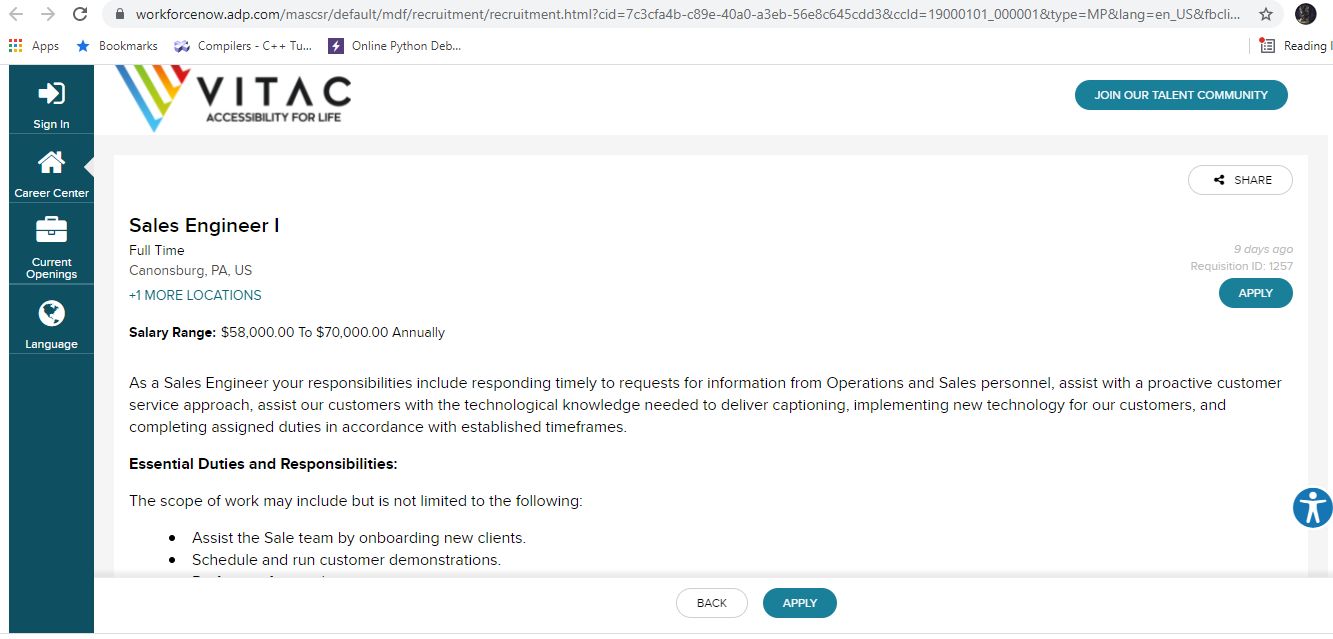
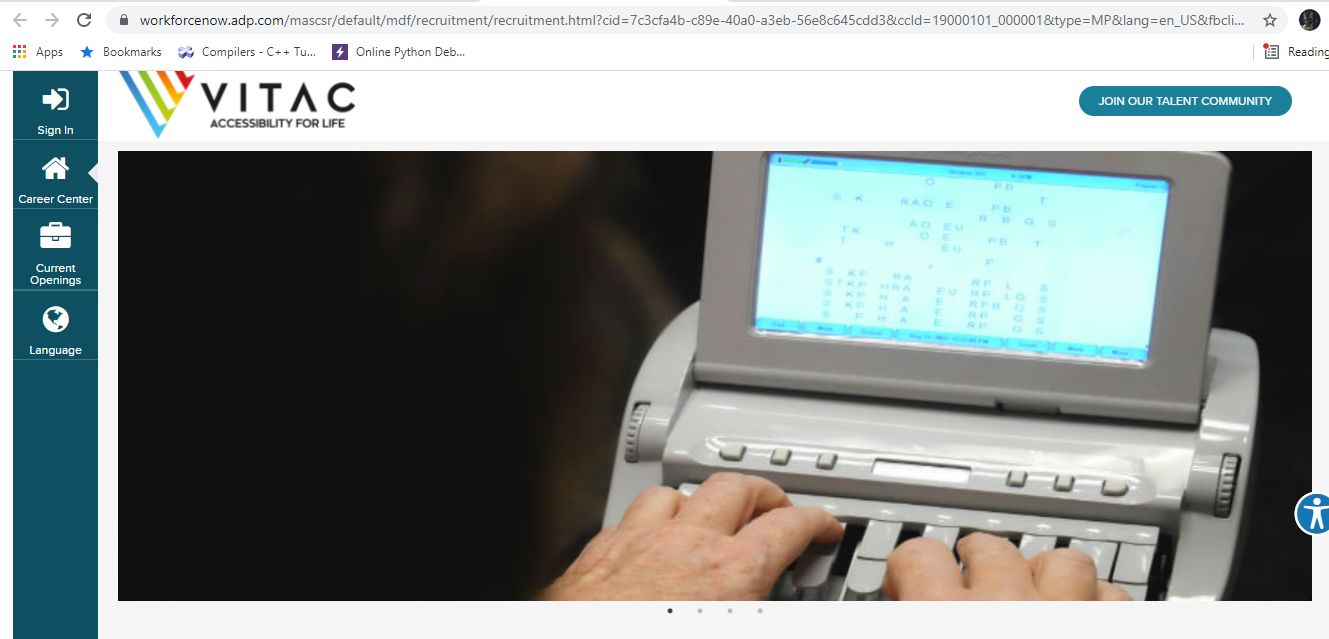
No offense, sales engineer I, but I think captioners have it a little harder than you do.
Maybe if you were offering more than $20/hr, I wouldn’t find this picture so comical.

Of course, having been in the field the last eleven years, I also have some basic familiarity with the rates that captioners and CART providers charge. $20 to $30 for a “live steno captioner” job seemed low to me. Knowing how companies in the court reporting sector have taken advantage of young reporters, I requested information from several service providers in the field with varying degrees of experience in the hopes that I could get solid info out there for young or unknowing captioners. This is what I learned:

Provider A stated that they did not provide broadcast captioning, but did caption telephone calls and Zoom meetings at a rate of “almost $40 an hour” through Innocaption. It was stated that the work was super easy and may even be possible for students to take, though Provider A did mention they usually do not recommend students work. Asked about their understanding of broadcast captioning rates, Provider A stated broadcast captioning was higher.

Provider B
stated “Even as a brand new CART provider, I never made less than $60 an hour. With one company, after I got my [certification], they bumped me to $65. Another company has always been $65 across the board. The third company has different rates for different jobs. Classes are $60 but if you are doing town halls, harder jobs, it is $75. Fourth Company was a smaller company and [they] paid me $80 per hour, and it was only classes. First company I spoke of is out of Illinois, second is Denver, third is California, fourth is Chicago. And I have never done broadcast captioning. I hope that helps!”

Provider C stated that they performed work for call services that did live captioning and were offered $40 an hour, but they were only taking down one side of a conversation.

Provider D, a 27-year veteran of our field and certified realtime reporter, stated that when they took on captioning work, it was 2014, they had a full-time job, and they did not need to make the same high rates independent contractors usually did. They made $50/hr in 2014 and a 2-hour minimum. That work came to a close. Come 2020, Provider D was again offered $50/hr and attempted to negotiate for $80 because the work was dense and contained a lot of science. The firm “did not know” if they could pay $80, and asked Provider D to come down to $70, which Provider D did with the caveat that they would renegotiate at a later date.

Provider D also received a call from a California-based company and negotiated $100/hr with a 2-hour minimum. The firm paying $100/hr expected no rough draft after events. The firm paying $70/hr required a rough draft. A third firm in Florida offered $80/hr. Provider D stated that the swing was generally between $50/hr to $100/hr and that they would never work for $20/hr because captioning is more than knowing realtime, you have to know how to connect to a multitude of platforms and devices, as well as troubleshoot on the fly.

Provider E wrote “My first response when I read [the $20 rate] was OMG! Yeah, that is SUPER low! So here’s what I know from where I sit in the Pacific Northwest:

There are four levels of captioning that I have ascertained.
1. Broadcast captioning, which is a whole other sphere that requires encoding software and usually above and beyond training to do TV captioning. I don’t really know much about that…” “I don’t know what rates they’re charging, but it has to be higher because the software is not cheap, like a $7k add-on with Eclipse.

2. CART captioning, either in person or remote, through a freelance company or own shingle. This is stuff like government meetings, group conferences, seminars and such, $120-$125/hr with 2-3 hour minimum in my area. We are sometimes requested to bring a projector and/or screen, which adds to rental fees. About half of people charge after hours rates on this. I feel the remote world has let this go a bit. But I know when I go back in person that’ll definitely go back in.

3. Schools. One on one with one student. they are notoriously cheap in my opinion even though they’re being paid by ADA funds, from my understanding. Most commonly in my area $85/hr, 2-hr min. But I’ve negotiated more for after hours and weekend work with one college.

4. There is one company whose name escapes me, probably more, who provide a captioner for phone calls. they only pay $30/hr. I was really bothered by this undercutting of the industry when I found out about the rates folks were accepting. But a reporter I talked to about it said [it’s] mostly sitting there doing nothing because you’re only writing half of the conversation, no transcripts, so super easy work. She considered it easy supplemental income.

That $20 is WAY out of line, especially if that requires continuous writing…”

Provider F wrote “everyone has their baseline. I will do $70 and hide my head, for a friend. But my default is $80 or $85. However, if it’s MY work, my clients, I charge 100 or 125 and pay $80 or $90 or $100 depending on the job…”

According to the Bureau of Labor Statistics inflation calculator, $50 in 2014 money is worth $58.08 in June 2021 dollars. $100 in 2014 money is worth $116.15 in June 2021 dollars. Again, for new captioners, this should put into perspective the value of the work and the importance of occasional raises.

I also reached out to StenoCaptions LLC and received the following response:

“Good afternoon, Mr. Day,

Thank you for your question about our company.  StenoCaptions LLC is proud to be a minority woman-owned business.  Our team of independent contractor captioners earn between $100-120 per hour depending on their qualifications and length of time in the field.  As our website discloses, we charge $140 per hour for most jobs.  This means that our captioners, who are the people doing the difficult and demanding work of providing live accurate Communication Access Real-time Translation, net between 70-86% of what we bill.  StenoCaptions LLC is proud to support our highly trained, highly reliable stenographic captioners.  

We are happy to be quoted on your  blog.  Let us know if you have any further questions.

Sincerely,
Wendy Baquerizo and Joshua Edwards
Co-owners
StenoCaptions LLC
StenoCaptions.com”

As of writing, there is little doubt in my mind that the rates being offered by VITAC, and I suppose by extension Verbit, are well below what could be considered a market rate no matter which market in the United States we examine. Again, in the best-case scenario of a $30/hr value, they are paying 40% less than Provider D, whose full-time job was not captioning, made in 2014! A company like Steno Captions is literally paying six times as much to their providers. This has some troubling implications. Verbit’s entire model, as I understand it, is automatic speech recognition transcription coupled with a human transcriber. Verbit claims on its site that after 8 hours it can provide ADA-compliant material at 99% accuracy, at least that’s how I understand their infographic. They also make the claim of 95% accuracy with an 8 to 12-second delay.
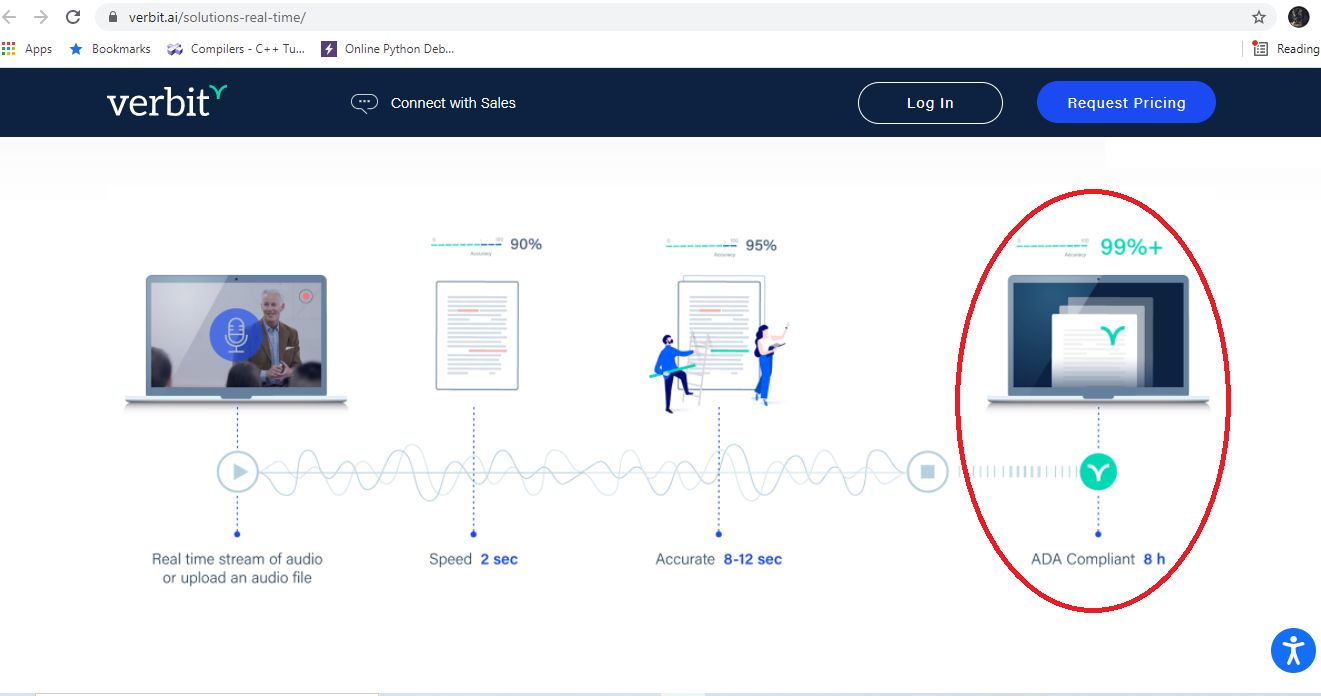
To be fair, it takes me about 8 hours to get 99 percent accuracy on 160 pages. But I’m not a captioner.

We have to deal with the hard fact that, in its series A funding, Verbit made the claim that its “adaptive speech recognition tech” could generate detailed transcriptions with over 99 percent accuracy at record speeds. In its series B funding, Verbit, through CEO Livne, said it would not take the human transcriber out of its workflow. Now it’s apparent that Verbit regards “record speeds” as 8 hours. We have to deal with the hard fact that, when studied by people at Stanford, an entire host of automatic speech recognition products from companies far larger than Verbit had accuracy levels that were 25 to 80 percent dependent on who was speaking.

There’s just no good reason to believe that Verbit consistently has the capabilities that it says it has. This is all part of the claim game that I demonstrated earlier this year. In the video I just linked, I tell six lies, one partial truth, and one actual truth in fifteen seconds. I challenged my readers to think about how long it would take to prove the truth or falsity of each claim. I have to make the same challenge here. Verbit’s website boasts that they are trusted by “400+ organizations,” but when one flips through the organization list, one sees about 16 organizations. Even if one wanted to spend the time and energy to fact check the claim of being trusted by 400 organizations, one could not do so. Why bring it up? Because stenographers need to be aware that a lot of the “intimidating” information out there falls apart when given any sort of investigation. Likewise, there are entities out there that will try to convince young captioners that their skill is not worth very much. I’m publishing this information today to counter that.

Perhaps the low pay wouldn’t bother me, but it goes directly against digital recording’s main talking point of “we need to record it because there are not enough stenographers to meet demand.”

You guys showcase the shortage. I’ll keep showcasing your BS.

Maybe the shortage of stenographic court reporters and captioners is exacerbated by companies like this coming in and offering pay that’s nowhere near the market rate. There’s no innovation involved. It’s a shameless war on workers. It doesn’t take a particularly bright person to say “gee, there would be more money for the company if only we could reduce the labor costs.” It also doesn’t take a particularly bright person to point out to captioners that they cannot accept this if they want a healthy field. We’re going to need the entrepreneurial individuals among us to consider jumping in, setting up shop, and competing. We’re going to need captioners to demand the pay they deserve. So if you come across an inexperienced reporter getting told they’re only worth $20/hr, please share this with them and be a major part of pushing back.

Addendum:
I realized after my initial draft that the $20 an hour could be a full-time job. Assuming 7 hours a day, five days a week, 52 weeks a year, that’s a salary of about $36,400, below the national average, and well below what I started working for as a court reporter around $70,000 a year. So even looking at it from the standpoint and potential of “more hours for less pay” I am unimpressed and captioners should be too.

Thinking of Taking Private Clients? New York Reporter: …Trust Yourself and Go Do It.

I had an e-mail exchange recently with a New York stenographic court reporter that began taking private clients. With the understanding their identity would remain anonymous, they gave me good insight into how it has increased their profit. I have presented plenty of academic theory on how low our page rates are here in New York and the importance of copies. Today I get to bring reporters a real-world example of just how much a little risk can increase your bottom line. Check out our Q&A below!

Q. How long have you been reporting?
A. I’ve been reporting for 10 1/2 years.


Q. We’ve had multiple discussions now where you’ve disclosed you’ve taken up private clients. How is that going for you?
A. So far it’s a success. I work with my clients 1-2 times a week, which I expected. They aren’t big firms, so I didn’t expect constant work. In March and September they gave me 15 jobs. One thing I hear people express concern about is collecting money for copies. That is, of course, a concern, and I have had to lean on law firms. But I can say that so far no law firm has stiffed me. And while some have been a little slow to respond, all have. So, fortunately, I haven’t had to chase anyone for payment yet. The best thing is the vastly increased copy rates, which makes this work a whole lot more enjoyable ๐Ÿ˜‰.


Q. Did anybody give you permission to do this or did you just start doing it?
A. No one gave me permission. I took it upon myself. It’s all about developing a relationship with the attorney. I should say mostly. A law firm that has used one agency for many years and is happy with the service will not likely change. But still, without developing the relationship, it is unlikely that they will try to work with you. It can take a while, but it doesn’t necessarily have to. I probably worked with my first client four or five times, but we got along very well. I brought up the possibility of his working with me at a time when there was little pressure. I definitely did not bring it up while on a job for someone else. I took a chance and it worked. He said yes. There are other factors that induced him to switch to me. We worked out a good financial arrangement which benefited his law firm, too.


Q. What are your feelings on poaching?
A. By poaching, do you mean taking clients? When we use that term, it makes this sound like you’re doing something wrong if you take a client. This is common practice in all industries. Most of the client the agencies have, they probably acquired through “poaching.” The only thing to avoid is unethical practices. As I said, I would never broach the subject while on a job for someone else. And of course don’t lie.


Q. The audience is going to want to know some hard numbers. What kind of differences are you seeing in take-home pay?
A. I turned in a job 131 pages long, including the [word index], and got two copies. Total take-home was roughly $1200. That was for a med mal case that might have gone two hours . And by the way, I do not charge high rates. So with a different client with the same factors, the total could have been considerably more. This is not the only one.


Q. Wow. That’s like $9 a page. You charge your clients $9 a page in New York?
A. [No], my rate is closer to 4. Again, this is a relatively low rate. But the real profit is in the copy rate. That’s where you’ll make the money. (Just a side note, not one law firm has contested my copy rates. Hopefully that will never be an issue. I’m saying this for those who are concerned about collecting the payment.) So I don’t mind if the law firm wants to negotiate a rate down a little, not too much, as long as I’m aware I can keep the copy rate. On that 131-page job, nearly $800 of my pay was from the copy rate! Keep this in mind, remember this, we’re in business providing a service for law firms. So a) be gracious and patient in dealing with the law firms; b) be open to negotiate rates, just as long as you keep in mind where you’re really earning your money from.


Q. Isn’t it a challenge getting them to pay you?
A. Sure. But I’ll take this challenge over the challenge of trying to make money when agencies are charging 4 dollars a page per copy and they’re giving, so generously, 40 cents a copy. Exactly what was said there. No more needs to be said. We have to strive upwards. I accept the challenge of collecting over the challenge of squeezing small incremental rate increases.


Q. Isn’t the cost of printing eating into your money?
A. Not really. I had a $1,200 job the other day. When it was all said and done, I paid $90 to have it printed up. How come reporters are willing to blow a third of their money on scopists but not willing to even consider seeking their own clients and spending 10 percent on printing? Compare the costs to that of most industries. The cost here is very small in comparison to that in most fields.


Q. Anything else you’d like to tell reporters generally or New York reporters?
A. Look, if someone does want to go out on their own, it’s understandable. For years, I said I would. I made halfhearted attempts, but didn’t really follow up. Even when I got my first client, I almost didn’t expect the attorney to take it seriously. But now that I see the huge difference in what I can earn per job, it’s motivated me to try and get more clients. I will say to those who want to try and do it on their own, just try it. Don’t be afraid of being blackballed by other agencies. You have nothing to lose and so much to gain. I’ve heard people say they don’t want to bother with putting transcripts together. First of all, it takes maybe 10 minutes. That’s it!

Second, it’s a great experience in motivating yourself to be an even better reporter, because you don’t want to turn in an error-filled transcript to your own client! You will be so much more careful and your notes will be so much better! I know because I’ve improved significantly just in the three months since I picked up my first client. If you’re so inclined to strike out on your own, I urge you to trust yourself and go and do it. Develop those relationships. Make business cards. Give them to everyone you know who knows attorneys. It can take time, so don’t get frustrated. Eventually you’ll get a first client. Not every job is big payday, but you will have some jobs where you will see double and maybe even more than what you would’ve earned if it was work for an agency.


In my view, this speaks for itself. Taking private clients can double your money. Collecting can become problematic, but the alternative of allowing certain agencies to continue to push substandard means of reporting on consumers is not a good one.

My girlfriend is very upset that I blew our vacation money on an ad campaign for steno. I’m not allowed to hire graphic designers anymore. Everybody that wants to donate to my vacation fund can do so at paypal.me/stenonymous. (joke)

Addendum:

A reader asked how many copies were charged in the above example. Our anonymous respondent said โ€œ2 copies. Keep in mind I give a discount to my client when I have copies. I also only charge 3/copy. Iโ€™m pretty sure many agencies, if not all, are charging more.โ€ For more context on this model, it is called a sliding scale. Companies will often decrease the cost to their client when copies are sold so as to be giving them a page rate that cannot be undercut. After all, why would a reporter offer someone $2.60 a page when they could work for an agency for around $4.00? But in New York this continues to hide the value of copies from the working reporter, who up until recently were accepting as little as $0.00 to $0.25 on a copy.

Over-Engineering Will Hurt Your Business

A close friend sent me a Bill Maher clip from a while back. Obviously, Maher has his political leanings, but after he gets done with flaunting those, he makes a decent point. He describes the over-engineering of society and gives some pretty striking examples. His preferred vapeโ€™s newest model has no mouthpiece despite being something you put in your mouth. Car handles are replaced with buttons in some cars despite no efficiency gains. He describes a situation where his rental car asked him if heโ€™d like to open the trunk while going 60 miles an hour. The point is clear, change for the sake of change is not always worthwhile or efficient. Indeed, change for the sake of change can be very dangerous.

This is connected to the exaggerated claims of salespeople that Iโ€™ve written about extensively, especially as it relates to voice recognition. I described it several posts ago as the claim game. Anybody can say anything. Anybody can make their business seem like the new, hot thing. Take this blog post by Kaplan Leaman & Wolfe from about a year ago. It reads nicely, and it sounds innovative. It mentions a flat-rate fee, affordable per-page price structure, a design to significantly reduce legal expenses. At the point in 2020 the post was written, everybody was doing remote stuff. Pretty much everybodyโ€™s got a per-page price structure. Anybody can claim their service is affordable or reduces expenses. Itโ€™s called puffery and itโ€™s an ordinary part of business.

Where it gets messy, and where Iโ€™ve tried to educate reporters, is some advertisements are easier to spot than others. If Burger King says theyโ€™ve got the best burger, most everyone knows thatโ€™s puffery and sales. Things get harder with technology. How do you prove or disprove whether someone has made a technological breakthrough without a comprehensive understanding of the science and concepts at work? Not all reporters understand the concept of machine learning. Even those of us that have researched quite a lot canโ€™t possibly know everything there is to know. This leaves a gap for tech sellers to come in and try to fool consumers into buying services that may not suit their needs using the hype train.

Told you I write a lot about this. I read a decent amount too.

This also leaves reporters playing a catch-up game of learning about these systems so they can help their clients navigate claims and discern fact from fiction. For example, the truism that technology is improving every day. We look around ourselves and marvel at this magical modern world. But Iโ€™ve taken the pretty hard stance that certain technologies, namely voice recognition and associated technologies, are not improving every day. Give it speech itโ€™s used to and itโ€™ll do fine. Give it speech thatโ€™s just a little off from what itโ€™s trained for and itโ€™ll turn โ€œwould you raise your right handโ€ into โ€œitโ€™s rage right hand.โ€

Yes, itโ€™s rageโ€™s right hand.

But surely reinventing the wheel and all these claims of being BETTER arenโ€™t BAD for business, right? If puffery is normal then a little bit of stretching the truth wonโ€™t hurt anybody! But we already see thatโ€™s not the case. Take Maherโ€™s example. One little glitch on the highway and you could have dead motorists. Take the fact that 25 percent of court reporting companies may be unprofitable; court reporting has been around a long time, itโ€™s likely the losers are the ones trying to switch it up too much too fast. Take vTestifyโ€™s massive switch from boasting about providing inexpensive court reporting services to providing an online platform for the legal industry. Take Verbitโ€™s claims in its series A funding of 99 percent accuracy and its subsequent announcement that it will use human transcribers after all, and the very real possibility that it is, despite all its funding, not profitable.

Exaggerated claims serve only as a cliff from which these companies have a chance to walk off of or step back from. The competition is going to wise up. The consumers are going to wise up. I can only hope that a lot of these tech companies realize this, wise up, and start putting their resources behind actually improving our technology. Itโ€™s a lot easier to compete in a field with maybe seven players like Stenograph or Advantage than it is to beat out thousands upon thousands of independent contractors and hundreds of reporting firms, many with their own clients and connections. Itโ€™s frighteningly easy to see thereโ€™s a more lucrative path than over-engineering what stenographic court reporters have made simple, and I can only hope that business owners realize this before walking investorsโ€™ money off that cliff.

1 in 4 Court Reporting Companies May Be Unprofitable

In my Collective Power of Stenographers post, we explored how court reporters collectively out-earn every company in business today. In Aggressive Marketing — Growth or Flailing, we took a look at VIQ Solutions, parent of Net Transcripts, and saw how a transcription company could be making millions in revenue but be unprofitable. This all set me down a path of learning about zombie companies, companies that are not making enough to meet debt obligations, or just barely enough to make interest payments. You can watch Kerry Grinkmeyer describe how that happens here. This isn’t very rare. A Bloomberg analysis of 3,000 publicly-traded companies found one in five were zombies. The main takeaway? Companies can make lots of money and still be taking losses.

I had the pleasure of looking through the Kentley Insights June 2019 Court Reporting and Stenotype Services market research report. I do want to be upfront about it: I have some reservations about the methodologies and some of the reporting. Very much like the Ducker Report, as best I can tell, it’s based off a sampling of respondents from in or around the field. There are parts of the report that are arguably a little incomplete or unclear. For example, being industry experts, we all know the vast majority of the work is done by independent contractors. Independent contractor isn’t a term that appears in the report. Unsurprisingly, when we reach the job pay bands and employment section, it says there isn’t detailed data on the industry and compares us to the telephone call centers industry. So this report is not a must-have for court reporters, but it does have some interesting insights.

Those remarks aside, when we get to the profitability section of the report, we get to see something pretty striking. Based on their data, more than 1 in 4 court reporting companies are not profitable. Average net income as a percent of revenue for the ones that are profitable? About 9.3 percent. For the ones that are not profitable, a loss of about 9.6 percent. And a pretty chart that says as much.

I never want to see the term capital benchmarks again.

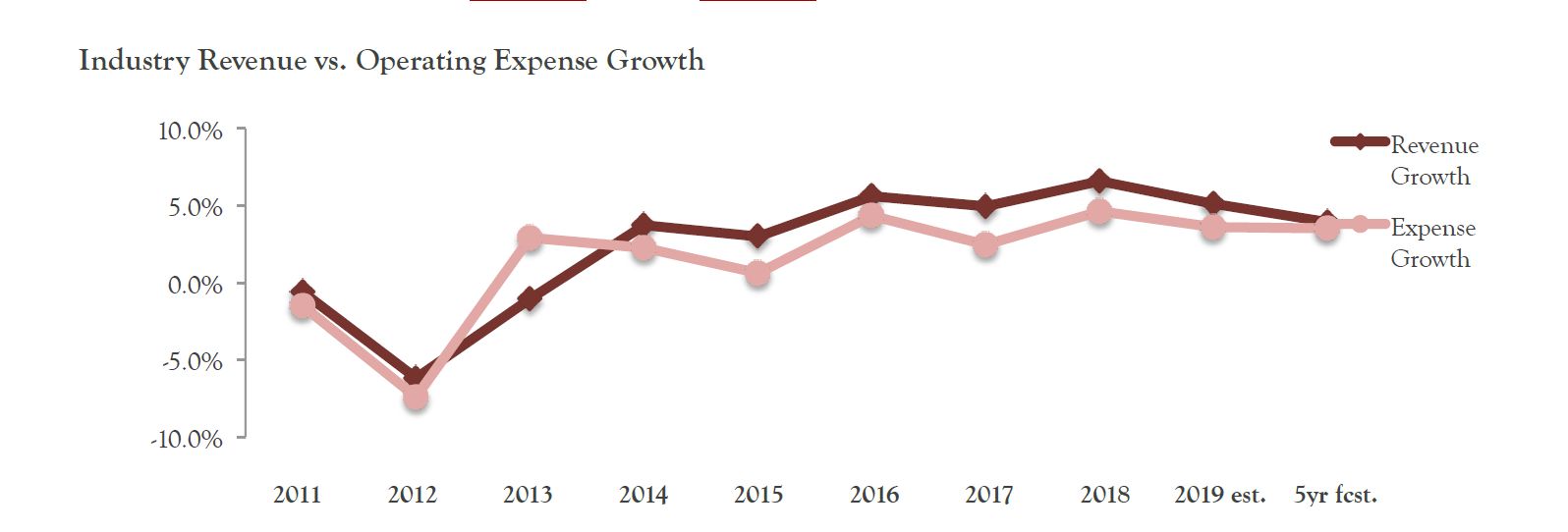
On the following page, there’s a forecast for operating expenses and industry revenue. That’s summed up in another pretty chart.

This was pre-pandemic, by the way.

If we look at the trends here, it’s pretty clear that the forecast is for expense growth to eclipse and outpace revenue growth. If that keeps up, the unprofitable companies are going to be looking at bigger losses year after year. Given all the information I have today, I surmise that the smaller court reporting companies are the more profitable ones and the bigger ones are the ones struggling. There are sure to be some outliers, like small court reporting shops that go bankrupt and leave their independent contractors unpaid. But overall, the smaller companies can’t afford to remain unprofitable for very long, so it’s probably the “big dogs” eating that 10 percent loss. If I’m right, that may also mean the push to go digital is the dying breath of companies that can’t figure out any other way forward. In February, I wrote “…we only lose if we do not compete.” That is becoming more evident with time and data. It is a great time for the stenographic reporter to open up shop and be a part of the 74%.

Speaking of data, if everybody that read this blog donated $1.50, we’d have enough money to stay ad-free for the next two decades. To all donors we’ve had to date, thank you so much, put your wallets away. To everybody else, check out this cool song from M.I.A. about taking your money.

What Law Offices Need To Know About A Court Reporter Shortage

There’s been a great deal of marketing and many press releases about “disruptive” technology in my field. I’ve been a stenographic court reporter for a decade. I’ve worked right next to reporters who have been working for three or four decades. All of us concede that technology, on average, is getting better. Computers today can do things that few could have imagined in 1970. Computer programs used to be written on punch cards. Try inserting one of those into your iPhone. It’s no wonder that when people see some of the older stenotypes, they ask where the punch card goes.

You write on a stenotype but type on a typewriter. Can’t explain that!

Of course there’s no punch card. But we end up getting a pretty bad rep because the keyboard layout we use is a hundred years old. It’s easy to look at that and forget there’s a whole arsenal of technology attached to that keyboard layout. By 1963 we were using magnetic tape for computer transcription. By 1987, our stenotypes were rocking floppy disks. Today’s stenotypes are so damn good you can read my notes off the screen without any special training.

You would be able to read the notes off the screen, if I ever took any.

There was no secret that there was a court reporter shortage coming. Our field first learned this shortage was coming towards us in 2013. By 2019, the entire country knew there was a shortage. There is a court reporter association in almost every state, a National Court Reporters Association, and myriad nonprofits and other initiatives aimed at solving the shortage. Since 2013, we’ve seen things like Open Steno, A to Z, and Project Steno all aimed at meeting the demand for stenographers in their own way.

With even a gentle push from the larger corporations in our field, things would have been fine. But we started to see some strange moves in our industry by some companies. Some companies started to ask law offices to change their deposition notices to allow for audio recording. Some companies started saying that reporters were unavailable even when we were all sitting at home on social media chatting away with each other. Some companies started completely fabricating news, saying things like “…this world hasn’t been digitized…” Some companies say AI is making things better even though AI only gets 65 to 80 percent of what’s being said. Some companies started to push “digital” court reporters. Digital reporters, while they are nice people, are just recording your deposition and taking some notes. They are being used by those companies as part of the record and transcribe method. These companies are literally taking people who could fill the stenographic reporter gap and telling them “no, do this instead, it’s newer.” They don’t bother to tell them that stenographic reporting utilized the record-and-transcribe method several decades ago with Dictaphone technology and has since evolved to be far more efficient. Stenography has been digital since before some of us were born.

Eventually, you have to ask yourself, “what’s the deal? If there’s is a shortage, why does Veritext, or Planet Depos, or US Legal advertise that they’re hiring digital court reporter positions in New York, but almost never a single ad for a stenographic reporter?” Well, reporting firms, like just about any other industry, make a good deal of their money being the broker for the buyer and seller. You buy our services, we sell them, and the court reporting companies make money by knowing how low we’ll go and how high you’ll go. I started out as a deposition reporter in 2010 and was offered $2.80 a page. Years later I learned that was almost the exact same rate given to reporters in the 1990s and far lower than the page rates that court reporters working in court got. Court reporting companies told me reporters were a dime a dozen and that law offices wouldn’t pay a penny more. Meanwhile, I was taking depositions where the attorneys were telling me how expensive our services were. On a deposition with a lot of copy sales, I wouldn’t be surprised if I was taking home 20 percent of the total invoice. That’s a lot of money to a company to market and print, bind, and mail a transcript that takes hours of reading, research, and transcription on my part.

Our entire profession is in a state of shock because we placed a great deal of trust in reporting firms to market our skills. This is similar to the trust you put in them to find you a qualified stenographic reporter. Yet we find ourselves compiling state databases, national databases, and nonprofit databases dedicated to helping you find stenographic reporters because some companies can’t be bothered to connect consumers with the service they want. They see the education culture that stenography has as a threat. They see it as an expense to do away with. What happens when you take a field with 60 nonprofits and dozens of schools dedicated to the welfare and training of court reporters and replace it with people that have no such support system? You get workers that are easier to intimidate and lowball in the long run. How do I know? It already happened when the Federation of Shorthand Reporters in New York collapsed. Worker pay stagnated while the invoices to attorneys skyrocketed; this is the same situation on a national scale.

What law offices need to know is that they alone decide what happens next in our industry. Ultimately, law offices set the demand. It’s you, the attorneys, office managers, paralegals, and secretaries. You can trust us to recruit enough to fill any shortage. You can trust us to adopt the latest technology. You can trust us to continue over a hundred years of tradition, value, and service by making sure your record is accurate and turned around quickly at the best cost. We have to trust you to demand a stenographic reporter every time so that steno schools can keep pumping out graduates and promising jobs. We have to trust you to look at claims that a stenographic reporter could not be provided with skepticism. We have to trust you to be smart consumers. We have to trust you to let your colleagues know what’s going on in our tiny industry. Don’t just do it so that I have a job in ten years. Do it for your clients. Do it for your consumers. I guarantee that if the demand for steno slips, you’re going to be looking at some crazy deposition bills and hearing some new excuse.

  • – – – – – – – – – – – – – – – – – – – – –

PS. This article comes after a great satire (image here) was done on this topic by a reporter under the alias DigitalByHumans. In that satire, posted to Craigslist, the writer describes a world where a company does this same sort of thing to attorneys, deciding to use “digital” attorneys, and goes on to note that the company makes a lot of customer comfort moves to hide the fact that they aren’t using actual attorneys. While my post here tries to focus on getting straight to the facts I know and the conclusions I draw, I really think that it was something special and illustrates the frustration a lot of us have on this topic. There are states where we are very heavily regulated and the regulating bodies have, through inaction or inability to enforce the law, allowed people to come in and record as “digital court reporters” without any regulation, whereas a stenographic court reporter doing pretty much the same thing would be fined or reprimanded. It’s not the digital reporters’ fault, it’s the companies’ fault, but until consumers and consumer protection agencies stand up and say “no,” the situation will continue.

Expedite Legal, Enhancing Coverage Nationwide?

Everyone is moving faster than ever into new solutions to problems. Adaptation of technology has spiked like never before. There are many hyped technologies out there that promise the world and don’t deliver. Then there are real companies with a tangible product. After taking the time out to review Expedite’s public-facing materials and after having a brief exchange with Expedite’s CEO, Eve Barrett, I am convinced that Expedite is among the companies out there that has a real product. In this case, it’s also a unique product.

We can think of Expedite as the Uber for legal service professionals. It’s helping link providers, namely court reporters and interpreters, with customers, namely courts, lawyers, agencies. I learned that the product is set up to be flexible. People can register as both a customer and a provider. This means that traditional reporting agencies can make use of Expedite to get coverage or get work. This means that independent court reporters can use it the exact same way.

A post I came across on Expedite’s blog, the Docket, sums business up well. Be willing to stick your neck out a little bit. In my view, there is great importance attached to being a skeptic, but we cannot allow our skepticism to hamper our willingness to try new things. I had touched briefly on Expedite’s model in my shortage solutions series. There was some honest skepticism there. But in normal times, we were experiencing a shortage of reporters partially as a result of the disjointed state of the market. There is no central marketplace to just log in and find a reporter. It’s not like the stock market where you can get immediate data on every business out there. There are a lot of tools out there for finding reporters or finding work. Why not add Expedite to your arsenal?

In my exchange with Ms. Barrett, she pointed me right to the Provider FAQ, blog, and vlog. I saw there’s a provider referral program. If a provider refers a provider and both get verified, there’s a bonus. I asked about whether the same was available for providers that refer customers to the program. It was confirmed that anyone can refer anyone, and the bonus shows up in the next job taken with Expedite. This is a smart way to get people using a nationwide app, and I think a robust referral program is a smart move.

The website and app are both available for customers. The app is available on Apple Store and Google Play. The overall message is one of courage and commitment to us. We’ve all been to the recent educational webinars. Presenters have talked about letting go of fear, adapting, making changes to enhance our businesses. I think Expedite is a major enhancement to many reporting businesses.ย  I asked pretty bluntly if there’s anything she’d tell reporters in the industry, or even people outside the industry. I’ll end with part of the response I got, as it says all it needs to say about the power of the individual. “My goal with Expedite was to help save the profession by alleviating the critical shortage. I also wanted to create a new business model for court reporters whereby they could work more efficiently, keep a higher percentage, receive payment faster, and market their services on a free platform. Iโ€™m just one reporter trying to solve the problems that have plagued our industry for decades.”

Copyright and Stenography

I created a masterpiece about a week ago. On the left, a very horrifying creature that took about three minutes to create and was instantly copyrighted upon creation. If you took my creation and slapped it on a mug and started selling it, I could probably successfully sue you. On the right, a file snapshot of years worth of transcript work, which could be freely copied by anyone any time, at least ostensibly, as any court that decides this issue seems to decide that transcripts are not expressive work protected under copyright. Sam Glover also wrote about this years ago, but seems to have purged it from his blog. Some courts, like the one in Urban Pacific Equities et al v The Superior Court of Los Angeles County (59 Cal. App. 4th 688, 69 Cal. Rptr. 2d 635), have taken the step of ruling that the transcript does not have to be turned over under a business record subpoena because it is a product of business and not a business record, but this does not necessarily prevent it from being copied if counsel obtains it another way.

Here in New York, we do have guaranteed payment of an original via our General Business Law 399-cc (Transcripts and stenographic services). In that way, I feel the state and legislature has already partially acknowledged the hard work that we do. But it’s no secret that court reporter businesses, for whatever reason, have chosen to make originals cheap, and make their businesses more or less dependent on these copy sales. It’s often reported in social media circles that attorneys at a deposition will openly and in front of the stenographic reporter offer to copy and give the transcript to counsel that would otherwise have to order the transcript from the reporter. Why not? As best anyone can tell, it’s legal! There’s also a darker side to this. If you do not have a clear agreement with your agency stating otherwise, they can probably also legally copy your work and not tell you about it. Again, why not? It’s legal!

The question arises, what do we do about this? Many ideas have been floated over the years. Some say we should change our model to reflect the lost copy sales and consider charging in a different way, like hourly, per diem, or a higher original. Personally, I believe it would not be unfair to create a body of law protecting stenographers’ rights to their work. Transcribers would probably be equally in favor, and it would certainly slow the rate of copying if it were explicitly not legal.

Many ideas have been floated in this regard, including putting it under theft of services. I don’t think anyone supports throwing attorneys in jail over this. That’s unreasonable to me. But I do think it’s fair to create a civil penalty for the copying of transcribed work. Virtually everything else is protected via patents, copyright, or intellectual property laws, and it seems weirdly unfair to have a class of people whose work is wholly unprotected.

I would propose language to the effect of “No person or business entity shall copy, reproduce, publish, or dispose of to another a copy of the transcript of any matter transcribed or stenographically reported. A person or business entity that violates this must pay a copy sale to the stenographer or transcriber that created the original transcript. Such copy sale price shall not exceed the mean average of the stenographer or transcriber’s copy sales for the twelve months preceding the copying, reproduction, publishing, or disposal.”

Now, if we were to propose such law, there’s a strong possibility we would have to make some concessions. Let’s be fair, many of these matters are matters of public domain and importance. I would propose a few important carve outs, such as, “nothing in this law shall be construed to abridge the right of any person to critique, cite, discuss, parody, or utilize a transcript’s content in any expressive matter.” This punches a bit of a hole in the law, but look at fair use in copyright law, and you’ll get what I’m trying to do. Also, “nothing in this law shall prohibit any person from preparing or having prepared by another their own transcript of the same proceeding or matter.”

There are some bigger issues we’d have to deal with. Would this law exclusively cover private transcribers / stenographers and not public employees? That’s a fantastic question. As a stenographer, I’m sure everyone knows where I stand, but as someone who reads a good amount of law, I understand that government work simply works out that way sometimes. I think if we’re serious about a New York City, New York State, or even someday federal law on this, it’s entirely doable. I think the important thing is prohibiting copying while allowing “fair use” type cases that don’t prohibit freedom of speech and expression. Notably, we could always go the way of this proposed Florida rule, which states plainly, “subdivision (g) requires a party to obtain a copy of the deposition from the court reporter unless the court orders otherwise…”

As always, discuss away or email me! It’s always fascinating to see what others have researched. Hopefully, if ever it becomes a serious discussion by our lawmakers, they’ll also get a chance to consult with authorities in our field like NYSCRA, NCRA, or even ASSCR.

Shortage Solutions 12: Stenography

If you haven’t had the time to use my site’s search box for all the shortage solutions available, I recommend giving it a try. Over the last year we’ve covered some phenomenal ideas. Many stenographers across social media have internalized these ideas, talked about them, made them better than I ever could’ve dreamed.

Well, this one’s for all the non-stenographers and a look into why our shortage mathematically requires us and not other methods of capturing the spoken word. May it help some of you educate non-reporters and maybe even reporting companies on who we are, what we really do, and why we are irreplaceable. Really quickly, machine shorthand reporting gets a bad RAP because it’s “old.” The stenotype style we use today originally was invented in 1906 by Ward Stone Ireland. With over a century of usage, it’s easy for other methods to say that the technology is outdated and point to something like digital recording, originally invented in 1970 by James Russell, as a newer, “better” technology.

Objectively, when you look at both methods, they have seen vast improvements. Back in “the day,” stenographers had to painstakingly transcribe paper tape notes or even dictate their notes back to a typist using Dictaphone-type technology, who would transcribe for them while they continued to take other proceedings stenographically. Modern stenography uses advanced word processing techniques to take the input from a stenographic writer and output text. The more skillful someone is at operating a stenography machine or stenotype, the cleaner the output text is. Some reporters, reaching a 99.9% untranslate or accuracy level, can practically hit print at the end of a job and have a ready transcript.

Even those of us without such a level of skill are more efficient than the record and transcribe methodology. The average person types about 50 words per minute (WPM). The average transcriber reaches about 80 WPM. The average stenographer? 225 WPM. So while it may seem paradoxical that this century-old technology is the fastest and most efficient method available to the consumer today, it’s true.

So when we talk about shortage, numbers, and the “impossible” gap stenographers must fill to meet rising demand and replace retiring reporters, let’s talk some real numbers. There are somewhere between 11,000 and 30,000 working reporters in this country depending on whose numbers you want to use. Let’s say a healthy 15,000. If we’re inputting words 2 to 4 times faster, on average, you need 2 to 4 people to replace every stenographer. If you need another person to operate the recording equipment, that means 5 people per stenographer today. It gets tougher. Hard-working transcribers have reported it takes up to six hours for them to transcribe a one-hour depo. I’m a pretty average stenographer. I know from timing my own work that a one-hour depo is about 40 pages, and I can transcribe 40 pages in 1 to 2 hours. On a great day where my input is good, I could even do it in 30 to 45 minutes dependent on page density and subject matter. But let’s stick to average, one hour transcription for one hour of testimony for one stenographer. Now compare that to the record and transcribe method, up to six hours for one hour of testimony. That could be six to seven people to do the work of one stenographer, or it could take six to seven times as long.

What do all these numbers mean? It means whoever’s numbers you want to use, if you want to say the gap is 10,000 people by 2030, or 1,000 people, or 5 people, it means you’re talking about filling a stenographic reporter gap. Companies who are pushing digital as a solution are saying there’s no way to get stenographers, but somehow they can find, organize, train, and utilize teams 4 to 6 times larger than their current stenographic reporting assets. We complain about the lack of stenography schools. How many digital reporting or transcribing schools exist? How long have those existed? AAERT lists four. NCRA lists almost four steno schools in New York alone. Tell us again how that is the future? Seems to me that if you’re scared about filling a gap of 1,000, a gap of 4,000 is pretty terrifying. If we’re talking replacement of 15,000 stenographers, we’re looking at 50,000 people plus the gap. Even with the abominable success rates of the past, pre A to Z, pre NCRA 2.0, 10 to 20 percent, it follows that if you’re introducing tens of thousands of hardworking people to the field of reporting, and you introduce them to stenography, you can overcome any shortage you would otherwise have. Smart transcribers and digital reporters have a head start on this. They’ve switched to steno because it’s better for them, their wallet, and the consumer.

Let’s just touch on AI as it relates to taking down the spoken word. Computer programming is not magic. Despite the claims of some that technology is advancing every day, an objective look at technology shows it hasn’t advanced much at all. How much better has your bank’s voice recognition gotten in the last ten years? It was hit or miss then, and it’s hit or miss now. Look at it in big picture terms instead of the daily claims of “tech news” sources. Improvements have been made, to be sure. Open source programming projects allow virtually anyone with a little time and technical knowhow to integrate voice recognition into their product or website. Promises of a $25 billion market draw new investors every day.

But the fact remains that a lot of the buzz surrounding automatic speech recognition is just that, buzz, smoke, promises of a better tomorrow that no one can guarantee. It’s a new spin on old news. To understand this, it is important to understand what computers really are. Computers are math-solving machines. Anything you can break down into numbers can be represented by a classical computer. Video games? Math. Word processing? Math. Internet search? Math. We are spoiled. We live in a world where you click buttons and have windows. Far gone are the days when programmers had to use punch cards to operate computers. But consider that everything your computer is doing is broken down into two signals, 1 and 0, on and off. How smart do you think someone has to be to figure out an equation to account for every accent, English dialect, or circumstance? Try differentiating four different speakers using math! I’ve said it before. There’s a very real possibility that it can be solved and that perfect voice recognition can be programmed. Could be tomorrow. Could be 100 years away. Might not even happen. We don’t know. But any claim that AI is the future must be met with serious and sustained skepticism, as AI-related companies can burn through half a billion dollars in a year and still have no major profitable product. There’s a reason the public trusts stenographers and not Siri, and that’s why smart investors stick with stenographer platforms.

Companies and organizations should really re-examine their own views on this. Stenography needs all hands on deck, and they’ll have a much easier time building on our education culture and matured technology than trying to switch over the industry to something untried, untested, and less consumer friendly than the personal and proper touch of a qualified stenographic reporter. The years of training and experience we have collectively, as well as the infrastructure of our large associations and institutions, are second to none. Ultimately, it will be up to the buyers in our market to examine that and decide: Do they want to ride the wave, improve the field as it stands today? Do they want to pay the great cost of reinventing the wheel in the hopes that things will someday be better? I suspect the smartest leaders have already crunched some of these numbers and weighed these factors. They know there’s a very real truth that replacing stenography is unlikely to work. It certainly doesn’t make sense mathematically, and that is why they hedge their investments and keep all avenues open.

Maybe this will serve as a wake-up call to companies on the fence. Do not go the way of US Legal, who apparently acquired Stenotrain just to scrub its Internet presence a couple of years later. These numbers are real. The challenges faced in finding coverage are real. These challenges are far from insurmountable. But it will be about four times harder to use non-stenographic transcribers than it would be to address the stenographer shortage. Follow the recent example of companies like Lexitas. Reach out to stenographers and ask them about schools that need your support to keep supplying you with quality reporters. Your investors will thank you. Your customers will have the best service for the lowest cost. You will not be subject to the inconsistency of professional flip-floppers. Your business won’t be broken by people who have no plan for when a transcript is needed for appellate review. Your companies will thrive. You will have a better outcome than you would losing money and clients up against a superior modality like stenography. Shortage solutions? Without a doubt, the resourceful entrepreneur picks steno.

Shortage Solutions 11: Logistics

One of the highlights of the January 2020 PYRP popup in Brooklyn was talking about the local shortage. One solution mentioned on the freelance side was how stenographers and stenographic reporters can advocate for attorneys to set depositions at different times. It was explained that it can be very difficult to accommodate every deposition at 10 a.m., and how a small change in attorneys’ ordering habits might make it simpler to cover work.

This is a small thing to talk about, but would be no small feat to accomplish. It would be a serious cooperative effort for the buyers and sellers of stenographic services to come together and do something to alleviate the coverage issues faced by all companies.

This also brings to light a truism we don’t talk about often. The winners of this market will be the logisticians. Companies and entrepreneurs that master matching reporters with work are necessary. If a reporter can only work in the afternoons, or close to home, or has some other need, an agency that can satisfy those needs is going to get coverage over an agency that just doesn’t care. This is a time for companies that truly support the stenographic reporter to really shine.

Reporters nationwide are advocating for stenography. I see no reason why scheduling habits can’t be a small part of our efforts at consumer education. If it’s the difference between covered and uncovered work, it’s worth mentioning, and it’s worth getting a stenographer into every proceeding possible. There is a digital reporting proponent named Steven Townsend. He has described an idea he calls the long tail, stating that digital recording can cover matters where transcript demand is not high. So when we talk about matters of coverage and jobs that are “not good enough” for a stenographer, remember that long tail. Remember that’s a core strategy of the companies gunning to replace you. Take enough of the “easy” work, become what lawyers regard as “the reporter” and then muscle in on the so-called valuable work under the idea that stenographers are obsolete. They even tell digital reporters we’re obsolete so that they don’t realize we’re a growing and vibrant career choice. There has already been talk in Veritext-owned companies in New York about digital reporters taking over EUOs, which are insurance jobs that many reporters are hesitant to take or refuse to take. Don’t let that happen. Those jobs fuel new stenographers and stenographers with a lower skill ceiling.

Nobody becomes a USPS or UPS-type master of logistics overnight. There is a lot that goes into getting a stenographer on every job. So let’s make it a part of the discussion and grow it together. Existing companies can adapt these ideas, or stenographers can form new companies that do it better. Either way, stenography and the consumer win.

A Night In Brooklyn, PYRP 78

This past weekend 78 pop-up events across the country launched for stenographers, almost all of which were at the same time on January 18, 2020. For Sabbath observers and those who couldn’t make the January 18 pop up, Devora Hackner organized and hosted one on the night of January 19 in Brooklyn. It was a fantastic night and a good indicator of what just a little solidarity can achieve. Protect Your Record Project, started in California by Kimberly D’Urso and Kelly Bryce Shainline, has swelled to a national movement where stenographers are saying loud and clear to the consumer that we are the fastest and most efficient method of capturing the spoken word.

The Brooklyn event was a real showing of stenographic society in NY. Every attendee’s presence was important and brought something special to the table. Nancy Silberger, immediate past president of NYSCRA and host of New York’s Saturday PYRP event was there. Howie Gresh and Reid Goldsmith, both longtime working reporters and educators were there. Ellen Sandles, a reporter who has done extensive research into the Federation of Shorthand Reporters was present. Representatives and owners of Little, Lex, and Diamond were also present. NYSCRA’s President, Joshua Edwards, also made an appearance some time after the event’s start. There were over thirty decades of collective reporting experience in the room and nearly two dozen attendees.

Everyone came together to talk about how to advocate for stenography. Ms. Silberger mentioned her ability to host some meetings. Ms. Sandles talked about having potential press contacts. Jane Sackheim of Diamond mentioned that space could be offered by Diamond to teach A to Z courses, something NCRA and Project Steno advocates should definitely ask about. Mr. Gresh reminded everyone about NYSCRA’s involvement in offering free test prep classes. Rivka Teich, a masterful reporter working at the Eastern District Brooklyn Courthouse talked about doing a career night and introducing more people to what we do and different jobs in the field. Mr. Edwards reminded everyone about NYSCRA’s mentoring program and urged people to sign up as mentors or to be mentored. He also brought up that attendees were still being accepted for the NYSCRA Court Reporting & Captioning Week Real-Time events.

Many, many ideas were covered. From high school outreach and following NYS legislation to PYRP’s available resources and files, all the way to potential legislative ideas, like copy protection for reporters’ work. The importance of starting discussions on stenography was noted. We talked about the potential of changing covers, parentheticals, and cert pages to say stenographer instead of court reporter. The importance of communicating with the videographer and injecting oneself into the record when necessary to make a better record was talked about.

There is one theme recurrent in all of this. The power of the individual is undeniable. That’s everyone who was present. That’s you. Reporters are getting together and great things are happening. Maybe there’s a skill you have, or some kind of connection you’ve made that can help educate a consumer or empower another reporter. You don’t have to wait for a giant winged creature to invite you, you just have to be brave enough to jump on the wagon.