You were told that to limit associations’ legal liability. In fact you can discuss rates lots and lots. I made a rates discussion group on Facebook, and surprise, it’s been rolling along for over a year. The FTC and big boxes don’t care.
I’ve been on the consumer awareness game for a long time. But I realize my site’s hard to navigate for some. I’ll just put this on the front page. Hopefully it sums it up nicely.
The first game is that while companies grind down on the page rates — the primary income of the court reporter you’re working with — they come up with fees that most of us wouldn’t dream of charging. This has the effect of making what you’re actually paying more than what you would with a small business or sole proprietor while making it look like you’re getting a lower “price per unit.”
The second game is that they’ll send bills with no itemization so that you don’t even know what you’re paying for and have to interact with them to get it. This is a frustrating experience, so some of you will just pay it.
The third game is that they lie and bait and switch you, sending digital court reporters when you order stenographers and telling you stenographers aren’t available while telling stenographers their rates are too high or there’s not enough work. The nonprofit Protect Your Record Project was formed, in part, to educate about this one.
But to understand all this, you previously had to navigate my site and find articles like the ones I’m about to link. Now you can just read this. Hooray.
While court reporters in New York City are working for anything from $3.25 to $4.50 a page, here’s what’s happening around the country:
Basically the trust you have in us as guardians of the record and our whole “ethics culture” has been abused by some in the community taking you all for suckers.
And if you should happen to come across things on this site that make you question my mental state or personality, just remember that a large portion of it is a performative media style where I use propaganda techniques to tell the truth and educate people on those same techniques. I chose that because I detected that propaganda techniques and the Empty City Strategy were being used to bamboozle the women of court reporting and their clients — you. I did most of the zany stuff because it runs in stark contrast to the cottage industry of court reporting, where everything was (is?) molded to be our own mini-distortion of your ostensibly more conservative and “slow-to-change” legal world.
I played my part. It got people talking.
Now all of you have a choice. Share this with your fellow attorneys and play a part in shaping a more ethical world, or close me out and forget we had this moment together.
Just know that whatever you choose, I wish you the best.
KRORPS K- SHAEUR TAO FPLT
Addendum:
A reader felt my use of “women of court reporting” was cringe because there are many men in the field. This is true. No offense meant to anybody. I used the term because we’re 88% women and I thought some of my readers would appreciate it. If that’s not the case, I’m quite happy to not use it again.
A source has provided a letter purportedly from Bobby Thompson from the Thompson Law Offices. Just like the other Huseby post, I’ll let everybody see the letter and then dive in with my commentary.
Letter to Huseby by Bobby Thompson, Esq.Letter to Huseby by Bobby Thompson, Esq.
First thing’s first, it’s surprising to me that there’s $200 in fees and none of them say “appearance fee.”
Then there’s the part about the $4.20 copy fee after original counsel paid almost $6.00. New York City reporters would probably explode if their copy rate was anything close to $4.00. When I was a young reporter, Diamond told some reporters it didn’t pay copies, and copies were about $0.25 a page here. Since I started publishing up a storm about the unfair treatment of reporters, people have seen raises as high as $1.00 a copy. These guys are looking to pull in 4x that. And I bet they all tell lawyers we’re the reason everything is so expensive.
As for not paying anything but the testimony, that’s debatable. I would demand full payment for a caption page and exhibits index, but it’s understandable why someone might not want to pay full-price pages for a word index, which can be provided at the click of a button (kind of like that thing we disparage digitals for.)
But the heart of what I’m getting at is this: Look at that initial $1,000 charge. The attorney re-evaluates the charges and thinks a more reasonable number would be in the ballpark of $700 cheaper. Some of this we could conceivably wave away by saying “attorneys want everything for free,” but I think we need to come to terms with the idea that the billing game has changed. It appears that attorneys are being billed far more than we’re charging, and we’re not in a great position to tell them “it’s not us, really.” There’s case law on this, so that tells me it’s a lot more widespread than we acknowledge in our circles.
Reached out to Mr. Thompson by email and never heard back.
I’ve been experimenting with creating text-based choices games. I’ve thrown together a joke game for court reporters everywhere that accurately captures the experience of being a court reporter. It should be playable on any browser. I have not tested it on mobile yet.
There is actually a real-world component that you can teach students using this game. Mathematically, the rate impacts your earnings more than the appearance fee (unless your appearance fee is crazy high.) This is likely why agencies favor bonuses instead of raising rates. If you play the game without cheating, though it’s very exaggerated, you’ll quickly find that the rate matters a lot more than the number of pages you do. This is true in the real world also based on math I’ve done in the past.
I may create other small projects, especially if people have interesting ideas. For those of you that want to become creators, I’m using Twine. I’m working on a much larger fiction game based around a sci-fi version of court reporting that will test the audience’s decision making and present uncomfortable scenarios, so I’m hopeful that when that’s done it becomes another piece of media we have out there in the world.
I also am considering exploring utilizing this technology for creating practice written knowledge tests. As some of you know, I created a computer program that generated practice tests for New York’s civil service exam, but that goes underutilized because it requires people to install Python 3 to use it. This requires no installation. It would be easier to create such a thing with some help, so if you’re someone that wants to see that dream realized, hit me up, or whatever the kids say these days. Chris@Stenonymous.com
Please feel free to spread this around or send me ideas. I’m a one-man team, currently trying to expand to a two-man team, so I can’t make too many promises. But I think the possibilities are endless. I planned and wrote this game in about 2 hours. I’m sure that with enough time and attention, much higher quality stuff is doable.
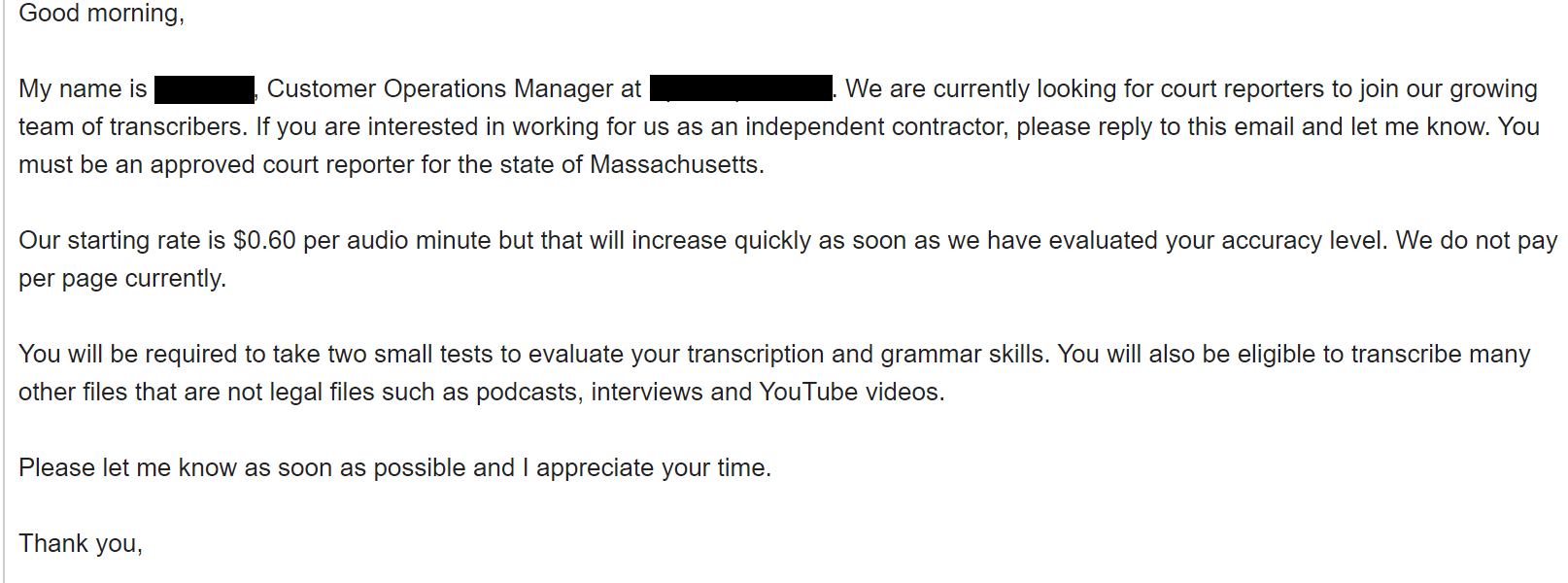
A member of our court reporting community was sent an e-mail soliciting work at $0.60 per audio minute. For contrast, I have heard of reporters working for $100 an audio hour or more, or the equivalent of $1.67 per audio minute, and that was over 10 years ago. It would be about $2.25 per audio minute today, or about $135 per hour, adjusted for inflation.
Independent contractors offered $0.60 per audio minute, less than half the going rate.
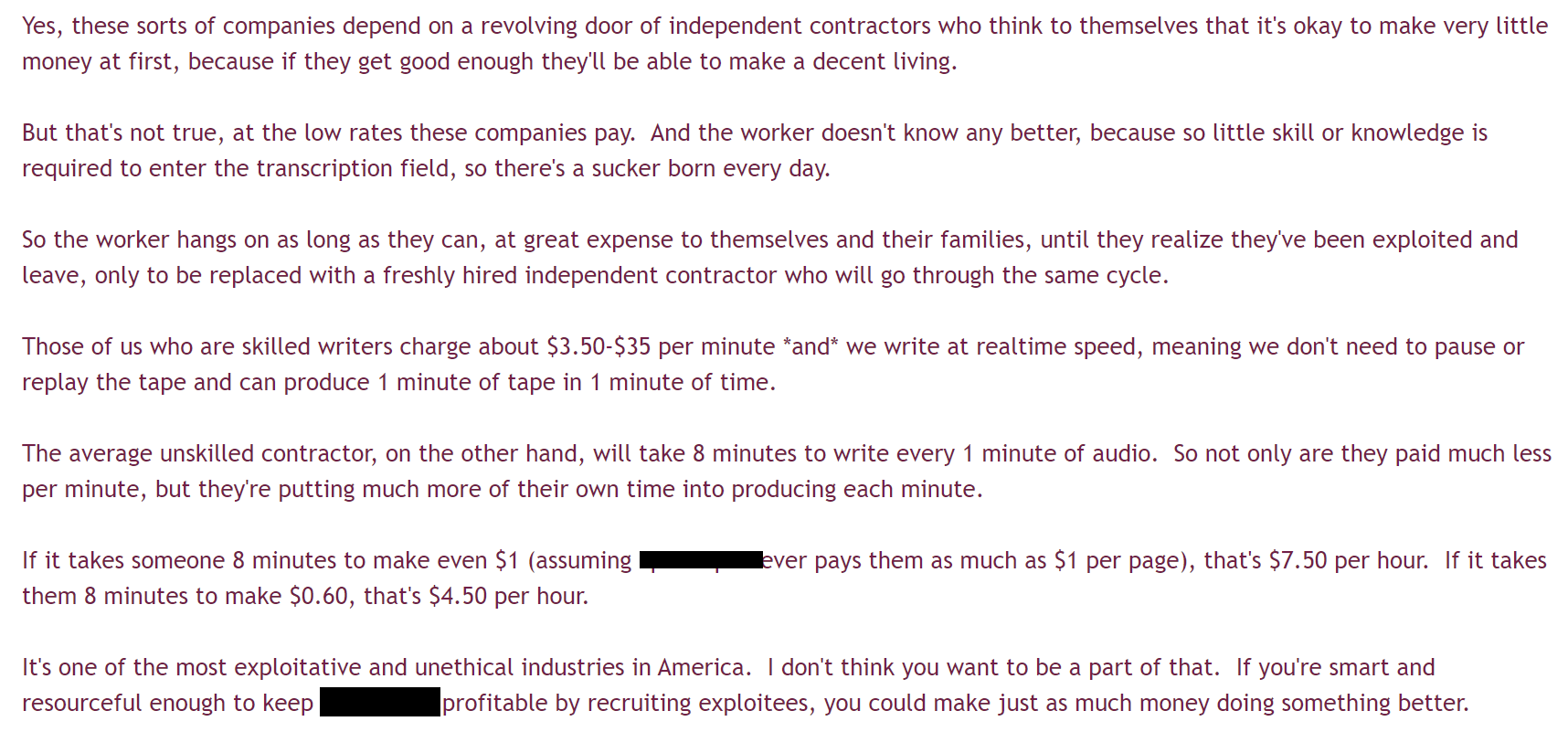
Many of us would take issue with that kind of an offer, but this stenographer took the opportunity to educate.
Response to independent contractors being offered $0.60 per audio minute, less than half the going rate.
The company rep apologized and explained that she was not aware. But the stenographer in question kept educating and advocating. I will note that, based on my knowledge of the industry, I believe there’s a typo here, $35 per minute should likely be $35 per page. For anyone not in the field, typically 40 to 60 pages an hour can be expected, meaning 0.66 to 1 page per minute.
Stenographer explains the exploitation of the transcription industry in America.
The corporate rep replied honestly. She had no idea about the earning potential of court reporters.
Response to the earning potential of stenographic court reporters.
Our brave friend continued to educate on the state of the industry.
Stenographer writing about the exploitation of private equity firms in transcription and stenographic court reporting.
To which our company rep closed with:
Company representative on the efficacy of AI in legal transcription.
There are a number of takeaways here. Taking everything at face value, we’re now opened to the possibility that at least some of these company reps are not adequately trained or briefed on the earning potential of court reporters. But it is interesting to note that a company representative is completely aware that AI is not adequate for transcription. It points to a world where we can be drivers of change by simply describing the truth.
It is very unfortunate that companies are diving into the space without an adequate plan to reimburse independently contracted transcribers. But if we can all respond with the above tact and facts when dealing with company reps and transcribers, we can create a shield of information where no one is unknowingly taken advantage of. Not only is speaking up the right thing to do; it will have the desirable effect of increasing job security for stenographic court reporters.
A big thank you for sharing these messages with all of us on Stenonymous.
Addendum:
A reader shared that if one is on the Massachusetts ACT list, they’re paid $3 per page, meaning $0.60 per minute would be a serious reduction in that rate. Even at a highly skilled level, one audio hour can equal one or two transcription hours, meaning that $0.60 a minute is the equivalent of $0.20 a minute or $12 an hour. Unskilled transcribers can take much longer, particularly if the audio quality is bad, meaning their true hourly rate is even lower.