In a May 5, 2023 article by Tracey Read, issues with recording were addressed. Interestingly to me, there was a blurb in there about our shortage.
In a 2023 article, it is stated that according to NCRA there is -currently- a shortage of 5,500 court reporters.
You might look at that and say, “so what?”
Remember those Speech-to-Text Institute folks that I call frauds? Well, let’s just take a look at this screenshot from what I just linked.
In a projection released by the Speech-to-Text Institute years before 2023, it was stated that there would be a gap (shortage) of 11,345 court reporters in 2023. A number that is potentially double the actual shortage.
On May 6, 2023, I reached out to NCRA to find out if this article was accurate, and I will publish the response, if any, in an addendum at the bottom of this post. If there’s no addendum, assume no response yet. I’d say check back in a week. As of now, all I’ve been told is “let us check and see where this might have come from, if anywhere, Christopher. Thanks for bringing it to our attention.”
Hopefully this makes it pretty clear why I’ve been so stuck on this issue. A shortage of 11,345 is a lot different than a shortage of 5,500, and now we have in print two very different numbers for 2023.
It seems pretty clear to me that our shortage is less severe than was forecasted, which means that it is more manageable than we have been told for about 5 years, which means that the big boxes in the Speech-to-Text Institute Bloc, having as much market share and working with as many reporters as they do, knew for a fact that the shortage was not as bad as forecasted, and perpetuated the lie anyway.
It’s bittersweet for me. I have been writing about the possibility of false claims being used to demoralize stenographers for almost half a decade, maybe longer. Many who have examined my writing and documentation over the years agree that there is something suspicious going on in stenography land. But many don’t have the time to investigate years worth of chronological discoveries and analyses. And quite frankly, after my medical issues in late 2021, it was easier for some to dismiss me entirely than to believe that such misconduct was occurring in our field.
But this should give stenographers a lot of hope. The shortage is less severe than forecasted. The NCRA is indisputably the strongest court reporting association and in the best position to address the court reporter shortage to the extent that it does exist. And as word spreads that the situation is not hopeless, as so many shills would have had my colleagues believe, we have a chance at drawing in investors to create new and better schools, and expand and improve existing programs in the United States, Canada, and the United Kingdom.
Should it turn out that this is not NCRA’s position, my past analyses about the shortage being less severe than forecasted stand. But then this shifts to a really good point: News media can make game-changing statements and be completely wrong. If we’re not funding our own media arm, we may very well be drowned by lies and incompetence. That’s the state of modern journalism. As industries grow bigger, more complex, and require more coverage, journalism is seeing an economic contraction and nearly a 10% reduction in jobs between now and 2031. Fewer journalists covering more news means we’d better start hiring some journalists if we want a fair shake. Oh, and the other side has probably been doing that for years, let’s not forget that part.
I leave my core audience with a poem.
AUFT AEFD SAEUD WHA T- SAEUD FPLT
EU SEUPL PHREU SHAEURD T- W- -T WORLD FPLT
EU TPHAOU TPHOT W-R T- HRED RBGS
OEPBL THAT WHAOEUT TPHRAG SHUD TPHOT -B UPB TPURLD FPLT
SKP SHUD KWES A RAOEUZ RBGS
AZ THE OFPB TKO RBGS
HRAOBG TPOR TRAO*UT SKPUL TPAOEUPBD TK-RB
TAES HRAOBG -G TPOR U TAO FPLT
Addendum:
NCRA President Jason Meadors responded to my initial May 6 inquiry on May 12, 2023.
“Chris, mystery solved. That was lifted from the Ducker Report, which was before my time and has been pretty well debunked now.”
A big thanks to NCRA for the transparency and honesty.
I came across a posting by attorney Gennadiy Naydenskiy seeking to buy a court reporting firm. I have been told that a New York or Florida firm is preferred, but any state would be considered.
We cannot control the buying and selling of businesses, so I share this freely in the hopes that it finds its way to a small business owner in need.
I was given some surprising information from Cassandra Caldarella recently, so keep an eye out for that post coming up!
Using Wolf PAC’s constitutional convention model, a move meant to stop the unlimited flow of corporate money into politics that occurred after the Citizens United ruling, the legislatures of the United States have convened a constitutional convention to introduce Amendment 28, the institution of the New Corporate Republic. The Executive, Legislative, and Judicial branches, and all other constitutional amendments except for the Second Amendment are hereby abolished. The S&P 500 will now control all functions, agencies, and responsibilities of the United States government and state government functions, and shareholders will be the only vote that counts. Elon Musk has already bought and moved into the White House, as it no longer serves a governmental function. Capitol Hill has been renamed Capital Hill. Former Supreme Court Justice Clarence Thomas went on record today, stating “wow, I took so many bribes from these people. I never thought they’d come for my job too.”
The new corporate government declared the United States is now a compulsory consumerist state. Anyone that does not buy at least one thing a day faces an automatic fine that cannot be waived. Those that do not pay the fine or violate the law again will be forced to work for free indefinitely or face summary execution for being an unproductive member of society that doesn’t contribute their fair share™️. Advocates for the poor and disabled object, but we didn’t like them when this was a free country so there’s no chance we’re excepting them from this rule now.
Free speech is suspended pending further changes to the law. Any expression that disparages the new government or any business interest is illegal and will lead to you and your family disappearing mysteriously in the middle of the night. A part-time government spokesperson issued a statement today, “the new rules are far more protective of our economy. If you wouldn’t say it to your boss or at the workplace, just don’t say it at all, because anything you’ve bought in the last 10 years is listening and you will face consequences.” The spokesperson further clarified that AI automatic speech recognition would be used to detect anti-business rhetoric. When asked how the system would safeguard against the constant errors in speech recognition technology, the spokesperson added “oh, it won’t. It’s much too expensive to hire people to double check. I suggest all of you make as little noise as possible.”
The song Beast by Nico Vega and any non-corporate media has also been outlawed. People suspected of producing music will face a convenience charge of $29.99 per song, and a song has been defined under the new law as “one minute of continuous or semi-continuous sound.” All other media will face a surcharge of $0.67 per second.
Our national animal has been changed to the AR-15. Citizens are encouraged to buy as many guns as possible, but first must be fitted with a brain-reader chip to scan for thoughts of harming business interests. Harming anything else is fair game, because it will likely stimulate the healthcare, construction, and insurance economies, making us a better nation.
Public schools will be closed nationwide over the next three weeks as the government decides which ones will be allowed to continue to operate as private institutions and which ones will be demolished so that the land can be repurposed for commercial and/or industrial development. Neighborhoods with high minority concentrations are said to be the most likely candidates for pollution-creating structures and carcinogenic products, because keeping that stuff away from whites ensures their obedience and apathy.
All citizens will be issued $100,000 of debt at birth. Immigrants face a $3,000,000 debt. If regular payments are not made by the debtor or their parents/guardians, the debtor will be seized by authorities.
Courts are suspended. Criminal actions will be punished with slavery, just like when we were a free country. Civil actions against business or economic interests are dismissed.
The American right to unionize and discuss pay shall be abolished. All unions and nonprofits, including religious institutions, are ordered to turn over all assets to the S&P 500 for repurposing and/or resale.
Anti-corporate terrorist Christopher Day will have his public execution live streamed, and the advertising revenue will be used to hunt down other dissidents. When asked what his crimes were, it was revealed that he wrote a blog called Stenonymous that spoke out against corporate misconduct. Asked how that makes one a terrorist, the government responded, “everyone we don’t like is a terrorist, just like when we were a free country.” Anyone else with a history of anti-corporate activism may opt out of public execution by adding $10,000,000 to their citizen debt.
U$A military spending will be increased by a factor of 10 so that the new corporate government can complete the Happy Consumer Satellite Array by SpaceX, which will help regulate human minds worldwide to be subservient to the New World Order, moving products from ownership to subscription-based. You will own nothing and you will be happy.
We are Earth United, brought to you by the New Incorporated States of America. Let freedom ring.
*None of this is true. It’s part of Stenonymous Satire Weekends, a project to help expose what’s occurring in my industry. I’m a blogger in my field of court reporting, and we’ve got a bit of corporate misconduct going on. I started publishing about it actively in September 2021 and we tried reporting it to government agencies that are supposed to handle that kind of thing like the FTC and New York State Attorney General. The FTC issued a weak statement about gig workers and the NYS Attorney General doesn’t investigate single complaints. It was kind of interesting for me because, being a court reporter, I was a big believer in the system. But the government at every level has shown that it has zero intention of doing anything that might harm business interests, even if they’re violating antitrust laws, deceptive business practices laws, and false advertising laws.
As an American, I’m disgusted. We rely on our government to enforce our laws equally. Imagine if the police didn’t investigate single complaints? “I just got robbed.” Sorry, we don’t investigate single complaints. “My brother was murdered.” Sorry, we don’t investigate single complaints. Well, you know what? Maybe the police are like that too, because a few months ago I met a man that says the authorities are ignoring his ex’s perjury and de facto kidnapping of his daughter. There’ll be a post about that someday soon, but the point is that we have a very real problem in this country of capitulation to anybody with money and chronic underfunding of government agencies meant to create balance in society.
And the “free press” that we rely on as Americans to report on a corrupt or inept government/organizations? It relies on corporate advertisers, so it’s not in the business of reporting on corporate fraud and, in our case, just repeats the corporate narrative of a court reporter shortage. So you literally have a situation where 18,000 to 30,000 good jobs are threatened with replacement by low-paying jobs due to the deceit of a few powerful corporations and the government and media side with the liars through their inaction, which will also likely lead to the degradation of court record accuracy and increase inequality when it comes to the recording of “minority speech” or dialects.
Billions of dollars lost to wage theft, but the media’s more concerned with what Elon Musk has for breakfast and our elected officials are basically using their offices for self-enrichment. Journalists that parrot the government or press releases have long been lambasted as stenographers. Hilariously, it’s thestenographers that are trying to bring you the truth.
If you don’t think any of this is a problem, I don’t know what to tell you. The government has signaled to corporate interests that it will not enforce the law against them. What happens when you tell a criminal their actions are consequence-free as long as they do it in a polite, sneaky fashion?
I don’t know exactly how to solve all this, but I’m willing to be a part of the solution. For starters, here’s a song I had commissioned to speak out against the corporate consolidation and corruption of the United States. Enjoy. If you want to throw a few dollars my way to help this reach more people, feel free to use the donation box on the front page of Stenonymous.com.
Patriots Against Corporatism Song by Anoynmous – Commissioned by Stenonymous.com
In the past I wrote about how the Active Readback guy was wrong. Medical transcription wasn’t necessarily improved by technology, and I felt that that was a rallying cry for us to realize that businesspeople do not have the health of industries in their hearts. They care only about extracting wealth.
Last night, Sue Terry, Past President of the National Court Reporters Association and someone I admire very much, sent this writing by Dale Kivi. It talks a lot about medical transcription, the shell game of fast vs. quality vs. cheap, and the changes they were seeing around March 2017. There are some major points I’d like to comment on.
The first major point is an argument we can adopt. One methodology was having physicians do the documentation themselves with assistive technology. Perhaps unsurprisingly, this costs time, and in a physician’s world, that’s money — up to $80,000. If any attempt is made to shift record creation to an automatic lawyer-assisted process, this is our first line of defense. It’s going to cost them time, and that’s going to cost them money. We know that because we already have an industry that tried it out. The argument can be augmented a bit. The time spent on reconstruction hearings for missing recordings, and/or the time spent remediating transcript issues, is time and money burned.
Transcription Shell Game by Dale Kivi excerpt for Stenonymous commentary.
“Traditional transcription was summarily dismissed as old school,” writes Kivi. This is word-for-word what’s being done to us. The perception that we are outdated is being used to peddle tech to lawyers. And even worse, as it says at the end, organizations then don’t admit errors because of the sunk cost fallacy. So where there are problems, organizations don’t admit them. Cough, cough, here’s talking to you, court administrators who have adopted electronic or digital recordings that mysteriously go missing with no oversight or public awareness of the problem. Perhaps a winning move in our fight is to point at the non-existent accountability of courts to the public. I’ve personally had conversations with court reporters that couldn’t speak out about missing audio because it would threaten their job or make their judge look bad. But you know what? Maybe these people should look bad, because their refusal to track problems or even admit there are problems threaten innumerable future court records and the lives of people those records impact. They’re trying to delete us state by state anyway. What do we have to lose?
Transcription Shell Game by Dale Kivi excerpt for Stenonymous commentary.
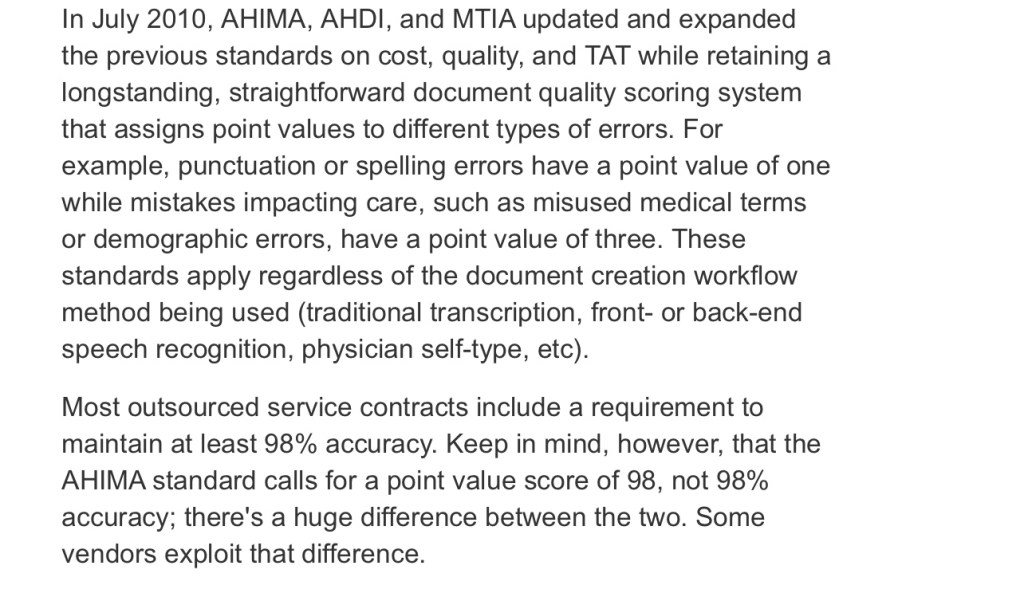
The next paragraph I’ve cut out shows you just how similar our fields really are. There are three associations, presumably with competing interests and methodologies, and word games are used to secure contracts. For example, Kivi writes about 98% accuracy versus a 98 in their scoring system. Elsewhere in the article it mentions these documents could be around 300 words. 98% means 6 words could be missing. Meanwhile, in the scoring system, missing a word that impacts care is an automatic fail. This is very similar to how automatic speech recognition makes big claims about word error rate, and that’s used to make the case for accuracy. But in reality a 5% word error rate is not a stenographer’s 95% accuracy because we count a lot of minutia in our errors. That’s not even addressing that we’ve seen word error rates as high as 75%.
Transcription Shell Game by Dale Kivi excerpt for Stenonymous commentary.
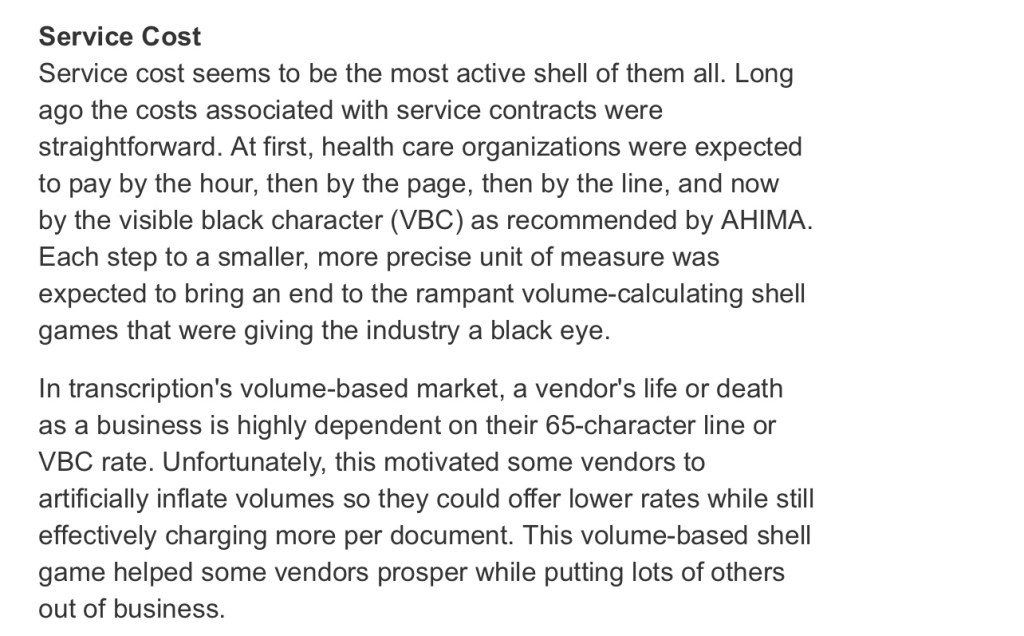
The next part is mind boggling. It talks about a shell game in service cost, and presents that some vendors would inflate volume to make up for offering lower rates that secured them contracts. This happens in our industry too. For years, there have been social media reports™️ of agencies taking the reporter’s work and changing the format to add pages, effectively cutting the reporter out of extra income created by the deceit. Funny how a price can go down but revenue can go up, isn’t it?
Transcription Shell Game by Dale Kivi excerpt for Stenonymous commentary.
The next part is simple. It talks about how vendors claim they are using the industry standard when no such standard exists or is encouraged by the associations of medical transcription. This is what we are experiencing now in court reporting. Somehow, everybody in the game has the newest, most cutting-edge technology and promotes high standards. Does that seem like it makes sense? Somehow, for the past 20 years, automatic speech recognition usable for the legal field has eluded the largest companies in the world, as per the Racial Disparities in Automatic Speech Recognition 2020 study. Yet all these little companies in a minuscule industry have it? As I wrote on social media, it is my belief that in actuality what occurred was that OpenAI’s Whisper and things like it went open source, companies took it and tweaked it a bit, and now it’s theirs™️. Is it better than voice writing? Doubtful.
Transcription Shell Game by Dale Kivi excerpt for Stenonymous commentary.
The next paragraph should be read by every lawyer in the country that utilizes court reporters. Summarized: After a big market fight over methodologies and pricing, “organizations are catching their breath, many are left with empty pockets, unhappy physicians, questionable quality issues, and shady pricing.” After the dust settles in the market war with stenography, voice writing, and digital, organizations (law firms) will be left with all of that too, in my estimation. If you follow my work, you’ll know I’ve said outright that I believe there’s a kind of antitrust predatory pricing mindset built into the digital side of the market. Strangle out the stenographer competition, the number of competitors goes down, prices likely go up in sneaky ways that lawyers won’t catch unless they’re looking, and voices for quality like ours fade away, effectively ceding the market to the most conniving competitors and the court reporting oligopoly I call STTI Bloc. More on that later in this post.
Transcription Shell Game by Dale Kivi excerpt for Stenonymous commentary.
The last bit really impressed me. Kivi openly admits he’ll be chairing the AHIMA Foundation, AHIMA being one of the associations written about. Our field is a bit spotty on that. Sometimes people reveal their allegiances and commitments, and sometimes they conveniently leave it out. The honesty, in my view, lends Kivi’s writing credibility.
But more than that, he writes, in pertinent part, “It’s time for HIM…” (health information management) “…to take the lead…” “…if vendors do not follow the AHIMA guidelines for…” “…best practices…” “…someone must be prepared to call them out.” What is he saying there? It is incumbent on the customer to demand better from vendors. Again, this is the situation in our field. We are doing everything in our power to alert lawyers to the realities of the field, some of which they haven’t had to deal with for decades. People that point at our self-interest never seem to address the elephant in the room: Whatever our interest, it is tiny compared to the interests of the big box firms, who have millions of dollars at stake and may be zombie corporations (zombie video).
Transcription Shell Game by Dale Kivi excerpt for Stenonymous commentary.
There is another issue to consider when it comes to medical transcription technology versus court reporting. In medical transcription there is typically one speaker, so software can be trained to that one speaker. Continuous dialogue and Q&A is quite a bit different from medical dictation, and likely makes it harder to train “AI” systems.
I would like to note, though it’s not explicitly said, we look to associations to set guidelines and standards. The curious person might ask why these associations are not the ones calling vendors out on their shady, shoddy practices. Associations are limited by antitrust laws because they can be seen as, and to some extent factually are, competitor collectives. Under antitrust laws, competitors cannot band together to force another competitor out of the market or collude to set prices. When I spoke to a lawyer about antitrust, I was told there needs to be 1) Monopoly power, 2) An anti-competitive act, 3) Damage. Monopoly power usually refers to a high market share, but the sway associations have on industries would likely count. The anti-competitive act would be competitors banding together to hurt a vendor’s reputation. The damage component is what it is. So, perhaps humorously, we live in a world where a large corporation could sue an association that called them out for bad practices by using antitrust laws even if the corporation had much more revenue than the association. Worse than that, the corporation would probably have better lawyers, because they have the money to spend on them.
It’s my belief that the STTI Bloc and the oligopoly plot would fit the mold too, which is why I’ve referred to their activity as an antitrust conspiracy. It’s very clear that the companies under the Speech-to-Text Institute, such as Veritext, US Legal, and Stenograph, are using their high market share and favorable positions in the field to strangle out smaller steno competitors. USL bought and killed StenoTrain and turned Patricia Falls into a digital shill. Veritext is buying everybody out while conditioning future consumers to view stenography as obsolete. Stenograph’s using its dominance in sten-tech to shift from “everyone must go realtime” to “all the technologies we provide are realtime, honest.” Unfortunately, the government is inert. Only consumers damaged by the deceit can bring a claim. And who is going to bring a claim when they’re unaware they’ve been defrauded?
This is why my strategy is independent publishing. I’m a guy with a blog. People donate if they like what I’m “selling.” Most of that money goes toward trying to raise consumer awareness. Again, consumers are the people with the most power to stop what’s occurring. This strategy eliminates the antitrust issues because my donors are not a competitor collective, they’re just giving me money in the hopes I’ll use it for good, which isn’t illegal. Any frivolous lawsuit would get tied up in the backlogged court system for somewhere between 2 and 6+ years, all the while giving the media time to pick up on the court filings and blow the fraud wide open Streisand Effect style. It would also open the doorway for misled lawyer and student consumers to bring their own deceptive business practice or other claims as word spread. That’s why Veritext harasses people for their posts on Facebook and leaves me alone even though I’m the one that comes up when you Google search Veritext. With enough funding, we could get the fraud in front of millions of eyes, and there’d be no running from it then.
Google searches of Veritext reveal Stenonymous’s fraud claims. The company has been silent on these claims for over a year and a half.
It’s actually pretty phenomenal that they’ve allowed me to do what I’m doing without any resistance. The smart consumer is going to look at my claims, look at the years-long non-response of the larger corps, realize they’re outside the statute of limitations on defamation, and realize that the officers have a fiduciary duty to uphold the best interest of the company and shareholders. That means if someone is trashing your company in such a way that it could impact the value of that company, you’re obligated to do something. The only world where you let someone do what I’ve done is a world where it’s all trueand there’s nothing you can do but hope the world doesn’t find out. Maybe a litigious shareholder will sue company officers for an alleged breach of fiduciary duty. Who knows?
So that’s my take on what we can learn from our sister industry along with the parallels and differences I saw. It’s also my take on why Stenonymous, at this point in the history of court reporting, is an effective performance for stopping corporate fraud.
In a statement released Thursday the popular court reporting blog Stenonymous revealed that it was seeking a sugar donor for investment in increasingly bold media stunts. Q1 Revenue was lower than expected, causing panic among the Stenonymous board of directors, long lambasted for its complete lack of diversity.
In other news…
New constitutional amendment: A stenographer must be present to record Miranda warnings.
New Constitutional Amendment: Stenographer must be present to record Miranda warnings. Stenonymous Satire Weekends.
Bud Light hires controversial stenographic strategist Christopher Day to promote the brand. “When the liberal mafia and real American conservatives figure out I’m a cis white male roleplaying as a malignant narcissist, sales will go through the roof,” says Day.
Juul settlement causes uproar in the world of court reporting. “Couldn’t they just wait until discovery was over?” says local deposition reporter.
NYC Fire Department’s Bureau of Investigations and Trials investigator under fire after fist bumping stenographer during secret proceeding.
NCRA Spokesperson: “No, we will not be having the convention in Intercourse, Pennsylvania.”
Disney searching for stenographer for impending lawsuit. Must pledge loyalty to the House of Mouse and will be paid in Disney gift cards.
*None of this is true. This is part of Stenonymous Satire Weekends where I try to mix news and current events with steno to get some hits and draw attention to ongoing fraud in court reporting. It brought up April’s stats, so I think it’s worth it to continue.
This is something I’ve thought about a bit. But it might help some of us cope and come up with solutions. A lot of it is personal perception based off stuff that’s happened over the years and conversations I’ve had, but I wouldn’t write it here if I didn’t believe it to be true.
For a long time, machine shorthand (stenotype) stenography was on top. Nobody could touch it, and that alone kept us “great.” Having minimal competition made us soft. In economic terms, the bigger you grow in a market, the harder it is to continue that growth, and we were the market. We arguably still are, but it’s hard to say because so much of the market is in private hands and misinformation is rampant.
Big money comes in, and it opens its Veritexts and US Legals. The big boxes would come in, tell reporters they have so much work, and get some reporters to work for just a little bit less. This game had varying levels of success dependent upon the state. Here in New York, it was particularly bad. Our freelancers make a whole lot less than people that live in states with a lower cost of living. Meanwhile, on the client side, big box could buy their way in with gifts to law firms and lockout deals with insurers. I’ve seen some estimates that say as much as 70% of litigation is insurance funded, so if you control that, you control the market. That’s also why small businesses have such a hard time growing. They’re literally picking up the scraps the big boxes do not care about. This all creates a market crash. People are asking reporters to work for less and less to keep competitive. Small court reporting shops take a beating (and then, years later, big box gets to buy out the survivors for cheap.)
That sets the stage for where we were when I came to this field. Nobody was talking about it except the schools. If you asked a school, it was the best thing in the world, court reporting sells itself. You’ll make so much money. The fact was you COULD make that money, but it was not a reality for what I suspect is a silent, overworked majority. I can only point to stories I heard from down south of a certain agency owner stiffing reporters on their bills and then declaring bankruptcy. If that kind of stuff was being pulled on veterans of the field, what was being done to newbies? Fewer people spoke about stories like that then, and people like me that tried to talk about the issues we were having were often ostracized. To this day, I remember being told that if I didn’t like what I was making I should just do something else. A lot of people I knew did go on and do something else. We lost people because we were too afraid of our own issues. We were too obsessed with proclaiming we were the best to actually make ourselves the best.
Oh, and as it happened, the schools started getting in trouble for misleading claims. Telling students they could graduate in two years when the average was five (program-dependent) and things like that. The for-profit sten-ed system was being attacked, and schools started closing, likely realizing their days of milking people with big promises were drawing to a close. A lot of good actually came from that, because we started to talk about the education more honestly, and some of us even started talking about how we improve the pass rate. But bad came from it, because digital’s big indictment of modern steno is “there are fewer schools than there once were.” Of course there are, you jackelopes, you’re literally siphoning away the money that created the demand for those schools.
Coincidentally, it’s around this time period that Jim Cudahy, then the Executive Director of the National Court Reporters Association, got the shortage forecasted via the Ducker Report that I love to poke holes in. Assuming good faith, he was trying to get us to do something about our retirement cliff. Assuming bad faith, there was, again, around that time period, a faction within NCRA trying to push digital as a solution, a “plan B,” so maybe that faction and big money already had a plan. We can’t know for sure, but I have suspicions.
What we do know is that a confluence of events and circumstances were driving down the demand for schools, stenographers, and small businesses. But conventional wisdom at the time was “realtime is the future, everyone should go realtime.” The NCRA was into that because a whole heap of its power is derived from certifications and if everyone is realtime it’ll mean a lot more certifications. The software vendors were into that because they could sell support and keep reporters on the hook through monthly/yearly contracts, which was important, because the new generation of exploited, “tech-savvy” reporters like me weren’t buying support contracts. The agencies were into it because creating a higher supply of realtime reporters would lower the price of realtime reporting, economics 101. Basically everybody was getting paid to tell reporters realtime is the future, and reporters believed it wholeheartedly. We didn’t know that they’d just turn around and start calling any technology realtime in order to satisfy their endless greed.
Stenograph starts calling its digital court reporting technologies realtime after the field spends the better part of two decades trying to force reporters down the highly specialized path of realtime.
Schools closing, new generation of steno reporters not buying support, actual retirements occurring — digital became a self-fulfilling prophecy. Digital reporters are easier to manipulate and control. Agencies like that. There are like a hundred stenography groups on Facebook and yet we still have people disconnected from the field. What hope do digitals have? They literally have to come onto our forums to get their questions answered. Digital’s weak community means it’ll be harder for them to resell their equipment to each other. Theturnover is probably pretty high too. Manufacturers and training programs like that. Meanwhile, our determination not to be erased as a culture and society of excellence means more engagement with NCRA, so it would be weird if NCRA didn’t like that too.
I mean, what a world, where everybody with wealth and power is economically incentivized to push on our jobs. But it seems like that’s what it boils down to. And worse, we’re still barraged with “realtime is the future” so that the realtime reporters don’t get together and fund a marketing campaign that would knock the socks off the people attacking their income. Pacified by a divide-and-conquer strategy anybody who looks can see from a mile away. “No, no, no, your job is safe, we promise. You are special. More special than them.”
I’m not too discouraged though. I’m planting nuggets all around the internet to dissuade people from going digital. I’m pretty sure the corporate ninnies have started copying the strategy to push people away from steno. I think overall the campaign to inform digitals as to the true state of the field is going well. I still view our position as one of strength. After all, the STTI Bloc has to run from the truth. I can stand firm and tell the same old story because it’s mathematical. They simply cannot have a shortage as large as the one they claimed we had without massive national cascading cancellations every single day for the last half decade. Good luck proving that in court.
But perhaps there’s something to be said for solutions. If I’m right and this is all being done due to perceived economic incentives, then we have two clear paths to reverse it. 1) Create economic incentives to use steno. 2) Disincentivize digital use. I’ve explained before that a lot of my activity is geared toward number two. People are pretty smart. You tell them something fishy is up, and in the best case scenario they join steno, but even if it just makes them opt out of court reporting completely, it’s one less person that big box has to fill “the gap.” More dollars spent recruiting = eventually they figure out it’s not such a winner.
Whatever the case, perhaps it will help put things into perspective for people. This is not some big evil conspiracy to end stenographers. It’s all about the money. It’s all about them controlling a market to extract the most money from that market. Each of us are players in the market, and our actions will shape what happens. As I’ve always said, if the situation was hopeless and your jobs were about to be redundant, the big corps wouldn’t bother trying to convince you of anything. They’d pave over you. Instead they’ve resorted to trickery, lies, “persuasion,” manipulation — because if they can get you to give up, it’s a free win.
Make the path of least resistance steno and then they’ll all be forced to go steno. I wrote earlier this year about how companies know how we think and that the best strategy is to be unpredictable. Well, now we know how they think. It’s myopic. It’s “a dollar today is better than a dollar tomorrow.” It’s a devotion to the dollar. That’s a big weakness. Because when you don’t want to lose money, you’ll let people like me walk all over you just to avoid a lawsuit. They’re terrified people like you will boycott. They’re terrified that people like you will follow Protect Your Record Project’s example and start talking with their clients. They count on your self-limiting civility to help cut down this field and steal away the futures of the students we mentor.
But I see something different from even two years ago. I see reporters talking about the issues with unprecedented fire and commitment to each other. It’s no longer lone voices or pockets of talent like NCRA Strong. Now everybody’s part of the solution. Maybe we could get to a point where we could crowdfund a sten-tech company. Maybe we could crowdfund a national training program like digital’s BlueLedge and get in with all the schools they’ve muscled in with. Maybe we could crowdfund a “cooperative big box.” Maybe we could try it my way and go scorched earth on everybody that doesn’t fall in line with the science. The possibilities are endless if we start pooling money, talent, and connections. It’s harder than having a big sack of money, but it’s still feasible.
It’s something special to come away from our neutrality to fight for ourselves for a change…
After the release of my blog about Veritext’s British Columbia advertorial, a reader sent me more information on the province. Their verbal oath confirmation from 1980 was lost and they were asked to sign a new document for them to stay on the official or authorized reporter list.
This reader believes that the language “or reporter realtime technologies” is intentionally vague so as to allow digital reporters in British Columbia. Years ago, I would’ve said “no way.” But given Stenograph’s push to call digital court reporting technologies realtime, it seems much more likely than not.
I’m also informed by this reader that there is a rumor Veritext is charging a separate fee for witness swearing. The reader stated swear-ins need to be done by official court reporters, therefore, lawyers will be economically incentivized to not have swear-ins, potentially allowing digital in the door. The reader’s prediction was such a fee would rise over time to push things further in that direction and allow companies like Veritext to cut stenographers out entirely. I don’t know that they’d cut us entirely, but I do know that increasing the pool of court reporters will cause rates to fall. That goes back to my whole supply & demand argument.
Official reporter oath sent by a retired British Columbia reporter. Allows for “real-time reporting technologies,” which is what Stenograph has now referenced its digital programs as being.
It’s kind of sad that the corporations spent two decades telling everybody realtime is the future just to pull the rug out from under the actual realtime reporters and just say whatever technology they’re peddling is realtime. Now that that trust is broken, Stenograph and any company like it will probably never have it again. When we figure out a way to ween ourselves off of their dominant position in the hardware and software market, it’s an entire stream of revenue that’ll be lost to them, and deservedly so.
This can be a lesson to us in the United States about how language can be used to lie without technically lying. If you’re dealing with someone with sales or legal training, it’s probably best to be on guard, and remember they’re not your friend.
Reader, if you’re reading and want to be credited, let me know. More often than not, people like the anonymity. Maybe we’re all Stenonymous.
Addendum:
A commentator wrote that in 2021 the rule was changed so that everybody had to resubmit their oath. So it is possible that it was not “lost,” but rather a thing that everybody had to do. Because of my lack of familiarity there, I can only go by what I’m told.
Update 5/9/23
My source wrote to me stating they do not believe it was related to the resubmission issue in 2021.
Response from Stenonymous source regarding 2021 rule change in British Columbia.
In a bizarre turn of events Tuesday, the stenographic spy network Stenonymous released a memo to all agents telling them to disrupt the Fox and Dominion settlement as quickly as possible. “Our livelihood hangs in the balance,” said Stenonymous, “disrupt the settlement talks in any way you can.” Communications experts were deployed immediately, but failed to stop the settlement, reported to be over $700 million.
Stenographer Special Operations Team deployed to disrupt settlement talks across the country. Stenonymous Satire Weekends.
In other news…
Cult of Steno voted least likely to drink the Kool Aid.
Stenographer yells loudly at Congress. Americans’ approval of stenographers jumps 30 points.
Senator Chuck Schumer fails to respond to constituents regarding corporate fraud in court reporting. New Yorkers demanding answers.
Local ASSCR member Christopher Day says “thank God we have this board and Eric Allen. Maybe one day I’ll thank them too.”
Testifying While Black study rendered irrelevant after mostly peaceful riots by court reporters.
Upton Sinclair of court reporting vows to end shortage as long as everyone buys his new book.
Mr. Clean reviews digital court reporting transcript. “There’s nothing that can be done about this mess,” says Clean.
*None of this is true**. It’s part of Stenonymous Satire Weekends, a project to humorously link court reporting to current events (or any events) in a bid to get more search engine hits and call attention to the lies perpetrated on consumers and court administrators by the Speech-to-Text Institute and the companies behind the nonprofit.
**Well, okay, I did contact Schumer’s office about this and try to get some help since the FTC seems inert. But he’s just as corporate-controlled as every other politician, so the chances of him helping were always pretty slim. It’s an interesting thing for me because I’ve been a believer in the system my whole life, only to find out that the system doesn’t give a damn about anything that doesn’t help big business crush or control small businesses and sole proprietors. Maybe I’m lucky Veritext doesn’t sue. The system would probably grant the company summary judgment on a motion to dismiss the complaint. For people that don’t know legalese, it would be like declaring the wealthier baseball team the winner of a game before the game even starts.
There are at least some people hitting up stenographer social media with praises about AI and how it’s going to take our jobs. If you see that stuff, keep in mind that if something so good could replace you at a fraction of the cost, they wouldn’t need to convince you about it, they could just replace you. 🧐
I was sent this by a contact over social media. It’s labeled as an advertorial. And that alone gives us enough to pick it apart and figure out what it’s selling. It’s written by Christy Pratt, VP of Veritext Canada.
Veritext releases advertorial about the court reporting shortage, strengthening Stenonymous arguments that the court reporter shortage is being exaggerated and exacerbated to artificially increase demand for digital court reporting.
It goes a little into the history of reporting to give the rest of the piece some credibility. I have no problem with that. But then it gets to its main sell: The shortage is real and times are changing! Hey everybody! Did you know times change? You can trust the rest of the advertorial because the author is making perfect sense up to this point.
Veritext advertorial showcasing that the shortage is being used as a selling point for digital court reporting.
Remember, this is posted to Trial Lawyers of BC. It’s clear who the audience is. They don’t want lawyers to complain about the transition from steno to digital, where the author admits steno is still in heavy use. They want to paint digital as the solution. It’s much easier to tell someone what they want is not available instead of telling them you don’t want to give it to them. It’s a lie to limit consumer choice.
It’s worth noting that the shortage isn’t as bad as it was forecasted to be in America and that the Speech-to-Text Institute’s Jim Cudahy left the field when I accused him of fraud for spreading court reporter shortage disinformation. It’s also worth noting that Veritext is represented in the Speech-to-Text Institute’s leadership by Adam Friend, VP of business development, and has not made any attempt to correct the misleading information put out onto the market by STTI. Misleading information that threatens the futures of ourselves and our students, by the way. Does anyone believe that Veritext, a multimillion dollar corporation that benefits financially from the expansion of digital, would not spread the same lies in Canada?
I’ve had people lie to me over $5. When the future direction of an industry is at stake, does anyone believe this isn’t fabricated? And I’m sure I have a detractor or two who would point at me and say the same, but let’s be real, in my wildest dreams Stenonymous makes me maybe a million dollars someday because some rich person realizes how much fun it would be to set me loose on the world or Veritext realizes my creative genius can be bought (in reality, I lose money on my media activities, even with the support of my wonderful audience.) This industry is close to $3 billion annually by estimates I’ve seen. Who has a greater incentive to lie? And it’s not like they can claim they don’t know about my research now. They’re basically using my arguments on AI to make the case for why court reporters won’t be replaced. I’ve basically never had better proof that Veritext execs read the blog and understand at least part of my work.
To make matters worse, a source inside a big box is saying the nickel and diming of stenographers is getting worse despite the alleged demand. If they’re chipping away at the incomes of high-end realtime reporters, the average reporter isn’t going to stand a chance.
Reporters, organize and resist or be ruled by people that don’t care if you have a good life. That’s all there is to it. I know my methods come off as extreme, but it’s an extraordinary case where an entire profession is threatened with extinction based on a lie. It’s a classic what-would-you-do scenario, and I’d like to think that if every reporter had the same statistics and information that I have seen and published, they’d be just as outraged. They’d fight just as hard, and maybe harder.
Steno Imperium has a post up about corporate responsibility and the various things that Planet Depos, US Legal Support, Verbit, Veritext and Stenograph have done. In some instances it alleged violations of law and dives heavily into the conduct of Kathy DiLorenzo.
It’s a long read, but provokes a lot of thought. I don’t want to take up your time or detract from the piece by regurgitating everything here, so go check it out!