About a month ago, I stepped away from most volunteer activities in organizations I really love and support. My reasoning at the time was simple. I had to step away for health reasons. Stress is a killer, and to say I was feeling stress in both my personal life and professional life would be an understatement. On a bad day, my commute can be two hours one way. At the point I sent my resignation emails, I was honestly in tears. I saw pretty quickly that I would be ineffective in my positions. I did what I thought was the right thing and stood aside so somebody better could step in. I will probably always keep my memberships going, but my volunteer duties have hit almost a full stop for now.
Kind of like this sign, which is written in steno.
But there was a much more pressing issue brewing. Juggling the responsibility a board member has to an organization with the self-imposed responsibility of reporting industry news and commentary had become impossible. If anyone threatens to sue me as an individual, I’ll deal with that. But what if someone attempted to drag an organization into a suit because of an article I wrote? What if a leader had to throw me off a committee because of some perceived liability or controversy I was causing? After all, if you ask NCRA, a bylaws amendment I support, which is completely proper under our bylaws, is out of order and illegal. You should vote yes on the amendment proposals this year, by the way. Not doing so makes our association weaker. That said, rather than create those difficult situations, I could step down and continue to be one of many voices out there saying what needs to be said. I didn’t ask permission or advice, I just did it.
But I still need support from you all. The biggest stories arise when people like you send me documents, emails, articles, and research. You don’t ask permission or advice, you just do it in the hopes that a more informed field is a stronger field. For example, I’ve “always” known and written about how copies make the bulk of the money in this business despite how deflated the copy sales are for New York City reporters. But getting a real-life example from a reporter allowed me to tell people they could double their money taking private clients.
With more information it will grow increasingly harder for corporations and unscrupulous people to take advantage of reporters new and old. It will grow increasingly harder for corporations and nonprofits to lie or mislead people. And when people stonewall this blog, they’ll be signaling to thousands of readers that there’s something to hide.
This is a lot of clicks for a field of 30,000 people and limited marketing. Imagine what I could do if I was actually good with money and business.
In a conversation with somebody I really love and admire, I was told “you don’t fight guns with bayonets.” That holds true here. We cannot continue to stay silent while corporations treat reporters poorly only to turn around and offer them positions as digital reporters. We cannot continue to stay silent while digital reporters are misled into believing stenography is antiquated or lacks viability as a career. We cannot stay silent while the media mindlessly republishes false or misleading information, or omits important facts regarding our work. My promise is that I will not stay silent. I will do what is necessary to accurately report on the business bonfire of automatic speech recognition. I will keep anonymous sources where appropriate. I will dig for information where I can. I will be honest even when it’s uncomfortable.
Intrinsic to my promise is trusting that reporters will continue to trust me. There are articles on the horizon that will slay sacred cows. From my perspective, this is necessary. Our field suffers greatly from gatekeeping and so much business being conducted solely by word-of-mouth. The simplest example goes back to the beginning of my education and career. In 2008 I was told “court reporting sells itself. It’s the best six-figure salary you haven’t heard of.” By 2011, I had been told there were too many reporters and not enough work. That’s why our rates were low. Attorneys wouldn’t pay extra for medical testimony. That’s what was told to me. “Attorneys see reporters as a dime a dozen.” All that information was wrong. It stands in stark contrast to all that’s said today. “Reporters are the gold standard, there just aren’t enough of them.” At a lawyer conference in New York just a couple of years ago I was told by lawyers “we want court reporters!” “Our firm exclusively uses stenographic court reporters.” The hard truth was reporting was a great skill and in great demand, but people would obfuscate that if it made them a buck. Had there been anyone tracking these claims, anyone would be able to look back and see exactly who did what, when they did it, and how those claims changed over time. And that’s the point of this promise. We collectively take things out of the realm of “I think XYZ happened in 2008” and present names, dates, and evidence that anyone can access.
From time to time I’m hit with a question along the lines of “why bother?” “Why do you care?” As a young reporter, I had to navigate starting life and sorting out who was lying, wrong, or withholding information. All those things I mentioned in the above paragraph happened to a young introvert who just wanted to keep his head down, do his work, and do okay in life. Often when I turned to friends and mentors, I felt more defeated than before I’d asked for help. If I was having trouble finding work, I wasn’t hungry enough. If I was overwhelmed with work, I wasn’t managing my time correctly. I was told by a mentor not to take a civil service test because I did not meet the experience requirement, but I later learned they encouraged someone with less time in the field than I had to take it. I regularly reported my experience in the field back to my school, and my school did not bother to share the information I gave it with students. Once I discovered copies were the bulk of the profit in the field, I shared that with a teacher and mentor. He said “of course. Without copies, these agencies wouldn’t survive.” He’d known all along and never bothered to tell me. These were my allies. They gained nothing from my ignorance. What chance did I ever have negotiating with people that benefitted from my ignorance, from offering me $2.50 a page on 50-h hearings, like Lex Reporting? How could I negotiate with agencies for better copies when market share monsters like Diamond Reporting weren’t paying most of their reporters copies at all and the reporters who were making copies felt pressured to tell no one? The worst of it was being treated like I was crazy. “Nobody pays big on copies. Why would that ever change?” “You have to pay your dues in this field before you can complain.” When did non-reporter owners pay theirs? It wasn’t until Mary Ann Payonk sponsored me going to an Anita Paul workshop, and I got to talk to an Ohio reporter making $2.00 a copy, that I learned just what kind of environment I was in. It doesn’t take a math genius to figure out that making 12 percent of what other reporters were making in an area with almost 5x the housing cost is well within the territory of “being screwed.” But it does take court reporters having the courage to share that kind of information to stop their fellow reporters from being screwed. But for the bravery of other reporters, I probably would’ve done what many of my contemporaries did and left this wonderful field. Now I have the chance to stop others from doing the same.
Housing 60.9. I can’t vouch for the accuracy of the index, but this is a snapshot for comparison.Housing 294. Almost 5x as much. Of course we should pay those people 88 percent less.
Certainly there is some level of personal responsibility, and I bear quite a bit of the blame for the rough times I had. I often was not assertive enough or reluctant to act on the advice of mentors after my initial letdowns. Some of my misfortune in the freelance sector was due to naivety or being a poor communicator. But even so, it didn’t have to be as hard as it was. It was made harder largely by gatekeeping and secrecy. These experiences and revelations culminated in some pretty human feelings, “it shouldn’t be this way.” “Someone should do something.” “No one should ever feel the way I did.”
As I see it, the future of this blog is in providing the news, facts, and accounts that will accelerate reporters’ journey in understanding the field and business. The future of this blog is aimed at making sure we’re not assuring our graduates there’s a future in this field and then letting them drown in the working world like many of us were left to. The future of this blog is in advocating for this field with a ferociousness that will make liars think twice before playing word games. Again, it all relies on submissions and people sharing information. So if you happen to stumble across something newsworthy or informative, please write me at ChristopherDay227@gmail.com. We can stop the next generation of reporters from being railroaded together.
A series of 2019 predictions by Gartner were reported on by Venture Beat on June 28, 2021. As explained in a priorpost, “AI”, or machine learning, relies on datasets and algorithms. If the data is imperfect or incomplete, a computer has a chance of giving bad output. If the algorithm that tells the computer what to do with the data is imperfect, the computer has a chance of giving bad output. It’s easy to point to anecdotal cases where “AI” makes a bad call. There have been reports of discrimination in facial recognition technology, driverless cars killing people, or Amazon’s algorithm deciding to fire drivers that are doing their job. I’ve seen plenty of data on the failings of overhyped technology and commercial ASR. What I hadn’t seen prior to today was somebody willing to put a number on the percentage of AI solutions that succeed. Today, we have that number, and it’s an abysmal 15%.
Perhaps this will not come as a surprise to my readers, considering prior reports that automatic speech recognition (ASR), an example of machine learning, is only 25 to 80 percent accurate depending on who’s speaking. But it will certainly come as a surprise to investors and companies that are dumping money into these technologies. Now there’s a hard number to consider. And that 15% itself is misleading. It’s a snapshot of the total number of implementations, not just ASR. ASR comprises a percentage of the total number of implementations out there. And it’s so bad that some blogs are starting to claim word error rate isn’t really that important.
Judge, I know I botched 20 percent of the words. But word error rate really isn’t that important.
That 15% is also misleading in that it’s talking about solutions that are implemented successfully. It is not talking about implementations that provide a positive return on investment (ROI). So imagine having to go to investors and say “our AI product was implemented with 100% success, but there’s still no money in this.”
The Venture Beat article goes on to describe several ways to make AI implementation a success, and I think it’s worth examining them briefly here.
Customizing a solution for each environment. No doubt that modeling a solution for every single business individually is bound to make that solution more successful, but it’s also going to take more staff and money. This would be almost like every court reporting company having their own personal software development staff to build their own CaseCAT or Eclipse. Why don’t they do that? It’s hopelessly expensive.
Using a robust and scalable platform. The word robust doesn’t really mean anything in this context. Scalability is tied to modular design — the ability to swap out parts of the program that don’t work for specific situations. For this, you need somebody bright and forward thinking. They have to have the capability to design something that can be modified to handle situations they may not even be aware exist. With the average software engineer commanding in the ballpark of $90,000 a year and the best of them making over $1 million a year, it’s hopelessly expensive.
Staying on course once in production. This involves reevaluating and sticking with something that may appear to be dysfunctional. This would be almost like the court reporter coming to the job, botching the transcript, and the client going “yes, I think I’ll use that guy again so that I can get a fuller picture of my operational needs.” It’s a customer service nightmare.
Adding new AI use cases over time. Piggybacking on number 3, who is going to want to continue to use AI solutions to patch what the first solution fails to address? This is basically asking businesspeople to trust that it will all work out while they burn money and spend lots of time putting out the fire. It’s a customer service nightmare.
I really respect Venture Beat trying to keep positive about AI in business, even if it’s a hopelessly expensive customer service nightmare.
With some mirth, I have to point out to those in the field that believe the stenographer shortage is an insurmountable problem that we now know machine learning in the business world has a failure rate that’s right up there with stenographic education’s failure rate. Beyond the potential of exploiting digital reporters or stealing investor money, what makes this path preferable to the one that has worked for the last hundred years? As I wrote a week ago, the competition is going to wise up. Stenographic court reporters are the sustainable business model in this field, and to continue to pretend otherwise is nothing short of fraud.
I had an e-mail exchange recently with a New York stenographic court reporter that began taking private clients. With the understanding their identity would remain anonymous, they gave me good insight into how it has increased their profit. I have presented plenty of academic theory on how low our page rates are here in New York and the importance of copies. Today I get to bring reporters a real-world example of just how much a little risk can increase your bottom line. Check out our Q&A below!
Q. How long have you been reporting? A. I’ve been reporting for 10 1/2 years.
Q. We’ve had multiple discussions now where you’ve disclosed you’ve taken up private clients. How is that going for you? A. So far it’s a success. I work with my clients 1-2 times a week, which I expected. They aren’t big firms, so I didn’t expect constant work. In March and September they gave me 15 jobs. One thing I hear people express concern about is collecting money for copies. That is, of course, a concern, and I have had to lean on law firms. But I can say that so far no law firm has stiffed me. And while some have been a little slow to respond, all have. So, fortunately, I haven’t had to chase anyone for payment yet. The best thing is the vastly increased copy rates, which makes this work a whole lot more enjoyable 😉.
Q. Did anybody give you permission to do this or did you just start doing it? A. No one gave me permission. I took it upon myself. It’s all about developing a relationship with the attorney. I should say mostly. A law firm that has used one agency for many years and is happy with the service will not likely change. But still, without developing the relationship, it is unlikely that they will try to work with you. It can take a while, but it doesn’t necessarily have to. I probably worked with my first client four or five times, but we got along very well. I brought up the possibility of his working with me at a time when there was little pressure. I definitely did not bring it up while on a job for someone else. I took a chance and it worked. He said yes. There are other factors that induced him to switch to me. We worked out a good financial arrangement which benefited his law firm, too.
Q. What are your feelings on poaching? A. By poaching, do you mean taking clients? When we use that term, it makes this sound like you’re doing something wrong if you take a client. This is common practice in all industries. Most of the client the agencies have, they probably acquired through “poaching.” The only thing to avoid is unethical practices. As I said, I would never broach the subject while on a job for someone else. And of course don’t lie.
Q. The audience is going to want to know some hard numbers. What kind of differences are you seeing in take-home pay? A. I turned in a job 131 pages long, including the [word index], and got two copies. Total take-home was roughly $1200. That was for a med mal case that might have gone two hours . And by the way, I do not charge high rates. So with a different client with the same factors, the total could have been considerably more. This is not the only one.
Q. Wow. That’s like $9 a page. You charge your clients $9 a page in New York? A. [No], my rate is closer to 4. Again, this is a relatively low rate. But the real profit is in the copy rate. That’s where you’ll make the money. (Just a side note, not one law firm has contested my copy rates. Hopefully that will never be an issue. I’m saying this for those who are concerned about collecting the payment.) So I don’t mind if the law firm wants to negotiate a rate down a little, not too much, as long as I’m aware I can keep the copy rate. On that 131-page job, nearly $800 of my pay was from the copy rate! Keep this in mind, remember this, we’re in business providing a service for law firms. So a) be gracious and patient in dealing with the law firms; b) be open to negotiate rates, just as long as you keep in mind where you’re really earning your money from.
Q. Isn’t it a challenge getting them to pay you? A. Sure. But I’ll take this challenge over the challenge of trying to make money when agencies are charging 4 dollars a page per copy and they’re giving, so generously, 40 cents a copy. Exactly what was said there. No more needs to be said. We have to strive upwards. I accept the challenge of collecting over the challenge of squeezing small incremental rate increases.
Q. Isn’t the cost of printing eating into your money? A. Not really. I had a $1,200 job the other day. When it was all said and done, I paid $90 to have it printed up. How come reporters are willing to blow a third of their money on scopists but not willing to even consider seeking their own clients and spending 10 percent on printing? Compare the costs to that of most industries. The cost here is very small in comparison to that in most fields.
Q. Anything else you’d like to tell reporters generally or New York reporters? A. Look, if someone does want to go out on their own, it’s understandable. For years, I said I would. I made halfhearted attempts, but didn’t really follow up. Even when I got my first client, I almost didn’t expect the attorney to take it seriously. But now that I see the huge difference in what I can earn per job, it’s motivated me to try and get more clients. I will say to those who want to try and do it on their own, just try it. Don’t be afraid of being blackballed by other agencies. You have nothing to lose and so much to gain. I’ve heard people say they don’t want to bother with putting transcripts together. First of all, it takes maybe 10 minutes. That’s it!
Second, it’s a great experience in motivating yourself to be an even better reporter, because you don’t want to turn in an error-filled transcript to your own client! You will be so much more careful and your notes will be so much better! I know because I’ve improved significantly just in the three months since I picked up my first client. If you’re so inclined to strike out on your own, I urge you to trust yourself and go and do it. Develop those relationships. Make business cards. Give them to everyone you know who knows attorneys. It can take time, so don’t get frustrated. Eventually you’ll get a first client. Not every job is big payday, but you will have some jobs where you will see double and maybe even more than what you would’ve earned if it was work for an agency.
In my view, this speaks for itself. Taking private clients can double your money. Collecting can become problematic, but the alternative of allowing certain agencies to continue to push substandard means of reporting on consumers is not a good one.
My girlfriend is very upset that I blew our vacation money on an ad campaign for steno. I’m not allowed to hire graphic designers anymore. Everybody that wants to donate to my vacation fund can do so at paypal.me/stenonymous. (joke)
Addendum:
A reader asked how many copies were charged in the above example. Our anonymous respondent said “2 copies. Keep in mind I give a discount to my client when I have copies. I also only charge 3/copy. I’m pretty sure many agencies, if not all, are charging more.” For more context on this model, it is called a sliding scale. Companies will often decrease the cost to their client when copies are sold so as to be giving them a page rate that cannot be undercut. After all, why would a reporter offer someone $2.60 a page when they could work for an agency for around $4.00? But in New York this continues to hide the value of copies from the working reporter, who up until recently were accepting as little as $0.00 to $0.25 on a copy.
A close friend sent me a Bill Maher clip from a while back. Obviously, Maher has his political leanings, but after he gets done with flaunting those, he makes a decent point. He describes the over-engineering of society and gives some pretty striking examples. His preferred vape’s newest model has no mouthpiece despite being something you put in your mouth. Car handles are replaced with buttons in some cars despite no efficiency gains. He describes a situation where his rental car asked him if he’d like to open the trunk while going 60 miles an hour. The point is clear, change for the sake of change is not always worthwhile or efficient. Indeed, change for the sake of change can be very dangerous.
This is connected to the exaggerated claims of salespeople that I’ve written about extensively, especially as it relates to voice recognition. I described it several posts ago as the claim game. Anybody can say anything. Anybody can make their business seem like the new, hot thing. Take this blog post by Kaplan Leaman & Wolfe from about a year ago. It reads nicely, and it sounds innovative. It mentions a flat-rate fee, affordable per-page price structure, a design to significantly reduce legal expenses. At the point in 2020 the post was written, everybody was doing remote stuff. Pretty much everybody’s got a per-page price structure. Anybody can claim their service is affordable or reduces expenses. It’s called puffery and it’s an ordinary part of business.
Where it gets messy, and where I’ve tried to educate reporters, is some advertisements are easier to spot than others. If Burger King says they’ve got the best burger, most everyone knows that’s puffery and sales. Things get harder with technology. How do you prove or disprove whether someone has made a technological breakthrough without a comprehensive understanding of the science and concepts at work? Not all reporters understand the concept of machine learning. Even those of us that have researched quite a lot can’t possibly know everything there is to know. This leaves a gap for tech sellers to come in and try to fool consumers into buying services that may not suit their needs using the hype train.
Told you I write a lot about this. I read a decent amount too.
This also leaves reporters playing a catch-up game of learning about these systems so they can help their clients navigate claims and discern fact from fiction. For example, the truism that technology is improving every day. We look around ourselves and marvel at this magical modern world. But I’ve taken the pretty hard stance that certain technologies, namely voice recognition and associated technologies, are not improving every day. Give it speech it’s used to and it’ll do fine. Give it speech that’s just a little off from what it’s trained for and it’ll turn “would you raise your right hand” into “it’s rage right hand.”
Yes, it’s rage’s right hand.
But surely reinventing the wheel and all these claims of being BETTER aren’t BAD for business, right? If puffery is normal then a little bit of stretching the truth won’t hurt anybody! But we already see that’s not the case. Take Maher’s example. One little glitch on the highway and you could have dead motorists. Take the fact that 25 percent of court reporting companies may be unprofitable; court reporting has been around a long time, it’s likely the losers are the ones trying to switch it up too much too fast. Take vTestify’s massive switch from boasting about providing inexpensive court reporting services to providing an online platform for the legal industry. Take Verbit’s claims in its series A funding of 99 percent accuracy and its subsequent announcement that it will use human transcribers after all, and the very real possibility that it is, despite all its funding, not profitable.
Exaggerated claims serve only as a cliff from which these companies have a chance to walk off of or step back from. The competition is going to wise up. The consumers are going to wise up. I can only hope that a lot of these tech companies realize this, wise up, and start putting their resources behind actually improving our technology. It’s a lot easier to compete in a field with maybe seven players like Stenograph or Advantage than it is to beat out thousands upon thousands of independent contractors and hundreds of reporting firms, many with their own clients and connections. It’s frighteningly easy to see there’s a more lucrative path than over-engineering what stenographic court reporters have made simple, and I can only hope that business owners realize this before walking investors’ money off that cliff.
Maybe three years ago I came up with the vast majority of lyrics for a parody of Under the Sea related to steno. In typical Chris fashion, it’s gone unused and unpublished, so I’m going to open it up to the community. Feel free to use this. Be mindful of fair use if you include music or anything like that. I won’t be enforcing copyright on the lyrics to the extent I own any, but Disney just might if you were to rip their music. ________________________________
The steno is always better… …in somebody else’s take. They think they’ll replace us… …but that is a big mistake! Just feel the words around you… …right here on the conference floor! Don’t let lies confound you! Stenographer’s what you looking for!
Steno and me. Steno and me.
Baby, it’s better. We get every letter. Take it from me! Upon the comp transcribe away… …even if it takes all day! While they are hatin’… …we demonstratin’!
Steno and me.
Here all the stenos happy… …as long as you pay the toll. And if the job is crappy… …bring on the alcohol! But if the alcohol is sucky… …this job’ll be in late! And if the boss unhappy… …it’s me she’ll berate.
Steno and me! Steno and me!
No one can beat us. AI won’t defeat us. You will soon see. We always play by the book… …perfecting the resting badass look! We is just typing… …calling it writing!
Steno and me. Steno and me.
Rinse and repeat now. Type to the beat, wow… …with alacrity! Even the secretaries, they… …want to learn the steno way! It is just faster… …to be steno master!
Steno and me.
The court do report. The CART write with heart. They get all the words… …and they play the part. The last Q was fast. The A was okay. Just look how this job shook my soul. (Ha!) Today, we can say… …the things this job brings… …are great but frustrate. I wish we had wings! Or an extra hand… …to get the words on demand. Just watch those orders grow!
Steno and me! Steno and me!
With this machine our work is pristine. I’m sure you’ll agree! What do they got? A lot of hype? I sure would like to see them type!
Our steno fam here… …know how to jam here. Steno and me
Each steno mug here… …lets us chug cheer. Steno and me
Each key we whale here… …steno never stale, dear.
That’s why it’s brighter… …to use Steno writer. We got your service! Never be nervous… …with steno and me!
In our court reporting field today, there are a number of roles that need filling by caring, competent people. There is a constant need for good stenographic court reporters and scopists. If one doesn’t care about the work, it taints the work itself. You can see this in anything; news articles that don’t bother to use spellcheck, contractors that get drunk on the job, or waiters that “Frisbee” food plates at you are all good examples of work tainted by laxity. In some circumstances, there are opportunities to check the licensing and/or certification of the service provider or vendor. In other instances, a license may not be necessary or a certification may be misleading.
Even honest recommendations or reviews can go wrong. In our world, there can be a lot of “guess and check” when it comes to the people we work with and rely on. Great working relationships have been forged on giving someone a chance or taking a shot in the dark. But this can also lead to a lot of unexpected or undesirable outcomes. As an example, a long time ago, I sought out scopists for help on a large amount of work that I was hit with unexpectedly. I reached out to at least four scopists, two of which were recommended to me. The first recommendation dragged their feet on what I sent them and later admitted they were too busy to do it. The second recommendation told me my writing was “too confusing and labyrinthian.” The other two powered through what I sent them without any problems. This doesn’t mean anyone in the scenario was a bad person, but it does stand out as a great example of how recommendations can go south.
In another situation, a friend needed a scopist and/or transcriber. An individual reached out to my friend to get the work and said “I know Christopher Day and Joshua Edwards.” I expressed some skepticism then, and I pointed out that most everyone knows us, for better or worse. At the time, I was a New York State Court Reporters Association board member, and Joshua Edwards is, as of writing, the president of NYSCRA. I also let my friend know I didn’t know that person, with the caveat that I don’t know many scopists because I scope most of my own work. As it turns out, the work was done inadequately. Letters were where words were supposed to be, the work was unfinished, and incorrect words were found throughout. It was disastrous.
There are even situations where ostensibly respectable people will lie to you. There is a court reporter in my state that, from all I know, is doing fine. They have built a nice book of business and command good rates. Some time ago, they contacted me, telling me that a reporter in another state was telling others that my writing was horrible and to never scope for me. That would be believable enough, but I had never hired the accused to scope for me, and the accused and I were and are pretty friendly. We had just gotten to meet in person at Empowerment 2019. In short, I knew that the accuser was lying, but if things had played out differently, I might not have.
Finally, there are situations where someone looks great on paper, but there are other factors that make them impossible to work with. In one instance, I was asked what I knew of another reporter, and I admitted that I did not know much, but they had several certifications, including realtime certification, and I felt at that time that they must be a great reporter because they had acquired so many certifications. That certified reporter ditched a job early without obtaining any backup reporter or alerting the agency because they didn’t like the jobthey were on. Prior to that day, such a situation was unfathomable to me. So even where someone has the skill necessary to do the work, they might possess traits that make them a bad fit for our wonderful field.
All this is to say I have seen, heard about, experienced, and evencreated some tough professional situations. In an effort to help others avoid having to live through the same, I’ve got some general advice and flags to look out for that one can apply to court reporting, scoping, and beyond. There are rarely hard deal breakers, but there are certainly some situations that may make you want to put brakes on the deal. Just keep in mind that though this post focuses on vendors/sellers, clients and buyers can have similar traits that make them bad for your business.
The Namedrop From all I have seen, when someone starts namedropping, it’s something the purchaser of the goods or services needs to take note of. Sometimes people are just proud of who they know or what they do, and that’s okay, but sometimes people drop a name or title to create an air of credibility. So don’t be a sucker. If somebody tells you they’ve worked for the president or that they know some other recognizable figure, take it with a grain of salt and consider verifying where possible. Giving the benefit of the doubt to the wrong person can be incredibly damaging to your wallet and/or reputation. The namedrop is also closely related to people that advertise skills and services that they don’t have. Be skeptical.
The Sad Story (SS) If somebody approaching you for work is telling you a very sad story, you may want to consider it a flag. In life there are people that share too much. It’s a natural human response to feel empathy and even want to help. Unfortunately, when someone is telling you the sad story™️, you can’t tell if they’re genuinely over-sharing, a con artist, or simply have habits that put them in the position they’re in. A friend hired a scopist who complained that they couldn’t get work anywhere. Nobody would work with them. In typical sad-story fashion, the friend gave them a chance, they stopped communicating on the status of the job, and eventually turned over substandard work. The sad story doesn’t always have to be sad. Any story that’s engaging your emotions can be someone trying to manipulate you. SS is also linked to making excuses or apologizing instead of improving. Hiring people that do not take responsibility for their actions or people that “take responsibility” but make no attempt to improve is a sure way to ruin your business. It’s as bad as hiring someone who has a bunch of sad stories and no skills. Remember that you don’t have to light yourself on fire to keep others warm.
The Uncertified Certholder Anybody can stick the letters RPR or CSR after their name in an email or transcript. There’s no Court Reporter Bureau of Investigation to bust down the door and arrest an offender the second they attempt to deceive someone. Luckily, you can often pull up a certified reporter in Sourcebook and check their certs on the spot. In places with licensure, you may also be able to do a license search. Trust, like empathy, is a fundamental part of being human, and therefore a major target for con artists. Trust, but verify.
The Unknown Certholder Even where a license or certification is verified, one must have some understanding of what a license or certification is before purchasing a good or service. As an easy example, in our field, there are NCRA, NVRA, AAERT, and many other certifications. There are practical and knowledge components to certification exams, but they stand for very different things. AAERT’s CER seems to focus on multiple choice questions with regard to knowledge about court procedures, annotations, and vocabulary. It requires 80 percent to pass. Then there is the CET. In addition to its multiple choice questions, it presents a practical portion where the transcriber must transcribe audio and create a transcript in accordance with federal guidelines. The transcription portion requires 98 percent accuracy. Compare that now to NCRA’s RPR, which has a knowledge portion and three skills portions where a reporter has to create transcripts at 95 percent accuracy. A buyer that does their homework knows the RPR is sitting there getting 95 percent accuracy with no chance to interrupt or repeat. The CET is being given 150 minutes to listen to and transcribe audio files given to them. The uninformed buyer might just assume 98 percent accuracy is better than 95. The informed buyer understands there are different skills being tested here; be informed.
Even when one understands the nuances of the different available certifications, one must be sure to remember that certifications are not testing for every skill that might be relevant to a job. Billing, binding, and disposition are all things that can seriously impact a job or project. Nobody tests for those! Certifications can be a great starting point or strong indicator that someone is serious about their work, but buyers must be aware that until they’ve built a relationship with a service provider, the service provider is an unknown, and certifications won’t change that. Don’t rely exclusively on certification.
The On Again Off Again (OAOA) Like any toxic relationship, somebody that is only there for you when it’s convenient for them is a problem. If you can’t get a hold of someone for weeks at a time and then they turn up when they need money, you’re not important to them. Chances are high you don’t want someone who doesn’t care about you working on your stuff. Dealing with the OAOA can be as simple as having an honest discussion with them or cutting them off completely, but it’s not often a problem that resolves itself. The hardest part of dealing with this is setting the boundary that their behavior is not acceptable. The OAOA may try to guilt you, may have a sad story or great excuse™️, or there may be any number of factors, such as a friendship in common, that make you hesitate in having a discussion about how you feel. OAOA’s nature is not always conscious or intentional and can arise from things like substance abuse or mental health issues. Ultimately, if someone is treating you in a way you do not like to be treated, it’s up to you to take action to stop it.
The Big Threat (TBT) You’ve just hired someone to provide a service. Suddenly, without any arrangement or discussion, they’re demanding payment upfront. If you don’t pay right now they’re going to tell everyone on Facebook you don’t pay your bills. The big threat people™️ solve problems through anger. They want what they want, and they’ll threaten you with whatever they can to get their way. Most people don’t really like conflict, and TBT largely takes advantage of this by applying pressure. “If you don’t do what I say, X will happen.” This could come in the form of threatening to file a lawsuit, threatening to damage your reputation, or in extreme cases threatening to harm you in some way. These conditional threats are designed to make you afraid and get you to do what TBT wants you to do, and often the way to deal with it is to call the bluff. Just like sextortion scams, if TBT carries through on their threat, they no longer have any leverage over you. If they do not carry through, then you get to see firsthand that their threats are empty and you will feel that much stronger and certain the next time someone tries to use threats against you. Let go of fear.
One major exception to the “ignore it” strategy is when threats are illegal. If the threat itself is coercive or otherwise illegal, it makes good sense to cut contact and alert the authorities. Do not wait until the threat is carried through. While I haven’t personally run into this in the court reporting world, I know that victims of crime often feel embarrassed or scared. A victim dealing with a violent or malicious TBT might very well blame themselves for getting into the situation. Police and district attorneys often publish resources about what to do if you are the victim of a crime or believe you may be the victim of a crime. Remember, the perpetrator is doing it to you because it worked on somebody else. Break that cycle and remember you are not alone.
The Buy Now We usually see this more in the timeshare business than the court reporting business. Anybody using high-pressure sales tactics to get you to commit to something is likely under some kind of quota or is not being upfront about what they want from you. If they’re under a quota, they do not care what they sell you, they care only that they sell it. If they don’t care, it calls into question the quality of the work or product that will be produced. As far as not being forthcoming, you might see that in the shape of “order a depo today, get one on us.” Free is never sustainable, and if someone offers something for free, the buyer needs to start questioning what’s sustaining those giveaways. Is the firm selling your information? Is the firm cost shifting? Is the firm going to hit you with lots of hidden fees and charges that they just forgot to mention™️? What are they getting from you and do you want to give it to them? It can get a little tricky differentiating regular sales and someone trying to rope you into a service you don’t need, but buyer beware the “buy now.” Ask questions.
The Sage Regularly you want someone confident to handle whatever you’re paying them to handle. The Sage takes that confidence to an unbearable extreme. They’ve been doing this so long that they discard your concerns out of hand. “I would really like it if you used the margins we agreed to last week” says the client. “Trust me, I know what I’m doing” says the sage. This one is big in court reporting. The average age of the court reporter is around 55 and the vast majority of reporters have been doing this one or more decades. Frankly, it’s not wrong to be reluctant to cave to every consumer demand. Most of us are independent contractors and the customer is not always right. But when you have someone that’s completely unteachable or so set in their ways that they won’t hear you out, it might be time for you to wise up and hire somebody else. Note that though we often equate age with experience, the sage mentality can happen at any age or experience level. Reasons matter, and if someone is almostalways answering your questions with “that’s just how it is,” it’s fair game to assume they’re a sage. Seriously, ask questions.
The Social Media Monster (TSMM) You can usually pick up a few things about a person from their social media. When you’re considering hiring them it’s not out of the question to check. If you see rants about their former employers littering their space, it’s a good idea to pause and evaluate whether or not you want to risk ending up there as well. We often go through life with the best of intentions, and no one wants to start off a business relationship by thinking about what might happen if it goes bad, but for TSMM you might want to stop and have that thought exercise and conversation with yourself.
Note that heavy social media use is not inherently a problem. I knew a very kindhearted albeit political interpreter that would attend many rallies and marches. Their social media broadcasted this heavily. They applied to be an employee for a local court. At the interview, they were asked about their activities and social media. “Do you think you can separate your personal activities from your work performance?” The answer was yes, and to this day they serve as a shining example of what a language interpreter should be. Let social media be a part of your hiring decisions, not a manual.
Great. What Do I Do? Now that we’ve gone through some problem personalities and things to look out for, it’s opportune to write about what to do when everything goes horribly wrong™️. But first, a word from our sponsors (WARNING, some viewers might find this unsettling or graphic. If cartoon violence bothers you, do not watch it. It’s also not really a sponsor. My only sponsors are donors.)
0. Admit there’s a problem. For everybody who skipped that, it’s a cartoon dog, sitting in a room that’s on fire, sipping coffee, saying “this is fine.” The point of the thing is the situation is clearly not fine, and by refusing to acknowledge that there’s a problem, our cartoon hero suffers a terrible fate. Similarly, when you are looking to buy a good or service, if you refuse to acknowledge a problem, you may suffer. Solving any dilemma requires admitting there is a dilemma, and psychology tells us that once we’ve invested time, money, or effort, we’re more willing to keep sinking resources into the investment even where the cost outweighs the benefit.
Like so many things in life, how to solve a problem can be very context sensitive. Creating a guide to every possible scenario and how to solve it would be long, boring, and nobody would read it, so I’ll boil down the thought process I use for solving most conflicts.
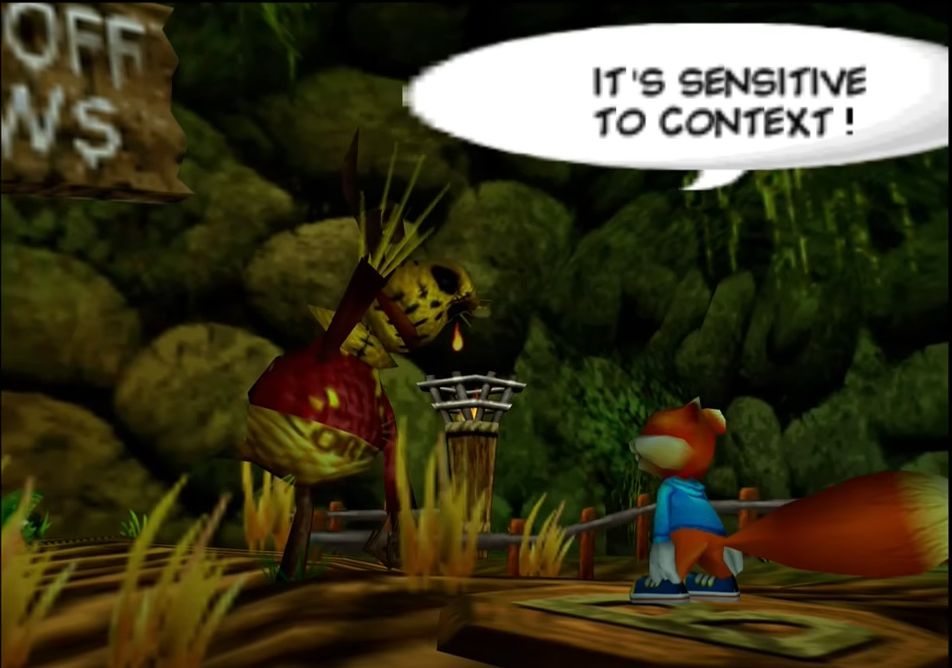
In Conker’s Bad Fur Day, Conker the Squirrel gets incredibly drunk before meeting the alcoholic scarecrow, Birdie. Birdie explains B Pads are context sensitive. So when Conker uses it near Birdie, it gives him some alcohol. When he uses it at the gate to start his journey, it gives him a magic hangover cure. We don’t get B Pads in real life, we just get Brains.
Assess the relationship. After you’ve admitted to yourself there’s an issue it’s time to start problem solving. What are the power dynamics of the relationship? What do you like about it? What do you dislike or what’s the problem? Is it a relationship you want to keep? What kinds of changes would salvage it? What changes could you personally make? What changes do you need the other person to make? This first step sets up everything else. You are going to treat a longtime business partner, friend, or lover differently than you will treat someone you met an hour ago. Right at the start, you want to start forming an idea of how much the situation is impacting you, your ideal solution, and boundaries you can live with if you cannot reach your ideal. The first step is assessing the relationship because you may very well realize you don’t want the relationship.
If you take a position on just about anything, you’re going to find that you have allies, enemies, and a whole lot of neutral parties. The allies are the ones you’re going to want to spend the most time on in the context of a problem or personality conflict.
Assess the communication. Have you communicated clearly to the other person that there’s an issue? Have they communicated to you that they understand the issue? Have they communicated that they see the issue differently? Do you believe their communicated perception of the situation is genuine? Is it possible that there’s been a miscommunication? When young children begin to lie, it is a sign of cognitive health, because they are grasping that other people have knowledge or beliefs different from their own. As adults, we often forget that and fall into a world where we assume people have seen the things we’ve seen, know the things we know, and most importantly, know what they’re doing. “He knows what he did.” “She knows what she did.” How do they know? Telepathy? People do this all the time; It’s a logical fallacy called the hasty generalization. In fact, I just did it by stating people do it all the time. If you haven’t communicated with whoever it is that there’s an issue, then it’s generally best to start from the assumption that they don’t know there’s a problem. By assessing the communication, you’re helping to make sure you’re not the problem.
This is something I have real experience with. In the context of this blog, I once had a situation where I published a post without doing enough research and without reaching out to a party for comment. Now, I do a lot of commentary, and I do not always ask people for their comment or quote, but I ended up looking pretty stupid because my communication was lacking. Don’t be stupid, communicate.
Assess the response. Once you’ve opened up the topic for discussion, it’s time to see what the reply is. If the person shuts down or stops answering, is it possible they’re busy? Are they belligerent? How many times have you attempted to have the conversation? Have they brought up valid counterpoints? Does it seem like the two of you can reach your ideal solution or, at least, a solution that is satisfactory to you? If you’re at this stage, it’s worthwhile to keep an open mind, because it means the relationship is worth salvaging and you care enough that you’ve communicated to the other person there’s an issue.
Even where you don’t know someone very well, or don’t feel it is comfortable or appropriate to communicate all your feelings or knowledge, it is possible to communicate enough that you form an idea of what the person thinks. For example, I had a situation where I vehemently disagreed with the way a reporter handled something. Rather than launch into a stalwart defense of all I stand for, I said “you know, I’ve been in the business a while, and generally, it’s not right to handle things that way.” They didn’t care, and that lack of caring was enough for me to realize this was not someone I would be associating with.
Conclude. Eventually you’ll have to decide what to do. You started off with a problem, got a rough idea of what you wanted to happen, communicated that to the other party, and got some kind of reply, even if the reply was silence. At this point, there are some general avenues you can take if you’re unable to reach a resolution together.
4a. Continue on with the problem. Take all the work you did assessing and communicating and throw it out the window. People take this avenue a lot. Maybe after everything they decide the problem isn’t big enough to threaten the relationship, or maybe they’ve fooled themselves into believing it’ll resolve on its own. Whatever the case, you can always choose to not do anything, but know that it may leave you unsatisfied or resentful no matter the benefits of working with the person.
4b. End the relationship. If the negatives outweigh the positives and the other person isn’t meeting your needs or won’t make any concessions, it’s time for things to end. This might take the form of hiring somebody else to scope or report the proceedings. This also can take the form of a final confrontation with the person where you let them know that they’ve let you down. Thanks to the sunk cost fallacy, this can be very hard to do dependent upon the situation. The relative smallness of our field can exacerbate the difficulty of letting go, since burning a bridge may mean something goes uncovered on some future date. But there are health considerations when dealing with someone who is stressing you out with no end in sight. You have to choose yourself.
4c. Be A Mentor. Sometimes in the course of communicating you’ll find out that the person is not being difficult on purpose. If you’re close enough, you may learn that they have some other underlying issue that’s causing them to behave strangely. Substance abuse, mental health issues, changes in medication, or domestic incidents are all things that can hit hard, fast, and without warning. For many business relationships, you simply won’t be close enough to a person to learn about what they’re going through. On the rare occasion that you become aware of such deep personal issues, you can take the time to listen, understand, and perhaps even offer suggestions or help. There are many ways to be a mentor. One can just listen and let the other party vent or one can go so far as to help the other party with their work obligations or schedule appointments. The most important part of being a mentor is setting boundaries, because simply erasing the other party’s problems creates a situation where you become a de facto punching bag. Some people will use up every ounce of your kindness and simply continue on with their bad habits. Just remember, mentor, you can only bring a horse to water.
4d. Create consequences. When someone’s bad behavior is pushing down your business, it’s fair game to push back harder than simply ending the relationship. This can take root via social media shaming, an ethics complaint, or even legal action. More often than not, my moral compass points toward compassion, unity, diplomacy, and forgiveness, and I’m sure that many of my readers cringe at the idea of “attacking” someone. But as noted above in the TBT section, there are people who will do whatever they want. Their philosophy in life is “screw you, stop me.” They will continue to crush people until somebody stands up to them. Lying, cheating, denial, and projection are all tools in the “screwer’s” arsenal.
Fiction can make very powerful statements about the real world while keeping things light and entertaining. I think the Boondock Saints movie said it best. “…We must all fear evil men. But there is another kind of evil which we must fear most, and that is the indifference of good men.” Sometimes taking the path of least resistance is an admirable course of action. Sometimes doing nothing simply allows the screwer to move on and screw the next person.
Many posts on this blog are an example of consequence. By keeping a public archive of statements and events in or around the field, it creates a social pressure that makes it harder for people to misrepresent events. Two years ago I pointed out that vTestify’s calculator erroneously claimed it could save attorneys $3,000 per deposition. As of today, a lot of that stuff has been scrubbed from their site and they now advertise themselves as a platform that, to me, is more reminiscent of Zoom than a traditional court reporting agency. Can I claim it was thanks to me? No. But I had a part to play in letting court reporters know “this company is saying they can do what you do for dirt cheap, and they’re pants-on-fire lying.” Happy they made the pivot. Haven’t heard anything bad about the platform. But consequences matter, and when someone is not being honest about a product or service, it doesn’t make you a bad person to stand up and say “NO.”
4e. Reroll. In the video game world, sometimes the strengths and weaknesses of a character or situation are decided by a roll of the dice or a random number picked by the computer. You don’t like what you get? Oftentimes you can reroll. Same holds true here. Sometimes restarting the whole process of assessing your relationship, communication, the other party’s reply, and your conclusion can change an outcome. Every few years I have the pleasure of getting raving-lunatic levels of angry at something or someone in this field. Usually with some time and reassessment I am able to see things from their perspective and realize something I thought was a huge problem in the moment is actually a minor bump in the road in the context of a close business and/or personal relationship. Other times, with time and reassessment, I feel more justified.
To really drive home the power of the reroll, about half a decade ago, I received a message telling me I needed to be more involved with the field. I had just started a new job that I felt completely unqualified for. I was in the middle of a relationship with someone who was hopelessly addicted to drugs. The insulin levels in my body were about eight times more than a normal human. I blocked the person that sent me that message. Be more involved?The only thing I wanted to be more involved with was laying in bed all day hoping tomorrow would forget to come. Over a week or so, I thought the situation over and quietly unblocked them. To this day they are one of the people I look up to and love in this field. We share a love for the field that not too many can match. Such a relationship would’ve been impossible without the reroll.
There will be people inside and outside of our little field grappling with all the same pains and problems. “Why don’t we get along?” “How do I navigate this stressful situation?” None of us will have all the answers, but I hope that this one reaches people who need it. It’s okay to stand your ground. It’s okay to change your mind. It’s okay to help people. It’s okay to help yourself. It’s okay to set boundaries. It’s okay to make the best decision you can with the information you have at the time.
It’s okay to be human, because if they wanted a robot, you wouldn’t be in that seat today.
If the sad iron stenographer got you to crack a smile today, pass it on.
A common line from the average person about my job is “why don’t you just record it?” There are numerous arguments against recording, including difficulty issuing a subpoena for testimony of transcribers outside the country, price concerns, and quality concerns. One thing that has not yet been adequately addressed is why recording seems to be working in some places right now and why many court reporters think that may change.
I have to turn to my New York experience. Our Workers Compensation Board took the reporters out of the workers comp “courtrooms” and wheeled in recorders. The legislature didn’t want this. The reporters didn’t want this. And over 50 reporters that didn’t leave WCB for the New York State Unified Court System remain in the background transcribing the recordings. To the outside observer, recording is working just fine. There’s no problem because society took the highly trained professional court reporters and hid them. They’re still there working behind the scenes, guarding the record via their expertise and knowledge.
Same thing happened in Massachusetts. They took reporters out of the courtroom and created an approved transcriber list, where many stenographic services continue our professional duty to protect the record. New York itself has many stenographic services willing to transcribe recorded matters. When jobs disappear, they’re really just shifting from public sector work to private sector work. The need for quality work still exists.
So what’s the problem? Who cares if we’re back office or in front of the courtroom? Well, it exacerbates our shortage. Schools see fewer job postings, they downsize or close. People stop seeing us and fall into the easy illusion that we don’t exist. We can already see it in the transcription industry. Companies like Rev boast about having as many as 50,000 transcribers. Beyond the few articles about their horrible pay and questionable working conditions, they might as well not exist to the average consumer.
It’s time to speak out against that for our field. We need to be bold and loud, albeit polite, and insist that people take us seriously. People need to know that their actions impact our situation. People need to know that recording is going well today because you still have an army of court reporters with court reporting experience transcribing. People need to know things simply won’t go as well when you take that army of reporters and replace it with people who do not have a strong educational or ethics-based culture.
For a fictional example of why recording will become a problem, imagine someone trying to slip me $1,000 to alter some trial testimony. I’d laugh. It’s against my morals. It could hurt the perception of my profession and court reporting family. It’s also nowhere close to worth risking my well-paid job for that amount of money. But for a transcriber, that can be 33 times their monthly pay for transcription work. Ethics are nice, but they take a backseat to things like eating and feeding the kids. But court administrators don’t know what they don’t know, so without input from reporters like you, this issue goes unsung.
It’s completely possible to make $6 an hour working for Rev! Yes, that’s what that breaks down to.
For a real-life example of advocacy, in recent months, a judiciary body reached out to just about every court reporting association in the country asking for help with their shortage. I wrote a personal reply, and I’m going to share it today so that others can see what I’m talking about when it comes to talking about these issues and trying to make a difference. If we do not make an effort to shape the conversation, we will simply be left out of it. So tell it like it is, recording works today because you’ve got a large contingent of reporters working behind the scenes.
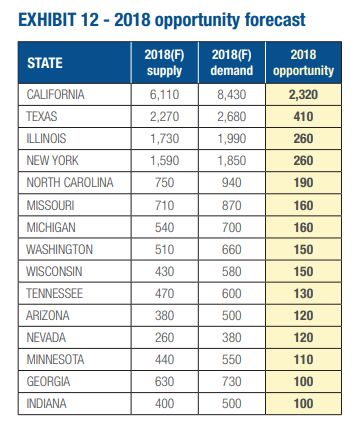
There is a small, loud contingent in the private sector that describes our stenographer shortage as mathematically impossible to solve. Years ago, the Court Reporting Industry Outlook by Ducker Worldwide, in a nutshell, forecasted the demand of stenographic reporters eclipsing the supply of stenographic reporters. At that point in the 2013-2014 report it was forecasted that about 70 percent of existing reporters would retire over the next 20 years. It was forecasted that in 2018 there would be a gap of about 5,500 court reporters due to increased demand and retirements. In a breakdown by state, it was clear that California, Texas, Illinois, and New York would have it the hardest, but the prediction was a gap of at least 100 reporters in several states by 2018.
This is but one of few bold arguments put out by digital recording proponents as to why the modality of taking the record must change away from stenographic reporting. As reporters and committees like NCRA Strong started to push back against the myth that digital was better or cheaper, and developed resources to help others explain the truth, the stenographer shortage became the last bastion of hope for recording equipment to take reporter seats.
It’s a simple message that’s easy to digest: “It takes too long to train stenographers and the failure rate is too high, therefore we must change.” This argument is even embraced by CSRs working for larger agencies that have actively promoted digital reporting as the way forward, such as Veritext or US Legal. I take umbrage with this simple message because it’s a lie. This idea that there is nothing we can do is a lie by omission, and it ignores any and all progress we’ve made in recruitment. Since the Ducker Report, Open Steno has expanded exponentially in introducing stenography and free resources to learn it to people all over the world. Its Discord channel continues to grow and has hundreds of users online each day.
8:00 in the morning and 300 online. It takes a remarkable person to build a community like that. Thanks Mirabai.
Also since the Ducker Report, NCRA A to Z was born. Project Steno began heavy recruitment activity. Independent actors such as Allison Hall have worked in their own communities to get programs started and flourishing. Again, all things generally ignored by the we-must-record crowd. It’s only business, right? If they can’t fill the seats, it’s not their fault! But it’s painfully obvious that digital recording proponents are not attempting to build interest in stenographic reporting. We are a community, and some members of our community are obsessed with spouting the shameful idea that there’s just nothing that can be done while watching everyone else do.
But even those of us who know all about the shortage and have worked in some capacity to fix it have overlooked some important industry comparisons. In the tech world, there’s a forecasted need of some 1.4 million workers and an expected graduation of 400,000 workers. If our 5,000-person shortage is mathematically impossible to solve then tech must be absolutely doomed, right? It takes a whole four years to get a computer science degree! Time to replace all the programmers with robots, right? Nope. Instead, the argument is made to look at the number of self-taught people or people that do not have a traditional degree. The argument is made that programmers should be paid more to entice workers. Even in fields of “unskilled workers”, when there is a shortage, they don’t sit around and whine about there being nothing they can do, they jack up the prices to reflect demand.
What? Businesses can create a problem by understaffing and then charge 40 percent more? Where do I sign up?
Compare this to our field, where freelance reporters in New York are currently working for less than 1991 rates adjusted for inflation and companies still aren’t happy. At a certain point, there’s simply no more we can give. We’d each do better taking our own customers and binding our own transcripts than continue to forfeit large percentages of our money just so we don’t have to handle clients. To illustrate this better, the following is a chart for the average US worker hourly pay adjusted for inflation.
Wow! Over a decade the average US worker wage became 58 cents more per hour! Bring on the steak and lobster!
If we were to have an identical chart for reporting in New York, for reporters making under $5.50 a page on their original, the number would be decreasing. We’re not just behind the average US hourly worker, we are steadily losing ground and the gap is widening. It’s not really surprising we’re having trouble filling seats. It’s good money for what we do, but the great money in the private sector has been quietly locked behind roughs and realtime, forcing reporters to work harder and write more to have the same buying power.
The above notes on pay come with a caveat. I’m not a stupid man. I know the money in this field comes from the copy sales. I know that’s very unlikely to change in the near future. But for an honest comparison, I’ve examined the original prices, and if the original prices are that deflated, reporters have to ask themselves if copy rates have budged when adjusted for inflation, and there’s no evidence to suggest they have.
So when we are discussing shortage, I hope there are four points everyone will remember and educate fellow reporters on when they buy the line that there’s nothing we can do.
1. The number of self-taught reporters is not counted, making our shortage forecast larger than it is.
2. There are many more programs and resources for people who want to learn about stenography today than there were when the stenographer shortage was forecasted. Some examples include NCRA A to Z, Open Steno, and Project Steno.
3. Companies that genuinely care about the shortage can directly impact it by promoting steno, relaxing deadlines, or increasing reporter pay, which is in line with other industries.
4. With an estimated 30,000 stenographers, if we each spent an hour a year on recruitment activity, it would be the equivalent of 82 hours of recruitment a day, far more time than any company is spending promoting or recruiting for other modalities.
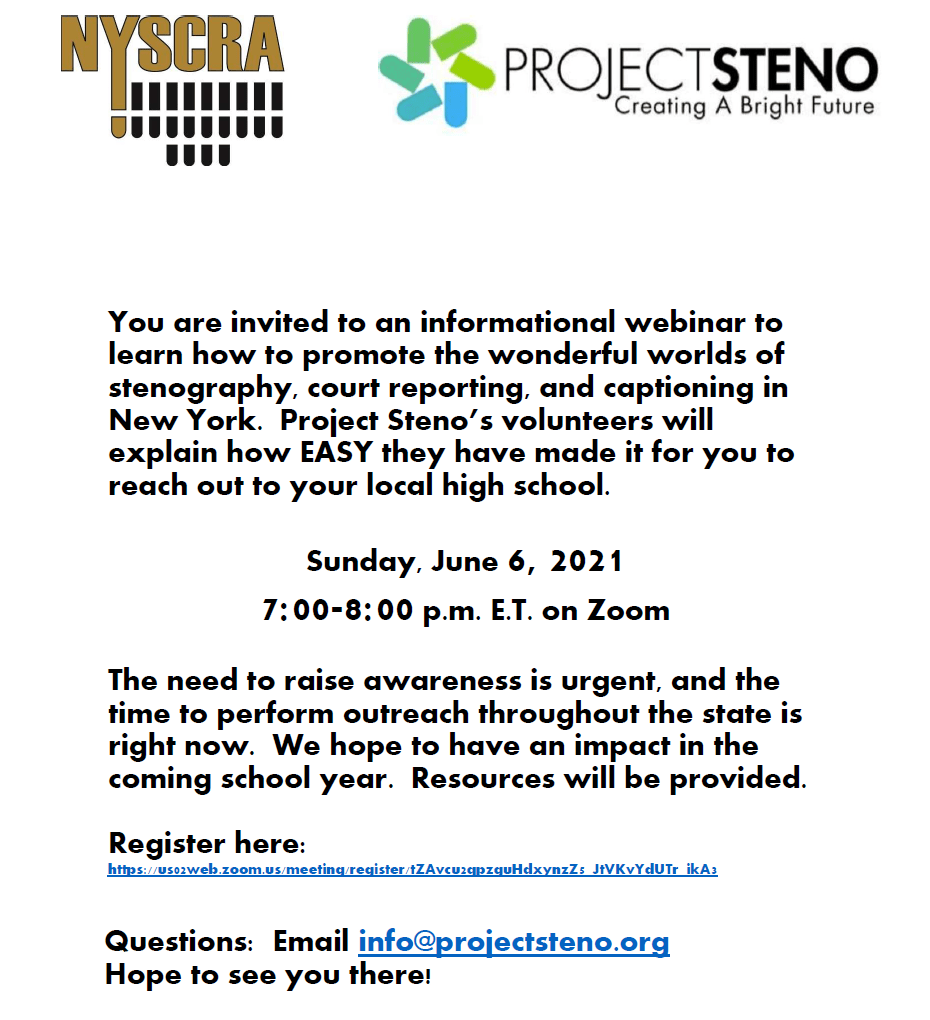
The New York State Court Reporters Association is promoting Project Steno’s June 6 outreach webinar, as told by NYSCRA’s Transcript Weekly, posted earlier today by NYSCRA Social Media Committee Chair Marina Dubson. Though stenographers have made great strides in recruitment and introducing people to this field through efforts like NCRA A to Z, Open Steno, and Project Steno, there remains a need to get word out to high school students and staff that court reporting is a viable and vibrant career that young people should give serious consideration. Resources will be provided, and it can all only be seen as a wonderful complement to the resources already published by the National Court Reporters Association. If you’ve got some time to attend at 7:00 p.m. Eastern Time this Sunday, definitely consider registering today!
In my Collective Power of Stenographers post, we explored how court reporters collectively out-earn every company in business today. In Aggressive Marketing — Growth or Flailing, we took a look at VIQ Solutions, parent of Net Transcripts, and saw how a transcription company could be making millions in revenue but be unprofitable. This all set me down a path of learning about zombie companies, companies that are not making enough to meet debt obligations, or just barely enough to make interest payments. You can watch Kerry Grinkmeyer describe how that happens here. This isn’t very rare. A Bloomberg analysis of 3,000 publicly-traded companies found one in five were zombies. The main takeaway? Companies can make lots of money and still be taking losses.
I had the pleasure of looking through the Kentley Insights June 2019 Court Reporting and Stenotype Services market research report. I do want to be upfront about it: I have some reservations about the methodologies and some of the reporting. Very much like the Ducker Report, as best I can tell, it’s based off a sampling of respondents from in or around the field. There are parts of the report that are arguably a little incomplete or unclear. For example, being industry experts, we all know the vast majority of the work is done by independent contractors. Independent contractor isn’t a term that appears in the report. Unsurprisingly, when we reach the job pay bands and employment section, it says there isn’t detailed data on the industry and compares us to the telephone call centers industry. So this report is not a must-have for court reporters, but it does have some interesting insights.
Those remarks aside, when we get to the profitability section of the report, we get to see something pretty striking. Based on their data, more than 1 in 4 court reporting companies are not profitable. Average net income as a percent of revenue for the ones that are profitable? About 9.3 percent. For the ones that are not profitable, a loss of about 9.6 percent. And a pretty chart that says as much.
I never want to see the term capital benchmarks again.
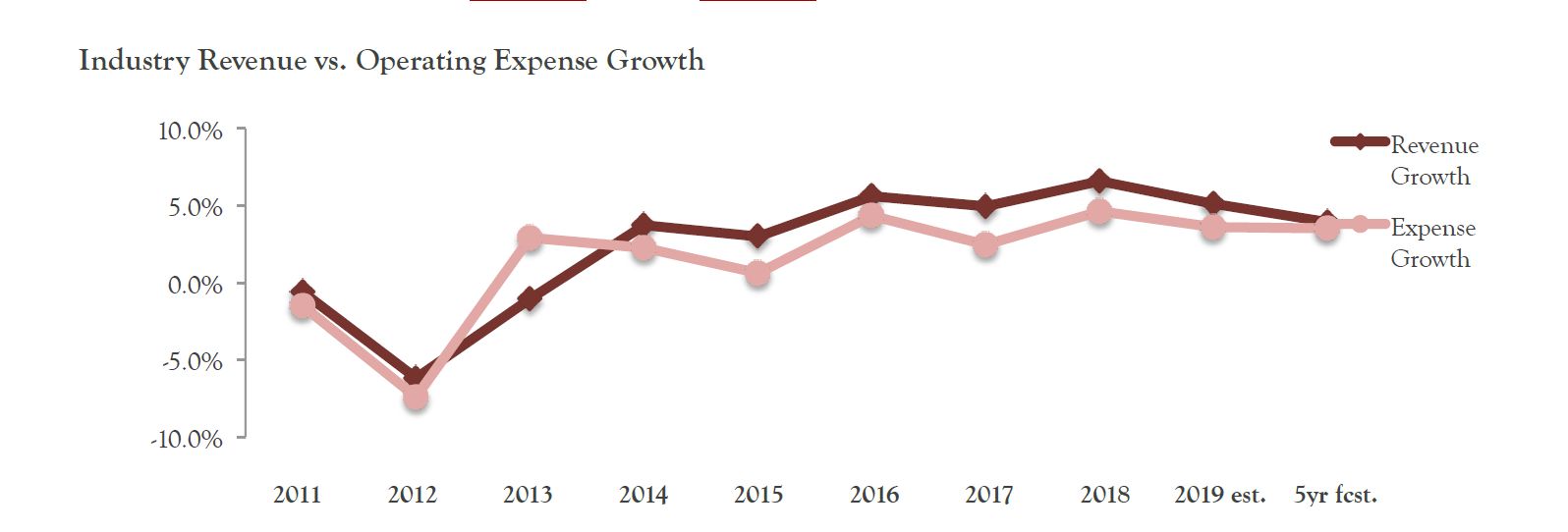
On the following page, there’s a forecast for operating expenses and industry revenue. That’s summed up in another pretty chart.
This was pre-pandemic, by the way.
If we look at the trends here, it’s pretty clear that the forecast is for expense growth to eclipse and outpace revenue growth. If that keeps up, the unprofitable companies are going to be looking at bigger losses year after year. Given all the information I have today, I surmise that the smaller court reporting companies are the more profitable ones and the bigger ones are the ones struggling. There are sure to be some outliers, like small court reporting shops that go bankrupt and leave their independent contractors unpaid. But overall, the smaller companies can’t afford to remain unprofitable for very long, so it’s probably the “big dogs” eating that 10 percent loss. If I’m right, that may also mean the push to go digital is the dying breath of companies that can’t figure out any other way forward. In February, I wrote “…we only lose if we do not compete.” That is becoming more evident with time and data. It is a great time for the stenographic reporter to open up shop and be a part of the 74%.
Speaking of data, if everybody that read this blog donated $1.50, we’d have enough money to stay ad-free for the next two decades. To all donors we’ve had to date, thank you so much, put your wallets away. To everybody else, check out this cool song from M.I.A. about taking your money.