Was Ducker Worldwide Wrong About Stenographer Shortage?

The main talking point of some industry hacks, is that we have a low pass rate for stenographic court reporting, about 10 to 20%, and therefore we cannot solve the stenography shortage by recruiting because recruitment will “never” keep up with demand. This is extrapolated from the information that was provided in the Court Reporting Industry Outlook 2013-2014 by Ducker Worldwide. As stated in the beginning of the report, the way that this forecast was created was by interviewing about 120 people from in and around our field, as well as some proprietary data analysis by Ducker.

My main strategy, up to now, has been to explain why these people are extrapolating incorrectly or making bad arguments. I’ve made counter arguments that suggest the shortage is best solved through stenographic reporting that put theirs to shame and have not been refuted. I’ve unapologetically named names on the corporations that are trying to bump us out because this matters to me. This is my field. This is what I want to do. This is where I can help society the most. If they are successful in changing the minds of reporters and consumers, my job is likely to be eliminated someday or the pay is likely to be substantially reduced. People will suffer greater inaccuracies in their court records because ASR is 25 to 80% accurate and non-stenographers transcribe English dialects like African American Vernacular English (AAVE) at a rate half as accurate as court reporters. To me, there is no greater dishonor than to do well and lift the ladder up while others are trying to climb. Not only are companies attempting to lift the ladder, they are indifferent to the fact that they would hurt people in the process.

I tried to be diplomatic about it for four years. I tried to convince colleagues and companies in a more polite, erudite manner. I made a very open warning that if they did not make companies where we were the standard, we would build them. We’re building. Look at the lawyers who started Steno. They put us in the name of their company. Not to mention Steno Captions LLC, a company that not only put Steno in the name, but gave me solid data that helped me show our field that VITAC was offering a disgustingly low amount of money. I’m not prescient, but I just told you that I love my field. I know my field. Humans are literally built to be this way; we get better and more knowledgeable at anything we do a lot. Now I have another open warning: Change direction or we will figuratively burn pathetic digital reporting businesses to the ground. It clearly isn’t as scalable or logistically feasible as it was thought to be and digital proponents look like clowns to anyone paying attention.

In this country, the elements for defamation are that plaintiff must prove defendant published a false statement of fact to a third party that causes damage to plaintiff. It’s been years of publishing information and not a single company has threatened to sue. That’s a clear indicator to me that I am accurate or real close in just about everything I publish, including that big companies may well be facing financial trouble. Sooner or later, the majority of reporters are going to work out that I am publishing truth. They will, as I have, work out that millions of dollars don’t mean much if these companies don’t have a good business model. By trying to force us out of the market, companies are giving themselves 27,000 competitors, a move that should make shareholders physically ill. No longer will we accept the false narrative that “there’s nothing they can do.” They’re bright people. Insist that they figure it out and see how fast they figure it out. Tell them to stop throwing up their little social media posts or reporter corners and calling that support while they put advertisement dollars and training effort down on digital. Nobody who thinks about the situation for more than a minute or two believes that they’re using digital because they can’t find stenographers. We have a national database of stenographers that goes underutilized. How do I know it’s underutilized? Easy. When I was a young reporter, I got inundated with emails from agencies that found me on Sourcebook. Today, after about four years of blogging, out of all the garbage-like companies that were pushing garbage-like product, namely US Legal, Planet Depos, and Veritext, I have received maybe one email looking for reporters, if that. Other companies are writing me and looking for stenographers. We certainly don’t see any recruitment campaigns as we do with digital. One email in four years? Nothing they can do? How about working with the very established industry that they’re operating in instead of trying to outsmart it? Tipping points are hard. Not getting fully behind stenographers is going to be much, much harder for businesses. Look at the news. Watson didn’t work out. Automation is looking less likely every day. Even the poster child for automation, Elon Musk, is having a rough time making good on his big tech promises. What hope does anyone with less fame or money have? We’re not even playing particularly rough and digital proponents can’t make it work. What happens to big firms when reporters start poaching clients, publishing invoices, publishing client lists, and creating marketing firms that could eclipse the annual marketing budget of any court reporting firm in the country? Again, this is not prescience, it’s observation. I am one guy with a blog. I have about as much money as the bear that wasn’t a bear. If I am able to poke holes and publish things that professional news organizations miss, just imagine what any person reading this is capable of, let alone many thousands of court reporters. That TikTok I posted Monday said it best: Do not fuck with stenographers.

In addition to changing the strategy from diplomacy to Hell March 2, I have to now point out the inherent flaws of relying on Ducker’s 2013 information in 2021. The industry outlook is eight years old at this point. Stenographers had a choice in 2013, go big or go home. After that time, NCRA A to Z, Project Steno, and Open Steno all went big. Plenty of other reporters did too. Kim Xavier began Stenovator Pathway Solutions. Allison Hall set up programs and initiatives to get students in schools and help them find their way, and most recently received an award from the Oklahoma judiciary. Katiana Walton started training people under StenoKey. Shaunise Day started Confessions of a Stenographer. Protect Your Record Project set up strategies to help educate consumers against the pushing of inferior digital reporting products. NCRA Strong created resources for members to help educate consumers. So many people did so many things that I regret ending the list there. The recruitment and content creation efforts of stenographers didn’t double or triple, it exploded exponentially into a runaway train that only keeps accelerating and will only go faster now. Ducker’s top reason for low enrollment was that stenography was relatively unknown. That just isn’t going to be the case anymore. The median age of reporters in 2013 was 51 according to page eight of the report. Today, NCRA statistics state the median age of reporters is 55. It has been eight years. Without any activity whatsoever, the median age should have been 59. We can already see the results of our work.

Another “problem” with relying on the forecast or cherry-picking data from it is that focusing directly on the shortage ignores all the nuance and the actual messaging of the report. Let’s go through the report together and see just how much it supported the conclusion that stenographic court reporters were needed. Check out page six, where they published the segmentation of court reporters to voice writers.
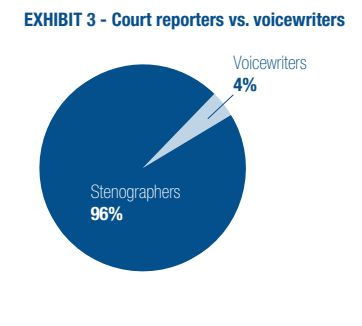
Remember, this is 2013 data.

Voice writing is actually a decent product. Yet voice writers still were only 4% of the field. For about five years companies stood silent. When they had the slightest hiccup in scheduling, 2018, they went digital because “stenographers take too long to train and have too high of a failure rate.” If that were true, perhaps they would have built the voice writing side of their business, since it was already far more established as a modality than digital reporting. It is far more likely that some companies’ ultimate goal is to offshore the work, a disastrous result for our justice system in America due to the fact that offshore transcribers will be beyond the subpoena power of local and state courts. Even if it is not the goal, it is the logical consequence of moving reporter transcription from the front end to the back end and taking us away from public view. What school would open to fill a job that nobody sees or knows about?

The number of reporters entering and retiring is touted by know-nothing companies like US Legal as the reason the stenographer shortage cannot be solved by recruiting more reporters. Recently they put out that we have an annual shrinkage of 920, and I explained why, even assuming that was true, they were wrong. The equation they presented would eventually lead to negative stenographers, which is impossible if there are 200 new entrants a year. Ducker also explains why they’re wrong. At the worst of our decline, when the study was commissioned, we had an estimated 1,500 entrants coming into the field from 2013 to 2018, about 300 a year. Are we really to believe that with all of the effort going into training court reporters and bringing attention to the field that the number of annual new entrants fell between now and then?
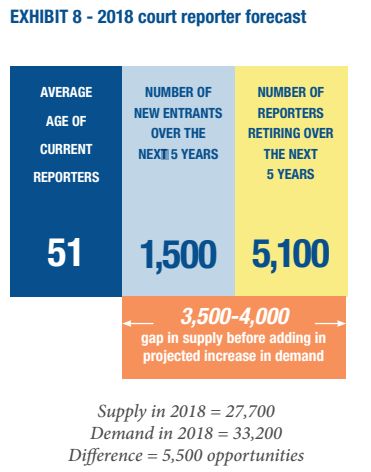
It took eight years for our median age to rise by four years.
That means we’re winning.

In addition to Ducker’s forecast with regard to the actual number of opportunities, there was data about violent crime which led to them to believe the demand for criminal court reporters would go up. According to them, it was trending up at that moment.
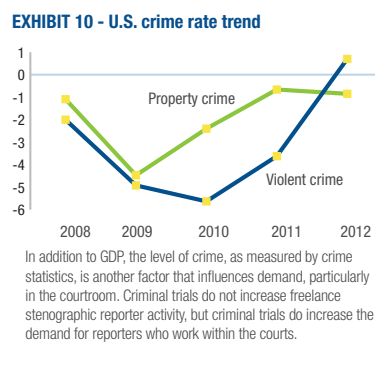
Trending up, but still negative until 2012.

But when we look at sites like Statista, we see that the violent crime did rise for about three years as predicted by Ducker. Then it started falling again. It is hard to say, given the events of 2020 and 2021, where that per capita violent crime rate is going to go in the years to come. But what we can see with clarity is that Ducker’s information became outdated on violent crime as quickly as 2016. That leads us to the question: What other information might be outdated that we simply do not know about?

Fun fact. You can prove violent video games do not cause violence because violent crime went down while violent video games prospered.

The next few pages of the Ducker Report focus on the demand for stenographic court reporters. It’s probably the single greatest marketing piece of its time for us. We needed people, and the forecast told us that. Page 13 of the report gave us some striking infographics that let us know California and the west coast were going to have the hardest time with meeting the demand.

If California survived past its catastrophic 2018 opportunity, I am pretty sure the rest of the country is going to be okay.
Their shortage is nearly 20x worse than the rest of the country and they have some of the craziest licensing laws there are.

The rest of the report focuses on state projections. Some states were projected to have a surplus. This means that any state with a surplus could theoretically lose reporters to states with shortage problems and still be fine. This is likely what occurred in 2020 when depositions moved online. The fact that depositions moved online and companies continued to push digital is another clear indication that this was never about the shortage. It was about messaging. Signal to reporters that their job is over and get them repeating that news over and over under the mantra of “nothing else we can do but go digital.” Let me pull a word from Stacey Raikes’s amazing JCR article: Hogwash. It was a sweet lie to ride on. It’s over now. And make no mistake that it is a lie so blatantly obvious that I predicted it would occur back in February, writing “there will be a strong push from certain entities to say there aren’t enough of us. That will happen regardless of the truth.” Let’s repeat this: Stenographic reporting is here to stay. There is a place for every single one of our students as long as they work hard and do good work.

So was Ducker Worldwide wrong? Not by my assessment. They made an accurate forecast based off accurate data that existed when the industry outlook was written. That said, as an industry, we need to stop letting others tell us what the report said, really look at it, and encourage colleagues to look at it. It was a message that stenographers were needed. The shortage was not ever impossible to solve. That was a lie propagated by STTI that the corporations picked up when they saw a chance at pushing our educated and highly trained workforce out so that they could exploit digital reporters. Offshore transcribers are also being exploited, with some of them being paid as little as $0.80 a page or $0.24 a minute. The only way that we get pushed out is if we let it happen. I began documenting these events years ago with hope that we would not. Don’t let me down.

Two years ago. This didn’t age well. About six months later the study “racial disparities in automatic speech recognition” was released and showed us ASR was 25 to 80% accurate depending on who’s speaking. Given old patents that show 92% ASR accuracy was possible in 2000, the idea that growth was exponential became laughable.

Addendum:

An awesome Reddit user pointed out that the way I describe the median age here does not account for retiring reporters and assumes none retired out. To that, I would have to partially agree, but also point out that Ducker conceded that many reporters stay past the retirement age, as shown in purple below. The number of reporters that reached retirement age in the last 8 years was not the retirement cliff we have been anticipating. The next ten years is the retirement cliff. So I see it as I do because the reporters that were not yet retirement age as of the Ducker Report are likely to still be with us in large numbers, with some exceptions, such as our very recently retired and beloved Dominick Tursi. Given the substantial increase in stenographic reporter recruitment in the last 8 years, the logical conclusion is that the reporters staying past retirement age are bringing the median age up. There is no doubt that we need to continue our recruitment efforts, but we should no longer be swayed by the arguments that the situation is “impossible.”

“Taking into account that court reporters tend to stay in the workplace longer than average…”

Stenographer Energy & Social Media Recruitment

Stenographers are no strangers to social media. We’ve had students like Isabelle Lumsden get thousands of eyes on our stenotypes. We have amazing content from accounts like Stenoholics. More recently, I got to see a video from the TikTok letsgetfries. The video starts with our hero mentioning that she’s been on jury duty for two weeks. The most important thing she’s learned? Stenographers have the wildest energy of anyone she has ever met in her life! Don’t fuck with them. Maybe she’d make a good court reporter, she got our hand and eye thing down already!

This is exactly how I look at work every day for the last 11 years and she nails it.

I bring this up for the entertainment value, but also as a reminder that strategically social media is our battleground. There are companies out there right now, like US Legal, that are claiming the stenographer shortage cannot be solved by training more stenographers. It’s a blatant lie dressed up like industry news to fool industry insiders and outsiders. Meanwhile, we know from the Open Steno 2021 Survey that about two thirds of people coming into contact with steno, at least in that community, are coming into contact with it thanks to the Internet. So we’ve got to out-presence them, recruit people, and steer our students clear of dishonest companies.

OH NO. EQUATIONS. RUN.

And make no mistake that I am calling US Legal dishonest. In their article they note 1,120 retirees a year and 200 new reporters. An annual shrinkage of 920 reporters, giving the impression that this is an annual gap that never ends and only gets larger. But that’s not how these numbers work. First of all, they’re extrapolated from the Ducker Report, which was a forecast based off 120 interviews and some proprietary data analysis, not a future-telling machine. As more and more reporters retire out, the retirees would decrease each year. Anybody with a second-grade math level can figure out their math is wrong because a shrinkage of 920 annually means there would be zero reporters in 30ish years. That’s not actually possible if you’re getting 200 new reporters a year. The equivalent would be me going on JD Supra and saying the CEO of US Legal gets two brain cells a year and loses ten, therefore his company will probably be bankrupt in ten years. Doesn’t matter if it’s true, it just sounds good. I don’t begrudge people for where they work, but as a company, no matter how great any individual employee might be, they’ve got to be among the most dishonest, toxic, harmful companies in our industry. You know that scene in Star Wars where Luke tells Kylo “amazing, every word of what you just said was wrong”? That’s how I feel. Reporters get some cognitive dissonance here because US Legal does have nice people working for them, but that doesn’t change how I feel about the entity itself. It’s like Theranos. I’m sure nice people worked there, but the entire operation was a big joke that should never have happened.

Letsgetfries, I don’t know if you’ll ever happen across this, but let’s just say we’re so used to being treated like potted plants that whenever anybody says anything nice about us, we boost them big time. From getting Stanley Sakai’s article featured on Medium last year or sharing John Belcher’s deposition strategies. You’re no different. As of late last week we had shared you over a thousand times! Hope you had a great experience with jury duty! If you know anybody who’d like to join our field, please let them know about NCRA A to Z, Project Steno, or Open Steno. For the record, our crazy energy is mostly thanks to everyone saying they can replace us and failing for the last half decade. We’re working it out. Thanks again!

Drillmaker for Students/Educators

A student recently explained to me that they had to create a drill for set of briefs they wanted to learn. In my view, the best way to do this would be creating a repetitive dictation of the brief(s) a person wants to drill, marking that for dictation, and then practicing at some kind of speed. I know minimal computer coding, and have made tools to try to help students and educators cut down on busywork in the past, but because my coding knowledge is so limited, I’ve never quite mastered it enough to make it easy for people, and consequently, the tools I’ve designed go underused.

I plan to continue to do research and make a real effort to make these tools accessible, but in the meantime, I have a workaround that anyone can do from their computer in five easy steps.

Step 1:
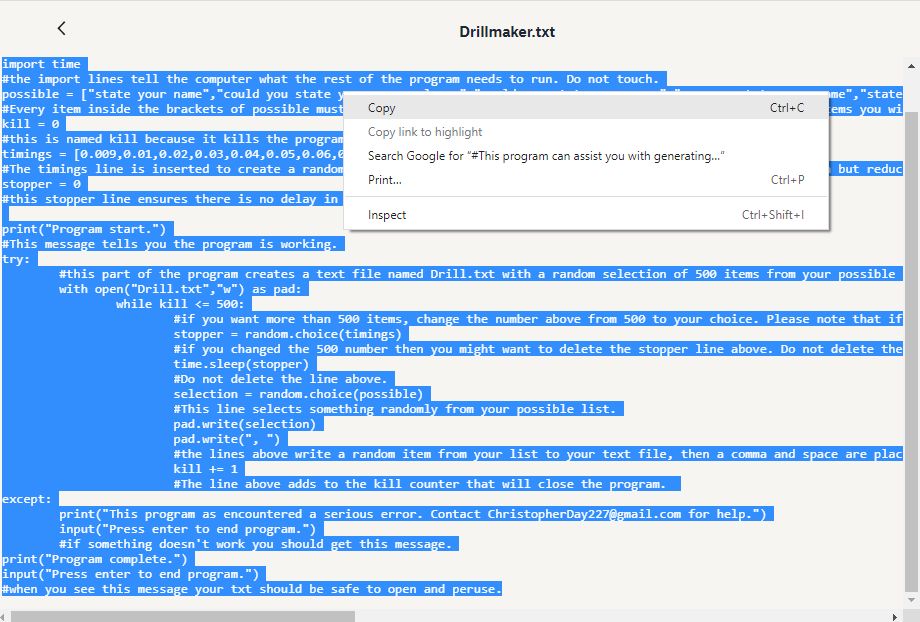
Get the code. Go to my Dropbox, highlight the code text, right click it, and copy it. You can also use CTRL+C when things are highlighted to copy them. Don’t waste your time reading this image, it’s just demonstrative.

Copy it because I’m about to ask you to paste it.

Step 2:
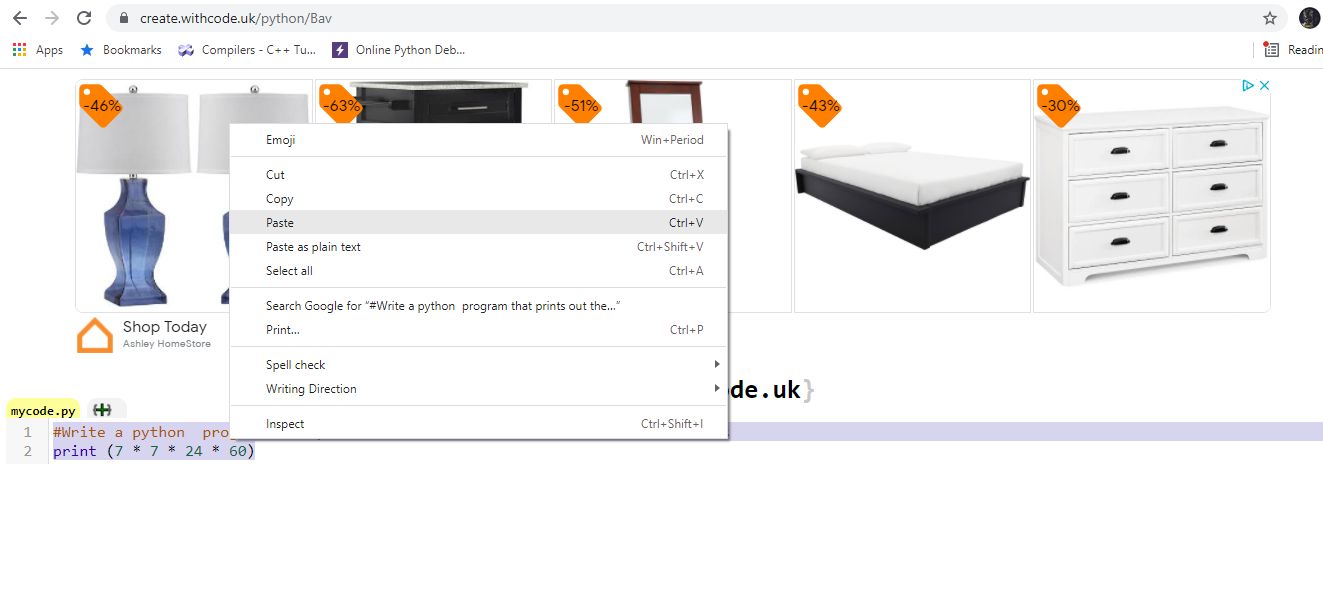
Paste the code into this person’s website. Note that when you open the site, they have some code there already. Just paste right over that or even delete it.

I am about to paste right over that code.

Step 3:
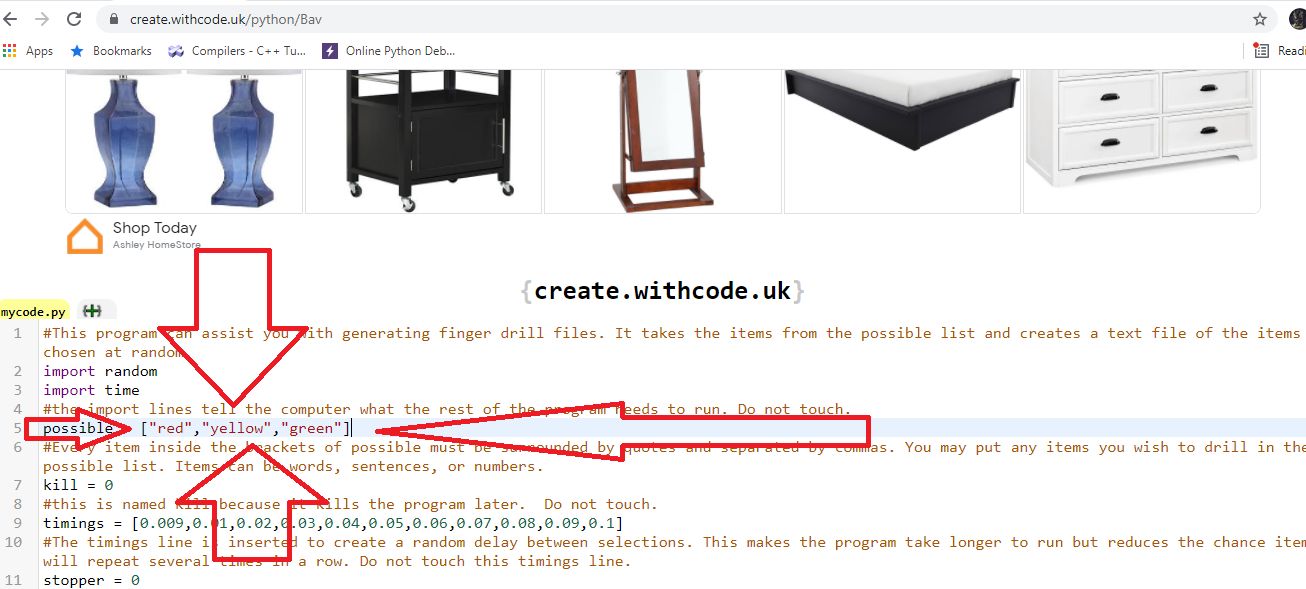
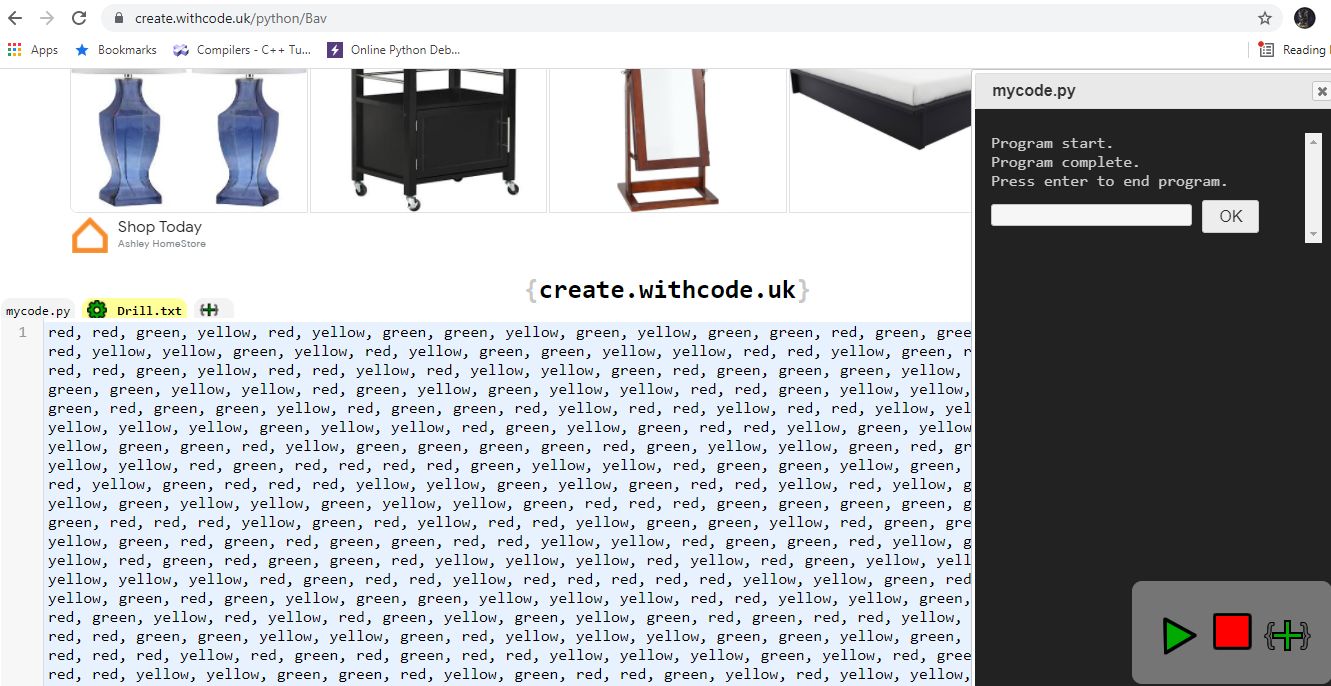
Once you have pasted the code in, go to line 5. There should be a line that says “possible.” Inside those brackets, you put whatever terms you want to show up in your drill. In order to make this work, every phrase or word you want must be surrounded by quotation marks and separated by commas. In the example below, I show what it would look like if you wanted to drill red, yellow, and green.

Put whatever words you want in there.

Step 4:
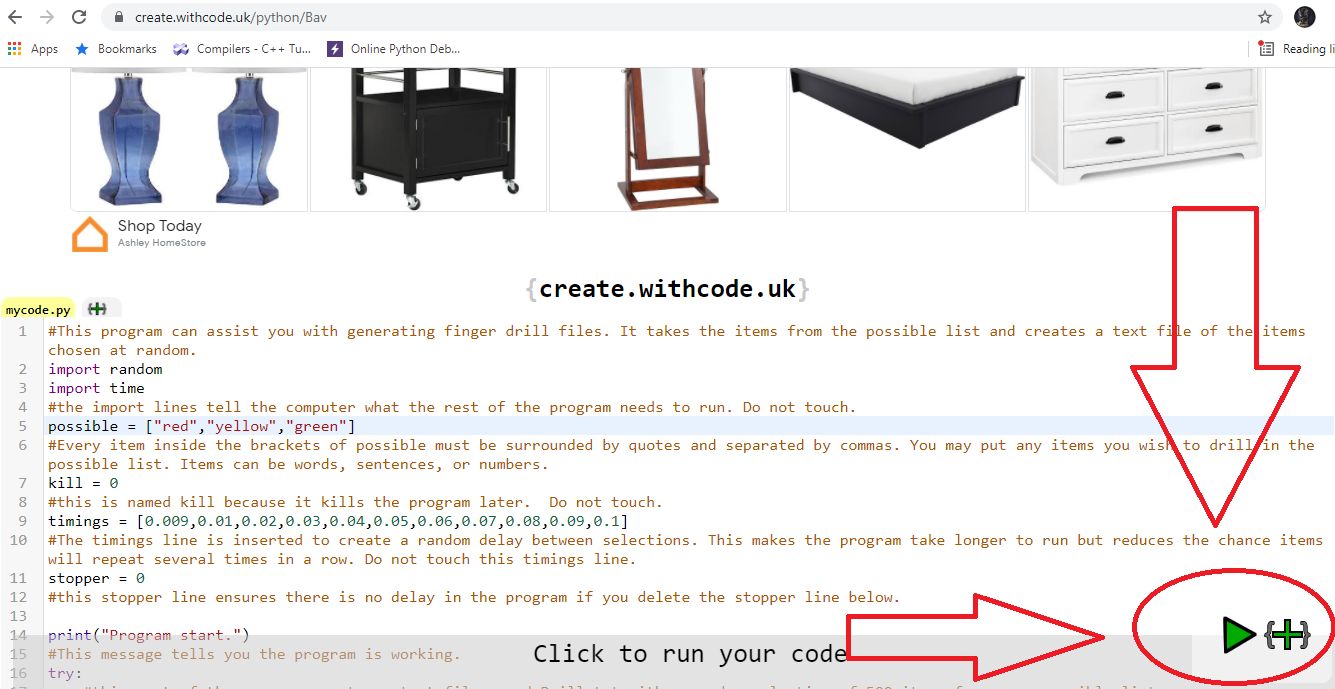
Once you have set up the words you want to appear in the drill, click the green “run code” button on the bottom right. A black box will pop up. If it says program start, the program is working. If it talks about an error, something went wrong. If it says program complete, it’s all done.

That’s the green run code button. It looks like a sideways green triangle.

Step 5:
After approximately one minute, the program will finish. You will have a file called Drill.txt on the left side of the screen. You can copy your drill into Todd Olivas’s slasher to help you mark it for dictation. If you need help dictating, see what I’ve written about that here.

Remember, this works with any words you want, even if they’re from a George Carlin routine.

I know that this is not ideal, but it is a fast and easy way to get long lists of words without having to painstakingly write and copy them multiple times. I really hope it helps. Special thanks to the student that gave me the idea.

Addendum:
Shortly after releasing this post I changed the code and Dropbox link to a much faster version of the program. It avoids repeating the same word twice and works in one second instead of fifty. The only drawback is that if you only put one item in your word list, the program will run forever without giving you an error message. Please put at least two items in the list.

Additionally, after sharing what I was working on with the Open Steno community, Joshua Grams created an HTML file that is much easier to use. Just download it and double click to open it in your browser. It does not randomize the words, but it does repeat whatever you type into it as many times as you ask it to.

Fear Public Speaking? Try StenoMasters!

I’ve been writing this blog to help people look at the issues in our field differently and realize that they, as individuals, can change outcomes. Many of us struggle with fear and anxiety, whether it’s about a boss, a work situation, a life situation, or even the simple act of speaking up for ourselves. This blog is about bringing comfort through knowledge and often points out there’s always a way forward.

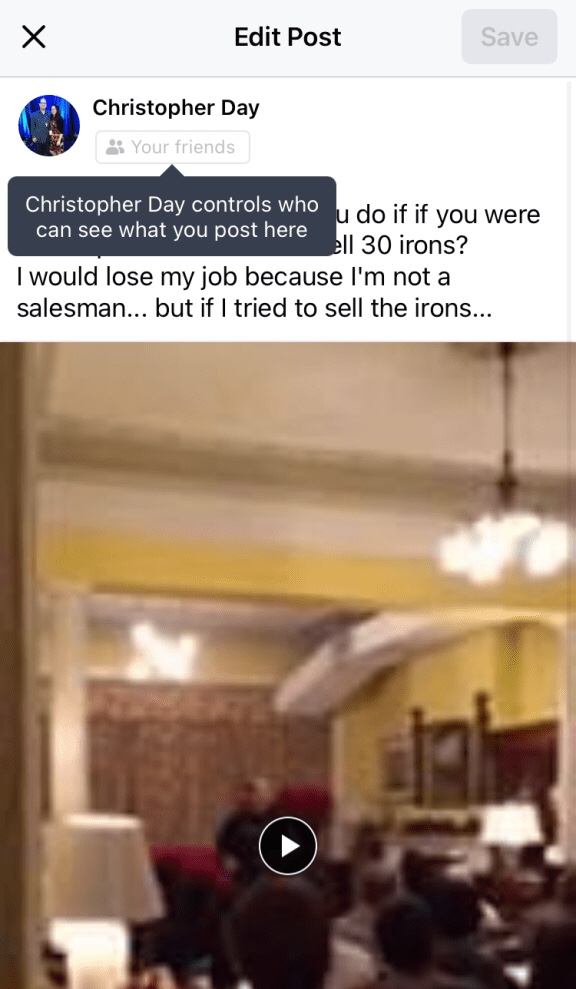
Here is a way forward for our future public speakers. Years ago, one of my best friends, NYSCRA President Joshua Edwards, asked me to attend a Toastmasters meeting. Toastmasters is a public speaking club. It helps people overcome their fear of speaking or enhance the skills they already have through practice. Toward the start of a meeting they had “table topics,” improvised scenarios for randomly-chosen guests to speak about. As luck had it, the very first time I attended I was chosen to talk about what I would do to sell clothing irons to people. I stood up, said I would lose my job, and launched deeper into an explanation about how I would sell those irons that only my Facebook friends can see because Facebook does not want me to touch the privacy settings on that one.

But I am Christopher Day!

At the conclusion of the meeting they asked “will you come back?” My response? “No, I enjoy my debilitating fear of public speaking.” I did come back a time or two and always listened to what Joshua had to say with great interest. He went on to become President of that Toastmasters chapter, participate in at least one regional contest, and sharpen his already-formidable speaking skills.

Now he’s setting up StenoMasters, an online speaking club. A Facebook group and page will be made soon. This will be geared toward stenographers, but it is not going to be exclusively stenographers, so if you have friends or family that want to jump into public speaking with you, have them check it out. There are many amazing options to learn about speaking and presenting. Because StenoMasters is going to be a nonprofit club, I assume it will be the most value for your dollar in public speaking practice, and I am very happy to share it with my audience. When enrollment opens, I hope to be the very first member to sign up.

We have a big messaging issue in steno. As more of us cross the threshold from voiceless to voices for the voiceless, our messaging and entire field will improve. Again, this is a life skill that will help you in all your personal and professional endeavors. I hope you’ll join me in joining StenoMasters.

The Magic of Cost Shifting – How Big Companies Beat the Working Reporter

After releasing the article on how a New York reporter doubled their money by taking private clients, I was hit with a scenario. “Chris, I went to get private clients, but they showed me invoices they were getting, and they were lower than what I get from my agency! How does anybody make money in this city?” Subsequently I came across an article regarding Veritext’s lawsuit with US Adjustment Corp., and from that lawsuit I was able to get a whole lot of old invoices.

At a glance, most of the invoices seem to be between $3.40 and $3.95, and this is indeed competitive with the rates given to reporters for O+2 work, which usually lands somewhere between $3.25 and $4.25 with no upcharges. For non-NY readers, your O+1 is our O+2. The witness’s attorney customarily gets their copy without charge. For those of you that would like to peruse 200 pages of invoices, enjoy. The rest of you, keep reading.

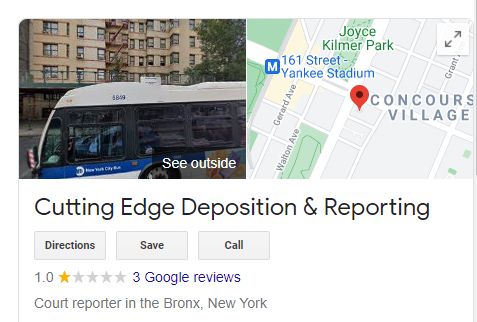
Just in case anybody missed it, at least one of these invoices is listed at the Cutting Edge Deposition office, a one-star digital reporting outfit. So there’s at least circumstantial evidence that Veritext was linked to or had a relationship with digital reporting services as early as 2015. Note also that there’s basically no difference between the price listed at the digital firm’s office and any other invoice. As old studies have shown, digital reporting is not cheaper.

Judging by that rating, Cutting Edge might cut some corners.

Obviously, these are all over half a decade old and may not reflect current market rates. Obviously whatever rates USAC was getting were probably discounted for the bulk work in the same way Diamond gave the Law Department great rates. The point stands that companies are finding a way to charge less than the reporter is making. How is that possible?

1. Cost shifting via copies.
2. Zombie behavior.

Cost shifting?
Cost shifting, in this context, is when one party underpays for a service or product, and the cost of that service or product is recovered from another party who is overpaying.

Again, using New York City’s market as an example, an agency could pay a reporter $3.25, $4.25, or whatever rate was agreed upon. The reporter generally makes the majority of that O+2. Where the agencies get their money is typically the copies. Let’s say you send Johnny on a deposition for $4.25 a page, but you give your client a sweet $3.95 rate because they have so much bulk work. A loss, right? Only if the job is an O+2. There’s no statutory cap on copies here that I know of, and copy rates are notoriously bad in New York City, between 25 cents and 50 cents, so a single copy of more than $0.55/page means profit for the company on that job. Just to put this into perspective, I’ve reviewed a Veritext email from the Midwest region that had copy rates in the $3.80 (regular) to $4.80 (expedite) ballpark. The copy rate for officials in New York, who also collect a salary in addition to their pages, has been hovering around a dollar for the last couple of decades. The idea that private sector is not charging more for that is pretty naive. So assuming an original of 3.95/page, a copy sale of 3.80/page, and a payment to Johnny of 4.50/page, the agency is pulling in $7.75/page in revenue. That’s nearly 42% of the money for them for what is essentially a finder’s fee. It also complicates things for Johnny, who can’t promise clients $3.95 unless he’s willing to take a pay cut and gamble on getting copies.

It goes beyond that with what’s called a sliding scale. The sliding scale awards the client, and sometimes the copy purchasers, with a discount dependent on the number of copies sold. Because the reporters are not fighting for their copies, companies have a lot of wiggle room. They can put $8 on a copy invoice. If a lawyer pays it, then they’ve just made $8 a page under the client’s assumption that “court reporters are so expensive.” If the lawyer complains, they can cut that rate down to $4 or $2, tell the lawyer they’re such a great client and getting such a great deal, pay the 25 cents to the reporter, and walk away with significant amounts of money. Think about it this way: Let’s send Sally on an O+6 for a rocking $5.25 a page, original and 4 copy sales at Johnny’s same rates. The agency can charge 2 bucks a page to everyone, walk away with $10 a page, and again make about what Sally is making despite it being Sally that’s doing 99% of the work because binding transcripts really isn’t hard. Again, Sally is stuck in a situation where working on her own might actually make her less money unless and until copy sales come into play. If Sally can’t survive the short-term pay cut, she doesn’t make it to the big bucks that are keeping agency rents paid, and she’s more likely to accept whatever rate the agency wants instead of the best rate her skill can command. And that $5.25 is generous, because prior to the court reporter shortage getting bad, some companies, like Diamond, didn’t even bother to pay all of their reporters copies. So a company like Diamond as it was would’ve been making 60% of the money from the job before factoring in the proofreading fee that some reporters were asked or told to pay.

The darker side of the sliding scale is when companies ask reporters to change their layout or give a discount on multiple copy sales/realtime hookups. There is typically zero guarantee that they are passing on those savings to clients. Think about that the next time you send a job in your preferred layout and an agency asks you to cram it into a new one that widens the margins or changes the page count. The N word can be your friend sometimes. I knew a realtimer who was asked to slide their rate back because of all the parties ordering. Acquiescence meant losing half their money on that job, but failing to acquiesce might’ve meant the entire job being given to someone else. They used the N word, got the job, and made lots of money. Reporters win when they stand up for themselves.

A hyper-realistic depiction of a court reporter using the N word.

Zombie Behavior? Brains…
Several articles ago I explained the concept of zombie companies. Companies can make money through loans and investors, keeping cash flow positive while losing money and/or earning no profit. Zombies can also be defined as companies that are just barely making their debt obligations. 1 in 5 companies examined by Bloomberg were zombies. In a 2019 Kentley Insights report, 1 in 4 court reporting companies was said to be not profitable. Those that were not profitable lost an average of 10% of their revenue a year. These companies can basically use their investor money to hire people and give customers great discounts. If they obtain large enough market share and run competitors into the ground, they can then jack up their prices monopoly style.

This isn’t a fantasy-land scenario. It’s what Uber did. It gave great discounts and even occasionally gave drivers incentives. It killed the taxi industry as best it could, made itself a fixture in people’s lives, and jacked up the rates while claiming a shortage. Meanwhile, the business model is losing billions of dollars a year. Honestly, I’m more concerned with the cost shifting than I am with the zombies. If companies can’t make money exploiting the “driving” skill, companies are doomed when it comes to a specialized skill like legal reporting. This is a simple calculation. About 80% of America drives and about 0.01% of America court reports. It’s about supply and demand. To me, that says that reporting zombie firms are about 8,000 times less likely to be profitable than Uber, a company which despite ubiquity and billions lost has not managed to turn a profit. But the danger of zombies is evident: They can take up significant market share, impact market rates, and bankrupt other service providers for decades before the money runs out. Again, look at what they did to the medallions. A high of $1 million in sales went as low as $140,000 in recent years, likely thanks to companies that do not even have a sustainable model.

What do we do?
Hope. I’ve been told “what? That’s business! You hate business? They’re not doing anything wrong!” Legally they are probably not doing anything wrong in New York. I’ll concede that much until I have real evidence to the contrary. But morally it’s pretty clear this is wrong. Why are the page rates such a shell game? Why is everything so hidden instead of the yesteryear commission split that reporters made? Why aren’t young reporters being taught the value of the copy and their work? It’s easy to control ignorant people and conclude a lot of companies want reporters to be ignorant so that the companies can continue to leech off of the work of reporters. So to address the morality question, ask yourself how you would feel about me if my mantra was “I need you to be dumb so I can profit off your work.” That would be pretty evil, right? How about if I reduced standard turnaround times so you were always too busy with work to think about the situation and whether you were getting a fair deal? Let’s say I wasn’t evil and circumstances just lined up perfectly for me to profit off your ignorance, and I let it happen. Am I a “good person” yet? Am I “not doing anything wrong?” Sometimes it seems we have this bizarre notion that anything goes in business except standing up and saying “no, this is wrong, I won’t cooperate with this.” I’m still in the process of vetting the following, but I was told by a colleague that reporting companies here in New York City brought on salespeople, the salespeople saw the money to be made in this field, started creating their own companies, killed the union, and from there our rates literally stagnated for about 30 years. In my younger years I was literally told “if you don’t like the way it is, leave.” A good four people that I knew in or around my graduating class of 2010 did leave. It’s been an incredible decade and we are now at the point where people are talking about this stuff pretty freely instead of telling newbies they’re the problem and that they should leave. As I see it, hope and communication are winning us many battles.

I can’t say with certainty where the tolerance to everything that keeps reporter rates down comes from Perhaps it’s all exacerbated by antitrust concerns and the fact that our associations cannot engage in anticompetitive behavior such as group boycotts. Perhaps we see they are silenced, so we mimic that silence. NCRA, for example, could never legally denounce Veritext, US Legal, or Planet Depos in the same way I’m allowed to. Maybe that tolerance is linked to survivorship bias. “I was successful and therefore anyone who is not successful must not be trying hard enough.” Maybe that tolerance is linked to expectations and the Pygmalion effect. “There’s nothing I can do, so I won’t try to change anything, and therefore nothing changes, validating my belief that there was nothing I could do.”

There’s no end to the list of “maybes,” but there is a profound power in spreading knowledge. With knowledge on how the court reporting firms are making their money, everyone from the grizzled four-decade reporter to the newbie graduate can compete. That’s a pretty scary thought for anybody who’s been making money off of reporter ignorance. That’s a scary thought for reporting companies that can’t even make a profit in the current climate. But for the people that actually do the work in this field and the reporter-owned companies, it provides real opportunity. Not so entrepreneurial? You’ve seen now hundreds of invoices and just how much money is in this field. It’s time to ask for your fair share. A typical finder’s fee is something between 5% and 35%. Why should you give up 95% on a copy?

Entrepreneurial? Try subcontracting your O+2 out to your non-entrepreneurial colleagues and grabbing those copy jobs. It may be frightening to lose money on any one job, but if you lose $100 on one job and make $1,000 on another, you put more in your pocket, and as I just showed you, it works out mathematically. You can pay your colleagues well and still make boatloads of money. If you’d like to be added to the list of agencies I compiled so that New York reporters can find you, let me know.

There’s no cheap fix. Industry health is a lot like personal health. Took me a long time to get heavy. It was about a decade of decline until I peaked at 290 pounds. It also took a long time and a lot of reporter apathy to get from the golden age 80s to the nightmare of a field I stepped into where rates were lower in 2010 than they were in 1991. Those of you who saw me at NCRA 2021 saw I’m a lot closer to 240 now and headed in a somewhat healthier direction. Without some communication from people that loved me, I probably would’ve remained hopeless and just kept gaining the weight. Similarly we can rehabilitate this field and make the working reporter’s wallet a lot healthier on average, but it’s going to take consistent effort to get word out to the newbies. The long-term consequence of an informed field is probably more stable pricing for consumers, the people we’re doing all this for to begin with, and I can’t see a single drawback.

Addendum:
As pointed out in a comment below, I neglected to point out that agencies also create a word index or concordance index and charge for those pages. Some firms charge a reduced rate and others charge a full rate. In my past experience, no firm paid the reporter for the index. Since it’s a practice that relates so closely to this topic, I am adding it here.

Is VITAC Paying Below Market Rates for Captioners?

About three months ago, after Verbit’s acquisition of VITAC, a well-known captioning provider, I published a strategic overview for captioners and how they can stand up for consumers. Not long ago, a live steno captioner position was posted by VITAC for less than $20 an hour. The position did boast other incentives, such as the potential for health insurance and a 401(k) for full-time captioners. With health insurance being valued by sources like Griffin at $1.52 to $7.42 an hour, it’s fair to say that we can consider a $19.23 hourly rate with benefits a value of about $30 an hour at best and a value of $20.75 at worst.

Remember, the value is slightly higher than the dollar value if benefits are offered.

Stenography is a highly specialized skill. But even other highly specialized skills, like realtime voice writing, were undervalued. The voice captioner posting said $30 hourly at the top, but then in the body of the description, a $17/hr training rate was advertised. It was further advertised that $35,000 could be made in the first year. $35,000 divided by 52 weeks in a year is about $673.08 a week. Assuming a 40-hour workweek, that’s about $16.83/hr — close to half the advertised rate!

Come work for me for $30 an hour! I mean $17! I mean $16.83!

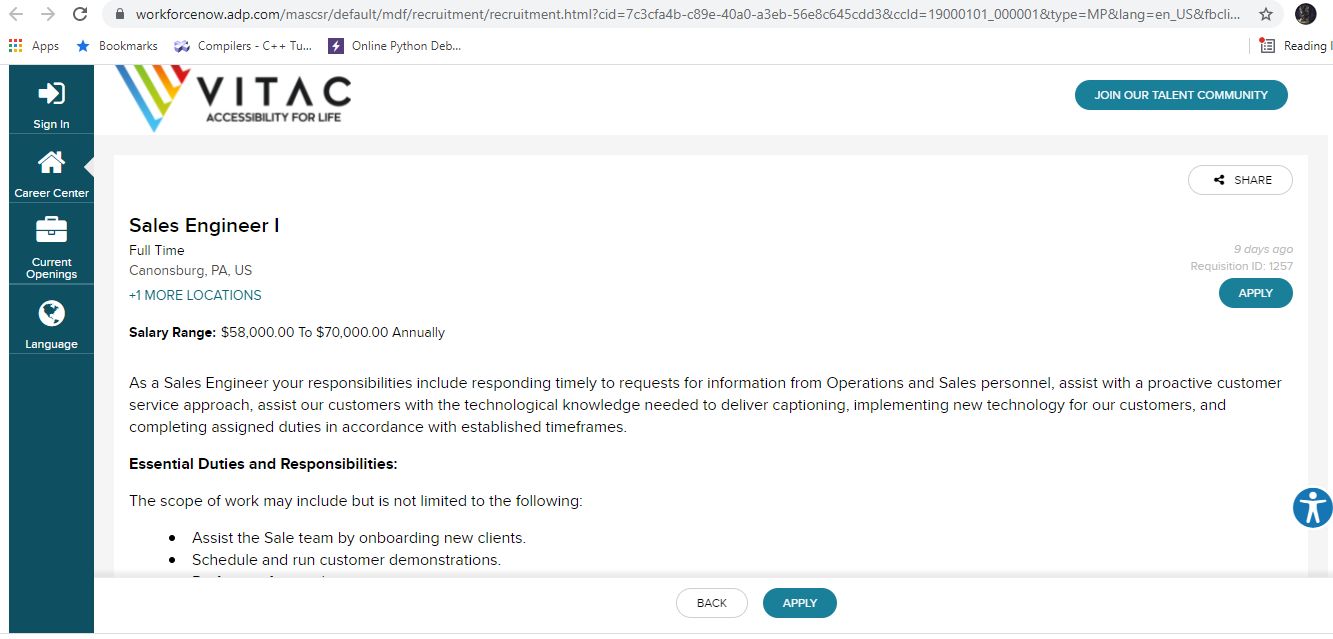
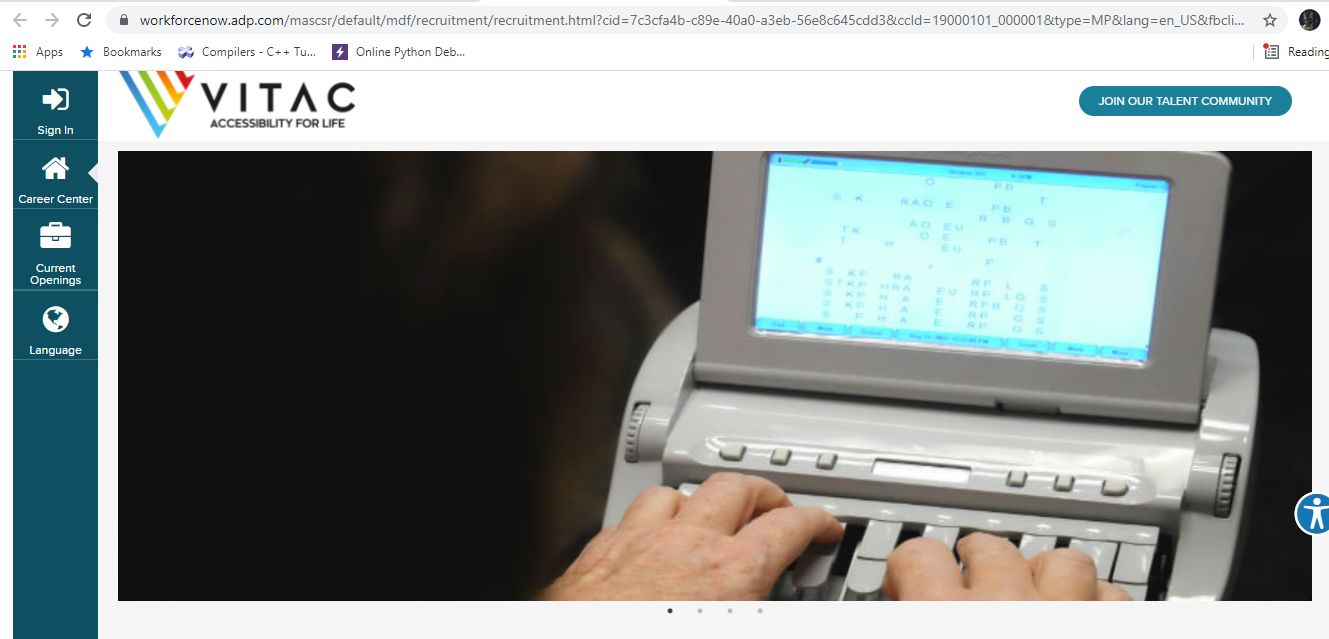
I thought, “if a company is going to pay its specialized workforce $20 or $30 an hour, certainly I feel bad for the positions that do not have labor shortages or specialized skills.” Then I came across VITAC’s posting for Sales Engineer I (SE1). An SE1’s job is all about onboarding new clients and responding to requests from Operations and Sales personnel. They’re offered $58,000 to $70,000 annually, the equivalent of $27.88/hr and $33.65/hr assuming the same 40-hour workweek. So VITAC’s apparent strategy is to pay the stenographer that is providing the actual service to the consumer about 60% of what they’re paying the salespeople. But just to make sure they look good, they added a modern stenotype to the website.

No offense, sales engineer I, but I think captioners have it a little harder than you do.
Maybe if you were offering more than $20/hr, I wouldn’t find this picture so comical.

Of course, having been in the field the last eleven years, I also have some basic familiarity with the rates that captioners and CART providers charge. $20 to $30 for a “live steno captioner” job seemed low to me. Knowing how companies in the court reporting sector have taken advantage of young reporters, I requested information from several service providers in the field with varying degrees of experience in the hopes that I could get solid info out there for young or unknowing captioners. This is what I learned:

Provider A stated that they did not provide broadcast captioning, but did caption telephone calls and Zoom meetings at a rate of “almost $40 an hour” through Innocaption. It was stated that the work was super easy and may even be possible for students to take, though Provider A did mention they usually do not recommend students work. Asked about their understanding of broadcast captioning rates, Provider A stated broadcast captioning was higher.

Provider B
stated “Even as a brand new CART provider, I never made less than $60 an hour. With one company, after I got my [certification], they bumped me to $65. Another company has always been $65 across the board. The third company has different rates for different jobs. Classes are $60 but if you are doing town halls, harder jobs, it is $75. Fourth Company was a smaller company and [they] paid me $80 per hour, and it was only classes. First company I spoke of is out of Illinois, second is Denver, third is California, fourth is Chicago. And I have never done broadcast captioning. I hope that helps!”

Provider C stated that they performed work for call services that did live captioning and were offered $40 an hour, but they were only taking down one side of a conversation.

Provider D, a 27-year veteran of our field and certified realtime reporter, stated that when they took on captioning work, it was 2014, they had a full-time job, and they did not need to make the same high rates independent contractors usually did. They made $50/hr in 2014 and a 2-hour minimum. That work came to a close. Come 2020, Provider D was again offered $50/hr and attempted to negotiate for $80 because the work was dense and contained a lot of science. The firm “did not know” if they could pay $80, and asked Provider D to come down to $70, which Provider D did with the caveat that they would renegotiate at a later date.

Provider D also received a call from a California-based company and negotiated $100/hr with a 2-hour minimum. The firm paying $100/hr expected no rough draft after events. The firm paying $70/hr required a rough draft. A third firm in Florida offered $80/hr. Provider D stated that the swing was generally between $50/hr to $100/hr and that they would never work for $20/hr because captioning is more than knowing realtime, you have to know how to connect to a multitude of platforms and devices, as well as troubleshoot on the fly.

Provider E wrote “My first response when I read [the $20 rate] was OMG! Yeah, that is SUPER low! So here’s what I know from where I sit in the Pacific Northwest:

There are four levels of captioning that I have ascertained.
1. Broadcast captioning, which is a whole other sphere that requires encoding software and usually above and beyond training to do TV captioning. I don’t really know much about that…” “I don’t know what rates they’re charging, but it has to be higher because the software is not cheap, like a $7k add-on with Eclipse.

2. CART captioning, either in person or remote, through a freelance company or own shingle. This is stuff like government meetings, group conferences, seminars and such, $120-$125/hr with 2-3 hour minimum in my area. We are sometimes requested to bring a projector and/or screen, which adds to rental fees. About half of people charge after hours rates on this. I feel the remote world has let this go a bit. But I know when I go back in person that’ll definitely go back in.

3. Schools. One on one with one student. they are notoriously cheap in my opinion even though they’re being paid by ADA funds, from my understanding. Most commonly in my area $85/hr, 2-hr min. But I’ve negotiated more for after hours and weekend work with one college.

4. There is one company whose name escapes me, probably more, who provide a captioner for phone calls. they only pay $30/hr. I was really bothered by this undercutting of the industry when I found out about the rates folks were accepting. But a reporter I talked to about it said [it’s] mostly sitting there doing nothing because you’re only writing half of the conversation, no transcripts, so super easy work. She considered it easy supplemental income.

That $20 is WAY out of line, especially if that requires continuous writing…”

Provider F wrote “everyone has their baseline. I will do $70 and hide my head, for a friend. But my default is $80 or $85. However, if it’s MY work, my clients, I charge 100 or 125 and pay $80 or $90 or $100 depending on the job…”

According to the Bureau of Labor Statistics inflation calculator, $50 in 2014 money is worth $58.08 in June 2021 dollars. $100 in 2014 money is worth $116.15 in June 2021 dollars. Again, for new captioners, this should put into perspective the value of the work and the importance of occasional raises.

I also reached out to StenoCaptions LLC and received the following response:

“Good afternoon, Mr. Day,

Thank you for your question about our company.  StenoCaptions LLC is proud to be a minority woman-owned business.  Our team of independent contractor captioners earn between $100-120 per hour depending on their qualifications and length of time in the field.  As our website discloses, we charge $140 per hour for most jobs.  This means that our captioners, who are the people doing the difficult and demanding work of providing live accurate Communication Access Real-time Translation, net between 70-86% of what we bill.  StenoCaptions LLC is proud to support our highly trained, highly reliable stenographic captioners.  

We are happy to be quoted on your  blog.  Let us know if you have any further questions.

Sincerely,
Wendy Baquerizo and Joshua Edwards
Co-owners
StenoCaptions LLC
StenoCaptions.com”

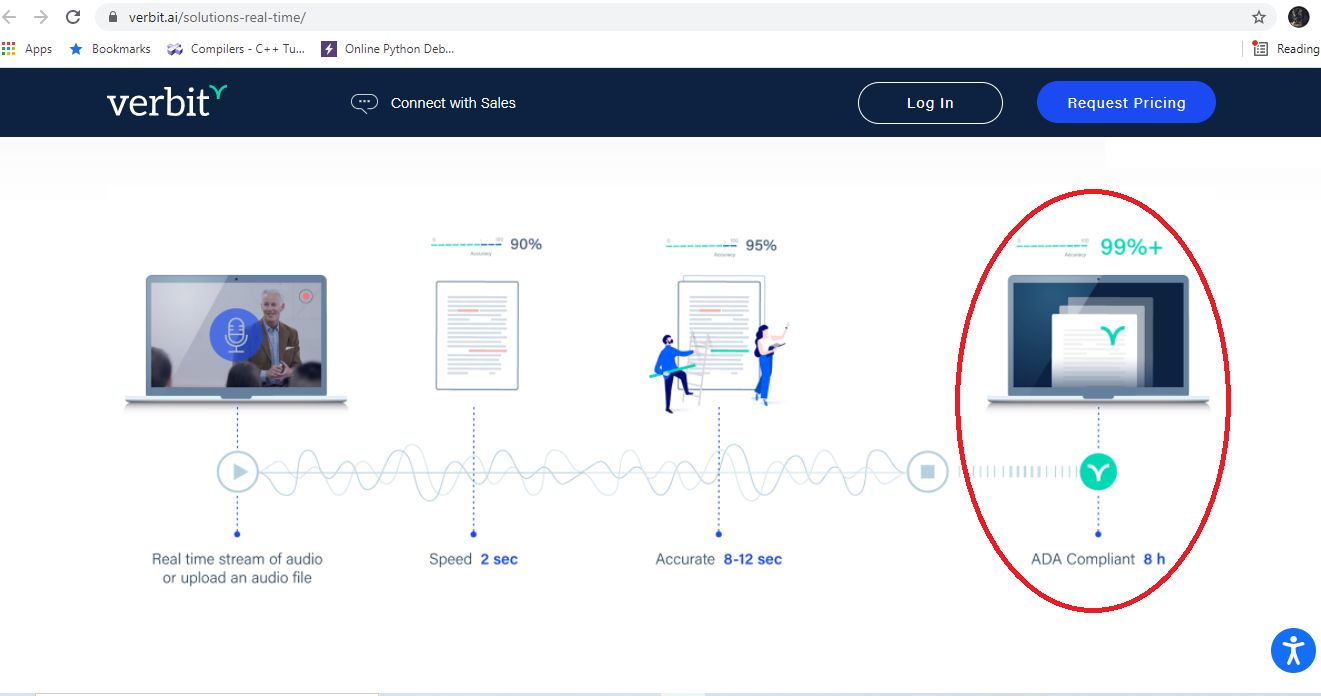
As of writing, there is little doubt in my mind that the rates being offered by VITAC, and I suppose by extension Verbit, are well below what could be considered a market rate no matter which market in the United States we examine. Again, in the best-case scenario of a $30/hr value, they are paying 40% less than Provider D, whose full-time job was not captioning, made in 2014! A company like Steno Captions is literally paying six times as much to their providers. This has some troubling implications. Verbit’s entire model, as I understand it, is automatic speech recognition transcription coupled with a human transcriber. Verbit claims on its site that after 8 hours it can provide ADA-compliant material at 99% accuracy, at least that’s how I understand their infographic. They also make the claim of 95% accuracy with an 8 to 12-second delay.

To be fair, it takes me about 8 hours to get 99 percent accuracy on 160 pages. But I’m not a captioner.

We have to deal with the hard fact that, in its series A funding, Verbit made the claim that its “adaptive speech recognition tech” could generate detailed transcriptions with over 99 percent accuracy at record speeds. In its series B funding, Verbit, through CEO Livne, said it would not take the human transcriber out of its workflow. Now it’s apparent that Verbit regards “record speeds” as 8 hours. We have to deal with the hard fact that, when studied by people at Stanford, an entire host of automatic speech recognition products from companies far larger than Verbit had accuracy levels that were 25 to 80 percent dependent on who was speaking.

There’s just no good reason to believe that Verbit consistently has the capabilities that it says it has. This is all part of the claim game that I demonstrated earlier this year. In the video I just linked, I tell six lies, one partial truth, and one actual truth in fifteen seconds. I challenged my readers to think about how long it would take to prove the truth or falsity of each claim. I have to make the same challenge here. Verbit’s website boasts that they are trusted by “400+ organizations,” but when one flips through the organization list, one sees about 16 organizations. Even if one wanted to spend the time and energy to fact check the claim of being trusted by 400 organizations, one could not do so. Why bring it up? Because stenographers need to be aware that a lot of the “intimidating” information out there falls apart when given any sort of investigation. Likewise, there are entities out there that will try to convince young captioners that their skill is not worth very much. I’m publishing this information today to counter that.

Perhaps the low pay wouldn’t bother me, but it goes directly against digital recording’s main talking point of “we need to record it because there are not enough stenographers to meet demand.”

You guys showcase the shortage. I’ll keep showcasing your BS.

Maybe the shortage of stenographic court reporters and captioners is exacerbated by companies like this coming in and offering pay that’s nowhere near the market rate. There’s no innovation involved. It’s a shameless war on workers. It doesn’t take a particularly bright person to say “gee, there would be more money for the company if only we could reduce the labor costs.” It also doesn’t take a particularly bright person to point out to captioners that they cannot accept this if they want a healthy field. We’re going to need the entrepreneurial individuals among us to consider jumping in, setting up shop, and competing. We’re going to need captioners to demand the pay they deserve. So if you come across an inexperienced reporter getting told they’re only worth $20/hr, please share this with them and be a major part of pushing back.

Addendum:
I realized after my initial draft that the $20 an hour could be a full-time job. Assuming 7 hours a day, five days a week, 52 weeks a year, that’s a salary of about $36,400, below the national average, and well below what I started working for as a court reporter around $70,000 a year. So even looking at it from the standpoint and potential of “more hours for less pay” I am unimpressed and captioners should be too.

Will Verbit Go Public in 2022?

Verbit’s constant attraction of investor money and recent acquisition of VITAC has set off a few optimistic waves in the media. Verbit bills itself as a unicorn, that is, a startup with a valuation of over $1 billion. Court reporters worried about that kind of classification should be aware that it means nothing. Fyre was set to be a unicorn, and yet Billy McFarland’s venture did little more than light Fyre’s investors’ money on fire and land him in jail. Theranos was valuated at $10 billion. It’s now worthless and Elizabeth Holmes may face jailtime. Powa was a unicorn with a valuation of $2 billion. That didn’t work out either.

I was shocked to come across an article that states that there are hopes of Verbit becoming a publicly-traded company by 2022. Ignoring things that the article gets incorrect, such as the firm being Manhattan-based (other articles state it’s an Israeli company), there are few reasons I can see for Verbit to become a publicly-traded company. Becoming publicly traded would allow investors to see the profit or loss. To give a great example, VIQ Solutions, parent of Net Transcripts, is publicly traded. It loses money every quarter despite reporting revenue in the millions. Companies that lose money aren’t attractive to investors and that’s why VIQ is about $7 a share today. Remaining private allows companies to continue a kind of “shell game” and operate despite being unprofitable. Based on Livne’s broadcasting of Verbit’s revenue and silence with regard to profit, I suspect Verbit would have the same exact problem, lots of revenue and little or no profit.

Going public would serve only one purpose in my view, an exit for current investors. Current investors could make a big deal about how it’s a company valuated at over $1 billion sitting “on top” of a market that’s allegedly worth $30 billion and watch as new investors dive in and take the bait. In the article above, Livne states the funding rounds were over-subscribed. That means they had a lot of money poured on them in their funding rounds that they did not need. If they’re over-funded, going public clearly wouldn’t provide the company with funds it needs — remember, it’s overfunded — again, it would give the current investors an exit. They get to cash out, some suckers get to buy in, and what happens after that is anybody’s guess. It remains a little strange to me that journalists buy the idea that a company that is maybe half a decade old has automatic speech recognition technology that is better than basically all the major players in the market. Those major players, according to one study, have accuracy levels between 25 and 80 percent.

My prediction is that Verbit will either fail to go public in 2022, or it will go public and take a hard fall sometime down the road after Livne and other investors have cashed out. I sincerely hope it’s the latter, because at least it would be a happy ending for the founder. Verbit finds itself in a precarious position of being a large target for the IRS. In the United States, one is a common law employee when the “employer” has direction and control. Verbit, according to the linked article, is using 30,000 freelancers to carry out its business model. If Verbit does not have direction and control, it cannot assure quality. If it does have direction and control, those are 30,000 employees it is failing to withhold taxes for. Like other companies that rely heavily on independent contractors, Verbit may soon find itself under attack from federal and state tax authorities where it conducts business or earns income. Anyone in the world can confidentially file a form 3949-A that puts Verbit under the spotlight, and that can only translate into headaches for the company and its investors. With that kind of exposure, I would not be investing in the company any time soon.

Even in a world where authorities turn a blind eye and there isn’t a decline in the company’s financial health, Verbit moving public could only give its competitors more information, which is something I’m looking forward to.

Meanwhile, back at Stenonymous HQ, an important meeting with my board of directors.

The Importance of Plover and Open Steno

Open Steno was developed by Mirabai Knight, a CART writer in New York City. I first got to hear her speak about it years ago in the context of the stenographer shortage. She explained that this was a matter of statistics. We knew and still know that stenography is hard to do at working speeds. Only about ten percent of people that embark on the journey make it all the way through, and at that point, there’s almost 100% employment. The concept was simple. We cannot force people to pass steno programs, but if we introduce steno to more people, more people will find out they’re good at it and maybe want to make it their career. We can also tear down barriers for people that simply cannot afford student software, taking a different but equally important approach to something like Allie Hall’s Paying It Forward project. People that believe the stenographer shortage is impossible to solve may be surprised to learn that Mirabai pretty much figured it out over a decade ago.

The Open Steno community has brought things into creation like Plover, a free translation software that allows people to understand the basics of maintaining a dictionary without spending a dime. It has also brought Art of Chording by Ted Morin, a free way to learn steno.

The Open Steno 2021 survey results were released recently, and they are remarkable. Out of 100 respondents, almost half had been learning for less than three months, which means lots of people have been introduced to steno very recently.

Again, nearly half heard about steno from the internet, a blog, or website. This gives stenographic reporters a real peek at the power of the internet for recruiting court reporters. Television and online video is a distant second.

Social media is our friend.

On the flip side, most Open Steno participants do not intend to attend formal school. This is a trend that we should pay serious attention to. Communities like Open Steno are going to attract the people the court reporting schools cannot.

About half of the respondents use steno heavily in their normal computer use and over 60 percent of those that use it heavily intend to use it on a regular basis.

Not a single person said no. They love stenography.

Nearly 75% of respondents intend to use stenography exclusively in day-to-day computer use!

Again, skewed by people like me, who would’ve answered “no, and I do not intend to.”

The Open Steno community also has different people learning different theories, including Plover, StenEd, Magnum, and Phoenix. A variety of steno softwares are also used, including CaseCAT, Eclipse, and DigitalCAT.

11 respondents use CaseCAT!

Professional reporters, this is definitely one of many groups deserving of your support, whether you pop into the Discord chat to offer advice or even make financial donations, this is a chance to make a difference and contribute to one project that’s focused on putting an end to the shortage through tool creation and even free games like Steno Arcade.

PCRA Wouldn’t Say Whether It Sees the Future Generation As Being Digital Reporters & What You Can Do About It

It came to my attention through an anonymous source that on June 26, 2021, the Pennsylvania Court Reporters Association held a webinar titled “Educating the Next Generation of Reporters.” The learning objectives were pretty standard: The importance of staying up to date with technology, how technology is affecting reporting, and recruiting individuals to become students of court reporting. At a glance these are all things related to technology and advocacy, and certainly fall under NCRA’s CEU guidelines. Nothing particularly surprising until we get to a couple of the presenters.

Moderated by an RDR, so it’s got to be legit, right?

Chrissy Boggs from Secure Transcription Solutions (STS) and Kelly Moranz from Tri-C. Secure Transcription Solutions doesn’t sound like court reporting and Ms. Moranz is on the board of the Speech To Text Institute (STTI). STTI is basically the new mouthpiece of digital reporting and automatic speech recognition. They claim that they want to set quality standards for all methods of record taking, but as we’ll get into, digital reporting, and especially automatic speech recognition, is inherently less efficient and cannot consistently meet the quality of stenographic court reporting or voice writing as of today.

No single technology holds exclusivity on uncompromising quality. Also, ASR gets 25 to 80 percent of the words depending on who’s speaking.

It was noted that Chrissy Boggs has worked with STS since its inception in 2019. “During that time, she has embraced the unique challenges posed by the court reporting industry; namely, the issue of expediently producing qualified reporters using critically needed and thoughtfully designed digital reporting technologies.” At this point, at least some reporters in attendance were confused, and for good reason. There is an audience requirement for CEUs. Courses must be designed to meet the continuing education needs of a specific credential holder segment. Take a look.

Considering NCRA’s stance as an association for stenographic court reporters, I have some trouble seeing how expediently training digital reporters fits.

During the presentation, automatic speech recognition by Parrot was showcased transcribing My Cousin Vinny. It performed poorly according to at least two sources. It was mentioned that there’s room for every method and they don’t diminish one method over the other. In summary, the presentation was a platform that legitimized digital reporting and automatic speech recognition as court reporting technologies, and if you don’t believe me, you can check out the extensive notes taken by my source.

Being somebody who just resigned from an association board last month, I thought “this must be in violation of their mission statement or bylaws.” I could not have been more wrong. As of today, PCRA’s bylaws do not define court reporters as stenographic court reporters. Their purpose is the general welfare of court reporting.

We can argue about the artfulness of the wording. But there’s nothing really raising flags at this point.
If you can capture the spoken word for instantaneous audio playback, you’re a court reporter. Maybe artfulness does matter.

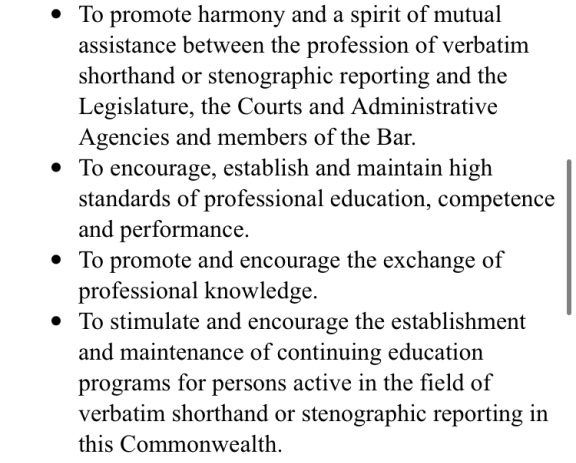
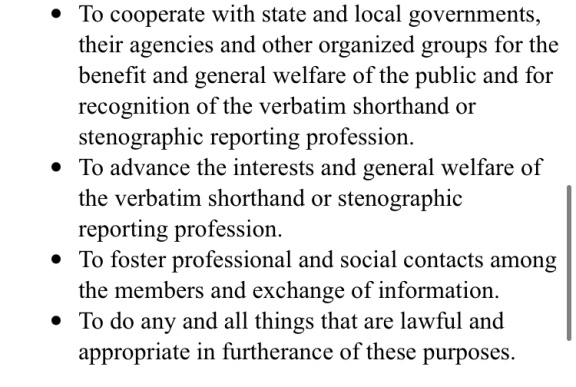
My investigation didn’t stop there. I took a look at the mission statement, which I could see was revised late last year.

Well, okay. There’s nothing particularly strange about this yet.

So then I used the Wayback Machine to get a look at what the mission statement had been in August 2020, prior to the revision. It unreservedly and unapologetically was about stenographic court reporting. That was the clear mission of PCRA prior to the November 2020 revision.

Oh, I like this.
Well, a bit lengthy, but okay.
Let’s make this a shorter and more concise statement by completely eliminating any mention of steno. That will tell people what this organization is about.

This leads, naturally, to some questions. Questions that I asked PCRA right away.

1. Does PCRA see the future generation of reporters as being digital reporters?
2. Why was PCRA’s mission objective changed from focusing on stenographic reporters in November 2020?
3. Doesn’t it seem nonsensical to promote the modalities as equal when stenographic reporting organizations like NCRA are many times bigger than digital reporting nonprofits?
4. Any other comments related to the session or PCRA’s stance as it pertains to stenographic reporting and digital reporting.

I was ready for them to kick my ass (in a good way). Maybe some kind of legal requirement was at play. Maybe I missed something very, very obvious. Maybe a mistake was made. Whatever the case, certainly a board of RPRs was going to set the record straight and make this situation clearer.

Oh. Yeah. Great.

If you take the statement at face value, it’s actually not a bad statement. A hundred percent steno sounds good. But my four questions were pretty softball questions. It would’ve been pretty easy for anyone with any conviction or strong feeling to say “The future is steno. No further questions.” They didn’t bother. Regardless of actual intention, this creates justifiable suspicion of a change in direction, a lack of conviction, and/or a desire to hide something. All things we do not need in leadership today. If that sounds harsh, let’s apply the response I got to some other situations together.

For those that can’t watch the video, I sit down with guest star Marina Dubson in a series of three short skits. In the first skit, the question is asked, “Did you cheat on me?” The response, “baby, I’m 100 percent you.” In the second skit, the question is asked, “Why did you eat all the snacks?” The response, “While the number of snacks has recently changed, my objective remains the same.” In the third skit, the question is asked, “Why would you invite Johnny to the party? You know we don’t get along.” The response, crickets. There’s not a single situation I can think of where avoiding questions like that doesn’t raise some suspicion, whether it be suspicion that the answerer is lying or that the answerer simply does not care enough to give a real answer.

Well, I am incredibly naive and gullible. Maybe they just forgot there were specific questions posed.

When I received this email, I considered becoming a dentist.

I cannot overstate how upsetting this is for me personally. I’m no association hater. I’m a member of six different associations this year, though admittedly not PCRA. In my view, PCRA has always been among the best teachers with regard to political writing and advocacy for reporters. They were the victims of a mindless media flop that I have spent years trying to correct. They have maintained great materials on their site with regard to writing to politicians or writing to editors since I was a young reporter. There’s a lot of great stuff about the organization that reporters should support. But this needs an immediate course correction. I’ve gotten better responses in the past from Esquire and Veritext. I hope I am not the only one that finds it a little odd that, when questioned, Veritext, ostensibly among the leaders of the corporations pushing digital reporting, says technology “...will not take the place of the stenographer” and PCRA, when questioned, can’t be bothered to answer directly. It’s about as bizarre as NCRA’s complete silence on the matter despite requests for comment from myself and others.

Maybe they don’t monitor their PR e-mail. Or maybe they’re too busy with the convention.
But none of that changes the fact that this time is critical for our profession and we need our associations to be better than this.

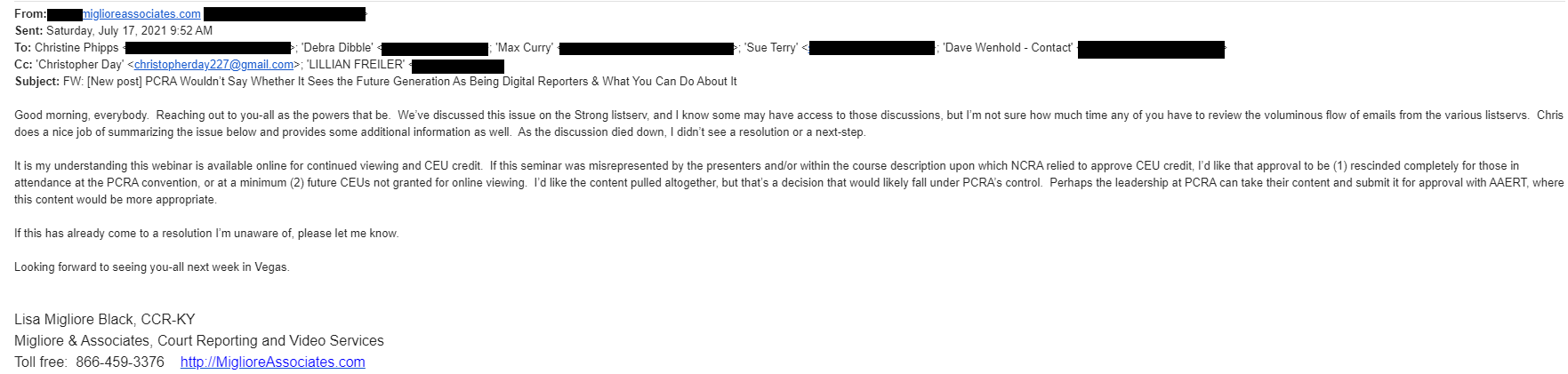
Just in case somebody thinks this is all bluster and that digital reporting and/or ASR really can be equivalent to stenographic reporting, let me set the record straight. It can take up to eight transcribers to complete a rough draft, something I was completely oblivious to until I consulted Lisa Migliore Black from Migliore & Associates. She had this to say:

“I’ve spoken with Verbit salespeople on a few occasions over the past few years. In the most recent sales pitch regarding the provision of rough draft transcripts, the representative stated that eight transcriptionists would be working behind the scenes to provide a rough draft of the day’s proceeding with a final transcript delivered the next day. Eight. Eight sources of potential breach of confidentiality. Eight transcriptionists to provide the rough draft that a single stenographic reporter could produce within seconds of the conclusion of a legal proceeding. Eight transcriptionists to provide the next day [that] a team of three (stenographic reporter, scopist/editor, and proofreader) could produce within an hour of the ending of the proceedings on the same day with a stenographic reporter in charge. If Verbit’s ASR technology were truly an advancement, shouldn’t it be more efficient and require far less human involvement?”

In brief, there’s no reason to believe the technology is equivalent, and Verbit, a digital reporting proponent, has conceded the lack of equivalence its own infographics, as I reported in the past.

Steno: “Our workforce is highly trained.” Digital: “Our workforce is not highly trained.” It just screams equal, doesn’t it?

For those that believe pay is commensurate with training or experience, enjoy this video where a Youtuber advertises that transcribers can make 23,000 Indian rupees a month working with Verbit. That’s about $308 a month as of writing. Good luck maintaining uncompromising quality and adhering to AAERT standards when digital proponents can pay people 8,000 miles away 6% or less of what court reporters make today. No matter what Moranz had to say during the presentation, the hard fact is that once you shift the reporter from the front end to the back end, unscrupulous and conniving people are going to be shipping the work off to Manila, Kenya, and India where your laws and best practices are not enforceable. How do we know? They already do it.

Everyone is eligible.

It’s just anti-intellectual to continue to pretend that these things are equal. 85 percent of AI business solutions, the umbrella under which ASR lives, are predicted to fail by 2022. There’s very good reason to believe some companies relying on digital solutions are unprofitable. Court systems have acknowledged that the use of such technologies would threaten access to justice. Captioning advocates refer to ASR output as autocraptions. That PCRA is okay with platforming this stuff as stenographic reporter education and then comfortable with giving me one of the most non-responsive responses I’ve ever had the displeasure of reporting should give reporters and the consumers we serve pause.

There’s a real easy way to remedy this situation, and there can be some good to come from it. Bylaws matter. Board members and the organizations they serve are obligated to follow the law and the organization’s bylaws. If you are not a Pennsylvania reporter, the best thing you could do for this industry right now is forward this to a Pennsylvania reporter. If you are a Pennsylvania reporter, then any three members of the board or any five members of the association can propose a bylaws amendment.

Or we could just trust that it’ll all work out.

You need only slip the word stenographic in front of “court reporting” and “captioning” in Article II and redefine court reporter in Article III to be any person who captures the spoken word by stenotype or stenographic means.

Two minor alterations.
And one slight touch up over here.

This exercise will serve a few purposes. If everything is cool, then the amendment is going to pass without issue, members can feel confident in their PCRA, and this post can go down as the ramblings of Chris Day, the registered paranoid reporter. It is not lost on me that there are good, professional people on that board right now and that leaders sometimes stay silent for strategic reasons or out of fear. At this point we really need our leaders to fear silence and take strides to safeguard our associations. I am unabashedly a steno ally. If I can’t get satisfactory answers, then any time a writer wants to spin a bullshit anti-steno story, they’re going to tear our leaders apart. Changing the bylaws will allow PCRA to come out strong on this issue and maybe give the organization some practice in responding to media inquiries.

The exercise will also help identify people who might be sitting in positions of power with an intention to spread the consumer nightmare that is digital reporting. If anyone fights the amendment, it’s a great indicator they’re trying to subvert your organization’s original mission and have got to be voted out. Those subversives, by the way, will be the ones saying “we don’t need to amend the bylaws because there’s no problem with the bylaws.” Those subversives will be the ones who want to publish a throwaway statement about this article instead of amending the bylaws.

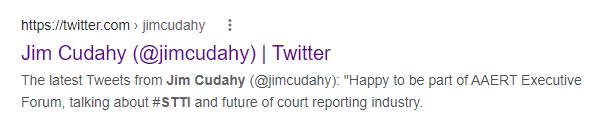
Subversives are not going to spell out for you that their intentions are not in line with what most of us expect from stenography’s leaders. How do we know? Again, it’s already happened before. Jim Cudahy was the Executive Director of NCRA. He did the association a great service in getting the stenographer shortage forecasted. Nowadays he’s using his “knowledge” and past title to advocate for an integrated market of stenographic and digital reporters and bring some legitimacy to AAERT and STTI.

Okay. I admit it. I’m just jealous because he’s better at hashtags than I am. (Joke)

Professional flip flopper, weaponizing the shortage against us, and completely shameless. It’s very dangerous to engage in pitchfork culture. It’s also very dangerous to continue to trust everybody when there is at least some evidence of a small minority in the field willing to use their credentials and experience to sabotage the rest of us. That’s why I urge Pennsylvania reporters to take control of the situation and get those bylaws amended in 2022.

This exercise will also put the industry on notice that stenographers are not going to sit idle while the dues they pay are used to advocate for their elimination. There is also some hope that every reporter in the country realizes now how important it is for us to take ownership of our associations. If you don’t want your association, STTI and AAERT supporters will be happy to have it, its legitimacy, and its bank account.

You want an easy win for steno? It takes three to five of you to make the difference. In an organization that is 100% steno, it will never get easier.

Addendum:
A few hours after this article launched, an e-mail was sent by Lisa Migliore Black to a number of people regarding whether the CEUs should be counted. A response by NCRA President Christine Phipps acknowledged that the course, in the way that it was submitted to NCRA, was appropriate. She pointed out that withdrawing the CEUs would punish certification holders that had already taken the course, and explained that steps had been taken to review the content. It was further mentioned that steps would be taken to deal with similar issues in the future. Not a bad outcome and certainly in line with what I had expected when I initially reached out to NCRA. As of writing, I cannot think of a way to screen CEU courses better without making it a much more burdensome process on nonprofit and commercial educators, so I think these actions are appropriate for addressing junk education.

I am happy that this article got some discussion going.
I am also happy that discussion was going prior to my article. Thanks NCRA!

NCRA News. Career Launcher and President’s Party

Just this weekend the Career Launcher launched. It is a course comprised of ten modules that will assist new reporters as they bridge the gap between graduation and their first job. It covers several important types of jobs new reporters are likely to run into, including plaintiff medical, personal injury, divorce, interpreted, corporate rep and medical depositions. At $100 for members and $175 for nonmembers, it’s an affordable complement to traditional reporter education. It does seem prices will rise in August, so please tell a new professional about it today!

For those attending the convention, the Utah Court Reporters Association will be holding a party at Margaritaville 7:00 to 10:00 p.m. on July 30, 2021. Proceeds from the event will go to the National Court Reporters Foundation, which is one of the philanthropic organizations in our profession. Check out the flyer I stole below!

You can buy tickets in support if you don’t want to go.

As an aside, many of my contemporaries run discussion groups with fairly strict rules or a specific purpose. There are reasons for that and I won’t disparage it. If you’re on Facebook, feel free to use my Stenonymous group for any field-related reason. Self-promotion is allowed. I will generally not censor discussion there in the same way I do not generally censor discussion on this blog. I may chime in if I really vehemently disagree with something, you’re being really nasty without some kind of attached reason, your comment is spam, or if I think your comment might hurt you, but I’m not going to play policeman where I can avoid it.

The next article may shock everybody. I would just urge people to read to the end. We lead busy lives. It can be very easy to read a headline, make some snap assumptions about what the article will be about, and pass it by. This one’s worth reading.