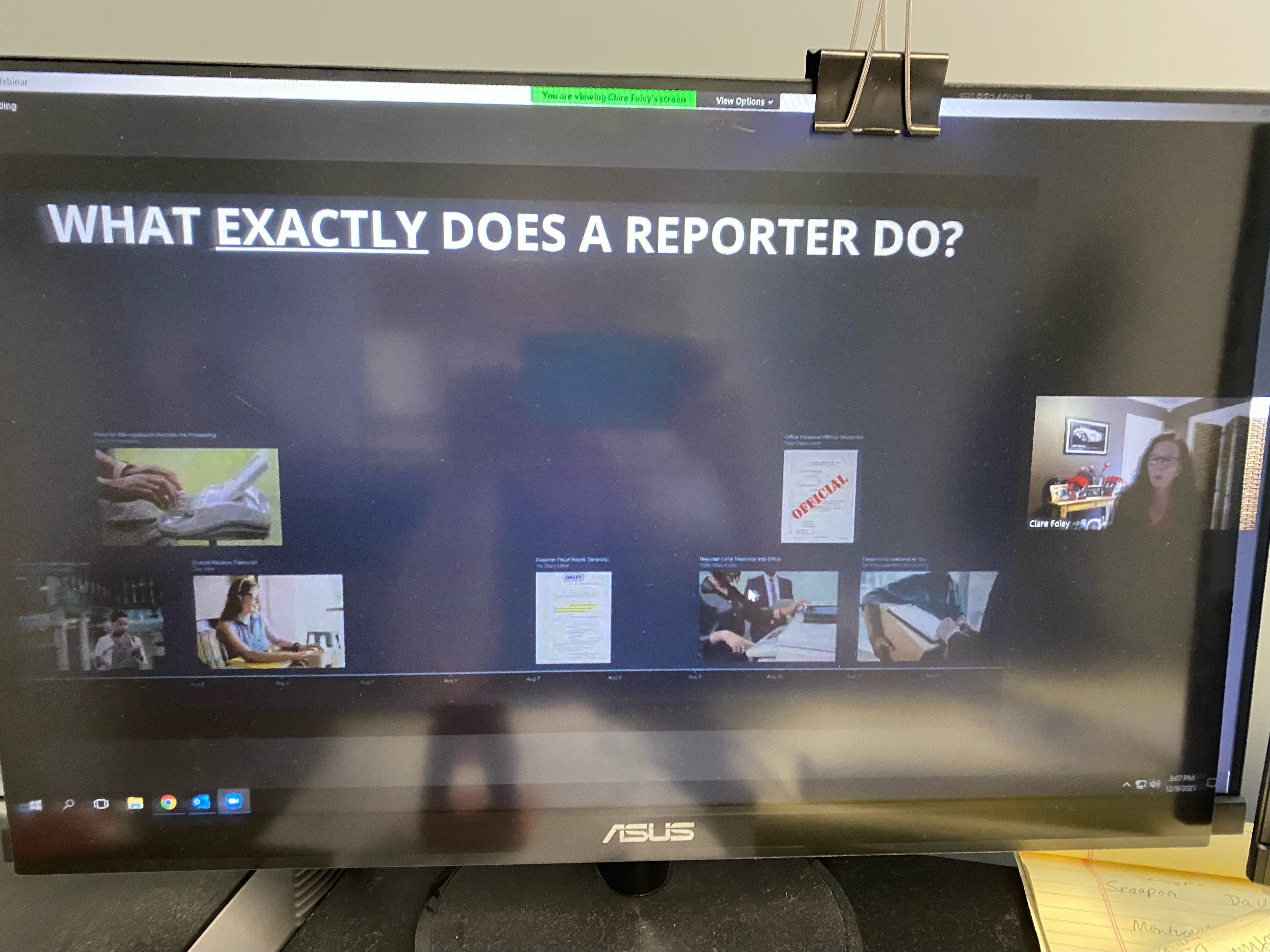
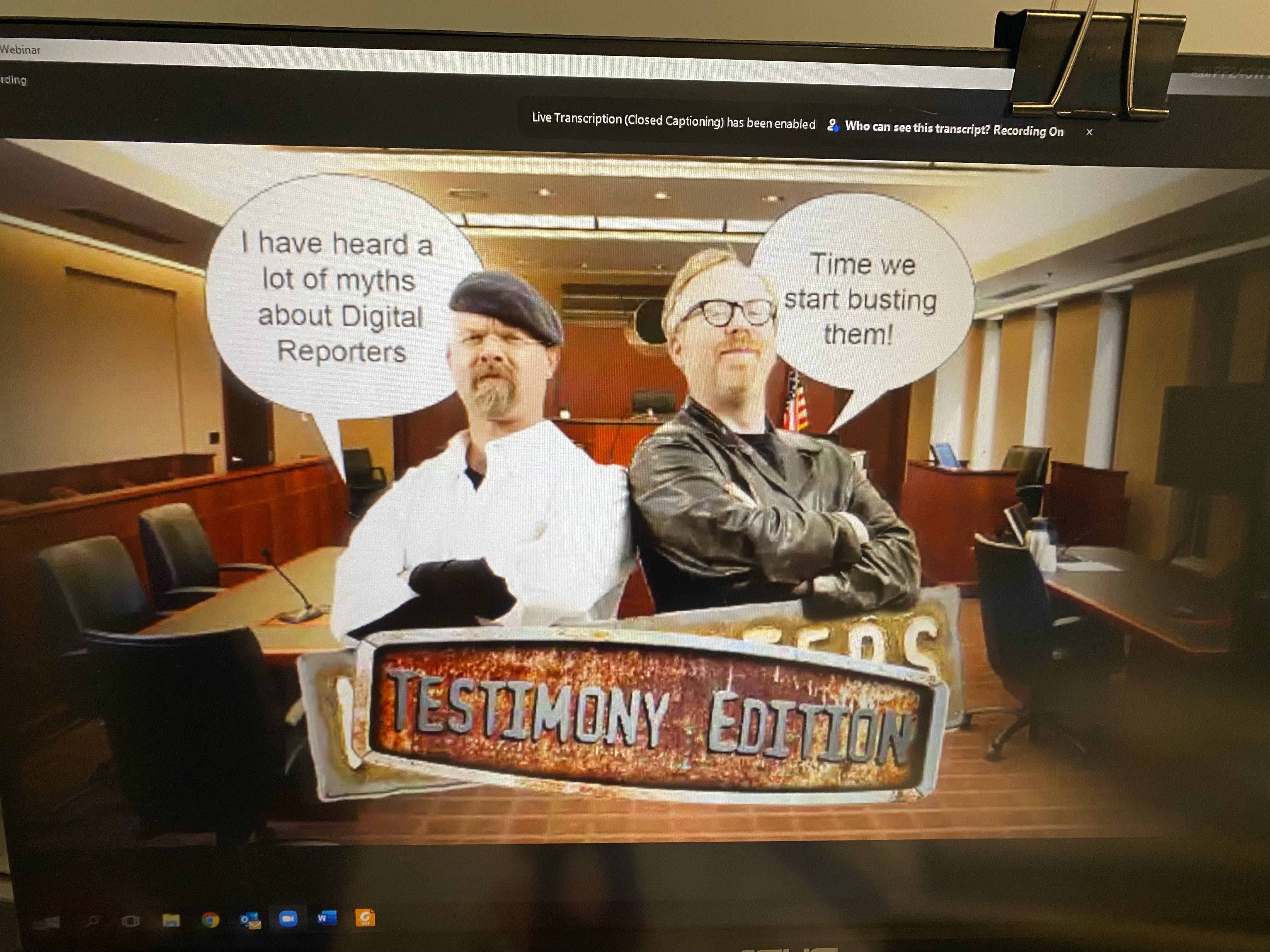
A source that shall remain anonymous passed me information that NYPTI prosecutors were being given education about stenography and court reporting that doesn’t match up with reality. During the presentation, stenography was made to look as old and outdated as possible when in actuality it is top-of-the-line tech in speech-to-text transcription. This supports my belief that the stenographer shortage is being intentionally exaggerated and exacerbated.
By my estimates there are 20,000 freelancers and 28,000 court reporters total in this country. We do not receive much formal legal education beyond the terminology we might hear. This has left many of us confused on our legal rights. Even the agencies that hire us, schools that train us, and the members of the bench and bar we work with every day lack basic information about important concepts we are dealing with. This puts court reporters at a serious competitive disadvantage against anyone with the funds to hire a lawyer.
It’s time for change. If you are ready for that change, please take some time to answer this 8-question survey. I encourage you to share it with anyone you feel might answer it honestly. Every single honest answer will pave the way for taking this from concept to execution. This survey allows me to gauge interest and expand the project. I will release more information as soon as it is appropriate and safe to do so.
We must keep recruiting and sharing information. But I would like to remind everyone to take care of yourself this holiday season. If the stenographic newswire or some other issue is causing you to feel down, take care of yourself. Try to reach out to a support system. Humans are communal. You are not bad, wrong, or alone. You are human. You will be okay because all feelings change over time.
A very special thank you to every single one of my readers. Your readership has made this moment possible. Let me just note that Sound Professionals’ Chris Carfagno has let me know about their latest product announcement. I have always heard good things about SP; I have a great impression of Chris and have no problem recommending them. I will state that I do not believe I’ve personally used their products. When I used to use audio, I think I was using a mic sold by Stenograph at the time, which probably explains why I don’t use audio anymore. I have also started transitioning to Eclipse in honor of the Stenograph boycott. It feels great to be learning new skills and technology in my field and I would encourage every single reporter in the industry to give it a try. Eclipse provides robust training resources on top of its Anytime Support. I even had to call them recently (weekday, business hours), and they returned my call in under three minutes. Switching isn’t easy, but Eclipse has done all it can to make my transition pleasant. I have a feeling that once I am done, I will be able to honestly tell readers which software I prefer from a performance standpoint. Stay tuned.
PS. Stenograph reached out to the Texas Court Reporters Association board. My understanding is that there will be a future meeting in 2022 where members will be allowed to ask questions. This is why I called for the boycott. The more pressure we apply, the more urgent it is for them to curry favor with our associations and make us happy. It would make me personally happy if Stenograph acknowledged that digital court reporting will likely hurt minority speakers’ transcript accuracy. I give my word that if Stenograph makes such an acknowledgment, I will call off the boycott. Until then, let’s see how far those revenues can fall for 2022 and 2023 renewals as people continue canceling support. This profession will endure. Stenograph’s endurance relies upon its service to this profession.
So I stumbled across the CourtReporterEdu.org website. A pleasant website that is facially neutral. You look at it, and it doesn’t seem to be anything “bad.” It talks about stenographers and shorthand. It has a picture of a stenotype. Looks like the kind of marketing stenographers should be doing.
Then you, reader, head on over to a magical place, court reporting info by state.
And when the reader goes to look at their state, they’ll infallibly get a long list of schools that have “court reporter programs.”
From my review of the New York schools listed, none have a digital court reporter degree. The few that mention digital court reporting sell the digital court reporting as a “continuing education” program. In short, they’re selling continuing education for a degree track that does not exist. Some of these schools have zero mention of digital court reporting on their website. Some schools, like BMCC, you reach out to admissions, and they know nothing about the program.
So, of course, I ask Ed 2 Go what the deal is, because Mark Pugal from Ed 2 Go has been trying to sell me on Digital Court Reporting for like a month now.
And of course, I trust, but verify.
BMCC asked for my concerns, so I put them out there.
Now, just to explain, in part, why I think CourtReporterEDU and possibly Ed 2 Go is being dishonest: (1) In many of the schools listed, when one goes to independently verify the existence of the program, it doesn’t seem to exist. Attempting to verify the program with the schools that actually do seem to offer it leads to this roundabout “we don’t have that program, but actually we do” response. Maybe at the point colleges are selling programs with no future and are so insignificant the admissions department doesn’t know they exist, or they don’t exist, we’ve gone too far. (2) Even where the program exists, it is selling students a course in something that is not the industry standard and does not have as many opportunities. (3) Putting a stenotype on your homepage and then diverting people to digital court reporting via esyoh.com and Ed 2 Go is just dishonest. Even if we forgive everything else, the way this page is set up is to confuse people and lend legitimacy to digital court reporting that it does not deserve.
At the bottom of this page is a video walking people through that part. Now for a bit of speculation. We know from the WHOIS lookup that the registrant’s address was in Florida. The server the site is hosted on appears to be in California, but that’s likely irrelevant.
Luckily, one of the schools actually advertising the program gives us a peek into who might be promoting it. Wagner College lists Merritt Gilbert and Natalie Hartsfield.
Merritt Gilbert is apparently in Florida and connected to BlueLedge. BlueLedge, as some may remember from a prior post, are aggressively marketing digital as the answer to the stenographer shortage exaggerated and exacerbated by STTI, Veritext, and US Legal. The author of that article stating digital reporting is the answer to shortage? Benjamin Jaffe. Who is Benjamin Jaffe? BlueLedge.
Who is Merritt Gilbert? BlueLedge.
Who is Natalie Hartsfield? Digital, BlueLedge, Florida.
Now here’s where it gets really interesting. Remember when I wrote yesterday that US Legal has been on inactive status in New York since 2001? BlueLedge, according to Florida Department of State, has been dissolved since 2019.
And just for anyone who thinks “maybe there are two BlueLedge companies in Florida,” take a look at that mailing address, 101 E Kennedy Blvd. Guess what the address for BlueLedge is.
If you guessed 101 E Kennedy Blvd, congratulations.
How is it legal for a dissolved company to misdirect the public, searching for stenographic reporter training, to Ed 2 Go and digital court reporting? It might not be, but it’s going to depend on us asking our various government agencies to look into this as a matter of false advertising and possibly operating illegally in the state. I reached out to my New York State Education Department as it pertained to this course being sold to New York consumers. Maybe this is something the members of each state association can tackle.
This situation blew my mind. We cannot stand for this. We have to fight and understand that we are playing against people that do not play by the rules or within the bounds of our self-imposed moral code. I have collected these images and ideas in a central place. Please use them to do good. I should note that at least one consumer was extremely confused and came onto our message boards asking about how to buy a stenotype for digital court reporting. We must act with compassion. Consumers are being lied to and we are the only people with the knowledge to explain it to them. They WILL stumble onto our message boards confused because they ARE being bombarded by lies.
Addendum:
After reaching out to ESYOH well after this article, they took action! The scheme is now less potent because of their valiant actions.
Where the schools used to lure students to a splash page, they now lead to box about degrees.
I hold myself out as an advocate for court reporters and people pass me info. A few have stated some large firms are offering packages to digital court reporters that are not being offered to stenographers, such as sign-on bonuses. I always ask for some kind of corroborating information so that I’m not publishing false statements. Today, I have some corroborating information.
In this Zip Recruiter ad, US Legal advertises that it offers family-friendly benefits to its employees, including retirement benefits, insurance, paid parental leave, and an EAP. It then goes on to describe a digital court reporter position. As I see it, either it’s (1) a clever play on words where they talk about the benefits that employees get and then hand the digital court reporters an independent contractor “job,” because employers can save a good 40% by misclassifying employees — seriously.
And up to 30% of workers may be, shockingly, misclassified.
OR (2) if it’s not a play on words and they’re actually offering all of these things to digital court reporters, then the fraud that I have been talking about just became really easy to explain: US Legal is, as far as we can tell, making the public claim that they cannot find stenographers. We know that stenographer rates are as much as 30 years behind inflation. We know that US Legal failed to use coverage apps or directories like PRO Link, Expedite Legal, and Cover Crow. In fact, corporate rep Rick Levy, who was on the board of NCRA at one time, attempted to pretend that he did not know what Sourcebook was. We know that US Legal is and was aggressively recruiting digital reporters on LinkedIn and did not attempt to do so for stenographers. We know that US Legal posted an impossible equation to JD Supra in order to convince readers the stenographer shortage was impossible to solve. We know that US Legal acquired and apparently destroyed StenoTrain. We know US Legal inflated the shortage numbers by a factor of six to convince the public stenographers were unavailable and that the shortage was impossible to solve. We know that US Legal’s Chief Strategy Officer Peter Giammanco and Rick Levy both had no problem bullying the women in our profession and others, but they give me carte blanche because they’ve worked out that I’m not afraid of them. We know that digital recruitment isn’t going well because they’ve had to publish their recruitment advertisements every day for months. Even if we want to excuse all of the company’s behavior, how do we excuse this? Reporters are 88% women and yet maternity leave was out of our grasp. All of these benefits that could bring reporters in, I have not seen offered to stenographers. Again, how can the company make a good faith claim stenographers are unavailable when the truth is that the company has done everything in its power to crush the stenographic modality?
If benefits are being offered to digital reporters, I’m happy for those digital reporters, but it’s only a matter of time before the companies turn on them too. We have to let digitals know what’s going on, get them working steno, scoping, and all the things that are going to improve their skills, and lead our industry by example. These big-money types won’t have a choice but to use steno if everybody they’re hiring is taking that money and putting it down on stenographic education. Here’s a hint: That’s happening right now.
We have a choice, as people, to not be complicit in our own demise. It is very clear that the company wishes to exaggerate shortage claims in order to sell attorneys the inferior digital court reporting product at inflated and unreasonable prices. Either we become very open and honest with the attorneys we work with that this fraud issue is ongoing or we risk our jobs being stashed and undervalued. Our value is not directly tied to our productivity, but to our ability to communicate our value and negotiate a better deal. We are players in a game where we hold most of the leverage. Our nonprofits are bigger. There are more of us. We do the vast majority of the work that makes the business and industry viable. We are the consumers of the software and equipment companies that are supposed to support the industry. We are each contributors to local economy — our money doesn’t just sit in the bank, it supports local businesses. There are so many court reporters in this country that we could singlehandedly run candidates for office. Again, we hold all of the leverage. My only suggestion is that we start using it unapologetically. Remember, when the shortage narrative was accepted without question, we were lied to. Now this industry has facts and figures that tell us we were lied to, and there’s a shocking amount of silence. Now that this industry has been shown we defeated stenographer shortage twice before, it’s only a matter of time until we defeat it again, and on that day court reporters would do well to remember every single person and company that said such a thing was impossible. Remember them and remember that when they had a choice to uplift young reporters or peddle garbage, they chose the latter.
StenoMasters, the online nonprofit speaking club formed by Joshua Edwards, is using the donation that I pledged at its inaugural meeting to induct seven students for free. Tell a student they can apply today! In my view, by using coaches such as Ana Fatima Costa or TALLsmall, and then using as the club as a safe place to practice, stenographers can become effective public speakers and advocates. Check out Joshua Edwards’s message to students below!
“Steno students,
You have a rare chance to earn a free annual StenoMasters membership. Thanks to a generous $1,000 donation from Christopher Day, RPR, we can induct seven students into the club for free for the first year (membership runs through Sept. 30, 2022), a value of $146.
StenoMasters is chartered under Toastmasters International, a 97-year-old organization that has been providing public speaking training and leadership development for people all over the world. Stenographic captioners, reporters, and students all over the country are invited to attend and join. We meet biweekly on Tuesday evenings at 8:30 p.m. ET/5:30 p.m. PT online. The next meeting is November 16.
Here are three steps to earn a free membership:
1. Read the FAQs at stenomasters.com to learn more about the club and decide if this interests you. 2. Email Info@StenoMasters.com to express your interest. 3. Show up at the meeting on 11/16.
Warm regards, Joshua Edwards, RDR, CRR StenoMasters Charter member”
My world changed when I started to read a little bit about human psychology. We are very hardwired to form beliefs and defend those beliefs vigorously. Things like confirmation bias and cognitive dissonance inform my opinion there. We also work subconsciously towards our own expectations, as discovered by Robert Rosenthal in 1968. We also can draw profound power from hope, as told by Richter’s rats. Human psychology appears to be recursive and amplifying — we get better at what we do, form habits, and habits are hard to break.
Now here’s the hope: Your psychology is malleable. I know that because I am, more or less, an average human, and if I am able to do something, chances are good all of us can. I pulled off some major changes in my thinking. What are some bad habits I had?
Overeating. I was 290 pounds at one time, and it was physically painful for me if I did not engage in daily overeating. I forced myself to stop the behavior, and over time that physical pain went away. I’m now about 223 pounds and it’s physically painful when I overeat. The problem wasn’t me, it was the way I thought about eating. By analyzing my daily calorie intake and bringing it below what I needed to sustain my body weight, I was able to reduce my body weight by over 23%. But I had to do that against my brain throwing me headaches and temperature fluctuations to try to keep the high calorie count coming. The subconscious mind tries very hard to assert dominance over the conscious mind when a habit is being undone. Keep this in mind when you’re reading about habits of fear below.
Arachnophobia. I was terrified of spiders, even small ones. Now I capture them so I can use them in TikTok videos about court reporting. A fear I could barely live with has become a joke to me. How did I get there? I changed my thinking about spiders. I studied them. I learned that they do not perceive us in the way we perceive them. Once I understood that spiders could not “understand” me, it was easy to not be afraid anymore. They are comparably dumb and will skitter in whatever direction they think safety is in. Who could be afraid of that? They’re much more likely to feel vibrations from your movement or breath than ever realize you are a living being. For an arachnophobe, there’s no greater release than to realize that if you stay still and calm, the chances of a spider noticing you go down to basically zero. I had to change my thinking to improve my quality of life.
Alcoholism. I could function well enough, but I had trained my body to take on so much alcohol that it would kill Mr. Snuffleupagus. Alcohol was a habit I was able to break by thinking about all the things I would lose if I didn’t get it under control. Life, liberty, and happiness were all on the line, and slowly trading away alcohol so that I could keep those things was an almost spiritual experience for me. The consequences of not working on my habit were too great to ignore.
Anxiety and low self-confidence. Here’s where Robert Rosenthal’s work came in. In order to be a voice for people, I had to expect to be that voice. If we go back to 2020, I trembled at the idea of doing any kind of presentation, content, or public conclusion beyond my very comfortable habit of blogging on Stenonymous. Now I’m accusing corporations that make millions in revenue of fraud on every channel and medium I can. I had to tell myself I could do it before I did it. There were social barriers that made me very afraid to do it. Paralyzed by an endless stream of what ifs, I rarely considered the consequence of not doing what I knew was right.
Once I did what I knew was right, a large contingent of our field came out in support. It turned out that I was not the first one to have a bad experience in court reporting. It turned out I was not alone. So many have now written privately and publicly in support. I learned we had been conditioned for so many years to believe that nothing would ever change that we did not expect it to change, and so we did not fight for positive change. Abuse thrives on silence, and we were a field so resigned to silence that when the Chief Strategy Officer of US Legal, Peter Giammanco, wrote in an email, “does it really matter if it’s legal or ethical…” on NCRA’s listserv, even our own NCRA, this organization that we fund to the tune of millions of dollars a year, was silent. It felt powerless. It felt afraid. It did nothing. If our flagship was afraid to sail, what hope would there be for any one of us? If I had not published those listserv emails, we would still be in the same position, being silently abused and resigned to our fate, overblown shortage claims killing our student pipeline. The habit of doing nothing would kill an entire industry, and to the detriment of our replacements and society as a whole.
Like all my other habits, anxiety was broken by thought. I decided that if NCRA retaliated against me for releasing the emails, the organization would be effectively killing itself. Who is going to support a nonprofit that attacks its own member for exposing corporate misconduct? If US Legal or Giammanco did anything, they’d be calling infinitely more attention to my work. Sure, there are now some people in the field that don’t like me. But they do not like me because I am helping others or because they do not yet understand me. That is a flaw in their thinking, not mine. As I said in a related video, I see two futures. One where I am wholly correct in my assertion that the shortage has been exaggerated and exacerbated by these big companies or one where there really is nothing we can do and shortage will defeat us. All the available data points to the former, and the latter is basically a guarantee that our profession will not exist in ten years. The morons at the top of the USL totem pole made this an easy choice for me. Thanks, Rick.
So much of what we do and who we are is habit. Our minds will seek ways to justify our habits so that we do not suffer from an identity crisis. After all, if one embraces this idea of psychological malleability, does it not open the door to the idea that core beliefs, such as sexual preference or religion, may also be changed without consequence? I bypass this identity crisis by deciding to change what I need to change in order to accomplish my goals, learn more, be a better person, and nothing more. Again, look to Richter’s rats and the power of hope. If you use God to tap into hope, then God makes you powerful. In my case, there is a loyalty to altruism that survived my religious days. I was able to tap into that, see that I could not help anyone in my previous state of being, laden with fear and exhausted from my own bad habits, and began taking actions that would help the largest number of people possible. The idea that I can help people gives me hope. What does hope make me? Now I get to share: Anyone can do this. Anyone can be powerful.
There are still plenty of bad habits I will have to work through. But the main idea is that humans are problem-solving machines, so when we really sit and analyze the root of a problem, we find solutions. Look at me. Problems that I had for 10 or 15 years evaporated largely over the course of six months as if they had never existed because I willed it to be so. Now that I know that such a thing is possible, how could I not share it with the world? How could I leave my fellow court reporters in fear? I’m not the only one to come to such a realization. Steno Imperium just released an article about fear. Max Curry’s 2020 presentation at Stenopalooza was all about letting go of fear. We know we are afraid.
The message has not reached everyone in the industry yet. Love and support each other to the extent practicable to overcome this fear. Support systems generate hope, and hope is a huge booster to survival. For those who insist on living in fear or perpetuating it, such as Stenograph’s Anir Dutta, so convinced that we are his Kodak that he’d kill Stenograph to support his habit of fear, we have only one message: Step back, reassess, and see that what we are saying has a far stronger basis in reality than your fear. I promise to do the same always. Together, we will get the industry wherever it’s going.
Alternatively, proponents of fear can stand in my way. But just remember that there are enough court reporters in the business to give NCRA something like $3 million a year. Standing against them means running the risk they’ll start funding me and then I’ll have to kick ass all day every day instead of just doing so when my full-time job permits. I’ve already got a proven track record of defending them with the donations that have come through and my own cash. “Here’s a guy so committed he put a thousand dollars of his own money down just to help stenographers find their voice.” It’s going to be an easy choice for them. The only way to stop that kind of outcome is to accept that stenography is here to stay and get serious about funding it and recruiting for it instead of cuddling up with the disgraceful and opportunistic digital reporting propaganda outfit, STTI.
[sic]
We know that speech recognition is not as good as claimed. 25 to 80% accuracy depending on who’s speaking. We’ve also got information that says 40% of AI startups show no AI in their products and tech startups that say they are AI can expect 50% more funding. This isn’t the future, this is an ill-advised attempted to garner funding for something that has over an 80% chance of failure.
Stenograph is now trying to sell garbage to a customer base that is increasingly aware of that fact and there’s a guy on the playing field with a moral conviction to explain it to them in simple terms. Stenograph is relying on a retirement cliff that has been fraudulently exaggerated by STTI, US Legal, Veritext, and possibly others. The perpetrators of the fraud don’t actually care if Stenograph fails. They’d use it to bolster the fraud — “oh look, the leading manufacturer went under.” Not a desirable position for the company, but also not one that I put it in. So when the cards fall in exactly the way I am predicting, it’s not my problem. And if I’m wrong? Even better.
Think about it. Stenograph’s in the same boat I was. Lots of habits and a choice to make.
In a series of images posted by Michelle M. Kirkpatrick on September 28, 2021, the failure of automatic captions was on full display.
What society would turn a blind eye to this kind of suffering?Not accessible = not acceptable
Knowing that people were in need, she stepped up to help and contacted deaf people in the area to let them know what the broadcast said.
It’s very clear how close to danger these people were.
This comes on the heels of reports that digital reporting proponent Verbit was pseudo-cybersquatting on 121 Captions.
Alternative to 121. I should try this strategy with them and see how it goes.
Given all the data released on Stenonymous as of posting, it is clear that digital and ASR solutions are inadequate for captioning. The dishonesty and blatant disregard for standard industry practices from Verbit in particular has been contemptible. The stenographic captioner has the best value out of all available methods. People interested in joining the profession and ensuring access for all should check out NCRA A to Z,Project Steno, or Open Steno. Despite claims by the STTI that there is an equivalency in modalities, it’s been shown that digital and non-voice writing ASR solutions would harm African American Vernacular English speakers. In the words of one ex-digital reporter, they were simply not paid enough to care. Luckily, spam filters continue to place STTI promotional material where it belongs.
Ana Fatima Costa is presenting a skills workshop tomorrow with Joanna Storey, Esq. It’s going to feature communication tips for attorneys, paralegals, support staff, and court reporters. If you haven’t seen Ms. Costa’s announcement on it, take a look and register now! Thanks to the San Francisco Paralegals Association for putting this on and letting us in! For those of us that missed the September 15 workshop, this is our chance! I’m already registered.
On that same topic of communication, I was also contacted by Kate Nielson and the American Association of University Women. The message was simple: Pay disparity thrives on silence. I wrote to her that a large percentage of our field is female, explained that we are making less than 30 years ago adjusted for inflation, and asked whether she thought we might benefit. Ms Nielson said she’d appreciate me publicizing the event so my audience would be able to join the discussion. If you’re tired of being silent, consider registering now for October 5.
We have so many allies in society. We are not alone, My advice? Jump in! Let Ms. Costa and Ms. Storey talk to you about communication tomorrow; let AAUW talk to you about the importance of breaking silence. Start writing your story. Even if you cannot attend these specific events, get on the mailing list for these associations so that you have a chance to take part in the future.
With the extremely public release of information confirming that automatic speech recognition and digital court reporting services are inadequate for court reporting at best and actively harmful to consumers at worst, U.S. Legal Support has decided to continue its recruitment of digital reporters and transcribers instead of stenographers.
For years in my industry it has been claimed that digital reporting expansion was only for emergency use due to stenographer shortage. It was only for jobs stenographers allegedly would not accept. That was largely a lie. In reality, these companies with millions in revenue are utilizing their market share to push stenographers out of the market, despite consumers’ preference for stenographers, which is reflected in the Court Reporting Industry Outlook 2013-2014.
As a reminder, U.S. Legal’s Chief Strategy Officer, Peter Giammanco, was kind enough to put in a Summer 2021 email, “does it really matter if done legally or ethically…” [if the products are the same, which they are not.]
Why is this a question? Corporations have a duty to follow the law.
Who does this hurt? African American Vernacular English speakers. How do we know? The Testifying While Black (2019) pilot studies told us stenographic court reporters understand the dialect at a rate twice as good as the average person and 1.5x as good as the average lawyer. The Racial Disparities in Automatic Speech Recognition study (2020) showed us that automatic speech recognition has 80% accuracy for white speakers, 65% accuracy for black speakers, and as low as 25 to 50% accuracy for AAVE speakers. This is something stenographic court reporters have been painstakingly fighting to bring to courts and lawyers since at least earlier this year. Nonprofits like Protect Your Record have been educating on the inappropriate substitution of digital in place of machine shorthand stenography for over two years. There is no good reason to believe USL is unaware of the data or my claims. If they are unaware, then we would all like to know exactly why the legal record should be entrusted to a company that can’t be bothered to keep current in the industry that was 70% of its business as of 2013.
After all, if you look at their public-facing materials, they consider the stenographer shortage to be a big deal. They must care about our industry (sarcasm font).
Yes, let’s see what they think.Using numbers from an 8-year-old report and disregarding all the recruitment, nonprofits, and projects stenography has created since, USL is attempting to artificially boost demand for digital.
And yet in the face of an ongoing national consumer awareness campaign, they still cannot be bothered to attempt to recruit stenographers. But they know how to recruit digitals. They’ve got that down to a science. I get alerts on my phone to become a digital court reporter!
High priority, unlike the shortage we have been fighting for eight years.
But they must promote stenography in some way to avoid being accused of not making good faith efforts to find a stenographer in accordance with consumer preference. Right?
Remember, your Legal Records Assembly Specialist will understand AAVE at roughly half the rate of stenographic court reporters if the audio is perfect. Imagine all the dialects and accents we have no data on.
So I can get recruitment notifications for digital court reporting, but by the admission of US Legal rep Rick Levy, the company was not using Sourcebook to recruit people. NCRA Sourcebook / PRO Link is a national directory of stenographers. It’s been in this field for over a decade. About one third of our field holds membership in NCRA and a large percentage of them are in that directory. It’s a great way to find stenographers. Rick Levy, a reporter of over 25 years and said to have been on the board of the National Court Reporters Association, asked me what it was!
For some reason, I genuinely believed he did not know at the time.
But this politeness from Levy was a ruse and excuse to spend more time obfuscating the fact that USL was doing effectively nothing to build interest in stenography, as I later realized and called him out on.
This was after several comments, messages, and emails between me and Rick. At this point, I knew his MO was to kill with kindness and talk about having a dialogue, but never actually have a dialogue. He’s the poster child of passive aggressive when it comes to my industry.
It gets worse. Thanks to one brave person’s response to our national ad campaign, we know that digital reporters and transcribers are not being paid enough to care and they are being trained to obfuscate.
Digital court reporters and transcribers, triple your money and go steno.“We were trained to obfuscate…” I am so sorry that was done to you, Stephanie. This is what digital court reporting companies are doing to people.
Meanwhile, stenographers are paid enough to care not just about our own jobs, but digital reporters’ jobs. I’m no longer willing to participate in any delusion that digital court reporting is an adequate solution to shortage. Remember, we got a glimpse of the digital court reporting future when Verbit posted a transcription template to the internet where they spelled “point” with a zero, spelled “court reporter” as “core reporter,” and spelled “state your appearances” as “state your up here.” That’s just three errors. How many can you count?
The redactions are mine by the way. I’m trying to communicate this problem without destroying the privacy of the litigants. Verbit didn’t bother.
We also know that USL is not the only company committed to lowering the standards of court reporting. Naegeli, Veritext, and Planet Depos are all in on expanding digital reporting and transcribing at the expense of the consumer. The only question is whether they are actively working together, illegally colluding to screw the consumer, or whether they just happen to all be doing the same exact thing and using similar language (sarcasm font). If nothing else, investors are being misled to believe digital court reporting is the future when it is a clear regression and a rollback of the industry standards we’ve been shaping for over a century.
I am not denying the shortage. I have spent unsung hours writing and posting about ways people can get into steno or help stenographers, including Open Steno, Project Steno, NCRA A to Z, StarTran Online, Simply Steno, CRAH, StenoKey, PAF Steno, Paying It Forward, and association mentoring. I have made a compelling case for how our shortage is being exaggerated and exacerbated by companies that may not even be profitable. I have simply advocated for students to make more money and have a better career than I did. I have simply advocated for a future where the working court reporter is not abused and where the public gets the best legal records possible. Anybody against that can get out of my way.
Tired of bad news? I’ve got some great news coming Friday. Stay tuned.
When I first found out my good friend Joshua Edwards was creating the nonprofit online speaking club StenoMasters, I was excited. I wrote about it right away. If you read the FAQ, the intention is to keep the dues as low as possible. It’s not a source of personal enrichment. I consider it a community and a chance for us to come together.
In my view, we are headed into a period of time where it will be vital for the stenographic reporter and his or her family to pick up some speaking skills. There are so many forces in life that will demand your silence. A club like StenoMasters is going to give you a safe place to develop your voice so that when the times comes you’ll be ready. Please join me at the inaugural meeting. It’s free! Even if you just go to lurk or observe, you will be helping others find their voice by providing them with that audience that so many of us struggle to speak in front of. If you have the time on October 4, it’s worth it. See the flyer below!