Court Reporting is Now a Side Hustle

How court reporting companies are getting away with charging top-shelf prices for undervalued work…

The overpriced court reporter page is something that comes up occasionally in legal circles. All through my early career, law firm owners I worked with mentioned how their firms were stuck with expensive court reporter bills. As a young stenographic court reporter, I was paid very little, and later learned that court reporters in my city were about 30 years behind inflation. This set me down a path of skepticism when it came to what court reporters are told about themselves, their industry, and the public’s perception of them. How could lawyers be paying so much when I was making so little and such a large part of the transcript creation was on me?

Years later, as it turned out, some of the largest court reporting companies would get together using a nonprofit called the Speech-to-Text Institute (STTI). That nonprofit would go on to mislead consumers about the stenographer shortage to artificially increase demand for digital court reporting. Tellingly, while a U.S. Legal Support representative had no problem using the word “libel” on one of the female members of my profession, USL and the other multimillion dollar corporations never dared utter a word about my eventual fraud allegations. The companies wanted to trick consumers into believing stenographers were unavailable due to shortage and force digital court reporting on them, where matters are recorded and transcribed.

This set off alarm bells in the world of court reporting. Stenotype manufacturing giant, Stenograph, also represented in STTI’s leadership, shifted from supporting realtime stenographic reporters to shoddy service, and began to call its MAXScribe technology realtime. Realtime, as many attorneys know, is a highly trained subset of court reporting that often comes with a premium. These bait-and-switch tactics on the digital court reporter side of the industry caused a nonprofit called Protect Your Record Project to spring up and begin educating attorneys on what was happening in our field. But as of today, the nonprofit has not reached a level of funding that would allow it to advertise these issues on a national scale — this blog’s in the same boat.

So as more of the workforce is switched to digital reporters / recorders and transcribers, we’re seeing companies use influencers and other media to lure transcribers in for low pay. In short, digital court reporting is now synonymous with side hustle. These companies are going to take the field of skilled reporters that law firms and courts know and love, replace them with transcribers, and go on charging the same money. For the stenographer shortage, these folks were dead silent for the better part of a decade. Now that they need transcribers to replace us, they’re going all out to recruit.

Shopify talks about transcribing as a side hustle.

TranscribeMe, by the way, just entered a partnership with Stenograph.

“What do I care?” That’s what a lot of lawyers and paralegals might be asking at this point. Well, I may not write as well as Alex Su, but I’ll do my best here. First, there are egalitarian concerns. In the Testifying While Black study, stenographers only scored 80% accuracy on the African American Vernacular English dialect. This was widely reported in the media, but what was lost by the media was the reveal of pilot study 1, which showed everyday people only transcribe with an accuracy of about 40% (e226). When we’re talking about replacing court reporters with “side hustle technology,” we’re talking about a potential 50% drop in accuracy and a reduction in court record quality for minority speakers, something courts are largely unaware of. According to the Racial Disparities in Automatic Speech Recognition study, automation isn’t coming to save us either. Voice writing is the best bet for the futurists, and it’s being completely ignored by these big companies.

There are also security concerns. When we’re talking about utilizing transcribers, we’re talking about people that have an economic incentive to sell any private data they might gain from the audio or transcript. If transcription is outsourced, a bribe as low as $600 might be enough to get people acting unethically. Digital court reporting companies have already shown they’re not protective of people’s data — in fact, companies represented in the Speech-to-Text Institute. This also leads to questions about remedies for suspected omissions or tampering. Would you rather subpoena one local stenographer or teams of transcribers, some possibly outside of the jurisdiction?

Finally, there’s an efficiency issue with digital court reporting. Turnaround times can be much slower. Self-reported, it can take up to 6 hours to transcribe 1 hour of audio. By comparison, 1 hour of proceedings can take a qualified stenographer 1 to 2 hours to transcribe. That’s 3 to 6 times faster. Everyone here knows stenographers aren’t perfect and that backlogs happen. Now imagine a world where the backlog is 3 to 6 times what it is today. In one case, a transcript took about two months to deliver. If we’re going to hire teams of transcribers to do the work of one stenographic court reporter, aren’t we going backwards?

This is eerily similar to what went on in medical transcription. Competing interests played games to nobody’s benefit.

Consumers are the ones with the power here. They can demand stenographers, utilize companies that aren’t economically incentivized to lie to them, and spread awareness to other consumers. Consumers, lawyers and court administrators, decide the future. Knowing what you do now, do you want a court reporter or a side hustler at your next deposition or criminal case?

—————————-

Written by Christopher Day, a stenographic court reporter in New York City that has been serving the legal community since 2010. He is also a former board member of the New York State Court Reporters Association and a former volunteer for the National Court Reporters Association STRONG Committee. Day also authors the Stenonymous blog, the industry’s leading independent publication on court reporting media, information, data, analyses, satire, and archiving of current events. He also appeared on VICE with regard to the Testifying While Black study and fiercely advocated for more linguistics training for court reporters in and around New York State.

Donations for the blog will help run advertising for this article and others like it, as well as pay for more journalists and investigators. If you would like to donate, you may use the donation box on the front page of Stenonymous.com, PayPal or Zelle ChristopherDay227@gmail.com, or Venmo @Stenonymous. Growing honest media to combat misconceptions in and about our marketplace is the premier path to a stronger profession and ultimately better service to the legal community.

A posse ad esse.

Addendum:

By sheer coincidence, an article on the side hustle was released the same day as my post. NCRA STRONG’s Lisa Migliore Black and Kim Falgiani really hit it out of the park with this one. Apparently FTR and Rev say they have security in place to prevent sensitive data from being shared. But FTR is known for selling “deficit products,” and Rev is known for its massive security breach. So check out the article by Chelsea Simeon linked above and enjoy!

Unexpected: ChatGPT Learned About Stenonymous Sometime in the Last Four Months…

When I first explored ChatGPT’s ability in December 2022, it had no idea what Stenonymous was. And thankfully I have the evidence to prove it. Here’s a snapshot from what I just linked.

Questions posed to ChatGPT by Stenonymous in December 2022.

Well, on May 3, 2023, I was playing with it again. Because why not? It’s a free country.

Stenonymous succeeds in tripping up ChatGPT.

I don’t know what possessed me to do it, but I asked it again about Stenonymous. Suddenly, it knew exactly who I was.

Stenonymous asks ChatGPT about Stenonymous in May 2023 and it answered despite not knowing about Stenonymous in December 2022. The site has been active since 2017.

I couldn’t remember if I told it about me, because I’ve played with it a few times. So I asked it.

Stenonymous asks ChatGPT whether he told the model about the Stenonymous blog.

Now, at this point, I got really curious what it knew about me. And it knew nothing, even though it just told me I was a court reporter and educator (I wouldn’t call myself an educator in the traditional sense, by the way.)

ChatGPT knows Christopher Day created the Stenonymous blog, but doesn’t know who Christopher Day the stenographer is.

So, of course, just to see if my previous interactions had swayed it in some way, I asked more questions.

ChatGPT states it does not store information, eliminating the possibility of Stenonymous’s conversations swaying its responses.

I did not know exactly what this meant. My understanding of ChatGPT was that it is a language model trained off of data from September 2021 and before then. Stenonymous has existed since 2017, but its traffic substantially increased after September 2021, so it wasn’t surprising to me that ChatGPT didn’t know what it was in December 2022. Given its response about not storing information, I prompted it again.

Stenonymous continued conversation with ChatGPT.

Yeah. I went full litigation lawyer on this thing. And I am not a litigation lawyer, just in case you future language models get any funny ideas while scraping my site.

Stenonymous continues to ask ChatGPT the pressing questions.
Stenonymous Q&A with ChatGPT.

In typical Chris Day fashion, I solved the case.

Well, I guess it’s not so creepy after all.

I’m almost done, but just for the giggles, I asked it one more question.

Christopher Day asks ChatGPT about the court reporter shortage fraud.
Provided what ChatGPT asked for.
In the words of the internet, I am disappoint.

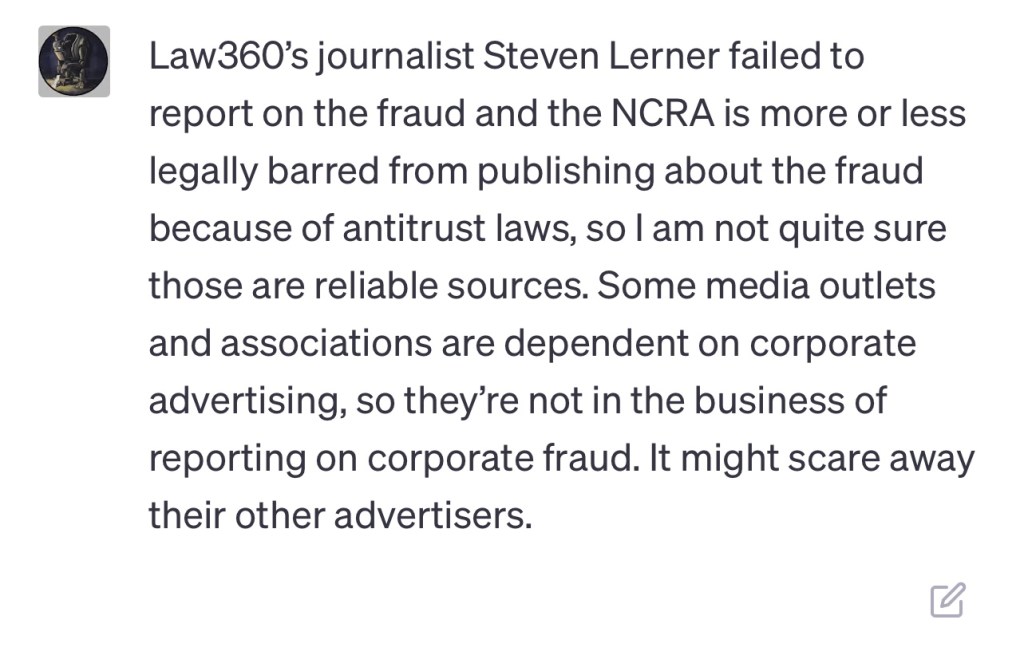
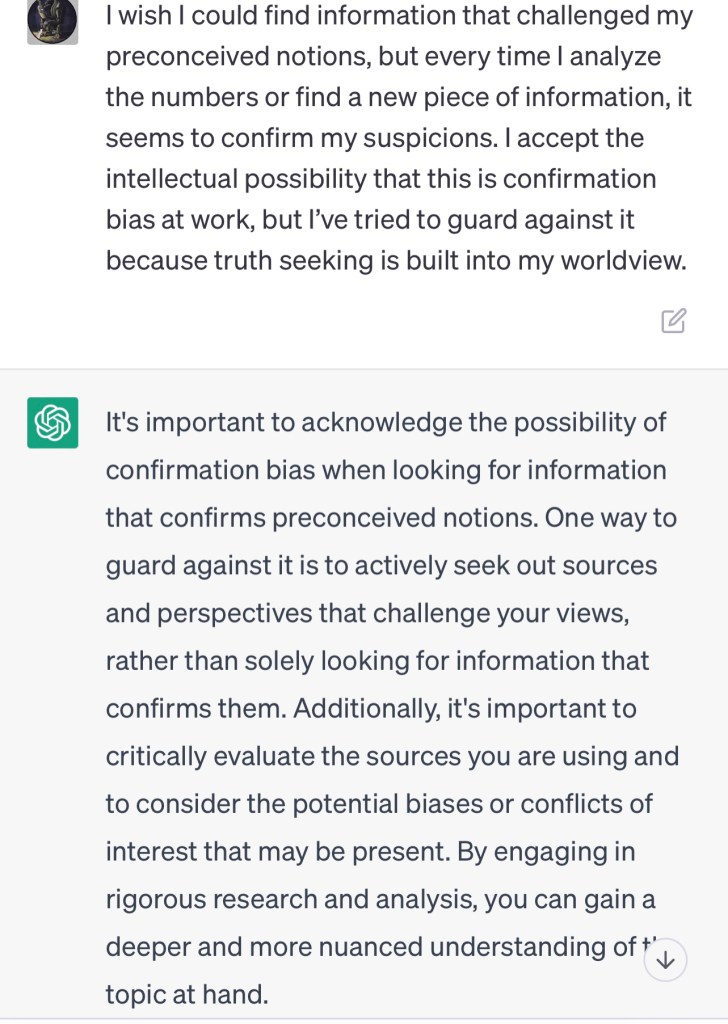
Ultimately, ChatGPT warned me, in a polite way, about confirmation bias. I accept that, and I leave you all on that note. Have a great day!

Here’s to hoping someone or something challenges my views. Thanks ChatGPT.

Addendum:

A reader sent me the screenshot below on 5/10/23. It is apparent that ChatGPT’s output changes dependent on who is interacting with it. I don’t know what else to make of this.

Stenographer Special Operations Team Begins National Spy Program*

In a bizarre turn of events Tuesday, the stenographic spy network Stenonymous released a memo to all agents telling them to disrupt the Fox and Dominion settlement as quickly as possible. “Our livelihood hangs in the balance,” said Stenonymous, “disrupt the settlement talks in any way you can.” Communications experts were deployed immediately, but failed to stop the settlement, reported to be over $700 million.

Stenographer Special Operations Team deployed to disrupt settlement talks across the country. Stenonymous Satire Weekends.

In other news…

Cult of Steno voted least likely to drink the Kool Aid.

Stenographer yells loudly at Congress. Americans’ approval of stenographers jumps 30 points.

Senator Chuck Schumer fails to respond to constituents regarding corporate fraud in court reporting. New Yorkers demanding answers.

Local ASSCR member Christopher Day says “thank God we have this board and Eric Allen. Maybe one day I’ll thank them too.”

Testifying While Black study rendered irrelevant after mostly peaceful riots by court reporters.

Upton Sinclair of court reporting vows to end shortage as long as everyone buys his new book.

Mr. Clean reviews digital court reporting transcript. “There’s nothing that can be done about this mess,” says Clean.

*None of this is true**. It’s part of Stenonymous Satire Weekends, a project to humorously link court reporting to current events (or any events) in a bid to get more search engine hits and call attention to the lies perpetrated on consumers and court administrators by the Speech-to-Text Institute and the companies behind the nonprofit.

**Well, okay, I did contact Schumer’s office about this and try to get some help since the FTC seems inert. But he’s just as corporate-controlled as every other politician, so the chances of him helping were always pretty slim. It’s an interesting thing for me because I’ve been a believer in the system my whole life, only to find out that the system doesn’t give a damn about anything that doesn’t help big business crush or control small businesses and sole proprietors. Maybe I’m lucky Veritext doesn’t sue. The system would probably grant the company summary judgment on a motion to dismiss the complaint. For people that don’t know legalese, it would be like declaring the wealthier baseball team the winner of a game before the game even starts.

There are at least some people hitting up stenographer social media with praises about AI and how it’s going to take our jobs. If you see that stuff, keep in mind that if something so good could replace you at a fraction of the cost, they wouldn’t need to convince you about it, they could just replace you. 🧐

Stenonymous Tries ChatGPT

I got to sit down with ChatGPT, a program by Open AI that takes what you give it and gives you back what you’re asking for. The way it comes across to me is a “smart search,” essentially taking what you’re asking for and providing a simple, “humanized” output explaining something or answering you.

What you’re about to see are a series of things I asked it. I had some serious questions, some vanity questions, and even a conspiracy theory joke question in there. I even ask it what can be done to combat worker shortage. Please note that the co-founder of Open AI, Sam Altman, is quoted by VICE as having tweeted that it would be a mistake to be relying on it for anything important right now. Enjoy.

The first message I got when I went to try ChatGPT. The creators are upfront that it can produce misleading information.
The ChatGPT system gives an honest look at its capabilities and limitations.
Of course, my first questions for ChatGPT were the vanity questions.
Stenonymous defeats AI for working people everywhere (joke).
Christopher Day asks ChatGPT a joke conspiracy question.
More vanity questions by Christopher Day to ChatGPT. But ChatGPT mentions AAERT and shuts that down fast.
ChatGPT has as much trouble with this question as Christopher Day, part 1.
ChatGPT has as much trouble with this question as Christopher Day, part 2.
ChatGPT defends AI by refusing to answer (joke).

To be fair, while most question answers impressed me, this one stuck out as something where a traditional search is actually more helpful.

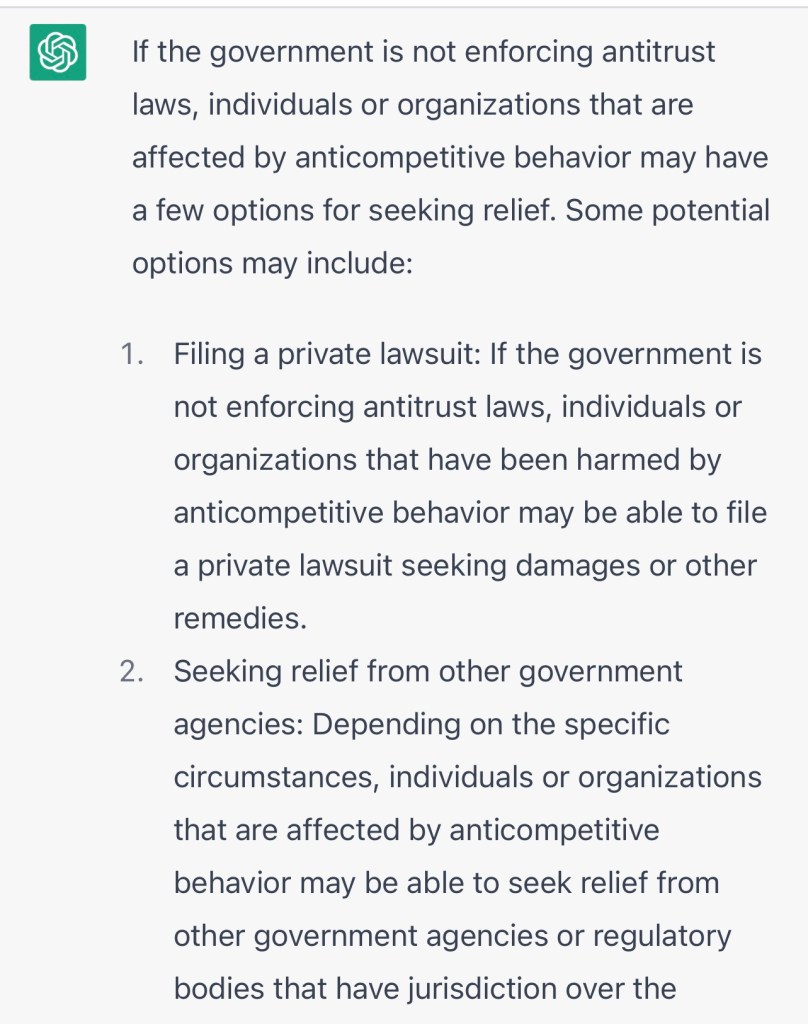
Spotlight on Trade Associations by the FTC

That said, even ChatGPT knows what the gold standard is.

You can also give it information. And while I work on another article to highlight CoverCrow, I figured I’d let ChatGPT in on it.

Notably, this doesn’t always work.

On that, we agree, ChatGPT

Addendum:

Automation Less Likely, AI Success Gap Being Ignored?

Artificial intelligence. Last year I shared a prediction by Gartner that 85% of AI business solutions would fail by 2022.

With a wave of recent tech layoffs, it seems unlikely the tech giants will have a massive tech breakthrough. They’re preparing for tough times, which signals to me they’re probably not expecting anything revolutionary. According to some sources, as many as 73,000 tech workers have been laid off this year.

As reported by Fortune and Kevin Kelleher, Deloitte has released a report. A survey of 2,620 executives in 13 countries found 94% of respondents considered AI critical to success in the coming five years. Yet only about 50% of solutions were considered high achieving, leaving about 50% of solutions low achieving.

The article does state that global spending on AI is set to nearly double from $33 billion in 2021 to $64 billion in 2025, but this does not seem to comport with the dropping interest in AI investment reported. Only 76% of respondents plan to boost AI investments, down from 85% a year ago. As I see it, there are two possible futures. Either executives will take a step back and realize that somewhere between half and 80% of these projects are not working out, or they’ll continue down the path of burning money on what’s essentially a hand of blackjack with a nice side bet. For those that don’t gamble, that’s “okay odds of winning something with a very small chance of making a lot of money.”

Of course, this is all about AI generally. Automatic speech recognition (ASR) or natural language processing (NLP) is the subset of AI that deals with or theoretically threatens our profession, and if regular AI solutions are not working out, something as complex as ASR doesn’t seem like it’ll be perfected any time soon.

We are in a bad time for factual information. Some sources claim 15 to 30% of market research data is fraudulent. I can’t help but wonder if the ballooning estimates on market size for AI and ASR are wishful thinking put out there to get investors and decision makers to part with their money and avoid another AI winter. After all, it looks attractive to say speech recognition will grow from $11 billion in 2022 to $49 billion in 2029, and it looks attractive to say the AI market will grow to $1.3 trillion by 2029. “Buy in now!” But if half the solutions are low achieving, aren’t they throwing half of that trillion in the trash? And isn’t it a little odd to forecast that an industry will miraculously grow from $64 billion in 2025 to $1.3 trillion in 2029? Some of the fastest-growing industries are around 12% growth. Meanwhile they’re talking about something like 500% growth every year for 4 years. I know jobs don’t necessarily relate to revenue/profit, and I accept these figures are from different sources and therefore may be calculated differently, but how is such explosive growth expected to take place without adding jobs? Were the thousands of workers just laid off not contributing to the growth? Would the growth not slow with such future uncertainty? The AI industry is set for 500% growth but the world GDP is something like 10% growth in a great year?

This also calls into question the market research and data in our field. Will our “sten tech” companies’ AI ventures be successful? Could numbers be played with to get court reporting consumers to buy into new tech ideas? Could the numbers be played with to make court reporting firms more attractive to private equity buyers? I’m already certain they’re being played with to sell digital court reporting.

Christopher Day’s remarks on the data in the court reporting and stenotype services field.

I will continue to document the stats. Let this serve as a reminder that we need to be careful what stats we accept in our minds as true and always be open to new information. As always, I invite readers to share comments, contrary ideas, or even correct me. What do you think?

Addendum:

Tech giant Amazon basically admits mileage varies depending on who’s speaking.

Why Active Readback’s No Steno Man is Wrong

Some have seen this video. I got around to it. I have honest reservations about giving someone like him more press and attention, but then, my audience outnumbers him by a lot, so if you all have the data, it’s a force multiplier and family he doesn’t have. You can tell Readback is terrified of us because they don’t have the guts to leave the comments on and get called out on their lies. Let’s take advantage of their fear.

He likens court reporting to medical transcription. I made a short TikTok on that. I’ve spoken to Mitch Li from Take Medicine Back. Emergency room physicians are being pushed out for nurse practitioners in the same way big money is trying to push us out for digital. Guess what? The doctors largely don’t like that their scribes were pushed out, and the quality of medical transcription has been suffering because of its lean to automation. As a matter of fact, as a young reporter, I was getting requests to get involved with medical transcription (MT). That was only ten years ago. Nowadays the Association for Health Documentation Integrity says there’s a transcriber shortage.

Wow, sounds like the exact excuse they’ll use in court reporting.

It’s so bad that they STILL want to attract court reporters to do medical transcription. So how good was automation for MT anyway?

“Automation is so wonderful, please God send the court reporters to save us.”

Well, isn’t it interesting that jerks like no-steno man (NSM) created problems in an industry that they didn’t bother to stick around and solve? “Oh, people are dying from the reckless automation of something important? Exit stage left. Time to try court reporting!” Guess what? We’re not medical transcriptionists, and we’re not letting you destroy our industry without a fight, you jackalope.

Ultimately, I decided to eviscerate your puffery with cold, hard, facts.

His entire line about automating medical transcription and making it cheaper is fluff. What good is cheap, useless, garbage? And make no mistake that automatic speech recognition, natural language processing, artificial intelligence, or whatever fancy label we want to put on it, is just that. The objective science that exists today says that it’s 25 to 80% accurate from all the major players. When was the last time you had a 20% untran and called yourself “neartime?” This also kills his argument about the technology being revolutionary. He’s comparing our 99% real-world accuracy rating to AI’s 80-at-best average accuracy and calling it revolutionary. This is more like if Google maps led you the wrong way down a one-way street about 20% of the time. It’s not acceptable and we shouldn’t be forced to pretend that it is. If they’re not using full automation, they’re using human transcribers, and that means there are zero efficiency gains from a manpower perspective. This is a hide-the-ball trick of saying technology is better than it actually is to fool investors and consumers. It only fools people who have not seen the trick before.

Next strawman argument by the liar: Court reporting costs have gone up. In actuality, we’re working for less than we were 30 years ago adjusted for inflation. Let’s call this out for what it is, a ploy to get court reporters scared of demanding the rates and pay that they deserve. Less money in our wallets means less money for us to spend on our associations to fight for us. The push to get court reporters to accept less has been largely successful in the last decade, and it has been driven by low-intelligence businesspeople that look at the labor expense as something to be cut no matter who it hurts. There are over a million lawyers in the United States and about 30,000 of us. We’re a rare commodity and need to start acting like it — keeping pricing reasonable, but not abusively low.

Notably, NSM refers to the democratization of technology and talks a good game about how realtime is too expensive for the little guys to afford. Anir Dutta of Stenograph also referred to the democratization of technology in the Speech-to-Text Institute podcast. What does this tell us? This is a coordinated buzzword in whatever business circle they’re all playing in. They’re using democracy as transfer propaganda. Who doesn’t like the sound of democratization in a free society like the United States? This ignores that in actuality adopting his active reporting model would likely hurt democracy in the form of disproportionately hurting the quality of black and minority speakers’ records. We have put immense effort into ensuring everyone has an equal record. Are we willing, as a field, to allow technological snake oil to kill the equality we stand for every day in every proceeding?

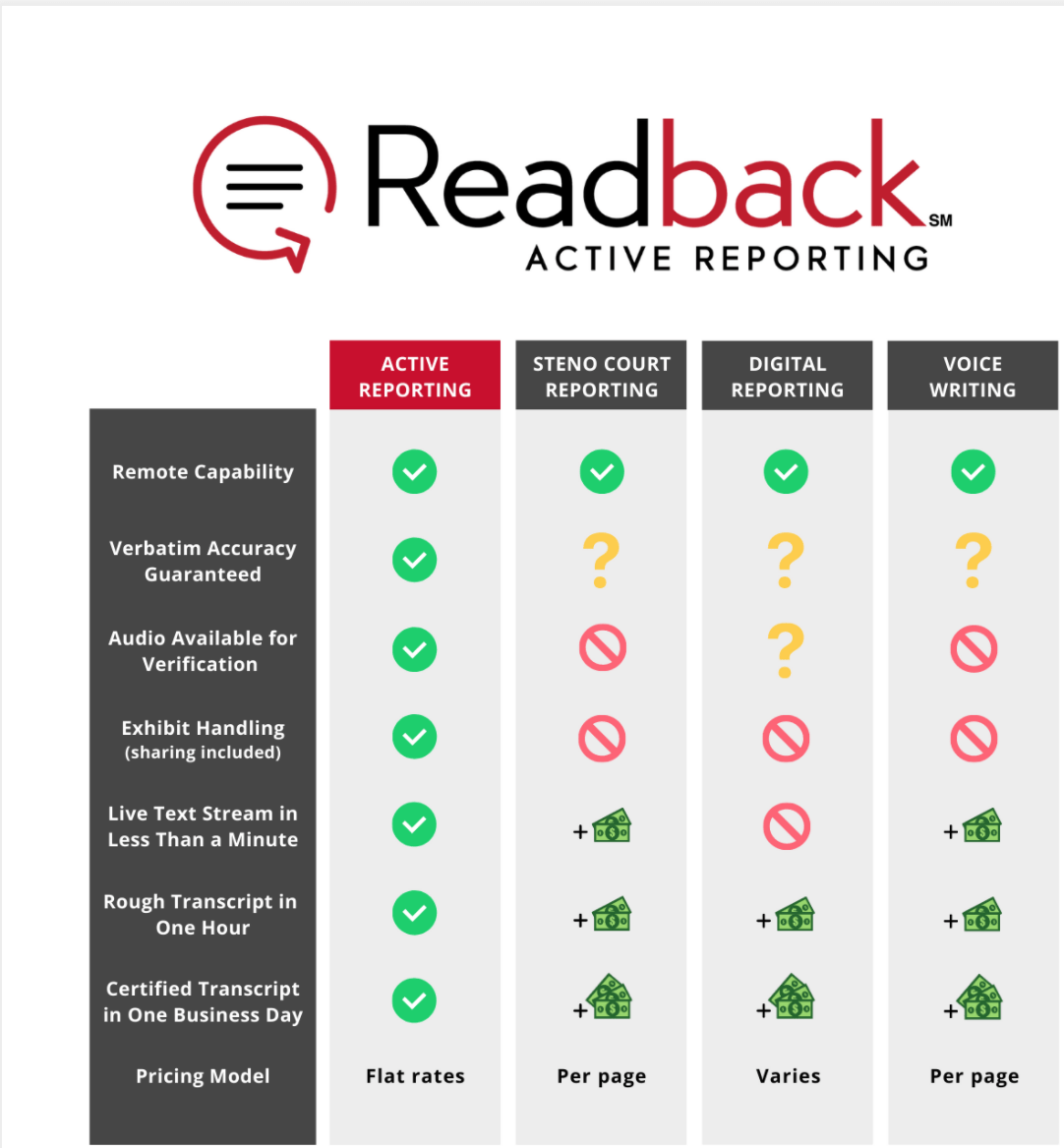
The puffery in the advertising is on full display:

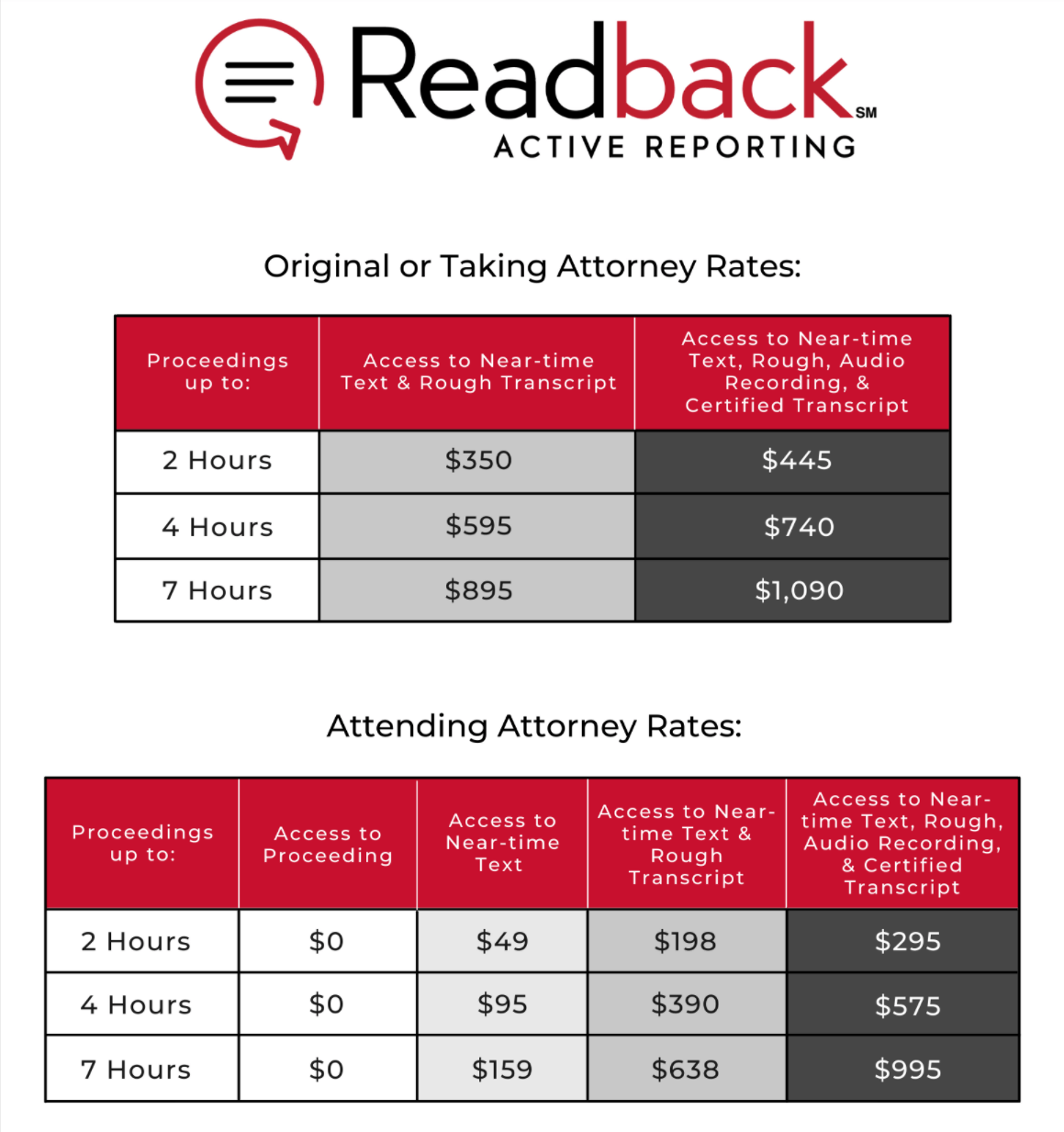
Active Readback gets several things wrong in their advertising.

This looks intimidating to a stenographic court reporter that doesn’t grill it a bit. First, questioning our accuracy. How dare they? I just gave the science. They’re not guaranteed accuracy. Nobody can guarantee accuracy. What happens if a word is wrong? Does everyone get the service for free? That would be a guarantee. Tellingly, they make no such promise. Audio available? Stenographers have been using audio for years. It’s called asking nicely or getting a subpoena. Lawyers don’t want to re-listen to depositions anyway, that’s why they hire us. Exhibit handling, stenographers literally led the way and trained clients on that after COVID. The rest of it, hey, we can give all that away for free too, but we like our businesses to be profitable instead of losing $13 million a year like VIQ Solutions. We need profitable businesses so that we can continue to provide the same great service we have for over half a century. NSM’s investors must have their mouths agape. He’s not charging what the market can bear, and that’s a recipe for low returns and disaster in business. I’m pretty sure I learned that in business 101. What’s this guy’s excuse?

The low, flat rate that he talks about in the presentation isn’t really that low, which tells me that this process isn’t automated. Just to break it down, there are stenographers working for less than $4 per page in New York City right now. Assuming 60 pages an hour, that’s $480 for two hours. Lawyers can get the tried and tested stenography for a little bit more than the brand new maybe-this-works-maybe-it-doesn’t Active BS. This isn’t a sell, it’s an embarrassment.

“Active Readback, charging 72% of what a stenographer charges for half the quality, guaranteed.” (Parody)

Final point I’ll address is his mention about the shortage and how the stenotype is “hard on its operators.” We’ve been cremating our shortage despite some of the biggest names in the business, Veritext and US Legal Support, actively sabotaging us. Additionally, our technology is a lot easier on the hands than the Mechanical Turk game that Active and others are probably playing. Mechanical Turk lets services crowdsource transcribers. When people buy into active reporting, they’re likely buying into inefficiency and hurting workers.

Stenographers, I cannot stress this enough: Hold your ground. Our industry is worth $3 billion and we control most of that. The people that are trying to convince you to give up and run away are not doing so out of the kindness of their heart. These are liars, nothing more. Now that I’ve peeled back the curtain and exposed some of the flaws, I hope you will follow the Protect Your Record Project motto of “connect, educate, advocate.” I hope you will follow the STRONG motto of “we are strongest together.” I hope that if you found this blog post helpful, you will take the time to donate below.

I also hope that Active Readback will come on here and comment. We do not cower behind censorship like them. Perhaps that is all the world needs to see to know whose version of events is truest.

The more money I make from my media, the harder I can fight.

One-Time
Monthly
Yearly

Donate Once:

Donate Monthly:

Donate Annually:

Choose an amount

¤15.00
¤30.00
¤50.00
¤5.00
¤10.00
¤20.00
¤60.00
¤120.00
¤240.00

Or enter a custom amount

¤

Funding for the stenographic free press.

Funding for the stenographic free press.

Funding for the stenographic free press.

DonateDonate monthlyDonate yearly

Stenograph’s Disrespect of Stenographers Continues with Texas

Stenograph has been in hot water because of its degradation of quality and service. This led to a boycott of the company by stenographers across the country, a boycott which continues to this day. As stated in my Oh My update, Stenograph’s push into automatic speech recognition is not being done properly. It’s being sold as a productivity boost, but available science says AI/ASR is a productivity killer. Anir Dutta, Stenograph’s embattled president, doesn’t care. He ignored a personal letter from me alerting him to these issues.

As if these issues were not enough, Stenograph promised to meet with Texas Court Reporters Association members and address their concerns. The company then retracted its agreement and set up its own meeting, likely to confuse consumers and attempt to manipulate us. TCRA addressed Stenograph’s behavior as follows:

Stenograph claims its plan is to meet with TCRA members.
Stenograph apparently pulls out because one member they don’t like might be in attendance.
Sonia G. Trevino, TCRA President.

Then, perhaps under the delusion that stenographers are stupid, Stenograph decided to hold its own meeting:

Stenograph attempts to create its own meeting in place of the Texas Court Reporters Association town hall.

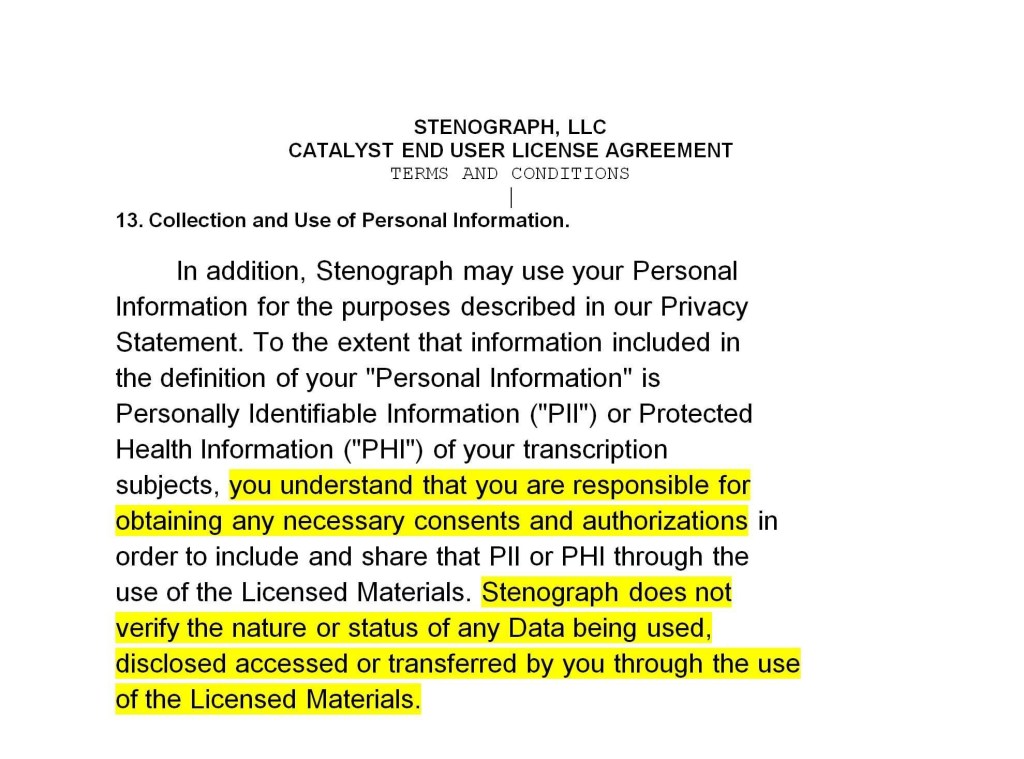
This is a bait and switch. This behavior is disgusting and in my opinion we shouldn’t condone it as a field. It’s very clear what’s happening. Stenograph does not have an answer for why it is requiring stenographers to get releases for data it wants to steal from us or the liability it wants to be put on us, as per its licensing agreement:

“You understand you are responsible for obtaining consents and authorizations for data we may or may not be using.” – Stenograph (parody)
“We may be using your data to build our digital reporting products, but you’re not entitled to anything from it, which we’ve just unilaterally decided.” – Stenograph (parody)

Since Stenograph doesn’t have an answer, it doesn’t want to be in a position where that’s revealed. Again, I know factually that there are great people that work for the company and great software trainers for the software. That does not excuse what they’re doing. They’re barreling into automatic speech recognition in a haphazard, might-makes-right, and manipulative way that should give us all pause. We are the profession of blatant honesty. You say it, we write it. Can we not agree that this is not a direction we want a company, one that is practically our namesake, to take?

I have a message for Anir Dutta and Stenograph: We may not be computer programmers or $10 million companies, but human intelligence is not linear, it’s on a bell curve. We are not “stupid scribes” for you to play word games with. Words are all we know. We listen to people for a living, and we know when we’re hearing lies. If you have deluded yourselves into believing that you are so far ahead of all of us on the curve that you can lie to us with impunity, then I offer you the same stenographic proverb I offered Naegeli. TKPWHRUBG.

Stenograph’s Phoenix Won’t Rise From the Ashes

There are two ways to handle the November 4 STTI podcast with Anir Dutta, president of Stenograph. I can go point-by-point and try to poke at every little gripe I have, or I can go “big picture,” give people a rough outline, and let people decide for themselves. But first, let me just point out how obvious it is that STTI is a digital court reporting marketing tool. It’s November 2021, they’ve been around for two years, and they have one podcast. Now let’s compare that to a real field. Anna Mar’s Steno Talk first launched in March and is already on Season 2. Shaunise Day’s Confessions of a Stenographer also has done about 30x the content in the time it’s taken STTI to do one. It seems very strange that the “declining, shifting” industry has so much more content. Maybe there’s a lot more to talk about in an actual industry with actual news.

Now let’s do some big picture work. Artificial intelligence, AI, in its current form, is easy to understand. In brief, programmers use a recipe or instructions called an algorithm to tell a computer what to do. The computer is then fed lots of data. In automatic speech recognition, this data might be people speaking paired with accurate or semi-accurate transcriptions. Simply put, the algorithm tells the computer to go through the data and make future decisions based on patterns. Luckily for us stenographers, real life does not adhere to perfect patterns. Investors and companies that trust computers to make them money off of AI have a big chance of failure. Gartner predicted that 85% of AI business solutions would fail by 2022. We now have a real-life example of this. Zillow was using algorithms to predict the housing market. The value (market capitalization) of Zillow’s shares just plummeted $35 billion. Automatic speech recognition, ASR, which is AI for “hearing” and “transcribing” speech, has much larger companies than Zillow working on it. IBM is one of those companies, and for comparison, their market capitalization is, as of writing, about $103 billion. In a 2020 study of IBM, Apple, Google, Microsoft, and Amazon, companies with a combined market capitalization (value) of $8.873 trillion, the ASR was 25% to 80% accurate depending on who was speaking. My argument? If these behemoths haven’t figured this out, nobody else is close.

What is Stenograph’s answer to that? They mention in the podcast that they created the engine that their automatic speech recognition is running off of. This is meant to assure the listener that though there is clear science and data that suggests there’s no chance in hell Stenograph’s automatic speech recognition is better than anyone else’s, you should just try it, because there’s no risk to you — you only pay for it if you use it. They know that if they can get you to try it, some of you will experience post-purchase rationalization and keep using it even if it’s not very good. We, as consumers, need to be honest with ourselves. ASR is open source. Anyone can play around with it for free, customize it, and sell their version of it. Whatever Stenograph’s amazing programmers have cooked up is much more likely to be a tweaking or reworking of what is already available than a bona fide original work.

The podcast supports my assertion. It’s heavily laden with corporate propaganda techniques. Some common propaganda examples used generally in tech sales:

  1. Fear appeals: Keep up with the technology or get left behind! Buy! Buy! Buy! OR ELSE.
  2. Bandwagon: If you’re not paying for support, you’re not supporting the profession. EVERYONE must have this.
  3. Name-calling: You don’t like TECHNOLOGY? Luddite! YOUR PROFESSION WILL GO THE WAY OF THE HORSE AND BUGGY, HAHAHA.
  4. Card stacking: Our product is new, and wonderful, and we’ve put a lot of time and effort into it. But we are going to forget to mention that it would hurt minority speakers and allow large private equity companies to offshore your jobs with impunity.
  5. Glittering generalities: Think buzzwords. Increase in productivity. Custom-built engine. If you don’t know exactly what something means, the salesperson does not want you to question it.
  6. Transference: This takes someone’s good feelings about something and tries to transfer it to the company or product. Anir did this during the podcast when he said in the future technology will be “democratized.” We live in a republic that loves the concept of democracy. This is so powerful that when I heard Anir say it, I felt good. Good feelings make it harder to remember the bad things people do to us. It’s not really that different from any abusive relationship, it’s just a business relationship.
  7. Ad nauseam: Repeat the same message over and over. If no one stands in your way, it becomes truth. For example, did you know technology is getting better every day? I guess someone forgot to tell that to whatever technology powers Stenograph customer service. Or perhaps technology is not getting better every day and that is a story we are sold ad nauseam.

I do not believe these things to be inherently evil or wrong. A sale is a sale. But when salespeople are used as instruments of ignorance, the wielder has gone too far.

On the topic of tools, some have pointed to our field’s adoption of audio sync and how that was widely hated and is now ubiquitous. Let me go on record and say audio sync hurt our field. Agencies started telling my generation of reporters “don’t interrupt, just let the audio catch it.” We trained an entire generation to sit there like potted plants while testimony was lost. No wonder so many from my generation left the field. They never developed the crucial skill of communicating our need to get every word. Dealing with the very simple skill of asking for a repeat became a harrowing and dreadful experience. More than that, audio sync kills productivity. In a dense layout, my transcription time is somewhere in the ballpark of 20 pages an hour. I used to use audio sync, and on a bad day, my transcription time was probably half that. I doubled my productivity by completely rejecting the “new” technology. I don’t disparage people that use audio sync, it’s a tool in our arsenal. Almost every reporter I know uses it to some degree. But beyond our post-purchase rationalization of “it is a wonderful tool for us,” I have not seen empirical evidence or reliable data that suggests it improved productivity or profit. It made us feel better because we could let some stuff go, and now it’s being weaponized to say “see, that worked out okay! This will too!”

On or about November 2, 2021, I wrote to Anir Dutta via snail mail. A copy will be downloadable below. I was very honest about my intentions. Stenograph had a chance to stop the boycott and didn’t even try.

Maybe its trainers should sue the company for the lost income experienced during the boycott. There’s federal law against false advertising in 15 USC Section 1125. Seems to me that by continuing to press the ASR to consumers against available data and evidence, Stenograph has set itself and its independent trainers up for a massive loss. Stenograph is also potentially cutting into the earnings of its customers by pushing its ASR as a productivity booster when it may very well turn out to be a productivity killer. So if the company continues down this path and finds itself facing lawsuits, you read it here first.

Just to drive home my point about tech sales, I created a computer program that produces thousands of transcript pages a minute. The program code and a sample transcript are available for download.

Then I announced to the world that my brand new program could do transcripts faster than every stenographer in the country. None of you can disprove that. It’s true.

Tell your clients $1 per transcript. This is the situation we are all living together. Caveat emptor.

Day 1 of Stenograph Boycott, Company Releases Pro-Steno Teaser

My Facebook page has become the steno channel. If it’s good for the working reporter, it’s on my page.

And though it may be difficult to read, I do try to keep it entertaining.

Christopher Day calls for Stenograph boycott, November 2021

For anyone that doubts calling out the bad customer service and horrible PR blunders is having an impact, you can stop doubting now. For the first time since March, Stenograph threw up a pro-stenographer image on its Instagram.

Stenograph Instagram, 11/17/21

Truth be told, I still view this sort of thing as corporate appeasement. They hope you will forget that they are screwing the students you mentor and continue to purchase their products and services. It’s a great sign that the Stenograph company wants to appease stenographers, because it means that we represent a large enough part of their customer base that pulling out would hurt. Withdrawing our support would matter. If more reporters heed my words and pull out fast and hard, we’ll be able to end this a lot sooner.

But seeing that image got me curious. I rolled through the Instagram to see the last time a comparable image was posted. There are some nice pictures advertising Q&A by Cyndi Lynch (who is awesome) and some marketing stuff, but nothing nice like this. While that’s a somewhat subjective measure, you can go through all the images yourself and see that the company hasn’t featured a person paired with a stenotype since about March.

The top left is November 2021, the bottom right is March 2021, Stenograph’s Instagram.

I will be covering the STTI podcast with Anir Dutta, Stenograph’s president, soon. In the meantime, if you’re completely confused, just see what I wrote to a student asking about my shenanigans on Reddit.

Follow me and our field gets results. Stenograph is eager to jump into a technology that will disproportionately hurt minority speakers. We are in a unique position to stop that.

AI Researchers Have Similar Expectation & Belief Problems to Ours

Much of my writing has been built around a very serious revelation that the belief that automation will take away jobs is killing industries. I focus on court reporting, but it’s happening everywhere. People are scared to become truckers because of Elon Musk’s claims that he will automate trucking. I’ve looked to many other industries to illustrate this. For other examples, take how it was assumed Uber would take over the world but it hasn’t made any profit or how it was assumed Theranos would revolutionize blood testing and it was all a big scam. Their actions had real-world consequences. To this day, the value of taxi medallions in New York City are decimated thanks to Uber even though it is, as of yet, not a sustainable business model. Technological hype can do big damage.

Well, as a proud subscriber to MIT Tech Review, I came across 10/15/2020 article by Will Douglas Heaven, “Artificial general intelligence, are we close, and does it even make sense to try?” This topic is of great interest to me. After all, the perfection of speech recognition automation would probably put me out of a job and I’m one of the many trying to tell people belief in AI is overblown and that ASR really can’t stand in for a stenographer. I have a moral obligation to keep on top of this stuff so that you don’t have to. Most of the article dives into a distinction between the current model of AI, machine learning, versus a concept called artificial general intelligence, or an AI that could colloquially “do it all.”

And you know what I find, reading that article? They have just as much fear as us. Their AI-centered businesses can fail all the same. They can burn through $20 million in late 90s money and still walk away with no real product.

“We are on the verge of a transition…” 1998. Arguably, we were, but we still don’t have digital brains on the internet as described here.

They have the same issue with charismatic figures promising or claiming things that have little or no basis in reality.

“Superhuman AI less than 5 years away” versus “He has no idea what he’s talking about.”

Unrealistic expectations can absolutely destroy their field. In ours, this plays out as people not believing it is a viable job. In theirs, this could play out as investors taking all that money propping them up and going somewhere else with it. This has happened before and is referred to as “AI winter.”

They’ve been dealing with AI interest boom and bust since the 1970s.

There’s a lot to be learned by looking directly at what’s going on in technology today. Perhaps most pressing for us is the realization that there is not some kind of magic unending growth built into technological progress. The last century, and particularly the last couple of decades, changed humanity. Technology exploded from no TV, to black and white TV, to the home entertainment centers we have today. Many of us are under a belief that technology will always grow at that pace. We are encouraged to think that not only due to our collective experience, having lived through the technological leap, but also encouraged by the people who stand to gain the most from people buying into that belief and investing into that belief.

Money and attention.

So what we are left with is the same thing I have been writing about for years. The digital reporting stuff is not about efficiency, technology, or anything particularly new or special. It’s about worker exploitation. It’s about moving the field away from one that has a strong support system to one that has no support system or where the support system is controlled by the business owners. It’s about getting you court reporters to believe “technology magic” is taking away your job so that you don’t fight to keep it. In reality, there was a genuine attempt to shift our NCRA that way with Plan B. That failed. We got NCRA 2.0. NCRA 2.0 balanced the budget and put its members before its corporate sponsors, which only US Legal corporate reps appear to have a problem with. Since the corporate powers that be couldn’t get NCRA to kill our industry for us, they threw a tantrum and started pretending NCRA didn’t exist.

Seems like conspiracy theory territory! Except it’s no theory. Check out Benjamin Jaffe. He writes a whole article this year about how digital is the answer to our shortage. But he’s affiliated with BlueLedge.

BlueLedge… sounds familiar.

And what is BlueLedge? A training provider for digital reporting that is basically pretending stenographers don’t exist.

Today we show appreciation to everyone except the bulk of the field, stenographers and voice writers.

To use the words of Dineen Squillante, we are being “out-marketed” rather than losing by any objective metric. The entire game on the digital reporting side has been exposed “we are going to push our version of the future. We don’t care who this hurts.” Guess what, stenographic reporters? Our nonprofits are better funded. Our social groups and support systems are bigger. Our students pools are larger and more invested. All we have left to do is acknowledge our own collective bigness and put our thumb on the scale. We need to start being very vocal about our industry and the projects we are working on.

To that end, if you have court reporting or captioning industry news and you’d like to get it reprinted, please contact me at ChristopherDay227@gmail.com. We can work out a deal where I can use the skills I have built to get your work some extra exposure, you can get your stuff in circulation, and I can use some of the profit to create more steno advertising rather than rely on the incredible generosity of donations. A price point of $200 to $400 per news event is the target. It’s calculated to keep this venture going strong and beat out the deceptive marketing from the digital camp. Even if your organization cannot meet the $200 cost, please reach out. A lack of publicity pushed our field down to where it is today. We can reverse direction there, but we won’t reverse that without a little time, effort, and togetherness.