

The march continues to educate the public about the art of writing. Who better to take the lead than my best friend, Joshua Edwards?
Tag: captioning
More Graphics for the Stenographic Legion
As I went into in another post, pictures get several times more engagement than text pieces. But it’s difficult to cram what’s going on into small bites.
I’m going to try a hybrid approach and run the newspaper image below as an advertisement. Hopefully it will shock consumers into action. If you’d like to contribute to the ad campaign, feel free to use the front page of Stenonymous.com to donate.
Feel free to spread these images if you think there’s somewhere they belong. I’m only one person. I can only post so much. There are like 30,000 of you.


The Sundance Jurors’ Walkout…
This Vanity Fair exclusive was sent to me by a reader. According to the report, jurors walked out of the Premiere of “Magazine Dreams” because there was a failure to provide captioning and appropriate access for deaf or hard of hearing individuals, including one juror. According to “multiple sources,” the jury has raised concerns about access before.
It’s noted that several filmmakers declined the request to provide open captions and that some buyers suggested including captions on screen could hurt a film’s asking price. I understand the economic concerns. I can’t help but feel this is the same problem we are experiencing all across America. The people in power making decisions are looking at the numbers and not the human impact of their actions. The dollars matter more than the people living, breathing, and in this case, enjoying films.
Sundance itself continues to broadcast its commitment to access.
Perhaps the most notable part of this story for our community is that if automation was good enough, there wouldn’t be a big cost for captioning. If the filmmakers are citing costs for captioning, I extrapolate (1) there are not enough transcribers available to drive down the price further. Supply and demand. (2) Automation is NOT CLOSE. They would be using it.
It’s either that or (3), they didn’t care enough and are trying to save face with their weak excuses.
This is an opportunity for stenographic providers to expand our market. Maybe somebody can use the article I linked as a justification for Sundance to hire a backup stenographer. Who knows what’s possible until we try?
Hat’s off to all the captioners out there providing access and even the captioners-in-training refining their skills. I focus very much on court reporting, but the public gets a lot more exposure to your work. You’re our frontline message for why the world still needs us. Thanks for all you do!
NYSCRA’s Upcoming Webinars Can Shape Our Profession
There are a slew of New York State Court Reporters Association webinars coming up that you can register for here. I’d like to point out two of them in particular:
How to Stay Relevant in an Industry at Risk of Disruption by Dr. Erika Jacobi. I want to hone in on one line from the flyer, “empower reporters, captioners, and individual business owners to thrive despite adversity.” The more of us that learn to do this, the more of us that can then turn around and share that knowledge or even sell the knowledge through educational events. By attending, you’re basically becoming a part of the first wave of stenographers that will teach the next waves ways to think which will culminate in an ocean of us all armed with the knowledge not just to survive, but to prosper.
Speech Perception, from Spoken Word to Written Text by Culture Point. The data available today says that stenographers are the best there is, but that there is room for improvement. This is part of that improvement. Through academic understanding of linguistics, we can improve how we hear. I’ve spoken to a stenographer with linguistics training about this, and her thoughts were that these types of classes are very important. Again, the first wave of us that learns these concepts can teach the next waves and increase our own personal value and our skills. I know this because I was a ripple sharing what I learned and it landed me on TV. I was on NYSCRA’s board when the first discussions about this workshop were had, and I have a firm belief that the education will help stenographers, both newbies and masters.
NYSCRA has put a lot into this. A press release was drafted and republished to various sites across the web like Daily Ledger, American Tech Today, and The Business Gazette Online. We all have an individual choice to make. Do we take that effort and toss it away, and allow these opportunities to pass unnoticed, or do we take charge of our profession and turn the first wave of stenographers to learn these concepts into a mile-high tsunami?
Recent events have made it very clear that you, reader, are in charge of what happens next in our profession. I hope that you will join me on those webinars and that we will march into the future ready to help others thrive and close the narrow gap in our stenographic linguistics training. I know that together we can make our gold standard shine brighter.
Worlds Collide: Open Steno Meets Professional Stenographers 2022
Saturday, January 22, at 4 p.m. EST, a number of professional court reporters and Open Steno advocates will be coming together to discuss our field. In the words of Dineen Squillante, it’s about building a bridge.

This marriage of worlds makes perfect sense. Open Steno is a community of hobbyist stenographers that, as of November 2021, was experiencing unimaginable growth. Thousands have been introduced to machine shorthand stenography because of Open Steno and the Plover program. Professional stenography needs new recruits. Who better to be recruited than people that love stenography so much they are teaching themselves?
If you’re looking to support Open Steno, please tune in on January 22, 2022 at 4 p.m. EST. You can set a reminder and subscribe to LittleChaSiu. To the professionals that follow me, every single time we take another under our wing, we change the future for the better and make a more-prosperous field for all of our students and new reporters.
If you want to check out the Plover Discord chat and become one of its 4,000 members, click here!
Fun fact, the Open Steno community, and specifically Charley Shattuck, was responsible for the StenoMod that I used as a prop in this video. You ever loved steno so much that you started designing keyboards for it? No? Help us build our bridge this week!
Open Steno’s Unprecedented Growth Continues
The Open Steno community formed years ago. It gave us Plover, a free stenographic translation software, as well as several other projects, such as the StenoMod. In the words of Mirabai Knight, Open Steno’s founder, “steno is going strong…” The community also gave us Steno Arcade, a computer game dedicated to stenography.
The Plover Discord has reportedly reached over 4,000 members, or about 13% of our industry’s size. The steno video creator Aerick has over 1,000 subscribers on YouTube as of writing. The Uni Kickstarter has raised $50,000, more than double its $20,000 goal. If companies like Stenograph are unwilling to support our profession, professionals might consider joining forces with and funding Open Steno’s creators. Their ability to do more with less has been well documented over the last decade.
As more professionals join the Discord chatroom and community, and assist those teaching themselves, I expect the number of people entering our professional track from Open Steno and other self-paced initiatives to skyrocket. This use of non-traditional self-learners is exactly how computer programmers have addressed much larger shortage concerns. In our field this also means there’s a large pool of recruits unaccounted for by organizations like STTI and US Legal.
Readers that wish to donate to the Open Steno general fund and Mirabai Knight may do so here. Together, we will continue a nationwide recruitment surge, mentor and nourish our self-taught and traditional students and graduates, and pave the way to a future for stenographic court reporters.

When Autocraptions Fail, Stenographers Step Up
In a series of images posted by Michelle M. Kirkpatrick on September 28, 2021, the failure of automatic captions was on full display.


Knowing that people were in need, she stepped up to help and contacted deaf people in the area to let them know what the broadcast said.

It’s very clear how close to danger these people were.

This comes on the heels of reports that digital reporting proponent Verbit was pseudo-cybersquatting on 121 Captions.

Given all the data released on Stenonymous as of posting, it is clear that digital and ASR solutions are inadequate for captioning. The dishonesty and blatant disregard for standard industry practices from Verbit in particular has been contemptible. The stenographic captioner has the best value out of all available methods. People interested in joining the profession and ensuring access for all should check out NCRA A to Z, Project Steno, or Open Steno. Despite claims by the STTI that there is an equivalency in modalities, it’s been shown that digital and non-voice writing ASR solutions would harm African American Vernacular English speakers. In the words of one ex-digital reporter, they were simply not paid enough to care. Luckily, spam filters continue to place STTI promotional material where it belongs.

Is VITAC Paying Below Market Rates for Captioners?
About three months ago, after Verbit’s acquisition of VITAC, a well-known captioning provider, I published a strategic overview for captioners and how they can stand up for consumers. Not long ago, a live steno captioner position was posted by VITAC for less than $20 an hour. The position did boast other incentives, such as the potential for health insurance and a 401(k) for full-time captioners. With health insurance being valued by sources like Griffin at $1.52 to $7.42 an hour, it’s fair to say that we can consider a $19.23 hourly rate with benefits a value of about $30 an hour at best and a value of $20.75 at worst.

Stenography is a highly specialized skill. But even other highly specialized skills, like realtime voice writing, were undervalued. The voice captioner posting said $30 hourly at the top, but then in the body of the description, a $17/hr training rate was advertised. It was further advertised that $35,000 could be made in the first year. $35,000 divided by 52 weeks in a year is about $673.08 a week. Assuming a 40-hour workweek, that’s about $16.83/hr — close to half the advertised rate!

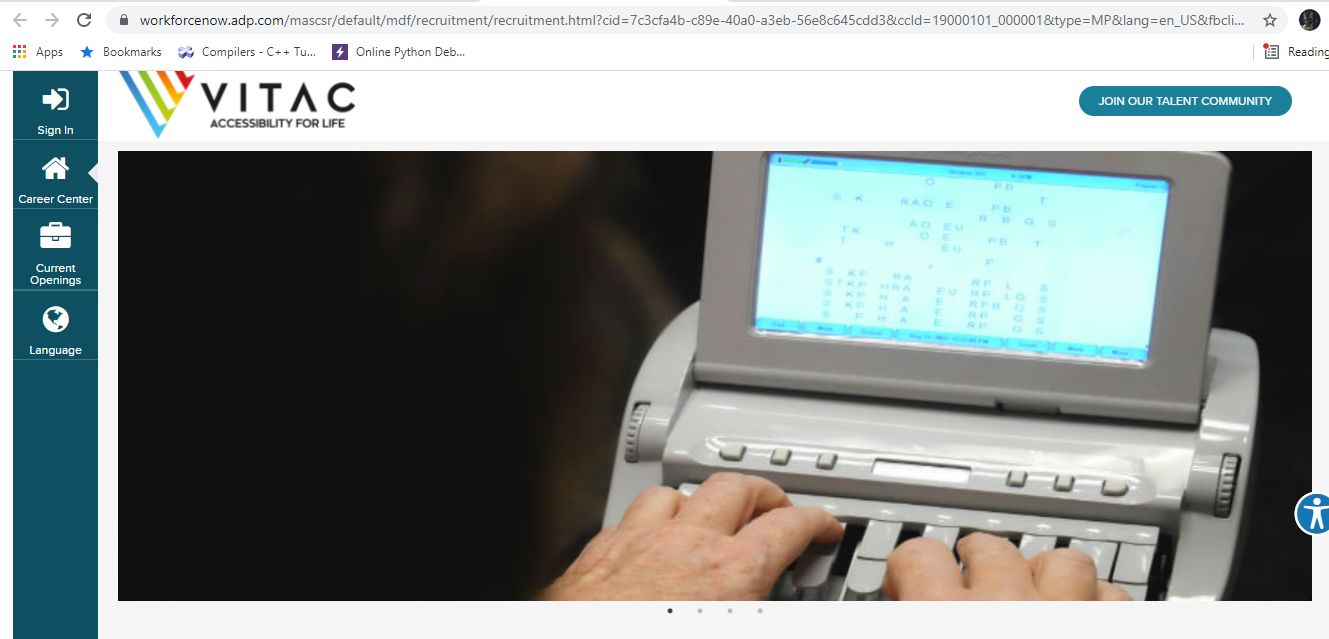
I thought, “if a company is going to pay its specialized workforce $20 or $30 an hour, certainly I feel bad for the positions that do not have labor shortages or specialized skills.” Then I came across VITAC’s posting for Sales Engineer I (SE1). An SE1’s job is all about onboarding new clients and responding to requests from Operations and Sales personnel. They’re offered $58,000 to $70,000 annually, the equivalent of $27.88/hr and $33.65/hr assuming the same 40-hour workweek. So VITAC’s apparent strategy is to pay the stenographer that is providing the actual service to the consumer about 60% of what they’re paying the salespeople. But just to make sure they look good, they added a modern stenotype to the website.
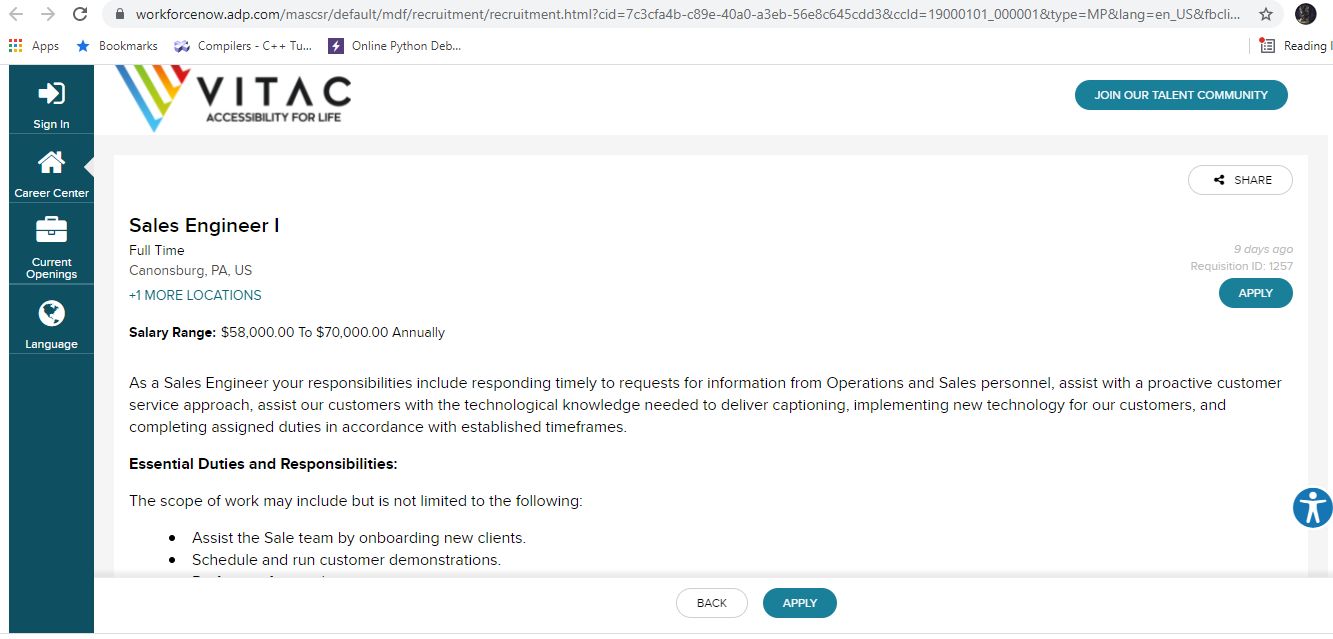
Of course, having been in the field the last eleven years, I also have some basic familiarity with the rates that captioners and CART providers charge. $20 to $30 for a “live steno captioner” job seemed low to me. Knowing how companies in the court reporting sector have taken advantage of young reporters, I requested information from several service providers in the field with varying degrees of experience in the hopes that I could get solid info out there for young or unknowing captioners. This is what I learned:
Provider A stated that they did not provide broadcast captioning, but did caption telephone calls and Zoom meetings at a rate of “almost $40 an hour” through Innocaption. It was stated that the work was super easy and may even be possible for students to take, though Provider A did mention they usually do not recommend students work. Asked about their understanding of broadcast captioning rates, Provider A stated broadcast captioning was higher.
Provider B stated “Even as a brand new CART provider, I never made less than $60 an hour. With one company, after I got my [certification], they bumped me to $65. Another company has always been $65 across the board. The third company has different rates for different jobs. Classes are $60 but if you are doing town halls, harder jobs, it is $75. Fourth Company was a smaller company and [they] paid me $80 per hour, and it was only classes. First company I spoke of is out of Illinois, second is Denver, third is California, fourth is Chicago. And I have never done broadcast captioning. I hope that helps!”
Provider C stated that they performed work for call services that did live captioning and were offered $40 an hour, but they were only taking down one side of a conversation.
Provider D, a 27-year veteran of our field and certified realtime reporter, stated that when they took on captioning work, it was 2014, they had a full-time job, and they did not need to make the same high rates independent contractors usually did. They made $50/hr in 2014 and a 2-hour minimum. That work came to a close. Come 2020, Provider D was again offered $50/hr and attempted to negotiate for $80 because the work was dense and contained a lot of science. The firm “did not know” if they could pay $80, and asked Provider D to come down to $70, which Provider D did with the caveat that they would renegotiate at a later date.
Provider D also received a call from a California-based company and negotiated $100/hr with a 2-hour minimum. The firm paying $100/hr expected no rough draft after events. The firm paying $70/hr required a rough draft. A third firm in Florida offered $80/hr. Provider D stated that the swing was generally between $50/hr to $100/hr and that they would never work for $20/hr because captioning is more than knowing realtime, you have to know how to connect to a multitude of platforms and devices, as well as troubleshoot on the fly.
Provider E wrote “My first response when I read [the $20 rate] was OMG! Yeah, that is SUPER low! So here’s what I know from where I sit in the Pacific Northwest:
There are four levels of captioning that I have ascertained.
1. Broadcast captioning, which is a whole other sphere that requires encoding software and usually above and beyond training to do TV captioning. I don’t really know much about that…” “I don’t know what rates they’re charging, but it has to be higher because the software is not cheap, like a $7k add-on with Eclipse.
2. CART captioning, either in person or remote, through a freelance company or own shingle. This is stuff like government meetings, group conferences, seminars and such, $120-$125/hr with 2-3 hour minimum in my area. We are sometimes requested to bring a projector and/or screen, which adds to rental fees. About half of people charge after hours rates on this. I feel the remote world has let this go a bit. But I know when I go back in person that’ll definitely go back in.
3. Schools. One on one with one student. they are notoriously cheap in my opinion even though they’re being paid by ADA funds, from my understanding. Most commonly in my area $85/hr, 2-hr min. But I’ve negotiated more for after hours and weekend work with one college.
4. There is one company whose name escapes me, probably more, who provide a captioner for phone calls. they only pay $30/hr. I was really bothered by this undercutting of the industry when I found out about the rates folks were accepting. But a reporter I talked to about it said [it’s] mostly sitting there doing nothing because you’re only writing half of the conversation, no transcripts, so super easy work. She considered it easy supplemental income.
That $20 is WAY out of line, especially if that requires continuous writing…”
Provider F wrote “everyone has their baseline. I will do $70 and hide my head, for a friend. But my default is $80 or $85. However, if it’s MY work, my clients, I charge 100 or 125 and pay $80 or $90 or $100 depending on the job…”
According to the Bureau of Labor Statistics inflation calculator, $50 in 2014 money is worth $58.08 in June 2021 dollars. $100 in 2014 money is worth $116.15 in June 2021 dollars. Again, for new captioners, this should put into perspective the value of the work and the importance of occasional raises.
I also reached out to StenoCaptions LLC and received the following response:
“Good afternoon, Mr. Day,
Thank you for your question about our company. StenoCaptions LLC is proud to be a minority woman-owned business. Our team of independent contractor captioners earn between $100-120 per hour depending on their qualifications and length of time in the field. As our website discloses, we charge $140 per hour for most jobs. This means that our captioners, who are the people doing the difficult and demanding work of providing live accurate Communication Access Real-time Translation, net between 70-86% of what we bill. StenoCaptions LLC is proud to support our highly trained, highly reliable stenographic captioners.
We are happy to be quoted on your blog. Let us know if you have any further questions.
Sincerely,
Wendy Baquerizo and Joshua Edwards
Co-owners
StenoCaptions LLC
StenoCaptions.com”
As of writing, there is little doubt in my mind that the rates being offered by VITAC, and I suppose by extension Verbit, are well below what could be considered a market rate no matter which market in the United States we examine. Again, in the best-case scenario of a $30/hr value, they are paying 40% less than Provider D, whose full-time job was not captioning, made in 2014! A company like Steno Captions is literally paying six times as much to their providers. This has some troubling implications. Verbit’s entire model, as I understand it, is automatic speech recognition transcription coupled with a human transcriber. Verbit claims on its site that after 8 hours it can provide ADA-compliant material at 99% accuracy, at least that’s how I understand their infographic. They also make the claim of 95% accuracy with an 8 to 12-second delay.
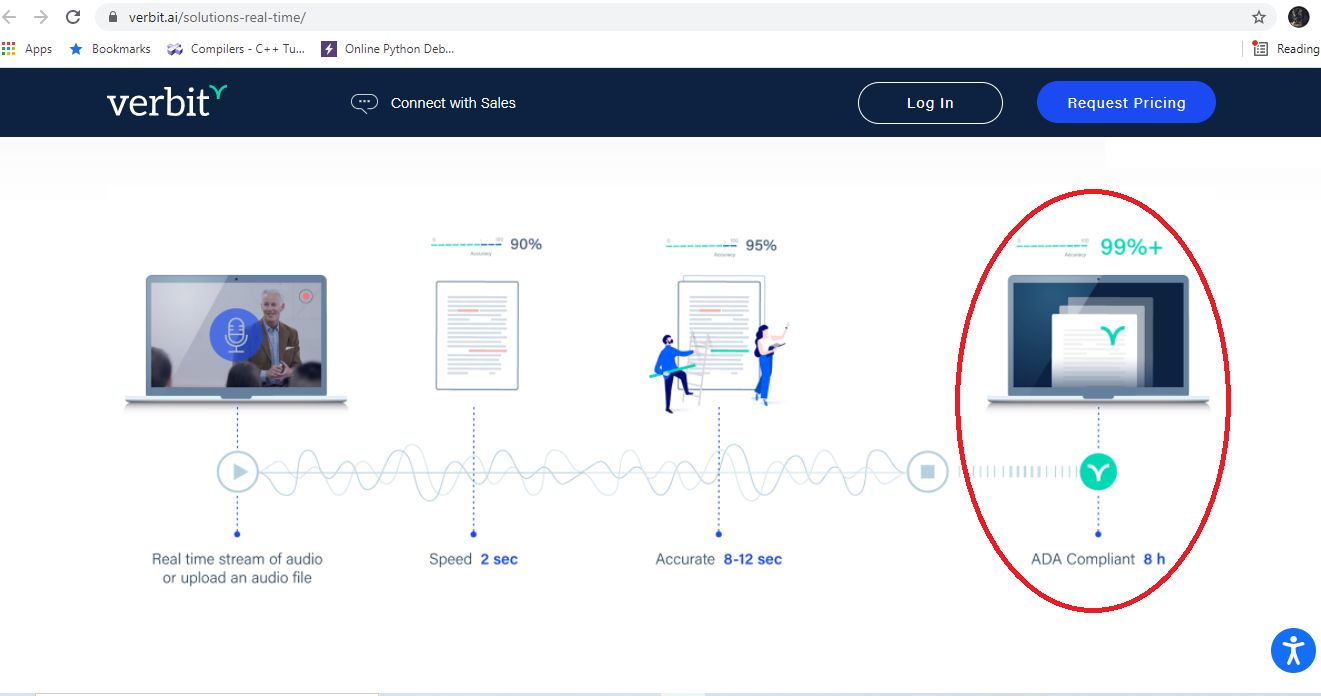
We have to deal with the hard fact that, in its series A funding, Verbit made the claim that its “adaptive speech recognition tech” could generate detailed transcriptions with over 99 percent accuracy at record speeds. In its series B funding, Verbit, through CEO Livne, said it would not take the human transcriber out of its workflow. Now it’s apparent that Verbit regards “record speeds” as 8 hours. We have to deal with the hard fact that, when studied by people at Stanford, an entire host of automatic speech recognition products from companies far larger than Verbit had accuracy levels that were 25 to 80 percent dependent on who was speaking.
There’s just no good reason to believe that Verbit consistently has the capabilities that it says it has. This is all part of the claim game that I demonstrated earlier this year. In the video I just linked, I tell six lies, one partial truth, and one actual truth in fifteen seconds. I challenged my readers to think about how long it would take to prove the truth or falsity of each claim. I have to make the same challenge here. Verbit’s website boasts that they are trusted by “400+ organizations,” but when one flips through the organization list, one sees about 16 organizations. Even if one wanted to spend the time and energy to fact check the claim of being trusted by 400 organizations, one could not do so. Why bring it up? Because stenographers need to be aware that a lot of the “intimidating” information out there falls apart when given any sort of investigation. Likewise, there are entities out there that will try to convince young captioners that their skill is not worth very much. I’m publishing this information today to counter that.
Perhaps the low pay wouldn’t bother me, but it goes directly against digital recording’s main talking point of “we need to record it because there are not enough stenographers to meet demand.”

Maybe the shortage of stenographic court reporters and captioners is exacerbated by companies like this coming in and offering pay that’s nowhere near the market rate. There’s no innovation involved. It’s a shameless war on workers. It doesn’t take a particularly bright person to say “gee, there would be more money for the company if only we could reduce the labor costs.” It also doesn’t take a particularly bright person to point out to captioners that they cannot accept this if they want a healthy field. We’re going to need the entrepreneurial individuals among us to consider jumping in, setting up shop, and competing. We’re going to need captioners to demand the pay they deserve. So if you come across an inexperienced reporter getting told they’re only worth $20/hr, please share this with them and be a major part of pushing back.
Addendum:
I realized after my initial draft that the $20 an hour could be a full-time job. Assuming 7 hours a day, five days a week, 52 weeks a year, that’s a salary of about $36,400, below the national average, and well below what I started working for as a court reporter around $70,000 a year. So even looking at it from the standpoint and potential of “more hours for less pay” I am unimpressed and captioners should be too.
CART v Autocraption, A Strategic Overview For Captioners
With the news that Verbit has bought VITAC, there was some concern on steno social media. For a quick history on Verbit, it’s a company that claimed 99 percent accuracy in its series A funding. In its series B funding it was admitted that their technology would not replace the human. Succinctly, Verbit is a transcription company where its transcribers are assisted by machine learning voice recognition. Of course, this all has the side effect of demoralizing stenographers who sometimes think “wow, the technology really can do my job” because nobody has the time to be a walking encyclopedia.
But this idea that Verbit, a company started in 2016, figured out some super secret knowledge is not realistic. To put voice recognition into perspective, it’s estimated to be a market worth many billions of dollars. Microsoft is seeking to buy Nuance, the maker of Dragon, for about $20 billion. Microsoft has reportedly posted revenue over $40 billion and profit of over $15 billion. Verbit, by comparison, has raised “over $100 million” in investor money. It reports revenue in the millions and positive cash flow. Another company that reports revenue in the millions and positive cash flow? VIQ Solutions, parent of Net Transcripts. As described in a previous post, VIQ Solutions has reported millions in revenue and a positive cash flow since 2016. What’s missing? The income. Since 2016, the company hasn’t been profitable.
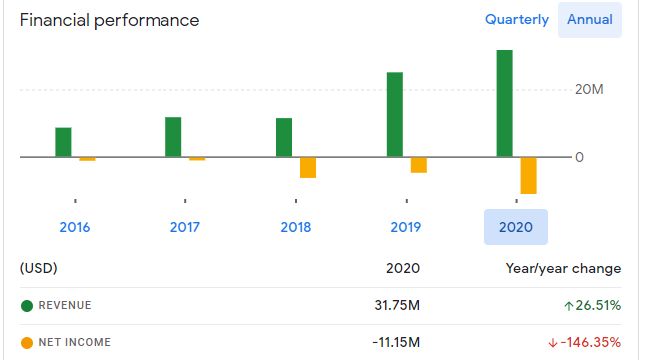
Obviously, things can turn around, companies can go long periods of time without making a profit, bounce back, and be profitable. Companies can also go bankrupt and dissolve a la Circuit City or be restructured like JCPenney. The point is not to disparage companies on their financials, but to give stenographic captioners real perspective on the information they’re reading. So, when you see this blurb here, what comes to mind?
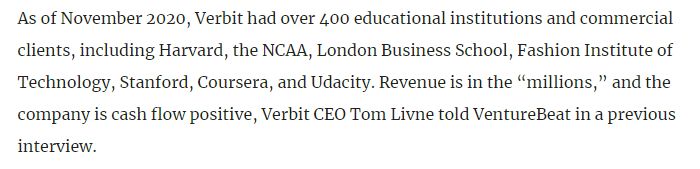
Hint. What’s not being mentioned? Profit. While this is not conclusive, the lack of any mention of profit tells me the cash flow and revenue is fine, but there are no big profits as of yet. Cash flow can come from many things, including investors, asset sales, and borrowing money. Most of us probably make in the ballpark of $50,000 to $100,000. Reading that a company raised $60 million, ostensibly to cut in on your job, can be pretty disheartening. Not so once you see that they’re a tiny fraction of the overall picture and that players far bigger than them have not taken your job despite working on the technology for decades.
Moreover, we have a consumer protection crisis on our hands. At least one study in 2020 showed that automatic speech recognition can be 25 to 80 percent accurate depending on who’s speaking. There are many caption advocates out there, such as Meryl Evans, trying to raise awareness on the importance of caption quality. The messaging is very clear: automatic captions are crap (autocraptions), they are often worse than having no captions, and a single wrong word can cause great confusion for someone relying on the captions. Just go see what people on Twitter are saying about #autocraptions. “#NoMoreCraptions. Thank you content creators that do not rely on them!”
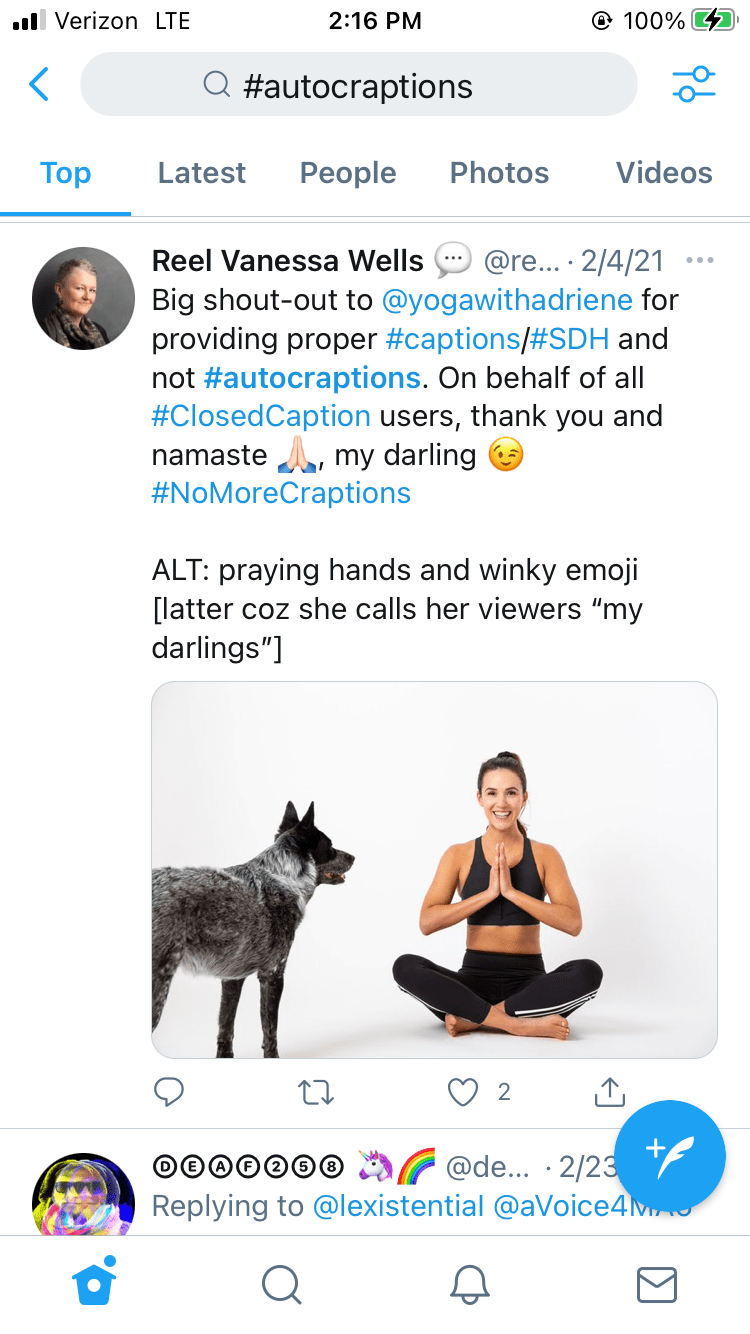
I wonder if a brand that looks good makes more money than one that doesn’t…
This isn’t something I’m making up. Anybody in any kind of captioning or transcription business agrees a human is required. Just check out Cielo24’s captioning guide and accuracy table.
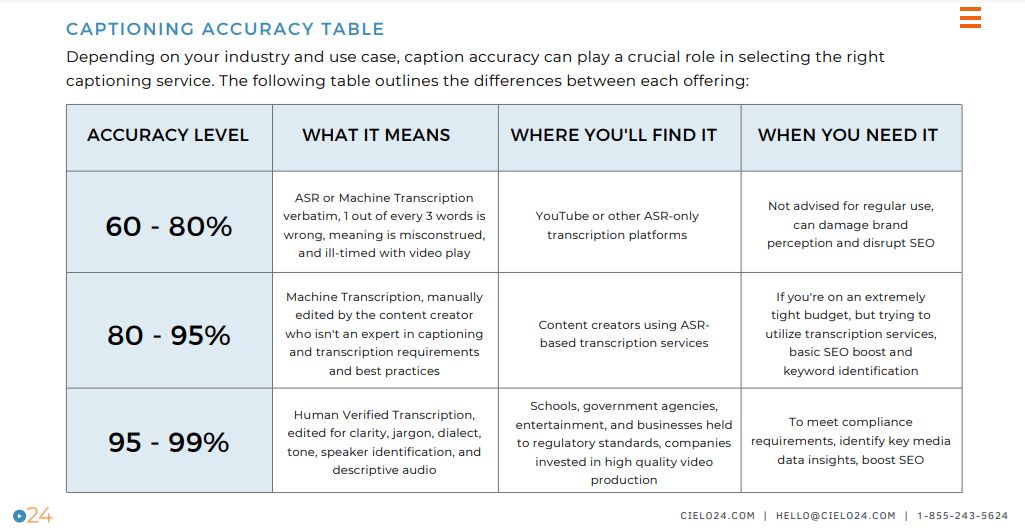
If someone’s talking about an accuracy level of 95 percent or better, they’re talking about human-verified captions. If you, captioner, were not worried about Rev taking away your job with its alleged 50,000 transcribers, then you should not throw in the towel because of Verbit and its alleged 30,000 transcribers. We do not know how much of that is overlap. We do not know how much of that is “this transcriber transcribed for us once and is therefore part of our ‘team.'” We do not know how well transcription skills will fit into the fix-garbage-AI-transcription model. The low pay and mistreatment that comes with “working for” these types of companies is going to drive people away. Think of all the experiences you’ve had to get you to your skill level today. Would you have gotten there with lower compensation, or would you have simply moved on to something easier?
Verbit’s doing exceptionally well in its presentation. It makes claims that would cost quite a bit of time and/or money to disprove, and the results of any such investigation would be questioned by whoever it did not favor. It’s a very old game of making claims faster than they can be disproven and watching the fact checkers give you more press as they attempt to parse what’s true, partially true, and totally false. This doesn’t happen just in the captioning arena, it happens in legal reporting too.
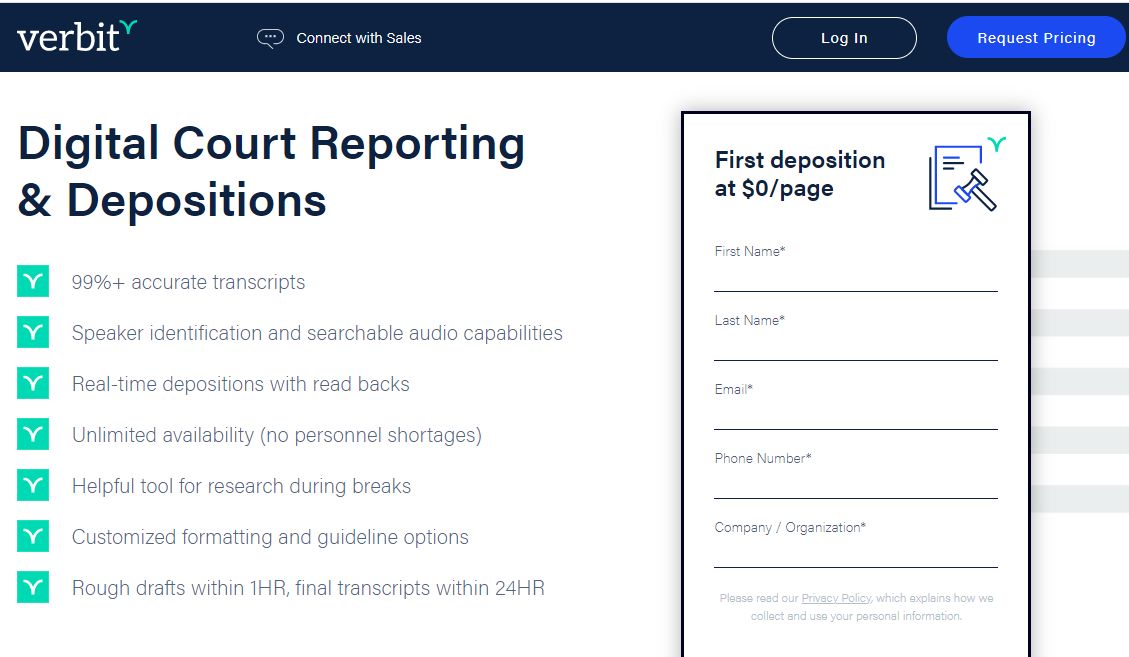
It doesn’t matter if they’re never profitable. It only matters that they can keep attracting investor money.
This seems like a terrifying list of capabilities. But, again, this is an old game. Watch how easy it is.
It took me 15 seconds to say six lies, one partial truth, and one actual truth. Many of you have known me for years. What was what? How long will it take you to figure out what was what? How long would it take you to prove to another person what’s true and what’s false? This is, in part, why it is easier for falsehoods to spread than the truth. This is why in court and in science, the person making a claim has to prove their claim. We have no such luxury in the business world. As an example, many years ago in the gaming industry Peter Molyneux got up on stage and demo’d Milo. He said it was real tech. Here was this dynamically interactive virtual boy who’d be able to understand gamers and their actions. We watched it with our own eyes. It was so cool. It was BS. It was very likely scripted. There was no such technology and there is no such technology today, over eleven years later. Do you think Peter, Microsoft, or anybody got in trouble for that? Nope. In fact, years later, he claimed “it was real, honest.”
Here’s the point: Legal reporters and captioners are going to be facing off with these claims for an indeterminate amount of time. These folks are going to be marketing to your clients hard. And I just showed you via the gaming industry that there are zero consequences for lying and that anything that is lied about can just be brushed up with another lie. There will be, more or less, two choices for every single one of you.
- Compete / Advocate. Start companies. Ally with deaf advocates.
- Watch it happen.
I have basically dedicated Stenonymous to providing facts, figures, and ways that stenographers can come out of the “sky is falling” mindset. But I’m one guy. I’m an official in New York. Science says there’s a good chance what we expect to happen will happen and that’s why I fight like hell to get all of you to expect us to win. That’s also why these companies repeat year after year that they’re going to automate away the jobs even when there’s zero merit or demand for an idea. You now see that companies can operate without making any profit, companies can lie, much bigger companies haven’t muscled in on your job, and that the giant Microsoft presumably looked at Verbit, looked at Nuance, and chose Nuance.
I’m not a neo-luddite. If the technology is that good, let it be that good. Let my job vanish. Fire me tomorrow. But facts are facts, and the fact is that tech sellers take the excellent work of brilliant programmers and say the tech is ready for prime time way before it is. They never bother to mention the drawbacks. Self-driving cars and trucks are on the way, don’t worry about whether it kills someone. Robots can do all these wonderful things, forget that injuries are up where they’re in heaviest use. Solar Roadways were going to solve the world’s energy problems but couldn’t generate any energy or be driven on. In our field, lives and important stakeholders are in danger. What happens when there’s a hurricane on the way and the AI captioning tells deaf people to drive towards danger?
Again, two choices, and I’m hoping stenographic captioners don’t watch it happen.
How We Discuss Errors and Automatic Speech Recognition
As a stenographic court reporter, I have been amazed by the strides in technology. Around 2016, I, like many of you, saw the first claims that speech recognition was as good as human ears. Automation seemed inevitable, and a few of my most beloved colleagues believed there was not a future for our amazing students. In 2019, the Testifying While Black study was published in the Language Journal, and while the study and its pilot studies showed that court reporters were twice as good at understanding the AAVE dialect as your average person, even though we have no training whatsoever in that dialect, the news media focused on the fact that we certify at 95 percent and yet only had 80 percent accuracy in the study. Some of the people involved with that study, namely Taylor Jones and Christopher Hall, introduced Culture Point, just one provider that could help make that 80 percent so much higher. In 2020, a study from Stanford showed that automatic speech recognition had a word error rate of 19 percent for “white” speakers, 35 percent for “black” speakers, and “worse” for speakers with a high dialect density. How much worse?
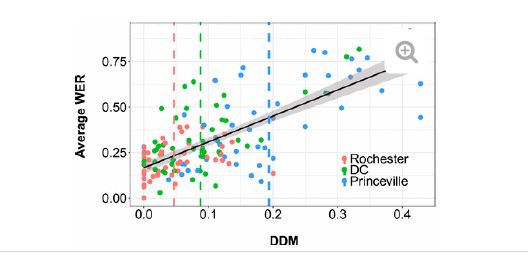
75 percent word error rate in a study done three or four years after the first claim that automatic speech recognition had 94 percent accuracy. But in all my research and all that has been written on this topic, I have not seen the following point addressed:
What Is An Error?
NCRA, many years ago, set out guidelines for what constituted an error. Word error guidelines take up about a page. Grammatical error guidelines take up about a page. What this means is that when you sit down for a steno test, you’re not being graded on your word error rate (WER), you’re being graded on your total errors. We have decades of failed certification tests where a period or comma meant a reporter wasn’t ready for the working world yet. Even where speech recognition is amazing on that WER, I’ve almost never seen appreciable grammar, punctuation, Q&A, or anything that we do to make the transcript readable. It’s so bad that advocates for the deaf, like Meryl Evans, refer to automatic speech recognition as “autocraptions.”
Unless the bench, bar, and captioning consumers want word soup to be the standard, the difference in how we describe errors needs to be injected into the discussion. Unless we want to go from a world where one reporter, perhaps paired with a scopist, completes the transcript and is accountable for it, to a world where up to eight transcribers are needed to transcribe a daily, we need to continue to push this as a consumer protection issue. Even where regulations are lacking, this is a serious and systemic issue that could shred access to justice. We have to hit every medium possible and let people know the record — in fact, every record in this country — could be in danger. The data coming out is clear. Anyone selling recording and/or automatic transcription says 90-something percent accuracy. Any time it’s actually studied? Maybe 80 percent accuracy, maybe 25; maybe they hire a real expert transcriber, or maybe they outsource all their transcription to Kenya or Manila. Perception matters; court administrators are making industry-changing decisions based on the lies or ignorance of private sector vendors.
The point is recording equipment sellers are taking a field which has been refined by stenographic court reporters to be a fairly painless process where there are clear guidelines for what happens when something goes wrong, adding lots of extra parts to it, and calling it new. We’ve been comparing our 95 percent total accuracy to their “94 percent” word error rate. In 2016, perhaps there were questions that needed answering. This is April 2021, there’s no contest, and proponents of digital recording and automatic transcription have a moral obligation to look at the facts as they are today and not what they’d like them to be.
If you are a reporter that wants more information or ideas on how to talk about these issues with clients, check out the NCRA Strong Resource Library, and Protect Your Record Project. Even reporters that have never engaged in any kind of public speaking can pick up valuable tips on how to educate the public about why stenographic reporting is necessary. Lawyers, litigants, and everyday people do not have time to go seeking this information; together, we can bring it to them.