Propaganda Guide for the Smart Steno Consumer

For those of you that haven’t read up on propaganda and persuasion techniques, you still probably won’t be too surprised to know that leaders, corporations, and all manner of people try to exert control. This usually isn’t done by direct threat or force, but by persuasion. Advertising, to some extent, can be propaganda. Networks of influencers are the modern machine that keep people scrolling. There are innumerable ways that forces we don’t even think about are trying to get in our heads. I confess that I, too, use some of the techniques I’m about to talk about. But that’s the point, if the consumer is aware, then they can make better choices. I am going to be stepping up my media game this year. You’ve all got to be ready.

Types of Propaganda:

Bandwagon Propaganda.

As humans we generally have a desire or drive to fit in. We’re interested in what’s trending for these reasons. When someone is trying to convince you that everyone else is doing it, they might be propagandizing you. In court reporting this is fairly common, software vendors will try to convince you to get on the new thing because everyone is getting on the new thing, but really they just need you buying equipment to feed the economic engines.

Card Stacking Propaganda.

This is about mentioning the positives without the negatives. Stacking all those positive cards on top of each other so that you don’t look at the negatives underneath. To be fair, this is actually a presentation technique and life tip, and I use it often, so I can’t knock it.

Plain Folk Propaganda.

This form of propaganda deals with displaying regular, relatable people and faces in advertising. It can kind of tie into the idea that “normal people” use a product or service being pitched.

Testimonial Propaganda.

This is about getting popular or famous people to pitch a product or service and is viewed as the opposite of plain folk propaganda. This tries to display people you look up to using a product or service so that you use it too.

Glittering Generality Propaganda.

This is when they use corporate speak that doesn’t really mean anything. Things like “we’ll be there for you” or “on your side.” Things that make you feel good, but don’t really convey a message or promise.

Name Calling Propaganda.

This is pretty rare in the corporate world, which is why I use it. This is exactly what it sounds like. Characterizing people. Calling people names. A fraud, a fake, a liar. It’s nasty stuff. I think my first use of this was when I called Frank N Sense a monster. Still kind of a monster. They posted that the NCRA board should resign. I honestly can’t agree. The NCRA board has the profession’s best interests at heart. Everybody has to follow through with what they know and believe in their hearts. It’s going to be just a little different for each of us. But I think they’re doing a damn good job this year and last. But anyway, name calling, yeah.

Transfer Propaganda.

This is when the propagandist uses something they believe will resonate with you in their messaging. Things like using a person’s religion to sell them things, or as I’ve said from our field, the “democratization of technology.” Most people like democracy, right? Transfer propaganda! If they’re using a vague concept related to something you love, it might be a flag.

Ad Nauseam Propaganda.

This is about messaging. Constant messaging so that you remember the brand. When I’m feeling healthy, I’m a little guilty of this, because I can write a lot more.

Stereotyping & Appeal to Prejudice Propaganda.

This is a big one. Pretty much every major player on the field is using this one against court reporters right now. We all have certain beliefs about digital reporters. We saw it when Verbit called them low skill. We see it when it’s used as a motivator to get people engaging with associations. We see corporations using it to eradicate us, pretending we’re obsolete because that’s our stereotype. The bottom line is that these players understand you. They understand how you think and what you like and don’t like. They understand how you feel about yourself. They’re going to be thinking about how to extract more money from you using that information. This was also effectively used to divide reporters, because for the last decade we were all on this “realtime is the future, everyone must tech up” drive, getting down on people who didn’t play the tech consumer game, and then when everybody sold enough equipment and training there, they packed up and went digital. This is why I have identified group think as dangerous to the profession. If they know us too well, they can manipulate more dollars out of us without giving us enough benefit.

Appeal to Fear Propaganda.

This is about using fear to get people to do things. It can be a product meant to alleviate a fear built up through advertising or it can be, in my opinion, putting you in a position of fear. On the topic of fear build up through advertising, Stenograph did this when it did its keyless drive. Gotta go keyless! Gotta buy the next thing! Gotta buy the new machine! We can all respect making money, but at a certain point, it’s just unnecessary oversaturation of the market. In terms of putting you in a position of fear, companies are doing it right now every day. They’re showing that they’re resolved to expand and switch to digital. They’re pressuring reporters to go digital, and conveniently buy their training and equipment. I think I’ve said this before, but if someone is scaring you, you might be getting propagandized.

Now You Know

When you start looking for these things, you will find them. We will all, one time or another, fall victim to propaganda. Sometimes it’s for a cause we really believe in. Sometimes it’s something we don’t really need in our lives. Sometimes it is the more comforting thing to allow ourselves to be propagandized.

Now, I should clarify, when I use these techniques, I do so for advancing truth and knowledge. All I have documented has been my honest perspective and recording. But in the end, people read and donate because it’s interesting, not because it’s honest. So if you catch me using some media tricks, it’s about keeping it interesting.

I’ve got some ideas in the oven! Get all your friends subscribed!
NCRA Town Hall: A to Z, Public & Government Relations

I attended the National Court Reporters Association Town Hall today with President Jason Meadors, and boy, am I glad I did. It gave me confidence that the association and its leaders are pushing hard to represent the interests of members. The entire session was almost exactly an hour, so there’s a lot to unpack.

Present at the meeting were, as stated, NCRA President Jason Meadors, Executive Director Dave Wenhold, Max Curry, a Past President and Chair of the A to Z committee, Annemarie Roketenetz, Director of Communications & PR, and Jocelynn Moore, Director of Government Relations. The meeting started off with a lengthy discussion from Max Curry about the A to Z program, and he took the time to explain where the program started and how it was completely revamped. According to Mr. Curry, A to Z began with about 50 boots-on-the-ground programs in the states. That fell away when the pandemic happened, and most programs closed. Programs in Texas, Tennessee, Minnesota, and California all went remote, which showed that the program could be done remotely. A new vision has come into place where the program can be done remotely and all of the resources can be centralized behind the program, with fewer boots-on-the-ground programs. Eight programs will be done a year, four asynchronous and four live. This is to capture the different kinds of learners — ones that can learn on their own AND people that need interactivity to succeed.

One of the truly exciting plans was for a landing page that can be centralized that brings people back to A to Z. NCRA is planning to reach out to organizations and associations to have them host a button or link to the landing page, creating a spiderweb or net that helps catch all the people that might be interested in this wonderful career and bring them back to the NCRA’s A to Z to give steno a try. They may ask firms to donate $5 to $10 of their Search Engine Optimization budget to help bring people to the landing page. NCRA President-Elect Kristin Anderson’s Houston President’s Party will act as a fundraiser for SEO dollars to ramp up advertising about court reporting and captioning as careers.

Lisa Dennison also spoke and informed us that 15 A to Z scholarships were given out at $750 per award. NCRA interacted with ASCA, the American School Counselor Association, getting school counselors’ contact information, adding them to a contact list, and getting them information about court reporting. It was mentioned that the communications team has been working on Instagram, QR Codes, and other ways to spread the message. Reliance donated money for student memberships for previous A to Z graduates, which helped grow association membership as well.

It was mentioned that NCRA continues to work with vendors such as Advantage, ProCAT, and Stenograph. The StenoCAT iPad app, iStenoPad, was also described as a way to simplify the logistics of getting stenotypes to participants.

It was explained that last year 295 students were picked up by A to Z. Max Curry clarified that some local programs do not coordinate with headquarters, so numbers from those programs are unavailable. Ms. Dennison asked that participant lists be sent to the NCRA so that better data can be compiled.

A quote by Brianna Coppola was shared. “I have never seen or heard of another ‘career test drive’ course. It really spotlights the encouragement within the community of reporters and their love for their jobs and dedication to the field.”

Dineen Squillante asked about the possibility of reaching out to departments of labor in each state. Lisa Dennison responded that it was something that could be looked into.

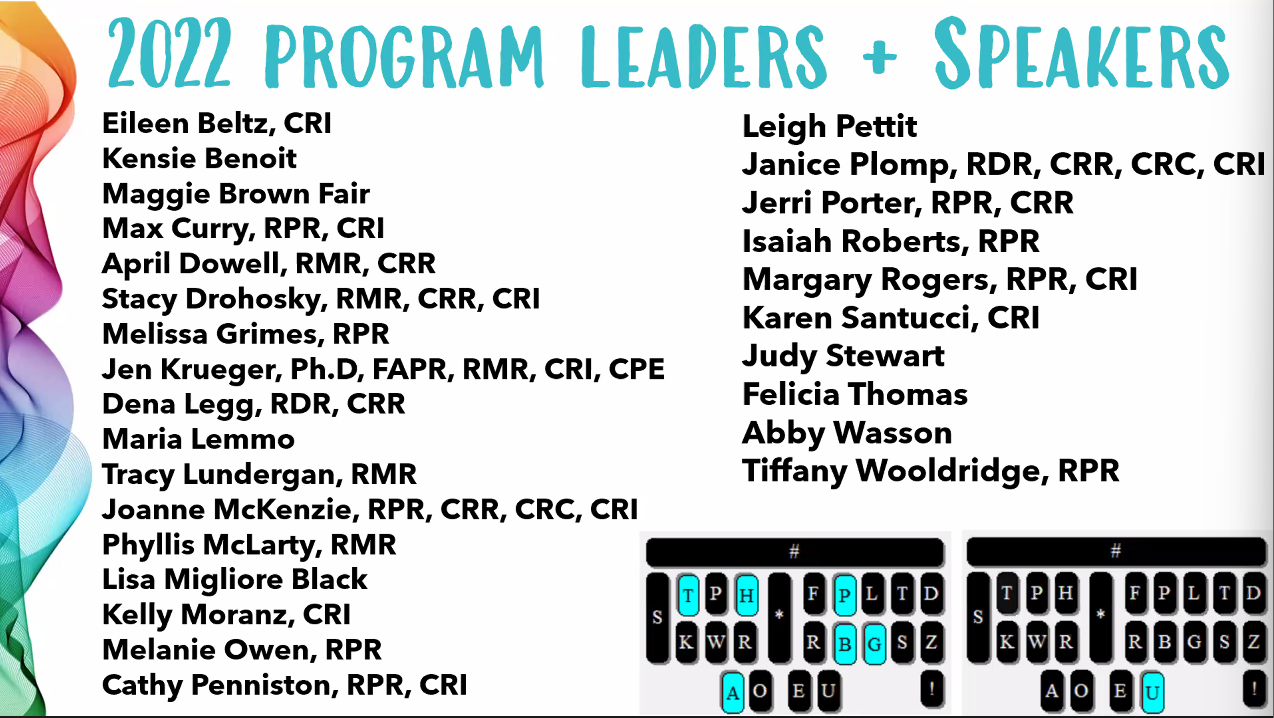
2022 Program Leaders and Speakers were thanked. It’s an extensive list, and I feel they deserve the recognition.

Ms. Dennison made it clear that the door was open to anyone that wanted to reach out on A to Z.

Annemarie Roketenetz talked a little bit about plants for Court Reporting & Captioning week, and a lot about the many endeavors of NCRA. She also mentioned that a number of press releases would be made, leading up to a larger press release that will link back to all the smaller ones. This is in line with dispatching our news and events regularly, and a very smart move on NCRA’s part. Several events were mentioned. Review the Town Hall recording at the Learning Center for more, I cannot do it justice in print. Our PR and communications are in good hands.

Mr. Meadors noted that Legislative Bootcamp has been called a “money grab.” He stated NCRA does not make money on bootcamp and reiterated what an important program it really is.

Jocelynn Moore expounded on bootcamp, explaining that it is extremely immersive training on how to be effective grassroots lobbyists. She stated that the training is “going to give you all of the tools necessary to go in front of a legislator, oppose legislation that doesn’t agree with the profession, or advocate for a bill coming through. Some of the topics covered will be “politics 101,” how associations work, and how you can mobilize with other members in your state to move forward on a particular issue.

The Training for Realtime Writers Act was mentioned. It was also mentioned that it will be difficult to reintroduce this under a Congress attempting to cut spending. More information will be provided on that at bootcamp, but also more on the situation from Indiana. Participants will learn how to advocate in front of different parties and teach members to speak to legislators, because legislators do not always have all of the information we have about our field.

Ms. Moore continued on to talk about the Indiana issue. The proposed prohibition of stenographers from Indiana courts was revealed. We learned that NCRA began a grassroots campaign to find out what happened and why the proposed change was introduced. The organization has found difficulty getting information about the change, but finds the language to be discriminatory and mandatory, robbing judges of their discretion and forcing them not to use a stenographer.

It was a packed hour. My only criticism of the event would be that they ran out of time for questions. But you know what? It happens. President Meadors directed that efforts should be made to record questions asked and that efforts would be made to have them answered. Everything wrapped up with Dave Wenhold thanking the participants for coming out on a Saturday. He said that if you get any information on Indiana, you can pass it to him or Ms. Moore. President Meadors noted that just showing up and asking questions meant participants were dedicated to the profession. The meeting subsequently came to a close.

Refinement of the programs we have is going to seize the day here. Leadership is doing something very impressive. My opinion may not count for much, but I’d thank each of them for the hard work that they do and continuing to fight for this profession. It’s inspiring, and I hope reading a little about it has inspired all of you.

The Learning Center can be used to locate and view past Town Halls.

Videos: Corporate Fraudsters, Stenographers say “We’re Coming for Ya!”

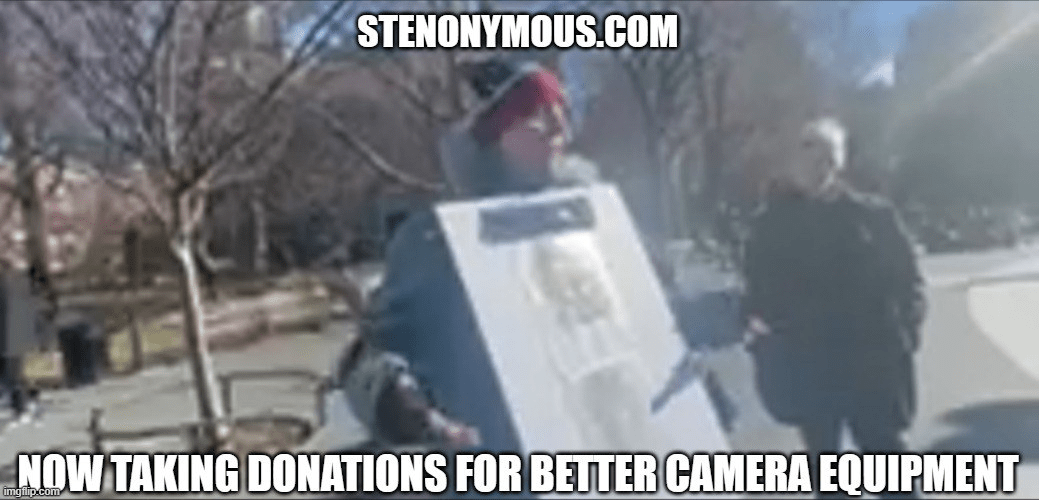
“Anything more to say about this fraud and stuff that you’re trying to fight?” “We’re coming for ya!” Corporate fraud in the court reporter shortage continues… (Stenonymous)

On Sunday my best friend Joshua Edwards and I headed out to Washington Square Park to talk to the public a little bit about court reporting generally and the court reporting shortage fraud that is ongoing in our field. With help from several locals, we managed to secure footage of our time out and it’s my pleasure to share it now with court reporters across the country.

As I see it, there are two ways to combat shortage issues today. Either help bring attention to the blatant fraud ongoing or try to raise awareness about the profession at schools and other events. This was something of a hybrid where we made some noise about our issues and spent time educating the public on court reporting. I also used the event to solicit some donations.

Christopher Day (Stenonymous) talking to the public about court reporting and court reporter shortage fraud.
Christopher Day at Washington Square Park to discuss court reporting and court reporter shortage fraud.

Just to prove that I’m really serious about supporting the stenographic legion, I may or may not have stood inside the fountain.

Christopher Day at Washington Square Park to talk to a bunch of chalk smiley faces about court reporting.

I mean, I even talked to the Garibaldi statue about court reporting.

Christopher Day (Stenonymous) talks to the Garibaldi statue at Washington Square Park about court reporting.

I got to talk about the Racial Disparities in Automatic Speech Recognition study.

Christopher Day (Stenonymous) discussing the Racial Disparities in Automatic Speech Recognition study.

I got to discuss digital recording and the two-month backlog that I published about on Saturday.

Christopher Day discusses a 2-month delay to digitally recorded transcripts.

Joshua Edwards, RDR, CRR, CRC, also got in on the action, letting members of the public know about Stenonymous and court reporting.

Joshua Edwards discusses court reporting and stenography with members of the public.

I made sure to let the public know that jobseekers are being misled into digital court reporting too.

Christopher Day (Stenonymous) speaks about jobseekers being misled into digital court reporting.

“Certain forces are trying to get rid of the stenographer…” That’s what we got to tell people. And we made sure to get it on camera so that all of you can easily share it. We all see what’s happening in Indiana right now.

Christopher Day (Stenonymous) and Joshua Edwards reveal there are forces trying to get rid of stenographers. We met a man who had a deposition because he was hit by a bulldozer. Medical transcription is also discussed.

I’d like to ask individuals and institutions to consider sending some funding to Stenonymous. I know many of you are busy people that cannot afford to take the time to dive into every last bit of my writing, research, and documentation over the last half decade. But clearly something is very wrong. The largest companies in our industry do not care enough about their brand to (a) attempt to convince me I’m wrong or (b) slap me with some kind of legal notice. Multimillion dollar corporations. Does it really seem off base to suggest that there might be antitrust issues here when some of the largest competitors in the field have syndicated behind a shell nonprofit to pump the market with misinformation?

If I’m right, then we should all be pretty concerned about having a marketplace where the government is inert while the largest players illegally bully the smaller court reporting providers into digital, which they’ve conveniently set up to have stakes in/relationships with, in terms of training and equipment vending.

If I’m wrong, then this is a very cruel field, because not one of you has tried to tell me I am wrong or pointed me to research that beats mine.

And if I’m right, then your money is pretty well spent on me. With the support of court reporters like you, we blew through the false media narrative of an “impossible” shortage. With more support we could afford to hire more writers, investigators, content creators, or even legal advocates. Who would like a filmed protest outside Veritext? Who’d like to have a media footprint that rivals other industries? Who’d like to push this issue until it can no longer be ignored? I’m the guy for the job. Help me out and I’ll bring allies to this field one by one.

A member of the public poses with Christopher Day (Stenonymous) in solidarity against corporate fraud.

Even if you choose not to throw any support my way, let this stand as a reminder that where there is injustice people can resist in small ways that lead to something greater. The name of the game is connecting with people, because if my time in Washington Square Park told me anything, it’s that they’re on our side.

Inside Stenonymous’s Strategy

My behavior, to some, may come off as strange. I started the digital court reporter helpline on Facebook. Some people, even my own readers, take issue with the fact that I refer to them as reporters. I’d like to level with people, I know that what I do is different from mainstream stenography. There are ideas and strategies behind many things that I do. I’d like to share some so that people can understand and make their own judgments. I’ll also memorialize some steno history as I see it.

First, on the issue of shortage, I envision possibilities and then document events until I know a probable truth. For example, certainly at the start of my journey, I wrote about shortage and I viewed the shortage as our main problem. As I started to see the Speech-to-Text Institute inundate our side of the field with claims that the shortage was impossible to solve, this belief was replaced, I came to believe that STTI was simply digital court reporter marketing, and that by emphasizing the shortage, they were trying to fool reporters into going digital, fool agencies into using digital, and ultimately fool our associations into embracing the “new” court reporting. It’s called framing. How you frame an issue dramatically changes the response you get. If they framed the shortage as insurmountable, we would come to the conclusion they wanted: You must go digital. To wrap up my thoughts here, I formed two possibilities in my mind. 1) The shortage is impossible to solve. 2) The shortage is possible to solve.

Eventually, after much documentation and research of their claims, I concluded 2 was most likely. I’ll spare everybody the explanation. But that’s where I jumped into a number of activities, writing about digital reporting, the pitfalls, the deception of jobseekers. Here’s the strategy part: This all creates a record. It populates searches with Stenonymous blog posts. It begins to shape digital court reporting’s online presence and frames the issue in the way STTI was doing to all of you. So when people look up digital, they might see it’s a kind of “soft scam” and go elsewhere. This makes the economic cost of filling digital positions higher, and therefore disincentivizes digital use in businesses. Even now, search engines may start pairing digital court reporter with scam just because I wrote them together. So for those of you that want me to call them recorders, this is why I won’t. The people in power now have to live with the toxic title they stole from us.

I also scare off people that have an agenda, but no conviction. I was connected with Jim Cudahy (then STTI), on LinkedIn for a short time. At that time a lot of shortage media was going out, and I realized the man had a connection with an association for journalists. While I can’t prove it, I believe at least some shortage articles were engineered because I have been trying to get an article run on corporate fraud for over a year (on and off) with little success. Why in the world is every journalist DYING to talk about the end of stenographers, a field for which they previously had no interest? It might be big business interfering in our industry media. One analyst, Victoria Hudgins, ignored me when I wrote to her with corrections and kept publishing stuff that put stenographers in a negative light. I finally ran an attack ad on her, and we haven’t heard from her since. I called Jim Cudahy a fraud and he ran away to the Alliance of Crop, Soil, and Environmental Science Societies. Now I’ve been watching Steven Lerner’s articles at Law360. He’s a senior reporter at Law360. I feel his articles put too much emphasis on calling things equal, mostly because the idiot called STTI a stenography association, and he has outright ignored many things I’ve sent him. So quite frankly he may be next. Say what you want about me. In medieval warfare getting the enemy to rout was a win. At the point where its enemies flee, the stenographic legion is winning.

There is also a strategy to being solo. I’m a bit of a loner and you can’t really ostracize a loner. I separated from my volunteer roles in associations. This has many benefits as far as lawsuits against me for my publishing. A potential plaintiff would have to target me as an individual. The amount they could collect is limited because I just don’t have very much. The economic cost of a lawsuit would also be phenomenal for a plaintiff. Imagine for a moment the 400 or so blog posts I’ve made over the years becoming exhibits, the depositions, the interrogatories, the emails, the trial! This is on top of the fact that a lawsuit against me would not be meritorious, and therefore plaintiff would risk losing against a pro se stenographer.

I tried contacting law enforcement, but I don’t have any details on where those reports go. This leaves us in a kind of twilight where we need the media to cover this and ask the hard questions, like “hey, multimillion dollar corporation Veritext, why would you let a respected member of the profession say these things about you without trying to convince him he’s wrong?” Remember, they don’t have to sue, they just have to convince me I’m wrong. They haven’t tried. Because it’s a fraud. I even wrote them a letter. We also need the media to ask government questions, because that would probably get government to act. Until it does, we are a nation of unenforced laws.

Again, possibilities. 1) An event will occur which triggers a viral moment, calling attention to us in a way that changes the trajectory of digital recruitment and definitively ends shortage, such as attracting investors. 2) Such an event will not occur. So what is digital court reporter helpline? An assumption that I will lose. I will assume that court reporters will not increase their funding of Stenonymous over the next decade, that no journalist or lawyer will come to our rescue in a way that makes a difference, and that the number of stenographers falls to the point where we won’t bounce back (unlikely). So then the goal, for me, at least, becomes improving the lives and working conditions of working reporters. That means organizing people. That means communicating with them. That means thinking well outside the box. And if you see the description for the helpline, you’ll see what I mean. Again, as I grow this movement, it will hopefully decrease the steno-digital pay gap, leading to incentivized stenographer use because we are more efficient on average. And if the corporations decide to discontinue their aggressive pursuit of digital before we have a viral moment, so be it. But that’s what the helpline is about, taking control of digital court reporter spaces in a way that associations could never do.

But until I’m fairly sure I’ve lost, I’ll be trying to reach that viral moment. I’ve done this in a lot of different ways, even some ways people wouldn’t think about, like being a little more rude or aggressive. This is because journalists are lazy and about ten thousand times more likely to publish an article about me saying something a little off key than the math showing shortage is exaggerated. Seriously, somebody lie and tell a journalist I made a racial slur and I’ll be in the news tomorrow. But corporate fraud affecting thousands of people isn’t important. In that same vein, I was hoping someone would start media antithetical to mine and start an ideology war with me. Power’s about eyeballs, and nothing would get eyeballs like an open market media war. The most I got was Mary Ann Payonk blocking me and badmouthing me to others.

You see, for years court reporters predictably went in the same direction and were stuck in a kind of “group think.” By injecting the market with a new and growing viewpoint, we create an environment that is uncertain. In a “certain” environment, status quo reigns supreme, and right now the aggressive expansion of digital is the status quo. In an uncertain environment, the largest players have the most to lose and are the slowest to act. By taking our predictability off the table, we can force the largest players on the field to react to us. If your opponent is reacting to you, it means you have a shot at controlling the game.

Some miscellaneous points. As for why I allow uncomfortable conversations in the Stenonymous Facebook group, my business is information. It’s a cop tactic. Let the suspect talk themselves into a corner. Let the people that make us uncomfortable speak, we might learn something or we might not, but we certainly will not if we silence dissent. And learning new information can only help us because we are the more-established workforce.

Before I conclude, I would just like to say I’m imperfect. My execution of things isn’t always great. So I am open to criticism. I don’t discard it when you send it. I do not censor contrary viewpoints. That’s why I’m writing this. Being open minded is also part of my strategy. Evidence will change my views, particularly over time and with reflection. Building truth seeking into my worldview allows me to re-evaluate things and avoid confirmation bias trapping me in an endless loop of “I’m right and you’re wrong.”

I guess the bottom line is my life as a court reporter has taught me that a lot of “bad people” go through life with a simple moral code. “Screw you, stop me.” I’m experimenting with what happens when a “good person” has had enough and takes on the same moral code. What happens when a “good person” is willing to be the “bad guy?”

Stenonymous.

Bulletin: Court Reporter Shortage or Fraud?

Law360: A Dire Court Reporter Shortage? Depends on Who You Ask.

Certain court reporting companies are exaggerating and exacerbating the stenographer shortage for the purpose of selling digital court reporting to lawyers/courts/consumers.

Veritext, US Legal Support, and Planet Depos have all publicly made statements about the unavailability or shortage of stenographers while putting most of their effort into expanding digital court reporting. Succinctly, utilizing their market share to obfuscate the availability of stenographers and artificially increase digital court reporter demand. It is unknown whether this is concerted or a form of tacit parallelism.

The resulting atmosphere is also misleading to those seeking a career in court reporting.

The nonprofit Protect Your Record Project was formed to educate consumers on the bait and switch tactics occurring in the court reporting industry.

In 2021, US Legal Rep Peter Giammanco wrote, “Does it really matter if done legally and ethically and both methods end with the same final transcript?” A consumer awareness campaign was subsequently launched. There are questions about whether digital recording is reliably the same as stenography. In one New York case, the court remarked that past holdings that recording was equivalent to stenography were belied by the record in that appeal.

Companies continue to profess shortage while placing the bulk of their effort into expanding the digital reporting market, effectively limiting consumer choice and ignoring consumer preference for stenography. The 2013-2014 Court Reporting Industry Outlook is used to add credibility to these claims, but that forecast is nearly a decade old and does not account for recruitment initiatives such as National Court Reporters A to Z, Project Steno, and Open Steno.

Attorneys, courts, and support staff can attempt to find stenographers or stenographer-run businesses through their state court reporting association or NCRA Pro Link.

The FTC has stated it will crack down on companies taking advantage of gig workers. It is unknown how this will affect court reporting, a field that is approximately 70% independent contractors according to available data. It is also unknown how rampant misclassification may be in the field.

Stenonymous (Christopher Day) is dedicated to informing the court reporting and legal community and has faced legal threat for accurate reporting in the past.

Does this look like they’re looking for stenographers?

Members of the community that wish to support advertising for this bulletin may send money through the donation box at Stenonymous.com.

Readback Seeks Reporter in Charge After Smashing Steno Machine

Readback, the company most known for declaring it’s going to do away with steno and making bogus claims, is on the hunt for a reporter in charge in California.

Active Readback seeks stenographer after bashing steno.

I cannot think of a company that has made it more clear that they hate stenographers, and stenographers would do well to lock them out of the California market’s whole licensing scam by just not working for them. It’s very simple. The data we have today is that stenography is more accurate. They effectively advertised wanting to be less accurate. In a field that’s all about accuracy, consumers and court reporters are going to run the other way. As for this game of “oh, your poor joints…” Maybe we were gullible enough as an industry to believe such a thing half a decade ago, but not now.

One has to wonder if the business types have taken notice that we are allegedly on our way out and have this massive retirement cliff, but we are able to organize, get legislatures to act on our behalf, and just generally be a pain in the ass of anybody that wants to eliminate positions for our students. It’s almost as if the data they were relying on is wrong. I wonder who could have predicted that?

Perhaps this message goes beyond the businesses and meets us directly. We have value for as long as accurate court records have value. A major part of the game is learning and pricing that value. Another part of the game is communicating the value of accuracy in a way that only we really can. A third piece is realizing that organization constitutes part of our value. The more we are able to organize and fund associations or entities that will advertise and advocate for the profession, the more collective benefit we pull.

One thing is clear: Stenographers will not let the shortage be the scapegoat for our replacement. Readback, what’s your next move?

Lightning Law Stands Up For The Record

Stenographers are not alone in explaining to others the pitfalls of tech mania™️. I was sent these this week and I feel it important to share. It’s from Lightning Law.

Lightning Law says the judicial record is at risk.
Live Court Reporter v Digital Recording by Lightning Law

There’s even a page set up to start collecting cases and facts.

It’s good to see businesses setting up for the counter to tech’s obsession with pretending to automate everything. Eventually investors will stop being fooled by the buzzword “AI,” and at that point businesses that value people will end up in the limelight. At present, LL caters to attorneys and mediators. It will be interesting to see future offerings for court reporters.

Texas Lawyer Cold Calling List For Sale

This is very similar to the California list put on sale last week. This is put out for any group of entrepreneurs, court reporting businesses, or others that might need a list of lawyers for cold calling operations in Texas. The development of sales & marketing strategies in our field is essential. Having information like this in one simple spot can be a game changer. There are over 1,600 entries on this list, so it’s priced at about $0.08 per entry. The format is xlsx, which can be opened via Google Sheets, Microsoft Excel, and if I’m not mistaken, Apache Open Office.

So, if you are in need of a cold calling spreadsheet for Texas, look no further.

I plan to release one or two more lists like this and then move into more educational materials that help make use of information like this, so if you’re generally interested and don’t have a use for this yet, sit tight, there is more to come. If you have an interest in a specific state, feel free to write me at contact@stenonymous.com. I’ll see what I can do.

Addendum:

A reader asked whether this list shows the city and e-mail address. This list has an address listed for most firms, with many located in Irving, Austin, Houston, and Dallas, but it does not have a great e-mail listings. There are services that provide more comprehensive lists, but they also tend to have a higher price point.

The Summer 2022 Record Protector is Out Now!

Protect Your Record’s Summer 2022 newsletter, The Record Protector, has been released. There’s a lot to read about this issue, including the story of what happened to StoryCloud in Texas with Jo Ann and Dennis Holmgren, a message from PYRP President Kimberly D’Urso, a vocabulary test, an article about Shaunise Day’s Fearless Stenographers conference. Sheri Smargon from the Florida Court Reporters Association wrote about her path through this field, as well as the importance of educating clients on what we do. There is also a California law and legislative update from Kim Kuziora, an update from Allie Hall on the liveliness of steno education, stenotype talk with Victor Nolasco from Personal Touch, and a call for future contributions.

The growth of stenographic media not only helps us communicate important ideas with each other, it helps give recognition to those of us that are going above and beyond to connect, educate, and advocate. I am very impressed by Kimberly D’Urso, Charlotte Mathias, and everyone else that put this together. I sincerely hope all of you will give the newsletter a read!