Stenograph Customers Start Petition for Town Hall

A petition has been made asking Stenograph to acquiesce to a town hall meeting.

After Stenograph’s actions in Texas and Illinois, as well as the reports of declining service from the past and its questionable partnerships with TransAtlantic and TranscribeMe, Stenograph would ultimately be doing itself a favor to start reuniting with its stenographer base. In my view, all it would take for any of these companies under the Speech-to-Text Institute to sway stenographers back to their side is admitting that the Speech-to-Text Institute got it wrong with regard to the impossibility of solving the stenographer shortage.

Stenographers, now’s the time to make your voice heard. The petition only aims for a thousand signatures, but according to Stenograph’s own numbers, as I recall from the Illinois article, the number of Stenograph customers is much higher, in the 20,000 ballpark. The more we can do to spread the word, the more pressure Stenograph will feel to accept.

There’s a big question about who would moderate, but my money’s on Joshua Edwards. He’s always been fair and professional. He’d ensure no nastiness. Even I’d behave.

I assume they won’t accept. Then again, I’ve learned to never say never. I was told people would never read the blog. Now at least a thousand visit every month. Stenographers have a real chance at being a part of positive change by trying, so go sign today!

Steno Imperium takes Hatchet to STTI Bloc.

Steno Imperium has a post up about corporate responsibility and the various things that Planet Depos, US Legal Support, Verbit, Veritext and Stenograph have done. In some instances it alleged violations of law and dives heavily into the conduct of Kathy DiLorenzo.

It’s a long read, but provokes a lot of thought. I don’t want to take up your time or detract from the piece by regurgitating everything here, so go check it out!

Shortage Solutions 16: Looser Deadlines

It seems almost a waste to make this its own post, but the thought occurred to me that if the shortage was really a pressing concern and something the agencies wanted to help alleviate, they might just take work a little later.

It varies from case to case and isn’t something that can be done everywhere, but in general, at least in New York, the deadlines have remained the same over the years. If anything, they’ve tried to demand transcripts even sooner than the two-week turnaround that existed when I started out.

It would not only enable individual court reporters to take more work, but also help draw the existing pool of reporters to an agency that’s easier to work for rather than trying to squeeze them for every ounce of productivity they can.

It’s not CoverCrow, but it’s still an idea.

Tips for Publishing Without Consequences

I get away with publishing pretty much anything I want. It’s something I’m proud of and really promote because I feel our field will grow stronger by having discussions and having things out in the open. That said, with this power comes some responsibility, so I’m going to share some of the thought processes that help keep me away from endangering my career so that others who follow might avoid the pitfalls of free speech.

1. Personal situation is important. One of the reasons I started Stenonymous was because government workers have some free speech protections. The large court reporting businesses had no power over me because my money is made completely independently from them. Freelancers have a hard time in this regard. There’s no protection and agencies have actively tried to cause trouble for them in the past. So the first thing to do before publishing is to take stock of your personal situation and imagine the pros and cons of speaking out. Sometimes speaking through someone else, as many people have done by corresponding with me and sharing information, is safer.

2. Details are important. Free speech protections aside, talking about your workplace could pose a problem. In general, don’t publish about the specific cases you work on, the court you work for, or the sensitive things you do in the course of your official duties. For example, I am free to absolutely trash California courts and policies if I want to. Doing the same in my backyard could be problematic. Keep in mind, it may limit career mobility to trash a lot of different places, so it may be undesirable to trash places in your publishing if you may uproot and move there in the future. This is why I don’t trash Kentucky. If the ocean ever swallows New York City I need Migliore & Associates to hire me.

3. Truth is important. The things you publish should be truthful. Truth is a defense to defamation and anyone is allowed to sue for any reason. Any of you could sue me right now in my hometown with a complaint that says “Chris Day is a bad man and owes me a million dollars.” You wouldn’t win, but the point stands, truth is a strong lawsuit deterrent.

4. Fair use is important. Take care if what you publish is copyrighted. All creative works are copyrighted upon creation. There is some wiggle room in the fair use doctrine where things created for parody, education, debate, commentary, etc, may allow the use of copyrighted material.

5. Have a backup to explain antisocial behavior. Most neoliberals back up their psychotic behavior by saying things like “it’s just business.” Usually as they’re firing single moms and stuff like that. My personal out is that I have adopted a performative media style called the “dirtbag left” style. This helps people reconcile my very mellow and polite in-person self with my more loud and visible media persona.

6. Punch up. People and organizations with wealth and power are far better targets for commentary. If they hit back, they’re the big bully preying on you for exercising your free speech rights. If they do nothing, they look weak to those that follow you, consume your content, or agree with your points.

7. Find a niche. The big money types are correct when they talk about business ecosystems and companies’ roles in those ecosystems. Free speech, power of the press, and general sharing and distribution of information are part of ecosystems too. Publishing is about finding your niche in the ecosystem. For example, there are people like Shaunise Day, Stephanie Hicks, Denee Vadell, and the Stenoholics. Like me, they’re all content creators. They make amazing stuff. But we don’t fill the same niches. I present analyses of and commentary on our field along with populating search engines with articles and images that counter the corporate narrative. Shaunise creates conventions that make me wish I wasn’t an introvert. Stephanie and Denee make videos that outclass anything I’ve ever made in my entire life. If I had the money, my new niche would probably be syndicating our stenographic media and pumping it out to the world (and getting our content creators paid.) The point is, whatever you do, be original or do things better, it’ll get your content more exposure and be more impactful.

8. Pay your taxes. Make sure to claim any income from your publishing hustle, even if it’s somehow expensed on a schedule C or something like that. Your rivals might just report you to the IRS if they see your content attracting real dollars.

9. Use personal attacks sparingly. Most of my publishing is about the conduct of corporations and not so much focused on the individuals that work for those businesses. If you’re going after somebody, you really want to have a firm grasp on why you’re doing it, because you may have to explain your conduct to a friend, follower, or employer.

10. Have fun and stay calm. Publishing comes with risks. People can sue, talk about you behind your back, or even openly trash you. It’s very advantageous to take on a nihilistic “nothing really matters” approach to the world in this regard. For example, I’ve put it out there again and again that given enough funding this blog will grow its media footprint and push the agenda of working reporters harder than anybody else has in the last 50 years. It ultimately doesn’t matter whether the funding comes through because I believe in what I’m doing and the information that I publish helps people. Money is a means to an end and not an objective. Similarly, it’s advantageous to have a mission behind what you do, because it will keep you going even when the funding takes a nosedive. Flip side of that, don’t become too obsessed with your mission, because if something comes along that stops you from achieving your objectives, you want to keep good mental health. If you’re not ready mentally for the potential consequences, it’s okay to walk away from a creative or content-generating project.

You’ve got my book of tricks. The First Amendment is our strongest card against an inert government and corporate corruption. Go build something better.

Support The Fruits of Discovery and Evidence Depositions Are the Testimony They Produce with Catherine Rajcan!

Catherine Rajcan made a nine-part series of posts through LinkedIn and other social media, titled The Fruits of Discovery and Evidence Depositions Are the Testimony They Produce, that I’d like to memorialize and share with everyone.

This is 1/9. This introduced the series and revealed that some legal service companies attempt to trick lawyers into believing digital court reporting is comparable to stenography.

Activism and information dispersal by Catherine Rajcan, titled The Fruits of Discovery and Evidence Depositions Are the Testimony They Produce 1/9

This is 2/9. This listed a series of distinctions stenographers have from digital court reporting, including the ability to instantaneously read back questions and testimony.

This is 3/9. This post explored failings of digital recording and times when stenographers must clarify to protect the record. The obvious implication is that this same level of quality is not guaranteed by digital.

Activism and information dispersal by Catherine Rajcan, titled The Fruits of Discovery and Evidence Depositions Are the Testimony They Produce 3/9

This is 4/9. This post explained the problems with chain of custody and linked my audio editing video. It makes it clear that by relying on audio, problems arise in the security of the record.

Activism and information dispersal by Catherine Rajcan, titled The Fruits of Discovery and Evidence Depositions Are the Testimony They Produce 4/9 (Christopher Day’s “editing audio easy” short video.)

This is 5/9. This dove into Illinois law and described how, though notaries are allowed to swear witnesses by law, it is not a replacement for certified shorthand reporters.

The Fruits of Discovery and Evidence Depositions Are the Testimony They Produce 5/9 (NCRA Strong shield)

This is 6/9. This post gave an explanation of shorthand reporting under Illinois law and the penalties for holding oneself out as a certified shorthand reporter when they are not one.

Activism and information dispersal by Catherine Rajcan, titled The Fruits of Discovery and Evidence Depositions Are the Testimony They Produce 6/9

This is 7/9. This revealed Illinois Supreme Court rules on audio-visual recording and the use sound-recording devices for proceedings such as depositions.

Activism and information dispersal by Catherine Rajcan, titled The Fruits of Discovery and Evidence Depositions Are the Testimony They Produce 7/9

This is 8/9. This post mentions the lack of regulation regarding digital court reporting and notes that using digital court reporting carries significant risk.

Activism and information dispersal by Catherine Rajcan, titled The Fruits of Discovery and Evidence Depositions Are the Testimony They Produce 8/9

This is 9/9. This post went into the NCRA’s efforts to warn attorneys about digital expansion.

Activism and information dispersal by Catherine Rajcan, titled The Fruits of Discovery and Evidence Depositions Are the Testimony They Produce 9/9
Activism and information dispersal by Catherine Rajcan related to The Fruits of Discovery and Evidence Depositions Are the Testimony They Produce, a 9-part series of posts.

Looking over all of this brings a lot of inspiration. Just look at the incredible effort put into keeping attorneys informed. If you’ve ever wondered how you can help, here’s a chance. Head over to these posts, like and share or show them off to an attorney in casual conversation. Start spreading the message so that attorneys equate stenographers with service and good standards. It’s arguments like this that will advance us, but we need participation from our colleagues. You can make a difference today!

Stenograph’s Attack on Stenographers in Illinois…

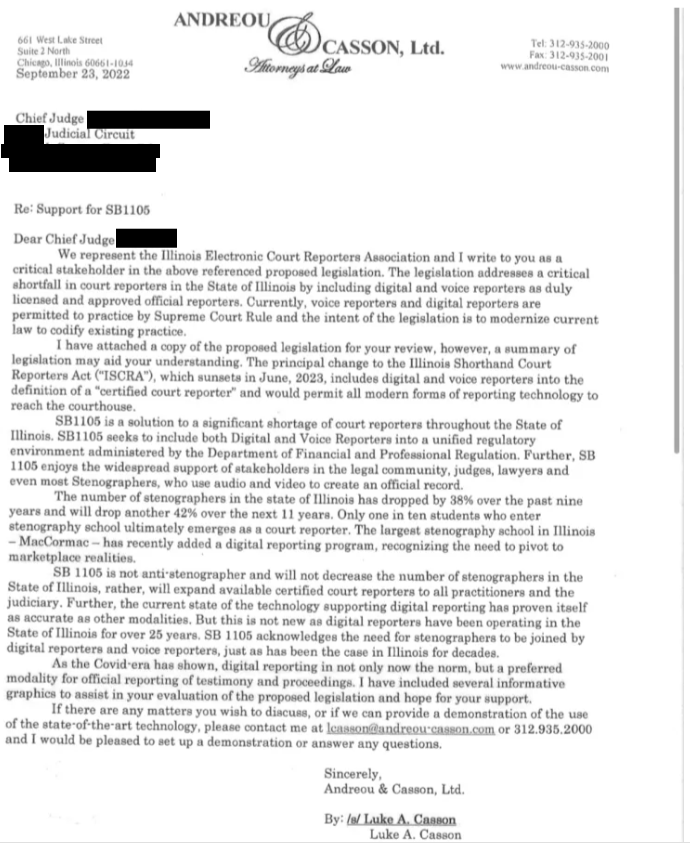
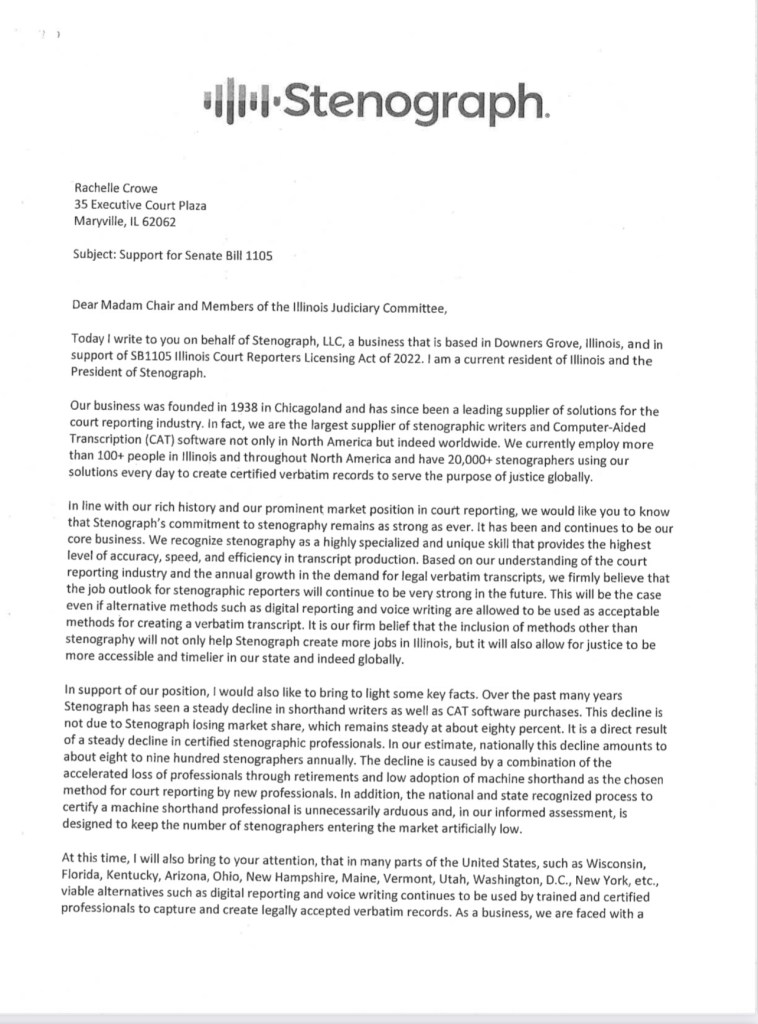
I’ve obtained a letter from Luke Casson of the Illinois Electronic Court Reporters Association and Anir Dutta from Stenograph. Along with these materials came some Speech-to-Text Institute materials.

Speech-to-Text Institute, as we know, is the nonprofit that lied when it said the court reporter shortage was irreversible. It used an outdated report to make its case, and its frontman, Jim Cudahy, left the field after I called him out on his fraud. STTI has several companies represented in its leadership, including The RecordXchange, Stenograph, Trans-Atlantic International Depositions, Planet Depos, Veritext, U.S. Legal Support, Neal R. Gross and Company, vTestify, Verbit, Kentuckiana, Tri-C Community College, RevolutionaryText, and For the Record. When I refer to the STTI Bloc, this is what I’m talking about. They used STTI to pump the market with misinformation, and as you’re about to see, they ride off those lies to push digital court reporting to policy makers and fellow court reporters.

If you look at those links above you’ll see that I’ve been on this since day 1. Court reporters can trust me to fight for them.

On that note, I think the best way to do this is to present each piece and then present my take on it. I’ll try not to nitpick too much and just bring out primary points.

I’ll be really fair here. He’s got a mission and he’s sticking to it, and that’s fair game. But I would say the idea that adding digital to the pool will not decrease the number of stenographer jobs is a lie. There is a total market. More of that market being covered by digital necessitates fewer available stenographic jobs. The idea that digital reporting is the preferred modality is also heavily in dispute. We literally call stenography the gold standard and even ChatGPT knows it.

Lies spread by the Speech-to-Text Institute used to support digital in Illinois

For the STTI materials, it’s 100% certain to exacerbate because the STTI Bloc has used all of its money and influence to grow digital over steno while lying to court reporters and the public. The number of stenographers shrinking in Illinois is pulled straight from Ducker’s “70% will retire before 2033” statement. There is basically zero chance that the report, which is a decade old, reliably predicted the future with 100% accuracy. Fewer than 1 in 10 become court reporters. I’ll concede that we say this a lot, but has anybody run the actual numbers with any consistency, or is it kind of like Ducker where we got some information once and then trusted that forever and ever? I have the same issue with stating the number of stenography students. It completely discounts the self-taught — and I personally know self-taught court reporters. It’s all fluff to suit an agenda. I no longer feel bad about calling it what it is. Nobody from that side of the equation has ever defended their inexcusable antisocial behavior. They simply pretend I don’t exist, because my existence is inconvenient to their agenda.

Stenograph supporting digital in Illinois

Stenograph claims to have 80% market share, and then claims that at least 20,000 use their software. That would put the number of stenographers at at least 25,000. That means Stenograph knows for a fact that STTI was wrong, since there were only supposed to be 23,000 of us as of 2023. Again, the idea that this will add additional jobs is laughable, it will only move market share to digital, which Stenograph has positioned itself to profit from. They also lie about New York, where voice writing is not accepted for civil service positions. Neither is digital. Anir writes well, and I admire his ability to stick to a story. Perhaps seeing this in print will lead people to realize why I was so down on Stenograph as an entity, but not its employees or trainers. As a company, they’re not doing right by us. Everybody else is just caught in the crossfire of that. But the company relies on you being the bigger person and letting it go. “It’s just business,” they say, as they twist the knife just a few more times.

Speech-to-Text Institute Propaganda that the shortage was impossible to solve with stenography only. Stenograph’s admission to 80% market share invalidates this number (2023)
Stenograph ad proclaiming support for stenographers.
Stenonymous remarking that Stenograph is part of the STTI Bloc, a group of corporations that got together to sell digital using misleading arguments and bad statistics.

The math from my last ad report was very clear. Using my current media knowledge, we could probably reach/engage over a million people for about $30,000. I can’t lay that out by myself right now, but it should put into perspective why I keep asking for money. It makes a difference.

Stenonymous advertisement warning consumers that the government is not protecting them when it comes to court reporting.
Stenonymous ad costs $0.04 per engagement, down from $1.00 per engagement on some old projects.

But as always, I leave it in the hands of my colleagues. Do we continue to wait and see what happens, or do we get serious about funding the only industry blog dedicated to purging corruption from the field? Regardless of the choice, reporters can count on me to continue being truthful.

And to give some good entertainment in the process.

Stenonymous poked fun at the STTI Bloc’s persistence with regard to digital court reporting v steno.

PSA: Why Realtimers Need to Defend Non-Realtimers

Something that comes up very, very often is “realtime is safe.” “There will always be a need for good realtime.” These things basically allow some realtimers to kid themselves into believing they are irreplaceable. I’m going to rip the band-aid off here. If we lose the non-realtime work, realtime will cease to be good income. It may take a while, but my basis for saying that goes back to economics / supply and demand. Needless to say, if you’re one of the many realtimers that gives a damn, the vitriol isn’t directed at you.

At present, we have a field of about 30,000 people. About 2,000 are CRRs. In the event that non-realtime work is lost, it will create a situation where about 28,000 people have an incentive to lie and say they are realtime providers. Effectively, the supply of realtime writers will go from a few thousand to tens of thousands. What happens when the supply of something increases while demand remains the same? The price falls. We’re talking about 10x or 15x today’s supply. Even if you think I suck at math and it’s a third of that, that’s still 3-5x the supply. The rates are going to fall through the floor as a matter of economic reality. The agencies will coddle you and tell you how special you are right up until they slit your throat and send someone else to do your job for less.

I accept that this will be unpopular. Confirmation bias is a powerful thing. For the last two decades you’ve all been soaked with “realtime is the future,” “everyone must go realtime,” “realtime will always be in demand,” “the cream rises to the top.” And all of that is bullshit. We’re all better than digital. The cream didn’t rise to the top there, they just started replacing us. If anyone thinks for one second companies won’t start sending “okay” realtimers who agree to work for less over “super special realtimers,” while pocketing the difference, then this might be a really rude but necessary awakening. USL allegedly stole from one of its executives, for crying out loud! You think they won’t pull off a completely legal move that makes them more money?

If you think court reporters wouldn’t lie about their realtime status, think again. It was happening back when I started in 2010. The smart ones figured out they could beat the atrocious rates by claiming to be realtime. Needless to say, I wasn’t so smart. Now imagine a world where the rug has been pulled out from under thousands of people and their families, and all they have to do to keep their jobs is say “oh yeah, I’m realtime too.”

I believe in realtime. I think it should continue to be a specialty. I think it should continue to command good income. I also know there are a lot of damn good realtimers that are fighting, educating, and care about everyone. But for those sitting on the sideline assuming things will just work out for you because you worked so hard to get where you are, rethink it. When they’re ready to turn the faucet off on you, you don’t get advanced notice.

Will they, though? Are you really sure? Do you have it in writing?

Lawyers don’t play this game. When the robots came for their “beloved” traffic court they fought back. They don’t throw those lawyers under the bus and say “the cream rises to the top, so sad for you.” And this is why this post is a little indignant. We’re the only ninnies that go around saying “yes, please take food off everyone else’s plate, but when you get to me, I know you’ll reward my loyalty with a second helping.”

TKPWHRUBG

How Big Business Wielded Antitrust Against Working People & How To Fight Back

Private equity’s incursion into medicine, court reporting, and beyond is about siphoning more of the ecosystem to its control because control makes more money, regardless of the societal consequences. If it truly had a better product, there would be no need for subterfuge. The future belongs to reporters. Together we can give a voice to the principles of accuracy and integrity we hold dear.

Veritext and Esquire brought antitrust suits that seemingly were consolidated against the Louisiana Board of Examiners of Certified Court Reporters. The complaint and settlement agreement can be found on the board’s website. The rules of this game should now be pretty clear. Where court reporters get laws enacted and there are attempts to enforce those laws, lawsuits will follow to wear down the will to enforce the law. Where court reporters fight to enact laws, the multimillion dollar corporations will have more money to lobby government and probably buy our lobbyists too. Where court reporters have laws that go unenforced, the multimillion dollar corporations get to corner and control the market oligopoly style while the government keeps the court reporters in check. Meanwhile, associations are hamstrung by the legal liability of being “competitor collectives.” I’ve only ever said what we’re all thinking: This game is rigged. That is not to say the lawsuit wasn’t meritorious, but then the law isn’t always just.

This situation is not without hope. Over the years I’ve read and written about employee misclassification. Things vary a little bit from place to place, but my understanding of the law is it doesn’t matter what the “employer” and worker call the relationship, a worker can still be found to be a common law employee for purposes of unemployment, workers compensation, Title VII, taxes, or other American rights, like the right to unionize. There’s a form SS-8 from the IRS for determining worker status. There are also DOL complaints. Of course, any one reporter could be singled out and retaliated against, so the key would be for a group of reporters from a similar geographic area / regional office to file, make the case that they are common law employees, and then get a petition going to start a union, preferably with the help of a lawyer.

This kind of organization isn’t easy, but it seems necessary. We face a de facto silencing as the multimillion dollar corporations continue broadcasting digital court reporter jobs and minimizing our online presence with articles about our “impossible” shortage.

Digital court reporting proponents mislead jobseekers by not educating them on the actual state of the industry. From Reddit r/courtreporting.

Just some of the things reporters could collectively bargain for are the right to refuse jobs, the right to work from home, equipment reimbursement, support contract reimbursement, higher pay or page rates, stenography training funds for digitals, staffing ratios of stenographers to digitals, paid association dues for court reporters, severance pay, paid leave, or even some retraining money in the event there is a major technological breakthrough that makes us redundant, which is unlikely. If the big box claims it can’t pay, it may have to open its books to the union.

There are good arguments for court reporters being misclassified under the law. Top of the list is that these businesses couldn’t exist without their independent contractors. Our businesses are not independent of theirs, our business is their business. Where there are ABC laws in place, the independent contractor is (A), free from direction and control in performing the work. A lot of us really aren’t. We’re forced to use a certain layout. Many of us aren’t allowed to subcontract jobs. The agency picks what they want to offer us. We don’t meet their terms, we don’t get the work. (B), the work takes place outside the usual business of the company and off the site of the business. I would love for these companies to defend themselves by saying court reporting businesses are not in the business of court reporting. (C), the worker customarily is engaged in an independent trade, occupation, profession, or business. This is where a lot of us are true independent contractors who have business with multiple firms or even lawyer clients. But for those that are working with the same company for years, as I did with Magna, there’s a real argument that they’re not engaged in independent anything.

Myths of misclassification by the Department of Labor.

In New York this is even muddier. The Court of Appeals, New York’s highest court, looked at who controlled the customer and assignments in the Postmates decision. Some of the things looked at there? Postmates (1), determined which couriers had access to which assignment. Sound familiar? (2), set the delivery fee charged to customers. In New York, at least, the agencies definitely decide the fees. (3), paid couriers a non-negotiable percentage of the delivery fee. Some agencies allow negotiation and some set rates. Some do both. (4), took on the risk of loss by paying couriers for deliveries regardless of whether the customer paid. Again, something that happens routinely in our business. (5), paid a portion of the couriers’ business expenses through prepaid debit cards. (6), did not permit customers to select specific couriers for deliveries on its platform. Lawyers can request us, but only if they know about us. We are effectively “hidden.” Even then, the agency decides whether or not to send us. (7), tracked the courier’s location and provided customers with estimated delivery times on its platform. Agencies occasionally attempt to put out rules like arriving 30 minutes early and so on. (8), assumed responsibility for replacing couriers who became unavailable after accepting a delivery. Agencies do this. (9), handled customer complaints and in some cases retained liability to customers for incorrect or damaged deliveries. One agency in New York has actually had reporters handle customer complaints after the Postmates decision according to a freelancer source, so there may be a shift here, but prior to the Postmates decision agencies generally handled customer complaints. As you can see, those of us with independent business or work from multiple sources may not qualify, but there’s ground to argue.

As individuals, we hold an advantage over organizations. We can make decisions and enact change much faster. Other court reporters have prodded at the issue, and it was enough to prompt talk of settlement.

Halbert et al v Atkinson-Baker Inc class action settlement notice raising a misclassification issue. Docket Alarm link to case.

We have a fairly predictable ethos in court reporting of clinging to our freelance title. That title actively robs us of our right to speak to each other on the issues that matter. It steals away the rights that most court reporters would have if properly classified under law that you just read with your own eyes and/or screen readers. Agencies understand court reporter culture and our lean towards tradition. They not only know the game, but how we react to the game. Who would continue to play a game knowing that it is rigged? If your opponent had a copy of all the moves you were going to make in a chess game, would you keep following the script? Stenographers should lead the movement and we have the best shot at altering the script. If digitals beat us to it, it’ll probably be the other way with contracts favorable to expanding digital.

It’s a question of whether we fight back in the name of ethics, accuracy, and the future careers of the students we’re training today, or whether we lay down and let private equity eat the industry ecosystem for the benefit of its bank account. The heart of what I’m doing is educating working people that things aren’t always as they’re said to be.

DOL Communication to Christopher Day

I find it funny that digital court reporting proponents like Veritext have antitrust concerns while they work together to lead the organization that was publishing fraudulent / misleading statistics apparently meant to manipulate a market.

Speech-to-Text Institute leadership primarily consists of digital court reporting proponent organizations. STTI is the organization that pushed misleading statistics to consumers and jobseekers.

A few thousand dollars and we shifted the narrative from impossible shortage to scumbag corporations tricking honest people. If you think I’m wrong on this, just look at my long history of running the corporations ragged with a minuscule fraction of the resources they have. They understand us? I understand them. And reporters talking about this post is their worst nightmare.

How To Stop Corporate Fraud in Court Reporting by Joe Gratton

The following was written by Joe Gratton for the Stenonymous blog, mostly unedited:

There’s currently ongoing and blatant corporate fraud in the court reporting industry. Yet many industry professionals remain unaware and unconcerned about the danger posed by companies deliberately exaggerating the court reporter shortage to espouse the benefits of digital court reporting as if the two services are somehow equivalent.

The companies that have tacitly colluded under the umbrella of the non-profit Speech-to-Text Institute (STTI) are engaging in deceptive practices by spreading misinformation about the cost, quality, and validity of digital court reporting services.

With little to no oversight by courts or government agencies, these companies are getting away with it. However, there are steps stenographers, lawyers, and other affected parties can undertake to ensure justice is served and the court reporting profession is protected from further subversion.  

Background to the Corporate Fraud Currently Occurring in the Court Reporting Profession

It’s worthwhile spending a few moments elucidating the circumstances that have allowed corporate fraud to occur unchecked thus far. 

It’s essential to start by explaining that, yes, there are court reporter shortages within the United States – primarily due to retirement. However, these shortages are minimal and localized. Moreover, these minor shortages are increasingly offset by excellent recruitment initiatives led by National Court Reporters A to Z, Project Steno, Open Steno, and other worthy organizations. 

The companies launching spurious claims that the shortage can’t possibly be filled with more stenographers (and, therefore, should be replaced with the vastly inferior practice of digital court reporting) base their assumptions on the deeply-flawed Ducker Report of 2013-14, which stated that 70% of court reporters would retire over the next 20 years (2013-2033). 

Not only is the report now rapidly approaching ten years since publication (significantly undermining its relevance), but those predictions were based on, wait for it, interviews with 120 industry professionals from in and around the industry. Even with some “proprietary data analysis” thrown in from Ducker, how anyone can profess that there’s currently a potentially industry-ending court reporter shortage based on such flimsy evidence is anyone’s guess.

Worse, when reviewing objective industry data, there are around 27,000 court reporters still active within the profession. How many were there in 2013, the year of the Ducker Report? 21,000. The predicted retirement cliff must be getting taller every day since stenographer numbers are still trending upward ten years later. 

And yet, companies such as Veritext, US Legal, and others have happily used these terribly inaccurate extrapolations to make even worse predictions about stenography’s future. 

For instance, they have gone on the record to claim the industry requires 82,000 stenography training program enrollments annually (based on a 10% graduation rate) to plug the self-proclaimed shortfall. Yet this figure would quadruple the size of the entire court reporter industry today and increase the pool of available court reporters to six times that of 2014, the year the so-called “shortfall crisis” started. 

With wildly incorrect and baseless predictions like these, it’s easy to see why those with only the most tenuous of links to the legal profession are raising eyebrows at how some of these court reporting companies are getting away with blatantly misleading the public for so long. 

Why Corporate Fraud in Court Reporting Continues Today

There’s a pretty obvious reason these companies keep promoting and disseminating their misleading and inaccurate claims: there’s a lot of money to be made.

Stenography is skilled labor and is remunerated as such (some might say underpaid). For someone to type at a rate of 225+ words per minute with an accuracy rate of 99.8% takes years of training and dedication. Stenographic writing is closer to playing the piano than typing on a keyboard. It takes at least two years in a stenography training program, state licensure, and professional certification. 

Digital court reporter training lasts six months, with most of that time spent learning how to take accurate notes and operate sound and video equipment. That’s it. 

In short, these companies want to replace those hard-earned skills with technology so they can charge less for their services and make huge profit margins while doing so. With audio and video equipment in place, digital court reporters merely make sure the equipment is working and note key pieces of testimony.

The companies in question want to mislead the world into thinking that digital court reporting does the same work as traditional court reporting. But once again, the objective facts of the profession paint a different picture.

Automated Speech Recognition (ASR) software delivers a dreadful 25%-80% accuracy rate, and non-stenographers transcribe English dialects such as African American Vernacular English (AAVE) at a rate half as accurate as court reporters. These are merely two of dozens of damning examples showing that digital court reporting cannot replace standard court reporting. 

And yet the two are conflated as one and the same on a daily basis by those that stand to profit most from doing so.  

How they have been allowed to for so long somewhat beggars belief. 

It seems that, thus far, the courts and government agencies tasked with protecting the public from fraudsters and con artists seem unwilling or unable to act.

So can change be instigated? How can those being hurt by these misleading and fraudulent claims take action?

How to Fight Corporate Fraud in Court Reporting 

The simple answer is to fight back. The very tactics companies use to mislead the public can be used against them. They are so brazen and demonstrably false that they are easy to report to the appropriate authorities. 

Report Antitrust, False Advertising, or Deceptive Business Practices to the State Attorney General

Where applicable, it makes sense to refer complaints about deceptive practices and patently false advertising to the relevant state attorney general. Not only will they have a more precise understanding of the misrepresentation at hand (being lawyers themselves) than government agencies such as the Federal Trade Commission (FTC), but state attorney generals have the legal power to act against such companies.

Their purview, among other responsibilities, includes enforcing their given state’s consumer protection laws. Given the flagrant breaches occurring, including false advertising, tacit collusion, and deceptive marketing practices, it would be entirely reasonable to expect that they can take action against these corporate fraudsters if made aware. 

Report Antitrust Violations and False Advertising to Federal Trade Commission

Given the attempts by the STTI to falsely create a market problem and sell the solution (digital court reporting), it’s worth reporting any antitrust or false advertising violations to the FTC.

Not only have they already pledged to protect gig workers from unfair, deceptive, and anticompetitive practices, but they have specifically stated they will also investigate exclusionary or predatory conduct that could cause harm to customers or reduced compensation, or poorer working conditions for gig workers.

Given the practices of these companies harms both customers (by giving the false illusion of equivalency between standard and digital court reporting and deceptively exaggerating the court report shortage) and the 70% of court reporters that work as independent contractors, the FTC should at the very least investigate these practices.  

Sending Information to Local and Corporate News Outlets

Sometimes the only way to draw attention to a problem is to throw a spotlight on it. By writing emails to editors of local newspapers or contacting local TV stations and radio stations, it’s possible to make clients aware of the deceptive practices and have them contact the relevant authorities and regulators to demand action. 

At the very least, it may be that these fraudulent operators have to answer very direct questions regarding their business practices. With the glare of a significant readership or viewership, they may squirm under the pressure and be forced into providing evidence and documentation that doesn’t actually support their statements. 

Contact Local Elected Officials

Another option for stopping corporate fraud on this scale is contacting elected local officials at either state legislature or county levels. 

Not only do they have the power to pass laws that protect consumers from unfair or deceptive trade practices, but they also have a direct line to the government agencies tasked with enforcing those laws, such as the FTC and state attorney general. 

Once again, those with the power to act can’t do so if they are ignorant of the problem in the first place. Only by publicizing these fraudulent practices can lawmakers and regulators be forced to act. 

Court Reporting is Under Attack from Those Standing to Benefit from Its Demise: It’s Time to Act

There’s no question that the court reporter shortage has been leapt upon by companies such as Veritext, US Legal, Planet Depos, and other members of the STTI as an opportunity to cash in on the digital court reporting market.

By replacing incredibly skilled labor with unskilled and automated digital transcription, they persist in attempting to convince law firms, courts, and even government agencies that digital court reporting is a viable replacement. 

The statistics speak for themselves on that front.

However, it’s the hyperbolic claims being made and the outright lies being spread about the court reporting industry in the name of corporate greed that are truly egregious. It’s naked corporate fraud that is only being further enabled by the willful ignorance of many lawmakers and regulators tasked with protecting consumers from unfair and deceptive trade practices.  

Thus, the onus is now on those willing to stand up for justice to take action using some, if not all, of the avenues mentioned above.

Hopefully, with coordinated and concerted action, there can be an end to the rampant corporate fraud taking place within the court reporting and stenography profession.   

Author: Joe Gratton
Bio: Joe Gratton is a professional writer who has worked with a number of legal firms in the United States, covering topics including court reporting, legal videography, electronic discovery (e-Discovery), and trial presentation services. 

A Puppet Explains Stenonymous and Court Reporting. Seriously!?

More court reporting content for the masses. With more support from stenographers like you, we’ll be moving onto bigger and better things. But if this is entertaining for you, consider dropping me a dollar using the front page of Stenonymous.com.

According to available statistics, court reporters pull in at least $1.2 billion a year across the industry. A fraction of that would supercharge my content creation. With more support I’ll be able to figuratively grind the STTI Bloc into paste. If you ever get tired of playing defense, consider cutting me loose and watching me work.