Interview of Trey Perez by Cheri Marks

( ADDENDUM: The plain text version is showing up crazy on my website. Give me some time to figure it out. )

(Unedited PDF):

“Are we working together, or are we working against each other?”
Cheri Marks speaks to Trey Perez

CM
Would you mind starting by giving me a little background about yourself, where you’re from, and how you initially came to be involved with court reporting issues?
TP
My name is Trey Perez, and I’m a videographer from Texas and Central Texas. I have an
associate’s degree in video technology. I want to make movies, but I got into the legal video business, and did that for 25 years. In 2019, I noticed there was a shortage of court reporters because of jobs that would be canceled.
CM
Could I back you up a little bit? How exactly does legal videography work?
TP
Sure. Back then it was separate. The attorneys would call the videographer, and then they would also call in a court reporter. The court reporting firms didn’t really handle a video then. They were strictly stenography. So in 2019 I got the idea to work on an app that would lay down the foundation of the transcript.
CM
Was there a defining moment that propelled you to design the stenography app? Or were you just watching the relationship between stenographers and videographers and sensing that it was inefficient?
TP
There’s a couple of different factors. One was the shortage of stenographers, and videographers losing jobs because of that. Then these companies, when there wasn’t a court reporter available, would hire us to go do video only depositions. One company in particular, Veritext, had a login which they wanted you to write down the times and objections etc. And so you would have this extra work to do. And I’m not very good at keeping notes. And so I had this friend of mine working on a website. He’s a very talented developer. And I told him about this situation and he developed the app for me. That’s why I created it, so that I could just take notes. By pressing a button, the speaker would change, it would designate who’s who. And that’s just how it started off.
CM
Do you think they initially were trying to cut corners and save money by having you do both the work of videographer and stenographer?
TP
No, I think there was a shortage. My understanding of the way it worked back then, was that the app would help the court reporter with her job, so that she could go back afterwards and listen to the audio, and know exactly where to go when listening for objections. They wanted us to take hand-written notes! The idea of having some sort of app that could simplify the process of finding objections seemed that it would just make the whole thing easier.
CM
Can you tell me how you got involved in the related antitrust lawsuits? How did you become aware of the criminality, and what were your first moves?
TP
The first thing was having a grievance filed against me by the president of the Court Reporters Texas Court Reporters Association. She’d sent me an email. And I was already getting little cryptic messages and things and telling me I was doing illegal things–
CM
By developing your app or by paying attention to–?
TP
By developing an app. That pissed off the court, big time. And so a grievance was filed against me.
CM
And what was the basis for the grievance?
TP
They said that I was trying to do court reporting.
CM
But isn’t that what they’d essentially asked you to do?
TP
When I came up with my app, I could produce a transcript easier and cheaper than the court reporters, but that wasn’t my intent. My intent was to offer it to them, and I did offer it to them. But no one would do business with me. It didn’t hurt the court reporting firms that the court reporters were upset with me. But still, they used the roar of the court reporters to shut me down. It was a tool to help the court reporters. And all the evidence will show that. It did change for me at one point, when there was no work left and my business was destroyed. By then I was just trying to make a living. But I did say that people could take a deposition without a court reporter, because everyone else was doing it! I never did this on my own. I never once built out a video-only deposition without a reporter unless the court reporting firm asked me to. So how can that be illegal?
CM
Right. And can you tell me then how it moved from you having a grievance filed against you to you being involved in that antitrust lawsuit from one to the next?
TP
For the grievance, I represented myself and it was dismissed. And then they appealed that dismissal and I got to speak again and they dismissed it again for the second time. And that’s their own body that governs the court reporting firms and the court reporters. But at that point, my business was devastated. There was so much evidence because the court reporters would taunt me on social media. They would post pictures or taunting videos along with my name, or make snide, thinly-veiled insults in my direction. So that pissed me off. Just the audacity: that I can’t even work now because I was developing a tool.
CM
It seems tragic, because presumably you and the stenographers shouldn’t even be the ones fighting. It seems like you both have a common enemy, which is these huge corporations that don’t have working people’s interests in mind.
TP
I tried to work with the court reporters here in Austin. I contacted a few, individual court reporters and asked them: what’s more important, your family or your career? Because it’s going to be a 20 billion dollar industry soon, and no one will be able to compete with that. I was trying to get the court reporters to come on board, and every time I talked to them, I said, we weren’t trying to replace court reporters. We were just trying to help out with the situation. They can deny it, but here in Texas, court reporters were getting 500 bonuses to up and leave a job they were supposed to do, if they got a better offer that same day.
CM
Geez. Do you feel like your reputation was smeared a bit unfairly?
TP
Oh, yeah, Most definitely. There’s a lot of rumors. It’s been difficult because when you don’t have any money, it’s hard to get representation.
CM
Are you still embroiled in the lawsuit, or are you past it at this point?
TP
I’m still involved. We’ve had really bad rulings, let’s put it that way. The name of my company was called Depo Notes, the notes of the deposition. And so the judge ruled that, in my case,
that in my hands, that it was illegal. Check this out. So when I couldn’t find work, I started doing landscaping and mowing grass. And I would go into different neighborhoods to do this. So then when I’m cutting grass, there’s these certain people who keep coming around, riding their bikes around me and, like, making racialized judgements about me. I could just sense that, you know, with the political climate here in Texas, all this talk about “getting rid of illegal people” – and then here I have a judge telling me that I can’t use my tool, my app that I developed, and it’s illegal in my hands. Then when I go out to cut grass, I have this person wondering if I’m illegal or not.
CM
Oh my God. That’s awful, I’m sorry. I feel like this is important, and I’m curious now– do you think there was institutional racism involved in your initial vilification?
TP
No, I think that the industry is 85% white, though. Here’s the thing, though. Why would a judge even be bringing up that AI could hurt minorities? I even wrote that in when my attorney wanted to leave. I wrote an objection to him leaving. I put that in there. That from the beginning this has been biased. And judges, I know they have court reporters that have been with them for many years. But for him to rule the way he’s ruled–it’s odd. What’s funny is that people that believe in the law, they say, yeah, the Constitution, the Constitution. But yet when their man tries to overthrow our government, they forget about the Constitution then.
CM
Absolutely.
TP
In my case, the judge said that for me to have this app was illegal because every deposition in Texas must be taken by a stenographic court reporter. But one of the biggest plaintiffs firms in Texas just put out an ad, and he does 98% of his job without a court reporter. And how do I know? Because I did some. And he came out with an ad saying that in the past four years, he’s given away $1 billion to his clients. He didn’t advertise that, of course, that he did it all without a court reporter.
CM
Do you feel like you were too primed for success and they wanted to quash you and take your ideas?
TP
No, it was because the firms themselves were worried. They were threatened by the app. But the court reporters are just worried about their jobs. Why didn’t they get on the court reporting firms that were hiring me asking me to do this? That’s who they should have been after.
CM
It’s easier to punch down than to punch up, right?
TP
Right. And I think that they thought I was just gonna go away, you know, and I’m not. Because
it’s hard to argue that the rules and laws apply to only me in this case. I don’t think they should be able to win.
CM
So when you win, you could very well be setting a legal precedent, perhaps, for this kind of case.
TP
That’s what I feel is going to happen.
CM
Is there an end in sight? Or is it one of those kind of entrenched legal things where it’s hard to
know when it’s going to end?
TP
It’s hard to know. And right now, I don’t have counsel. My attorney withdrew, and I don’t even
know why– “irreconcilable differences” he wrote. The real “differences” were that he wasn’t
willing to fight for me. We had even agreed that these rulings were wrong, but there was nothing he could do about it. It’s about the truth. That’s what we do is we take testimony down. And, you know, I know it’s a talent to be able to type fast, and that’s a skill and it’s worth some money. It has value. And. But when you don’t have that– because not every court reporter is the same– you could be greatly assisted by using this type of technology.
CM
What do you think about, the claims that AI has an inherent racism to it because of the people
that are building it and the speed at which it’s being kind of put into the world before being read
by an ethics committee, for example, or do you have any opinion on that?
TP
I think that a human being, at the end of the day, is the one that signs off. AI is not going to be
certifying itself. You would have someone reading [post trial, in this case] it and cleaning it up,
and we could be improving the performance of the tool in this way.
CM
You can check accuracy against AI instead of just giving over all the responsibility.
So at this point, have they shuttered your business and have they told you you’re not allowed to
reopen it, because it’s illegal?
TP
No. Once money stops coming in and work stops coming in for a couple years, your developer
gets pissed and, you know, those relationships don’t last. So development stops and then, you
know, then everything stops.
CM
I’m so sorry. Do you feel like you’ll have the drive at some point to develop a new app? Or are
you kind of done with it?
TP
I’m done with it, yeah. So this will be, understandably, my last fight. And that is to change the
way that I’ve asked this question on social media, on LinkedIn: can a deposition be taken in
Texas without a court reporter? Yes or no.
CM
Why are they afraid to say?
TP
Because if they say yes, then that helps my case. But if they say no, they’re lying, because
they’re doing it already.
CM
So, they’ve put you and court reporters between a rock and a hard place just to benefit this huge
Speech to Text Institute and these corporations that are developing the same software.
TP
When they filed a grievance against me, I spoke anyway. So the reporters are commenting on
this thread and they say: “He spoke at the meetings. He says he can’t find work. Says he’s basically been blackballed or boycotted”. And then the next person chimes “Hell yes, we did!” And another one writes “He bit the hand that fed him. He wanted to have his cake and eat it too.
Maybe if he would have stayed in his lane”…that kind of thing
CM
It’s really a shame. I wanted to ask you how you felt about Stenonymous’s previous coverage of
your lawsuits– and if you felt it was too focused on the speech to Tech Institute involvement.
TP
No, I just think that he’s biased and he’s on the side of the court reporters.
I haven’t done anything illegal. There is no evidence stating I did anything wrong. We were
never reprimanded for developing a tool, a tool that they’re actually using now.
CM
It seems like you’re just being bullied.
If that were to stop, could you see any opportunity for collaboration with court reporters
happening in the future, for example with sympathetic figures or outlets like Stenonymous?
TP
I don’t see it because it’s just been too much. You know, last time I went into the deposition, I got kicked out. So, I just don’t see it. You know, I’d walk in a room and I’d get this just look of
disdain. And then the court reporters got racist, too. You know, saying I was jealous of them. One lady, and her husband represents some of the court reporters that are defendants in this case, even went as low to repeat the racist stereotype, “most Hispanic men are short and have ego issues”
CM
That’s really awful, I’m sorry.
TP
So, they talk about how AI can be biased. But that lady just proved that a court reporter can be
biased as well. The court reporter is taking live deposition, and she’s biased right there in your
face.
CM
So what’s your best case scenario, both with the legal case and your own future and career?
TP
My end goal is to set a precedent here in Texas, and that’ll be my legacy. The testimony in
Texas will be able to be taken down by other means, not just stenographically. And it’ll be clear,
you know, because apparently there’s currently this gray area. I want it to be clear because
litigants should have a choice. That’s why I feel like I have a case. I’m gonna appeal. So they can be happy all they want, but it’s not over. It got personal.
CM
I look forward to hearing about your success with this case, and you setting the precedent.
TP
Did you hear about the case that was filed by the court reporters against the NCRA? It was on
Stenonymous– the court reporters filed a lawsuit against their association, antitrust as well.
Okay. So that brought up another topic: that videographers record the court. And the court could want our audio. And under the NCRA, if you’re a certified legal video specialist, you have to give it to them, that’s just courtesy. But the thing is, they’re suing the NCRA, the court reporters, because in order to become certified, and stay certified, a court reporter has to take these continuing education courses. And in order to do that, they have to have a membership with the NCRA. And so that’s why they’re saying that there’s an antitrust lawsuit there. They don’t have any competitors. And then the videographer would just have to give away his work product. And that’s a thing that I have an issue with now, because here I was getting blackballed. And then I’d go to a job and the court reporter would want my audio for free. And I’d be like, damn, are we working together or are we working against each other? They would say that we’re working together, but it didn’t seem that way…
CM
It seems like there’s a lot of elements at play here. Thank you for taking the time to talk to me
today. I wish you the best.
TP
Thank you

Bulletin: Lawsuit: The National Court Reporters Association Violated Antitrust Laws

My son is being born today so this’ll be a quick link.

The bottom line is that the tying of membership product to certification product is illegal under antitrust laws. NCRA is now being sued.

Maybe the board will realize whose watch this happened on.

Maybe it’s time for new leadership.

Wish me luck today. I will need it.

Addendum:

complaint.

NCRA later issued a statement

I just realized I was cited in the complaint thanks to my best friend.

P.S.

If ever my son should find this, mom and dad waited a long time for this day.

We love you. And we will love you forever.
I set these events you’re reading about in motion with the help of powerful people — and readers just like you.

And though I hope you will, like me, stand against injustice and the bullying of others when you are ready…

I want you to know that I will be happy no matter who you become.

I can’t wait to meet you.

Lawsuit Update: Pasqual Perez III v Speech-to-Text Institute, et al. March 2024 Update

ORIGINAL POST HERE.

July 2023 update.

November 2023 update.

I’ve been slacking on our favorite Texas Western District Court case. Perez had contacted me at some point saying I should look into the case. I wish I’d done it sooner.

Unfortunately, I am trying to keep my billable pages under 30 with PACER so that I don’t have to pay any money. So I’m going to include the docket report and a few select documents below.

There’s been a lot of back and forth, looks like a dismissal with prejudice at some point. A scheduling order was also filed. Lots of motions and replies.

Of course, my interest is with regard to the Speech-to-Text Institute. The organization was ordered to appear through a licensed attorney. It failed to do so. Subsequently, an order to show cause was issued. So STTI may have defaulted. I suspect this is because it has no value and therefore nothing to lose. But it will be really interesting if they ever get to the part where STTI’s materials were being used around the country to mislead decision makers and break non-digital businesses in favor of what I’ve termed the STTI Bloc, a group of relatively powerful corporations in our field that had representatives on the STTI board, including names like U.S. Legal Support, Veritext, and Stenograph. Notably, Veritext has allowed me to associate its name with fraud for the last several years despite being directly informed of what I was doing and its propensity toward harassing reporters for what they post on Facebook.

When you Google Veritext fraud, there’s a chance you’ll find my work.

Anyway, the docket report is here.

The order that ordered the Speech-to-Text Institute to appear is here:

The order to show cause with regard to STTI’s failure to appear? That’s here:

The scheduling order? Right here.

They have to complete discovery on or before February 28, 2025. Good luck, folks!

————-

Addendum:

Footage of Trey Perez being kicked out of a deposition was later brought to my attention. We continue to follow the court process for updates about the group boycott of his business.

Lawsuit: Court Reporters and the Speech-to-Text Institute Blackballed and Boycotted Me…

Related: Stenonymous Slays Speech-to-Text Institute. A hobbyist blog did more to fight corporate fraud than the FTC in our case.

I’ve been made aware of the lawsuit Pasqual Perez III v the Speech-to-Text Institute, the Texas Court Reporters Association, and a host of other court reporting services. Maybe I didn’t beat STTI, maybe it deleted its site to cover its anticompetitive behavior.

I did ask Pasqual, who I’ve always known as Trey, for comment before I posted this blog. I asked a few others too, but since there’s pending litigation, people understandably didn’t have any comment to make.

“Hi Christopher. For now I will just let the complaints speak for itself. Thanks, Trey.” – Pasqual Perez III

I think the most creative way to approach this is go bit by bit through the lawsuit and share my thoughts as someone who has a good general understanding of the field and has been talking about Speech-to-Text Institute’s anticompetitive behavior for a long time.

Austin Legal Video v Speech-to-Text Institute et al.

Beginning is real simple. It’s an antitrust action. Competitors cannot get together and perform group boycotts to force other competitors out of the market. That’s the basic idea going forward.

They mention this “fend off the attack by the barbarians,” line and attribute it to “the former president of the National Court Reporters Association.” I become confused by this later, because they attribute it to Steve Townsend. I thought he was involved in AAERT and STTI, not NCRA. Now, keep in mind, this is just a complaint. Just like the US Legal lawsuit, it’s just allegations. Let’s keep going.

Blah, blah, blah, boring legal stuff. That’s what this part is. It’s true.

The complaint starts listing the parties and talks a little bit about the field, how some lawyers contract directly with court reporters and some use litigation support firms. Pretty standard stuff.

This continues for a little while.

It names the Texas Court Reporters Association as a party, as you see above. Then it mentions the Speech-to-Text Institute.

Still nothing special. It’s just going through and talking about who the parties are.

This is where it gets kind of interesting and mentions Steve Townsend in the context of NCRA again. I would appreciate it if court reporters with a better memory than mine correct the record, but I really remember Townsend as AAERT and not NCRA. The complaint is basically saying that STTI was meant to keep competition like Trey’s out of the market in favor of the established methods. I actually think there’s some truth to that and sent an email to the plaintiff lawyer, which is included at the bottom for your viewing pleasure.

The complaint gets into a little more about the industry. Still nothing particularly juicy for my audience, who are mostly court reporters that know roughly how this stuff works.

Now, it launches into an allegation that innovative technology is not welcome in the court reporting industry, and I would actually argue that this is true, but with a simple explanation. The digital court reporting side of the equation is obsessed with firm profits. They’ll push digital regardless of who it hurts or how illegal or unethical the behavior might be. The stenographic side is skeptical of technology claims because they’ve been misleading for at least the last half decade. There are studies such as Testifying While Black and Racial Disparities in Automatic Speech Recognition, which point to the inferiority of other methods. Right off the bat, the stenographic defendants are in a much better spot, because they can simply say they weren’t convinced the tech was right for them based on the long history of tech sellers outright lying to people in our field. I’m not saying Trey is a liar. I actually think he’s one of the honest business owners out there. But I am saying that court reporting businesses are right to be wary, and my cursory understanding of law makes me think that might just be a problem for his lawsuit.

This part is mostly about uncertified roughs. I think that’s where plaintiff believed the money would be. It’s a fair allegation.

Then it’s laid out that before being blackballed, comments from a Lexitas production manager seemed to point at his product being accepted.

The allegation is made that Shelly Tucker told him he was being blackballed. Obviously, in the context of an antitrust suit, these would be important statements for the parties, and eventually, a fact finder, to examine. But again, court reporters could just point to the long history of tech claims being deceptive and say that Trey just got lumped in with them in their minds. As far as I know, businesses can all independently come to the conclusion that they don’t want to work with another business. If they can point to doubts they had about the product or things they didn’t like about Trey’s reputation, it might just be enough to explain why they came to that independent conclusion. And Trey does have a bit of a reputation. For example, he was being fairly abrasive in one of my Facebook groups, and I had to ban him. But then later we had a brief discussion, and I remember understanding some of where he was coming from. I guess my point is that this is a mixed bag, and if he got abrasive with business owners, they might just point to that behavior to escape this lawsuit.

This is more of the same. Was it antitrust blackballing? Was it a concerted effort to break competition? Or was it the “tech exhaustion” that court reporters have suffered from for decades? Remember, we’ve had tech sellers telling us our replacement is on the way for decades. At a certain point, you’d just start to paint all tech solutions with the same “prove it or lose it,” attitude conveyed here. It mentions how court reporters got angry over the Stenograph logo change. But to be fair, Stenograph had other problems.

It mentions that court reporters attempted to get regulatory action taken against Pasqual and StoryCloud. The complaint against Trey was dismissed. The writ filed against the JBCC for StoryCloud caused the company to shut down, so in the court of public opinion, we’re pretty sure they were breaking the law. Again, not Trey, StoryCloud.

I’m just going to put this out there, it’s absurd to think that trying to get the government to enforce the law equally is anticompetitive. I understand if this is being given for background, explaining that Trey’s company was not breaking the law, but otherwise, I don’t see the value.

This is where we point the finger at the Texas Court Reporters Association. It’s basically saying “hey look, they were discussing me right before this boycott.” But I think it’s the substance of those discussions that might make or break the case against TCRA. Court reporting associations across the country are very, very cautious when it comes to behavior that might violate the antitrust laws. Some might say overprotective. For example, trade associations can gather and distribute aggregated pricing data, but almost none of them do because they’re afraid of antitrust claims. Reconciling that fact with the idea that TCRA was engaging in conspiratorial or group boycott behavior is going to be one of the paramount goals of the plaintiff.

The complaint talks about the markets this affects. It’s actually really interesting because it breaks down what I would refer to as the court reporting and stenotype services market into certified transcript, uncertified transcript, video recording, and speech-to-text markets.

It keeps going on about the markets. I didn’t see anything particularly important at this part beyond fleshing out the complaint/allegations some more.

This is where the complaint really starts to drive home the damages. Basically boils down to “we were blackballed and boycotted in all these markets and then we lost substantial revenue.” If you follow my work, you know that I consulted with a lawyer as it pertains to the Speech-to-Text Institute’s anticompetitive behavior, and I was told that a successful action needed 1) Monopoly power, 2) Anticompetitive act, 3) Damage. If Trey can show damage, he might really be able to stick it to the Speech-to-Text Institute. Anyone reading this has probably figured out that I have some doubt that the case can be proven against stenographic court reporters. But I think it’s a slam dunk on STTI, the organization that failed to defend itself against fraud claims made by me for like a year and a half and that was, in fact, a group of competitors syndicated behind a shell nonprofit to pump the market with misinformation and manipulate it — the same organization that deleted its website about a month after this lawsuit we’re talking about was filed.

I don’t know about procompetitive, but I do know there are social and political reasons for stenographers to stand up against the speech-to-text stuff. Again, it’s all related to the bogus claims made by tech sellers of the past and the science that I mentioned. That’s not a reflection of Trey’s business, but it is an unfortunate market reality.

More legal jargon and the beginning of the prayer for relief. The complaint is starting to wrap up at this point.

This part mentions that to the extent any procompetitive business objectives exist, such objectives could’ve been achieved by something other than total boycott. I actually agree here. I think the players in the market can invest in a little more science to work out what the best methods are in what circumstances. But this responsibility falls to the bigger fish in the pond, as a lot of the smaller owners simply can’t afford to fund such an endeavor. Coincidentally, many of those bigger fish were backing the Speech-to-Text Institute’s bogus claims and its agenda of market manipulation.

The complaint continues to state the causes of action. For anybody that’s never drafted a complaint before, if your complaint doesn’t allege facts that would support a cause of action, your lawsuit can be dismissed. Federal pleading standards changed after Twombly, so lawyers need to write much better complaints than in years gone by.

Plaintiff demands a jury trial and asks for an injunction, damages, treble damages, attorneys’ fees, and interest.

There it was. His lawyer’s email. I couldn’t help myself. I felt compelled to write to Dov Preminger. So I did.

If more information comes in, I’ll put an addendum right below here or make a new post.

Addendum:

July 2023 Update.

November 2023 Update.

March 2024 Update.

June 2024 Update.

August 2025 Update.

Lawsuit: U.S. Legal Support Managers Illegally Underpaid Commissions and Diverted Sales…

As reported by the New York Law Journal and Emily Saul, and shared by Paul Lucido publicly on LinkedIn, a suit has been filed in Manhattan Supreme Court, the state’s highest trial court, alleging that U.S. Legal Support managers would game software to “underpay commissions owed to salespeople and divert sales to certain friends or favored coworkers.”

Executives are charged with creating a “fake employee” in order to illegally retain profits for themselves, reports Saul. It boils down to a claim that the founder, Charles Schugart, undermined Lucido’s earnings and lied about stock options. The claim further alleges that managers Amy Williamson and Carrie Cosenza would divert sales by gaming the HubSpot tracking software. It’s claimed that over $150,000 in commissionable revenue was lost, according to the report.

Lucido’s lawyer is quoted, in part, as saying “only discovery will reveal how widespread US Legal’s fraudulent practices were…” As of writing I could not locate the case on WebCivil Supreme, so I have no idea whether a Request for Judicial Intervention or Answer has been filed.

Needless to say, I emailed Emily Saul. We’ll see if anything comes of that.

This comes over a year after my public complaints that US Legal was part of a scheme to defraud jobseekers and consumers by supporting the Speech-to-Text Institute’s bogus claims that the stenographer shortage was impossible to solve, and the post where I revealed U.S. Legal Rep Peter Giammanco’s comment, “does it really matter if done legally and ethically…?” This is how these people think. They don’t care about ethics. They care about winning money.

Christopher Day (Stenonymous) poking fun at how non-litigious our society really is when you call out corporate fraudsters.
Christopher Day (Stenonymous) poking fun at current events in court reporting.

That leads me to my next ask. If you disagree with the corporate fraud rampant in our field, please consider funding media like mine that supports exposing and purging it if you haven’t already. My donation box is right on the front page of Stenonymous.com. I can also receive Venmo @Stenonymous or PayPal at ChristopherDay227@gmail.com. I promise that once we’ve defeated the foul play, we can turn to what truly matters, enhancing stenographic education and expanding opportunities for stenographers. Serving the public through production of the legal record. How long do you think the shortage would last if a guy like me had a fraction of the money all these other players have? That’s what I bring to the table.

Alternatively, to the corporations of the STTI Bloc, you have a chance to buy the blog for $10 million. That way I get to ride off into the sunset and you get to continue your fraud completely unopposed by anybody with any kind of power in this business and the government. I feel bad selling out for so little, but I have to be realistic about the amount of work it’s taking to take you guys down with my current bank balance of $59.95. If you do buy it, I hope you will still consider the points I’ve made in the past about potential harm to minority speakers. I would never even do what I’m doing if not for that unexplored harm. Also, if you buy me out, consider making Joshua Edwards an offer on creating a corporate training arm for stenographers. With the right resources, he could revolutionize stenographic education and breathe new life into the realtime initiatives we have fought so hard for. We could train stenographers in sales, marketing, and steno, set them loose on the market, and watch them produce revenue streams that never existed before. EVERYONE wants to be heard. Who better to listen than your local stenographer? Even if it’s an upper middle class hobby, shouldn’t those dollars be captured, shouldn’t those voices be heard? If any of you care, my math says $360 an hour will obtain, retain, and retrain talent.

A posse ad esse. I can be a neoliberal too.

Addendum:

I was later informed that the legal claims between US Legal and Lucido go both ways. Pretty interesting, no?

Stenonymous Receives Demand for Correction & Apology from Naegeli

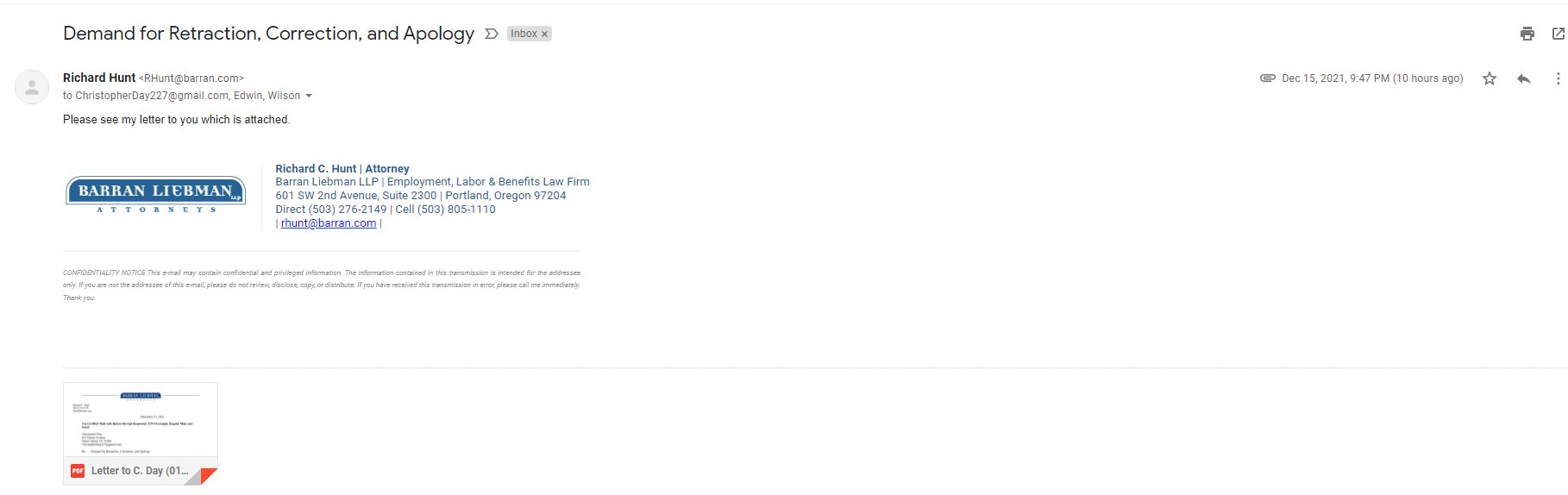
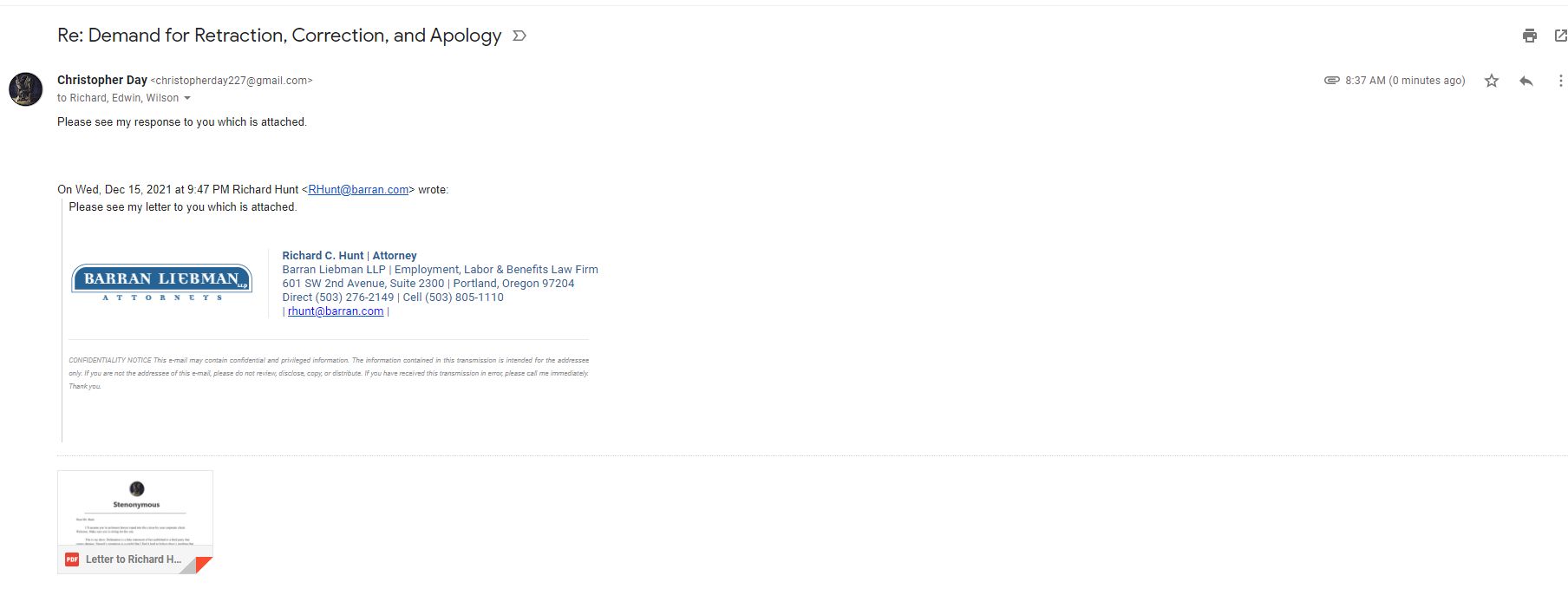
Last night at about 10:00 p.m., I received an e-mail from Richard Hunt of Barran Liebman LLP about Naegeli. It was a fairly standard legal threat, not that I know what those look like, since I’ve never received one before. If you’re short on time, skip their nonsense and read my reply.

The demand letter is available for download here:

Now, I understand that this kind of thing may have a chilling effect on the free speech I have worked so hard to promote in our industry. I must ask all of you not to be afraid, but to turn to your state and federal legislators and law enforcement. Take this opportunity to share with them what is happening. I will lead by example in defense of our collective futures. I will be brave as I am asking all of you to be.

The PDF download and plain text is below.

Dear Mr. Hunt:

I’ll assume you’re an honest lawyer roped into this circus by your corporate client. Welcome. Make sure you’re sitting for this one.

This is my show. Defamation is a false statement of fact published to a third party that causes damage. Naegeli’s reputation is so awful that I find it hard to believe there’s anything that could be said that would damage its reputation further. Some of the statements I make are factual, and truth is an affirmative defense to defamation. Beyond that, some of the statements I make are an opinion based on my expertise as a stenographic court reporter for the last 11 and a half years and creator of what is indisputably the largest blog in my industry. You do not have a cause of action and therefore it would be legally wrong for you to file a complaint against me.

You should peruse my blog. I’ve been reporting corporate corruption against much larger corporations than Naegeli. Veritext and US Legal Support appear to be involved in a plot to rig the court reporting and stenotype services industry against consumers/lawyers. What was done to the healthcare industry as portrayed in the series Dopesick about Purdue Pharma is more or less being done to my industry. The difference here is that what is occurring in my industry is what would have happened if one doctor rallied the others to fight the misleading advertising and dishonest behavior. Conceded that the series is a dramatization of the actual events, of course. I have a moral obligation to stop the lies and dishonesty rampant in my field because of the damage this plot will likely do to my profession, its students, minority speakers, and testimony transcript accuracy. Once the public takes note and begins alerting the DOJ, FBI, and FTC as I have, there is virtually no chance the plot will continue. Naegeli’s gouging was such a minor and unrelated part of that, that in my wildest dreams, I couldn’t have imagined this kind of foolish overreaction and strategic blunder.  Thank you.

My field is beset by silence and fear. I aim to break this. To achieve this I have become a goal-oriented person. You see, now that Naegeli has threatened to sue through an actual law firm, it’s put itself in a much worse position than anyone could have conceived. Now Naegeli has two choices. It can fail to sue me, and show an entire field of nearly 30,000 court reporters that it is a scared barking dog, which will embolden them.  The competition from all of them will become so fierce that it will run the company into the ground. Alternatively, Naegeli could sue. I am quite sure that I can find a valid counterclaim. We can lock each other in for a lawsuit and give this field the show it never knew it needed. It will be the single-largest destruction of capital the industry has ever seen and your client’s reputation will drop even more as court reporters across the nation realize that money could’ve gone into advertising to fix the stenographer shortage. Imagine the backlash. “Yes, I could’ve spent $400 an hour advertising this profession but instead I, Naegeli & Co., have decided the money is better spent stifling Christopher Day’s free speech.”

I know the latter seems like an attractive choice, but it will only expand my audience exponentially and possibly allow me to run daily ads decrying Naegeli’s hatred of free speech and the stenographic free press. I took a personality test recently, and it claimed I was a mediator. Perhaps unsurprisingly, I have come up with a third option. I can use my media personality to completely rehabilitate Naegeli’s reputation. We can sign a contract that Naegeli will use only stenographers and/or voice writers, and will shift their billing model to be the more open and honest “split of invoice” method. I’ll take $100,000 for up to two dozen press releases or media actions in 2022. Together, we will find a way to repair Naegeli’s image in the eyes of the public and court reporters across the nation. We can donate 5% of the contract to NCRF and 5% of the contract to Open Steno to show the field our resolve and unity. 

I have about $1,200 to my name and am about $20,000 in debt. You see, the corporations in my field looted it so much by the time I got here that as a young man, I simply didn’t have a fair shot. I let you know that in order to explain that in the event you sue and somehow manage to bribe a judge and/or jury to see things your way, you will have succeeded in little more than obtaining a piece of paper called a judgment that says “you win, congrats.” Meanwhile, the work I am doing will ensure that not a single stenography grad ever has to suffer like that again. If you believe there is any universe where I will back down, there is an ancient stenographic proverb designed just for you.

TKPWHRUBG.

Stenonymous Promotes Naegeli’s Lawsuit Threat on Twitter — Naegeli Backs Off Threat

On Friday I made a post about how Naegeli charged about $11.50 per page on a copy sale. This is related to an original-copy cost shifting scheme that is common in our field. Within hours of the post, Naegeli gave me an ultimatum to take down the post. If I did not take down the post by 9 PST today, they stated their attorneys would be filing an action against me. So I did what any reasonable person would do and advertised what they did on Twitter.

About 8,000 people saw it.

About 100 people liked it. And I tagged the man responsible for the Young Turks network, Cenk Uygur.

I also wrote the Better Business Bureau since Richard Teraci no longer wants me to contact him directly. Luckily, Richard was dumb enough to respond to BBB, so I learned Naegeli has no intention of suing me.

“I am a coward that threatens news bloggers.” — Richard Teraci, Naegeli USA 11/22/21 (parody)

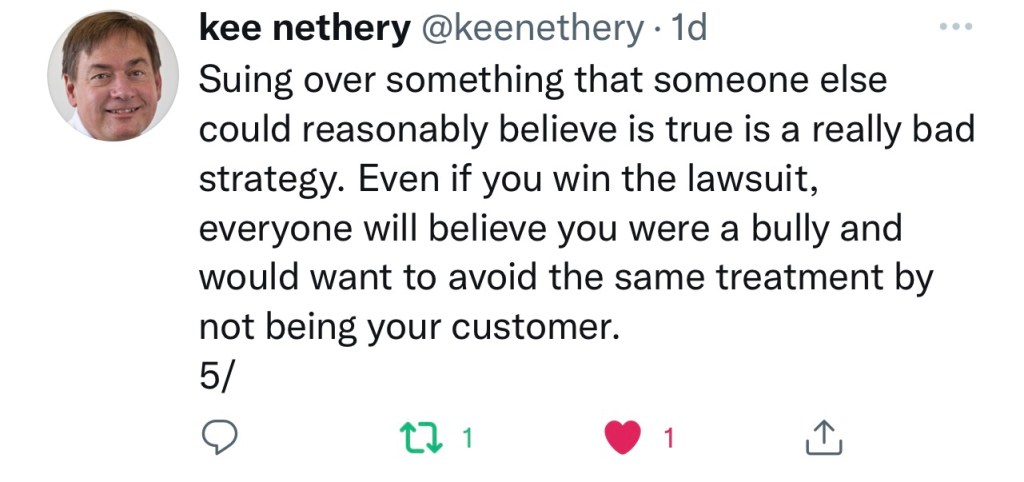
Reporters, you now see for yourselves that bullies will use all at their disposal to shut you down. If you hold firm, the bully will resort to whining. The bully’s power is derived from your self-imposed silence and restraint. The bully’s power is derived from the complicity and complacency of victims and bystanders. If we believe Richard, king of the bullies, he spoke to the other bullies, and they said STAY AWAY because the more people that find out about what is being done to court reporters, the more likely people will put a stop to it.

Don’t believe so? Just see what the general public thinks. See one man’s response to my Twitter question.

Stenographers, you are not alone. If you would take the time to send this article you’ve just read to your local news, it would go a long way to ensuring our message is heard and that the consumers being misled are given a fighting chance. Thank you.

Naegeli Threatens Legal Filing Against Stenonymous

I had a lot of fun writing the Naegeli article. When I was done with it, I let them know it was live.

In my defense, it was 7:30 EST.

Naegeli apparently doesn’t agree with what I’ve written. Richard Teraci told me the company’s attorneys would be filing suit against me if it is not removed by Monday, November 22, 2021 at 9 PST. My response can be read below. I also accidentally BCC’d a number of news organizations and field contacts so that if Naegeli fails to take legal action everyone sees it’s a barking dog with no teeth.

“Can’t wait. Supreme Court, Richmond County, New York State.” — Christopher Day 11/19/21 writing to Naegeli USA.

Unfortunately, Richard didn’t appear to appreciate my response much.

“You are not to contact me ever again. All communication from this point forward will be through our attorneys.” — Richard Teraci, Naegeli USA

Some companies seek to keep court reporters silent. Fear is a tool used to maintain silence. Either the company will fail to sue me and show you all there is nothing to be afraid of, or they will sue, lose, and show you all there is nothing to be afraid of. Either way, reporters across the nation will get to see this for what it is, a baseless attack on our right to free speech. More as this story develops.

If this is the most entertaining thing you’ve read yet today, please consider donating.

PayPal: ChristopherDay227@gmail.com

Venmo: Christopher-Day-141

Zelle: ChristopherDay227@gmail.com or 917 685 3010.