Lawsuit: Court Reporters and the Speech-to-Text Institute Blackballed and Boycotted Me…

Related: Stenonymous Slays Speech-to-Text Institute. A hobbyist blog did more to fight corporate fraud than the FTC in our case.

I’ve been made aware of the lawsuit Pasqual Perez III v the Speech-to-Text Institute, the Texas Court Reporters Association, and a host of other court reporting services. Maybe I didn’t beat STTI, maybe it deleted its site to cover its anticompetitive behavior.

I did ask Pasqual, who I’ve always known as Trey, for comment before I posted this blog. I asked a few others too, but since there’s pending litigation, people understandably didn’t have any comment to make.

“Hi Christopher. For now I will just let the complaints speak for itself. Thanks, Trey.” – Pasqual Perez III

I think the most creative way to approach this is go bit by bit through the lawsuit and share my thoughts as someone who has a good general understanding of the field and has been talking about Speech-to-Text Institute’s anticompetitive behavior for a long time.

Austin Legal Video v Speech-to-Text Institute et al.

Beginning is real simple. It’s an antitrust action. Competitors cannot get together and perform group boycotts to force other competitors out of the market. That’s the basic idea going forward.

They mention this “fend off the attack by the barbarians,” line and attribute it to “the former president of the National Court Reporters Association.” I become confused by this later, because they attribute it to Steve Townsend. I thought he was involved in AAERT and STTI, not NCRA. Now, keep in mind, this is just a complaint. Just like the US Legal lawsuit, it’s just allegations. Let’s keep going.

Blah, blah, blah, boring legal stuff. That’s what this part is. It’s true.

The complaint starts listing the parties and talks a little bit about the field, how some lawyers contract directly with court reporters and some use litigation support firms. Pretty standard stuff.

This continues for a little while.

It names the Texas Court Reporters Association as a party, as you see above. Then it mentions the Speech-to-Text Institute.

Still nothing special. It’s just going through and talking about who the parties are.

This is where it gets kind of interesting and mentions Steve Townsend in the context of NCRA again. I would appreciate it if court reporters with a better memory than mine correct the record, but I really remember Townsend as AAERT and not NCRA. The complaint is basically saying that STTI was meant to keep competition like Trey’s out of the market in favor of the established methods. I actually think there’s some truth to that and sent an email to the plaintiff lawyer, which is included at the bottom for your viewing pleasure.

The complaint gets into a little more about the industry. Still nothing particularly juicy for my audience, who are mostly court reporters that know roughly how this stuff works.

Now, it launches into an allegation that innovative technology is not welcome in the court reporting industry, and I would actually argue that this is true, but with a simple explanation. The digital court reporting side of the equation is obsessed with firm profits. They’ll push digital regardless of who it hurts or how illegal or unethical the behavior might be. The stenographic side is skeptical of technology claims because they’ve been misleading for at least the last half decade. There are studies such as Testifying While Black and Racial Disparities in Automatic Speech Recognition, which point to the inferiority of other methods. Right off the bat, the stenographic defendants are in a much better spot, because they can simply say they weren’t convinced the tech was right for them based on the long history of tech sellers outright lying to people in our field. I’m not saying Trey is a liar. I actually think he’s one of the honest business owners out there. But I am saying that court reporting businesses are right to be wary, and my cursory understanding of law makes me think that might just be a problem for his lawsuit.

This part is mostly about uncertified roughs. I think that’s where plaintiff believed the money would be. It’s a fair allegation.

Then it’s laid out that before being blackballed, comments from a Lexitas production manager seemed to point at his product being accepted.

The allegation is made that Shelly Tucker told him he was being blackballed. Obviously, in the context of an antitrust suit, these would be important statements for the parties, and eventually, a fact finder, to examine. But again, court reporters could just point to the long history of tech claims being deceptive and say that Trey just got lumped in with them in their minds. As far as I know, businesses can all independently come to the conclusion that they don’t want to work with another business. If they can point to doubts they had about the product or things they didn’t like about Trey’s reputation, it might just be enough to explain why they came to that independent conclusion. And Trey does have a bit of a reputation. For example, he was being fairly abrasive in one of my Facebook groups, and I had to ban him. But then later we had a brief discussion, and I remember understanding some of where he was coming from. I guess my point is that this is a mixed bag, and if he got abrasive with business owners, they might just point to that behavior to escape this lawsuit.

This is more of the same. Was it antitrust blackballing? Was it a concerted effort to break competition? Or was it the “tech exhaustion” that court reporters have suffered from for decades? Remember, we’ve had tech sellers telling us our replacement is on the way for decades. At a certain point, you’d just start to paint all tech solutions with the same “prove it or lose it,” attitude conveyed here. It mentions how court reporters got angry over the Stenograph logo change. But to be fair, Stenograph had other problems.

It mentions that court reporters attempted to get regulatory action taken against Pasqual and StoryCloud. The complaint against Trey was dismissed. The writ filed against the JBCC for StoryCloud caused the company to shut down, so in the court of public opinion, we’re pretty sure they were breaking the law. Again, not Trey, StoryCloud.

I’m just going to put this out there, it’s absurd to think that trying to get the government to enforce the law equally is anticompetitive. I understand if this is being given for background, explaining that Trey’s company was not breaking the law, but otherwise, I don’t see the value.

This is where we point the finger at the Texas Court Reporters Association. It’s basically saying “hey look, they were discussing me right before this boycott.” But I think it’s the substance of those discussions that might make or break the case against TCRA. Court reporting associations across the country are very, very cautious when it comes to behavior that might violate the antitrust laws. Some might say overprotective. For example, trade associations can gather and distribute aggregated pricing data, but almost none of them do because they’re afraid of antitrust claims. Reconciling that fact with the idea that TCRA was engaging in conspiratorial or group boycott behavior is going to be one of the paramount goals of the plaintiff.

The complaint talks about the markets this affects. It’s actually really interesting because it breaks down what I would refer to as the court reporting and stenotype services market into certified transcript, uncertified transcript, video recording, and speech-to-text markets.

It keeps going on about the markets. I didn’t see anything particularly important at this part beyond fleshing out the complaint/allegations some more.

This is where the complaint really starts to drive home the damages. Basically boils down to “we were blackballed and boycotted in all these markets and then we lost substantial revenue.” If you follow my work, you know that I consulted with a lawyer as it pertains to the Speech-to-Text Institute’s anticompetitive behavior, and I was told that a successful action needed 1) Monopoly power, 2) Anticompetitive act, 3) Damage. If Trey can show damage, he might really be able to stick it to the Speech-to-Text Institute. Anyone reading this has probably figured out that I have some doubt that the case can be proven against stenographic court reporters. But I think it’s a slam dunk on STTI, the organization that failed to defend itself against fraud claims made by me for like a year and a half and that was, in fact, a group of competitors syndicated behind a shell nonprofit to pump the market with misinformation and manipulate it — the same organization that deleted its website about a month after this lawsuit we’re talking about was filed.

I don’t know about procompetitive, but I do know there are social and political reasons for stenographers to stand up against the speech-to-text stuff. Again, it’s all related to the bogus claims made by tech sellers of the past and the science that I mentioned. That’s not a reflection of Trey’s business, but it is an unfortunate market reality.

More legal jargon and the beginning of the prayer for relief. The complaint is starting to wrap up at this point.

This part mentions that to the extent any procompetitive business objectives exist, such objectives could’ve been achieved by something other than total boycott. I actually agree here. I think the players in the market can invest in a little more science to work out what the best methods are in what circumstances. But this responsibility falls to the bigger fish in the pond, as a lot of the smaller owners simply can’t afford to fund such an endeavor. Coincidentally, many of those bigger fish were backing the Speech-to-Text Institute’s bogus claims and its agenda of market manipulation.

The complaint continues to state the causes of action. For anybody that’s never drafted a complaint before, if your complaint doesn’t allege facts that would support a cause of action, your lawsuit can be dismissed. Federal pleading standards changed after Twombly, so lawyers need to write much better complaints than in years gone by.

Plaintiff demands a jury trial and asks for an injunction, damages, treble damages, attorneys’ fees, and interest.

There it was. His lawyer’s email. I couldn’t help myself. I felt compelled to write to Dov Preminger. So I did.

If more information comes in, I’ll put an addendum right below here or make a new post.

Addendum:

July 2023 Update.

November 2023 Update.

March 2024 Update.

June 2024 Update.

August 2025 Update.

Stenonymous Slays Speech-to-Text Institute!

I attended the Stenograph Town Hall last night, and eventually, I’ll sit down and do a write up, or release a transcript, or some quirky mix of the two. Personally, I really appreciate that the company did what it did. Anir Dutta, Michelle McLaughlin, and Dan Denofsky were really brave. We can be a tough customer base to please. But at the point where a company is holding a public meeting to speak to its customer base, I think it’s safe to say they’re really trying. I applaud it. I may have good or bad comments when I’ve had some time to absorb, reflect, fact check, and get feedback from readers. I know the BlueLedge question really stood out. We’ll see. But they made it look good. If I was a neutral journalist with no background info, I’d eat it up. I know some have commented that their BS meters went off, and I felt some of that too, but I think some of that is inherent to business. It’s about making people feel good about buying from you, whether that’s competing price or relationship.

Anir Dutta said something that rocked my world. He said he was no longer Vice President of the Speech-to-Text Institute. This was surprising to me because I’m on that site frequently and he’s been listed as the vice president every time I’ve checked. So I went and checked. The site was down.

The Speech-to-Text Institute, the propaganda outfit I denounced as a fraud, is dusted from the internet. This blog still stands. It’s thanks to people like you that that happened. But since I’m roleplaying a malignant narcissist, I’m going to take the credit. I couldn’t buy the domain, so it may go back up in the future, but for now, pretty much anyone can point at their materials and say “they were accused of fraud and took their site down.” It’s true!

In all seriousness, we’ve just proven that it’s possible to dismantle fraudulent activity without law enforcement or judicial involvement. Wouldn’t that be an incredible thing for the news to cover? I guess we’ll just have to settle for more important news.

Feel free to celebrate this one with the Mechanics of War track by Xtortion Audio, from the album RAGE. They’re not sponsoring this post, but their music pumps me up enough to slay shell nonprofits used to manipulate markets. Hell March 2 does the same.

I’m pretty sure Stenograph just made court reporting history by distancing itself from the Speech-to-Text Institute and its bogus claim that the stenographer shortage was impossible to solve. Nice move.

I’m still really surprised that the geniuses running the the STTI Bloc companies didn’t just pay me to shut up or write for them. Maybe it just goes to show that as smart as they are, there are costly blind spots. I know it wasn’t the most orthodox job application, but I’m pretty sure I just proved to the world that the pen is mightier than the dollar.

Thanks again to everyone that made this happen.

Addendum:

Stenograph lived up to its promise and released the recorded town hall.

Stenograph Town Hall from May 2023 uploaded by Stenograph.

Court Reporting is Now a Side Hustle

How court reporting companies are getting away with charging top-shelf prices for undervalued work…

The overpriced court reporter page is something that comes up occasionally in legal circles. All through my early career, law firm owners I worked with mentioned how their firms were stuck with expensive court reporter bills. As a young stenographic court reporter, I was paid very little, and later learned that court reporters in my city were about 30 years behind inflation. This set me down a path of skepticism when it came to what court reporters are told about themselves, their industry, and the public’s perception of them. How could lawyers be paying so much when I was making so little and such a large part of the transcript creation was on me?

Years later, as it turned out, some of the largest court reporting companies would get together using a nonprofit called the Speech-to-Text Institute (STTI). That nonprofit would go on to mislead consumers about the stenographer shortage to artificially increase demand for digital court reporting. Tellingly, while a U.S. Legal Support representative had no problem using the word “libel” on one of the female members of my profession, USL and the other multimillion dollar corporations never dared utter a word about my eventual fraud allegations. The companies wanted to trick consumers into believing stenographers were unavailable due to shortage and force digital court reporting on them, where matters are recorded and transcribed.

This set off alarm bells in the world of court reporting. Stenotype manufacturing giant, Stenograph, also represented in STTI’s leadership, shifted from supporting realtime stenographic reporters to shoddy service, and began to call its MAXScribe technology realtime. Realtime, as many attorneys know, is a highly trained subset of court reporting that often comes with a premium. These bait-and-switch tactics on the digital court reporter side of the industry caused a nonprofit called Protect Your Record Project to spring up and begin educating attorneys on what was happening in our field. But as of today, the nonprofit has not reached a level of funding that would allow it to advertise these issues on a national scale — this blog’s in the same boat.

So as more of the workforce is switched to digital reporters / recorders and transcribers, we’re seeing companies use influencers and other media to lure transcribers in for low pay. In short, digital court reporting is now synonymous with side hustle. These companies are going to take the field of skilled reporters that law firms and courts know and love, replace them with transcribers, and go on charging the same money. For the stenographer shortage, these folks were dead silent for the better part of a decade. Now that they need transcribers to replace us, they’re going all out to recruit.

Shopify talks about transcribing as a side hustle.

TranscribeMe, by the way, just entered a partnership with Stenograph.

“What do I care?” That’s what a lot of lawyers and paralegals might be asking at this point. Well, I may not write as well as Alex Su, but I’ll do my best here. First, there are egalitarian concerns. In the Testifying While Black study, stenographers only scored 80% accuracy on the African American Vernacular English dialect. This was widely reported in the media, but what was lost by the media was the reveal of pilot study 1, which showed everyday people only transcribe with an accuracy of about 40% (e226). When we’re talking about replacing court reporters with “side hustle technology,” we’re talking about a potential 50% drop in accuracy and a reduction in court record quality for minority speakers, something courts are largely unaware of. According to the Racial Disparities in Automatic Speech Recognition study, automation isn’t coming to save us either. Voice writing is the best bet for the futurists, and it’s being completely ignored by these big companies.

There are also security concerns. When we’re talking about utilizing transcribers, we’re talking about people that have an economic incentive to sell any private data they might gain from the audio or transcript. If transcription is outsourced, a bribe as low as $600 might be enough to get people acting unethically. Digital court reporting companies have already shown they’re not protective of people’s data — in fact, companies represented in the Speech-to-Text Institute. This also leads to questions about remedies for suspected omissions or tampering. Would you rather subpoena one local stenographer or teams of transcribers, some possibly outside of the jurisdiction?

Finally, there’s an efficiency issue with digital court reporting. Turnaround times can be much slower. Self-reported, it can take up to 6 hours to transcribe 1 hour of audio. By comparison, 1 hour of proceedings can take a qualified stenographer 1 to 2 hours to transcribe. That’s 3 to 6 times faster. Everyone here knows stenographers aren’t perfect and that backlogs happen. Now imagine a world where the backlog is 3 to 6 times what it is today. In one case, a transcript took about two months to deliver. If we’re going to hire teams of transcribers to do the work of one stenographic court reporter, aren’t we going backwards?

This is eerily similar to what went on in medical transcription. Competing interests played games to nobody’s benefit.

Consumers are the ones with the power here. They can demand stenographers, utilize companies that aren’t economically incentivized to lie to them, and spread awareness to other consumers. Consumers, lawyers and court administrators, decide the future. Knowing what you do now, do you want a court reporter or a side hustler at your next deposition or criminal case?

—————————-

Written by Christopher Day, a stenographic court reporter in New York City that has been serving the legal community since 2010. He is also a former board member of the New York State Court Reporters Association and a former volunteer for the National Court Reporters Association STRONG Committee. Day also authors the Stenonymous blog, the industry’s leading independent publication on court reporting media, information, data, analyses, satire, and archiving of current events. He also appeared on VICE with regard to the Testifying While Black study and fiercely advocated for more linguistics training for court reporters in and around New York State.

Donations for the blog will help run advertising for this article and others like it, as well as pay for more journalists and investigators. If you would like to donate, you may use the donation box on the front page of Stenonymous.com, PayPal or Zelle ChristopherDay227@gmail.com, or Venmo @Stenonymous. Growing honest media to combat misconceptions in and about our marketplace is the premier path to a stronger profession and ultimately better service to the legal community.

A posse ad esse.

Addendum:

By sheer coincidence, an article on the side hustle was released the same day as my post. NCRA STRONG’s Lisa Migliore Black and Kim Falgiani really hit it out of the park with this one. Apparently FTR and Rev say they have security in place to prevent sensitive data from being shared. But FTR is known for selling “deficit products,” and Rev is known for its massive security breach. So check out the article by Chelsea Simeon linked above and enjoy!

Fooling Litigation Lawyers and Law Firms is Easy, says Veritext*

After a successful campaign to trick lawyers and law firms into allowing digital court reporting via their deposition notices, the court reporting industry giant Veritext made a statement on Thursday that it would continue its aggressive expansion of digital court reporting. Part-time spokesperson Richard Stubbins said:

“Since nobody opposed us using the Speech-to-Text Institute (STTI) to join with our fellow competitors, spread the lie that the stenographer shortage was impossible to solve, and generally manipulate the market, we’re in good shape. Consumers are too complacent to explore antitrust options against our successful bait and switch of digital court reporting in the place of stenography, and the government agencies that are meant to protect consumers are too underfunded and terrified of our lawyers to do much of anything, so we will now move to the next phase of the operation.”

Asked to expound, the industry behemoth stated that it would continue to work its way into lawyer education and legal spaces in order to continue to frame stenographers as old and outdated, despite the fact that stenography is referred to as the gold standard of court reporting and more efficient than digital court reporting.

“It’s a genius plan, really. Lawyers don’t want to think about what we do and they let us handle everything. We take advantage of that by charging them gold standard prices for substandard service and charging them as much as possible even though they could probably hire any stenographer off NCRA PRO Link for less. We wanted legal professionals to use digital, and they wouldn’t, so we simply pushed the narrative that the stenographers they prefer are unavailable. Bottom line is the only people standing against us are a nonprofit designed to call out misconduct, an idiot with a blog, and a field of women. With those odds, I’d put money on the dishonest corporate machine any day. It’s not like news media are going to report on corporate fraud, they’re reliant on corporate advertisers.”

Critics of the expansion of digital court reporting point to the difficulty of being able to subpoena foreign transcribers in the event of suspected error or tampering. They also believe that the lower paid workers will have an incentive to sell or distribute sensitive or private information that standard court reporters simply do not have.

Stenographic and voice writing proponents point to the importance of having a court reporter that can be called to testify as to the truth and accuracy of stenographic or audio notes. In today’s AI-heavy world, voice cloning and manipulation leaves mere digital recording at severe risk of tampering to produce favorable court outcomes.

“Even though our clients are some of the smartest people on the planet, they haven’t worked out a way to stop us from giving away sweetheart deals to BigLaw and its insurance counterpart while overcharging smaller shops on the copies they’re more or less forced to buy from us. Since there are zero consequences, we don’t intend to stop any time soon. Worst case scenario, we’ll just tell them all the stenographers are making a big deal out of self-interest. Nobody’ll think about our own self-interest as a multimillion dollar company. It’ll be great.”

*This is satire and should not be taken as a factual article. It’s part of Stenonymous Satire Weekends, a project to bring more eyes to corporate fraud in court reporting. As you can imagine, it’s the centralized power of capital versus the decentralized power of 18,000 to 30,000 stenographers. The situation is just a tad asymmetrical and we have to push back in ways that don’t involve spending thousands of dollars, at least until court reporters get so fed up that they “GoFundMe” enough to hire people that’ll hammer on corporate fraudsters full time.

Some would say “don’t step in front of the steamroller,” but I can’t help it, it’s who I am.

To sum it up, a group of court reporting competitors and companies syndicated behind the Speech-to-Text Institute to pump the market with misinformation that the stenographer shortage was impossible to solve and make the case that therefore digital reporting is necessary. Digital proponents talk about the equivalency of steno versus digital, but then they do things like call the workforce not highly trained, presumably to create the illusion that this shift will be cheaper for the consumer. Don’t believe me? Check out this old Verbit infographic.

Infographic by Verbit claiming digital court reporting does not require a highly trained workforce.

I started publishing about these issues in pursuit of the truth. I soon learned that nobody actually cares about the truth; power seizes the day, and it does not mind deceiving people to win.

But the people this impacts are very real. So I’ll continue to use every shred of power I get in pursuit of the truth, no matter what they say about me or threaten me with.

Steno Imperium takes Hatchet to STTI Bloc.

Steno Imperium has a post up about corporate responsibility and the various things that Planet Depos, US Legal Support, Verbit, Veritext and Stenograph have done. In some instances it alleged violations of law and dives heavily into the conduct of Kathy DiLorenzo.

It’s a long read, but provokes a lot of thought. I don’t want to take up your time or detract from the piece by regurgitating everything here, so go check it out!

Stenograph’s Attack on Stenographers in Illinois…

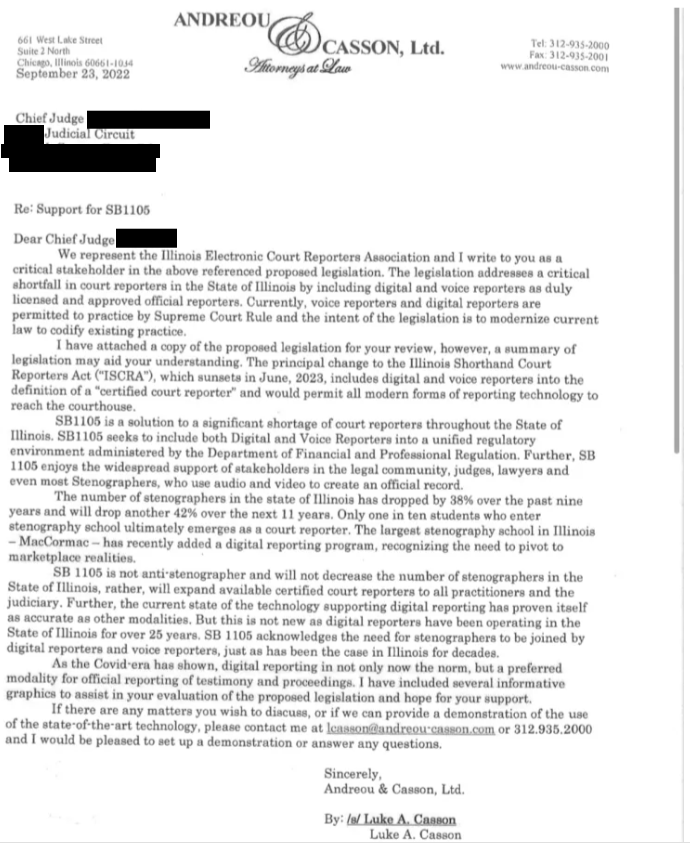
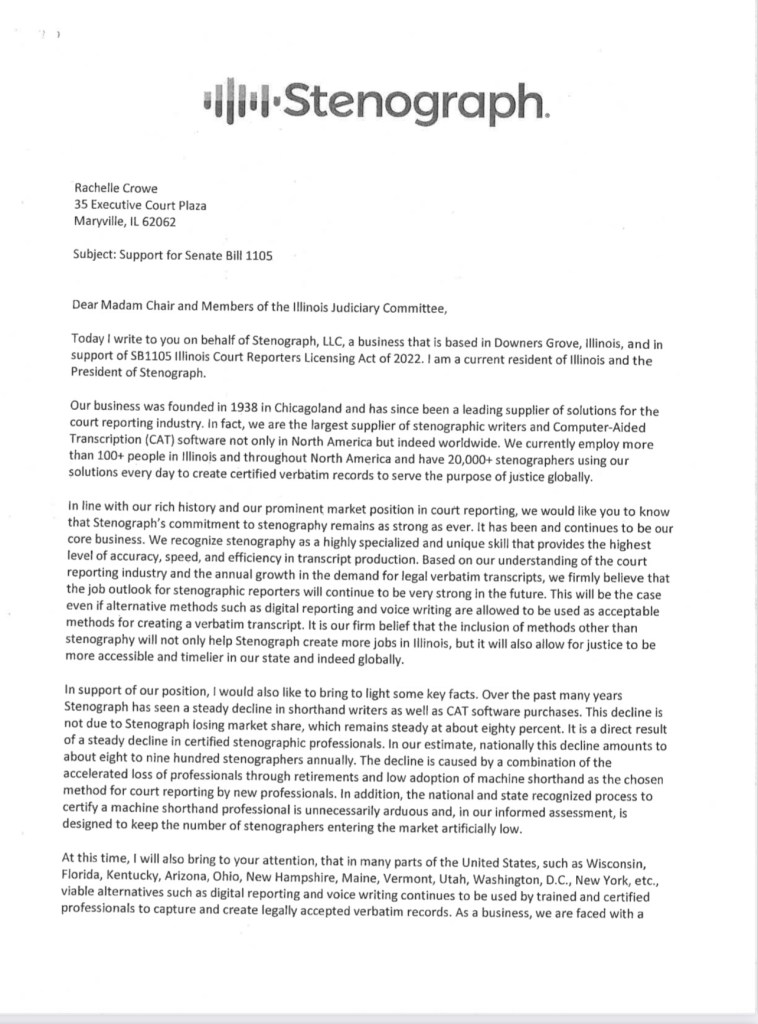
I’ve obtained a letter from Luke Casson of the Illinois Electronic Court Reporters Association and Anir Dutta from Stenograph. Along with these materials came some Speech-to-Text Institute materials.

Speech-to-Text Institute, as we know, is the nonprofit that lied when it said the court reporter shortage was irreversible. It used an outdated report to make its case, and its frontman, Jim Cudahy, left the field after I called him out on his fraud. STTI has several companies represented in its leadership, including The RecordXchange, Stenograph, Trans-Atlantic International Depositions, Planet Depos, Veritext, U.S. Legal Support, Neal R. Gross and Company, vTestify, Verbit, Kentuckiana, Tri-C Community College, RevolutionaryText, and For the Record. When I refer to the STTI Bloc, this is what I’m talking about. They used STTI to pump the market with misinformation, and as you’re about to see, they ride off those lies to push digital court reporting to policy makers and fellow court reporters.

If you look at those links above you’ll see that I’ve been on this since day 1. Court reporters can trust me to fight for them.

On that note, I think the best way to do this is to present each piece and then present my take on it. I’ll try not to nitpick too much and just bring out primary points.

I’ll be really fair here. He’s got a mission and he’s sticking to it, and that’s fair game. But I would say the idea that adding digital to the pool will not decrease the number of stenographer jobs is a lie. There is a total market. More of that market being covered by digital necessitates fewer available stenographic jobs. The idea that digital reporting is the preferred modality is also heavily in dispute. We literally call stenography the gold standard and even ChatGPT knows it.

Lies spread by the Speech-to-Text Institute used to support digital in Illinois

For the STTI materials, it’s 100% certain to exacerbate because the STTI Bloc has used all of its money and influence to grow digital over steno while lying to court reporters and the public. The number of stenographers shrinking in Illinois is pulled straight from Ducker’s “70% will retire before 2033” statement. There is basically zero chance that the report, which is a decade old, reliably predicted the future with 100% accuracy. Fewer than 1 in 10 become court reporters. I’ll concede that we say this a lot, but has anybody run the actual numbers with any consistency, or is it kind of like Ducker where we got some information once and then trusted that forever and ever? I have the same issue with stating the number of stenography students. It completely discounts the self-taught — and I personally know self-taught court reporters. It’s all fluff to suit an agenda. I no longer feel bad about calling it what it is. Nobody from that side of the equation has ever defended their inexcusable antisocial behavior. They simply pretend I don’t exist, because my existence is inconvenient to their agenda.

Stenograph supporting digital in Illinois

Stenograph claims to have 80% market share, and then claims that at least 20,000 use their software. That would put the number of stenographers at at least 25,000. That means Stenograph knows for a fact that STTI was wrong, since there were only supposed to be 23,000 of us as of 2023. Again, the idea that this will add additional jobs is laughable, it will only move market share to digital, which Stenograph has positioned itself to profit from. They also lie about New York, where voice writing is not accepted for civil service positions. Neither is digital. Anir writes well, and I admire his ability to stick to a story. Perhaps seeing this in print will lead people to realize why I was so down on Stenograph as an entity, but not its employees or trainers. As a company, they’re not doing right by us. Everybody else is just caught in the crossfire of that. But the company relies on you being the bigger person and letting it go. “It’s just business,” they say, as they twist the knife just a few more times.

Speech-to-Text Institute Propaganda that the shortage was impossible to solve with stenography only. Stenograph’s admission to 80% market share invalidates this number (2023)
Stenograph ad proclaiming support for stenographers.
Stenonymous remarking that Stenograph is part of the STTI Bloc, a group of corporations that got together to sell digital using misleading arguments and bad statistics.

The math from my last ad report was very clear. Using my current media knowledge, we could probably reach/engage over a million people for about $30,000. I can’t lay that out by myself right now, but it should put into perspective why I keep asking for money. It makes a difference.

Stenonymous advertisement warning consumers that the government is not protecting them when it comes to court reporting.
Stenonymous ad costs $0.04 per engagement, down from $1.00 per engagement on some old projects.

But as always, I leave it in the hands of my colleagues. Do we continue to wait and see what happens, or do we get serious about funding the only industry blog dedicated to purging corruption from the field? Regardless of the choice, reporters can count on me to continue being truthful.

And to give some good entertainment in the process.

Stenonymous poked fun at the STTI Bloc’s persistence with regard to digital court reporting v steno.

More Graphics for the Stenographic Legion

As I went into in another post, pictures get several times more engagement than text pieces. But it’s difficult to cram what’s going on into small bites.

I’m going to try a hybrid approach and run the newspaper image below as an advertisement. Hopefully it will shock consumers into action. If you’d like to contribute to the ad campaign, feel free to use the front page of Stenonymous.com to donate.

Feel free to spread these images if you think there’s somewhere they belong. I’m only one person. I can only post so much. There are like 30,000 of you.

Cartoon commissioned by Stenonymous.com to stop corporate fraud in court reporting by the Speech-to-Text Institute
Cartoon commissioned by Stenonymous.com to warn consumers about digital court reporter training by BlueLedge. DCRs have less career mobility/flexibility.
Satire created by Stenonymous.com to explain the likely outcome of corporate fraud in court reporting, which goes unabated thanks to government’s failure to enforce existing law, including the FTC and New York Attorney General.

How To Stop Corporate Fraud in Court Reporting by Joe Gratton

The following was written by Joe Gratton for the Stenonymous blog, mostly unedited:

There’s currently ongoing and blatant corporate fraud in the court reporting industry. Yet many industry professionals remain unaware and unconcerned about the danger posed by companies deliberately exaggerating the court reporter shortage to espouse the benefits of digital court reporting as if the two services are somehow equivalent.

The companies that have tacitly colluded under the umbrella of the non-profit Speech-to-Text Institute (STTI) are engaging in deceptive practices by spreading misinformation about the cost, quality, and validity of digital court reporting services.

With little to no oversight by courts or government agencies, these companies are getting away with it. However, there are steps stenographers, lawyers, and other affected parties can undertake to ensure justice is served and the court reporting profession is protected from further subversion.  

Background to the Corporate Fraud Currently Occurring in the Court Reporting Profession

It’s worthwhile spending a few moments elucidating the circumstances that have allowed corporate fraud to occur unchecked thus far. 

It’s essential to start by explaining that, yes, there are court reporter shortages within the United States – primarily due to retirement. However, these shortages are minimal and localized. Moreover, these minor shortages are increasingly offset by excellent recruitment initiatives led by National Court Reporters A to Z, Project Steno, Open Steno, and other worthy organizations. 

The companies launching spurious claims that the shortage can’t possibly be filled with more stenographers (and, therefore, should be replaced with the vastly inferior practice of digital court reporting) base their assumptions on the deeply-flawed Ducker Report of 2013-14, which stated that 70% of court reporters would retire over the next 20 years (2013-2033). 

Not only is the report now rapidly approaching ten years since publication (significantly undermining its relevance), but those predictions were based on, wait for it, interviews with 120 industry professionals from in and around the industry. Even with some “proprietary data analysis” thrown in from Ducker, how anyone can profess that there’s currently a potentially industry-ending court reporter shortage based on such flimsy evidence is anyone’s guess.

Worse, when reviewing objective industry data, there are around 27,000 court reporters still active within the profession. How many were there in 2013, the year of the Ducker Report? 21,000. The predicted retirement cliff must be getting taller every day since stenographer numbers are still trending upward ten years later. 

And yet, companies such as Veritext, US Legal, and others have happily used these terribly inaccurate extrapolations to make even worse predictions about stenography’s future. 

For instance, they have gone on the record to claim the industry requires 82,000 stenography training program enrollments annually (based on a 10% graduation rate) to plug the self-proclaimed shortfall. Yet this figure would quadruple the size of the entire court reporter industry today and increase the pool of available court reporters to six times that of 2014, the year the so-called “shortfall crisis” started. 

With wildly incorrect and baseless predictions like these, it’s easy to see why those with only the most tenuous of links to the legal profession are raising eyebrows at how some of these court reporting companies are getting away with blatantly misleading the public for so long. 

Why Corporate Fraud in Court Reporting Continues Today

There’s a pretty obvious reason these companies keep promoting and disseminating their misleading and inaccurate claims: there’s a lot of money to be made.

Stenography is skilled labor and is remunerated as such (some might say underpaid). For someone to type at a rate of 225+ words per minute with an accuracy rate of 99.8% takes years of training and dedication. Stenographic writing is closer to playing the piano than typing on a keyboard. It takes at least two years in a stenography training program, state licensure, and professional certification. 

Digital court reporter training lasts six months, with most of that time spent learning how to take accurate notes and operate sound and video equipment. That’s it. 

In short, these companies want to replace those hard-earned skills with technology so they can charge less for their services and make huge profit margins while doing so. With audio and video equipment in place, digital court reporters merely make sure the equipment is working and note key pieces of testimony.

The companies in question want to mislead the world into thinking that digital court reporting does the same work as traditional court reporting. But once again, the objective facts of the profession paint a different picture.

Automated Speech Recognition (ASR) software delivers a dreadful 25%-80% accuracy rate, and non-stenographers transcribe English dialects such as African American Vernacular English (AAVE) at a rate half as accurate as court reporters. These are merely two of dozens of damning examples showing that digital court reporting cannot replace standard court reporting. 

And yet the two are conflated as one and the same on a daily basis by those that stand to profit most from doing so.  

How they have been allowed to for so long somewhat beggars belief. 

It seems that, thus far, the courts and government agencies tasked with protecting the public from fraudsters and con artists seem unwilling or unable to act.

So can change be instigated? How can those being hurt by these misleading and fraudulent claims take action?

How to Fight Corporate Fraud in Court Reporting 

The simple answer is to fight back. The very tactics companies use to mislead the public can be used against them. They are so brazen and demonstrably false that they are easy to report to the appropriate authorities. 

Report Antitrust, False Advertising, or Deceptive Business Practices to the State Attorney General

Where applicable, it makes sense to refer complaints about deceptive practices and patently false advertising to the relevant state attorney general. Not only will they have a more precise understanding of the misrepresentation at hand (being lawyers themselves) than government agencies such as the Federal Trade Commission (FTC), but state attorney generals have the legal power to act against such companies.

Their purview, among other responsibilities, includes enforcing their given state’s consumer protection laws. Given the flagrant breaches occurring, including false advertising, tacit collusion, and deceptive marketing practices, it would be entirely reasonable to expect that they can take action against these corporate fraudsters if made aware. 

Report Antitrust Violations and False Advertising to Federal Trade Commission

Given the attempts by the STTI to falsely create a market problem and sell the solution (digital court reporting), it’s worth reporting any antitrust or false advertising violations to the FTC.

Not only have they already pledged to protect gig workers from unfair, deceptive, and anticompetitive practices, but they have specifically stated they will also investigate exclusionary or predatory conduct that could cause harm to customers or reduced compensation, or poorer working conditions for gig workers.

Given the practices of these companies harms both customers (by giving the false illusion of equivalency between standard and digital court reporting and deceptively exaggerating the court report shortage) and the 70% of court reporters that work as independent contractors, the FTC should at the very least investigate these practices.  

Sending Information to Local and Corporate News Outlets

Sometimes the only way to draw attention to a problem is to throw a spotlight on it. By writing emails to editors of local newspapers or contacting local TV stations and radio stations, it’s possible to make clients aware of the deceptive practices and have them contact the relevant authorities and regulators to demand action. 

At the very least, it may be that these fraudulent operators have to answer very direct questions regarding their business practices. With the glare of a significant readership or viewership, they may squirm under the pressure and be forced into providing evidence and documentation that doesn’t actually support their statements. 

Contact Local Elected Officials

Another option for stopping corporate fraud on this scale is contacting elected local officials at either state legislature or county levels. 

Not only do they have the power to pass laws that protect consumers from unfair or deceptive trade practices, but they also have a direct line to the government agencies tasked with enforcing those laws, such as the FTC and state attorney general. 

Once again, those with the power to act can’t do so if they are ignorant of the problem in the first place. Only by publicizing these fraudulent practices can lawmakers and regulators be forced to act. 

Court Reporting is Under Attack from Those Standing to Benefit from Its Demise: It’s Time to Act

There’s no question that the court reporter shortage has been leapt upon by companies such as Veritext, US Legal, Planet Depos, and other members of the STTI as an opportunity to cash in on the digital court reporting market.

By replacing incredibly skilled labor with unskilled and automated digital transcription, they persist in attempting to convince law firms, courts, and even government agencies that digital court reporting is a viable replacement. 

The statistics speak for themselves on that front.

However, it’s the hyperbolic claims being made and the outright lies being spread about the court reporting industry in the name of corporate greed that are truly egregious. It’s naked corporate fraud that is only being further enabled by the willful ignorance of many lawmakers and regulators tasked with protecting consumers from unfair and deceptive trade practices.  

Thus, the onus is now on those willing to stand up for justice to take action using some, if not all, of the avenues mentioned above.

Hopefully, with coordinated and concerted action, there can be an end to the rampant corporate fraud taking place within the court reporting and stenography profession.   

Author: Joe Gratton
Bio: Joe Gratton is a professional writer who has worked with a number of legal firms in the United States, covering topics including court reporting, legal videography, electronic discovery (e-Discovery), and trial presentation services. 

Inside Stenonymous’s Strategy

My behavior, to some, may come off as strange. I started the digital court reporter helpline on Facebook. Some people, even my own readers, take issue with the fact that I refer to them as reporters. I’d like to level with people, I know that what I do is different from mainstream stenography. There are ideas and strategies behind many things that I do. I’d like to share some so that people can understand and make their own judgments. I’ll also memorialize some steno history as I see it.

First, on the issue of shortage, I envision possibilities and then document events until I know a probable truth. For example, certainly at the start of my journey, I wrote about shortage and I viewed the shortage as our main problem. As I started to see the Speech-to-Text Institute inundate our side of the field with claims that the shortage was impossible to solve, this belief was replaced, I came to believe that STTI was simply digital court reporter marketing, and that by emphasizing the shortage, they were trying to fool reporters into going digital, fool agencies into using digital, and ultimately fool our associations into embracing the “new” court reporting. It’s called framing. How you frame an issue dramatically changes the response you get. If they framed the shortage as insurmountable, we would come to the conclusion they wanted: You must go digital. To wrap up my thoughts here, I formed two possibilities in my mind. 1) The shortage is impossible to solve. 2) The shortage is possible to solve.

Eventually, after much documentation and research of their claims, I concluded 2 was most likely. I’ll spare everybody the explanation. But that’s where I jumped into a number of activities, writing about digital reporting, the pitfalls, the deception of jobseekers. Here’s the strategy part: This all creates a record. It populates searches with Stenonymous blog posts. It begins to shape digital court reporting’s online presence and frames the issue in the way STTI was doing to all of you. So when people look up digital, they might see it’s a kind of “soft scam” and go elsewhere. This makes the economic cost of filling digital positions higher, and therefore disincentivizes digital use in businesses. Even now, search engines may start pairing digital court reporter with scam just because I wrote them together. So for those of you that want me to call them recorders, this is why I won’t. The people in power now have to live with the toxic title they stole from us.

I also scare off people that have an agenda, but no conviction. I was connected with Jim Cudahy (then STTI), on LinkedIn for a short time. At that time a lot of shortage media was going out, and I realized the man had a connection with an association for journalists. While I can’t prove it, I believe at least some shortage articles were engineered because I have been trying to get an article run on corporate fraud for over a year (on and off) with little success. Why in the world is every journalist DYING to talk about the end of stenographers, a field for which they previously had no interest? It might be big business interfering in our industry media. One analyst, Victoria Hudgins, ignored me when I wrote to her with corrections and kept publishing stuff that put stenographers in a negative light. I finally ran an attack ad on her, and we haven’t heard from her since. I called Jim Cudahy a fraud and he ran away to the Alliance of Crop, Soil, and Environmental Science Societies. Now I’ve been watching Steven Lerner’s articles at Law360. He’s a senior reporter at Law360. I feel his articles put too much emphasis on calling things equal, mostly because the idiot called STTI a stenography association, and he has outright ignored many things I’ve sent him. So quite frankly he may be next. Say what you want about me. In medieval warfare getting the enemy to rout was a win. At the point where its enemies flee, the stenographic legion is winning.

There is also a strategy to being solo. I’m a bit of a loner and you can’t really ostracize a loner. I separated from my volunteer roles in associations. This has many benefits as far as lawsuits against me for my publishing. A potential plaintiff would have to target me as an individual. The amount they could collect is limited because I just don’t have very much. The economic cost of a lawsuit would also be phenomenal for a plaintiff. Imagine for a moment the 400 or so blog posts I’ve made over the years becoming exhibits, the depositions, the interrogatories, the emails, the trial! This is on top of the fact that a lawsuit against me would not be meritorious, and therefore plaintiff would risk losing against a pro se stenographer.

I tried contacting law enforcement, but I don’t have any details on where those reports go. This leaves us in a kind of twilight where we need the media to cover this and ask the hard questions, like “hey, multimillion dollar corporation Veritext, why would you let a respected member of the profession say these things about you without trying to convince him he’s wrong?” Remember, they don’t have to sue, they just have to convince me I’m wrong. They haven’t tried. Because it’s a fraud. I even wrote them a letter. We also need the media to ask government questions, because that would probably get government to act. Until it does, we are a nation of unenforced laws.

Again, possibilities. 1) An event will occur which triggers a viral moment, calling attention to us in a way that changes the trajectory of digital recruitment and definitively ends shortage, such as attracting investors. 2) Such an event will not occur. So what is digital court reporter helpline? An assumption that I will lose. I will assume that court reporters will not increase their funding of Stenonymous over the next decade, that no journalist or lawyer will come to our rescue in a way that makes a difference, and that the number of stenographers falls to the point where we won’t bounce back (unlikely). So then the goal, for me, at least, becomes improving the lives and working conditions of working reporters. That means organizing people. That means communicating with them. That means thinking well outside the box. And if you see the description for the helpline, you’ll see what I mean. Again, as I grow this movement, it will hopefully decrease the steno-digital pay gap, leading to incentivized stenographer use because we are more efficient on average. And if the corporations decide to discontinue their aggressive pursuit of digital before we have a viral moment, so be it. But that’s what the helpline is about, taking control of digital court reporter spaces in a way that associations could never do.

But until I’m fairly sure I’ve lost, I’ll be trying to reach that viral moment. I’ve done this in a lot of different ways, even some ways people wouldn’t think about, like being a little more rude or aggressive. This is because journalists are lazy and about ten thousand times more likely to publish an article about me saying something a little off key than the math showing shortage is exaggerated. Seriously, somebody lie and tell a journalist I made a racial slur and I’ll be in the news tomorrow. But corporate fraud affecting thousands of people isn’t important. In that same vein, I was hoping someone would start media antithetical to mine and start an ideology war with me. Power’s about eyeballs, and nothing would get eyeballs like an open market media war. The most I got was Mary Ann Payonk blocking me and badmouthing me to others.

You see, for years court reporters predictably went in the same direction and were stuck in a kind of “group think.” By injecting the market with a new and growing viewpoint, we create an environment that is uncertain. In a “certain” environment, status quo reigns supreme, and right now the aggressive expansion of digital is the status quo. In an uncertain environment, the largest players have the most to lose and are the slowest to act. By taking our predictability off the table, we can force the largest players on the field to react to us. If your opponent is reacting to you, it means you have a shot at controlling the game.

Some miscellaneous points. As for why I allow uncomfortable conversations in the Stenonymous Facebook group, my business is information. It’s a cop tactic. Let the suspect talk themselves into a corner. Let the people that make us uncomfortable speak, we might learn something or we might not, but we certainly will not if we silence dissent. And learning new information can only help us because we are the more-established workforce.

Before I conclude, I would just like to say I’m imperfect. My execution of things isn’t always great. So I am open to criticism. I don’t discard it when you send it. I do not censor contrary viewpoints. That’s why I’m writing this. Being open minded is also part of my strategy. Evidence will change my views, particularly over time and with reflection. Building truth seeking into my worldview allows me to re-evaluate things and avoid confirmation bias trapping me in an endless loop of “I’m right and you’re wrong.”

I guess the bottom line is my life as a court reporter has taught me that a lot of “bad people” go through life with a simple moral code. “Screw you, stop me.” I’m experimenting with what happens when a “good person” has had enough and takes on the same moral code. What happens when a “good person” is willing to be the “bad guy?”

Stenonymous.

Does Anyone Feel Bad For Stenograph?

Picture this. You are among the leaders of “sten-tech.” Widely acclaimed. Admired in many circles. Supported by hundreds or thousands of stenographers by way of support contracts for the hardware and software you make.

Some of the largest companies in the court reporting industry decide digital is the future. They ostensibly create a shell organization to propagandize the field, claim the stenographer shortage is impossible to solve, and highlight digital reporting as the solution. Anticipating the direction of the market, you join. Unknown whether you joined with or without knowledge of the fraud, but whatever.

Some guy with a blog is writing some stuff about inequality and the shortage stats being misleading. Who really knows? Digital is the future. Ahead to the future!

Ah, but wait, that guy with the blog was onto something and other respectable members of the profession are now starting to say the Ducker Report really isn’t reliable in modern times.

Oh, crap. Well, if people figure out the guy with the blog was right about that, they might start to wonder what else he was right about. They might even realize you’re on the board of the organization that was trying to get rid of them. Time to make a blog about how much you support people!

Stenograph’s message to stenographers in a December 2022 post.

There are a few ways to view Stenograph’s message. You can either see it as the markup is way above 1000% and therefore they were making way more money off of us than a lot of us ever really cared to think about, you can see it as they sacrificed or maybe even took a loss for customers, or you can just assume they’re lying. I won’t tell readers what to believe this time. I honestly don’t know.

I do know that if Stenograph wants to make it right with stenographers, there’s an easy way. Break rank with the companies trying to strangle the market, disavow STTI’s ludicrous claims that the stenographer shortage is impossible to solve, and detach from the STTI Bloc. NCRA Strong left the door wide open. If Stenograph can’t do that, then can it really say that Stenograph remains committed to the future of stenography? It’s literally intermingled with an organization that tried to bury stenography under a wave of shortage media. We may have big hearts and short memories, but anybody that was paying attention 2020 to 2021 is just going to feel insulted or gaslighted.

Stenograph could make history in our field by withdrawing its support from the STTI Bloc and denouncing the lies STTI told about our profession. Not only is it the right thing to do, it’s arguably the smart thing to do. Despite the media blackout, the illegal collusion of big box companies to manipulate a market, and the complete collapse of support from what I thought was our largest manufacturer, we’re winning. With minimal funding and relatively little institutional support, we’re winning. Even though most of us have to advocate in addition to and after our full-time jobs, we’re winning. We know we’re winning because if our numbers were so catastrophic that we could not bounce back, Stenograph wouldn’t spend any time trying to appease or impress stenographers. If Stenograph was suckered in by the bad stats and misinformation, a lot of us were, stenographers will forgive it. If it continues to dance around the issues and pretend we are stupid, don’t feel too bad about what happens next.