US Legal Rep: Does It Really Matter If Done Legally and Ethically…?

Lawyers, court administrators, and support staff, there is a real struggle taking place in the United States court reporting industry today. For the last eight years, we have known that there would be a stenographic court reporter shortage. We knew because our national association commissioned the 2013-2014 Court Reporting Industry Outlook by Ducker Worldwide, colloquially known as our Ducker Report. In response to that, many initiatives to recruit stenographers were born including National Court Reporters Association A to Z program, Project Steno, and Open Steno. As of today, there are far more schools for stenographic reporting in the United States than there are for transcribers. If we base our count on NCRA-approved schools against AAERT approved schools, the ratio is about 5:1. Stenographic court reporters are by far better equipped to handle the shortage. But there is a lie being sold about us, our shortage is being exaggerated and exacerbated by companies that stand to profit from it.

In our industry there are stenographic court reporters, voice writers, and digital court reporters. Stenography’s all about taking down verbatim notes on a stenotype. Voice writing is all about speaking into an automatic speech recognition (ASR) system tuned to the reporter’s voice. Digital reporting sees the reporter record the audio, which is then distributed to transcribers. About two years ago a nonprofit called STTI popped onto the field and started spreading the lie that the stenographer shortage would be nearly impossible to solve, citing the Ducker Report and “industry experts” that believed they could predict what the field would look like 20 years from now. They claimed they wanted to be an authority in all speech-to-text modalities but it’s fairly obvious to anyone paying attention that it’s an attack on consumer choice. Ducker could not have been clearer that market preference was stenography:

Court Reporting Industry Outlook 2013-2014, Ducker Worldwide. Page 6.

The conclusions STTI drew were so wrong it appears intentional. Jim Cudahy was the Executive Director of NCRA when the Ducker Report was made, and yet so many years later ended up in the STTI camp using his NCRA experience to help lend credibility to the false idea that our shortage was impossible to solve. An opportunist, he saw a chance to lead the charge into an “emerging” market and he took it, business 101. Large corporations in my field started to push the same lie, likely due to financial pressure. Veritext started trying to train lawyers to allow for digital reporting in their deposition notices, Planet Depos started to build the digital side of its business. Verbit flip flopped between telling investors there was 99% accuracy and that technology would not replace the human. The race was on to legitimize digital reporting in your minds as consumers. This is being done despite some evidence that it would put already-marginalized groups of speakers at risk and the fact that it is less efficient. Utilizing digital reporting would take the production of the transcript offshore, out of range of your subpoena power, and make it much easier for tampering to occur.

If any other field has a shortage, sellers jack up prices. In ours, despite the fact that we are behind inflation in some markets, some of our biggest sellers were now pushing for our replacement. They were telling consumers no stenographer was available, but they weren’t using any of our numerous Facebook groups, LinkedIn, or our national database of stenographers to recruit us. This lie did not go completely unchallenged. Nonprofits like Protect Your Record organized to get the word out, but they were up against corporations that, according to Owler, control a combined revenue amount of over half a billion dollars. Our field, comprised of 88% women, was being bamboozled and blitzed by the message that companies were only going digital out of need. “Of course stenographers are the gold standard, there just are not enough of them.” It was a game of messaging and perception that we were losing.

I had identified a pattern of “shifting narratives” and I used my love of reading and writing to document what I could so that the truth would not be lost. It was through this documentation that the New York State Court Reporters Association, Association of Surrogate’s and Supreme Court Reporters, and many other unions were able to give the New York State Unified Court System a warning on the dangers of automating trial transcription. This work was having a real impact and giving us the power to communicate our importance to the legal field in more concrete terms. Some of my work even got republished by NCRA in industry media and social media. I became a part of changing the false messaging and misconceptions killing my profession.

While court reporters on social media were debating whether companies were utilizing digital court reporters, I was documenting as much as I could and trying to urge my colleagues to push back. My attention was raised to US Legal Support building its digital business and how, in the Holly Moose v US Legal Case, despite 70% of its business coming from court reporters, it claimed it was not organized as a shorthand reporting firm and therefore should be immune to regulations meant to protect consumers in California. Moose lost the case from a failure to prove the injury element, but we now had valuable information, the company was willing to do and say anything to benefit itself. Sounds like a bold claim, but let’s be real, they don’t advertise themselves as “not a shorthand reporting firm.”
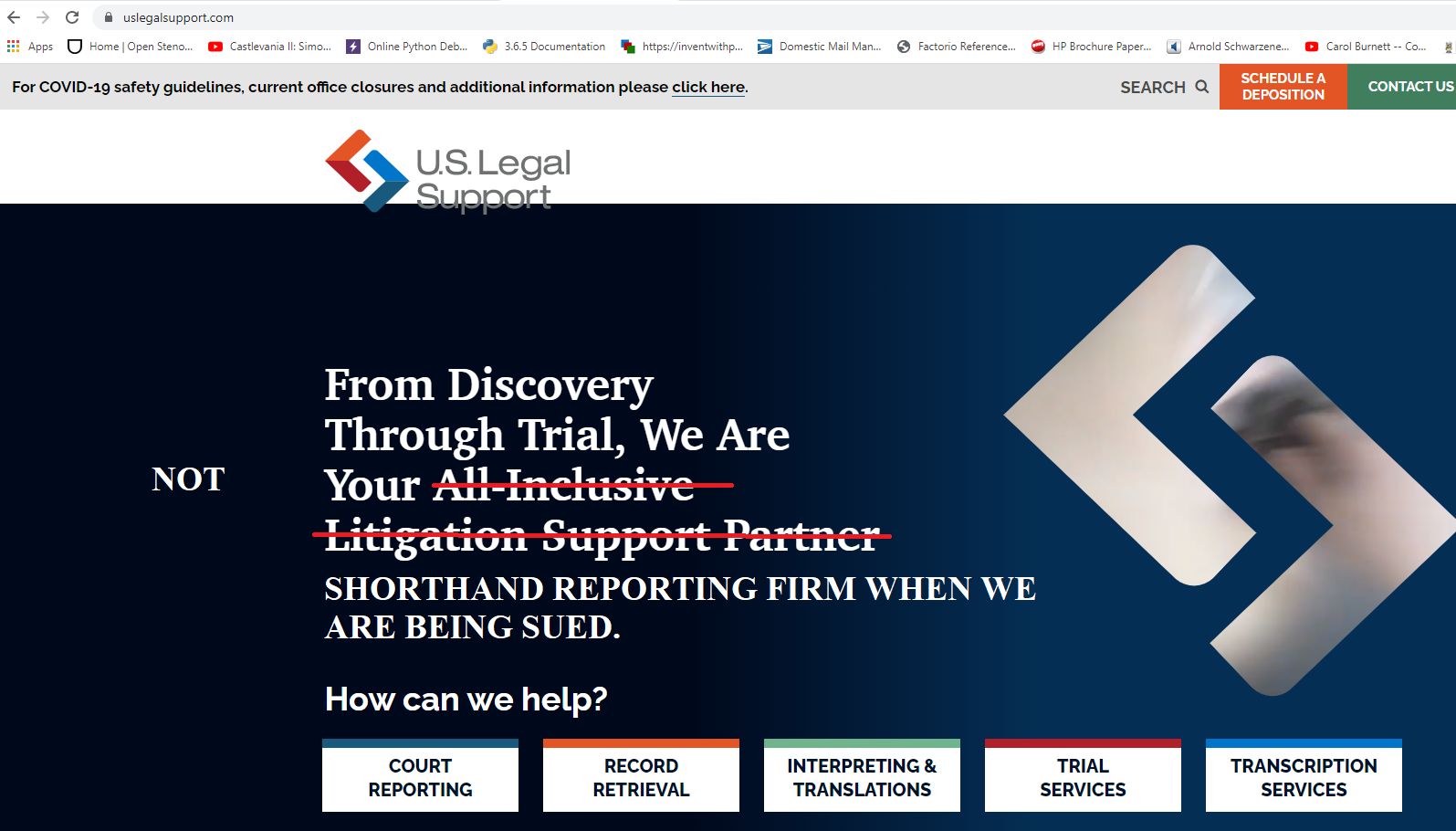
Remember, we were 70% of their business as of the Holly Moose case.

While outwardly professing that it wanted stenographers, it was doing everything in its power to sabotage us. Stenotrain was acquired by US Legal and apparently mismanaged into oblivion. US Legal was aggressively recruiting digital court reporters on LinkedIn as recently as May 2021, but no such effort was made to get stenographers. In July 2021, a JD Supra article was put up by the company that claimed the stenographer shortage would be nearly impossible to solve and set up an equation to give it the appearance of credibility. Their numbers were extrapolated from an eight year old report and likely outdated, but even assuming those numbers to be true, the equation, if reiterated in perpetuity, would lead to negative stenographers, which is logically impossible if you’re getting 200 new stenographers a year. The equation assumed the retirements would always be constant and did not acknowledge any of the recruitment efforts at the top of this page. I realized there was a major inaccuracy, and I started to spread the word that we could not rely on these large corporations to be honest with us or our clients.

Reality is simple: Move some numbers around and anything sounds good. But did that make it true? No.

A real breakthrough came when I got a US Legal rep to admit they had not been using NCRA PRO Link / Sourcebook, our national directory of stenographers, to recruit us. How could they dare make a claim that stenographers were not available when they were not utilizing a database consisting of roughly one third of the field? Worse than that, prior to publishing my September 9 article, court reporters reported not being contacted by larger firms. The best we had was a vague promise from Rick Levy that US Legal would look into whether it was “viable” to use the directory to recruit stenographers. After I publicly cried foul, they started to use the directory to recruit stenographers that same day! When it became clear I was going public with these allegations, they went from “looking into it” to attempting to cover up the fraud they had perpetrated on the legal community.

You have to ask yourself why a stenographer living paycheck to paycheck could figure out that the best way to recruit stenographers was to utilize free national resources and the $100 million corporation could not.

There was a part of the puzzle I had and held close to the chest. I had been given emails from the NCRA Firmowners listserv from May 2021 where representatives from US Legal got into a “debate” with a group of court reporters. In my assessment the discussion was rife with obfuscations, distractions, and gaslighting. But their Chief Strategy Officer at the time, Peter Giammanco, gave us a window into what’s going on.

Does it matter if it’s legal? Man’s on a mission.

In a wall of text designed to cast doubt in everyone reading, he writes “Does it really matter if done legally and ethically and both methods end with the same final accurate transcript?” This is an example of the straw man argument. Given that court reporters are twice as good as your average person at taking down dialects like African American Vernacular English (AAVE) even though we have no formal training in it, there is no reason to believe that anyone else will have the same final accurate transcript. These companies won’t tell you that people like Allison Hall are successfully cutting the training time of some stenographers in half or that our recruitment efforts have exploded in the last eight years, they’ll just keep repeating their narrative, and as I just showed you, they do not care if it is legal or ethical. They do not care what is true. The positions they hold are not based on merit or honest debate, they are based on a mission or agenda. This comports with anecdotes I’ve received. Here in New York an acquaintance expressed her desire to leave our field, and US Legal offered her work as a digital court reporter. Meanwhile, these companies are not telling digital reporters that stenographic reporting is an option. Concurrently, companies are telling everyone that stenography is the gold standard and there just aren’t enough of us. Given that it would take as many as eight transcribers to replace a single stenographer, one has to wonder why there was no attempt to encourage digital court reporters to join the gold standard of stenography. It’s a lie so blatant and disgusting that I regularly try reaching out to digital court reporters to let them know what’s coming.

Most of the email images are available for download here. I’d just like to point out from those emails that when dealing with the women of my profession, including the very president of our association, C. Phipps, both men were happy to go on and on bashing NCRA’s organizational approach and falsely accuse L. Freiler of libel. It’s quite telling that when I reached out, there was dead silence.

I publish the emails because this is a matter of public importance. This mission that has been admitted to, to replace stenographers with recorders, will threaten access to justice. It is also almost certainly consumer fraud. What else do you call a concerted effort to make it seem as though stenographers are not available when there has been such an abject failure to attempt to recruit any of them in addition to the incredible mistreatment of the workforce? They rely on our consumers being too busy to pay attention to the situation. Asked for comment by me via email on August 12th, Peter didn’t respond, and US Legal asked me to take them off their mailing list. They’re confident you’re not reading my work or that you will throw your hands up and say “not my problem.” They are counting on you being complicit in the suffering and struggle of our young reporters.

How did we get here? Our field is one of mostly independent contractors. Many of us meet the definition of common law employees, but there’s basically no government enforcement there and so any misclassification claims are handled on a case-by-case basis if they’re raised by the court reporter. The only one I ever read about was settled. As independent contractors, we can be considered competitors with these large firms, and therefore the institutions meant to advocate for us have their hands tied. Our court reporter associations cannot call any one company a liar, lest they be accused of group boycott. They do not allow discussion of rates, lest they be accused of anticompetitive behavior. Thrust into a field where large corporations may assert any false claim without being checked, federally-protected discussions of pay are categorically banned, and almost none of us have the legal knowledge to navigate the nuances of employment law, the stenographic reporter has a whole lot stacked against her. We are a field that largely has none of the employee protections written into law. And we have seen as a society just what corporate culture does to women who have those protections. The stenographic reporter? She prevails despite that.

I may not be a woman, but for a decade I have watched my colleagues recount mistreatment and abuse. I will not stand for it longer. If society is seeking a gender pay gap, it need not look further than this situation we find ourselves in. When our field was male dominated, it rose to such prominence and importance that it has a nonprofit in almost every state dedicated to it. As the field transitioned to majority women, rates were frozen. Adjusted for inflation, the average American worker’s pay rose about 58 cents over the last decade. Adjusted for inflation, the stenographic reporter’s pay fell over the last 30 years, in some cases, by nearly 50%. Corporations have court reporters and captioners working much harder today for far less value than 30 or 40 years ago, have made no genuine effort to fix the shortage situation, and then they have the nerve to tell courts and attorneys we aren’t available. It’s like lighting somebody’s house on fire while they’re sleeping, throwing a few droplets of water on it, and telling the firemen you did your best and there’s nobody in the house to rescue.

We need your help. We need you to take a brief but intense interest in our little field of about 30,000 so that we can continue to serve you and the public. Talk to each other about the court reporting service you’re using, talk to your court reporter, start comparing prices. There is a kind of gambling or cost shifting built into our pricing structure that makes it confusing, but ultimately consumers have the power here. You are some of the most educated people on the planet. Whether by legislation or choice, you can make a profound difference in our future. Pass this up to your bosses. Ask them to read it. Ask them whether these are the kinds of businesses we want to entrust the creation of the legal record to. If you’ve been told a stenographic reporter is not available, consider asking some more questions, because there’s a big chance you’re being lied to. Considering investing in stenographic schools or companies. Consider using PRO Link to find a reporter yourself. And of course consider introducing the recruitment resources at the top of this post to someone in your life. We need stenographic court reporters, and all indications are that we will for a long, long time. For my part in it, I will answer any questions I can at ChristopherDay227@gmail.com.

As in the Columbus Bar Lawyers Quarterly, Spring 2020, Caveat Emptor!

To My Usual Readers:

Court reporters, I stand on the backs of all of you at this point. Without your hard work I wouldn’t have been in a position to publish this story. But if we don’t get it in front of people, this is for nothing. I have made about $400 in donations these past two weeks and I will sacrifice every dime of it to boost this post. If you can afford a donation, please send $20. If you cannot, please consider sending this to lawyers and/or tagging a local bar association on the Facebook and Twitter campaign. They cannot be expected to be experts in our industry. We must guide them. Every state is important, but California, Texas, Illinois, and New York are where the majority of our business is, and where the shortage lies can hurt us most. This is not new. This is something we felt in 2019 and now have much more concrete evidence of.

It’s now clear our institutions are not equipped to handle liars, and it is therefore vital for us to seek out allies among the legal community who will see this for what it is, an attack on their choice as consumers; an attack on their clients’ access to justice; and an attack on a field of women and introverts where it was assumed nobody would have the guts to say anything because nobody has bothered to say anything for at least three decades.

I understand why freelancers are hesitant to speak up against companies. They sign your paychecks. The often unsung threat of them withholding work from you leaves you feeling powerless. But if we want a field that has integrity, then we must act now and sound the alarm so that these levels of dishonesty are never seen again. Court reporting firms need to be at least as terrified of dishonesty as we are of speaking against it. I resigned from my board position and asked you to trust me. Trust that action will spare future generations of reporters from sitting silent as their quality of life is eroded year after year. We have to break the silence on the silent problem facing our nation’s courtrooms and spend just a little energy on writing our own collective story.

The Layperson’s Guide To Why Stenographic Reporting Is More Efficient Than Digital Reporting & ASR

Simply put, stenographers have integrated digital recording into their own technology. The option to record and transcribe has been around for 30 to 50 years depending on whether you want to start the clock at digital or analog. We stenographers have not been supplanted, which is an easy argument for our superiority as a modality.

Our detractors scoff and say that has to do with our political power. That’s a lie. We have very little political power. Most of our money seems to flow to our continuing education requirements and not lobbying. Our associations only recently sprang into action when we realized consumers were in danger. Even then, the associations routinely hamstring things that might make associations “too strong,” like abolishing term limits for effective association presidents.

Available data also shows that automatic speech recognition is 25 to 80% accurate and not the 99.999% sold to some people by dishonest companies.

Digital’s not cheaper. It allows the offshoring of very valuable private data to poor people who will have an incentive to sell it. It’s more taxing on the transcribers’ hands. How? It takes over 20 keystrokes to type “beyond a reasonable doubt” on a QWERTY. Steno does that in one.

Digital court reporting companies, groups, and associations talk a good game. This is because investors are burning money on them in the misguided belief that they’ll be first in on a new market. The reality is the modality has been around decades and fails to deliver. Just look at VIQ Solutions and its 2021 loss of over $13 million. Personally, I can’t wait until investors realize that these companies know this and took their money anyway.

For all the people who wonder how positive cash flow with negative income happens, check this out.

In brief, digital reporting and its derivatives such as “active reporting” or “AI-assisted reporting” are not cheaper. They aren’t a good investment. All available data says progress on automation has been mostly stalled for 20 years except where the automated program is configured to a speaker and their microphone. Unless we are going to force every litigant and defendant to train ASR for how they personally speak, we are going to need people to do this job. Since a stenographer is anywhere from 2 to 8 times faster than a transcriber, it makes good sense to invest in the expansion of stenotype services.

Also, generally, stenographers don’t support worker exploitation.

Of course, what do I know? I’m “just” a stenographer.

What Is Realtime Voice Writing and Why Is It Better Than Digital Reporting?

In our field there are three main modalities for taking the record or captioning. There is stenography, voice writing, and digital recording. Stenography is using a chorded stenotype and computer dictionary to instantaneously take down and transcribe the spoken word. Digital recording is all about letting a microphone pick up the audio and having somebody transcribe it after the fact. Sometimes digital recording proponents insist that they can run the audio through automatic speech recognition (ASR) systems to “assist the transcriber.” I’ve been pretty open about my feelings there.

Transcribers and digital reporters can do better switching to steno.

There are also nonprofits representing each modality. NCRA is all-in for steno. NVRA admits stenographers, but in my mind is really more for voice writers, and rightfully so. AAERT is pro-recording. ATSP is pro-transcriber to the extent it has any court reporting industry presence. There are others like Global Alliance or STTI that claim to be for all three modalities, but I’ve always gotten a “jack of all trades, master of none” vibe from those types of associations.

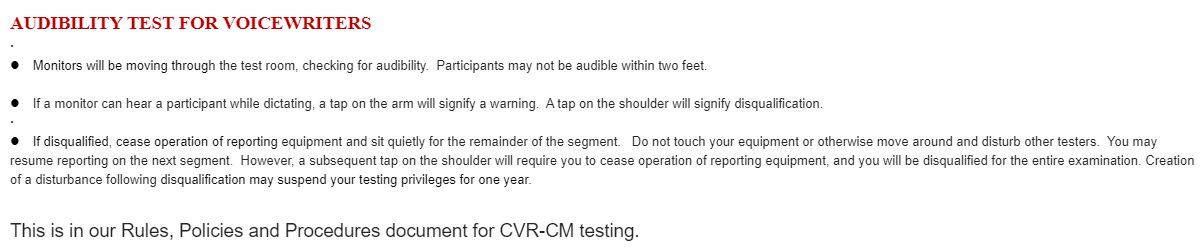
From information available to me, I believe that NCRA is by far the largest organization and in the best position to handle the court reporter shortage, but NVRA does provide an incredibly important role in certifying voice writers. One common problem in the early years of voice writing, which some New York attorneys still hold against them, was that occasionally they could be heard through the mask. Even now, when there is a lot of sibilance, one can infrequently hear a voice writer through the mask. Modern certification requires that the voice writer is able to perform without being heard, and a two-strike policy is employed in which the first time a writer is heard during a test they are tapped on the shoulder. The second time they are heard, they are disqualified. Voice writing tests, like ours, give the voice writer one shot at getting their “voice notes” correct. They are not allowed to repeat or review the test audio. This kind of testing is important and represents the quality standards this industry needs. NVRA confirmed its testing policy in an 8/11/21 e-mail to me.

No audibility within two feet.

Most reporters know that voice writing is, at its core, speaking into a Stenomask or other voice mask and allowing automatic speech recognition to assist in the transcription of what’s said. In some settings, a voice writer may use an open mic. Some stenographic reporters may be surprised to learn that realtime voice writing is superior to digital reporting and general ASR use. In general ASR use, the microphone takes input from everyone and the computer system gives its best guess based on the training data it has. In a study from last year, it was shown that that technology’s accuracy could drop as low as 25% dependent on who is speaking. Realtime voice writing, by comparison, is a trained operator, the voice writer, often speaking into a closed microphone, and utilizing ASR that has been trained to that writer’s voice. In the best of circumstances, that ASR can reliably put out highly accurate transcriptions of the voice writer’s voice — as high as 98%. Many realtime voice writers utilize Dragon by Nuance connected to their preferred CAT software. I guesstimate that Nuance has the best ASR tech, and there’s no coincidence that despite all the other ASR vendors out there, Nuance is the one Microsoft wanted to buy. This lead in technology comes from the system being trained to understand the specific user or voice writer.

One important distinction is the difference between realtime voice writers and voice writers that speak into the mask and have someone else transcribe and do the work. This is very similar to the divide in stenographic reporting where some scopists report having to fill in huge chunks of information missed by the court reporter. A realtime voice writer, like a realtime stenographer, does not have to provide realtime services, but they do maintain the equipment and capability to do so.

The knowledge and preparedness of the voice writer is integral to the integrity of the record produced. Think of all the glitches and anomalies in stenographic CAT software. Think about how reporters create macros and dictionary workarounds every day to deal with them. As an easy example, my software does not like certain punctuation marks to be together. Early in my career, I worked out that placing a backslash between the two marks and then deleting it would override the software’s programming to delete punctuation. Similarly, voice writers have to deal with the complexities of the ASR system, the CAT software, and how they interact in order to overcome word boundary and formatting issues.

The understanding and maintenance of a voice writer’s equipment is also paramount. How the computer “hears” a writer’s voice in one microphone can be vastly different than another microphone. Different masks can be given different training configurations to enhance the ASR transcription. Voice writers are speaking into a mask, and where saliva or liquid gets into the mask it can alter what the computer hears. The competent voice writer monitors their realtime and keeps redundant equipment in case of an equipment failure, including extra masks and multiple audio backups of their “voice notes.” As someone who keeps two stenotypes in case one decides to die mid-trial, I admire the voice writers that take the time to ensure the show goes on in the event of computer problems.

Like us, there are many briefs or triggers voice writers use. The key difference is that they must speak the “steno.” The same way we must come up with a stroke for designating a speaker, they must come up with a voice command. The same way that stenographers must differentiate the word “period” from the punctuation symbol of a period, voice writers historically had to create differentiations. For example, in years gone by, they might have had to say “peerk” for the symbol and “period” for the word. Modern ASR systems are sometimes able to differentiate the word versus the mark without any special command or input from the voice writer! Again, the experience and ability to predict how the software will interpret what is said is an important skill for the realtime voice writer.

The obvious question arises as to why this blog tends to be silent on voice writing. There’s no overt hostility there and deep admiration for the people at the top of the voice writing modality of record taking. Simply put, I truly believe that stenographic reporting is better and will open more doors for students. That’s colored by my own experiences. As of today, voice writers are not allowed to work in my court and be in my civil service title. We can argue about whether they should be allowed, but the simple fact is that New York courts today tend to utilize stenographic reporting or digital recording. It’s easy to see that the qualified voice writer is a far better choice than the digital recording, but I couldn’t say to a student “get into voice writing! You’ll have the same opportunities as I do!”

I also have to present a warning to voice writers and stenographers. I have seen many of us fall into the mindset of “the enemy of my enemy is my friend.” We are much closer to each other than either modality is to digital reporting for the simple reason that we like our jobs. Digital reporting proponents have made little effort to hide that their ultimate goal is to offshore the jobs to Manila, Kenya, India, or wherever they can. Digital reporting proponents want to pay stenographers and voice writers less than half of what they’re worth. Digital reporting proponents don’t even respect their own digital reporters, which is why I’ve suggested those people join the stenographic legion.

There is a tumultuous history between stenographic court reporters and voice writers. I’ve been told by multiple NCRA members that when an effort was made to include voice writers about two decades ago, there was heavy backlash and even some harassment that occurred against those that were pro-integration. That was the climate of yesterday. While it seems unlikely that there will be formal alliance, inclusion, or cooperation, the separation we see today is not the same violent rejection of voice writers from the early 2000s. The civility of NCRA’s 2021 business meeting showed that court reporters are ready to disagree without belligerence and keep our industry moving forward. This is more akin to why the North American Olive Oil Association probably doesn’t partner much with the Global Organization for EPA and DHA Omega-3s. Olive oil and fish oil are both fine oils, but every second and cent spent advocating for one could be spent advocating for the other. It doesn’t make much sense to divide the time and resources. That’s where we are today. What the future holds for tomorrow, I can only imagine.

A big thank you to everyone that made this article possible, up to and including the NVRA. One source of my information was the esteemed Tori Pittman. Trained in both stenography and voice writing, Tori gave me a full demonstration of voice writing and agreed to speak at length about voice writing. See the full interview below!

Drillmaker for Students/Educators

A student recently explained to me that they had to create a drill for set of briefs they wanted to learn. In my view, the best way to do this would be creating a repetitive dictation of the brief(s) a person wants to drill, marking that for dictation, and then practicing at some kind of speed. I know minimal computer coding, and have made tools to try to help students and educators cut down on busywork in the past, but because my coding knowledge is so limited, I’ve never quite mastered it enough to make it easy for people, and consequently, the tools I’ve designed go underused.

I plan to continue to do research and make a real effort to make these tools accessible, but in the meantime, I have a workaround that anyone can do from their computer in five easy steps.

Step 1:
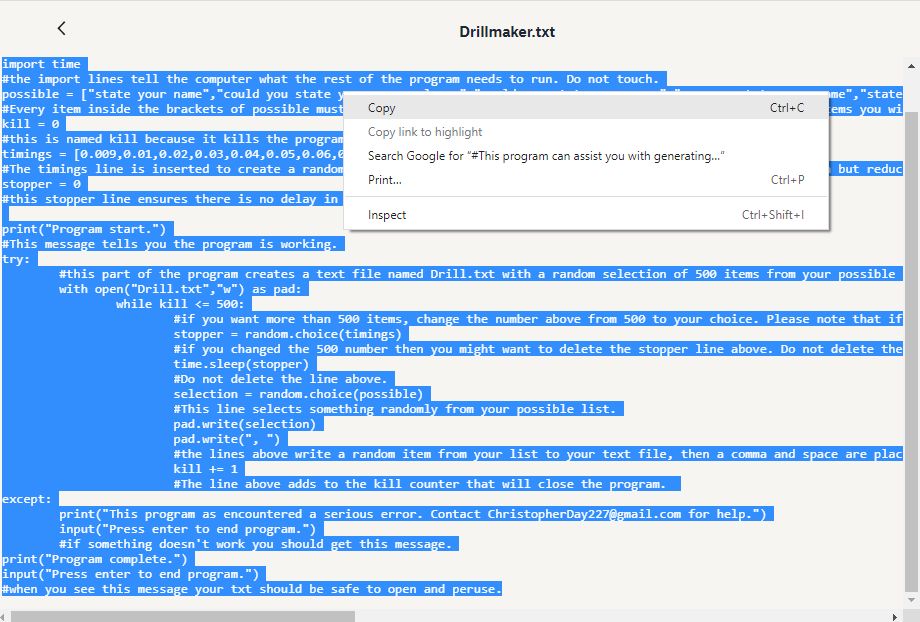
Get the code. Go to my Dropbox, highlight the code text, right click it, and copy it. You can also use CTRL+C when things are highlighted to copy them. Don’t waste your time reading this image, it’s just demonstrative.

Copy it because I’m about to ask you to paste it.

Step 2:
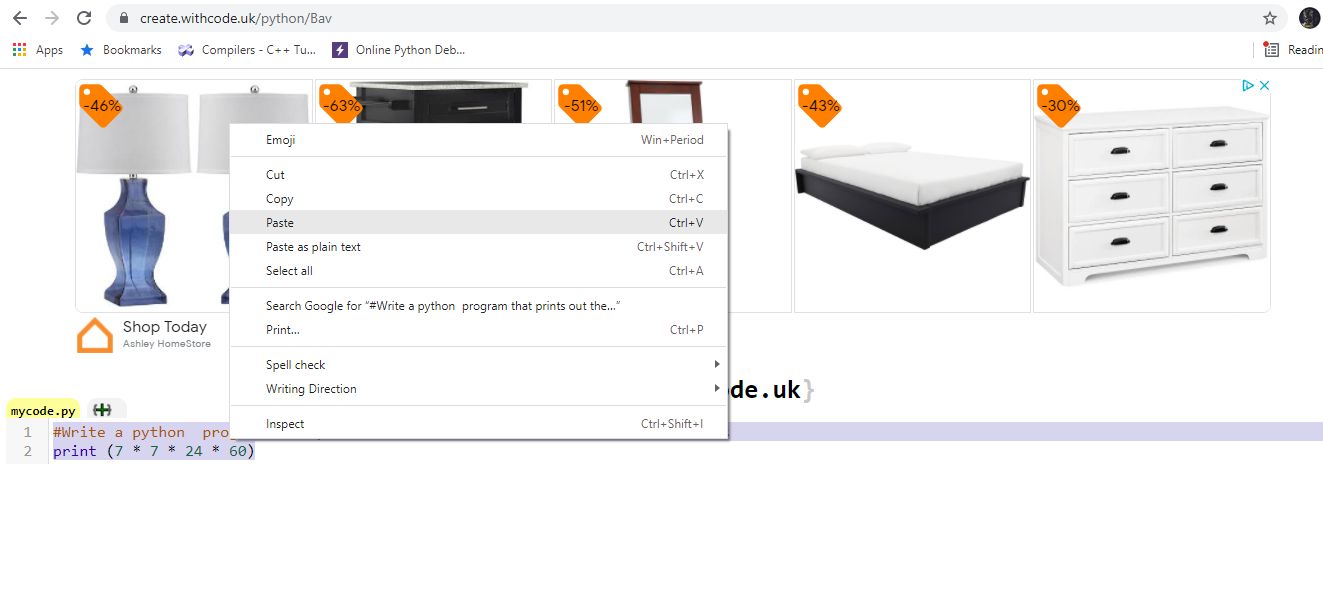
Paste the code into this person’s website. Note that when you open the site, they have some code there already. Just paste right over that or even delete it.

I am about to paste right over that code.

Step 3:
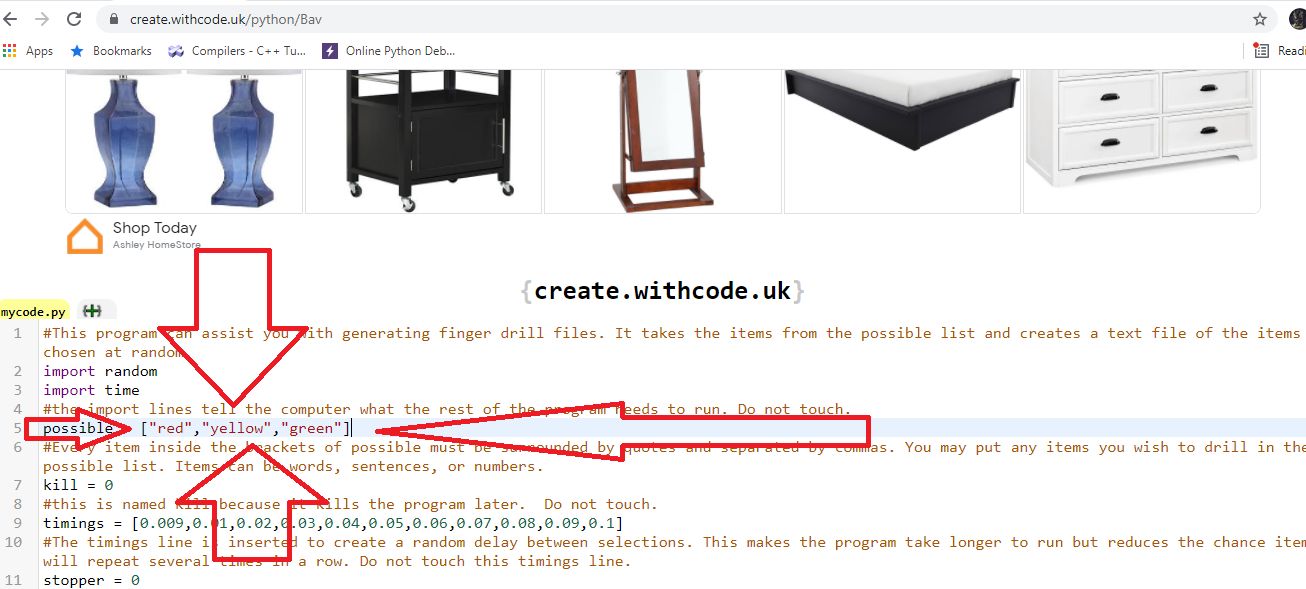
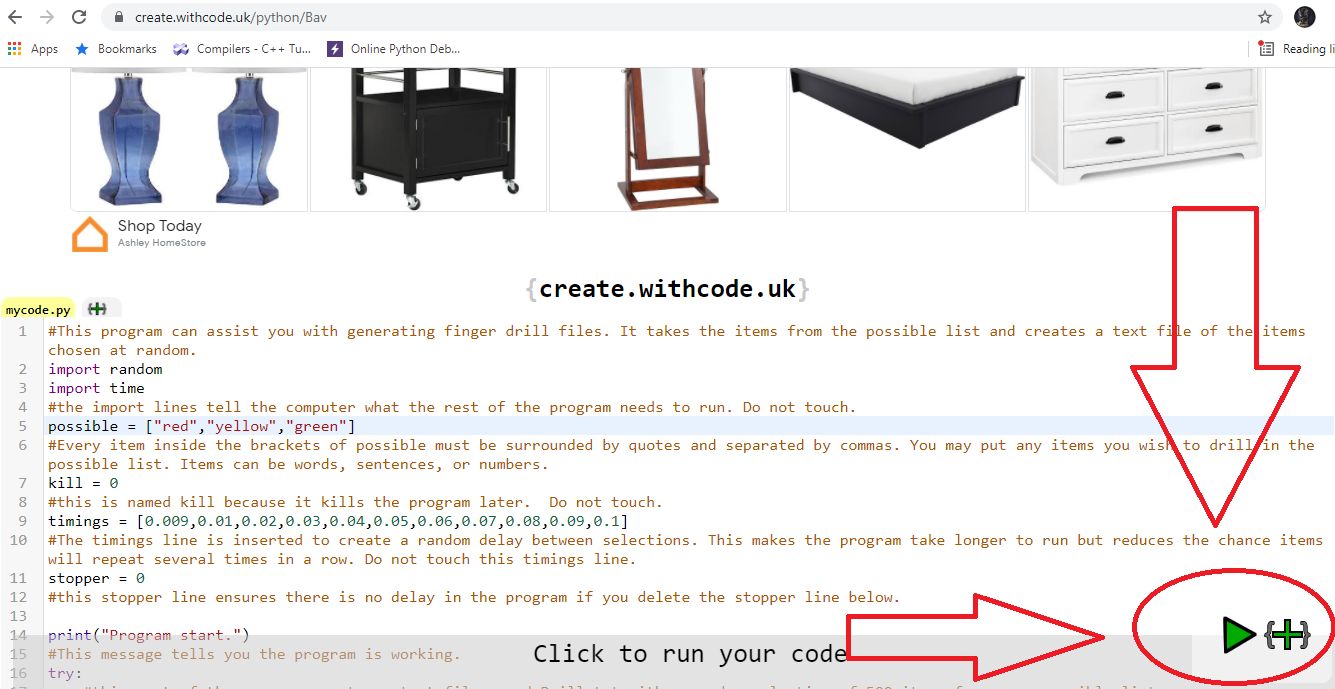
Once you have pasted the code in, go to line 5. There should be a line that says “possible.” Inside those brackets, you put whatever terms you want to show up in your drill. In order to make this work, every phrase or word you want must be surrounded by quotation marks and separated by commas. In the example below, I show what it would look like if you wanted to drill red, yellow, and green.

Put whatever words you want in there.

Step 4:
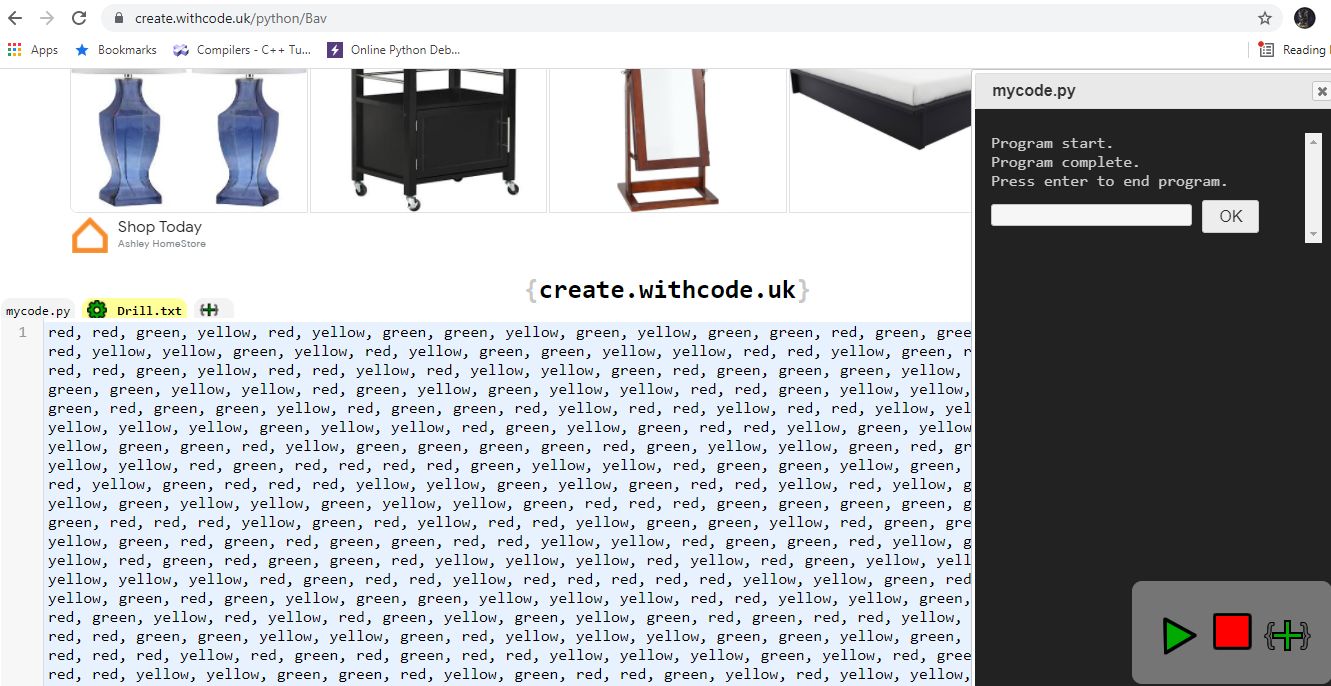
Once you have set up the words you want to appear in the drill, click the green “run code” button on the bottom right. A black box will pop up. If it says program start, the program is working. If it talks about an error, something went wrong. If it says program complete, it’s all done.

That’s the green run code button. It looks like a sideways green triangle.

Step 5:
After approximately one minute, the program will finish. You will have a file called Drill.txt on the left side of the screen. You can copy your drill into Todd Olivas’s slasher to help you mark it for dictation. If you need help dictating, see what I’ve written about that here.

Remember, this works with any words you want, even if they’re from a George Carlin routine.

I know that this is not ideal, but it is a fast and easy way to get long lists of words without having to painstakingly write and copy them multiple times. I really hope it helps. Special thanks to the student that gave me the idea.

Addendum:
Shortly after releasing this post I changed the code and Dropbox link to a much faster version of the program. It avoids repeating the same word twice and works in one second instead of fifty. The only drawback is that if you only put one item in your word list, the program will run forever without giving you an error message. Please put at least two items in the list.

Additionally, after sharing what I was working on with the Open Steno community, Joshua Grams created an HTML file that is much easier to use. Just download it and double click to open it in your browser. It does not randomize the words, but it does repeat whatever you type into it as many times as you ask it to.

Fear Public Speaking? Try StenoMasters!

I’ve been writing this blog to help people look at the issues in our field differently and realize that they, as individuals, can change outcomes. Many of us struggle with fear and anxiety, whether it’s about a boss, a work situation, a life situation, or even the simple act of speaking up for ourselves. This blog is about bringing comfort through knowledge and often points out there’s always a way forward.

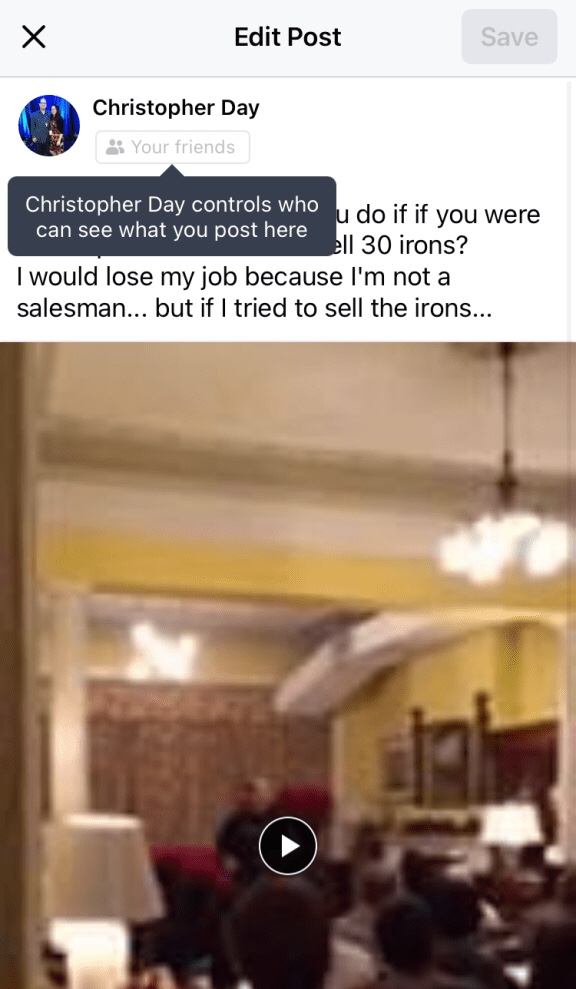
Here is a way forward for our future public speakers. Years ago, one of my best friends, NYSCRA President Joshua Edwards, asked me to attend a Toastmasters meeting. Toastmasters is a public speaking club. It helps people overcome their fear of speaking or enhance the skills they already have through practice. Toward the start of a meeting they had “table topics,” improvised scenarios for randomly-chosen guests to speak about. As luck had it, the very first time I attended I was chosen to talk about what I would do to sell clothing irons to people. I stood up, said I would lose my job, and launched deeper into an explanation about how I would sell those irons that only my Facebook friends can see because Facebook does not want me to touch the privacy settings on that one.

But I am Christopher Day!

At the conclusion of the meeting they asked “will you come back?” My response? “No, I enjoy my debilitating fear of public speaking.” I did come back a time or two and always listened to what Joshua had to say with great interest. He went on to become President of that Toastmasters chapter, participate in at least one regional contest, and sharpen his already-formidable speaking skills.

Now he’s setting up StenoMasters, an online speaking club. A Facebook group and page will be made soon. This will be geared toward stenographers, but it is not going to be exclusively stenographers, so if you have friends or family that want to jump into public speaking with you, have them check it out. There are many amazing options to learn about speaking and presenting. Because StenoMasters is going to be a nonprofit club, I assume it will be the most value for your dollar in public speaking practice, and I am very happy to share it with my audience. When enrollment opens, I hope to be the very first member to sign up.

We have a big messaging issue in steno. As more of us cross the threshold from voiceless to voices for the voiceless, our messaging and entire field will improve. Again, this is a life skill that will help you in all your personal and professional endeavors. I hope you’ll join me in joining StenoMasters.

Will Verbit Go Public in 2022?

Verbit’s constant attraction of investor money and recent acquisition of VITAC has set off a few optimistic waves in the media. Verbit bills itself as a unicorn, that is, a startup with a valuation of over $1 billion. Court reporters worried about that kind of classification should be aware that it means nothing. Fyre was set to be a unicorn, and yet Billy McFarland’s venture did little more than light Fyre’s investors’ money on fire and land him in jail. Theranos was valuated at $10 billion. It’s now worthless and Elizabeth Holmes may face jailtime. Powa was a unicorn with a valuation of $2 billion. That didn’t work out either.

I was shocked to come across an article that states that there are hopes of Verbit becoming a publicly-traded company by 2022. Ignoring things that the article gets incorrect, such as the firm being Manhattan-based (other articles state it’s an Israeli company), there are few reasons I can see for Verbit to become a publicly-traded company. Becoming publicly traded would allow investors to see the profit or loss. To give a great example, VIQ Solutions, parent of Net Transcripts, is publicly traded. It loses money every quarter despite reporting revenue in the millions. Companies that lose money aren’t attractive to investors and that’s why VIQ is about $7 a share today. Remaining private allows companies to continue a kind of “shell game” and operate despite being unprofitable. Based on Livne’s broadcasting of Verbit’s revenue and silence with regard to profit, I suspect Verbit would have the same exact problem, lots of revenue and little or no profit.

Going public would serve only one purpose in my view, an exit for current investors. Current investors could make a big deal about how it’s a company valuated at over $1 billion sitting “on top” of a market that’s allegedly worth $30 billion and watch as new investors dive in and take the bait. In the article above, Livne states the funding rounds were over-subscribed. That means they had a lot of money poured on them in their funding rounds that they did not need. If they’re over-funded, going public clearly wouldn’t provide the company with funds it needs — remember, it’s overfunded — again, it would give the current investors an exit. They get to cash out, some suckers get to buy in, and what happens after that is anybody’s guess. It remains a little strange to me that journalists buy the idea that a company that is maybe half a decade old has automatic speech recognition technology that is better than basically all the major players in the market. Those major players, according to one study, have accuracy levels between 25 and 80 percent.

My prediction is that Verbit will either fail to go public in 2022, or it will go public and take a hard fall sometime down the road after Livne and other investors have cashed out. I sincerely hope it’s the latter, because at least it would be a happy ending for the founder. Verbit finds itself in a precarious position of being a large target for the IRS. In the United States, one is a common law employee when the “employer” has direction and control. Verbit, according to the linked article, is using 30,000 freelancers to carry out its business model. If Verbit does not have direction and control, it cannot assure quality. If it does have direction and control, those are 30,000 employees it is failing to withhold taxes for. Like other companies that rely heavily on independent contractors, Verbit may soon find itself under attack from federal and state tax authorities where it conducts business or earns income. Anyone in the world can confidentially file a form 3949-A that puts Verbit under the spotlight, and that can only translate into headaches for the company and its investors. With that kind of exposure, I would not be investing in the company any time soon.

Even in a world where authorities turn a blind eye and there isn’t a decline in the company’s financial health, Verbit moving public could only give its competitors more information, which is something I’m looking forward to.

Meanwhile, back at Stenonymous HQ, an important meeting with my board of directors.

The Importance of Plover and Open Steno

Open Steno was developed by Mirabai Knight, a CART writer in New York City. I first got to hear her speak about it years ago in the context of the stenographer shortage. She explained that this was a matter of statistics. We knew and still know that stenography is hard to do at working speeds. Only about ten percent of people that embark on the journey make it all the way through, and at that point, there’s almost 100% employment. The concept was simple. We cannot force people to pass steno programs, but if we introduce steno to more people, more people will find out they’re good at it and maybe want to make it their career. We can also tear down barriers for people that simply cannot afford student software, taking a different but equally important approach to something like Allie Hall’s Paying It Forward project. People that believe the stenographer shortage is impossible to solve may be surprised to learn that Mirabai pretty much figured it out over a decade ago.

The Open Steno community has brought things into creation like Plover, a free translation software that allows people to understand the basics of maintaining a dictionary without spending a dime. It has also brought Art of Chording by Ted Morin, a free way to learn steno.

The Open Steno 2021 survey results were released recently, and they are remarkable. Out of 100 respondents, almost half had been learning for less than three months, which means lots of people have been introduced to steno very recently.

Again, nearly half heard about steno from the internet, a blog, or website. This gives stenographic reporters a real peek at the power of the internet for recruiting court reporters. Television and online video is a distant second.

Social media is our friend.

On the flip side, most Open Steno participants do not intend to attend formal school. This is a trend that we should pay serious attention to. Communities like Open Steno are going to attract the people the court reporting schools cannot.

About half of the respondents use steno heavily in their normal computer use and over 60 percent of those that use it heavily intend to use it on a regular basis.

Not a single person said no. They love stenography.

Nearly 75% of respondents intend to use stenography exclusively in day-to-day computer use!

Again, skewed by people like me, who would’ve answered “no, and I do not intend to.”

The Open Steno community also has different people learning different theories, including Plover, StenEd, Magnum, and Phoenix. A variety of steno softwares are also used, including CaseCAT, Eclipse, and DigitalCAT.

11 respondents use CaseCAT!

Professional reporters, this is definitely one of many groups deserving of your support, whether you pop into the Discord chat to offer advice or even make financial donations, this is a chance to make a difference and contribute to one project that’s focused on putting an end to the shortage through tool creation and even free games like Steno Arcade.

John Belcher on Winning Depositions

Spreading through social media is a clip from John Belcher. He talks about how he got his dream job as a prosecutor, which allowed him to be in court almost every day and work with court reporters and other court staff. He talks about all the things that court reporters hope attorneys talk about. Some key takeaways?

  1. Don’t do something you wouldn’t do in front of the judge. They read the transcripts.
  2. Don’t step on the witness. Count to four before starting the next question or answer.
  3. Speak a little slower. He suggests 70% speed.
  4. Don’t disrespect opposing counsel, the witness, the court reporter, or other attendees.
  5. Be careful about side discussions that take away or distract from the proceeding.
  6. Adding fillers at the beginning of questions like “okay” or “perfect” may create bad habits for trial questioning.
  7. Preparation is key. Expecting the court reporter to put up your exhibits for you may burn valuable time.

Don’t take it from me, check out his video on LinkedIn today! You can also see his YouTube here.

Gartner: 85% of AI Implementations Will Fail By 2022

A series of 2019 predictions by Gartner were reported on by Venture Beat on June 28, 2021. As explained in a prior post, “AI”, or machine learning, relies on datasets and algorithms. If the data is imperfect or incomplete, a computer has a chance of giving bad output. If the algorithm that tells the computer what to do with the data is imperfect, the computer has a chance of giving bad output. It’s easy to point to anecdotal cases where “AI” makes a bad call. There have been reports of discrimination in facial recognition technology, driverless cars killing people, or Amazon’s algorithm deciding to fire drivers that are doing their job. I’ve seen plenty of data on the failings of overhyped technology and commercial ASR. What I hadn’t seen prior to today was somebody willing to put a number on the percentage of AI solutions that succeed. Today, we have that number, and it’s an abysmal 15%.

Perhaps this will not come as a surprise to my readers, considering prior reports that automatic speech recognition (ASR), an example of machine learning, is only 25 to 80 percent accurate depending on who’s speaking. But it will certainly come as a surprise to investors and companies that are dumping money into these technologies. Now there’s a hard number to consider. And that 15% itself is misleading. It’s a snapshot of the total number of implementations, not just ASR. ASR comprises a percentage of the total number of implementations out there. And it’s so bad that some blogs are starting to claim word error rate isn’t really that important.

Judge,
I know I botched 20 percent of the words.
But word error rate really isn’t that important.

That 15% is also misleading in that it’s talking about solutions that are implemented successfully. It is not talking about implementations that provide a positive return on investment (ROI). So imagine having to go to investors and say “our AI product was implemented with 100% success, but there’s still no money in this.”

The Venture Beat article goes on to describe several ways to make AI implementation a success, and I think it’s worth examining them briefly here.

  1. Customizing a solution for each environment. No doubt that modeling a solution for every single business individually is bound to make that solution more successful, but it’s also going to take more staff and money. This would be almost like every court reporting company having their own personal software development staff to build their own CaseCAT or Eclipse. Why don’t they do that? It’s hopelessly expensive.
  2. Using a robust and scalable platform. The word robust doesn’t really mean anything in this context. Scalability is tied to modular design — the ability to swap out parts of the program that don’t work for specific situations. For this, you need somebody bright and forward thinking. They have to have the capability to design something that can be modified to handle situations they may not even be aware exist. With the average software engineer commanding in the ballpark of $90,000 a year and the best of them making over $1 million a year, it’s hopelessly expensive.
  3. Staying on course once in production. This involves reevaluating and sticking with something that may appear to be dysfunctional. This would be almost like the court reporter coming to the job, botching the transcript, and the client going “yes, I think I’ll use that guy again so that I can get a fuller picture of my operational needs.” It’s a customer service nightmare.
  4. Adding new AI use cases over time. Piggybacking on number 3, who is going to want to continue to use AI solutions to patch what the first solution fails to address? This is basically asking businesspeople to trust that it will all work out while they burn money and spend lots of time putting out the fire. It’s a customer service nightmare.

I really respect Venture Beat trying to keep positive about AI in business, even if it’s a hopelessly expensive customer service nightmare.

With some mirth, I have to point out to those in the field that believe the stenographer shortage is an insurmountable problem that we now know machine learning in the business world has a failure rate that’s right up there with stenographic education’s failure rate. Beyond the potential of exploiting digital reporters or stealing investor money, what makes this path preferable to the one that has worked for the last hundred years? As I wrote a week ago, the competition is going to wise up. Stenographic court reporters are the sustainable business model in this field, and to continue to pretend otherwise is nothing short of fraud.

Over-Engineering Will Hurt Your Business

A close friend sent me a Bill Maher clip from a while back. Obviously, Maher has his political leanings, but after he gets done with flaunting those, he makes a decent point. He describes the over-engineering of society and gives some pretty striking examples. His preferred vape’s newest model has no mouthpiece despite being something you put in your mouth. Car handles are replaced with buttons in some cars despite no efficiency gains. He describes a situation where his rental car asked him if he’d like to open the trunk while going 60 miles an hour. The point is clear, change for the sake of change is not always worthwhile or efficient. Indeed, change for the sake of change can be very dangerous.

This is connected to the exaggerated claims of salespeople that I’ve written about extensively, especially as it relates to voice recognition. I described it several posts ago as the claim game. Anybody can say anything. Anybody can make their business seem like the new, hot thing. Take this blog post by Kaplan Leaman & Wolfe from about a year ago. It reads nicely, and it sounds innovative. It mentions a flat-rate fee, affordable per-page price structure, a design to significantly reduce legal expenses. At the point in 2020 the post was written, everybody was doing remote stuff. Pretty much everybody’s got a per-page price structure. Anybody can claim their service is affordable or reduces expenses. It’s called puffery and it’s an ordinary part of business.

Where it gets messy, and where I’ve tried to educate reporters, is some advertisements are easier to spot than others. If Burger King says they’ve got the best burger, most everyone knows that’s puffery and sales. Things get harder with technology. How do you prove or disprove whether someone has made a technological breakthrough without a comprehensive understanding of the science and concepts at work? Not all reporters understand the concept of machine learning. Even those of us that have researched quite a lot can’t possibly know everything there is to know. This leaves a gap for tech sellers to come in and try to fool consumers into buying services that may not suit their needs using the hype train.

Told you I write a lot about this. I read a decent amount too.

This also leaves reporters playing a catch-up game of learning about these systems so they can help their clients navigate claims and discern fact from fiction. For example, the truism that technology is improving every day. We look around ourselves and marvel at this magical modern world. But I’ve taken the pretty hard stance that certain technologies, namely voice recognition and associated technologies, are not improving every day. Give it speech it’s used to and it’ll do fine. Give it speech that’s just a little off from what it’s trained for and it’ll turn “would you raise your right hand” into “it’s rage right hand.”

Yes, it’s rage’s right hand.

But surely reinventing the wheel and all these claims of being BETTER aren’t BAD for business, right? If puffery is normal then a little bit of stretching the truth won’t hurt anybody! But we already see that’s not the case. Take Maher’s example. One little glitch on the highway and you could have dead motorists. Take the fact that 25 percent of court reporting companies may be unprofitable; court reporting has been around a long time, it’s likely the losers are the ones trying to switch it up too much too fast. Take vTestify’s massive switch from boasting about providing inexpensive court reporting services to providing an online platform for the legal industry. Take Verbit’s claims in its series A funding of 99 percent accuracy and its subsequent announcement that it will use human transcribers after all, and the very real possibility that it is, despite all its funding, not profitable.

Exaggerated claims serve only as a cliff from which these companies have a chance to walk off of or step back from. The competition is going to wise up. The consumers are going to wise up. I can only hope that a lot of these tech companies realize this, wise up, and start putting their resources behind actually improving our technology. It’s a lot easier to compete in a field with maybe seven players like Stenograph or Advantage than it is to beat out thousands upon thousands of independent contractors and hundreds of reporting firms, many with their own clients and connections. It’s frighteningly easy to see there’s a more lucrative path than over-engineering what stenographic court reporters have made simple, and I can only hope that business owners realize this before walking investors’ money off that cliff.