I was directed to the Department of Consumer Affairs in California regarding the Court Reporter Board licensing fiasco. I wrote them a fun little comment. Because why not? It’s already public knowledge that the licensing board violates the law and fails to protect consumers. I also submitted something to the Auditor. But I’m not holding my breath. New York, California, and Texas all have government agencies that have ignored various complaints for various lawbreaking behaviors. In Texas, a writ had to be filed to get the government to follow the law. In California, the Board just denied they had any responsibility to protect the consumer under the law. It’s like the government’s version of being a sovereign citizen. Make shit up until you’re forced to follow the law. That should give the public confidence in its public institutions.
If you have more knowledge about that member of the licensing board rumored to have sold their business to one of the lawbreaking companies, you should probably write the Auditor. I just don’t have my notes on that anymore, so I’m not very much help to the Auditor.
This really isn’t my domain. I’m over 2,000 miles away. But if you’re in California, it might be beneficial to stop trying to work with the Board and start looking at how to completely restructure it and sweep whoever’s on it out. They deserve as much for their systemic failure.
Maybe go to your legislature and just be like “yeah, the lawbreaking companies got together under a fraud nonprofit to push misinformation, then this idiot with a blog outed them for fraud and the nonprofit deleted itself from the internet, then licensing boards in several states miraculously stopped doing their job, then our licensing board decided it wants to legalize the illegal behavior and is probably going to use you all to do it. Is this copacetic?”
Text from the complaint of a person kind enough to share theirs, since it was more professional than mine:
Please briefly describe your complaint:
I am a longtime California Certified Shorthand Reporter and would like to remain anonymous due to overall lack of trust of the current Court Reporters Board.
In short, I strongly believe the California Court Reporters Board is in need of an audit.
We currently have unlicensed individuals all over the state calling themselves court reporters and practicing without a license. When these people get reported to the CRB, the Board’s standard response is that the CRB has no oversight of non-licensees.
So, there is only oversight and/or consequences for licensees while it’s a free-for-all with the CRB for anyone else who wants to pretend they’re a court reporter. This in no way protects the consumer.
The other Boards who serve under the Department of Consumer Affairs do not make similar claims. They don’t protect unlicensed individuals working in their professions. For example: “Acting as a contractor without a license is a crime (Business and Professions Code 7028). Those convicted risk up to six months in jail, a fine of up to $5,000 and administrative fines of up to $15,000.”
If it is true that the CRB can do nothing about unlicensed individuals practicing in the field (creating legal transcripts used in civil and criminal cases), then why have steps not been taken to rectify this? Allowing unlicensed digital court reporters to produce transcripts is clearly not protecting the public.
I read an article by an attorney who indicated that she didn’t realize her reporter was an unlicensed digital reporter and not a CSR until she got the transcript back with a 60-page chunk missing. This was a domestic violence restraining order case, and the missing testimony directly caused a ruling by the judge that was not in favor of the alleged victim; yet this digital reporter continues to practice without consequence while a licensed CSR in the same position would surely have been disciplined if not lost their license.
Note that a “digital reporter” is not licensed and is someone who records proceedings with a recorder and then sends the recording out to be typed. In the case of the 60-page chunk of transcript missing, the recording was sent to several different people to type portions of, with office staff then inadequately attempting to assemble the pieces of transcript.
Again, the CRB as it stands is not protecting the public.
Thank you for your consideration of an audit of the California Court Reporters Board.
Date
Date is ongoing.
What do you want the person or company to do to resolve your complaint?
As requested above, a full audit of the CRB and its practices, particularly with reference to the lack of oversight of unlicensed individuals and there being no consequence for practicing without a license.
———————
The text of my comment to the Department of Consumer Affairs:
The Court Reporter board regulates court reporting / stenographers. When companies began illegally using what’s known as digital court reporters, the board claimed that it couldn’t do anything about digital because it didn’t have jurisdiction over them. This is very much like if someone was unlicensed to be a doctor and was practicing medicine, but they called themselves a digital doctor, so the licensing board was just like “we don’t have jurisdiction” and continued to allow the illegal activity. Now the board wants to bring digital reporters under its licensing. So this is like if we made a special exception to make the digital doctors legal. Maybe you guys should look into whether past or present board members sold their business to the companies illegally using digital. Might be a little something to do with why they’re shirking their responsibilities. Not to be too forthright, but the companies illegally using digital used a fraud nonprofit to pump the market with misinformation called the Speech-to-Text Institute. That nonprofit was later sued for its anticompetitive conduct and shut down its website. The point I’m trying to convey here is that the median bribe in this country is $60,000 and these companies have millions of dollars, so it wouldn’t surprise me at all if there’s been a little money exchange to make sure people look the other way.
Interestingly enough, this happened in Texas too. A writ had to be filed against the licensing authority out there to get them to investigate StoryCloud’s illegal activity. Coincidence that the two states with the strongest court reporter licensing in the nation tie a blindfold around their eyes and stick their head up their ass to avoid doing their job? Nope.
My great big suggestion is put some systems in place to avoid the appearance of your licensing boards being dirty and bribed.
(I even linked them to my article. How kind of me.)
To their credit, I was responded to, which is more than I get from a number of governmental authorities in New York when I write to them about people abusing parking placards to park in front of schools for disabled children.
Of course, to me, it’s all nonsense, but I’ll keep an open mind.
Came to my attention that under 2422 California test takers were allowed to review their dictation licensing test. At least one source has stated that since 2020, CSR candidates have not been entitled to review their test.
Since the CA CSR Board has been violating the law for at least four years, they’ve decided to correct that by changing the rules so that they simply won’t allow people to review their test. Ana Fatima Costa is spearheading some activism related to this. Allowing our students to review errors can only improve pass rates. If you want to help, go take a look now. This is really something that you want all your state legislators and the people on Ana’s list to be looking at, because it’s a good example of how government should not be doing its business. It’s shady. I’ll demonstrate how:
Word on the street is that this is about preventing cheating. Oh, I’m glad that we’re worried about cheating suddenly after all these decades and not the alleged shortage of doom that allegedly requires the wholesale replacement of stenographic court reporters with digital court reporters. It’s not our fault you only have 20 tests in the vault and can’t be bothered to periodically write more. Sounds like you manufactured a problem to get a desired result, at least to anyone that thinks about it for more than five seconds.
The CA CSR Board is the poster child for my corruption arguments. Let’s put it this way: If the Board is 100% uncorrupted, they’ve done everything in their power to look as dirty as possible. The CA CSR Board is known for failing to protect consumers and crushing working people. If you’re using all of your regulatory power, authority, and trust to make it harder for us to license actual court reporters, laying down the law on solo practitioners, and hurriedly looking away when the multiverse of corporate America breaks the law by using digital, then you are effectively handicapping our side of the market and the motivations for that become fair game for discussion. Yeah, I get it, it’s pretty lucrative for the government to ignore these things, let these businesses spend some money trying their luck at taking that work off the plates of California CSRs using the companies’ illegal business models, and take a slice every time a dollar gets spent in that competitionwhile simultaneously milking the CSRs for their dues. Does that make it right? Does that mean that we should treat corporations better than people wherever it’s economically convenient?
First Amendment was made for issues like ours.
P.S.
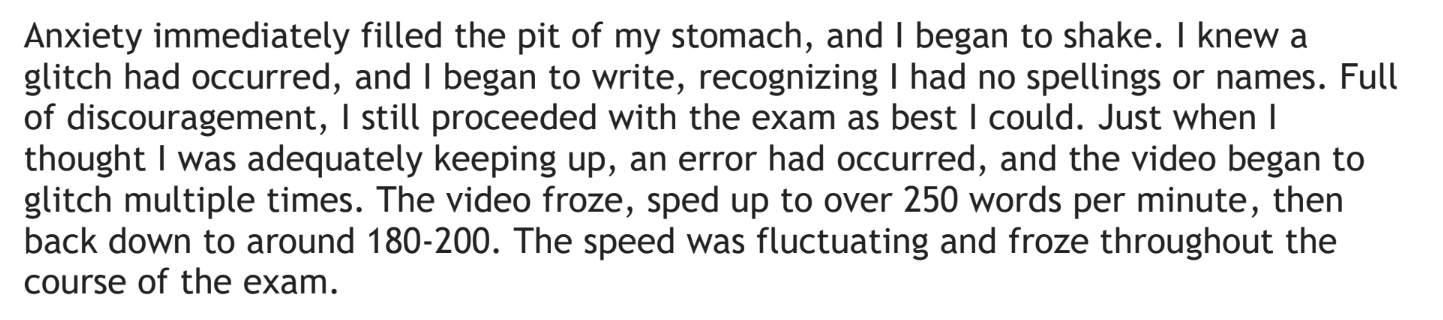
Excerpt from a letter detailing the experience of a California CSR candidate submitted by a Stenonymous source.
I know digital court reporters can’t be court reporters in California. I use the verbiage I do for the standardization of language and so that when people find out digital court reporting is a scam, they don’t get confused! It also picks up better in search engines. It’s like the typing/writing thing. We can’t force the whole world to use the language we want them to use. We can, however, stand up and speak out against state-sanctioned lawbreaking. We can share why we prefer the language we prefer.
I’ve been told a participant in a public hearing was muted because they asked when survey results from a survey done by the board would be published. I sure wish I could use my government-granted powers to silence people that ask questions I don’t like. That’s the American dream, baby.
If any of you have lawyer friends, maybe it’s time for us to crowdfund some writs, or lobbying, or whatever makes us enough of a headache that the games and obvious deflections end. I guarantee you that your success is directly related to how many people you can get to take action.
Cassandra Caldarella reached out to me a while ago with some information about California. Given my relative lack of familiarity with California’s court reporting laws and statistics, the interaction was very welcome. I’ve said it many times, but I would be nowhere without information sent in by readers.
The first thing I was told was that in 2013 there were 7,100 active CSRs in California and that there are now 6,580 CSRs in 2023, a loss of 520, or about 8%. A loss of about 50 per year, or 0.7% of that 7,100 total. The Ducker Report told us something like 70% of reporters would be retiring between 2013 and 2023, so about 2.3% a year. 4.67% per year if you count from 2018, when the shortage was supposed to start getting bad. What does all this mean? The California shortage may be half as bad as it was forecasted to be.
An explanation of CSR license numbers from Cassandra Caldarella.
We can pull straight from Ducker to confirm something is off.
Ducker Report, Forecasted Supply for CA in 2018, 6,110.
There was a 6,110 supply of stenographers forecasted in 2018, and it was supposed to get worse and worse every year until 2018. If it is accurate that there are now 6,580, then we are doing much better than the forecast.
Cassandra went on to explain that these were not straight losses and that there were a lot of new CSRs coming in.
I was then given a yearly breakdown of out-of-state CA CSR licensees. The average before COVID was about 10 per year. 2020 to 2023, that jumps to about 16.
Out-of-state California CSR licenares per year according to Cassandra Caldarella.
I did go snooping for these numbers, because I don’t like to publish without some fact checking, and I did find at least one piece of information from SB662 that seems to contradict or call into question these numbers.
2022, 5,605 CSRs according to SB662 bill text. 4.,829 listed an address in California. 8,004 in 2000. 7,503 in 2010. 6,085 in 2020.
That’s a much more grim outlook. But perhaps it’s just market forces at work? Unless 30% of the workforce has been replaced by digital, it means that the demand for court reporters is simply lower than it once was or that there was not enough demand in the market for those 8,004 CSRs. A lot of people believe in the self-correction of markets. Why is our labor market any different? We could blame it on government regulation. Then again, we could also blame it on the larger corporations that stood by and did basically nothing for half a decade. If there was a retirement cliff, they sure weren’t worried about it, and I think that says a lot.
Let’s work with the most relevant numbers presented here. 7,503 in 2010. 1,418 drop from 2010 to 2020. A loss of about 19%, 1.7% a year. Still below the 2.3% to 4.7% it was supposed to be, but not quite as rosy as the 0.7% figure I was hoping for.
I’d really like to get the discussion going here. Are there more accurate direct sources I’ve missed? Has anybody run these numbers and come up with similar results? Have I gotten something completely wrong?
The comments are open.
Addendum:
Some edits were done to the images and text in this post after it went live. Subsequently, I was sent a spreadsheet that purports to show about 6,849 California CSRs active as of May 10, 2023. So, after seeing that, I think it’s reasonable to conclude that we are in much better shape than was forecasted.
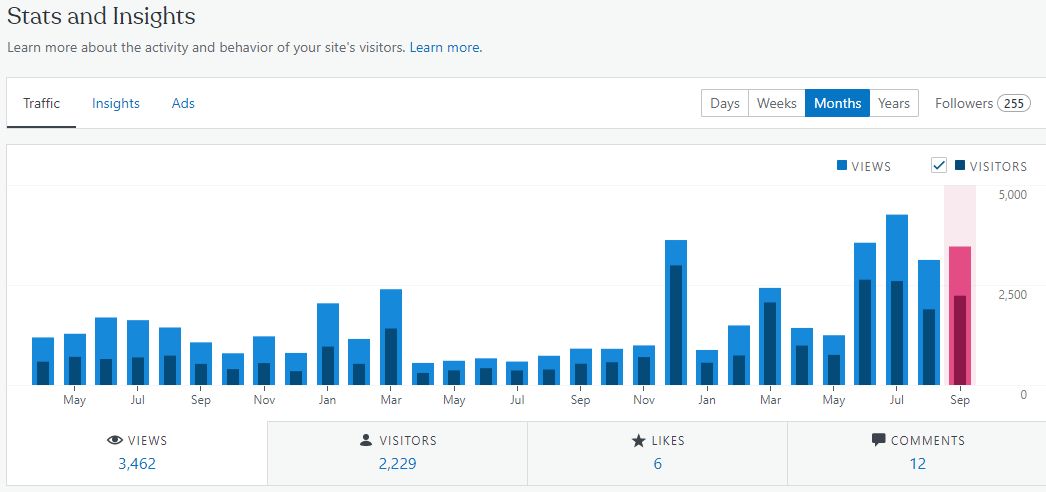
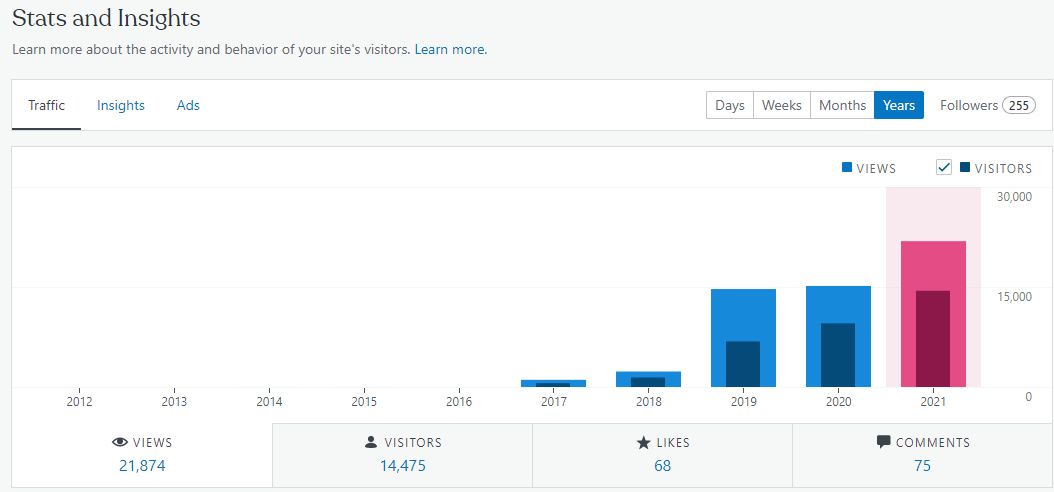
Following a series of unprecedented articles that touched on US Legal’s nonsensical JD Supra article, STTI’s awful and intentional misreading of the Ducker Report, and a bit of history, science, and my thoughts on how we got here, the response was overwhelmingly positive. People donated. People said “thank you for writing what others are scared to say.” There are more Sad Iron Stenographer mugs in existence today than there were last week, let me tell you. It’s September 9, 2021, and we’ve already had more visitors this month than all of August and blown past readership from previous years. If you’re enjoying your time on Stenonymous, you’re in good company.
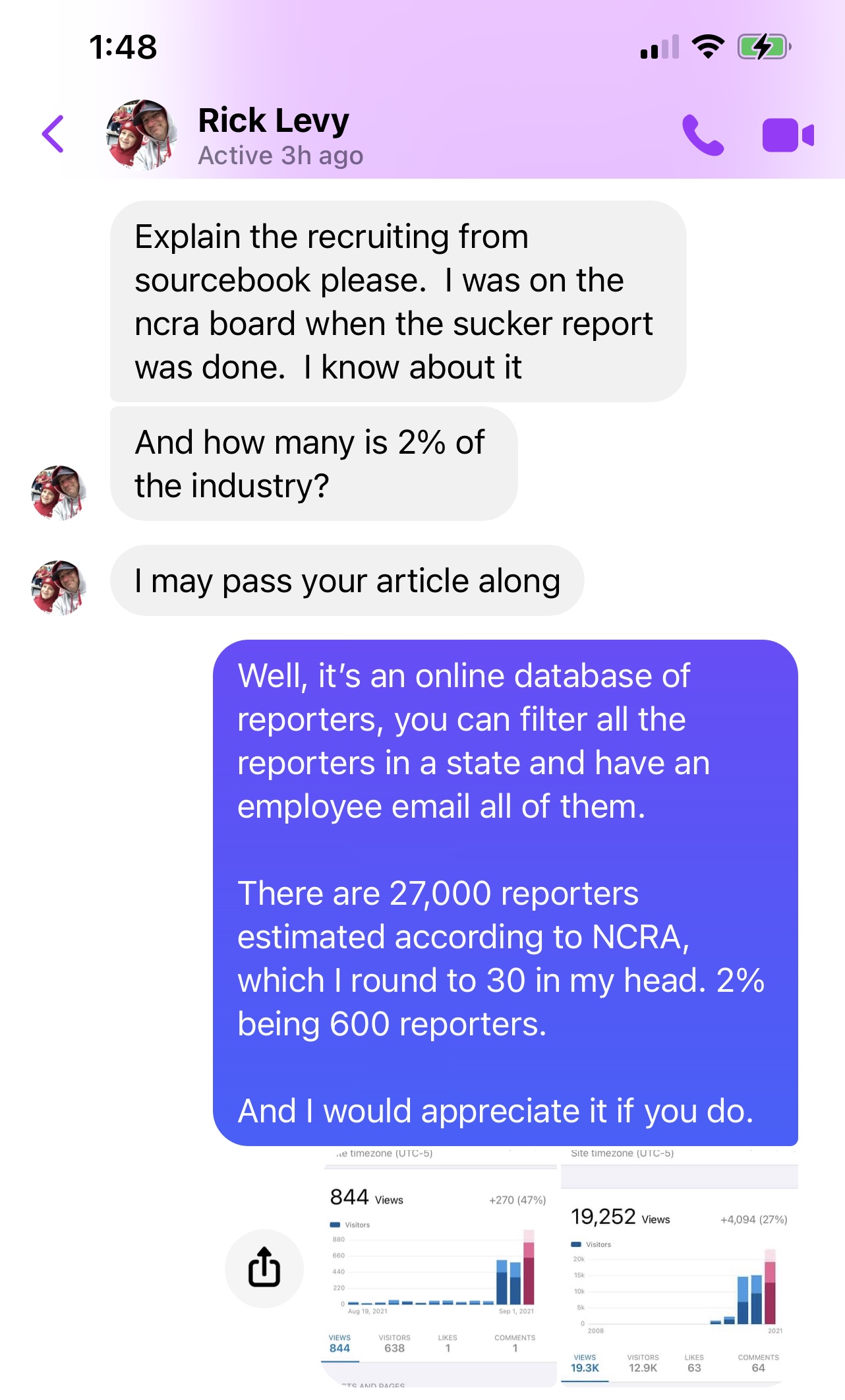
Over 2,000 visitors in a month is really good when that month has 20 days left and there are only about 27,000 people in your field.
Associations, consider reaching into the wallet and advertising our field a bit. Miniscule amounts of money make a large difference in exposure.
Let me just note that when I’m referring to corporations, I’m really looking at the colloquial “big box” variety. The ones that we would think have millions of dollars in the budget but spend almost all of their outward effort on building their digital reporting business no matter what a bad decision that is. Small agency owners might look at my work and think “anti-business,” but it’s really pro-people. If you’re not being a liar or a bully, the chance that you’re going to end up here in a bad light goes down. If you are being a liar or a bully, just stop doing that, we’ll have a redemption special, it’ll be fun. It’s a lot easier than fooling all of the people all of the time, which I’m about to give a lesson in.
So while most of the responses from my work were positive, there were a few comments that came off as trolling comments. I’ve written about trolls before, how they can be hired to achieve a goal, and how it is important to not allow the narrative to be controlled by them. Now it seems important to point out that “trolling” comes in two major forms, intentional and unintentional. An intentional troll is someone who understands the issues and plays dumb or attempts to obfuscate an issue. They’re basically gaslighters meant to confuse, discredit, and distract. A paid troll would be an example of intentional trolling. An unintentional troll is someone who makes a comment that could come off as hostile or disingenuous, but is just ignorant or sees a situation differently, not malicious in any way. It can actually be really hard to distinguish between the two because the key difference is intent, which you cannot usually tell from a one-off interaction. Defined this way, even I’ve been an unintentional troll before. It’s just a thing that happens. Sometimes we interpret something incorrectly, say the wrong thing, or fail to correctly assess a situation.
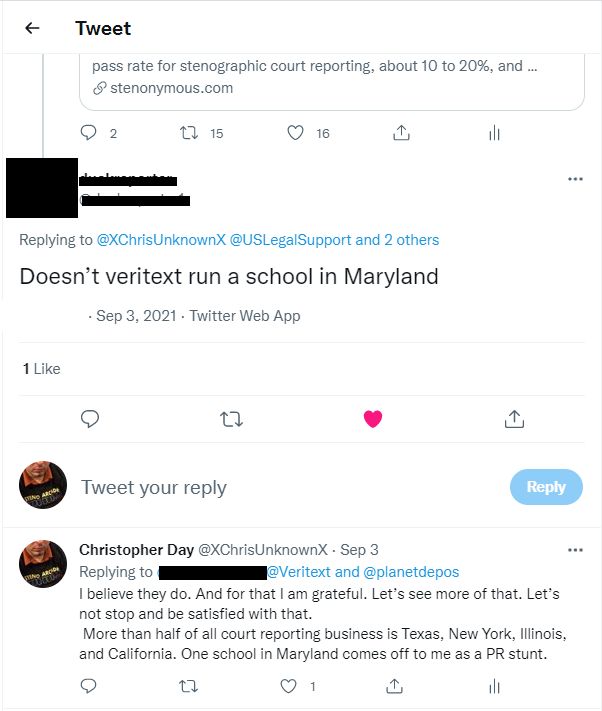
What we are going to see now is a push to confuse the issues. The intentional trolls will plant doubts and let the unintentional trolls carry those doubts into the discussion so that we spend more time arguing and less time organizing / advertising. The key to this is to respond cordially and logically if you are not absolutely sure who the person is or where they’re coming from. Take the following example off Twitter:
I’m using social media screenshots. I’m officially a journalist.
The comment writer correctly points out that Veritext has some involvement with a school in Maryland. At that point, I have three choices, let it get under my skin and react in a hostile way, ignore the person for daring to question my “amazing writing,” or reassess my feelings and ask myself why I feel the way I do about Veritext. And I feel the way I do because about five years ago, we were all asking each other whether digital was in use and to what extent. That’s not necessarily Veritext’s fault, but there was a lot of back and forth on social media about how digitals weren’t in use or were in emergency use only. Because evidence was scarce, stenographers were divided. Eventually, I got my hands on evidence that they were trying to get lawyers to change deposition notices to allow for digital. It was very clear that they were interested in promoting digital reporting. Then the VP of Sales wrote a pro-digital piece that caused an uproar, and the company threw her under the bus. I tried to keep an open mind and was pretty open about broadcasting scholarships they sponsor for our field. If you go back to just last year, you can see my cognitive dissonance with all this forming, but I was pretty sure the company as whole was not being honest with our community. It all culminated in me asking them what the deal was. Why was I getting digital reporting ads on LinkedIn instead of stenographic reporter ads? I was given a throwaway response about how they feel recruiting from their network is more effective, and I pretty much left it there.
After reassessment, I was still left with a choice of what to do. Without knowing this person, and having no information that they are malicious, I can only assume that their intentions are good and that they are a potential ally. As you see, I chose to make a concise statement in support of the good that Veritext has done for the field, but used my knowledge of the Ducker Report to make the point that more than half of court reporting business comes from California, Texas, Illinois, or New York. These are the states where we have the most ground to lose and in my estimation the most likely to produce reporters that will relocate to other states due to their high cost of living. By spreading that idea, anyone who reads has a piece of information that they may not have had before, and the truth prevails rather than the distraction of “but they support a school!” Any other choice would’ve made me come off as a jerk or make it appear that my writing was based off incomplete information.
The bipolar attitude corporations have towards stenographic court reporting is likely a result of the hedging mindset. Will stenographers fail to recruit enough to meet demand? The company has no idea, so it has to support both, lest it choose the losing side. This is the same mindset that the straddle strategy is based on in investing. If someone thinks the market will move in a particular direction, they hold two opposing positions, and the winning position hopefully makes enough money to cover the loss and earn a profit. It’s quite brilliant, but it’s not good for us because we are people and not stock options. This all gives us valuable information though. If the $400 million company doesn’t know what’s going to happen, there’s a pretty good chance nobody does. That means what we do, how we think, and how we talk to each other will change the future. It also shapes how the corporations respond, which we know from studying how the narrative has shifted over time and how fast they threw that VP under the bus when we started talking to each other.
This isn’t even a new thing. History is rife with the status quo versus the voiceless. Look at women’s suffrage in the United States. Here there was an entire class of people with no right to vote, who were brutalized for demanding such a right, and yet still successfully persuaded the voting class to do what they wanted them to do. Here we are a hundred years later, 2021, with largely the same pattern of institutions and organizations telling a field of 88% women how to feel, what to think, and that the situation is hopelessly against them. What is the difference beyond issue and scale? It’s one group of people telling another group of people how things should be, and the group of people that wins gets to decide how the story is told later — sort of.
But now that you’ve had an example of unintentional trolling and hopefully see why responding without facts or failing to respond at all is dangerous, let’s discuss further how to distinguish the unintentional from the obviously malicious or misleading views.
A comment that looks like it’s designed to make my blood boil? I have literally trained my whole life for this.
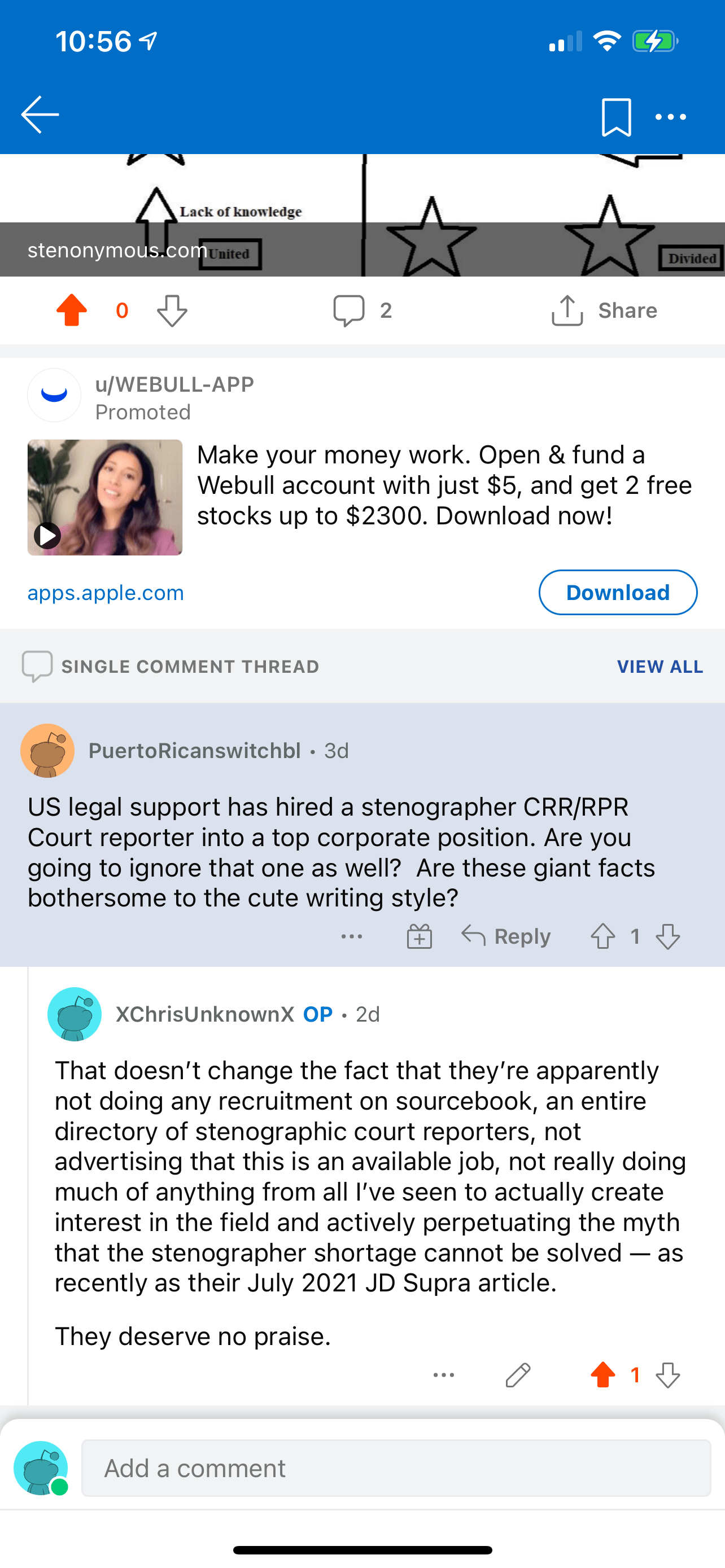
A Reddit account slapped down some good information about how US Legal has hired a stenographer into a top corporate position. They asked if I was “going to ignore that one as well” and asked if giant facts were bothersome to the cute writing style. This is an example of the claim game video that I published in May where I told six lies, one partial truth, and one actual truth in fifteen seconds and challenged my readers to identify which was which and think about how long it would take to prove or disprove any one of those claims. The commentator is sprinkling one truth, that US Legal Support hired a stenographer, among a bunch of distractions meant to discredit my work. Was I going to ignore it? No, I’m about to write about it. Are these giant facts too bothersome? What giant facts? The commentator is gaslighting me. They created the Reddit account in order to create a post that would cast doubt on my work. We know that because the account was created shortly before commenting and this was the only comment on the profile.
I can’t assume good intentions here because there’s no substance to what they’re writing about and they seem to have created a Reddit account for the sole purpose of discrediting my blog.
As an aside, isn’t it a little strange that a field so small has so much intrigue that people are fabricating Reddit profiles to take shots at my blog? I am both fascinated and confused.
Let’s review. Honest comment that we personally disagree with? Don’t attack. Attacking risks losing valuable time and energy that could be spent advocating for our field and spreading facts. Malicious comment that is clearly designed to derail the conversation? Same deal. Don’t spend too much energy on attacking. Lay out the facts or ask for clarification. We’re not going to win the malicious commentator over, the win comes from what other people think when they read the comment.
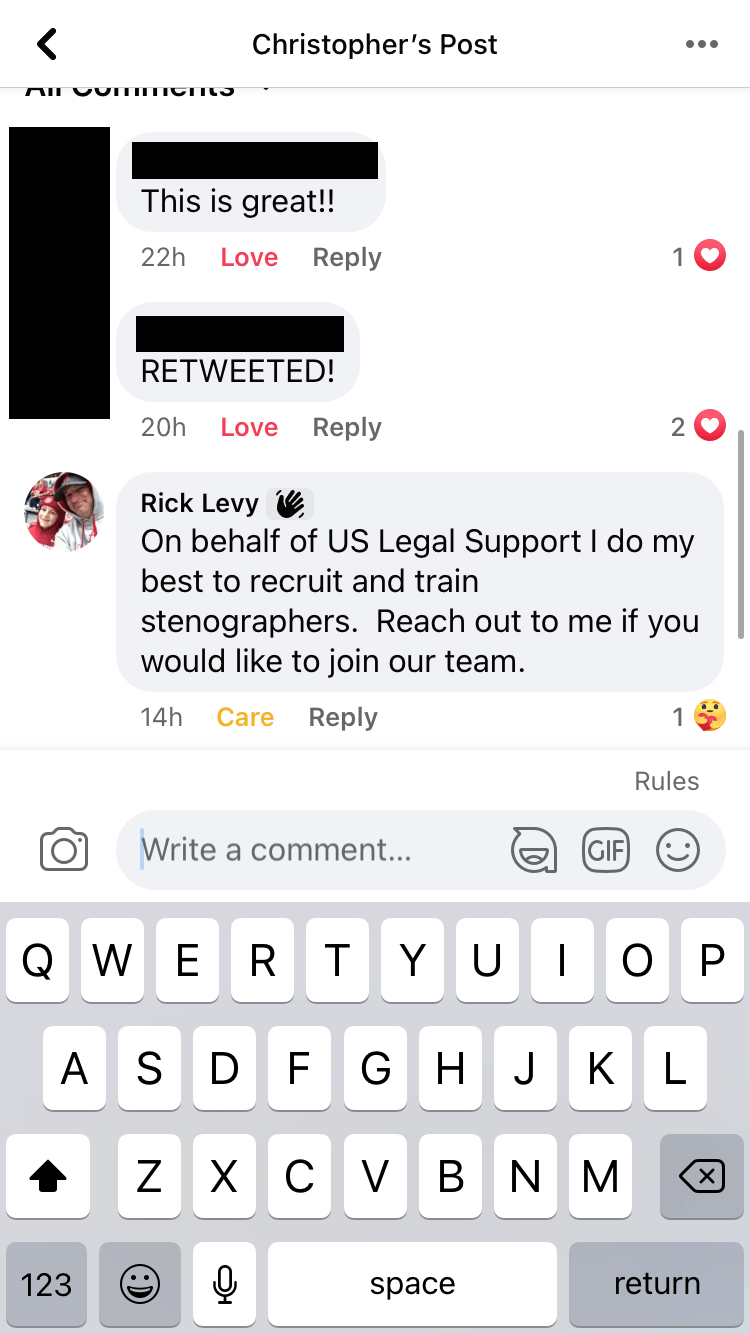
What happens when things are not so cut and dry? What do you do when your soul tells you things could be either way? I had such a moment with the very same stenographer that I assume the Reddit commentator was talking about, Rick Levy. My blog posts have been making shockwaves on social media, and he’s commented a few times in ways that I was actually quite moved by. I started to doubt my own conviction US Legal was supporting digital out of an agenda rather than a need. I started to doubt my own conviction that they had intentionally not put enough effort into Stenotrain. I started to doubt my own conviction that the lackluster stenographic recruitment was intentional even though I had documented how robust their digital recruitment was by comparison. I have to ask my readers: When you look at this, do you feel all those same doubts?
He does his best. And at that time, I believed him.
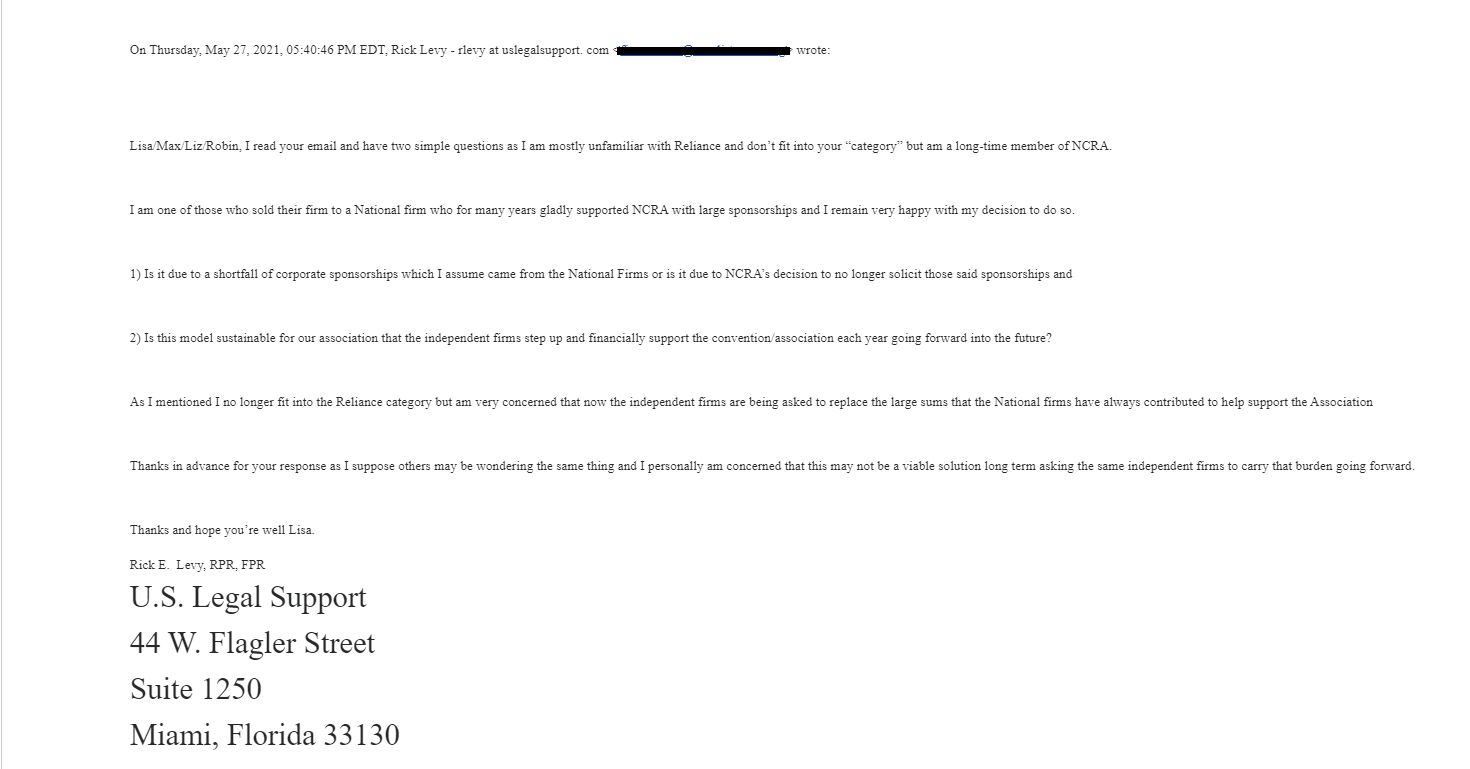
I no longer doubt my convictions. But I am not operating in a total vacuum. I have in my possession a series of e-mails exchanged in May 2021 from the NCRA firm owners listserv. I spent most of August doing research for upcoming articles related to those e-mails, and those e-mails acquainted me with Rick’s modus operandi of disarming people with kindness. Since I’m not ready to publish all of those today, I’ll give some context. In the e-mail string, Lisa Migliore advertises Reliance, a collection of court reporters and smaller firms that donates to NCRA to keep yearly costs down. Rick Levy starts questioning Reliance’s potential. By itself, it’s actually a good thing. It is GOOD to question, learn, and reassess.
Remember, questions, GOOD.
Rick asks: 1. If Reliance is necessary due to lack of funds from national firms. 2. If the model is sustainable.
During my August investigation, I learned that not only was Reliance successful, but very much like Allie Hall, it takes my theory about the collective power of stenographers, kicks my ass, and turns it into reality. After reaching out to Lisa Migliore, I learned that in 2019 Reliance met its $25,000 goal in three days. Once payments were settled for 2021, it would double that, with $50,000 collected for 2021. Not only does Reliance seem sustainable, it seems capable of raising sums of money that will eclipse national firms that do not start supporting stenographic court reporters. We can also see this in Project Steno’s donors, where the big donations — and particularly the ones from US Legal — are a great boon for a great nonprofit, but small donations add up to something special.
We did that together.
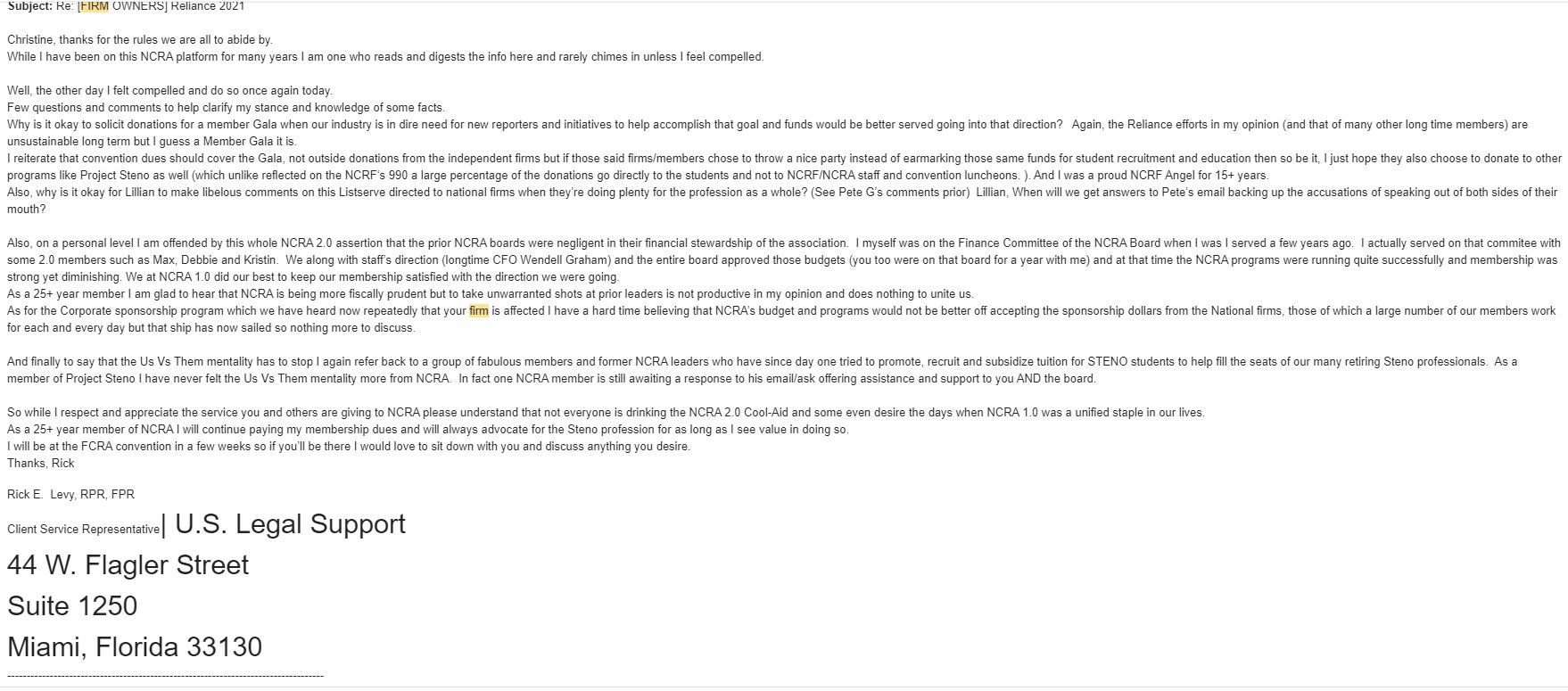
Things got a little heated in that e-mail exchange and then-President Christine Phipps reminded everyone of the listserv rules. Then there was a big wall of text where Lillian Freiler was accused of making libelous comments and NCRA 2.0 was accused of disparaging past leaders. And I started to realize something very important —
very, very important.
— there was a possibility that this was gaslighting instead of genuine concern! The claim game was hard at work. Remember, gaslighting is about confusing, discrediting, distracting. And it was starting to look very much that way. Why do I term it as distraction? Think of magicians. They set up a trick, get you to look somewhere else, and then wow you with the trick. Here, there trick is getting everybody in defense mode so they don’t talk about Reliance and/or US Legal’s hedging/dishonesty. I’m going to sum up his points and why I feel they’re examples of gaslighting.
1. Is Reliance necessary? Irrelevant. Reliance exists and is raising money for stenography. Distraction. 2. Is Reliance sustainable? $50,000 in 2021 say it’s more than sustainable, it’s successful. Distraction. 3. I was an NCRF Angel and not enough of that goes to students. Distraction. 4. Accusing Lillian Freiler of libel. Scare tactic and distraction. She was merely citing my work, which I have not been accused of libel for because it’s not libelous. 5. I’m offended because NCRA 2.0 is advertising that they stopped burning members’ money and fixed the budget. Another distraction. Seriously, is anyone actually upset that NCRA balanced the budget? But going on the offensive has a chance of getting people involved in that discussion to doubt themselves; it looks much more like a tactic than an honest feeling.
While everyone is focused on these distractions, the main point, the undisputed fact that US Legal is trying to bury us, gets buried.
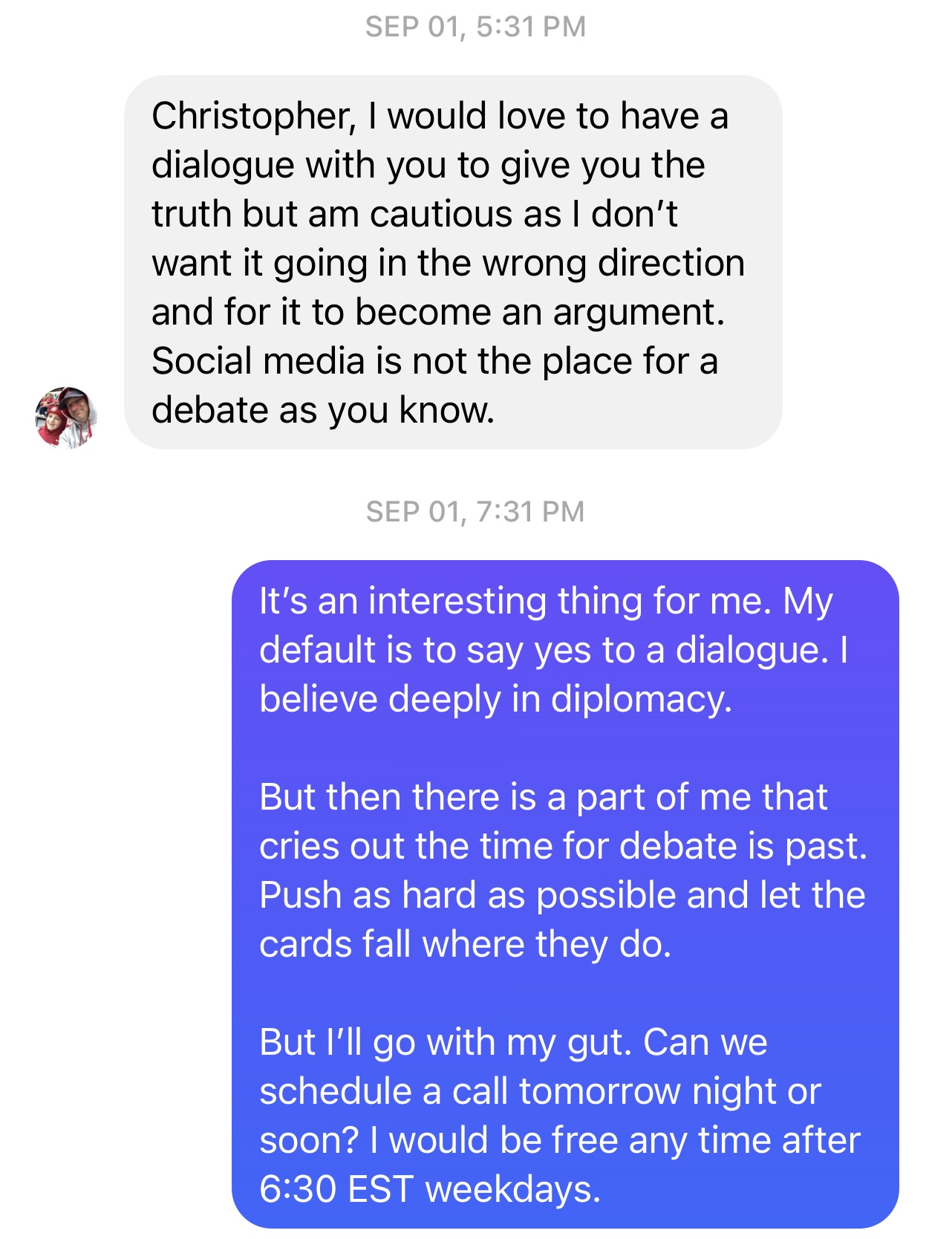
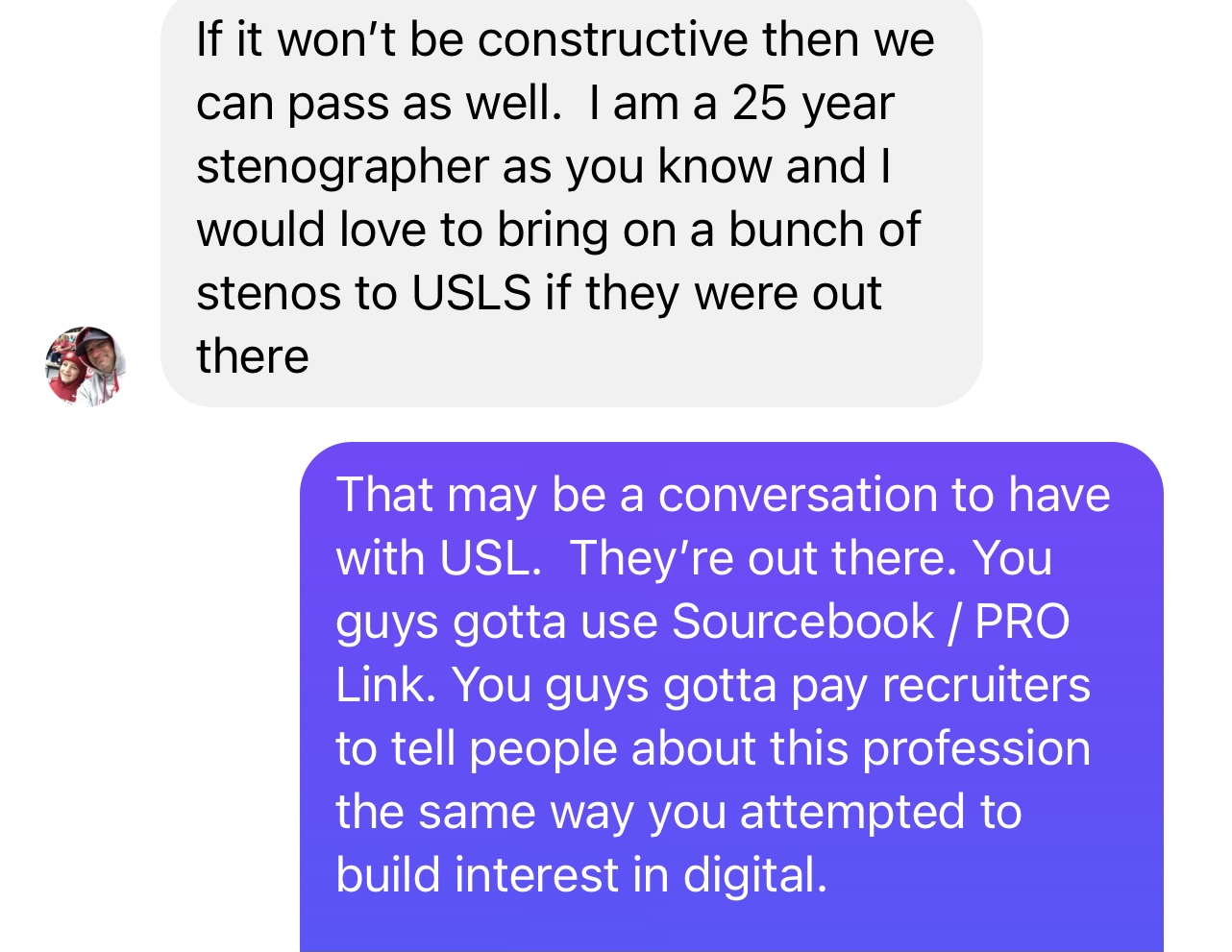
Now I had suspicions of dishonesty, but this was not enough for me to make up my mind about the situation. After all, we cannot expect everyone to remember, research, and document every facet of court reporting. Luckily, I was given another window from which to view this situation. After my articles last week, Rick Levy messaged me in what I can only describe as the strangest conversation of my life. I’m the purple. It all started with an offer to talk.
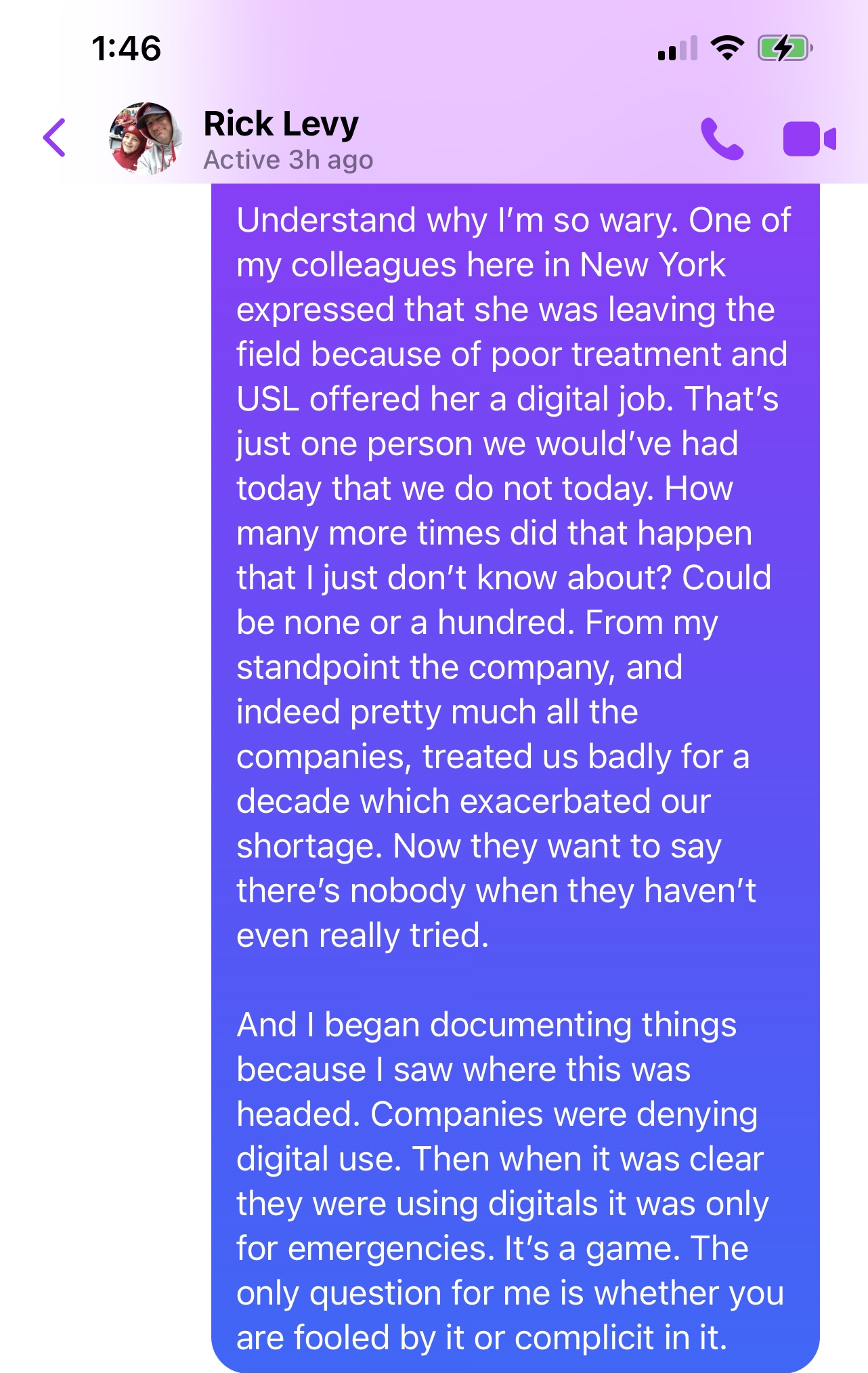
Again, my response is in the context of the shifting narrative we are experiencing in my field. But he came back and gave me some more.
“I’m willing to talk with you, but I don’t know if I can trust you.” “Well, if you don’t want to talk, fine, I’ve got 25 years in the field, and haven’t you heard about the shortage?” “How about we stay on point and talk more about what USL can do for us?”
The only question for me was whether you were fooled by it or complicit in it.
So let’s get something straight here, here I am on a Wednesday night, eleven years into my career, telling a stenographer of 25 years and self-reported NCRF Angel of 15 years that works for what is ostensibly a $100 million corporation that they can find stenographers on Sourcebook, now renamed PRO Link, which has existed for years. If that was not weird enough for me, it got weirder.
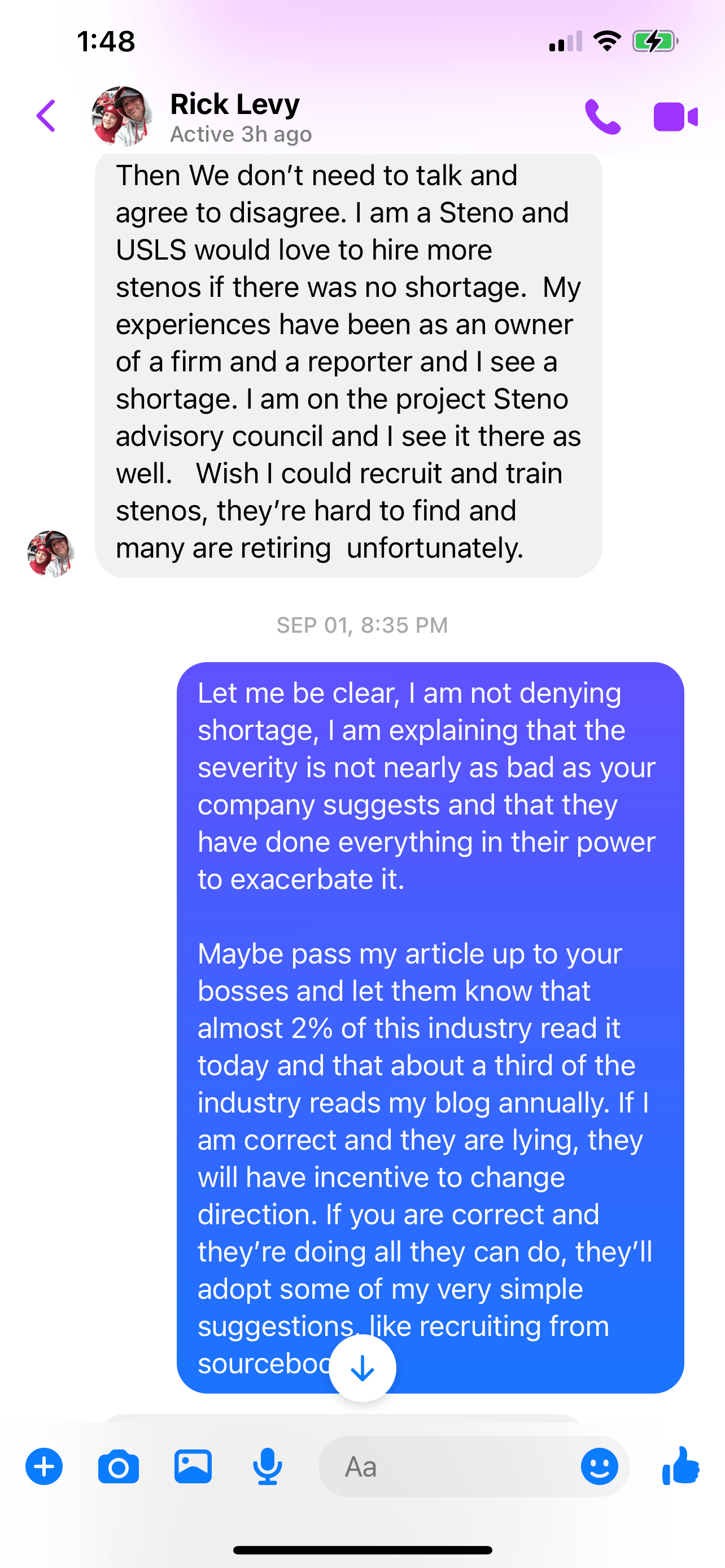
And, idiot me, makes the assumption that this is genuine. I explain Sourcebook and give proof that a large swath of the industry is reading my blog. He mentions he was on the board when the Ducker Report was done and that he knows about it. Then he asks a question of profound importance.
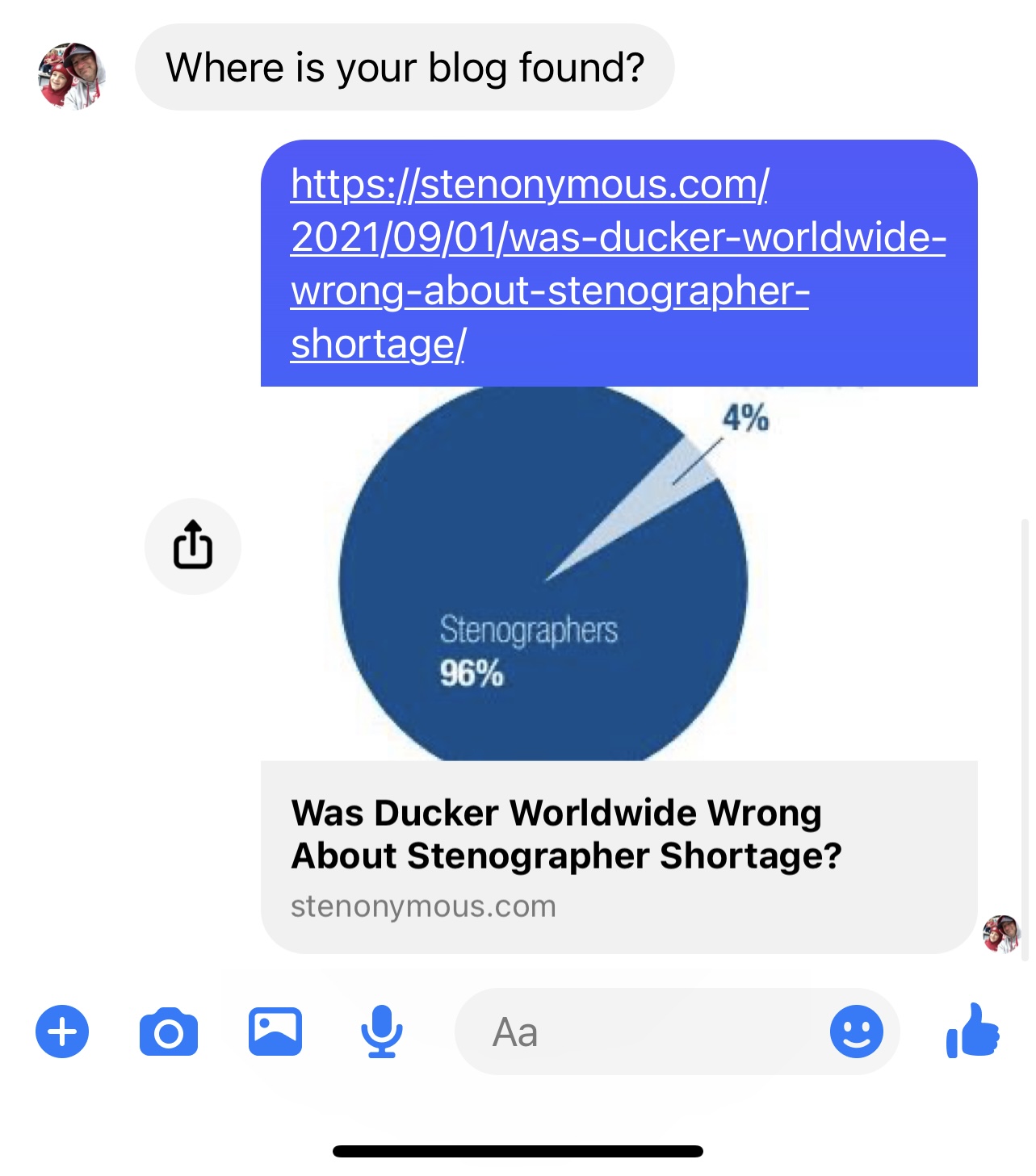
He asked me where my blog is well after he had commented on it on Facebook. Now I knew that the commenting was more or less a public relations thing. US Legal’s intention is not to recruit stenographers, it is to get us doubting ourselves and each other. So the next time that Rick commented on my stuff, I did what I could do to “politely” tell it like it was.
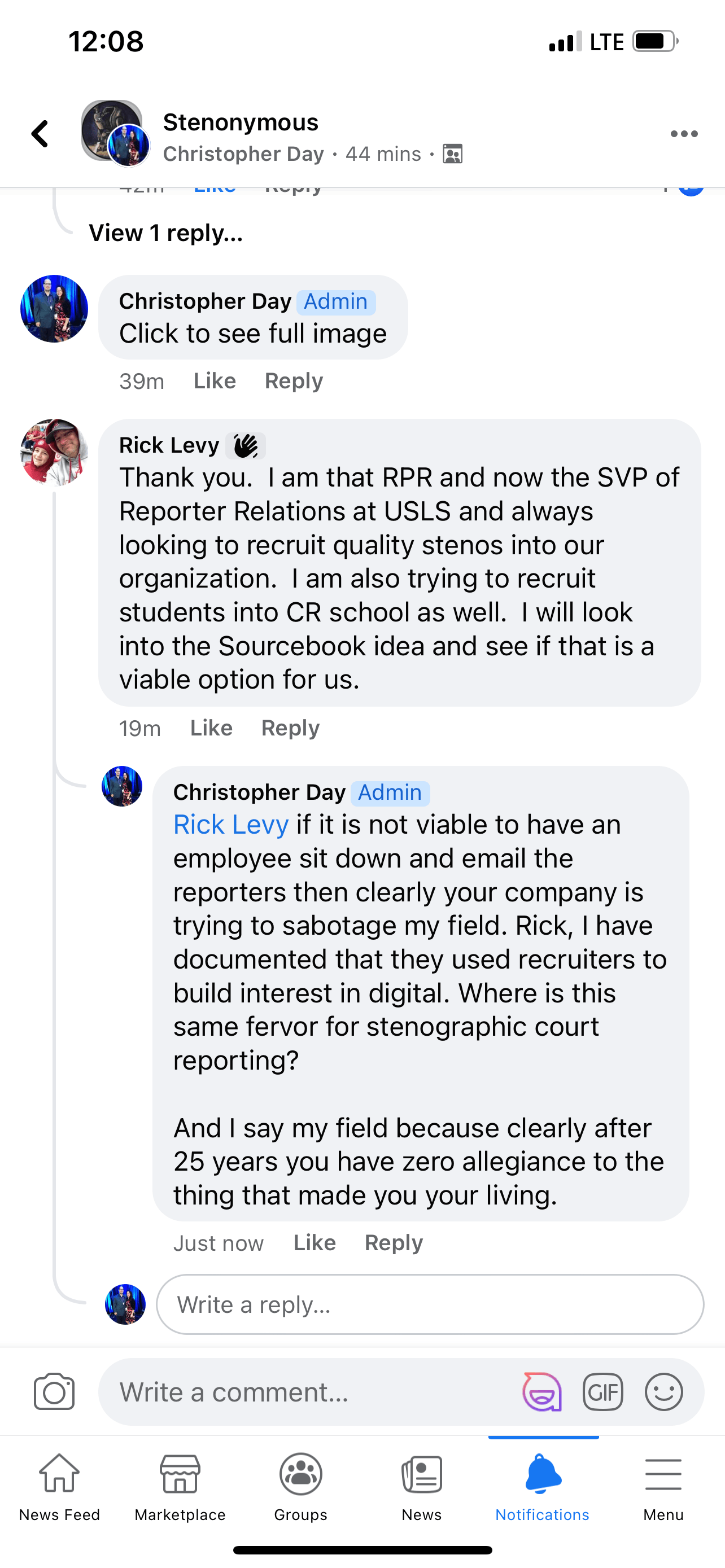
Let’s review. We have an admission that they’re not recruiting through Sourcebook. We have an incredibly weak public pledge days later that the stenographer with probably the most pull at US Legal will “look into it.” We have that after a very serious conversation with me where I was as honest as practicable about my intentions, data, and feelings. Again, I’m looking at the totality of the circumstances. How can they make the claim that the stenographer shortage is impossible to solve when they have not, by their own admission, done the bare minimum to find stenographers? When they can arrange for recruiters to try to drum up digital reporting interest but can’t be bothered to know Sourcebook exists, there’s a problem. How many lawyers are being lied to about a stenographic court reporter being unavailable when they’re not trying to recruit court reporters?
But we continue to harvest valuable information. The corporate mentality has absolutely no answer to this kind of blunt trauma by truth. Our consumers are lawyers, some of the most educated people on the planet, and it’s very hard to keep lying to them when someone is publishing evidence that there is a lie in progress and thousands of people are sharing it. All they can manage is a “we’ll try, we’re trying, really.” And rather than chase down 101 distractions, I suggest we keep with one simple answer, “try harder or cease to exist.” Seems fair to me. That’s pretty much what we’ve been told as a profession.
We all have a choice. We start taking action to counteract the false narrative or we sit back and watch this gaslighting continue. I will be working on an ad campaign for next week that will wrap up a lot of articles and links in a digestible format for the legal profession. Once that’s launched, I will ask for donations in the amount of about $20 a reader. My statistics show we’d have about 120 weeks worth of heavy advertising if everyone reading this contributed, which I’m happy to split between advertising steno and facilitating consumer awareness. Even if a reader can’t donate, there are other ways to help, which I will put right at the bottom of the ad campaign itself.
In my view there should be no more excuses. Short of a binding contract where US Legal agrees to tell every single one of its digital reporters how to get involved in our wonderful field, scaling back that part of the business over the next few years, and taking actual steps to build interest in our field, their words are hollow and the company should no longer be allowed to poison the legal field with its lies.