To those in the know, my PACER account was disabled. But we’re in business now and I looked to see if there were any updates on the antitrust lawsuit against the National Court Reporters Association.
Not really.
Here is a PDF of all the filings in the case as of about 6:00 a.m. this morning.
To those that don’t understand lawsuits, basically they start with pleadings, usually a complaint and an answer. Sometimes before an answer is filed, a motion to dismiss is made. That’s where we are now. An amended complaint was filed in April 2025. A motion to dismiss was filed by the National Court Reporters Association (defendant) in June 2025. A brief in opposition to the motion was filed by the plaintiffs in July 2025. A reply was filed by the defendant on August 11, 2025. There have been no filings since, presumably waiting for the motion to be decided.
In full disclosure, I have not had time to digest the documents I am about to share to give an accurate picture where we’re at legally. I do know that federal pleading standards were tightened via the Twombly or Iqbal cases years back, so it’s not as easy to make it past the pleading stage as it once was. If the case survives the motion to dismiss, in all likelihood, the National Court Reporters Association will be forced to either settle or answer the complaint and proceed to discovery where the facts of the case come out.
Before I share these documents, I would just like to note this is not or does not seem to be incredibly uncommon in our federal judiciary. I have seen cases in the past where people die before they see justice because of situations like this, where it’s almost a year since the last filing in the case and the court just hasn’t made a decision yet. The benefit for the court of people dying before they see justice is, of course, that they never have to bother with deciding the actual case. Not alleging that this is intentional, but it is a consequence of the way our system is set up, and anyone that cannot acknowledge that has perhaps not considered the math of cramming like 250,000 cases a year more or less through 900 judges and their referees, staff, etc., with some of those judges taking a disproportionate number of the cases. Even if everything was split evenly, we’re talking about a situation where a judge could research and write one opinion every business day, all day, for eternity, and still never actually get to every case. Perhaps knowing that it is astonishing that things are working as well as they are.
Honorable mention, one of the plaintiff attorneys died during the case and therefore had to withdraw from the filing system. Rest in peace Mr. Lindsey Taylor.
Good luck, litigants and litigators. Have a wonderful day.
P.S.
PACER case search revealed only four federal lawsuits against the National Court Reporters Association, with the most recent one prior to this being over two decades ago.
Isn’t it interesting that all these multimillion dollar business operations hide everything behind their paywalls and we rely on either thousands of people paying $15 to the federal government to inform themselves like I did or some jackass with a website to post the information for free also like I did?
Actually, this is a really powerful case study in human psychology. It is completely public information that stenographers pay a nonprofit $3 million a year to lie to them and make them feel like everything will be okay. And we are not dumb people. We’re just people.
How many humans in history do you think figured that shit out and decided “I’m gonna go work in the association management business?”

PACER Case Search revealed four federal lawsuits against the National Court Reporters Association
Addendum July 2026:
I have actually read that the averages for deciding a motion to dismiss are shorter than a year. My deepest apologies to all the judges on all the cases where the timeline is much tighter. Unfortunately it would appear absent further information that I fell into one of those psychological pitfalls I often write of and educate on.
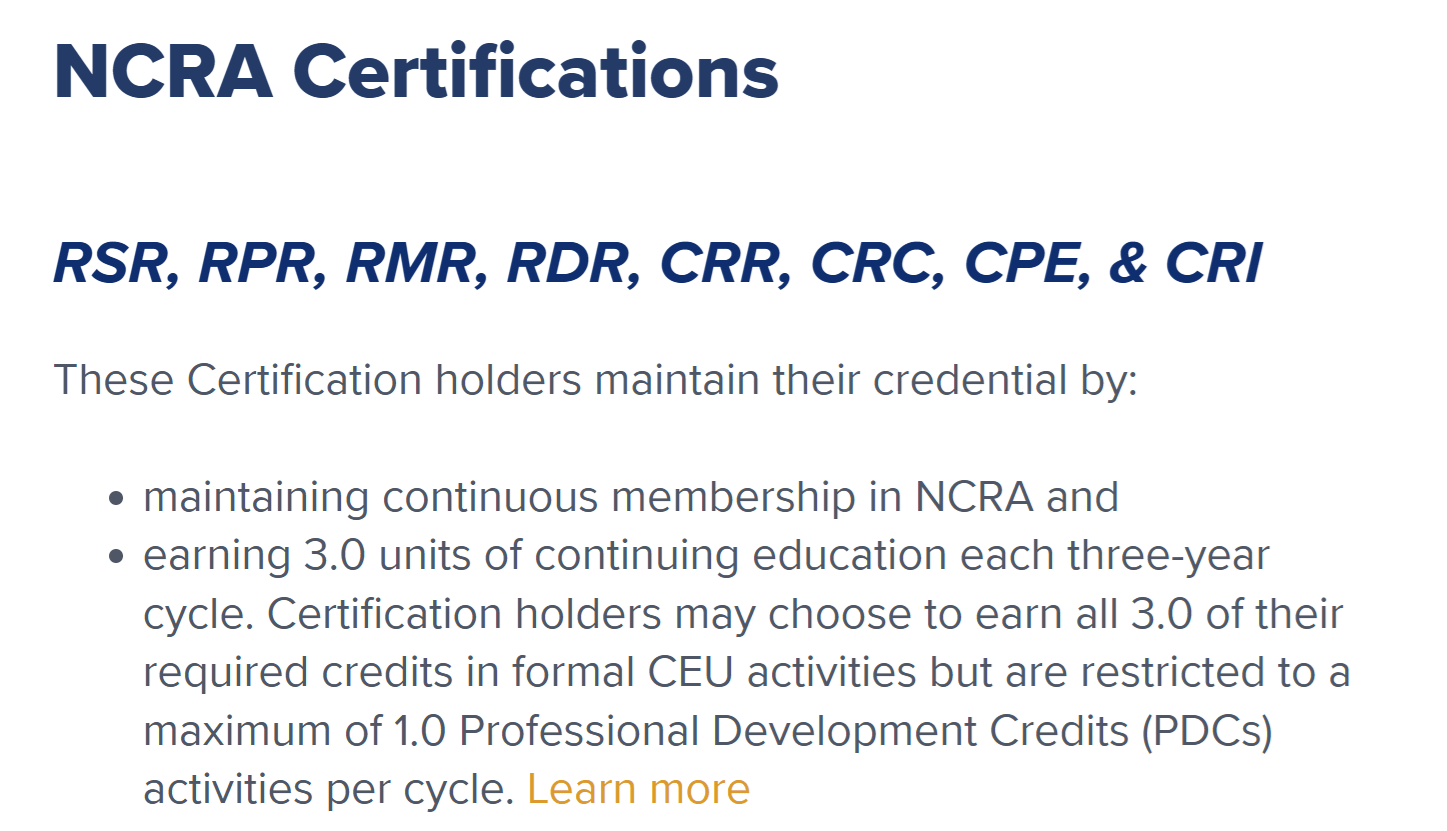
Some time ago I consulted with a law firm about the tying of the National Court Reporters Association’s certifications to its membership, possibly in violation of antitrust laws. I’m not privy to what happened afterwards except that they apparently found plaintiffs and are attempting to move forward with a class action. I got my hands on NCRA’s reply in support of the motion to dismiss and I’ve decided to share it.
Having only read a sliver of it, I must say it’s comical that they call the membership and certification inseparable. Anybody with a few brain cells can see that it’d be easyto separate out the testing and CEUs from the membership. The NCRA simply doesn’t want to because it would cost them money. I’m hopeful that the court sees through such a ruse and the lawsuit survives the pleading stage, because at that point they’ve boxed themselves into a corner of “yes, our membership is tied to certification [in violation of antitrust law.]”
I have no reservations about where I stand. In the question of institutional loyalty versus loyalty to my fellow court reporters, I choose my fellow court reporters. And I’ll clip a comment from Facebook that lays out some of what I think of when I think of NCRA.
This refers to Jim Cudahy leaving NCRA to return under the Speech-to-Text Institute years later, the fact that Dave Wenhold manages probably a dozen organizations and therefore by definition cannot be invested in court reporting in the way we need him to be at this critical moment, the decline of court jobs on NCRA’s watch, and the decades-old lie that court reporters cannot discuss rates.
There is a certain cult-like thinking in court reporting where we believe in people and organizations that are clearly failing us. This is due in large part to propaganda. Being something of a propaganda expert that has used propaganda to tell the truth and raise consumer awareness, I must point out that if we do not break free from this de facto mind control, we will collectively walk off a cliff that there’s no climbing back from.
I must point out that with the kind of funding court reporters pour into the NCRA and Dave Wenhold’s pocket, Stenonymous could disrupt corporate propaganda dragging down your incomes, and has proven that in the past through the annihilation of the Speech-to-Text Institute, a venture that was backed by all the biggest names in the business including Stenograph and Veritext — and a direct threat to the prevalence of machine shorthand reporting.
I must point out that you can make a donation today on the front page of Stenonymous.com.
If change from within is not forthcoming, change from without is the only path forward.
P.S. Trey, if you happen to be reading, I know I still owe you a post. Life got in the way. I’ll be working on it sometime soon.
“Are we working together, or are we working against each other?” Cheri Marks speaks to Trey Perez
CM Would you mind starting by giving me a little background about yourself, where you’re from, and how you initially came to be involved with court reporting issues? TP My name is Trey Perez, and I’m a videographer from Texas and Central Texas. I have an associate’s degree in video technology. I want to make movies, but I got into the legal video business, and did that for 25 years. In 2019, I noticed there was a shortage of court reporters because of jobs that would be canceled. CM Could I back you up a little bit? How exactly does legal videography work? TP Sure. Back then it was separate. The attorneys would call the videographer, and then they would also call in a court reporter. The court reporting firms didn’t really handle a video then. They were strictly stenography. So in 2019 I got the idea to work on an app that would lay down the foundation of the transcript. CM Was there a defining moment that propelled you to design the stenography app? Or were you just watching the relationship between stenographers and videographers and sensing that it was inefficient? TP There’s a couple of different factors. One was the shortage of stenographers, and videographers losing jobs because of that. Then these companies, when there wasn’t a court reporter available, would hire us to go do video only depositions. One company in particular, Veritext, had a login which they wanted you to write down the times and objections etc. And so you would have this extra work to do. And I’m not very good at keeping notes. And so I had this friend of mine working on a website. He’s a very talented developer. And I told him about this situation and he developed the app for me. That’s why I created it, so that I could just take notes. By pressing a button, the speaker would change, it would designate who’s who. And that’s just how it started off. CM Do you think they initially were trying to cut corners and save money by having you do both the work of videographer and stenographer? TP No, I think there was a shortage. My understanding of the way it worked back then, was that the app would help the court reporter with her job, so that she could go back afterwards and listen to the audio, and know exactly where to go when listening for objections. They wanted us to take hand-written notes! The idea of having some sort of app that could simplify the process of finding objections seemed that it would just make the whole thing easier. CM Can you tell me how you got involved in the related antitrust lawsuits? How did you become aware of the criminality, and what were your first moves? TP The first thing was having a grievance filed against me by the president of the Court Reporters Texas Court Reporters Association. She’d sent me an email. And I was already getting little cryptic messages and things and telling me I was doing illegal things– CM By developing your app or by paying attention to–? TP By developing an app. That pissed off the court, big time. And so a grievance was filed against me. CM And what was the basis for the grievance? TP They said that I was trying to do court reporting. CM But isn’t that what they’d essentially asked you to do? TP When I came up with my app, I could produce a transcript easier and cheaper than the court reporters, but that wasn’t my intent. My intent was to offer it to them, and I did offer it to them. But no one would do business with me. It didn’t hurt the court reporting firms that the court reporters were upset with me. But still, they used the roar of the court reporters to shut me down. It was a tool to help the court reporters. And all the evidence will show that. It did change for me at one point, when there was no work left and my business was destroyed. By then I was just trying to make a living. But I did say that people could take a deposition without a court reporter, because everyone else was doing it! I never did this on my own. I never once built out a video-only deposition without a reporter unless the court reporting firm asked me to. So how can that be illegal? CM Right. And can you tell me then how it moved from you having a grievance filed against you to you being involved in that antitrust lawsuit from one to the next? TP For the grievance, I represented myself and it was dismissed. And then they appealed that dismissal and I got to speak again and they dismissed it again for the second time. And that’s their own body that governs the court reporting firms and the court reporters. But at that point, my business was devastated. There was so much evidence because the court reporters would taunt me on social media. They would post pictures or taunting videos along with my name, or make snide, thinly-veiled insults in my direction. So that pissed me off. Just the audacity: that I can’t even work now because I was developing a tool. CM It seems tragic, because presumably you and the stenographers shouldn’t even be the ones fighting. It seems like you both have a common enemy, which is these huge corporations that don’t have working people’s interests in mind. TP I tried to work with the court reporters here in Austin. I contacted a few, individual court reporters and asked them: what’s more important, your family or your career? Because it’s going to be a 20 billion dollar industry soon, and no one will be able to compete with that. I was trying to get the court reporters to come on board, and every time I talked to them, I said, we weren’t trying to replace court reporters. We were just trying to help out with the situation. They can deny it, but here in Texas, court reporters were getting 500 bonuses to up and leave a job they were supposed to do, if they got a better offer that same day. CM Geez. Do you feel like your reputation was smeared a bit unfairly? TP Oh, yeah, Most definitely. There’s a lot of rumors. It’s been difficult because when you don’t have any money, it’s hard to get representation. CM Are you still embroiled in the lawsuit, or are you past it at this point? TP I’m still involved. We’ve had really bad rulings, let’s put it that way. The name of my company was called Depo Notes, the notes of the deposition. And so the judge ruled that, in my case, that in my hands, that it was illegal. Check this out. So when I couldn’t find work, I started doing landscaping and mowing grass. And I would go into different neighborhoods to do this. So then when I’m cutting grass, there’s these certain people who keep coming around, riding their bikes around me and, like, making racialized judgements about me. I could just sense that, you know, with the political climate here in Texas, all this talk about “getting rid of illegal people” – and then here I have a judge telling me that I can’t use my tool, my app that I developed, and it’s illegal in my hands. Then when I go out to cut grass, I have this person wondering if I’m illegal or not. CM Oh my God. That’s awful, I’m sorry. I feel like this is important, and I’m curious now– do you think there was institutional racism involved in your initial vilification? TP No, I think that the industry is 85% white, though. Here’s the thing, though. Why would a judge even be bringing up that AI could hurt minorities? I even wrote that in when my attorney wanted to leave. I wrote an objection to him leaving. I put that in there. That from the beginning this has been biased. And judges, I know they have court reporters that have been with them for many years. But for him to rule the way he’s ruled–it’s odd. What’s funny is that people that believe in the law, they say, yeah, the Constitution, the Constitution. But yet when their man tries to overthrow our government, they forget about the Constitution then. CM Absolutely. TP In my case, the judge said that for me to have this app was illegal because every deposition in Texas must be taken by a stenographic court reporter. But one of the biggest plaintiffs firms in Texas just put out an ad, and he does 98% of his job without a court reporter. And how do I know? Because I did some. And he came out with an ad saying that in the past four years, he’s given away $1 billion to his clients. He didn’t advertise that, of course, that he did it all without a court reporter. CM Do you feel like you were too primed for success and they wanted to quash you and take your ideas? TP No, it was because the firms themselves were worried. They were threatened by the app. But the court reporters are just worried about their jobs. Why didn’t they get on the court reporting firms that were hiring me asking me to do this? That’s who they should have been after. CM It’s easier to punch down than to punch up, right? TP Right. And I think that they thought I was just gonna go away, you know, and I’m not. Because it’s hard to argue that the rules and laws apply to only me in this case. I don’t think they should be able to win. CM So when you win, you could very well be setting a legal precedent, perhaps, for this kind of case. TP That’s what I feel is going to happen. CM Is there an end in sight? Or is it one of those kind of entrenched legal things where it’s hard to know when it’s going to end? TP It’s hard to know. And right now, I don’t have counsel. My attorney withdrew, and I don’t even know why– “irreconcilable differences” he wrote. The real “differences” were that he wasn’t willing to fight for me. We had even agreed that these rulings were wrong, but there was nothing he could do about it. It’s about the truth. That’s what we do is we take testimony down. And, you know, I know it’s a talent to be able to type fast, and that’s a skill and it’s worth some money. It has value. And. But when you don’t have that– because not every court reporter is the same– you could be greatly assisted by using this type of technology. CM What do you think about, the claims that AI has an inherent racism to it because of the people that are building it and the speed at which it’s being kind of put into the world before being read by an ethics committee, for example, or do you have any opinion on that? TP I think that a human being, at the end of the day, is the one that signs off. AI is not going to be certifying itself. You would have someone reading [post trial, in this case] it and cleaning it up, and we could be improving the performance of the tool in this way. CM You can check accuracy against AI instead of just giving over all the responsibility. So at this point, have they shuttered your business and have they told you you’re not allowed to reopen it, because it’s illegal? TP No. Once money stops coming in and work stops coming in for a couple years, your developer gets pissed and, you know, those relationships don’t last. So development stops and then, you know, then everything stops. CM I’m so sorry. Do you feel like you’ll have the drive at some point to develop a new app? Or are you kind of done with it? TP I’m done with it, yeah. So this will be, understandably, my last fight. And that is to change the way that I’ve asked this question on social media, on LinkedIn: can a deposition be taken in Texas without a court reporter? Yes or no. CM Why are they afraid to say? TP Because if they say yes, then that helps my case. But if they say no, they’re lying, because they’re doing it already. CM So, they’ve put you and court reporters between a rock and a hard place just to benefit this huge Speech to Text Institute and these corporations that are developing the same software. TP When they filed a grievance against me, I spoke anyway. So the reporters are commenting on this thread and they say: “He spoke at the meetings. He says he can’t find work. Says he’s basically been blackballed or boycotted”. And then the next person chimes “Hell yes, we did!” And another one writes “He bit the hand that fed him. He wanted to have his cake and eat it too. Maybe if he would have stayed in his lane”…that kind of thing CM It’s really a shame. I wanted to ask you how you felt about Stenonymous’s previous coverage of your lawsuits– and if you felt it was too focused on the speech to Tech Institute involvement. TP No, I just think that he’s biased and he’s on the side of the court reporters. I haven’t done anything illegal. There is no evidence stating I did anything wrong. We were never reprimanded for developing a tool, a tool that they’re actually using now. CM It seems like you’re just being bullied. If that were to stop, could you see any opportunity for collaboration with court reporters happening in the future, for example with sympathetic figures or outlets like Stenonymous? TP I don’t see it because it’s just been too much. You know, last time I went into the deposition, I got kicked out. So, I just don’t see it. You know, I’d walk in a room and I’d get this just look of disdain. And then the court reporters got racist, too. You know, saying I was jealous of them. One lady, and her husband represents some of the court reporters that are defendants in this case, even went as low to repeat the racist stereotype, “most Hispanic men are short and have ego issues” CM That’s really awful, I’m sorry. TP So, they talk about how AI can be biased. But that lady just proved that a court reporter can be biased as well. The court reporter is taking live deposition, and she’s biased right there in your face. CM So what’s your best case scenario, both with the legal case and your own future and career? TP My end goal is to set a precedent here in Texas, and that’ll be my legacy. The testimony in Texas will be able to be taken down by other means, not just stenographically. And it’ll be clear, you know, because apparently there’s currently this gray area. I want it to be clear because litigants should have a choice. That’s why I feel like I have a case. I’m gonna appeal. So they can be happy all they want, but it’s not over. It got personal. CM I look forward to hearing about your success with this case, and you setting the precedent. TP Did you hear about the case that was filed by the court reporters against the NCRA? It was on Stenonymous– the court reporters filed a lawsuit against their association, antitrust as well. Okay. So that brought up another topic: that videographers record the court. And the court could want our audio. And under the NCRA, if you’re a certified legal video specialist, you have to give it to them, that’s just courtesy. But the thing is, they’re suing the NCRA, the court reporters, because in order to become certified, and stay certified, a court reporter has to take these continuing education courses. And in order to do that, they have to have a membership with the NCRA. And so that’s why they’re saying that there’s an antitrust lawsuit there. They don’t have any competitors. And then the videographer would just have to give away his work product. And that’s a thing that I have an issue with now, because here I was getting blackballed. And then I’d go to a job and the court reporter would want my audio for free. And I’d be like, damn, are we working together or are we working against each other? They would say that we’re working together, but it didn’t seem that way… CM It seems like there’s a lot of elements at play here. Thank you for taking the time to talk to me today. I wish you the best. TP Thank you
It’s almost as if… someone… who blogs a lot…. figured this out…. a long time ago…. and made a page called court reporter rates discussion.
I’m copying the plain text so that when Emperor Donald Trump wipes away the pro-worker link, we have some memory of what it said.
FTC Issues Policy Statement Clarifying that Independent Contractors, Gig Workers’ Organizing Activities Are Shielded from Antitrust Liability
The Federal Trade Commission today issued a policy statement clarifying that independent contractors, including gig workers, are shielded from antitrust liability when engaging in protected bargaining and organizing activities—such as seeking better compensation and job conditions.
According to the FTC’s policy statement, the Commission will not challenge collective action by independent contractors and gig workers, which include rideshare and food delivery drivers, that provide labor services and are seeking better compensation and job conditions because such activities are exempted under the antitrust statutes.
“Companies increasingly rely on gig workers and independent contractors. As more of these workers consider unionizing to secure better pay and conditions, the FTC is making clear that the antitrust laws do not stand in the way of their efforts to collectively organize or bargain,” said FTC Chair Lina M. Khan.
“Gig workers shouldn’t be forced to accept low wages or poor working conditions just because they’re independent contractors,” said Hannah Garden-Monheit, Director of the FTC’s Office of Policy Planning. “The FTC’s policy statement today makes clear that the antitrust laws do not prevent gig workers from collectively organizing to fight for a better living.”
Under the Clayton and Norris-LaGuardia Acts, the ability of workers to organize and collectively bargain over wages and labor conditions is protected from antitrust liability. However, as more workers are increasingly classified as independent contractors and gig workers, they face a patchwork of cases regarding the potential application of the labor exemption.
The FTC’s policy statement makes clear that workers engaged in protected bargaining or organizing activity are not categorically excluded from the antitrust exemption simply because they do not have a formal employer-employee relationship with the firm with which they are negotiating regarding compensation or working conditions. According to the policy statement, the protection of all workers from antitrust liability when they are engaged in protected labor activities is firmly grounded in the statutory text, consistent with existing case law, and reflective of the original meaning of the labor exemption.
Categorically excluding all independent contractors from the protections of the labor exemption would give employers both the incentive and opportunity to exploit asymmetries in antitrust liability protection between workers, according to the policy statement. For example, businesses would have an opportunity and incentive to classify (or misclassify) their workers as independent contractors to suppress wages and to gain an unfair advantage against competitors who provide better compensation and job conditions to workers.
But I think it’s about time to say it out loud: The National Court Reporters Association does so many things in the name of legal liability. They refused to speak out against the fraud nonprofit Speech-to-Text Institute. They refused to entertain a bylaws amendment I proposed in 2021. They rejected an ad I wanted to place in the Journal of Court Reporting in 2022. Anything with any sort of legal liability is taboo at NCRA and it’s a convenient excuse for the board and staff to strike down membership’s desired direction.
So what’s the deal, NCRA? You use legal liability as a crutch when it suits you, but when it lets you screw members out of money, you’re all good with taking on the legal risk? Maybe you really are in bed with the big box brigade. This smells.
I hope people sue. How will your insurance rates do when it becomes public knowledge that this was a totally foreseeable liability that you ran into head first? You want to tell us GC didn’t know about this risk? Maybe it’s time for a new GC. Maybe it’s time for a new board that doesn’t put our national association at extreme risk of being sued. Because I’ve got news for you: If American Osteopathic is settling, you are too!
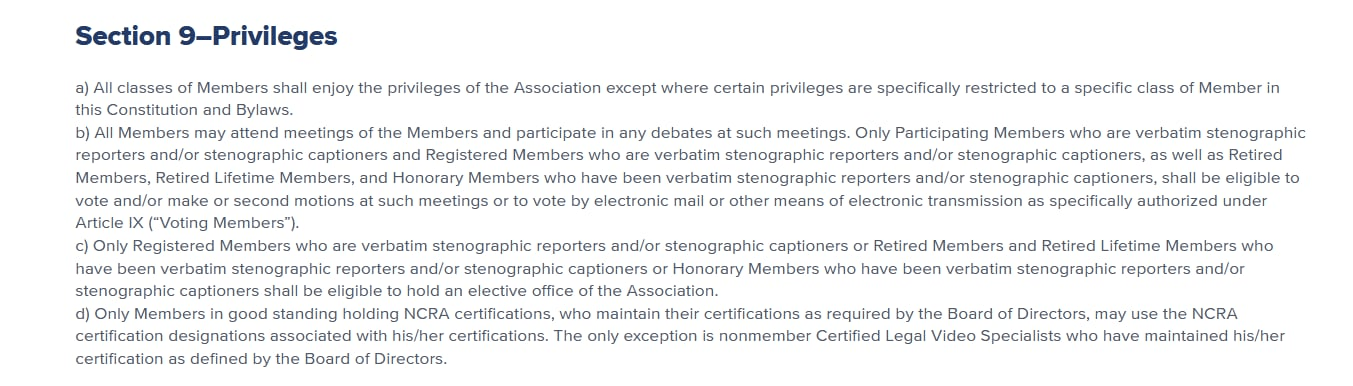
Even better, this potential violation of law is written right into the bylaws.
I’ve reached out to a lawyer myself. I’ll see where it goes. But from my reading of everything, members would have much more standing than I would. Especially members who require certification to work in their state. Imagine getting back years or decades of dues that you were all paying that you never had to pay in the first place. Isn’t that worth getting together and giving it a shot? You decide.
Because we already know the NCRA’s stance. Pay, pay, pay, and don’t complain!
I’ve been made aware of the lawsuit Pasqual Perez III v the Speech-to-Text Institute, the Texas Court Reporters Association, and a host of other court reporting services. Maybe I didn’t beat STTI, maybe it deleted its site to cover its anticompetitive behavior.
I did ask Pasqual, who I’ve always known as Trey, for comment before I posted this blog. I asked a few others too, but since there’s pending litigation, people understandably didn’t have any comment to make.
“Hi Christopher. For now I will just let the complaints speak for itself. Thanks, Trey.” – Pasqual Perez III
I think the most creative way to approach this is go bit by bit through the lawsuit and share my thoughts as someone who has a good general understanding of the field and has been talking about Speech-to-Text Institute’s anticompetitive behavior for a long time.
Austin Legal Video v Speech-to-Text Institute et al.
Beginning is real simple. It’s an antitrust action. Competitors cannot get together and perform group boycotts to force other competitors out of the market. That’s the basic idea going forward.
They mention this “fend off the attack by the barbarians,” line and attribute it to “the former president of the National Court Reporters Association.” I become confused by this later, because they attribute it to Steve Townsend. I thought he was involved in AAERT and STTI, not NCRA. Now, keep in mind, this is just a complaint. Just like the US Legal lawsuit, it’s just allegations. Let’s keep going.
Blah, blah, blah, boring legal stuff. That’s what this part is. It’s true.
The complaint starts listing the parties and talks a little bit about the field, how some lawyers contract directly with court reporters and some use litigation support firms. Pretty standard stuff.
This continues for a little while.
It names the Texas Court Reporters Association as a party, as you see above. Then it mentions the Speech-to-Text Institute.
Still nothing special. It’s just going through and talking about who the parties are.
This is where it gets kind of interesting and mentions Steve Townsend in the context of NCRA again. I would appreciate it if court reporters with a better memory than mine correct the record, but I really remember Townsend as AAERT and not NCRA. The complaint is basically saying that STTI was meant to keep competition like Trey’s out of the market in favor of the established methods. I actually think there’s some truth to that and sent an email to the plaintiff lawyer, which is included at the bottom for your viewing pleasure.
The complaint gets into a little more about the industry. Still nothing particularly juicy for my audience, who are mostly court reporters that know roughly how this stuff works.
Now, it launches into an allegation that innovative technology is not welcome in the court reporting industry, and I would actually argue that this is true, but with a simple explanation. The digital court reporting side of the equation is obsessed with firm profits. They’ll push digital regardless of who it hurts or how illegal or unethical the behavior might be. The stenographic side is skeptical of technology claims because they’ve been misleading for at least the last half decade. There are studies such as Testifying While Black and Racial Disparities in Automatic Speech Recognition, which point to the inferiority of other methods. Right off the bat, the stenographic defendants are in a much better spot, because they can simply say they weren’t convinced the tech was right for them based on the long history of tech sellers outright lying to people in our field. I’m not saying Trey is a liar. I actually think he’s one of the honest business owners out there. But I am saying that court reporting businesses are right to be wary, and my cursory understanding of law makes me think that might just be a problem for his lawsuit.
This part is mostly about uncertified roughs. I think that’s where plaintiff believed the money would be. It’s a fair allegation.
Then it’s laid out that before being blackballed, comments from a Lexitas production manager seemed to point at his product being accepted.
The allegation is made that Shelly Tucker told him he was being blackballed. Obviously, in the context of an antitrust suit, these would be important statements for the parties, and eventually, a fact finder, to examine. But again, court reporters could just point to the long history of tech claims being deceptive and say that Trey just got lumped in with them in their minds. As far as I know, businesses can all independently come to the conclusion that they don’t want to work with another business. If they can point to doubts they had about the product or things they didn’t like about Trey’s reputation, it might just be enough to explain why they came to that independent conclusion. And Trey does have a bit of a reputation. For example, he was being fairly abrasive in one of my Facebook groups, and I had to ban him. But then later we had a brief discussion, and I remember understanding some of where he was coming from. I guess my point is that this is a mixed bag, and if he got abrasive with business owners, they might just point to that behavior to escape this lawsuit.
This is more of the same. Was it antitrust blackballing? Was it a concerted effort to break competition? Or was it the “tech exhaustion” that court reporters have suffered from for decades? Remember, we’ve had tech sellers telling us our replacement is on the way for decades. At a certain point, you’d just start to paint all tech solutions with the same “prove it or lose it,” attitude conveyed here. It mentions how court reporters got angry over the Stenograph logo change. But to be fair, Stenograph had other problems.
It mentions that court reporters attempted to get regulatory action taken against Pasqual and StoryCloud. The complaint against Trey was dismissed. The writ filed against the JBCC for StoryCloud caused the company to shut down, so in the court of public opinion, we’re pretty sure they were breaking the law. Again, not Trey, StoryCloud.
I’m just going to put this out there, it’s absurd to think that trying to get the government to enforce the law equally is anticompetitive. I understand if this is being given for background, explaining that Trey’s company was not breaking the law, but otherwise, I don’t see the value.
This is where we point the finger at the Texas Court Reporters Association. It’s basically saying “hey look, they were discussing me right before this boycott.” But I think it’s the substance of those discussions that might make or break the case against TCRA. Court reporting associations across the country are very, very cautious when it comes to behavior that might violate the antitrust laws. Some might say overprotective. For example, trade associations can gather and distribute aggregated pricing data, but almost none of them do because they’re afraid of antitrust claims. Reconciling that fact with the idea that TCRA was engaging in conspiratorial or group boycott behavior is going to be one of the paramount goals of the plaintiff.
The complaint talks about the markets this affects. It’s actually really interesting because it breaks down what I would refer to as the court reporting and stenotype services market into certified transcript, uncertified transcript, video recording, and speech-to-text markets.
It keeps going on about the markets. I didn’t see anything particularly important at this part beyond fleshing out the complaint/allegations some more.
This is where the complaint really starts to drive home the damages. Basically boils down to “we were blackballed and boycotted in all these markets and then we lost substantial revenue.” If you follow my work, you know that I consulted with a lawyer as it pertains to the Speech-to-Text Institute’s anticompetitive behavior, and I was told that a successful action needed 1) Monopoly power, 2) Anticompetitive act, 3) Damage. If Trey can show damage, he might really be able to stick it to the Speech-to-Text Institute. Anyone reading this has probably figured out that I have some doubt that the case can be proven against stenographic court reporters. But I think it’s a slam dunk on STTI, the organization that failed to defend itself against fraud claims made by me for like a year and a half and that was, in fact, a group of competitors syndicated behind a shell nonprofit to pump the market with misinformation and manipulate it — the same organization that deleted its website about a month after this lawsuit we’re talking about was filed.
I don’t know about procompetitive, but I do know there are social and political reasons for stenographers to stand up against the speech-to-text stuff. Again, it’s all related to the bogus claims made by tech sellers of the past and the science that I mentioned. That’s not a reflection of Trey’s business, but it is an unfortunate market reality.
More legal jargon and the beginning of the prayer for relief. The complaint is starting to wrap up at this point.
This part mentions that to the extent any procompetitive business objectives exist, such objectives could’ve been achieved by something other than total boycott. I actually agree here. I think the players in the market can invest in a little more science to work out what the best methods are in what circumstances. But this responsibility falls to the bigger fish in the pond, as a lot of the smaller owners simply can’t afford to fund such an endeavor. Coincidentally, many of those bigger fish were backing the Speech-to-Text Institute’s bogus claims and its agenda of market manipulation.
The complaint continues to state the causes of action. For anybody that’s never drafted a complaint before, if your complaint doesn’t allege facts that would support a cause of action, your lawsuit can be dismissed. Federal pleading standards changed after Twombly, so lawyers need to write much better complaints than in years gone by.
Plaintiff demands a jury trial and asks for an injunction, damages, treble damages, attorneys’ fees, and interest.
There it was. His lawyer’s email. I couldn’t help myself. I felt compelled to write to Dov Preminger. So I did.
If more information comes in, I’ll put an addendum right below here or make a new post.
Private equity’s incursion into medicine, court reporting, and beyond is about siphoning more of the ecosystem to its control because control makes more money, regardless of the societal consequences. If it truly had a better product, there would be no need for subterfuge. The future belongs to reporters. Together we can give a voice to the principles of accuracy and integrity we hold dear.
Veritext and Esquire brought antitrust suits that seemingly were consolidated against the Louisiana Board of Examiners of Certified Court Reporters. The complaint and settlement agreement can be found on the board’s website. The rules of this game should now be pretty clear. Where court reporters get laws enacted and there are attempts to enforce those laws, lawsuits will follow to wear down the will to enforce the law. Where court reporters fight to enact laws, the multimillion dollar corporations will have more money to lobby government and probably buy our lobbyists too. Where court reporters have laws that go unenforced, the multimillion dollar corporations get to corner and control the market oligopoly style while the government keeps the court reporters in check. Meanwhile, associations are hamstrung by the legal liability of being “competitor collectives.” I’ve only ever said what we’re all thinking: This game is rigged. That is not to say the lawsuit wasn’t meritorious, but then the law isn’t always just.
This situation is not without hope. Over the years I’ve read and written about employee misclassification. Things vary a little bit from place to place, but my understanding of the law is it doesn’t matter what the “employer” and worker call the relationship, a worker can still be found to be a common law employee for purposes of unemployment, workers compensation, Title VII, taxes, or other American rights, like the right to unionize. There’s a form SS-8 from the IRS for determining worker status. There are also DOL complaints. Of course, any one reporter could be singled out and retaliated against, so the key would be for a group of reporters from a similar geographic area / regional office to file, make the case that they are common law employees, and then get a petition going to start a union, preferably with the help of a lawyer.
This kind of organization isn’t easy, but it seems necessary. We face a de facto silencing as the multimillion dollar corporations continue broadcasting digital court reporter jobs and minimizing our online presence with articles about our “impossible” shortage.
Digital court reporting proponents mislead jobseekers by not educating them on the actual state of the industry. From Reddit r/courtreporting.
Just some of the things reporters could collectively bargain for are the right to refuse jobs, the right to work from home, equipment reimbursement, support contract reimbursement, higher pay or page rates, stenography training funds for digitals, staffing ratios of stenographers to digitals, paid association dues for court reporters, severance pay, paid leave, or even some retraining money in the event there is a major technological breakthrough that makes us redundant, which is unlikely. If the big box claims it can’t pay, it may have to open its books to the union.
There are good arguments for court reporters being misclassified under the law. Top of the list is that these businesses couldn’t exist without their independent contractors. Our businesses are not independent of theirs, our business is their business. Where there are ABC laws in place, the independent contractor is (A), free from direction and control in performing the work. A lot of us really aren’t. We’re forced to use a certain layout. Many of us aren’t allowed to subcontract jobs. The agency picks what they want to offer us. We don’t meet their terms, we don’t get the work. (B), the work takes place outside the usual business of the company and off the site of the business. I would love for these companies to defend themselves by saying court reporting businesses are not in the business of court reporting. (C), the worker customarily is engaged in an independent trade, occupation, profession, or business. This is where a lot of us are true independent contractors who have business with multiple firms or even lawyer clients. But for those that are working with the same company for years, as I did with Magna, there’s a real argument that they’re not engaged in independent anything.
In New York this is even muddier. The Court of Appeals, New York’s highest court, looked at who controlled the customer and assignments in the Postmates decision. Some of the things looked at there? Postmates (1), determined which couriers had access to which assignment. Sound familiar? (2), set the delivery fee charged to customers. In New York, at least, the agencies definitely decide the fees. (3), paid couriers a non-negotiable percentage of the delivery fee. Some agencies allow negotiation and some set rates. Some do both. (4), took on the risk of loss by paying couriers for deliveries regardless of whether the customer paid. Again, something that happens routinely in our business. (5), paid a portion of the couriers’ business expenses through prepaid debit cards. (6), did not permit customers to select specific couriers for deliveries on its platform. Lawyers can request us, but only if they know about us. We are effectively “hidden.” Even then, the agency decides whether or not to send us. (7), tracked the courier’s location and provided customers with estimated delivery times on its platform. Agencies occasionally attempt to put out rules like arriving 30 minutes early and so on. (8), assumed responsibility for replacing couriers who became unavailable after accepting a delivery. Agencies do this. (9), handled customer complaints and in some cases retained liability to customers for incorrect or damaged deliveries. One agency in New York has actually had reporters handle customer complaints after the Postmates decision according to a freelancer source, so there may be a shift here, but prior to the Postmates decision agencies generally handled customer complaints. As you can see, those of us with independent business or work from multiple sources may not qualify, but there’s ground to argue.
As individuals, we hold an advantage over organizations. We can make decisions and enact change much faster. Other court reporters have prodded at the issue, and it was enough to prompt talk of settlement.
Halbert et al v Atkinson-Baker Inc class action settlement notice raising a misclassification issue. Docket Alarm link to case.
We have a fairly predictable ethos in court reporting of clinging to our freelance title. That title actively robs us of our right to speak to each other on the issues that matter. It steals away the rights that most court reporters would have if properly classified under law that you just read with your own eyes and/or screen readers. Agencies understand court reporter culture and our lean towards tradition. They not only know the game, but how we react to the game. Who would continue to play a game knowing that it is rigged? If your opponent had a copy of all the moves you were going to make in a chess game, would you keep following the script? Stenographers should lead the movement and we have the best shot at altering the script. If digitals beat us to it, it’ll probably be the other way with contracts favorable to expanding digital.
It’s a question of whether we fight back in the name of ethics, accuracy, and the future careers of the students we’re training today, or whether we lay down and let private equity eat the industry ecosystem for the benefit of its bank account. The heart of what I’m doing is educating working people that things aren’t always as they’re said to be.
DOL Communication to Christopher DayDOL Communication to Christopher Day
I find it funny that digital court reporting proponents like Veritext have antitrust concerns while they work together to lead the organization that was publishing fraudulent / misleading statistics apparently meant to manipulate a market.
Speech-to-Text Institute leadership primarily consists of digital court reporting proponent organizations. STTI is the organization that pushed misleading statistics to consumers and jobseekers. Speech-to-Text Institute leadership primarily consists of digital court reporting proponent organizations. STTI is the organization that pushed misleading statistics to consumers and jobseekers.Speech-to-Text Institute leadership primarily consists of digital court reporting proponent organizations. STTI is the organization that pushed misleading statistics to consumers and jobseekers.
A few thousand dollars and we shifted the narrative from impossible shortage to scumbag corporations tricking honest people. If you think I’m wrong on this, just look at my long history of running the corporations ragged with a minuscule fraction of the resources they have. They understand us? I understand them. And reporters talking about this post is their worst nightmare.
The FTC has changed its complaint procedure. To briefly explain antitrust, companies aren’t allowed to work together to mislead consumers. By setting up dummy sites to mislead student consumers and making the stenographer shortage seem larger than it is, Speech-to-Text Institute, Veritext, and US Legal appear to be doing just that.
Please take five minutes to send this information to the FTC. More attention on the issue means a higher likelihood the government will act. First step, click this link. Now follow the pictures:
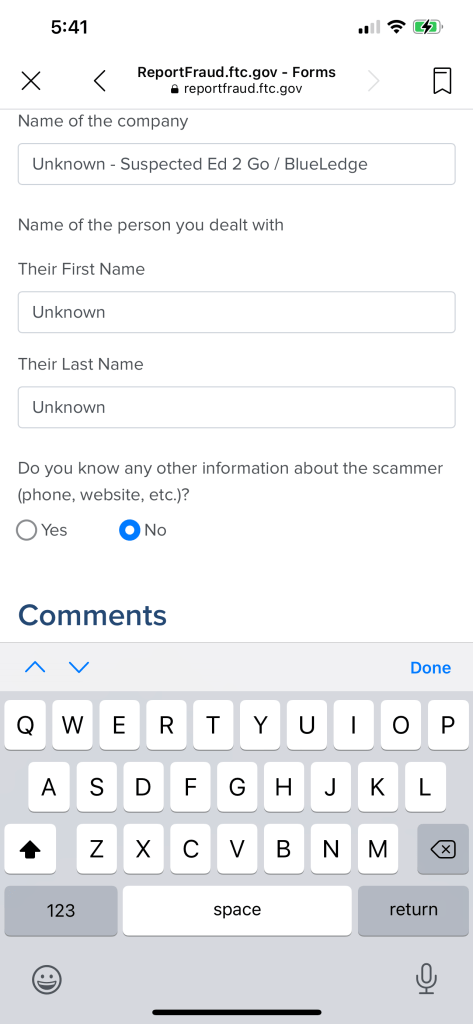
Since we are reporting something about a job, click job, investment, or money-making opportunity.Job scam, job listing. This most closely matches what we are reporting.Since our evidence is heaviest on CourtReporterEDU, let’s go after that. You can change the date you first noticed the problem.As you’ll see in my article, it appears this activity is related to BlueLedge. We don’t know that for sure, which is why I write “Unknown – Suspected Ed 2 Go / BlueLedge.” Give the government a brief synopsis of what’s going on. You can copy word-for-word what I write here.
It’s important to mention that the NCRA was lied about. Here is proof.
You’ll have to give the government your contact info. Don’t enter mine.If you own a business damaged by the illegal conduct, feel free to enter its information.Submit your report and get your report number.
Remember, more reports will mean higher likelihood of action. We are a field of nearly 30,000 stenographers being victimized by this illegal corporate conduct. Ask your fellow reporters to take this seriously. Single complaints are not resolved by the FTC. Hundreds or thousands will get their attention.
Students who were misled into digital might be able to get their money back thanks to you. Remember, your action counts.
This likely concludes my work on the illegal conduct angle. In defense of our profession and the law I have spent the last many months documenting the illegal conduct. Now I need associations and stenographers across the country to take action. Feel free to tell the FTC it was my idea. Any agreements that restrain competition are illegal. Bamboozling consumers to affect the market counts. The government relies on Americans like us to report crime. If you were watching a robbery, would you call it in or would you sit by and say “well, no court has told me this is illegal?”
We all have a choice. I hope you call it in on this metaphorical “robbery in progress.”
P.S. Michael McDonner of Kentuckiana attempted to intimidate me by stating I was attempting to conspire with others by trying to get others to act on the illegal conduct. This is an example of the digital camp trying to scare us into inaction. It’s the same reason Naegeli threatened to sue me. I expect members of the digital camp to try to intimidate some of you. Know that arguably all of you with no direct clients are common law employees and not direct competitors and therefore cannot illegally conspire. We’re not the ones benefitting from the illegal market rigging. Do not let these bullying tactics stop you from doing what you know to be right.
There appears to be horizontal conduct occurring in our field. Speech-to-Text Institute, Global Alliance of Speech-to-Text Captioning, Veritext, and US Legal all appear to be giving misleading data on the shortage to lull consumers into being okay with digital court reporting. With Veritext and US Legal specifically, they are not trying hard to recruit and wedging digital court reporters in under the guise of shortage. Out of all of them, Global Alliance seems the least culpable. The most I’ve personally seen them do is ignore the data that digital court reporting is bad news for captioning.
From the student angle, USL bought and killed Stenotrain. Veritext uses digital court reporting trainer BlueLedge. BlueLedge partnered with Ed 2 Go, a company that was using ESYOH splash pages to lure student consumers into digital court reporting. When we alerted ESYOH to the illegal conduct, ESYOH helped kill the illegal splash pages.
I’ve done a few things to push for action. I’ve posted right to NCRA’s pages that there should be action. If this discussion is killed, let us all ask why. Our brave volunteers on STRONG and in other committees are fighting very hard to protect this field. The organization needs to throw its weight on this problem.
Also on the freelance page, Facebook.
I’ve also posted to Reddit. User Tracygee immediately pounced on my recent mental health issue. This is bullying to silence me, nothing more. Another user, Dozzi92, jumped into say she’s right.
But guess what? When challenged, Dozzi92 backed down. Turns out they can’t contest the veracity of what I’m saying. They just don’t like that I’m saying it.
*it’s honesty that’s frankly refreshing. Stenographers make typos too.
The bottom line is that we have a national association membership that is fighting tooth and nail against this stuff. My detractors have nothing to point at except “he had a medical issue in December 2021!” The national association must get behind its volunteers with the full support of its general counsel and funding. If not now, when? We have brave leaders like Stacey Raikes giving their all for this profession. We support them. We must demand NCRA give them full operational support. Often we are told that NCRA is busy with this or that. There’s no boot camp this year. How about that time is used purely on this issue, since this issue affects the health and future of our entire profession and the NCRA itself?
Addendum:
Tracygee resorted to lying about me on that Reddit post. I feel it is important for our field to see.
For clarity, this is an urgent and important issue. ESYOH is being used to lie about NCRA’s position on digital court reporting. I have alerted NCRA to this issue.
This is not true. NCRA never predicted over 33,000 digital court reporters could be needed by 2033.