My Facebook page has become the steno channel. If it’s good for the working reporter, it’s on my page.
And though it may be difficult to read, I do try to keep it entertaining.
Christopher Day calls for Stenograph boycott, November 2021
For anyone that doubts calling out the bad customer service and horrible PR blunders is having an impact, you can stop doubting now. For the first time since March, Stenograph threw up a pro-stenographer image on its Instagram.
Stenograph Instagram, 11/17/21
Truth be told, I still view this sort of thing as corporate appeasement. They hope you will forget that they are screwing the students you mentor and continue to purchase their products and services. It’s a great sign that the Stenograph company wants to appease stenographers, because it means that we represent a large enough part of their customer base that pulling out wouldhurt. Withdrawing our support would matter. If more reporters heed my words and pull out fast and hard, we’ll be able to end this a lot sooner.
But seeing that image got me curious. I rolled through the Instagram to see the last time a comparable image was posted. There are some nice pictures advertising Q&A by Cyndi Lynch (who is awesome) and some marketing stuff, but nothing nice like this. While that’s a somewhat subjective measure, you can go through all the images yourself and see that the company hasn’t featured a person paired with a stenotype since about March.
The top left is November 2021, the bottom right is March 2021, Stenograph’s Instagram.
Follow me and our field gets results. Stenograph is eager to jump into a technology that will disproportionately hurt minority speakers. We are in a unique position to stop that.
Getting attorneys to stop stipulating away their consumer choice away is an outstanding move™️, and one that everyone can take part in by spreading this image. If we do not support our national association now, there may very well not be one to support in ten years. If you’re on the fence about renewing, this would be a reason to give it one more year and see what the president does.
Thank you, President Dibble and all the staff at the NCRA for not laying down on these important issues facing our field. If we can get jurisdictions to begin enforcing procedural rules, it is progress on the road of protecting consumers and the legal record.
It was reported to me that a call to Stenograph’s support yesterday took an entire 30 minutes of wait time. At the end of that 30 minutes, the call disconnected. The stenographer called back and was then forced to sit on the phone waiting about another 15 minutes. 45 minutes from call to resolution for someone that paid $139 for help with upgrading their software, on top of the support contract, which cost about $700 a year! I was just kidding about it being reported to me, I was physically present when it happened.
And this is not an isolated incident. It’s been an ongoing problem for months — Stenograph’s shoddy service, that is.
This is on top of reports that Luminex II is cracking in the same spot on the shell for multiple reporters. Maybe we should all start comparing notes and seeing if we are being sold defective products.
The problem is so bad that it simply cannot be hidden.
“I haven’t called today, but the last few weeks I had to call several times, and I have to wait a long time. Twice I just hung up and figured it out for myself.” -Stenograph Customer*“Happened to me last week. It was actually worse than the IRS, and that’s saying something.” – Stenograph Customer*“They’ve always been that way. Eclipse blows them away.” – Stenograph Customer*“Switch to Eclipse and it won’t be a problem lol” – Stenograph Customer*
It wasn’t all bad news though. They pull through for some of the people some of the time.
But they don’t fool all of the people all of the time. Stenograph is taking our money for support and then keeping us waiting on queues like we’re an inconvenience. They’re relying on our politeness and silence. Let me be the one to break the silence: This is wrong. We were propagandized for years to tell us that we needed support, and now the quality of that support is declining while Stenograph tries to build and sell its ASR business off our backs and with our money.
I suppose it ultimately doesn’t matter if Stenograph is sabotaging us. It leaves us to seek solutions to the problems we’re perceiving. Stenograph owners, the science shows ASR is a snake oil market. Make me a fair offer on the company, see if I can crowdfund the purchase. Much better than a boycott — we can get those trainers raking in the dough and make your employees happy too! Mr. Dutta can move on to some industry that doesn’t have a man with a blog. We all win. ChristopherDay227@gmail.com.
The alternative is to boycott Stenograph and buy it when it’s up for bankruptcy. It’s just business.
*There is no evidence that any of the comments were from Stenograph customers.
To preface this post, I do not suspect the previous owner of Orange Legal of anything untoward at this time. Some in our field disagree with selling small businesses out to large national firms, and I understand why, but I am personally ambivalent to the sole act of “selling out.” The only time that I grilled someone for “selling” was Rick Levy, and that was because he lied to me.
BlueLedge was voluntarily dissolved in 2019 even though it still appears to be in operation. Its address? 101 E Kennedy.
Orange Legal has the same address.
So this strengthens the evidence that Veritext and BlueLedge are close.
As previously posted, BlueLedge was voluntarily dissolved in 2019. Coincidentally, after over 30 years of keeping its regular filings, Orange Legal was administratively dissolved in 2020*. It apparently failed to file its annual report. Dissolution is not a permanent thing. Corporations can remedy that and become “active” again.
But the dissolution issue is not entirely without its problems. According to various sources online, contrary to my previous belief that inactive corporations should not be doing business in a state, it appears that dissolved or inactive corporations may generally continue to operate. It is notable that liability may spill over to corporate officers of inactive corporations and that corporations that are inactive may not be able to defend themselves in court.
In short, the dissolution angle does not appear to be the game changer I thought it was. It’s still pretty interesting and puts any dissolved company that’s breaking the law at a serious disadvantage. For example, in a state like mine, a consumer can bring a deceptive business practice claim. If a consumer were to do that against an inactive corporation, it is apparent the corporation would have to solve the dissolution before it could even begin to defend itself in court. And in New York, where lawyers can cost $400 an hour, that’s a lot of money.
Addendum:
Shortly after release of this post, a reader pointed out Benjamin Jaffe of BlueLedge worked for Orange Legal.
Addendum:
*On 11/28/21, well after publishing, I realized that the holding company for Orange Legal came up in place of Orange Legal and I have now added images for both entries. Note that my original line about when the dissolution took place may be off, but the images of the publicly-available info are exactly what I saw.
BlueLedge is the digital reporting training company that apparently dissolved two years ago in Florida that I suspect is behind CourtReporterEDU. BlueLedge, as far as I can tell, continued to operate after its voluntary dissolution in 2019, because in August 2020, it entered a strategic partnership with Ed 2 Go.
Many reporters reached out to let me know that Veritext used or uses BlueLedge, but I didn’t have time to look into it. Finally, someone sent me the Google search. Step A, if you want to complete Veritext’s digital court reporter partner program, is to register with and complete the BlueLedge program.
This, by itself, isn’t much of a problem. But it strengthens the argument that the court reporting shortage is being exaggerated and exacerbated by Veritext. If the company was genuinely interested in recruiting stenographers, it might have constructed such a detailed pipeline for the education of stenographers. Instead, the company routinely tells stenographers what they want to hear and pours its resources into expanding its digital business despite the potential harm to minority speakers. One reporter brought up to me that Veritext has some involvement with a school in Maryland. I have even reported on its scholarship activities. I’m happy about those pro-steno activities. But at a time when 50% of our field, according to Ducker, is in California, Texas, Illinois, and New York, and while Veritext is working with BlueLedge, a company that has hooked its claws into national recruitment using Ed 2 Go, it remains clear where Veritext’s priorities are — expanding digital recruitment not as a supplement to our shortage, but at the direct expense of stenographic court reporters.
Telling consumers/attorneys that no stenographer is available while taking steps to alienate practicing reporters and undermining our industry’s intense recruitment efforts is just wrong. It’s like Burger King lighting cattle fields on fire and yelling about a beef patty shortage. The only difference is we would all immediately identify the arson as criminal, whereas here, if you hide the dishonest, anticompetitive, and potentially criminal behavior behind layers of dissolved companies and corporate paperwork, you get people defending the bad behavior. What would we do without Veritext? Probably be a lot better off!
Less importantly, Stenograph was getting cozy with BlueLedge as early as August 2021.
So let me add that to Stenograph’s PR problem. We need to boycott the company until it sells for stenography and voice writing only. We want no more expansion of digital court reporting. Keep hard on that line and it will happen. Consider Stenograph an arms dealer. It thinks it will sit there and sell to both sides. Except, in this very particular case, our field of stenographers has far more customers and most of our money is earned as opposed to being “borrowed” from investors. We are in a much stronger position financially even if we believe digital reporting has more actual dollars down on it. A lot of people in our field became CaseCAT trainers. They’re killing your industry and income to build digital. I want to grow stenography so you have more business. So even the CaseCAT trainers have a reason to stand up in defiance here, let alone the rest of us.
Succinctly, the money being sunk into digital reporting is money that investors will be expecting back. When it does not make the returns promised, and we have good reason to suspect it won’t because of companies like VIQ Solutions giving us a window into digital reporting financials ($10 million in losses June 2021), the faucet will turn off. All the companies relying on investor cash flow instead of company profit will start to decline. It is in our best interest as a profession to take the power of our good money away from it. The digital money will dry up on its own. If Stenograph is smart, it will cave to our demands. If it is not smart, we can crowdfund, buy it when it goes bankrupt, and put its employees back to work for us like I’m sure many of them want to be. We can even divvy up what Dutta’s salary would’ve been and give them a raise.
Stenograph, at this point, is relying on our nostalgia of it being “our company” and assuming we will not turn our backs on it. I’ve got some nostalgia of my own. There’s a scene in the original StarCraft that sums up my feelings well. Acting predictably is our enemy. We predictably divide and conquer ourselves time and again. Stand together on this one and watch things roll our way. It’s really that simple.
“An illusion? Are you afraid to face me, Templar?”“So long as you continue to be so predictable, O Queen, I need not face you at all. You are your own worst enemy.”
This continues to be a profound moment in our field where we must choose between loyalty to each other and loyalty to companies whispering “trust us, trust us” while they systematically work to reduce our numbers and undermine our judicial system for profit. Not the hardest decision in history.
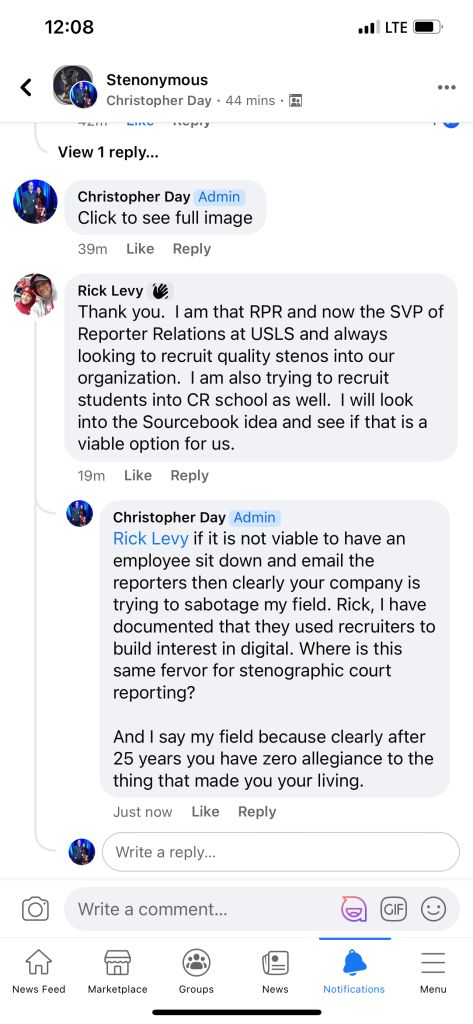
Stenographers across the country should be feeling confident. It’s time to ask for a raise. We were barraged by false claims that the shortage could not be solved. It has been about two months since I first pointed out there was an honesty problem with the company. The company’s response to the social pressure? Run, hide, and hope no law enforcement comes knocking. Prior to my allegations, Rick Levy from US Legal spent a good amount of time trying to convince reporters that the company was on our side.
Image originally posted 9/9/21, Stenonymous.com
What is he doing these days? Pretending that I don’t exist. That’s a perfectly normal thing to do when someone is accusing your outfit of fraud. Right?
It is not my actions alone that are making the difference, but the actions of court reporters across the country. It is all of you educating each other and sharing my posts. It is all of you continuing to supply me with information and monitoring questionable behavior in our industry. It is all of you sending donations so that we can spread word of what’s happening in our field. It is all of you that have filed complaints where appropriate. It is all of you that are bringing my research to attorneys. We are collectively making a difference just like I said we could.
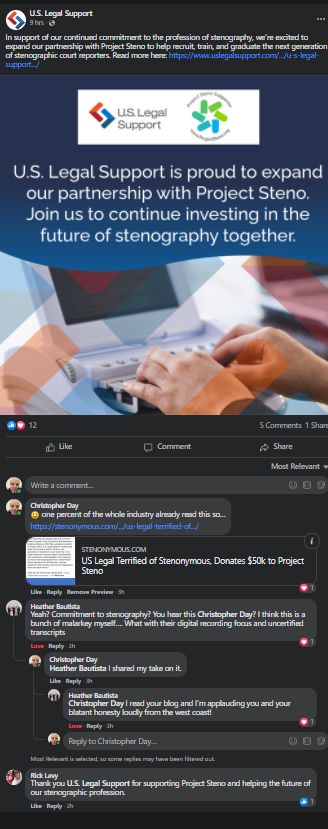
As of today about $6,751 has been spent. Over 260,000 impressions have been made. About $2,800 from donations must still be allocated. Seeing how we are changing the course of a $3 billion industry with less than $10,000, I must ask my colleagues that have not donated to consider doing so. Financial security for me would only free up my time to fight for your financial security and the future of working reporters across the country. In two months you have seen the shortage go from impossible to solve to an expansion of the USL partnership with Project Steno. Trust that every single dollar will make a tremendous impact and that I will not stop until every last one of you has the respect you were robbed of these last two decades.
To my friends in US Legal Supportleadership, you can still start recruiting stenographers and paying them fairly. If you do not, you risk 30,000 court reporters making me a millionaire and a full-time advocate. Abuse thrived in silence and now yours has told us all that we will ever need to know about you.
So I stumbled across the CourtReporterEdu.org website. A pleasant website that is facially neutral. You look at it, and it doesn’t seem to be anything “bad.” It talks about stenographers and shorthand. It has a picture of a stenotype. Looks like the kind of marketing stenographers should be doing.
Then you, reader, head on over to a magical place, court reporting info by state.
And when the reader goes to look at their state, they’ll infallibly get a long list of schools that have “court reporter programs.”
From my review of the New York schools listed, none have a digital court reporter degree. The few that mention digital court reporting sell the digital court reporting as a “continuing education” program. In short, they’re selling continuing education for a degree track that does not exist. Some of these schools have zero mention of digital court reporting on their website. Some schools, like BMCC, you reach out to admissions, and they know nothing about the program.
So, of course, I ask Ed 2 Go what the deal is, because Mark Pugal from Ed 2 Go has been trying to sell me on Digital Court Reporting for like a month now.
And of course, I trust, but verify.
BMCC asked for my concerns, so I put them out there.
Now, just to explain, in part, why I think CourtReporterEDU and possibly Ed 2 Go is being dishonest: (1) In many of the schools listed, when one goes to independently verify the existence of the program, it doesn’t seem to exist. Attempting to verify the program with the schools that actually do seem to offer it leads to this roundabout “we don’t have that program, but actually we do” response. Maybe at the point colleges are selling programs with no future and are so insignificant the admissions department doesn’t know they exist, or they don’t exist, we’ve gone too far. (2) Even where the program exists, it is selling students a course in something that is not the industry standard and does not have as many opportunities. (3) Putting a stenotype on your homepage and then diverting people to digital court reporting via esyoh.com and Ed 2 Go is just dishonest. Even if we forgive everything else, the way this page is set up is to confuse people and lend legitimacy to digital court reporting that it does not deserve.
At the bottom of this page is a video walking people through that part. Now for a bit of speculation. We know from the WHOIS lookup that the registrant’s address was in Florida. The server the site is hosted on appears to be in California, but that’s likely irrelevant.
Luckily, one of the schools actually advertising the program gives us a peek into who might be promoting it. Wagner College lists Merritt Gilbert and Natalie Hartsfield.
Merritt Gilbert is apparently in Florida and connected to BlueLedge. BlueLedge, as some may remember from a prior post, are aggressively marketing digital as the answer to the stenographer shortage exaggerated and exacerbated by STTI, Veritext, and US Legal. The author of that article stating digital reporting is the answer to shortage? Benjamin Jaffe. Who is Benjamin Jaffe? BlueLedge.
Who is Merritt Gilbert? BlueLedge.
Who is Natalie Hartsfield? Digital, BlueLedge, Florida.
Now here’s where it gets really interesting. Remember when I wrote yesterday that US Legal has been on inactive status in New York since 2001? BlueLedge, according to Florida Department of State, has been dissolved since 2019.
And just for anyone who thinks “maybe there are two BlueLedge companies in Florida,” take a look at that mailing address, 101 E Kennedy Blvd. Guess what the address for BlueLedge is.
If you guessed 101 E Kennedy Blvd, congratulations.
How is it legal for a dissolved company to misdirect the public, searching for stenographic reporter training, to Ed 2 Go and digital court reporting? It might not be, but it’s going to depend on us asking our various government agencies to look into this as a matter of false advertising and possibly operating illegally in the state. I reached out to my New York State Education Department as it pertained to this course being sold to New York consumers. Maybe this is something the members of each state association can tackle.
This situation blew my mind. We cannot stand for this. We have to fight and understand that we are playing against people that do not play by the rules or within the bounds of our self-imposed moral code. I have collected these images and ideas in a central place. Please use them to do good. I should note that at least one consumer was extremely confused and came onto our message boards asking about how to buy a stenotype for digital court reporting. We must act with compassion. Consumers are being lied to and we are the only people with the knowledge to explain it to them. They WILL stumble onto our message boards confused because they ARE being bombarded by lies.
Addendum:
After reaching out to ESYOH well after this article, they took action! The scheme is now less potent because of their valiant actions.
Where the schools used to lure students to a splash page, they now lead to box about degrees.
In an effort to obfuscate its fraud and deceit, US Legal donated $50,000 to Project Steno on Friday.
Much like with Stenograph, I applaud donations to pro steno causes. But let me just say that it is an incredible coincidence that all of the entities undermining stenographers have ditched NCRF and NCRA for Project Steno. The only people that might benefit from NCRA being weaker? Digital reporting CEOs.
At this juncture, I don’t have any information that Project Steno is doing anything bad. It’s my assumption that it’s being used. The appeasement of stenographers has been a corporate tactic for a while. Given how US Legal and Stenograph both donate to Project Steno whenever there’s any modicum of political pressure applied to them, I think it’s safe to say that that’s what these “big ticket” donations are.
Just to put into perspective what stenographers are generally asked to give, NCRF asks its angels to donate about $1,000. If you make $100,000 that’s 1% of your income. If you make $200,000 that’s 0.5% of your income. US Legal is estimated by Owler to make about $100 million. 50,000 is about 0.05% of its income if Owler is accurate. To put this into better perspective, this would be like celebrating me donating $50.
So unless we are ready to celebrate me donating $50 on the same level as that $50,000 donation, we shouldn’t be celebrating US Legal. Remember that US Legal is the company that bought and destroyed StenoTrain and has advertised for a digital reporter on LinkedIn every day since I accused it of fraud, including the day of its donation. This is the company that, on multiple occasions, attempted to frame the stenographer shortage as impossible to solve despite clear evidence and math saying that it could be solved. The donation is a hedge or hedging strategy. When they fail to eradicate stenography, they hope they will get to turn around and point to their Project Steno donations to “prove” their good will towards the profession. They’re probably even relying on me doing what I usually do, backing off, and saying “wait, let’s see.”
Let me surprise everybody. Keep the pressure on hard! I repeat my words yesterday. If your profession was going extinct, they wouldn’t give a damn about you. You hold all the cards. Keep pointing out to attorneys that they are being defrauded. You can use materials by NCRA STRONG and Protect Your Record Project to do it. Digital proponents really whine when we use the STRONG stuff.
“Waaah, the stenographers we were trying to lie out of existence didn’t lie down and die like we told them to.”
Keep starving the company pushing so hard to starve you and your families. The company does not deserve your mercy or the benefit of your doubt. The company’s Chief Strategy Officer had no problem bullying the women in our field or others. The company had no problem underpaying stenographers. The company had no problem charging unreasonable rates for services. We need to have no problem burying the company under the weight of its own dishonest, incompetent, and arguably illegal behavior.
I must urge colleagues not to relent. Every time you share my video or research and every conversation you have about it leads to a world where US Legal can no longer ignore its bad behavior. From potential collusion to operating in a state where it has been inactive for two decades, US Legal has a lot to answer for.
Seriously, it’s been inactive in New York for 20 years. I’m still trying to figure out if it’s even allowed to do business here while in inactive status.
Some will have seen the scathing post I made on Friday about Stenograph’s survey. They wanted to know if court reporters cared about tall or short keys, and I pointed out that such a concern was a waste of time and effort. This is on the heels of news months ago from Stenograph customers that they were unable to log into their software. But the question remains, how do you get me, a stenographer that has exclusively used Stenograph products for 11 years, to write something like this?
Simple. Stenograph has been making moves to cuddle up with digital court reporting and ASR. We know this from who they’re hiring.
We know this from who they’re talking to. Stenograph cuddled up with anti-stenographer writer Victoria Hudgins after the customer base complained about the logo change. How do I know she’s anti-stenographer? I wrote her over a year ago to point out that Stenograph apparently gave Legal Tech a stock photo and that there were several inconsistencies with the companies, news reporting, and technologies at play. Was any of that addressed? No. So Hudgins writes as an “analyst” but does not actually appear to do any analyzing beyond the chosen narrative — very much like STTI. This is in stark contrast to other organizations like NCRA, NVRA, and Global Alliance, all of whom are far more fair and balanced in the way they present ASR and digital reporting than how stenography is treated by Hudgins, Cudahy, STTI, or even the AAERT.
We also know that Anir Dutta, President of Stenograph —
— is on the board of STTI.
[sic]
And we know that STTI is a digital reporting propaganda outfit. So it’s undeniable that Stenograph is diversifying. Under normal circumstances, we could maybe call that smart. But these are not normal circumstances. This is a world where we know ASR and digital reporting will hurt minority speakers. We know digital reporting outfits like VIQ Solutions are not turning a profit. We know that the shortage is being exaggerated and exacerbated by Veritext and US Legal. Stenograph is diversifying under the belief that there will be a drop in supply of stenographers and a rise in demand. The data we have today says the demand may not be rising as quickly as anticipated and the supply is not falling as quickly as anticipated. The Bureau of Labor Statistics data may also be wrong. In short, Stenograph is diversifying out of a market where its stenographer customers will likely reign supreme. We also know that they’re in such a rush to diversify that they branded over Phoenix theory with Phoenix ASR. Not too subtle about paving over us there.
I’m not the only one to feel that way. Massachusetts Court Reporters figured that all out too, and released an open letter earlier this week. The letter was reportedly also sent to Anir Dutta via email.
In full disclosure, I did help draft an initial copy of this letter, but what was ultimately released was way better than what I wrote. I also wrote a physical letter to Anir Dutta on November 2, which I will release someday in the future, assuming the company does not change direction. It is my sincere belief and hope that he is not against us. I think that he saw what happened to Kodak and he tried to adopt digital as a way of preventing Stenograph from sharing the same fate. A lot of the stuff we know about digital reporting companies today, we did not know when he started at Stenograph. But even if he has no animosity towards us, it will not stop him from making decisions that negatively impact our field, and so to the degree that Stenograph and Anir Dutta make decisions like that, the ball is in our court to stop them.
Now, stenographers, the important thing you need to keep your eye on is how the company responds to all of this. If the writing was on the wall and stenography was doomed™️, they wouldn’t care what you think. Put it this way: Have you ever asked yourself what a T-Rex would think of you? Probably not, because all the T-Rex’s that might have thought about you are dead. We know the writing is not on the wall and that our thoughts and opinions matter very much. How do we know? Stenograph commented on the situation.
And, of course, realizing that if we actually get Stenograph to change direction, the shortage fraud gets exposed, Jim Cudahy did his best to broadcast the message.
Just to be clear about why I’m not nice to Cudahy, he was the Executive Director of NCRA, urged the organization to commission the Ducker Report and learn about the stenographer shortage, and then used his previous title with NCRA to lend credibility to his false and misleading claims that the shortage is impossible to solve. People familiar with this situation basically point to him as the man that weaponized our shortage against us. The jump from NCRA to STTI was not the result of some profound change in technology, it was opportunism, plain and simple.
What I need court reporters to understand now is simple: You have all of the power in this situation. You tell the company as loudly as possible that you will not buy another product and that you will not recommend the company to a single student from now until the end of time unless they change direction, and they will change direction. If they do not change direction, it is clear just how much we meant to them, and it should make it even easier to walk away. If they change direction, I’ll be the first to say GO STENOGRAPH. Until then? I have to lean boycott. It’s our best play and the most direct way we have of influencing the company. Take all the anger we routinely experience via social media and channel it into something very simple and healthy for us all.
Now, inevitably, some will look at Stenograph’s response and want to side with the company. But here are some things to consider for each bullet.
1. Stenograph states it continues to invest heavily in Luminex II and CaseCATalyst. Maybe so. But let’s not shy away from talking about how quickly the company discontinues support for its products. When I was a young reporter in 2010, I was told by teachers that my first machine should be paper. I failed to follow their advice and I bought a Diamante. Not long after, Stenograph sold its paper business and systematically shut down support for anything “old.” My rebellious decision ended up being a smart one. The company does that so much now that we don’t even discuss it as a field. It’s kind of like the EA Games of Court Reporting.
2. Stenograph states it has doubled the number of engineers working on writing enhancements. This is impressive if the engineering team is fairly large, but for all we know they had one person working on it and doubled it to two.
3. Stenograph is releasing a new CaseCAT version in the future and is committed to continuous releases on an ongoing basis. There is no actual commitment here. If they change their mind, they can just say they were committed at the time.
4. Proof It, which is supposed to be ASR for stenographers, will allegedly improve efficiency 40%. There’s no actual reason to believe this claim since ASR from the largest ASR providers in the world is 25 to 80% accurate. 40% is pretty close to 50%. A real 50% efficiency gain would mean transcribing jobs in half the time. If Stenograph created something that could cut transcription time BASICALLY in half, they would be letting you know about that every second of every day until you bought in. Instead it is tucked away in this response.
5. Stenograph claims it continues to have dedicated stenographic teams, but again, this is actually not a commitment. A dedicated team can be dedicated to any number of things. They can be dedicated to digital reporting and stenographic reporting. In a field where two of the largest companies inflate numbers by a factor of six to fool stenographers, it’s not incredibly surprising Stenograph would play with some words in a perfectly legal puffery-like way. It would also be pretty dumb to maintain separate dedicated teams, since you’d be paying effectively double to staff the company.
6. Stenograph announced a partnership of Caseview Net with vTestify. It’s possible this supports my belief that Stenograph is not actively against us but rather being misled. vTestify was that silly company that I blasted for saying it could save attorneys $3,000 on a deposition. After that, they started working more on being a platform and less on being a service. So this, to me, says that Stenograph’s leadership just doesn’t know some things about our field. They wouldn’t tout a relationship with vTestify if they did.
7. Stenograph is committed to growing the profession. And they support this with their Project Steno donations. I hate to punch down on an effort that I commend, because I do commend Stenograph and every company that donates to pro steno initiatives. I actually wrote about Stenograph’s donation in a positive way when it happened. I like Project Steno and I often mention it right alongside A to Z and Open Steno. But at the end of the day we have to realize that Project Steno is a write off and there is a benefit to companies PR-wise and monetarily to donate to it. At this point, it comes off as a publicity stunt to get us quietly accepting the company’s lean away from us. Let’s face facts, NCRA dumped its corporate sponsorship program, US Legal and their pals realized they couldn’t get the NCRA to push the digital product for them, and ever since then there’s been this bizarre “separate but equal” stance where companies just happen to support Project Steno over NCRA or NCRF. Considering that NCRA is basically THE trade association for stenographers, it’s easy to see that the goal is to undermine the stranglehold stenographers have on the market. That’s basically how I regard Project Steno at this point. A convenient place for all the entities not supporting NCRA to point and say “we care about steno too!” It’s called hedging.
8. Stenograph donates hours of training. Most vendors donate when asked. It’s kind of a chicken and egg, cost of doing business thing. You have a society of people, court reporters and stenographers. You have organizations that try to bring these people together, like NCRA. Playing ball with the organization that gives you access to your customers is called par for the course.
9. Stenograph uses a dedicated technical support team. Again, the word dedicated doesn’t even mean anything to me. It wouldn’t surprise me if the “dedicated” tech support is outsourced in whole or in part, just like their stock photo office picture.
I asked some of my audience to give me their comments on Stenograph’s bullets. This is some of what your fellow reporters say:
Respondent A: “My thoughts on it – One of the best things my dad ever told me was “You should always listen to what people have to say, but it’s more important to watch what they do.”
This is a typical PR response, and it sounds nice. But what I see Stenograph doing is channeling their resources to directly compete with their primary customers. What I see is Stenograph entering into increased alliances with STTI (a digital front, despite what they say), and AAERT. What I saw from Stenograph at the NCRA convention was a booth and their separate training offering (I think people had to pay for that in addition to the convention, but I’m unsure on that. If so, then they didn’t “donate” the training.) I saw a decreased level of event sponsorship. When I open the JCR, I no longer see any ads from Stenograph. These actions certainly indicate to me that while of course they would like to keep their steno customers, their focus is now on their digital product.
And I’d like to know if by integrating their realtime platform (CaseView) with VTestify, they plan to mine those transcripts to improve the AI for their digital program.”
Respondent B: “Thanks for sharing. The language in that post and PDF is basic and appears to have been written by a sales executive. Not a whole lot of depth there.
Two things:
Are they going to begin manufacturing and/or selling digital recording equipment?
Their last bullet point appears to be more about shortening their customer service employees’ time on service calls. The language is unclear about their policy or commitment to meeting their stenographic customers’ needs.”
Again, one thing is for sure. If the writing was on the wall, Stenograph wouldn’t care what you have to say. It has tipped its hand and admitted it cares very much. Use your collective power as consumers and walk away until the company is behaving in a manner that is actually accountable to you and not lip service. Let them know that’s what’s happening. Let them know it’s because of me if you want to. They’re using their position as a tech company to make you feel unqualified to judge their product. Meanwhile, when you ask someone like Stanley Sakai, someone that knows computer programming and steno, he can tell you why we use stenotypes. I can too. Why can’t Stenograph? The company has a monetary incentive not to. Take that away and you have a company with no choice but to support us or fold. If the company was on solid ground, we wouldn’t be able to cut through its arguments like Darth Vader cutting through rebel troops at the end of Rogue One. The company’s condition today is not our fault and we shouldn’t feel guilty about using it to our advantage. Certainly no one in this industry has felt guilty about using us.
I got to review this infographic put out by the Speech-to-Text Institute. I had seen it around before, but never had time to study it.
Assuming their numbers are accurate — though I don’t know why we would considering STTI is a digital reporting marketing front — we can already see some issues. From my analysis of available statistics, we have about 28,000 court reporters in 2021. This is just a bit upward from the NCRA estimate of 27,000. STTI claims that in 2018, we had 27,700 reporters, and this is a number taken straight from the Ducker Report.
Why is this a problem? STTI fails to account for ANY increase in recruitment since Ducker. We know that NCRA A to Z, Project Steno, and Open Steno all grew considerably after the 2013 industry forecast. There are other programs like Steno Key that grew considerably in that time. To assume they had no impact tells us all we need to know about STTI’s mission. They do not care about accuracy, they care about telling a story.
STTI also claims we’ll have 23,000 reporters by 2023. The idea that 20% of the field is retiring in the next year and two months is crazy. Just to bring us back to what Ducker actually told us, it told us about 70% of the field would retire over the next 20 years — between 2013 and 2033.
So if we assume that that 70% is retiring evenly over the 20 years, that’s about 3.5% a year. If we assume absolutely no one retired 2013 to 2018 and then suddenly there was a cliff of retirement that would constitute 70% of our field, that would be an average of 4.67% a year. Again, assuming that in any given year 20% of our field is retiring is either stupidity so overwhelming it looks like fraud or fraud so confident it doesn’t care how stupid it looks.
And it is stupid. What if we take the numbers as they are? Digital recruitment is not going well. Between the poor treatment of digital court reporters and our industry’s efforts to let digital court reporters know they’re being played, I suspect the recruitment will only get worse. So what if we had really had a gap of 5,500 reporters in 2018? Well, 5,500 required + 27,700 existing = 32.200 total need. So 5,500/32,200 = about 16.6%. 2018 to 2023, over 16% of depositions or proceedings would have went uncovered, with a growing number of uncovered depositions each year. Those of you that own businesses, are 16% of your depositions going uncovered? Less? That means we are doing better than forecasted. More? That means we are doing worse than forecasted.
Like I always do, I asked Lisa Migliore from Migliore & Associates to weigh in, this time on her uncovered jobs. What did she say?
“I have yet to have a job go uncovered by a stenographic reporter. Sure, there are a handful of days a year where it can be a challenge on a particularly busy day/time to find coverage, but that’s the exception, not the rule. But I have a good relationship with many firms and reporters and don’t engage in practices that make accepting work from my firm unattractive, or worse, ILLEGAL. It’s no surprise to me that firms that are known to contract with parties in interest, are known to dictate low rates to reporters, and are known to engage in unethical practices have a smaller pool of talent from which to draw. I won’t work for these firms, and I imagine there are many others like me that don’t want to take a long, hot shower to scrub the stink off of themselves at the end of a workday either. It shouldn’t come as a surprise that most of the largest firms have become the largest firms by taking unethical and illegal shortcuts to their success, that they value the dollar more than integrity and impartiality in their dealings.”
To be entirely fair, according to Ducker, Kentucky was one of the states with a surplus of stenographers. It’s not surprising that Migliore & Associates is doing well. So I asked a couple of New York firm owners, and they said their percentage of uncovered jobs is under 5%. One firm said only one job has gone uncovered in 30 years. But our shortage in California is forecasted to be worse than the rest of the country, so it seems fair to ask Californian business owners. Out of the people that responded, nobody gave an estimate close to 16% of jobs uncovered, which means to drag the average up to where it’s supposed to be, “big box” companies would have to be letting go of way more than 16% of their jobs. If that’s happening, I think it’s safe to say the problem is the mismanagement of those companies and not our shortage.
Sorry to say, we’ve been duped. These jackals have been telling us the math is stark and irrefutable, and we’ve been eating it up, but the only thing the math actually shows is that our stenographer shortage can and will be defeated if we continue to recruit. The math shows us that we’re the best value workers in the country, because we haven’t asked for a raise in 30 years. The math shows us that if we successfully communicate the fact that attorneys are being defrauded, we do have the numbers to turn this around and build a field far larger than the one we have today. Will we do it? I think so. Fool me once, shame on you. Fool me twice, shame on me. Magician’s tricks only work for as long as they go unexplained. And now that everyone has a quick reference guide for the number games going on here, let’s see what happens.