After Stenograph’s actions in Texas and Illinois, as well as the reports of declining service from the past and its questionable partnerships with TransAtlantic and TranscribeMe, Stenograph would ultimately be doing itself a favor to start reuniting with its stenographer base. In my view, all it would take for any of these companies under the Speech-to-Text Institute to sway stenographers back to their side is admitting that the Speech-to-Text Institute got it wrong with regard to the impossibility of solving the stenographer shortage.
Stenographers, now’s the time to make your voice heard. The petition only aims for a thousand signatures, but according to Stenograph’s own numbers, as I recall from the Illinois article, the number of Stenograph customers is much higher, in the 20,000 ballpark. The more we can do to spread the word, the more pressure Stenograph will feel to accept.
There’s a big question about who would moderate, but my money’s on Joshua Edwards. He’s always been fair and professional. He’d ensure no nastiness. Even I’d behave.
I assume they won’t accept. Then again, I’ve learned to never say never. I was told people would never read the blog. Now at least a thousand visit every month. Stenographers have a real chance at being a part of positive change by trying, so go sign today!
After the release of my blog about Veritext’s British Columbia advertorial, a reader sent me more information on the province. Their verbal oath confirmation from 1980 was lost and they were asked to sign a new document for them to stay on the official or authorized reporter list.
This reader believes that the language “or reporter realtime technologies” is intentionally vague so as to allow digital reporters in British Columbia. Years ago, I would’ve said “no way.” But given Stenograph’s push to call digital court reporting technologies realtime, it seems much more likely than not.
I’m also informed by this reader that there is a rumor Veritext is charging a separate fee for witness swearing. The reader stated swear-ins need to be done by official court reporters, therefore, lawyers will be economically incentivized to not have swear-ins, potentially allowing digital in the door. The reader’s prediction was such a fee would rise over time to push things further in that direction and allow companies like Veritext to cut stenographers out entirely. I don’t know that they’d cut us entirely, but I do know that increasing the pool of court reporters will cause rates to fall. That goes back to my whole supply & demand argument.
Official reporter oath sent by a retired British Columbia reporter. Allows for “real-time reporting technologies,” which is what Stenograph has now referenced its digital programs as being.
It’s kind of sad that the corporations spent two decades telling everybody realtime is the future just to pull the rug out from under the actual realtime reporters and just say whatever technology they’re peddling is realtime. Now that that trust is broken, Stenograph and any company like it will probably never have it again. When we figure out a way to ween ourselves off of their dominant position in the hardware and software market, it’s an entire stream of revenue that’ll be lost to them, and deservedly so.
This can be a lesson to us in the United States about how language can be used to lie without technically lying. If you’re dealing with someone with sales or legal training, it’s probably best to be on guard, and remember they’re not your friend.
Reader, if you’re reading and want to be credited, let me know. More often than not, people like the anonymity. Maybe we’re all Stenonymous.
Addendum:
A commentator wrote that in 2021 the rule was changed so that everybody had to resubmit their oath. So it is possible that it was not “lost,” but rather a thing that everybody had to do. Because of my lack of familiarity there, I can only go by what I’m told.
Update 5/9/23
My source wrote to me stating they do not believe it was related to the resubmission issue in 2021.
Response from Stenonymous source regarding 2021 rule change in British Columbia.
Steno Imperium has a post up about corporate responsibility and the various things that Planet Depos, US Legal Support, Verbit, Veritext and Stenograph have done. In some instances it alleged violations of law and dives heavily into the conduct of Kathy DiLorenzo.
It’s a long read, but provokes a lot of thought. I don’t want to take up your time or detract from the piece by regurgitating everything here, so go check it out!
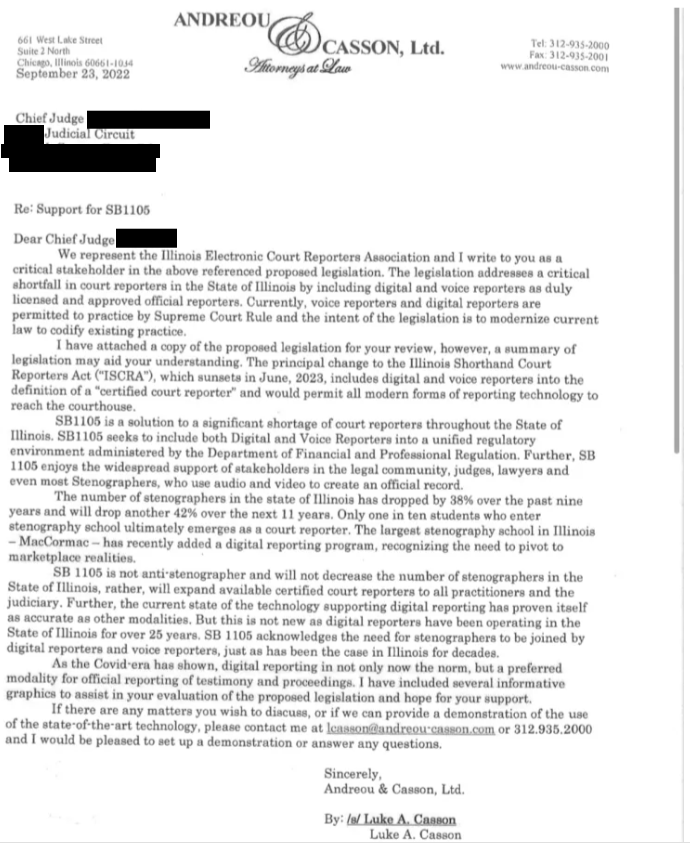
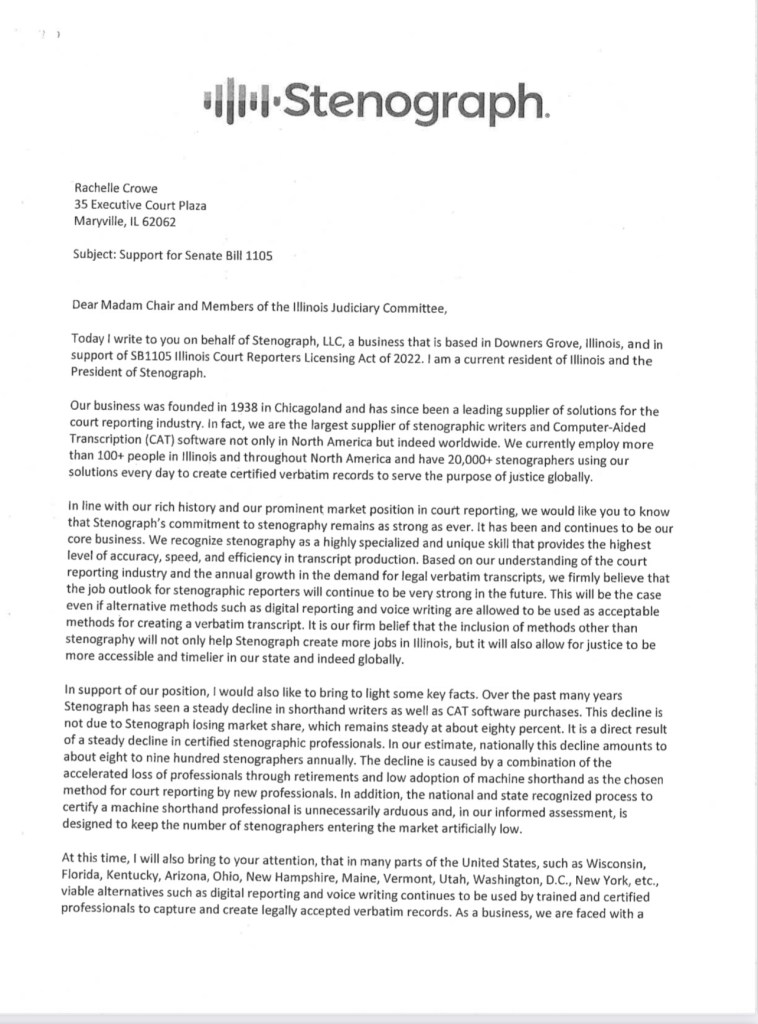
I’ve obtained a letter from Luke Casson of the Illinois Electronic Court Reporters Association and Anir Dutta from Stenograph. Along with these materials came some Speech-to-Text Institute materials.
Speech-to-Text Institute, as we know, is the nonprofit that lied when it said the court reporter shortage was irreversible. It used an outdated report to make its case, and its frontman, Jim Cudahy, left the field after I called him out on his fraud. STTI has several companies represented in its leadership, including The RecordXchange, Stenograph, Trans-Atlantic International Depositions, Planet Depos, Veritext, U.S. Legal Support, Neal R. Gross and Company, vTestify, Verbit, Kentuckiana, Tri-C Community College, RevolutionaryText, and For the Record. When I refer to the STTI Bloc, this is what I’m talking about. They used STTI to pump the market with misinformation, and as you’re about to see, they ride off those lies to push digital court reporting to policy makers and fellow court reporters.
If you look at those links above you’ll see that I’ve been on this since day 1. Court reporters can trust me to fight for them.
On that note, I think the best way to do this is to present each piece and then present my take on it. I’ll try not to nitpick too much and just bring out primary points.
I’ll be really fair here. He’s got a mission and he’s sticking to it, and that’s fair game. But I would say the idea that adding digital to the pool will not decrease the number of stenographer jobs is a lie. There is a total market. More of that market being covered by digital necessitates fewer available stenographic jobs. The idea that digital reporting is the preferred modality is also heavily in dispute. We literally call stenography the gold standard and even ChatGPT knows it.
Lies spread by the Speech-to-Text Institute used to support digital in Illinois
For the STTI materials, it’s 100% certain to exacerbate because the STTI Bloc has used all of its money and influence to grow digital over steno while lying to court reporters and the public. The number of stenographers shrinking in Illinois is pulled straight from Ducker’s “70% will retire before 2033” statement. There is basically zero chance that the report, which is a decade old, reliably predicted the future with 100% accuracy. Fewer than 1 in 10 become court reporters. I’ll concede that we say this a lot, but has anybody run the actual numbers with any consistency, or is it kind of like Ducker where we got some information once and then trusted that forever and ever? I have the same issue with stating the number of stenography students. It completely discounts the self-taught — and I personally know self-taught court reporters. It’s all fluff to suit an agenda. I no longer feel bad about calling it what it is. Nobody from that side of the equation has ever defended their inexcusable antisocial behavior. They simply pretend I don’t exist, because my existence is inconvenient to their agenda.
Stenograph supporting digital in IllinoisStenograph supporting digital in Illinois
Stenograph claims to have 80% market share, and then claims that at least 20,000 use their software. That would put the number of stenographers at at least 25,000. That means Stenograph knows for a fact that STTI was wrong, since there were only supposed to be 23,000 of us as of 2023. Again, the idea that this will add additional jobs is laughable, it will only move market share to digital, which Stenograph has positioned itself to profit from. They also lie about New York, where voice writing is not accepted for civil service positions. Neither is digital. Anir writes well, and I admire his ability to stick to a story. Perhaps seeing this in print will lead people to realize why I was so down on Stenograph as an entity, but not its employees or trainers. As a company, they’re not doing right by us. Everybody else is just caught in the crossfire of that. But the company relies on you being the bigger person and letting it go. “It’s just business,” they say, as they twist the knife just a few more times.
Speech-to-Text Institute Propaganda that the shortage was impossible to solve with stenography only. Stenograph’s admission to 80% market share invalidates this number (2023)Stenograph ad proclaiming support for stenographers.Stenonymous remarking that Stenograph is part of the STTI Bloc, a group of corporations that got together to sell digital using misleading arguments and bad statistics.
The math from my last ad report was very clear. Using my current media knowledge, we could probably reach/engage over a million people for about $30,000. I can’t lay that out by myself right now, but it should put into perspective why I keep asking for money. It makes a difference.
Stenonymous advertisement warning consumers that the government is not protecting them when it comes to court reporting.Stenonymous ad costs $0.04 per engagement, down from $1.00 per engagement on some old projects.
But as always, I leave it in the hands of my colleagues. Do we continue to wait and see what happens, or do we get serious about funding the only industry blog dedicated to purging corruption from the field? Regardless of the choice, reporters can count on me to continue being truthful.
And to give some good entertainment in the process.
Stenonymous poked fun at the STTI Bloc’s persistence with regard to digital court reporting v steno.
Picture this. You are among the leaders of “sten-tech.” Widely acclaimed. Admired in many circles. Supported by hundreds or thousands of stenographers by way of support contracts for the hardware and software you make.
Some of the largest companies in the court reporting industry decide digital is the future. They ostensibly create a shell organization to propagandize the field, claim the stenographer shortage is impossible to solve, and highlight digital reporting as the solution. Anticipating the direction of the market, you join. Unknown whether you joined with or without knowledge of the fraud, but whatever.
Some guy with a blog is writing some stuff about inequality and the shortage stats being misleading. Who really knows? Digital is the future. Ahead to the future!
Stenograph’s message to stenographers in a December 2022 post.
There are a few ways to view Stenograph’s message. You can either see it as the markup is way above 1000% and therefore they were making way more money off of us than a lot of us ever really cared to think about, you can see it as they sacrificed or maybe even took a loss for customers, or you can just assume they’re lying. I won’t tell readers what to believe this time. I honestly don’t know.
I do know that if Stenograph wants to make it right with stenographers, there’s an easy way. Break rank with the companies trying to strangle the market, disavow STTI’s ludicrous claims that the stenographer shortage is impossible to solve, and detach from the STTI Bloc. NCRA Strong left the door wide open. If Stenograph can’t do that, then can it really say that Stenograph remains committed to the future of stenography? It’s literally intermingled with an organization that tried to bury stenography under a wave of shortage media. We may have big hearts and short memories, but anybody that was paying attention 2020 to 2021 is just going to feel insulted or gaslighted.
Stenograph could make history in our field by withdrawing its support from the STTI Bloc and denouncing the lies STTI told about our profession. Not only is it the right thing to do, it’s arguably the smart thing to do. Despite the media blackout, the illegal collusion of big box companies to manipulate a market, and the complete collapse of support from what I thought was our largest manufacturer, we’re winning. With minimal funding and relatively little institutional support, we’re winning. Even though most of us have to advocate in addition to and after our full-time jobs, we’re winning. We know we’re winning because if our numbers were so catastrophic that we could not bounce back, Stenograph wouldn’t spend any time trying to appease or impress stenographers. If Stenograph was suckered in by the bad stats and misinformation, a lot of us were, stenographers will forgive it. If it continues to dance around the issues and pretend we are stupid, don’t feel too bad about what happens next.
Had the pleasure of viewing this interview between Stenograph and TransAtlantic about their new partnership. TransAtlantic’s David Ross, Secretary/Treasurer of the Speech-to-Text Institute, mentions during the interview that a machine will “never, ever, ever” replace the reporter. I found the interview to be seeded with more generalities about the shortage. It came across to me as trying to sell the idea of shortage.
Mr. Ross did have a lot of positives to say about stenographers, “And we’re very proud of them and honored to have them and I just wish there were more.” But the direction of the company seems clear, it’s going to be about digital court reporter integration. He even mentions the possibility of stenographers switching over to “try something new.” Towards the close of the interview he notes we should never be threatened by technology and keep an open mind. But those of us that dispute the severity of shortage are open minded. Most of us had to be convinced by math and science that there was a problem with the numbers and narrative being distributed to the public. Why has there been a push to get stenographers to go digital if digital is so easy to recruit and train for?
It’s tough for me. I personally see many companies coming and saying they have a shortage, but I see little in the way of communication. They’re largely not on our Facebook groups, not using PRO Link, not using recruiters on LinkedIn, and not asking our associations for help. This is why I am generally suspicious of the narrative being sold at every turn: “The shortage is insurmountable, you must change, or else.” It’s fear appeal propaganda. I do it too, but for truth.
MAXScribe and the Digital Court Reporting Academy were both brought to my attention. Before I launch into my usual full defense of stenography, I’ll put it out there that I think I understand Stenograph from a business perspective. My assumption is that they see the retirement cliff combined with big money’s interest in expanding digital, and they are doing what they see as the most profitable move, diversifying into a product line that they expect will be growing (digital) rather than shrinking (ostensibly stenography). From a purely business mindset, I think all of us get it. But I’ve been down on Stenograph these last few months and remain so.
My criticism comes from a place of circumstance. We let Stenograph into our schools and gave them access to our students. We encouraged each other to get and keep support contracts over the years, though admittedly I was never in with that crowd. The bottom line is that we built Stenograph with our wallets and brand dedication. We need to grapple with the obvious truth, Stenograph does not have the same dedication to its customers, the stenographic trainers, or anyone else. It’s going to sell to whoever will buy.
By itself, that might be annoying, but there is another reason I find fault with what they’re doing. We have some data that suggests stenography is better for equality. If we look back at the Testifying While Black study, stenographers scored something like 80% on African American Vernacular English — a shock at the time it happened. The pilot studies of that study tested laypeople and lawyers, and those people scored around 40% and 60%. The hard truth is that stenographers may, on average, be understanding more of what’s said by speakers of that dialect in the courtroom or deposition than anybody else. Couple that with the Racial Disparities in Automatic Speech Recognition study, where automatic speech recognition by major companies scored as low as 25% on the same dialect. Simply put, stenographers are better for accuracy on the dialect studied. I’d bet results would be similar for a number of dialects and accents, though funding for further studies seems elusive. By taking this hard push towards digital, companies, including Stenograph, are basically saying “we do not care about people.” Anir Dutta and others have used the words “democratization of technology.” Perhaps this really is the democratization of technology and we have simply “voted” that AAVE speakers and anyone else that would be better served by stenography or voice writing does not deserve that service. Good thing nobody’s told the press. Seems like the kind of thing the public might object to. “Court case? Congratulations, if you don’t speak in the way the powers that be deem appropriate, your transcript’s accuracy may be lower.”
Even putting aside all that science stuff, Stenograph’s claims are questionable. Take a look.
Excerpt from Stenograph explaining MAXScribe.
It states the number of pages produced per hour can be boosted up to 50%. If there was such a product, wouldn’t it have been marketable to stenographers? If it’s not marketable to stenographers, then that likely means stenographers already produce pages faster. If stenographers already produce pages faster, why is Stenograph not trying to improve our methods and processes? It doesn’t make much sense unless one locks oneself into the bubble of “big money wants digital, and we want big money.”
Excerpt about MAXScribe by Stenograph
Maybe it’s time for us to get into the business of helping out digital court reporters. Dear DCRs, anyone that says they can double your earnings without giving you a real good idea of how that happens is lying to you. Ask questions.
Then there’s the Digital Court Reporting Academy.
Digital Court Reporting Academy by Stenograph
The effort put into enticing digital court reporters is obvious. But I suspect that Stenograph has missed the mark here. Digital court reporters are likely to face the same income disparities stenographers are currently facing, and they’ll make cuts largely the same way stenographers have because they’re people too. The problem remains this wage or income issue. Cash-strapped “contractors” cut corners and court reporting and transcription companies are forcing as many expenses onto the contractor as possible. That means Stenograph is trying to run from a world where stenographers are avoiding purchases because the money isn’t there to a world where digitals will avoid purchases because the money isn’t there.
Though perhaps I have a naive view of the world. I have assumed that the working reporter is the customer. But perhaps they are all really after the “potential working reporters” or students. If you sell 80 student stenotypes for $1,500, it’s a lot more money than selling 5 professional stenotypes to graduates at $5,000. That same logic likely carries to digital. I expect there will be incredibly high turnover based on communications I’ve gotten from past and present digital reporters about their treatment. Stenograph may be financially incentivized to support that turnover because every person that tries digital and doesn’t like it would be a potential customer.
Big money wants digital. It wants digital so bad that lies about the NCRA were plastered to the internet before NCRA apparently got them taken down, students were being misled into digital, questionable claims have been made to get attorneys onto digital reporting, and a piece to discredit me was apparently commissioned and poorly executed. These are just some of the things we look at in horror and wonder how we could find ourselves in such a lopsided competition where actors on the digital side of the equation get to lie and obfuscate while we get cudgeled by our licensing authorities and consumers are left to fend for themselves. Stenograph’s not responsible for any of that, but by continuingto alienate existing customers and continuing to chase big money over morals, Stenograph has set itself up to hemorrhage stenographic customers, and if growth of digital is stunted by stenographers spreading the word that there’s a better career in stenography, the company may well end up the sten-tech industry’s biggest loser.
There are two prevailing schools of thought when it comes to the gold standard of machine shorthand stenography in United States legal proceedings. There are those that truly believe in the standard. There are those that give it lip service, only ever talking about stenography when pressed or pressured. Of course, there’s a third school of thought in the people that can’t or won’t spend much time thinking about why we still use our chorded stenotype keyboard design over a century after its development. For the third schoolers, we use QWERTY layouts despite that design being over a hundred years old too. It’s easy to imagine why: 1. There’s a market for it. 2. No technology has come along that is more intuitive and better.
I recently had an experience where I had to pick something off of an audio recording painstakingly in transcription mode. It gave me a lot of insight into where stenography’s superiority comes from. It’s in the room control. Some people are always going to be able to speak faster than we can “write” or type. You throw a stenographer into a situation where they have no room control and the participants are speaking above the stenographer’s skill level, and what do you get? You basically get digital court reporting / recording. The stenographic notes are a useless game of fill in the blank.
For the last twelve years that I’ve been in the industry, companies have been pushing reporters to interrupt less. I get it. Just like anybody else, lawyers don’t like to be interrupted. The loudest complaints were probably from the ones that are most self-important. The companies likely sought to end complaints by telling stenographers to let the audio catch it. But every time we do that, we risk record degradation “Didn’t understand that when they said it, don’t understand it no matter how many times I replay it.” It also increases the amount of time we have to spend on the matter due to re-listening to testimony rather than having it clearly in our notes. Since many depositions go unread until there’s a motion to be filed or trial’s coming up, the number of complaints related to poor transcript quality will likely always be lower than the number of “your reporter interrupted me” complaints. This skews the world the non-reporter owned agency lives in. Make the customer happy and things will work out. Just hope they don’t need whatever was inaudible or unintelligible to make their case.
That’s a major problem for digital, and I am not the first one to write something like this thanks to Jean Whalen. You have audio monitors that may or may not know anything about legal transcription listening for issues that they anticipate the transcriber will have. By removing the ability of the person responsible for the transcript to interrupt, you increase the chance of serious errors. Throw away all my prior calculations. The answer is really that simple.
From a productivity standpoint, room control makes a big difference. I’ve timed myself no audio versus heavy audio use, and I personally can be an astounding 12x slower putting together a transcript when heavy audio use is involved. This is why collectives like Ana Fatima Costa’s Speak Up For The Record group are so vital. In some jurisdictions, there is no mandatory license. There is no legal standard. Our newbies and veterans alike are connected to best practices through the stories and experiences we share amongst ourselves and the encouragement we give each other to be better. Let that be my share: We will not be attracting anyone to this field if they’re peeling things off audio in the name of “our client doesn’t like to be interrupted.”
The Lip Service School
More mainstream legal news has been picking up on the fact that there’s an ongoing debate. I’d like to share some highlights from the article “Glitches Still Persist In Digital Court Reporting Tech” by Steven Lerner, Law360 Pulse.
“…90 hours of testimony digitally recorded in a trial in the Northern Mariana Islands in 2008 resulted in poor audio quality and transcripts that were deemed unreliable and inaccurate.” It’s worth mentioning, but since it was so many years ago, it’s a minor point.
Planet Depos told Law360 Pulse that the problem with a 285-page transcript in Maryland was not the technology, but rather the setting of a public hearing where they were unable to control audio quality, overlapping speakers, and random unidentified speakers scattered across a large room. This goes directly to my points about room control. If we are not serious about speaking up when the record is in danger, we are not serious about record accuracy. Customer education is going to be this decade’s biggest challenge.
Brian Jasper, an attorney at Thomas Law Offices PLLC told Law360 Pulse “the technology was a problem, and it interrupted the deposition. I don’t scrutinize the depositions for perfection, but as an attorney, I have much more confidence in a stenographer because they are taking it down in real time.” This speaks to my point on room control. We generally know when we’re not getting it.
The article talks about the Stanford study where voice recognition by Apple, Google, Microsoft, IBM, and Amazon was tested. Error rates for black men were over 40%. I’m happy that this is getting more attention, because the adoption of automatic speech recognition (ASR) into legal transcription can really hurt equality and quality in general.
Stenograph, through Anir Dutta, claimed the average wait times for customers is seven minutes. This conflicts with reports at the end of last year that wait times for some were over a half an hour. Anir Dutta is quoted as saying “if that means that that customer is going to go on Facebook and make it so that everybody thinks that our average hold times are tremendously high, I think it’s unfair and frankly malicious.”
Lisa Migliore Black is quoted. “After 25 or more years of always keeping my Stenograph support contract up to date so that I would have the most current software advances, I let my support contract expire in January of 2022 due to long hold times with technical support and their failure to resolve the problems I was experiencing over the course of several months.” “My perception as a customer is that Stenograph is pulling too many available resources to develop the ASR side of their business.” I have to say I’m with Lisa. after over a decade of using CaseCAT, I’m very slowly teaching myself Eclipse, because being married to Stenograph just comes off as risky to me. The company seems obsessed with being at the helm of an evolution in court reporting that may never actually happen.
Dutta stated 80% of the company’s investment is still in stenography and that it is a “false narrative” that going into digital court reporting is shifting its focus. He’s quoted saying “If Apple started making iPhones, does it mean that they make substandard laptops?” Again, this goes against what has been documented prior, a drop in customer service.
Asked about the Stanford study, Dutta stated “People can quote studies from three years ago….” “…technology moves a million miles every three months.” This is demonstrably false. There’s a patent from 2000 showing 90% automatic speech recognition (ASR) accuracy was thought to be possible. The 2020 Stanford study showed accuracy lower than 80%. Is there anyone on Earth that believes 90% to 80% over the course of two decades is technology moving a million miles every thee months? ASR has improved. But it largely depends on who’s speaking and how good the audio is. I also find it humorous that Dutta takes exception to a 2020 study being cited when the entire basis for digital court reporting infiltration is Jim Cudahy, Speech-to-Text Institute, and a 2013-2014 Court Reporting Industry Outlook. Odd that an entire industry should shift focus for something that was done almost a decade ago and never adjusted for but should pay no mind to current events because “tEcHnOloGy.”
It’s a very interesting time to be in court reporting because nobody knows what happens next. Do the shot callers realize they’re wasting a lot of money trying to create a market for digital court reporting and start investing in the training of stenographers that will make them consistent profits? Will there be a breakthrough technology that renders stenography obsolete? Will our shortage get worse? Will our adoption of remote technologies compensate for the uneven distribution of court reporters across the country?
The data we’ve got doesn’t point to replacement. Until there’s a magic box that does everything, humans will be required to control the room, and it never gets more efficient than someone turning the speech into text right then and there with 95% or more accuracy. I’ll speculate that technology like CoverCrow will become more polished, mainstream, and accepted in helping with stenographer shortage woes. Agencies say they’re having coverage issues, and from what I understand, CoverCrow aims to work collaboratively with companies rather than cutting them from the equation.
As it stands, stenographers have a huge say in what happens next. Why?
There’s a market for it. 2. No technology has come along that’s more intuitive and better.
Stenograph has been in hot water because of its degradation of quality and service. This led to a boycott of the company by stenographers across the country, a boycott which continues to this day. As stated in my Oh My update, Stenograph’s push into automatic speech recognition is not being done properly. It’s being sold as a productivity boost, but available science says AI/ASR is a productivity killer. Anir Dutta, Stenograph’s embattled president, doesn’t care. He ignored a personal letter from me alerting him to these issues.
As if these issues were not enough, Stenograph promised to meet with Texas Court Reporters Association members and address their concerns. The company then retracted its agreement and set up its own meeting, likely to confuse consumers and attempt to manipulate us. TCRA addressed Stenograph’s behavior as follows:
Stenograph claims its plan is to meet with TCRA members.Stenograph apparently pulls out because one member they don’t like might be in attendance.Sonia G. Trevino, TCRA President.
Then, perhaps under the delusion that stenographers are stupid, Stenograph decided to hold its own meeting:
Stenograph attempts to create its own meeting in place of the Texas Court Reporters Association town hall.
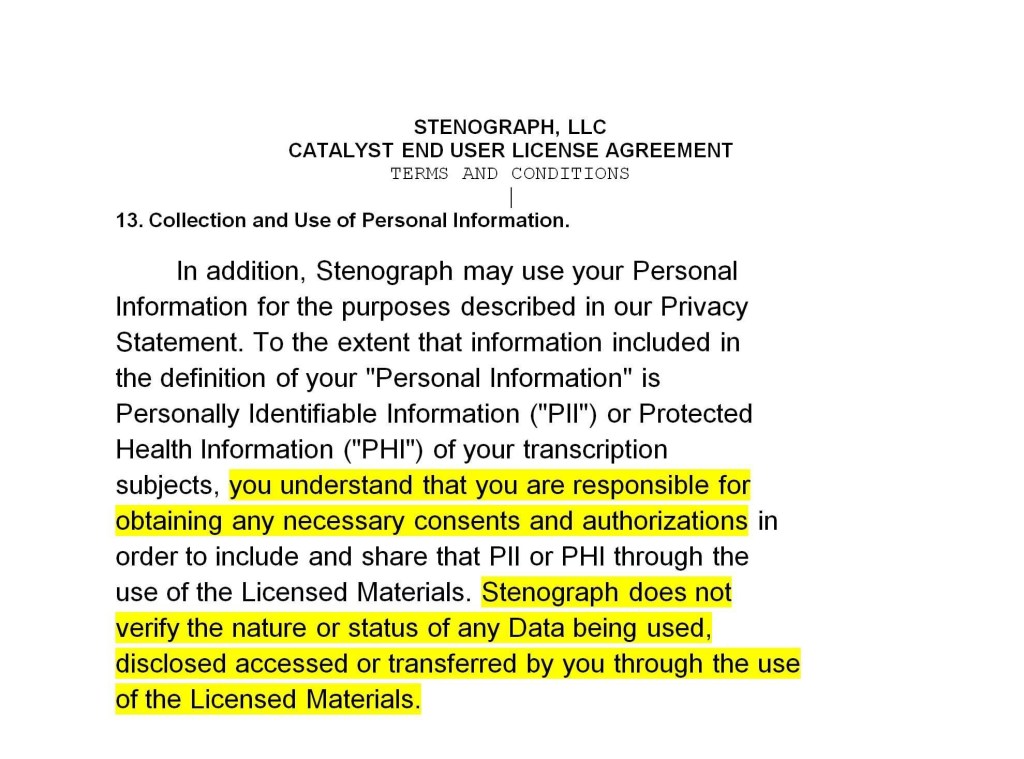
This is a bait and switch. This behavior is disgusting and in my opinion we shouldn’t condone it as a field. It’s very clear what’s happening. Stenograph does not have an answer for why it is requiring stenographers to get releases for data it wants to steal from us or the liability it wants to be put on us, as per its licensing agreement:
“You understand you are responsible for obtaining consents and authorizations for data we may or may not be using.” – Stenograph (parody)“We may be using your data to build our digital reporting products, but you’re not entitled to anything from it, which we’ve just unilaterally decided.” – Stenograph (parody)
Since Stenograph doesn’t have an answer, it doesn’t want to be in a position where that’s revealed. Again, I know factually that there are great people that work for the company and great software trainers for the software. That does not excuse what they’re doing. They’re barreling into automatic speech recognition in a haphazard, might-makes-right, and manipulative way that should give us all pause. We are the profession of blatant honesty. You say it, we write it. Can we not agree that this is not a direction we want a company, one that is practically our namesake, to take?
I have a message for Anir Dutta and Stenograph: We may not be computer programmers or $10 million companies, but human intelligence is not linear, it’s on a bell curve. We are not “stupid scribes” for you to play word games with. Words are all we know. We listen to people for a living, and we know when we’re hearing lies. If you have deluded yourselves into believing that you are so far ahead of all of us on the curve that you can lie to us with impunity, then I offer you the same stenographic proverb I offered Naegeli. TKPWHRUBG.
By my estimates there are 20,000 freelancers and 28,000 court reporters total in this country. We do not receive much formal legal education beyond the terminology we might hear. This has left many of us confused on our legal rights. Even the agencies that hire us, schools that train us, and the members of the bench and bar we work with every day lack basic information about important concepts we are dealing with. This puts court reporters at a serious competitive disadvantage against anyone with the funds to hire a lawyer.
It’s time for change. If you are ready for that change, please take some time to answer this 8-question survey. I encourage you to share it with anyone you feel might answer it honestly. Every single honest answer will pave the way for taking this from concept to execution. This survey allows me to gauge interest and expand the project. I will release more information as soon as it is appropriate and safe to do so.
We must keep recruiting and sharing information. But I would like to remind everyone to take care of yourself this holiday season. If the stenographic newswire or some other issue is causing you to feel down, take care of yourself. Try to reach out to a support system. Humans are communal. You are not bad, wrong, or alone. You are human. You will be okay because all feelings change over time.
A very special thank you to every single one of my readers. Your readership has made this moment possible. Let me just note that Sound Professionals’ Chris Carfagno has let me know about their latest product announcement. I have always heard good things about SP; I have a great impression of Chris and have no problem recommending them. I will state that I do not believe I’ve personally used their products. When I used to use audio, I think I was using a mic sold by Stenograph at the time, which probably explains why I don’t use audio anymore. I have also started transitioning to Eclipse in honor of the Stenograph boycott. It feels great to be learning new skills and technology in my field and I would encourage every single reporter in the industry to give it a try. Eclipse provides robust training resources on top of its Anytime Support. I even had to call them recently (weekday, business hours), and they returned my call in under three minutes. Switching isn’t easy, but Eclipse has done all it can to make my transition pleasant. I have a feeling that once I am done, I will be able to honestly tell readers which software I prefer from a performance standpoint. Stay tuned.
PS. Stenograph reached out to the Texas Court Reporters Association board. My understanding is that there will be a future meeting in 2022 where members will be allowed to ask questions. This is why I called for the boycott. The more pressure we apply, the more urgent it is for them to curry favor with our associations and make us happy. It would make me personally happy if Stenograph acknowledged that digital court reporting will likely hurt minority speakers’ transcript accuracy. I give my word that if Stenograph makes such an acknowledgment, I will call off the boycott. Until then, let’s see how far those revenues can fall for 2022 and 2023 renewals as people continue canceling support. This profession will endure. Stenograph’s endurance relies upon its service to this profession.