Ai-Media Claims LEXI 3.0 Rivals Human Captioning at a Fraction of the Cost

Ai-Media acquired Alternative Communication Services in May 2020. According to the recollection of one source, there was a little buzz about it at the time and there were some who were concerned about the replacement of captioning providers and some that didn’t believe such a thing would happen. Well, they’ve been touting something called LEXI 3.0.

“…uses the power of AI to deliver results rivaling human captions, at a fraction of the cost.” – Ai-Media
“Sad to see this. Rivalling human captioners? You have (or had) an amazing team there — please don’t sell them short in the name of profit.” – Mike Rowell, RDR

This wasn’t the only post done on the matter.

“…AI to deliver results rivalling human captions, at a fraction of the cost.” – Ai-Media

So, I guess I really have to say to captioners what I have said to court reporters. If I get some funding behind me there’s a lot we can do. We could sponsor independent studies into the accuracy of AI versus human transcribers/captioners. What we have so far in that department is promising.

But even short of that level of funding, we could do more advertising to increase public awareness about misleading technology claims and perceptions, something that is hitting mainstream media right now. After all, as I reported on this blog, Microsoft said they had achieved tech as good as human transcribers back in 2016. Then it flopped in the Racial Disparities in Automatic Speech Recognition 2020 study. Verbit flip-flopped between its series A and series B funding, first talking about saving on manual labor and then saying that they would not take the human transcriber out. So now when Ai-Media claims its LEXI 3.0 is rivaling human transcribers, it makes me wonder if this might be just another claim that they’re using to sell, sell, sell.

The best part? They don’t even have to lie to mislead. Check out the post above. “The world’s most advanced and accurate automatic captioning solution!” This is what’s referred to in legal circles as puffery. Even if it’s BS, it’s probably not false advertising. “Watch our video to see how LEXI 3.0 uses the power of AI to deliver results rivalling human captions, at a fraction of the cost.” Well, anybody can declare something rivals something. I declare apples rival oranges and Stenonymous rivals Veritext. It doesn’t mean anything. At the end of the day, if the AI gets 40% and captioners get 90%, they still rival each other, it’s just that one would be a really poor rival. At a fraction of the cost? Does that mean all of the cost savings are passed directly to consumers? It sure isn’t a guarantee.

This is why I’m so forward about educating reporters on marketing tricks and propaganda techniques. We are all subjected to media that influences our thoughts, and those thoughts go on to influence our actions. If a person is constantly inundated with the message that technology is exponentially growing and that it’s coming for all the jobs, they won’t seek out information that challenges that belief, like all the links I posted above that most people probably skip over out. Thanks confirmation bias and busy schedules.

Meanwhile, there’s a totally alternate reality where we start dumping money into calling out these companies and working out exactly how true their claims are so that we can share it with the world.

Captioners, Stenonymous is on your side.

And yes, that’s an example of propaganda. But it’s also true.

Stenograph Customers Start Petition for Town Hall

A petition has been made asking Stenograph to acquiesce to a town hall meeting.

After Stenograph’s actions in Texas and Illinois, as well as the reports of declining service from the past and its questionable partnerships with TransAtlantic and TranscribeMe, Stenograph would ultimately be doing itself a favor to start reuniting with its stenographer base. In my view, all it would take for any of these companies under the Speech-to-Text Institute to sway stenographers back to their side is admitting that the Speech-to-Text Institute got it wrong with regard to the impossibility of solving the stenographer shortage.

Stenographers, now’s the time to make your voice heard. The petition only aims for a thousand signatures, but according to Stenograph’s own numbers, as I recall from the Illinois article, the number of Stenograph customers is much higher, in the 20,000 ballpark. The more we can do to spread the word, the more pressure Stenograph will feel to accept.

There’s a big question about who would moderate, but my money’s on Joshua Edwards. He’s always been fair and professional. He’d ensure no nastiness. Even I’d behave.

I assume they won’t accept. Then again, I’ve learned to never say never. I was told people would never read the blog. Now at least a thousand visit every month. Stenographers have a real chance at being a part of positive change by trying, so go sign today!

Court Reporting is Now a Side Hustle

How court reporting companies are getting away with charging top-shelf prices for undervalued work…

The overpriced court reporter page is something that comes up occasionally in legal circles. All through my early career, law firm owners I worked with mentioned how their firms were stuck with expensive court reporter bills. As a young stenographic court reporter, I was paid very little, and later learned that court reporters in my city were about 30 years behind inflation. This set me down a path of skepticism when it came to what court reporters are told about themselves, their industry, and the public’s perception of them. How could lawyers be paying so much when I was making so little and such a large part of the transcript creation was on me?

Years later, as it turned out, some of the largest court reporting companies would get together using a nonprofit called the Speech-to-Text Institute (STTI). That nonprofit would go on to mislead consumers about the stenographer shortage to artificially increase demand for digital court reporting. Tellingly, while a U.S. Legal Support representative had no problem using the word “libel” on one of the female members of my profession, USL and the other multimillion dollar corporations never dared utter a word about my eventual fraud allegations. The companies wanted to trick consumers into believing stenographers were unavailable due to shortage and force digital court reporting on them, where matters are recorded and transcribed.

This set off alarm bells in the world of court reporting. Stenotype manufacturing giant, Stenograph, also represented in STTI’s leadership, shifted from supporting realtime stenographic reporters to shoddy service, and began to call its MAXScribe technology realtime. Realtime, as many attorneys know, is a highly trained subset of court reporting that often comes with a premium. These bait-and-switch tactics on the digital court reporter side of the industry caused a nonprofit called Protect Your Record Project to spring up and begin educating attorneys on what was happening in our field. But as of today, the nonprofit has not reached a level of funding that would allow it to advertise these issues on a national scale — this blog’s in the same boat.

So as more of the workforce is switched to digital reporters / recorders and transcribers, we’re seeing companies use influencers and other media to lure transcribers in for low pay. In short, digital court reporting is now synonymous with side hustle. These companies are going to take the field of skilled reporters that law firms and courts know and love, replace them with transcribers, and go on charging the same money. For the stenographer shortage, these folks were dead silent for the better part of a decade. Now that they need transcribers to replace us, they’re going all out to recruit.

Shopify talks about transcribing as a side hustle.

TranscribeMe, by the way, just entered a partnership with Stenograph.

“What do I care?” That’s what a lot of lawyers and paralegals might be asking at this point. Well, I may not write as well as Alex Su, but I’ll do my best here. First, there are egalitarian concerns. In the Testifying While Black study, stenographers only scored 80% accuracy on the African American Vernacular English dialect. This was widely reported in the media, but what was lost by the media was the reveal of pilot study 1, which showed everyday people only transcribe with an accuracy of about 40% (e226). When we’re talking about replacing court reporters with “side hustle technology,” we’re talking about a potential 50% drop in accuracy and a reduction in court record quality for minority speakers, something courts are largely unaware of. According to the Racial Disparities in Automatic Speech Recognition study, automation isn’t coming to save us either. Voice writing is the best bet for the futurists, and it’s being completely ignored by these big companies.

There are also security concerns. When we’re talking about utilizing transcribers, we’re talking about people that have an economic incentive to sell any private data they might gain from the audio or transcript. If transcription is outsourced, a bribe as low as $600 might be enough to get people acting unethically. Digital court reporting companies have already shown they’re not protective of people’s data — in fact, companies represented in the Speech-to-Text Institute. This also leads to questions about remedies for suspected omissions or tampering. Would you rather subpoena one local stenographer or teams of transcribers, some possibly outside of the jurisdiction?

Finally, there’s an efficiency issue with digital court reporting. Turnaround times can be much slower. Self-reported, it can take up to 6 hours to transcribe 1 hour of audio. By comparison, 1 hour of proceedings can take a qualified stenographer 1 to 2 hours to transcribe. That’s 3 to 6 times faster. Everyone here knows stenographers aren’t perfect and that backlogs happen. Now imagine a world where the backlog is 3 to 6 times what it is today. In one case, a transcript took about two months to deliver. If we’re going to hire teams of transcribers to do the work of one stenographic court reporter, aren’t we going backwards?

This is eerily similar to what went on in medical transcription. Competing interests played games to nobody’s benefit.

Consumers are the ones with the power here. They can demand stenographers, utilize companies that aren’t economically incentivized to lie to them, and spread awareness to other consumers. Consumers, lawyers and court administrators, decide the future. Knowing what you do now, do you want a court reporter or a side hustler at your next deposition or criminal case?

—————————-

Written by Christopher Day, a stenographic court reporter in New York City that has been serving the legal community since 2010. He is also a former board member of the New York State Court Reporters Association and a former volunteer for the National Court Reporters Association STRONG Committee. Day also authors the Stenonymous blog, the industry’s leading independent publication on court reporting media, information, data, analyses, satire, and archiving of current events. He also appeared on VICE with regard to the Testifying While Black study and fiercely advocated for more linguistics training for court reporters in and around New York State.

Donations for the blog will help run advertising for this article and others like it, as well as pay for more journalists and investigators. If you would like to donate, you may use the donation box on the front page of Stenonymous.com, PayPal or Zelle ChristopherDay227@gmail.com, or Venmo @Stenonymous. Growing honest media to combat misconceptions in and about our marketplace is the premier path to a stronger profession and ultimately better service to the legal community.

A posse ad esse.

Addendum:

By sheer coincidence, an article on the side hustle was released the same day as my post. NCRA STRONG’s Lisa Migliore Black and Kim Falgiani really hit it out of the park with this one. Apparently FTR and Rev say they have security in place to prevent sensitive data from being shared. But FTR is known for selling “deficit products,” and Rev is known for its massive security breach. So check out the article by Chelsea Simeon linked above and enjoy!

What Year Did Your Association Reach the Internet?

After comparing the net assets of several key associations, it raised my curiosity as to when they all hit the internet. Such a thing is not dispositive of the meritoriousness of any given argument or the validity of an organization, but since this is a blog, I have the luxury of doing some things “for fun.”

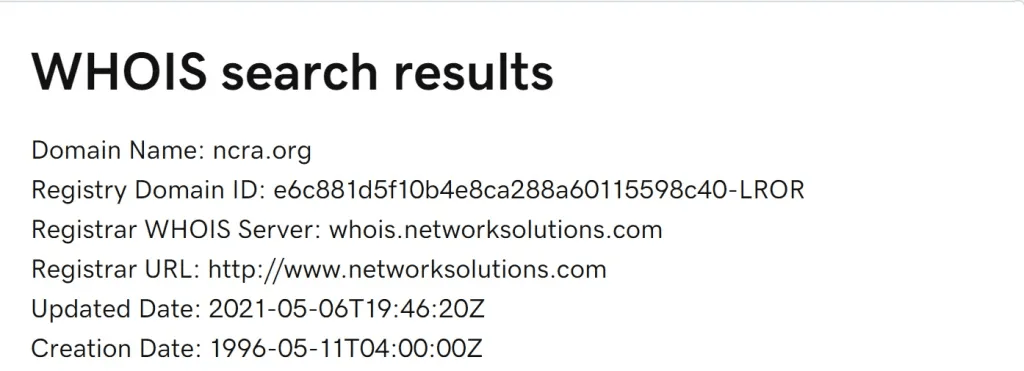
Using GoDaddy’s WHOIS lookup, I got to see the date that each domain was created.

May 1996, National Court Reporters Association. Perhaps unsurprisingly, the National Court Reporters Association was the first to hit the web. In my view, its power position in the field should be afforded much more weight than it is by journalists that cover our field. In fact, one of my only criticisms of NCRA is that it has a culture of organizational inertia and is obsessed with the status quo despite the evidence that there’s a whole corporate cabal threatening the livelihoods of its membership.

WHOIS Lookup for National Court Reporters Association.

June 1997, American Association of Electronic Reporters and Transcribers. In my view, one of the most stunning indictments against STTI’s credibility and digital court reporting as a whole is that it had to rebrand itself to make any progress. Steve Townsend was one of the people that got AAERT rolling. Any coincidence he’s president of STTI today? And what’s STTI’s purpose? Convincing the public stenographers are no longer necessary and/or cannot meet demand of the legal field.

WHOIS Lookup for American Association of Electronic Reporters and Transcribers.

January 1998, National Verbatim Reporters Association. The last of the well-known organizations to hit the internet in the 90s. I have not much to say about NVRA. It’s worth noting that realtime voice writing is still better than digital court reporting based on available data, so there’s big room for growth.

WHOIS Lookup for the National Verbatim Reporters Association.

In 2019, the Global Alliance of Speech-to-Text captioning came online. I mostly leave this organization alone, though I did try to share my thoughts on the Testifying While Black study with someone from it once as to why stenographers are probably the best bet.

WHOIS Lookup for the Global Alliance of Speech-to-Text Captioning.

In 2019, the Speech-to-Text Institute hit the web. This is the organization I’ve said has acted fraudulently in its information dispersal regarding the stenographer shortage in America.

WHOIS Lookup for the Speech-to-Text Institute.

With this little bit of internet history preserved, I’ll be drafting my next big post™️.

Shortage Solutions 16: Looser Deadlines

It seems almost a waste to make this its own post, but the thought occurred to me that if the shortage was really a pressing concern and something the agencies wanted to help alleviate, they might just take work a little later.

It varies from case to case and isn’t something that can be done everywhere, but in general, at least in New York, the deadlines have remained the same over the years. If anything, they’ve tried to demand transcripts even sooner than the two-week turnaround that existed when I started out.

It would not only enable individual court reporters to take more work, but also help draw the existing pool of reporters to an agency that’s easier to work for rather than trying to squeeze them for every ounce of productivity they can.

It’s not CoverCrow, but it’s still an idea.

Tips for Publishing Without Consequences

I get away with publishing pretty much anything I want. It’s something I’m proud of and really promote because I feel our field will grow stronger by having discussions and having things out in the open. That said, with this power comes some responsibility, so I’m going to share some of the thought processes that help keep me away from endangering my career so that others who follow might avoid the pitfalls of free speech.

1. Personal situation is important. One of the reasons I started Stenonymous was because government workers have some free speech protections. The large court reporting businesses had no power over me because my money is made completely independently from them. Freelancers have a hard time in this regard. There’s no protection and agencies have actively tried to cause trouble for them in the past. So the first thing to do before publishing is to take stock of your personal situation and imagine the pros and cons of speaking out. Sometimes speaking through someone else, as many people have done by corresponding with me and sharing information, is safer.

2. Details are important. Free speech protections aside, talking about your workplace could pose a problem. In general, don’t publish about the specific cases you work on, the court you work for, or the sensitive things you do in the course of your official duties. For example, I am free to absolutely trash California courts and policies if I want to. Doing the same in my backyard could be problematic. Keep in mind, it may limit career mobility to trash a lot of different places, so it may be undesirable to trash places in your publishing if you may uproot and move there in the future. This is why I don’t trash Kentucky. If the ocean ever swallows New York City I need Migliore & Associates to hire me.

3. Truth is important. The things you publish should be truthful. Truth is a defense to defamation and anyone is allowed to sue for any reason. Any of you could sue me right now in my hometown with a complaint that says “Chris Day is a bad man and owes me a million dollars.” You wouldn’t win, but the point stands, truth is a strong lawsuit deterrent.

4. Fair use is important. Take care if what you publish is copyrighted. All creative works are copyrighted upon creation. There is some wiggle room in the fair use doctrine where things created for parody, education, debate, commentary, etc, may allow the use of copyrighted material.

5. Have a backup to explain antisocial behavior. Most neoliberals back up their psychotic behavior by saying things like “it’s just business.” Usually as they’re firing single moms and stuff like that. My personal out is that I have adopted a performative media style called the “dirtbag left” style. This helps people reconcile my very mellow and polite in-person self with my more loud and visible media persona.

6. Punch up. People and organizations with wealth and power are far better targets for commentary. If they hit back, they’re the big bully preying on you for exercising your free speech rights. If they do nothing, they look weak to those that follow you, consume your content, or agree with your points.

7. Find a niche. The big money types are correct when they talk about business ecosystems and companies’ roles in those ecosystems. Free speech, power of the press, and general sharing and distribution of information are part of ecosystems too. Publishing is about finding your niche in the ecosystem. For example, there are people like Shaunise Day, Stephanie Hicks, Denee Vadell, and the Stenoholics. Like me, they’re all content creators. They make amazing stuff. But we don’t fill the same niches. I present analyses of and commentary on our field along with populating search engines with articles and images that counter the corporate narrative. Shaunise creates conventions that make me wish I wasn’t an introvert. Stephanie and Denee make videos that outclass anything I’ve ever made in my entire life. If I had the money, my new niche would probably be syndicating our stenographic media and pumping it out to the world (and getting our content creators paid.) The point is, whatever you do, be original or do things better, it’ll get your content more exposure and be more impactful.

8. Pay your taxes. Make sure to claim any income from your publishing hustle, even if it’s somehow expensed on a schedule C or something like that. Your rivals might just report you to the IRS if they see your content attracting real dollars.

9. Use personal attacks sparingly. Most of my publishing is about the conduct of corporations and not so much focused on the individuals that work for those businesses. If you’re going after somebody, you really want to have a firm grasp on why you’re doing it, because you may have to explain your conduct to a friend, follower, or employer.

10. Have fun and stay calm. Publishing comes with risks. People can sue, talk about you behind your back, or even openly trash you. It’s very advantageous to take on a nihilistic “nothing really matters” approach to the world in this regard. For example, I’ve put it out there again and again that given enough funding this blog will grow its media footprint and push the agenda of working reporters harder than anybody else has in the last 50 years. It ultimately doesn’t matter whether the funding comes through because I believe in what I’m doing and the information that I publish helps people. Money is a means to an end and not an objective. Similarly, it’s advantageous to have a mission behind what you do, because it will keep you going even when the funding takes a nosedive. Flip side of that, don’t become too obsessed with your mission, because if something comes along that stops you from achieving your objectives, you want to keep good mental health. If you’re not ready mentally for the potential consequences, it’s okay to walk away from a creative or content-generating project.

You’ve got my book of tricks. The First Amendment is our strongest card against an inert government and corporate corruption. Go build something better.

Veritext Ignores Fraud Allegations, Goes After Reporter for Facebook Post

Today it was revealed on the Protect Your Record Project Facebook page that someone’s post was screenshotted and given to Veritext. The company then tried to “cause trouble” for one of our fellow reporters.

Partial Statement by Kimberly D’Urso, Protect Your Record Project

Needless to say, the rules of etiquette were reviewed. Sharing posts without permission is not allowed in the group. I got permission to share the basic points of this story and my comment.

Christopher Day (Stenonymous) takes another shot at Veritext, a company accused of perpetuating the court reporter shortage fraud.

I must remark again on the hilarity of Veritext’s silence.

Truth be told, this too is part of my strategy. It is my belief that court reporters are smart. Eventually, even people that haven’t read my work will realize that my fraud allegations hit a home run. They can’t sue because it’s true. They watched the statute of limitations on defamation come and go without a care in the world because they are spineless cowards that couldn’t bear to be confronted with what they do to the women and men of this profession and the lie that they spun to kill the profession itself. When court reporters realize that the STTI Bloc is a direct threat to their income, that NCRA is more or less legally barred from doing anything to stop them, that Christopher Day is ready to fight for them in a way that this profession hasn’t ever seen before, and that the multimillion dollar corporations have to pretend Christopher Day doesn’t exist thanks to the Streisand Effect, there’s a chance they’ll find the funding for Stenonymous. We fund the NCRA to the tune of about $3 million a year. To put that kind of money into perspective, it’s enough for me to retire and spend the rest of my life fighting for working reporters and against corruption in our field. I won’t ask for that. But I will ask those that have not contributed to contribute something using the front page of Stenonymous.com, my PayPal at ChristopherDay227@gmail.com, or my Venmo @Stenonymous.

I don’t just take your money and do nothing with it while waiting for some magic number. I run ad campaigns and have media commissioned. I run a pretty good internet campaign that stretches across many Google searches and social media accounts. But I’m at the point where I’ve spent a considerable amount of my own money to keep things going. I genuinely need some help. If you can’t contribute monetarily, I have been considering the merits of a letter writing campaign. Perhaps some of you would join that when announced, or at the very least encourage others to join that. As I see it, if we want to continue to have this culture and society, if we want the speed contests and camaraderie to continue, we need to get serious about pushing back. We need to push back so hard that not one person in this whole field will even consider corruption and lying to make a buck.

Easiest way to lose a game is to forfeit. We’re a profession that has fought over comma placement. Can’t we join together and fight this?

Support The Fruits of Discovery and Evidence Depositions Are the Testimony They Produce with Catherine Rajcan!

Catherine Rajcan made a nine-part series of posts through LinkedIn and other social media, titled The Fruits of Discovery and Evidence Depositions Are the Testimony They Produce, that I’d like to memorialize and share with everyone.

This is 1/9. This introduced the series and revealed that some legal service companies attempt to trick lawyers into believing digital court reporting is comparable to stenography.

Activism and information dispersal by Catherine Rajcan, titled The Fruits of Discovery and Evidence Depositions Are the Testimony They Produce 1/9

This is 2/9. This listed a series of distinctions stenographers have from digital court reporting, including the ability to instantaneously read back questions and testimony.

This is 3/9. This post explored failings of digital recording and times when stenographers must clarify to protect the record. The obvious implication is that this same level of quality is not guaranteed by digital.

Activism and information dispersal by Catherine Rajcan, titled The Fruits of Discovery and Evidence Depositions Are the Testimony They Produce 3/9

This is 4/9. This post explained the problems with chain of custody and linked my audio editing video. It makes it clear that by relying on audio, problems arise in the security of the record.

Activism and information dispersal by Catherine Rajcan, titled The Fruits of Discovery and Evidence Depositions Are the Testimony They Produce 4/9 (Christopher Day’s “editing audio easy” short video.)

This is 5/9. This dove into Illinois law and described how, though notaries are allowed to swear witnesses by law, it is not a replacement for certified shorthand reporters.

The Fruits of Discovery and Evidence Depositions Are the Testimony They Produce 5/9 (NCRA Strong shield)

This is 6/9. This post gave an explanation of shorthand reporting under Illinois law and the penalties for holding oneself out as a certified shorthand reporter when they are not one.

Activism and information dispersal by Catherine Rajcan, titled The Fruits of Discovery and Evidence Depositions Are the Testimony They Produce 6/9

This is 7/9. This revealed Illinois Supreme Court rules on audio-visual recording and the use sound-recording devices for proceedings such as depositions.

Activism and information dispersal by Catherine Rajcan, titled The Fruits of Discovery and Evidence Depositions Are the Testimony They Produce 7/9

This is 8/9. This post mentions the lack of regulation regarding digital court reporting and notes that using digital court reporting carries significant risk.

Activism and information dispersal by Catherine Rajcan, titled The Fruits of Discovery and Evidence Depositions Are the Testimony They Produce 8/9

This is 9/9. This post went into the NCRA’s efforts to warn attorneys about digital expansion.

Activism and information dispersal by Catherine Rajcan, titled The Fruits of Discovery and Evidence Depositions Are the Testimony They Produce 9/9
Activism and information dispersal by Catherine Rajcan related to The Fruits of Discovery and Evidence Depositions Are the Testimony They Produce, a 9-part series of posts.

Looking over all of this brings a lot of inspiration. Just look at the incredible effort put into keeping attorneys informed. If you’ve ever wondered how you can help, here’s a chance. Head over to these posts, like and share or show them off to an attorney in casual conversation. Start spreading the message so that attorneys equate stenographers with service and good standards. It’s arguments like this that will advance us, but we need participation from our colleagues. You can make a difference today!

New York Courts Test Opens First Time in Nearly Half a Decade

Filing has opened for the New York State Unified Court System Court Reporter and Senior Court Reporter civil service exam! This is a monumental event that happens about once every 4 years due to civil service law. If you’ve ever wanted a career in the New York State Unified Court System, the time has come! Listen to prominent New York reporters like ASSCR President Eric Allen, secure your and your family’s future!

The most important tip that anyone can give you is to read through ALL of the examination materials. Do not skimp on it. For example, there’s an FAQ. You should read it. The exam application is linked here.

For the court reporter test, there’s an exam announcement. Read that too. A copy is archived below so that future court reporters will be able to see what it looks like when it’s taken down. Court website link.

For the court reporter exam, there’s a subject matter guide. You’re going to want to download and read that.

There’s a written examination sample questions page. Make sure you get that. I also generated some tests to simulate what the test was like several years ago. The written examination page is also available for download below or off the court’s website.

There are also a sample transcript. In my view, most of us will be familiar with this, but read it anyway.

There’s a sample video. Watch it.

Then there’s an orientation guide. Read the entire guide. Be familiar with the guide. They’ve changed the testing procedures this year from years prior! You cannot go off of tests you’ve taken in the past!

All of this applies to the Senior Court Reporter exam as well. There’s a subject matter guide.

There are written component sample questions.

There are the transcript and video. Finally, there’s the orientation guide.

Just for completeness, the job announcement for Senior Court Reporter is here.

For anybody that came down this far, here’s my take. Politically, we’ve got a lot of forces trying to push us out. New York is relatively stable. But we’ve all seen what they’re doing in California, crying shortage while refusing to use funding earmarked for attracting stenographers. If we get a lot of people filing for this test, I bet it’ll keep New York stable at least another decade. So if anybody knows anybody that might want this wonderful career, now is the time to let them know. You won’t just be helping the individual. You’ll also be benefitting us all as a group.

Again, read all the materials. I cannot stress this enough. Every single time this test is given there are people that fail because they did not read all the instructions and were not ready. I personally failed so badly once that I had to withdraw from the test. So give yourself the best chance to succeed, read all the materials, practice hard, and prepare yourself. You’ll do great.

Congressman George Santos Weighs in on Court Reporting*

George Santos, nobel-prize winning congressperson who surpassed Elon Musk as the richest person in the world last Tuesday, has teamed up with Veritext to promote digital reporting. “The cure for cancer will come from digital reporting. I bet all of Veritext’s money on it.” Mr. Santos also says that the inaudibles are a necessary part of any transcript because most people don’t know what anyone is saying half the time anyway.

The Veritext CEO spoke to the Congressman about the shortage in the industry. Representative Santos replied, “don’t worry, people won’t look into it. Look at my resume.” While he advocates for digital reporting, he says “I understand the importance of digital and I can speak to it because I’m also a stenographer who’s won the National Court Reporters Association award for Fastest Fingers seven times in a row.”

Santos was later declared the new NCRA Spokesperson, and attended a masonic order dinner, trying to build a bridge between NCRA and the Illuminati.

*None of this is true. It is a satire on the lies occurring in the court reporting industry, political lies, and poking a bit of fun at how people often use or misuse NCRA’s name and cred for their own agenda. It also satirizes modern journalism. It makes fun of me too, but that’s much more subtle.

In other news, Staten Island man dressed in a peanut butter-covered raincoat was arrested. Reportedly stated to arresting officers: “I was just celebrating court reporting and captioning week!”

ENJOY YOUR WEEKEND!