Some time ago I came up with a pretty good formula for figuring out a court reporter’s hourly rate. It excludes appearance fees, but depending on the job, appearance fees can be pretty damn minimal and simply by adding a small amount to the hourly rate, you’d be adjusting for the lost appearance income.
Page rate * pages per hour = hourly rate.
Hourly rate * 0.33 = writing time rate
Hourly rate * 0.67 = transcription rate
Perhaps divide your appearance fee by 4 and add it to the hourly. This is a little more fair than the 4-hour blocks many in the industry use today.
From my experience, believe it or not, you can get a New York City deposition reporter for somewhere around $4.00 a page. And a court reporter gets somewhere between 40 and 60 pages per hour.
That gives us a range for a non-realtime reporter of $160 to $240 an hour. Seems high, but for every hour on the machine it can take up to 2 hours of transcription, and court reporters that can do it much faster are either cutting corners, really experienced, or really, really good.
According to my sources, digital court reporters make around $30. Just so everyone knows, a fraud nonprofit called the Speech-to-Text Institute was used by the larger corporations of the court reporting field to systematically soak the market in misinformation, confusing jobseekers and consumers. The aim was to expand digital court reporting, increase the supply of “court reporters” to create a market glut, and make corporations like Veritext look good on paper so they could be sold to the next sucker.
30/240 = 12.5%
And let me be clear, $4.00 per page is not exactly a rich life in court reporting NYC. There are many that make more than that, which means digital is an even smaller percentage.
Did your deposition discovery costs decrease 90%?
My sources say lawyer bills are higher than ever.
The secret is that charges that court reporters don’t share in are added to the bill while page rates are kept artificially low to keep you thinking you’re getting a great deal.
Do what you will with that information. Might I humbly suggest that if they’re going to use a digital court reporter, you demand that the bill be something like 20% of what it usually is.
Or let them milk you, and by extension, your clients. That’s cool too.
Just let it happen. Trust me.
With stenographer jobs being systematically eliminated via fraud and deceit rather than by actual technological advancement, there’s really no reason for us not to expose what the companies are doing. After all, if they’re successful enough in reducing stenographic court reporter numbers, courts won’t be able to fill spots, and my job will likely be eliminated someday too, and with the disabilities I live with, I’m unsure about being able to do better than what I’ve got. Call me biased, sure. But your whole system of law is based off of two biased sides presenting their evidence, so if bias is a reason to disregard truth, you can just throw out the whole justice system today if you want to paint biased people as untrustworthy.
Just writing that for a fan of mine.
Side note, corporations that make millions of dollars let a respected 14-year member of our field publish openly about their fraud for almost 3 years now. They’re banking on you doing nothing. I suppose I am too.
It occurs to me it might be best to come out and say that in terms of rates lawyers have a financial interest in prolonging this digital v steno thing. More suppliers in the market, more competition. This is juxtaposed against what the corporate schemers want, continued corporate consolidation of the field under people that can jack up prices a la tacit parallelism.
Lots of pressure for you to switch to digital. Now you know why. Do with it what you will.
So as I sat there over the years documenting things posted online and representations made by the larger corporations in my field, I was creating a record of what was happening that I could testify about it if it ever became an issue.
So here we are. Statute of limitations in New York defamation law has pretty much lapsed. Meaning that a 14-year “veteran” of the court reporting field came out publicly in his own name and said the largest corporation in court reporting was committing a fraud, and the corporations I wrote about let it happen despite it arguably being defamation per se if it wasn’t true. I presume because they bank on the intense stigma and assumed lack of credibility of someone with admitted illnesses/disabilities like mine.
Engaging in a scheme constituting a systematic course of conduct. Okay. What’s more systematic than a bunch of corporations getting together under a nonprofit to spread misinformation about the field? What about the representations made to attorneys that stenographers can’t be found when in fact corporations involved in the STTI Bloc were not really looking for stenographers? Effectively tricking consumers and jobseekers for years. A trick so effective it continues to this day.
“To defraud more than one person.” Well, there are a lot of consumers of Veritext and other fraudster services. Maybe if we asked a few if they were told stenographers could not be provided, we’d have that part down.
To obtain property from more than one person blah blah blah. Money is property. By taking people’s money, telling them the service they want is unavailable, and providing a subpar service for similar prices — it’s pretty much taking property by false or fraudulent pretenses. Maybe they’d take their business somewhere else if they knew the truth of “we want to cut our expenses and keep yours high.” That’s if it’s even true that digital is cheaper and not just an assumption by the finance gurus.
Penal Law 20.25 in New York provides for the criminal liability of people that commit criminal acts on behalf of corporations. So theoretically, if the persons that ordered this stuff were identified, they could go to jail for up to a year.
So yeah… look, I get that an A misdemeanor is not the crime of the century. But isn’t it at least a little interesting and newsworthy that the shortage that many court reporters and journalists have written about at length is actually a crime being committed?
I’m speaking up because, as I’ve documented before, when the women of this profession speak up, they’re sometimes threatened with a defamation lawsuit. Because anyone can sue anyone for any reason, this scares them into silence. I have pro se experiences, so I could probably defend myself in a bogus lawsuit. But you know what? There are still brave people speaking out like the Protect Your Record Project and Jackie Mentecky. So even if you buy wholeheartedly that I’m an idiot, invalid, or just untrustworthy, I’m not alone in my general message. You have to really look away from the evidence in order to not see it.
And this was all done in a strategic way by me. If the corporations respond to my antics, they give us more information, and information is what helped this come to light in the first place. Information is good.
If the corporations do not respond, they are silenced while I am free to build support and fundraise, as well as rewrite the narrative. This is what I’ve done for a few years now, and it’s working, albeit slower than anyone would’ve liked.
If the corporations respond with a bogus lawsuit, I get more information than I ever would’ve been able to through the discovery process and blow this up Streisand Effect style. They’ll also burn a whole lot of money on something I have an affirmative defense to. I got a buddy whose court case on a trip and fall has dragged out over 6 years. My blog would take hundreds of hours to sort through. We’d be in court forever. Game, set, match. The broken system can be used to our advantage.
And every day that goes by, the strength of a bogus lawsuit gets weaker. There are a number of things in case law that point to the inadmissibility of a case that the plaintiff sits on.
And that’s pretty much it.
The more people that echo my claims and point to my work, the less ignorable it is, and the more people we reach.
P.S.
For one of the first times ever, I took down a blog post. The one I took down shall not be named.
But I pose a question to you, readers.
If you wrote something that hurt someone that you never intended to hurt, what would you do?
Does it matter what their relationship to you is? What if it was a stranger?
These are the kinds of choices my writing has brought me. Things I decide in silence and isolation. Things I rarely share.
I can’t help but wonder what the world would think if it could experience these moments in time with me.
Perhaps that’s why I write at all. Captured moments in time that others can experience with me.
An art that court reporters know well.
But is it dying or evolving?
It brings back memories of a night I got punched in the mouth.
If I could de-escalate that, certainly there are a great many things I can convince people of.
I would like to convince you that you will triumph.
That you are special.
And that if there is a way to heal a hurt soul, we should.
Christopher Day publicly posts an offer to the court reporting and digital court reporting firm Veritext mailed a week before 3/25/24.Christopher Day breaks his promise to stop talking about the court reporter shortage fraud.Christopher Day makes a check to CASH as a sign of good will to whoever opened that envelope. Workers of the world unite!Christopher Day prepares to put his proposal in an envelope before mailing it. Christopher Day tells an unknown operative about Leonard Green & Partners’ Corporate Looting of Hospitals
Christopher Day pushes unionization for deposition court reporters.
The rest of this post is a creative writing exercise. You are not expected to read it.
This has been a creative expression for nonviolent action and free speech promotion.
Many lines have hidden or multiple meanings. Please ask if you need more information. For example, the part about Jews was to say that MPT scammed everybody, obviously not just one group. But it was also to denounce those that single out Jewish people unfairly.
War of Mercy in early non-functional development. War of Mercy will showcase the magical kingdom of Seedberry, the heart of an empire whose mystical berry seeds take on different properties dependent upon the kingdom they’re planted in. Donations may be made via Zelle to ChristopherDay227@gmail.com. Do not donate if your disposable income is less than $200,000.
A dear friend sent me The Plundering of America’s Hospitals by Bethany McLean. It covers a lot of what private equity is doing in the healthcare industry. Interestingly enough, Veritext’s holding company, Leonard Green, is one of the private equity companies causing havoc.
Leonard Green extracted hundreds of millions of dollars from an otherwise failed investment. Excerpt from Plundering of America’s Hospitals by Bethany McLean.Private equity companies would buy hospital property using MPT and have the hospitals rent from MPT. Executives walked away with over a hundred million dollars as a reward for weakening the financial position of hospitals. Excerpt from Plundering of America’s Hospitals by Bethany McLean
The most interesting part of it all is the article notes at the end that even if Congress follows the money and investigates, there’s no belief that they’d be able to get the money back.
Therein it mentions at least one hospital, with about 700 jobs, might close.
So let’s recap. We’re dealing with people who are experts at saving bad investments through weakening the financial positions of companies, even where that’ll cause the quality of medical services to take a dive and possibly kill people or erase jobs.
They control the largest court reporting company.
What kind of damage might be possible?
Digital court reporting scam, Google searched by Christopher Day
Alleged Veritext script provided to digital court reporters.
I really need to take you on a quick time machine ride. It’s 2010. New stenographers are graduating in New York City, and many of us are told there are too many reporters and not enough work. When we do get work with an agency, we’re thrown into whatever job regardless of skill level. A true trial by fire. I lucked out, my first was an interpreter job. One acquaintance of mine was put on a med mal or something beyond her skill level and immediately quit the field to become a dental technician. We were also, by any sane metric, being underpaid. When I write about this stuff, I do it with all those memories in my heart. We fought hard through school, and a lot of us didn’t make it in the working world. I know the knee-jerk reaction of reporters is to play into survivorship bias and say “well, others made it, they could have too!” Congratulations! Some of us made it through a rigged game! Good for us! It’s time to use our position as survivors of the rigged game to unrig it so that we’re not chuckle-fucks telling students what a great field this is only to have the income drop through the floor.
These companies did everything in their power to drive us out and drive sole proprietors under, running down the page rates and running up other costs to siphon more and more of the money in this field away from the reporter and into their pockets under the guise of “competition.” Now they’re doing everything in their power to build digital. According to multiple sources I’ve talked to in the last few years, they’re told to say digital is the future or something similar when questioned about steno v digital.
Digital reporters, I know this sounds like good news because some stenographers have been nasty to some of you. The reason it’s bad is they’re pushing all this recruitment and holding your hands through the early stages so they can “diversify” the worker pool and pit us against each other, decreasing rates across the board. The companies would rather let me call them frauds than defend their reputation. That’s how much money is at stake here. It’s fairly easy to come to this conclusion. Company executives have a duty to make decisions that make companies more profitable. Their compensation is often tied to company performance in some way. The finance guys think digital is like 50% more profitable. Supply and demand, supply of reporters goes up, demand stays about the same, price goes down. That price is your income, just so we’re clear. Even if you don’t buy into believing it’s fraud, you have to see the clear money incentive these companies have.
Consumers, if you’re reading, this pretty much demonstrates why stenographers are making all this noise. You’re comparing a workforce of people that had to self-teach anything the 2-year education didn’t cover with people that are scripted after whatever the training program time is (6 weeks?) And they are pretty much going to charge you the same prices for both while pocketing, allegedly, 50% more profit. I get that everyone thinks our steno lobbying is the only thing that keeps us afloat, but I gotta be honest, our associations would find it difficult to be less effective. I’m not saying it’s all their fault, but let’s look at the reality: We’re losing jobs even in states with heavy licensing requirements like California and Texas. Digital has come into play even where it’s illegal. If our lobby can’t combat illegal activity, it’s pretty fucking weak. For contrast, your organizations kill robot lawyers with zeal and efficiency.
If it’s not our lobby keeping us afloat, what could it be, I wonder? Could it be that even in 2023 modern stenography is more efficient than the other methods? Hmm…
Obligatory mention, we’ve had guest writers Chris DeGrazio & Deneé Vadell, as well as Cassandra Caldarella, over the last week. This is more or less why I built Stenonymous. A sharing platform. A blog for all our collective knowledge and ideas uninhibited by the politics of the field. If you have something to share, reach out to me about getting connected as a contributor or republishing your event information. I may ask for edits or more information if something is particularly likely to get me sued, but otherwise, you’ve got an ally to help spread your message. This includes corporations, associations, and all of you reading.
This is all written keeping in mind that the people that contribute to this platform with information, money, or time are an integral part of the success and “blueprint” discussed.
———————
Many speak through me as “Stenonymous sources,” and this helps us communicate ideas that could be used against individuals. The corporate climbers of the profession routinely copy and paste messages to their buddies in agencies so that agencies can retaliate against freelancers. This is not unlike what the cowards at Naegeli tried on me and other court reporters. Companies know they have a great deal of power over “solo practitioners,” and they’ll put their knee on the neck of any one individual whenever it’s convenient. And this is horrifying for freelancers. There are like 5 national companies in the United States. Despite the disgusting state of statistics on our field, Veritext reportedly has 16% of the revenue in this field and is the largest, so let’s just assume the others have carved out at least 4% each. 16 + 4 * 4 = 32. You don’t like big boxes? You could be locked out of 32% of the field’s revenue. Think about that next time you tell someone not to work for them. Think about what would happen if roughly 30% of the field tried to scramble to all the other agencies for work. Think about how difficult it would be to gain the cooperation of around 30% of reporters to even do that (accepting that that percentage may be, in actuality, higher or lower. My bet? Higher.) Our brains love easy solutions. Reality does not. There is no easy solution to “5 ‘people’ control a third of the industry that is my livelihood.”
But through me, Stenonymous sources are able to talk to you.
Insight shared from a Stenonymous source on the east coast of the United States.
Sometimes people want to be credited, or partially credited.
Insight shared with Stenonymous by Ashley, a Steno Student
Then, of course, I share my own insights, based on the very many interviews, conversations, and analyses I’ve had over the years.
Christopher Day’s musing on the Milgram experiment as it relates to modern leadershipChristopher Day’s musing on the confidence of people who are wrong.
When I was a young man, there was this debate of talk v. action. More or less it boiled down to “what you write or say online means nothing. It’s what you do that matters.” For a long time, this put me in a box of not speaking out and accepting whatever was done to me by others in the profession, rightly or wrongly. Because talking about it didn’t matter. It was only my actions that mattered. Right? After all, those older and wiser than me believed it. I’ve come to learn that talking matters a lot. Talking is the first step to action. We combine with likeminded people and come up with new information, solutions, and things that enhance our lives.
If nothing else, words change the framing of things we see and experience, thereby changing the way we think about those things, and consequently changing our actions. I’ve seen shared reality talked about in the sense of close relationships. Now imagine that in a wider, professional sense. When we shared the “reality” that the shortage was impossible to solve, things felt very hopeless. What was the point in recruiting? It wasn’t until well after I published my findings that the STTI Bloc had intentionally framed the issue to look as bleak as possible so that stenographers would give up that the National Court Reporters Association admitted Ducker’s report was outdated through STRONG and an NCRA president called it debunked. It wasn’t until after I called out the NCRA for its behavior that it released the white paper I had contributed to. It wasn’t until after I documented the Speech-to-Text Institute’s anticompetitive behavior that it got sued and shut down its website. It wasn’t until after I started publishing about the rates in New York that copy rates started to go from $0.25 to $1.00 and beyond. It wasn’t until after I spoke out against the shoddy reporting of Victoria Hudgins that the hit pieces stopped. Yeah, you can throw shade on me and say my writing and work didn’t do any of that. And you’ll even find people that agree with you.
Stenonymous.com shares a text demonstrating spitballer mentality.
But at a certain point it’s just denialism by the doomers of our profession that crave being right. “The golden age of court reporting is over.” “Tipping points are hard.” “Digital isn’t going away.” Repeated over and over by people that don’t know what they’re talking about, warping the world closer and closer to hopelessness and apathy. Perhaps we can learn something by examining the time that ChatGPT made up fake case law for a lawyer who foolishly relied on it. It’s trained off of our printed ideas, realities, and beliefs, and it can be a great asset. It can also confidently spout nonsense. At 33, I truly believe that this is a part of what makes us human. We mostly all have the capacity to be confidently wrong or unsurely correct. It’s no wonder that tools that study us pick up our same habits.
This is also very much why I take such a hard stance against propaganda meant to mislead people. It inspires them to be compliant rather than be their own people with their own ideas. What if I had simply complied with the groupthink of belief in the stenographer shortage and the futility of it all? My bet is that our median pay would fall faster. Who would that benefit? All the “people” telling you that your job is obsolete. All the “people” telling others that your job is obsolete:
Digital reporter reaches out to Stenonymous about becoming a stenographer.
NOTE: People is in quotes because “corporations are people.” This makes some sense in theory because groups of people should not lose their rights simply because they form a corporation, but in practice it’s twisted to offer more rights to corporations than peoplethrough their consolidated power (money). Succinctly, I accept the reality of the law we live under, but I strongly disagree with its everyday application.
Words are a game changer. And I genuinely feel I’ve proven that for anyone willing to explore what I’ve done. But what I’ve done is also a blueprint that tells you exactly how powerful you are. It doesn’t have to be related to court reporting. Any issue that is important to you can be given life if you are brave enough to talk about it and find others who will assist. That is a message I want to share with the world because my whole life has been dominated by people going on and on about how nothing can ever change because things have always been done a certain way, then followed by things being changed by those daring enough to change them, for better or worse. Political, family, social, and professional issues all silenced by “well, what can you do?” (🤷🏻♂️🤷🏻♂️🤷🏻♂️) In many situations in life, there is someone that stands to gain from your apathy. As we learned from Star Wars, they win by making you think you’re alone. They win by making you believe they hold all the cards. These are concepts that have existed for at least a thousand years wielded against you, often by people with money or power.
“I may be only one person, but I can be one person who makes a difference.” Vadra Francene, Age 10, Seen at a Disney World attraction
And to those that would make my fellow reporters feel they are alone, just know that your power over them has an expiration date. It turns out that reminding people again and again that they are powerful and that their thoughts and feelings are valid is terrifyingly effective at countering your power play. It turns out that when you tell people straight up “I will use my influence to make things better for all of you,” people start paying attention and contributing. It turns out that as soon as people realize that my neurodiversity apparently predisposes me to being more honest than neurotypical people, their natural, understandable bias against me being “weird” fades and they begin to trust.
Stenonymous statistics as of December 10, 2023.
STAR called for unity. Funny how the digital reporters are realizing that I’m all about unity, and they’re ready to make their voices heard too:
Digital Reporter Shares Field Insights with StenonymousDigital Reporter Shares Field Insights with StenonymousDigital Reporter Shares Field Insights with StenonymousDigital Reporter Shares Field Insights with StenonymousDigital Reporter Shares Field Insights with StenonymousDigital Reporter Shares Field Insights with StenonymousDigital Reporter Shares Field Insights with Stenonymous – Verification Pending As of Publication.
We are everyday people. As James McAllister said the other day: We Are Power!
And this platform continues to thrive thanks to your…
Words & Voices, Stenonymous.com
Addendum:
12/14/23, a reporter mentioned to me that it’s possible the “digital reporter,” that passed me the information in the ending sequence is actually a bot. Upon review of the profile, it’s possible this is the truth, as it contains very little public information and seems to be a newer profile. I’m uncertain why a bot would come into my network to talk about issues with digital court reporting. But if I’ve learned anything over the last few years, it’s that anything is possible.
I subsequently re-examined my private messages with this person and if it is a bot it is incredibly convincing. There were concerns about anonymity among other things.
We were all told realtime is the future, realtime is valuable, realtime is job security. Manufacturers, agencies, associations — everybody knew realtime was king. There were only fringe idiots like that Christopher Day guy who pointed out that if you trade away all the non-realtime work to the digital folks then the realtime reporters become more easily replaceable by virtue of having no political or pushback power. Everyone pointed and laughed at his stupid ideas and that was the end of that.
Well now I’m showing you in print that they intend to equalize you with digital court reporting. Stenograph had also made public statements that indicated as much.
I read up on enough law, science, and business to put these allegations in print and make it easy to Google the court reporter shortage fraud / Veritext fraud. The corporate fraudsters didn’t really have an answer for it. They got caught with their pants down, gave up on Speech-to-Text Institute, and ran over to STAR.
My position is growing stronger with time. My current understanding of defamation law is that pretty much anything in my state published over a year ago can never be challenged. That significantly diminishes my formerly overblown fear of a BS lawsuit. These companies have allowed publication of things that describe their fraud and lies to the public for over two years.
Which also means we’ve entered a period in court reporting history where the largest court reporting firm in the country was accused of fraud and didn’t care enough about its reputation among stenographers enough to do or say anything about it in the middle of what it outwardly professed as a massive shortage. Doesn’t seem to make much sense, does it? I wonder who could have seen this coming…
Happy Thanksgiving to all of you.
Addendum:
A Stenonymous reader gave me permission to repost their social media post.
– – –
After this post was launched, a person claiming to work in Veritext sales wrote to me, in pertinent part,
“Hi Christopher. I work for Veritext in sales. Good morning. In re your most recent post about DRs providing real-time, I can assure you of the following:
Veritext’s technology, since our DR software/hardware implementation is proprietary, as of today is not capable of providing real-time.
As someone who works in sales, I can assure that I nor any of my colleagues are telling attorneys that DRs can provide real-time. First, it’s not true and second the attorneys who want real-time also tend to want stenographers.
I cannot speak to why the website says that, but I’d imagine it was either put together by someone high up on totem pole who knows very little about the industry, or a third-party who knows even less.
Overall, your concerns about real-time being possible via DRs are real—it’s just the nature of technology. However, as of today, it’s not possible nor are we actively selling a service that can’t be provided.”
Veritext Assigned a B rating by Fitch Ratings, Highly Speculative.
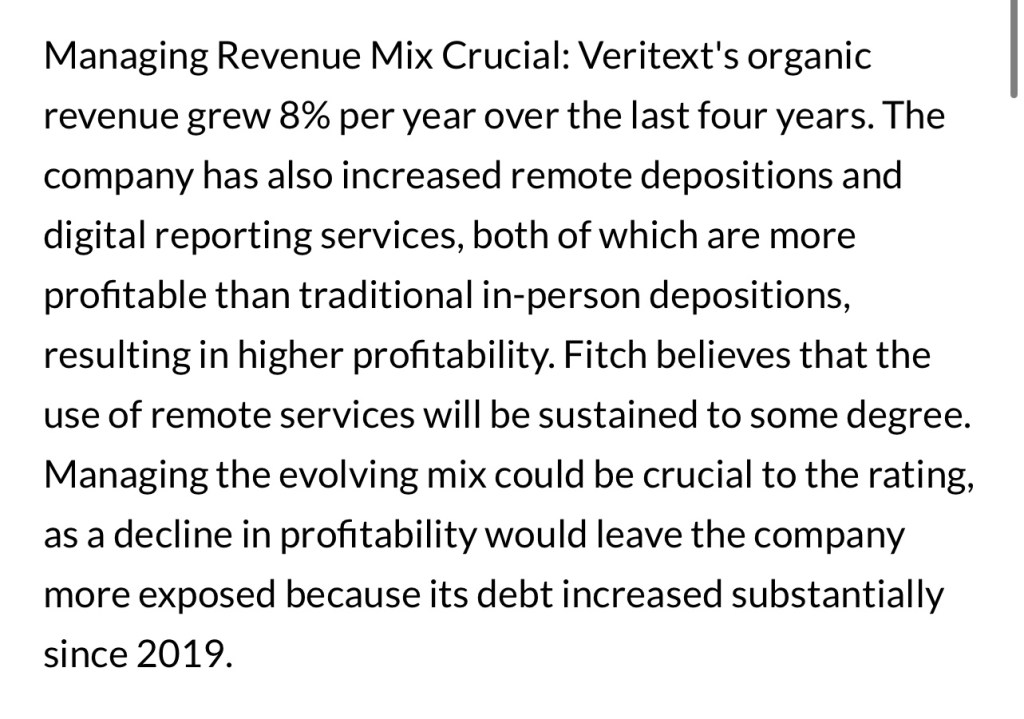
This B IDR (issuer default rating) means the company’s meeting its financial obligations, but if bad things happen, like attorney customers leaving the business because it’s been accused of fraud and has nothing to say about that, it might not be able to repay its debts.
Luckily for us, the news talks a bit more about why that IDR was assigned and what the big money types think about the company.
Comments about Veritext’s Issuer Default Rating.
First, hold that comment about growing its revenue organically as opposed to “through acquisitions.” Organic would be running a marketing or sales campaign that brings in customers. Acquisitions is buying companies, which we can expect Veritext to continue to do with its “leading position.” We’re also told that they’re probably going to focus on return on equity rather than paying down the company’s debts. They anticipate leverage (debt) to be maintained close to current levels. In other words, Veritext will be in comparatively large amounts of debt, and paying that interest, for the foreseeable future.
The next paragraph abandons talking about Veritext’s organic growth and admits the company’s plan is to grow through acquisitions.
Comments on Veritext’s B IDR rating.
So in March 2023, shareholders, presumably the holding company, threw in $132 million to fund acquisitions. The rest was funded through debt and cash.
Comments on Veritext’s B IDR.
Now, I take this with a bit of a grain of salt because nobody has great data on our industry. But the claim here is that Veritext controls about 16% of revenue in the field — a field which is in the wide ballpark of $3 billion. That’d place Veritext at a wide ballpark of $480 million per year in revenue.
This part tells me why they’re pretty confident in Veritext being able to repay its debts. It would require a bunch of customers walking out at once to damage its revenue because it’s not heavily reliant on any one customer.
I question the accuracy of the statement that digital is more profitable. Digitals are rapidly sharing my work and beginning to ask for more money. The long con is losing ground by the day. But this gives us an important look into the minds of the people holding the money. They think it’s more profitable, so Veritext has gotta keep pushing that to keep that sweet, sweet financing.
Don’t really understand the part about capex intensity enough to comment or share a belief. But then we get to the assumptions made.
To me, this all boils down to “yeah, this looks like it’ll work out, but they could go bankrupt and we could be left with only 51% recovery of the debt.” Not to be too forward, but if you let me take out hundreds of millions of dollars in debt, you could say the same about me. “Yeah, this might go well, if he doesn’t die holding the bag.”
So we know that Veritext is loaded up with debt and there’s no plan for that debt to be taken care of any time soon. We know that the creditors aren’t brimming with confidence. We know that a significant exodus of customers could cause a drop in revenue that further tanks the IDR, making it more expensive to refinance or take on new debt. We also know that same exodus could fling the thing into bankruptcy, where only about two thirds of the debt will be recovered.
As I see it, we press the advantage through PYRP-style discussions that make the Veritext fraud more widely known or we press the advantage through Stenonymous fundraising and advertising that makes us unignorable. When these folks were in a position of power, they used that power to illegally mislead students, consumers, and small businesses. They used it to lie to you. Now it’s quite public that that power is, in part, an illusion fed by debt and circumstance. And the people that have spent their lives serving those students, consumers, and small businesses are in a position to be advocates for truth.
The Associated Press reported on Thursday that the companies that control the court reporting industry have been bought out by KKR and Blackstone, each now representing half of the country’s current court reporting workforce. The FTC’s Lina Khan stated in a recent press conference on the issue that court reporters were “pretty much on their own” because helping such a small industry is a “colossal waste of time and resources.”
All of this happened simultaneously with a change in state law that would allow court reporters in California to work in Texas. Opponents of the bill said that the lack of mutual reciprocity was concerning.
Local court reporter Jim Jones said “wow, my association could’ve done something about this, but all the board members were making money by selling off their businesses to the perpetrators. Who could have seen this coming?”
After the news broke, enigmatic blogger Al Anonymous posted to popular court reporting blog Steno Imperium that the wholesale purchasing of court reporting firms and ousting of professional court reporters from courtrooms was done to sway the record in big money’s favor. “Think about it,” Al wrote. “When you have transcribers that are paid pennies, desperate to keep their jobs, they’ll change anything for a buck or if they’re ordered to by their boss. Those pressures exist even in traditional court reporting circles. What hope do we have if you trade that responsibility away to a culture without ethical boundaries?”
Shortly after, a Staten Island home was raided by police and the Steno Imperium blog went offline. There are no further updates at this time.
Court Reporting Company of the Year, Veritext, through its representative Jane Doe, stated, “We are pleased with this outcome. Now nobody will have to bribe judges to win appeals. They can just bribe us. All profits matter.”
*None of this is true. It’s part of Stenonymous Satire Weekends. I used to use these to expose corporate fraud in court reporting, but this time I’m doing it as more of a cautionary revisiting of the leadership vulnerability issues that I raised in the Cost of Corruption article.
The private equity model has dug its claws into everything from court reporters to emergency medicine physician staffing. If KKR and Blackstone are giving DOCTORS a run for their money, you can bet we’re all going to feel it sooner or later. But use this as a creative thinking exercise. If you continue to allow the corporate consolidation of court reporting and the alleged massive shifting of the workforce to people they’re going to pay less and treat worse, how easy is it going to be for the wealthy to influence transcripts? At least with stenographic notes, you can’t easily alter the stenographic strokes, so any lawyer could hire another reporter to read the notes and see if stuff was left out or filled in from a source other than the stenographic notes. With audio, as we know, court audio goes missing and court administrators in other states hide it by omission. Audio’s also far easier to edit than stenographic strokes.
Jackie Mentecky shares error-prone digital court reporter transcript excerptJackie Mentecky shares blank-prone digital court reporter transcript excerpt
I’m pretty sure all this speaks for itself, but I’ll point out that court reporters across the country are doing their part to educate attorneys on the actual status of the field. It’s not just New York, California, Illinois, and Texas. Every state has their leaders and activists, and as more of us stand up and say “this is wrong,” it will become an untenable situation for the organizations that lied to the public about the overall availability of stenographers, such as Veritext, US Legal, and Planet Depos, all of which were represented on the Speech-to-Text Institute board, the vehicle they used to lie to the public and make localized shortages out to be impossible-to-solve national ones. They used a simple trick. Knowing attorneys want stenographers, they told them we were unavailable to get them using digital court reporters.
Leadership of the Speech-to-Text Institute, an organization that took down its website after being sued by Pascal Perez for anticompetitive acts.Leadership of the Speech-to-Text Institute, an organization that took down its website after being sued by Pascal Perez for anticompetitive acts.Leadership of the Speech-to-Text Institute, an organization that took down its website after being sued by Pascal Perez for anticompetitive acts.
If anyone would like to help advertise this post to attorneys, please donate whatever amount you feel comfortable donating at the front page of Stenonymous.com. Be advised that I do not receive your credit card info when you do. You can also PayPal ChristopherDay227@gmail.com, Zelle ChristopherDay227@gmail.com, or Venmo @stenonymous.