Obligatory mention, we’ve had guest writers Chris DeGrazio & Deneé Vadell, as well as Cassandra Caldarella, over the last week. This is more or less why I built Stenonymous. A sharing platform. A blog for all our collective knowledge and ideas uninhibited by the politics of the field. If you have something to share, reach out to me about getting connected as a contributor or republishing your event information. I may ask for edits or more information if something is particularly likely to get me sued, but otherwise, you’ve got an ally to help spread your message. This includes corporations, associations, and all of you reading.
This is all written keeping in mind that the people that contribute to this platform with information, money, or time are an integral part of the success and “blueprint” discussed.
———————
Many speak through me as “Stenonymous sources,” and this helps us communicate ideas that could be used against individuals. The corporate climbers of the profession routinely copy and paste messages to their buddies in agencies so that agencies can retaliate against freelancers. This is not unlike what the cowards at Naegeli tried on me and other court reporters. Companies know they have a great deal of power over “solo practitioners,” and they’ll put their knee on the neck of any one individual whenever it’s convenient. And this is horrifying for freelancers. There are like 5 national companies in the United States. Despite the disgusting state of statistics on our field, Veritext reportedly has 16% of the revenue in this field and is the largest, so let’s just assume the others have carved out at least 4% each. 16 + 4 * 4 = 32. You don’t like big boxes? You could be locked out of 32% of the field’s revenue. Think about that next time you tell someone not to work for them. Think about what would happen if roughly 30% of the field tried to scramble to all the other agencies for work. Think about how difficult it would be to gain the cooperation of around 30% of reporters to even do that (accepting that that percentage may be, in actuality, higher or lower. My bet? Higher.) Our brains love easy solutions. Reality does not. There is no easy solution to “5 ‘people’ control a third of the industry that is my livelihood.”
But through me, Stenonymous sources are able to talk to you.

Sometimes people want to be credited, or partially credited.

Then, of course, I share my own insights, based on the very many interviews, conversations, and analyses I’ve had over the years.


When I was a young man, there was this debate of talk v. action. More or less it boiled down to “what you write or say online means nothing. It’s what you do that matters.” For a long time, this put me in a box of not speaking out and accepting whatever was done to me by others in the profession, rightly or wrongly. Because talking about it didn’t matter. It was only my actions that mattered. Right? After all, those older and wiser than me believed it. I’ve come to learn that talking matters a lot. Talking is the first step to action. We combine with likeminded people and come up with new information, solutions, and things that enhance our lives.
If nothing else, words change the framing of things we see and experience, thereby changing the way we think about those things, and consequently changing our actions. I’ve seen shared reality talked about in the sense of close relationships. Now imagine that in a wider, professional sense. When we shared the “reality” that the shortage was impossible to solve, things felt very hopeless. What was the point in recruiting? It wasn’t until well after I published my findings that the STTI Bloc had intentionally framed the issue to look as bleak as possible so that stenographers would give up that the National Court Reporters Association admitted Ducker’s report was outdated through STRONG and an NCRA president called it debunked. It wasn’t until after I called out the NCRA for its behavior that it released the white paper I had contributed to. It wasn’t until after I documented the Speech-to-Text Institute’s anticompetitive behavior that it got sued and shut down its website. It wasn’t until after I started publishing about the rates in New York that copy rates started to go from $0.25 to $1.00 and beyond. It wasn’t until after I spoke out against the shoddy reporting of Victoria Hudgins that the hit pieces stopped. Yeah, you can throw shade on me and say my writing and work didn’t do any of that. And you’ll even find people that agree with you.

But at a certain point it’s just denialism by the doomers of our profession that crave being right. “The golden age of court reporting is over.” “Tipping points are hard.” “Digital isn’t going away.” Repeated over and over by people that don’t know what they’re talking about, warping the world closer and closer to hopelessness and apathy. Perhaps we can learn something by examining the time that ChatGPT made up fake case law for a lawyer who foolishly relied on it. It’s trained off of our printed ideas, realities, and beliefs, and it can be a great asset. It can also confidently spout nonsense. At 33, I truly believe that this is a part of what makes us human. We mostly all have the capacity to be confidently wrong or unsurely correct. It’s no wonder that tools that study us pick up our same habits.
This is also very much why I take such a hard stance against propaganda meant to mislead people. It inspires them to be compliant rather than be their own people with their own ideas. What if I had simply complied with the groupthink of belief in the stenographer shortage and the futility of it all? My bet is that our median pay would fall faster. Who would that benefit? All the “people” telling you that your job is obsolete. All the “people” telling others that your job is obsolete:

NOTE: People is in quotes because “corporations are people.” This makes some sense in theory because groups of people should not lose their rights simply because they form a corporation, but in practice it’s twisted to offer more rights to corporations than people through their consolidated power (money). Succinctly, I accept the reality of the law we live under, but I strongly disagree with its everyday application.
Words are a game changer. And I genuinely feel I’ve proven that for anyone willing to explore what I’ve done. But what I’ve done is also a blueprint that tells you exactly how powerful you are. It doesn’t have to be related to court reporting. Any issue that is important to you can be given life if you are brave enough to talk about it and find others who will assist. That is a message I want to share with the world because my whole life has been dominated by people going on and on about how nothing can ever change because things have always been done a certain way, then followed by things being changed by those daring enough to change them, for better or worse. Political, family, social, and professional issues all silenced by “well, what can you do?” (🤷🏻♂️🤷🏻♂️🤷🏻♂️) In many situations in life, there is someone that stands to gain from your apathy. As we learned from Star Wars, they win by making you think you’re alone. They win by making you believe they hold all the cards. These are concepts that have existed for at least a thousand years wielded against you, often by people with money or power.

And to those that would make my fellow reporters feel they are alone, just know that your power over them has an expiration date. It turns out that reminding people again and again that they are powerful and that their thoughts and feelings are valid is terrifyingly effective at countering your power play. It turns out that when you tell people straight up “I will use my influence to make things better for all of you,” people start paying attention and contributing. It turns out that as soon as people realize that my neurodiversity apparently predisposes me to being more honest than neurotypical people, their natural, understandable bias against me being “weird” fades and they begin to trust.

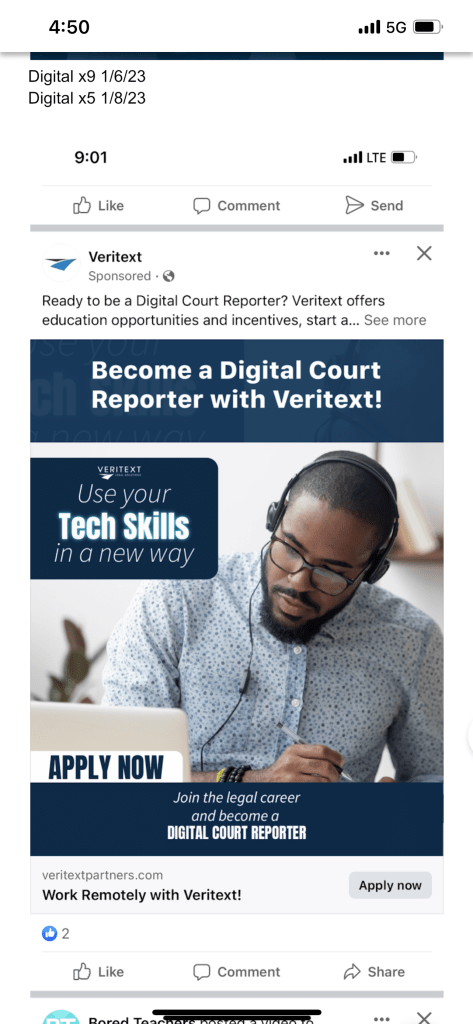
STAR called for unity. Funny how the digital reporters are realizing that I’m all about unity, and they’re ready to make their voices heard too:


We are everyday people. As James McAllister said the other day: We Are Power!
And this platform continues to thrive thanks to your…

Addendum:
12/14/23, a reporter mentioned to me that it’s possible the “digital reporter,” that passed me the information in the ending sequence is actually a bot. Upon review of the profile, it’s possible this is the truth, as it contains very little public information and seems to be a newer profile. I’m uncertain why a bot would come into my network to talk about issues with digital court reporting. But if I’ve learned anything over the last few years, it’s that anything is possible.
I subsequently re-examined my private messages with this person and if it is a bot it is incredibly convincing. There were concerns about anonymity among other things.