NCRA: Please Don’t Talk About Us On Social Media, It Might Force Us To Address Your Concerns…

National Court Reporters Association:

Message from Kristin Anderson, new President of the NCRA 2023-2024

I’ll start with an admission: The headline is not entirely fair. It’s my belief that the individuals involved with NCRA care very much individually. Especially STRONG. But the organization itself has problems, and I’m ready to write about what I’ve experienced and largely why I no longer have confidence in the association.

I do take umbrage with the whole concept of “don’t use social media to discuss the issues.” It restricts effective communication? As a guy who runs the equivalent of a stenographic spy network, I would say the communication’s pretty poor no matter what we do. In the time that it took to systematically dismantle the corporate campaign against stenographers, I’m hard pressed to name anything NCRA has done besides conventions and business as usual. Telling us not to discuss the issues is basically saying “we do not want you to participate.” I have found in my dealings with NCRA that the association doesn’t do anything unless you have an army at your back, and social media is exactly how that army organizes. The army wouldn’t need to organize in the first place if the association was proactive instead of always playing damage control. That’s not Kristin Anderson’s fault. She’s doing what she has to do as president of the association. But there is a real deafness in NCRA’s organization culture and core.

Let me put out there that I was not, historically, an NCRA hater. In my early years I disagreed with some stuff, but overall, I saw the benefit of a large national association for stenographers. I used the power of media to change minds when Frank N Sense was harping on NCRA. I joined NCRA STRONG and put in a lot of effort to try to make a difference, including preparation of a draft white paper and video to help get the message out there that there were issues with recording versus stenography. My efforts were mothballed without explanation. See that from my perspective: Took the time to volunteer, attend discussions, work on materials, and then had hours of time deleted for a reason I was never given. It’s amazing I didn’t call them out right then and there. Then I proposed a series of amendments in 2021 and one of them was so popular that the NCRA made up a reason it couldn’t be voted on. That’s right, this organization that’s always whining for people to take part didn’t even allow members to vote on what I proposed.

Then I had my medical incident, and I wrote some stuff about Dave Wenhold, the Executive Director, that I didn’t have the evidence for, and that was wrong of me. And I genuinely understand if people in the NCRA felt unsure about me at that point, but I was still trying to be a team player and alerted the organization to the fact that its name was being used to spread lies. I also became a National Court Reporters Foundation Angel in 2022. Next thing I know, it’s two or three months after the incident, and I’ve got then-president Dibble calling me to write something retracting what I said about Dave. At first, because I was still recovering from what I had been through, I was genuinely hesitant. I didn’t know what to believe, and I said something along the lines of “I get that you guys want what you want, but don’t discard the information I sent you.” It was only at THAT point that the lie about NCRA got scrubbed from the internet, presumably thanks to action taken by them. But I felt heard, and my recovery progressed to the point where I knew what to believe, so I did what I had been asked to do.

Next thing that happened was I tried to put together an advertising campaign for the Journal of Court Reporting to the tune of thousands of dollars. The idea behind the scenes was that our antitrust training was incomplete, and I was going to make connections and start building interest in re-imagining it. For example, the NCRA says you can’t discuss rates. That’s a lie. Right on the FTC site it says trade associations can collect and distribute aggregated rate data. The ad didn’t talk about any of that, it just gave the name of the project. You can see the ad image here. That got rejected. So here’s an organization that’s resistant to telling the truth. Why? Do you think stenographers are too stupid to understand the nuance that the association doesn’t entertain rates discussions because it can lead to a lawsuit? And if you do think that way about us, why are we paying dues?

There was also a point where I nominated a stenographer from New York that has done amazing things for the field to be a FAPR. Not only was he not made a FAPR, but the rules were subsequently changed so that he would no longer be eligible. And, I, moron that I am, continued to give the NCRA a pass, and even promote them where I could.

But now the silence is broken. There have been a number of things that have come to my attention over the past week. A lot of the small stuff, I still give a pass. It’s hard to run an organization like NCRA. But the continued alienation of the organization’s strongest supporters is disgusting. I have watched with my own eyes a die-hard supporter that had just about every idea she ever had struck down. I’ve heard that a certain educator — one that has gotten graduation times down to a year in some cases and set the wheels in motion to sponsor lots of students for the convention — wasn’t acknowledged. I’ve heard that someone with a real talent for putting together events was looked at as competition and not potential collaboration. I’ve heard the qualifiers weren’t fully acknowledged. I’ve heard that a student got escorted off premises at the convention. Again and again, stories of people giving what they can and getting shit on for it. And that’s just this year. If any of you are reading, here’s a question: Why does an organization begging for talent shit on all its potential talent?

Well, I’m here to tell all of you: You are not alone. They did this shit to me too, and I tried the whole grin and bear it thing for the greater good. It’s not worth it. They don’t change direction. They just cycle to the next president and we all hope it’ll work out better this year. It doesn’t matter who’s in leadership, the organizational inertia just comes up with reasons why we can’t do whatever the members, volunteers, or probably even board members want to do.

It’s become clear to me that the direction that the NCRA is headed is going to continue alienating members, the membership is going to dwindle, eventually the digital-friendly stenographers will have enough votes to pass digital membership, and then the corporations I’ve been blogging about are going to co-opt the organization, its resources, and the brand recognition. And even if they don’t go that way — and it would be dumb for them not to — the dwindling membership is going to let all our enemies point and say “look, all their members are retiring, it must be the shortage. Guess we just have to use digital.”

At this point, the NCRA as an organization is a liability. People believe in it as a vehicle for change and they waste their time pushing for incremental changes that never really amount to anything as we continue to slide back in wages adjusted for inflation and lose jobs to other methods. The myopic tunnel vision of “sticking to what works” isn’t working in this decade. These people can all make a real difference. They’re being held back. They’re not being given the institutional support necessary to foster a healthy profession. And if that support isn’t forthcoming, then what’s the point in donating any amount of time? We’d be better off privatizing our efforts a la the Project Steno thing.

There’s a quote out there, “hard times create strong men. Strong men create good times. Good times create weak men. And, weak men create hard times.” Maybe that’s what happened. The golden era of stenography made us top of the food chain. By the time I got here, the bulk of us had no idea how to compete. So when competition came calling, Steve Townsend basically ran circles around everybody, because he’s damn smart. This is not to say the amazing women of this profession are weak or stupid. They are this profession. But many were not set up to succeed. After all, their 100-year-old associations had made no institutional ties to help safeguard against the propaganda campaign that was sprung on them.

What more is there to say? If there’s interest in starting a new national stenographic association with safeguards against institutional inertia, then I’d be happy to put that together and seek pledges. One idea I’ve had in the past is a grand assembly type structure that can petition or even force the board / organization to act as long as it’s not a violation of law. Maybe the mere threat of more competition arising will encourage organizational change. Every person alienated will become another potential ally for me. Good luck, NCRA. I suppose this is my very public resignation from an association I held in the highest regard. I’m sorry it has to be this way, but I am a slave to my moral compass as much as anyone. I will always do my best to be fair. But what was done to me was not fair. What’s done to others isn’t fair. Silencing ourselves for some greater good that never comes isn’t right. And if any of you are feeling that, remember that this blog exists for your

Words & Voices, Stenonymous.com

Addendum:

The white paper I was upset about in this post was released in November 2023.

Tech Expert: AI Hallucination Is Not Fixable

Hopefully by now most people have heard that ChatGPT and similar language models can confidently pump out falsehoods.

Came across this really interesting article in Fortune. Emily Bender, a linguistics professor and director of the University of Washington’s Computational Linguistic’s Laboratory, is quoted as saying the AI hallucinations that ChatGPT experiences are not fixable.

Yet what’s the next thing the article talks about? It claims the McKinsey Global Institute projects AI will add somewhere around $3 trillion to $4 trillion to the economy. It talks about how Google is offering up similar technology to news media companies. It talks about how Sam Altman, CEO of ChatGPT, is optimistic about the technology, and quoted another CEO, Shane Orlick of Jasper AI, as saying “hallucinations are actually an added bonus.”

“Hey, this doesn’t work right, and the issue doesn’t seem fixable.” “FULL STEAM AHEAD, it’ll be better for the economy and the things it gets wrong are actually a good thing!” How deluded are these people? And when does it become socially acceptable to tell someone they’re full of crap? Never? Well then I guess we’ll just continue to live in a world where big money can lie on an industrial scale and never be held accountable.

This is not unlike our field, where AI can and does confidently pump out wrong words. We learned that AI wasn’t as good as us, particularly on the African American Vernacular English dialect, from the Racial Disparities in Automatic Speech Recognition 2020 study. AI scored as low as 25% in that study. When we were tested in the Testifying While Black study, we were about 80% accurate. When we broadcasted that in professional circles, the big money in our field ignored it and kept with their agenda. After all, what kind of monster would let science, facts, and egalitarianism stand in the way of a corporate operation designed to push the market in a singular direction?

Succinctly, it is not the most meritorious narrative that seizes the day, but the strongest. That’s why tech continues to pump out the message that it’s going to be a massive boon to the economy. Who cares if it’s true? It keeps investor money flowing, avoids AI winter, and that money gives them more legitimacy as they keep pumping out the aforementioned message that then lures in more investors and money. That’s also why I sought funding from the field. Our message could overpower big box on the digital v steno debate, and then, right or wrong, we’d be victorious, and the win would be self-reinforcing. Not a single corporation in the market today would dare to do the dishonest and illegal things I’ve documented over the last few years.

It makes me wonder if the answer is to “corporatize” our media and seek shareholders. I’ll take answers in the comments if anyone will share. For those of you that don’t donate, would you put some money on the table if there was a return involved? How much money? How much return? For those of you that do donate, feel free to answer too. There is some reason to suspect a corporate accountability media company would be successful. It’s been said that millennials alone are going to be 75% of the workforce by 2025, and millennials have a lot of reasons to love corporate accountability — the main one being that, rhetorically, there hasn’t been any since we were born. Monetize what people want, get the shareholders some money, and do it with a flavor that distinguishes us from nonprofits in the space.

We can see with our own eyes that there is no position too absurd for big money. We can also see how an internet campaign by one guy with some hardcore supporters can run circles around big money. Combining these two ideas, why not run circles around big money for big money?

I’d do it. Who’s with me?

Steno Imperium Offers $1,000 to Confirm Alleged Veritext Policy

Steno Imperium is at it again. Its most recent post claims a former Veritext employee mentioned there is/was a policy to have 50% digital throughout all offices. $1,000 is being offered for any document proving this.

I’ll be looking for developments on this. If it can be confirmed, then the next question is whether these offices have anywhere close to 50% today.

The post also claims that Andy Fredericks, COO of Veritext, stated that digital was 10% of California market share in 2021. It’s hard for me to believe they were able to expand that to 50% over two years.

It must be pointed out that the expansion of digital jobs is ultimately a loss of stenographer jobs that will drive down demand for our students and probably force more school closures. Forced diversification of the workforce allows them to bump stenographers whenever they want and keep digitals and stenographers hungry. Hungry digitals and stenographers compete with each other and come down on their price. Winner? Big box every time. Realtimers should really start paying attention. The digital side has already started saying they have realtime. They’re going to start swapping you all out too.

I believe we should keep letting digitals know the value of the work they’re being given. Imagine, for example, someone being paid $15 an hour learns the value of the work they’ve been given was $75 an hour. What happens? The smart ones start asking for more. What if we could mathematically show digitals the total value of stenographer pages converted into hourly form? That’s what the conversion calculations at the bottom of this post were all about. What do we have to lose? Apparently some of the big boxes are already set on replacing the jobs despite the science, equality, and quality issues I’ve written about in the past. Might as well give them a little run for their money.

Have to hand it to Steno Imperium for gathering this info, putting it out there, and trying to gather more solid proof. Thanks!

The Court Reporter Shortage Fraud Timeline as told by Stenonymous

This is a timeline of events I wrote out for another project. It presents a snapshot of what I have documented over the years and links many blog posts to form what I feel is the bulk of the story.

Perhaps it will help supporters to have a single document like this. Perhaps it’ll help those who get lost trying to navigate the site and understand the issues. Perhaps it’ll sit on the internet collecting internet dust. Whatever the case, just know that I appreciate every single one of you for spreading the word and sending me information. It has made all of this possible.

Summary of Fraud:

The basic idea is that these multimillion dollar corps (Veritext, US Legal, etc) got together under the nonprofit Speech-to-Text Institute to claim the stenographer shortage was impossible to solve and artificially increase digital demand, which they all then benefit from. Stenograph was also a part of STTI, as its president, Anir Dutta, was vice president of the STTI. While making these claims through STTI, many of the companies were representing to attorneys and the public that they couldn’t find stenographers. Meanwhile, they weren’t using basic methods to find stenographers, like Sourcebook / PRO Link, a national directory of stenographers. Jim Cudahy is instrumental in getting the shortage forecasted via NCRA, then he turns around and weaponizes it against us years later before I declare him a fraud and he runs off to another association about a year before the STTI gets sued and takes down its site.

Timeline of Documentation: 

2013 – The Court Reporting Industry Outlook 2013-2014 is created by Ducker Worldwide for the National Court Reporters Association. Jim Cudahy is Executive Director of NCRA at this point and instrumental in getting the shortage forecasted. Notably, California’s shortage is forecasted to be 5x to 20x worse than any other state.

2014-2018 – Initiatives such as NCRA A to Z, Project Steno, and Open Steno boost stenographic recruitment and public awareness of steno. Jim Cudahy is replaced as Executive Director during this time period and goes on to do whatever he does (7 MARCOM, I think). All of the companies in question were incredibly quiet, considering there was allegedly an impending shortage of doom.

2018 – At this point, the field didn’t even believe the larger companies were using digital court reporting. I know this because it surprised people when I published about it. Around this time, companies also began advertising huge bonuses with jobs to get court reporters to cover in California, lending some credibility to shortage concerns.

2019 – Veritext begins propagandizing lawyers to get them to change their deposition notices and allow for digital court reporting. US Legal Support buys and later kills StenoTrain, which was run by Patricia Falls (court reporting educator that is now all about digital.) At this point in history, companies were trying to get digital court reporters seen as just court reporters. We began differentiating ourselves as stenographers. Remote reporting comes up as a potential fix for shortage woes.

Veritext VP Gina Hardin writes a piece about digital reporting changing the landscape of reporting. After big social media buzz, she’s allegedly fired.  Veritext makes it out like she did this of her own choice rather than following the direction of the company. Veritext makes the public statement that stenography is the life-blood of our industry and that of Veritext.

Companies begin popping up making outrageous claims. For example, vTestify had a calculator on its site that said it could save attorneys $3,000 per deposition

Stenographers are often insulted as “expensive,” but in 2019 I learned we were working for rates 30 years behind inflation. (NY)

Jim Cudahy reappears under the Speech-to-Text Institute making the claim that the stenographer shortage is impossible to solve.

At this point, the bait and switch tactics of sending digital court reporters instead of stenographers are known. A nonprofit called Protect Your Record Project is formed to warn consumers.

Open letter released from Veritext about the shortage.

2021 – Veritext makes a statement to Stenonymous that technology will not take the place of the reporter. I begin to realize the Ducker Report was flawed. I get my hands on an email from US Legal Rep Peter Giammanco where he puts IN WRITING “does it really matter if done legally and ethically…[if both products are the same.]” I document some of the materials that companies are using to promote digital and note the scarcity of pro-stenographer material. I note that BLS statistics appear inaccurate and don’t match up with NCRA’s statistics. STTI, U.S. Legal, and Veritext all use a flimsy game of numbers to continue to push the propaganda the shortage is impossible to solve.

At this point the switch is flipped and I start poking holes in STTI materials. 

A website using stenography images to lure people into digital court reporting is found. When I alert ESYOH to the fraud, they take parts of it down. 

BlueLedge Digital Court Reporter training is linked to Veritext – the full extent of the relationship is unknown. And Stenograph is definitely in on making money off of digital court reporting and part of STTI. Interestingly, a Veritext company appeared to share an office with BlueLedge. Stenograph’s stenographer support also took a massive dip during this time period. Even NCRA notes there may be illegal conduct coming from digital land. 

It’s also noted that Veritext ran a training for NYPTI prosecutors (prosecutors often go into civil lit, Veritext’s domain). They made it seem like stenography was old and outdated despite modern computerization. Basically eliminating us in attorneys’ minds through education.

At this point in history, I declared Jim Cudahy a fraud for his part in advancing STTI’s agenda.

2022 – A couple of hit pieces are put out on me. I actually got one of them taken down. A lie is published to the internet that the NCRA predicts a need for 30,000 digital court reporters, which we later get taken down. We launch a campaign to tell the FTC what’s happening. STTI continues to publish garbage. Jim Cudahy leaves to the Alliance of Crop, Soil, and Environmental Science Societies. I note that according to BLS statistics, our median pay is falling, which is not something that occurs if there is a shortage of something (supply down, price go up.) We have a campaign to tell the FTC what’s going on. FTC makes the claim it will crack down on companies taking advantage of gig workers. I publish and advertise the fraud some more. I document STTI has -$100,000 net assets according to a tax return. NCRA Strong finally points out that the Ducker Report is outdated.

2023 – Veritext subsidiary is discovered to have purged popular stenographer anecdote. Indiana proposes a ban on stenography in its courts. A lawsuit emerges claiming USL stole commissionable income from one of its executives, in my view strengthening the case that they’d commit illegal acts. Veritext goes after a court reporter for something they wrote on Facebook after ignoring my claims for over a year (well beyond the statute of limitations for defamation at this point.)

A lawsuit is filed against the Speech-to-Text Institute for anticompetitive behavior and the STTI takes its site off the web. 

[REDACTED] calls me [REDACTED], and when this is discovered, he apologizes. The situation causes an uproar in its customer base that results in a Town Hall Meeting with customers where Mr. Dutta stated he was no longer affiliated with the STTI organization.

That’s the story so far. I’ll let you draw your own conclusions. But I beg you to look at the inertia of the companies for half a decade prior to the shortage compared to their aggressive expansion of digital thereafter, as well as the flip flopping by Veritext that points to a very real intent to deceive.

Addendum:

As of July 2023:

1. Lawsuit update.

2. Correction to the original article which accidentally said Jim Cudahy changed associations months before STTI took down its site. In fact it was more like a year. This confusion was a 2022/2023 typo in my notes.

As of August 2023:

I scraped the old STTI leadership off the Wayback Machine so that people can see what I’m saying when I talk about the STTI Bloc or the companies behind the organization.

Then leadership of the Speech-to-Text Institute, as preserved by Stenonymous.com and the Wayback Machine

As of November 2023:

I was alerted to the dismissal of many of Trey’s claims, but as of writing, nothing to indicate that the claim against the Speech-to-Text Institute has been dismissed.

As of March 2024:

I was alerted to the apparent default of the Speech-to-Text Institute. The cowards would rather default than defend themselves in court.

As of April 2024:

I redacted some information on this page pursuant to a discussion I had on April 24, 2024. I also wrote out a quick “legal theory” on why the fraud claims can be legally substantiated even though the FTC and other law enforcement agencies have apparently decided not to pursue. Anir Dutta stepped down from Stenograph.

As of May 2024:

The Coalition to Capture the Record, clearly a digital court reporting front, would not disclose its backers to Law360.

I am now uploading the art that’s been used to communicate our position.

I’m starting to think that the reason this hasn’t been picked up by the ALM brands or Law360 is because ALM is big business’s bitch and Law360 is a B2B scam that doesn’t have any interest in actually informing people. Smaller news shops probably figure “eh, the legal news world hasn’t picked this up, so it must be fake.” Nope. Here it is. Christopher Day, court reporter extraordinaire, has been accusing the largest court reporting provider of fraud for years. It’s the industry’s biggest open secret. And it’s only secret because American media is a corporate consolidated hellhole that will readily mislead the public for a dime.

This shit really happens, bro. Same way the media cut the news about the pilot studies in Testifying While Black.

As of September 2024:

California Court Reporters Association said the shortage conditions were manufactured by the court system to justify digital reporting.

Founder’s Courier: The Inferiority of Digital Court Reporting…

A brief analysis of digital court reporting versus stenography was posted to Founder’s Courier recently. It mentions the companies that are under the umbrella of the Speech-to-Text Institute and some of the security concerns about digital.

As the push continues to grow stenography’s presence in web media, I really appreciate any and all donations that come in. They help ensure things are flowing in the right direction.

THE TKO T- TAO FPLT

Massachusetts Court Reporters Association Publishes Open Letter to Stenograph (Town Hall Response)

An open letter by the Massachusetts Court Reporters Association was published to their Facebook page today, May 25, 2023. It is my understanding it will be sent directly to Mr. Anir Dutta, president of Stenograph later today.

Jill Kourafas, President of the Massachusetts Court Reporters Association, publishes an open letter about the May 20233 Stenograph Town Hall Meeting.

It points out many of the things I mentioned in my blog yesterday and asks Stenograph to give more control of the event to the stenographic community.

Open Letter to Stenograph by the Massachusetts Court Reporters Association, Part 1.
Open Letter to Stenograph by the Massachusetts Court Reporters Association, Part 2.

It’s a big question how Stenograph will respond, if at all, to the letter. But if you’d like to show support to the MCRA on this brave move, share this today, and consider a donation to the association!

Addendum:

The open letter was edited after the original post and the links have changed. Link 1. Link 2.

Stenograph Town Hall To Be Held on May 31, 2023

In an email received at about 3:11 p.m. today, Stenograph announced the date of its town hall meeting and distributed an invite link. Participants are asked to send their questions to townhall23@stenograph.com by May 30, 2023.

Stenograph May 2023 Town Hall invitation.

I’ll start with something positive. I think this is a step in the right direction. Customers have been asking for a little love and attention for a long time, and this is definitely trying to give them what they asked for. The petition went out last week. Mr. Dutta’s public comments were discovered this weekend, and here we are.

There are some problems with the way this is being done. First, Stenograph being in control of the questions means that some questions may be disregarded. If you send in questions, consider saving evidence that you sent them and then letting me know if any of your questions were ignored afterwards. We can at least create a record of what wasn’t asked if my paranoia over Stenograph’s control of the event turns out to be healthy skepticism. Overlapping with that concern, there are questions about whether any live questions will be taken or whether the town hall will be exclusively limited to questions sent to the email provided by May 30. I have to admit, I believe that Stenograph should take some questions beforehand because it’s a company and it’s hard to answer questions on the fly about a company with no prep as to what those questions will be. But I also believe a healthy town hall would have some live question component.

Another problem that arises is that at 6 pm EST, it’s 3 PM PST. Many stenographers will be working at the time of the event, and if it is not recorded and distributed, they will miss it. Participants could record themselves using Open Broadcast Software or their phones or whatever, but it’s an extra step many won’t take. And again, paranoia strikes. What if low attendance is used to support the shortage narrative pushed by Stenograph, Veritext, US Legal Support, and the Speech-to-Text Institute? In my heart, I hope the company wouldn’t do that, but I’ve learned to stop thinking with my heart and understand that people play games.

If there are questions you want to ask that you don’t feel comfortable sending to Stenograph yourself, please comment them here. I will send them and keep a record of what I send. I will not send anything overtly inappropriate.

I’ve said many times before that if Stenograph admits that the Speech-to-Text Institute was wrong about the stenographer shortage being impossible to solve, it will make court reporting history. That’s what I’ll be looking out for. I have other questions about the percentage of revenue that goes into their R&D budget and what percentage of that is specifically spent on stenographic technology, but other than that, I haven’t yet decided what to ask.

For what it’s worth, if anybody from Stenograph is reading, thanks for doing this, but these are honest concerns court reporters have.

Court reporters, if you fight, you will win. You wanted a town hall and you got one. Make the most of it and remember this moment the next time someone tells you something cannot be done.

Addendum:

I messed up the times in the original post. It’s 6 PM EST, 3 PM PST. May 31, 2023.

Court Reporting is Now a Side Hustle

How court reporting companies are getting away with charging top-shelf prices for undervalued work…

The overpriced court reporter page is something that comes up occasionally in legal circles. All through my early career, law firm owners I worked with mentioned how their firms were stuck with expensive court reporter bills. As a young stenographic court reporter, I was paid very little, and later learned that court reporters in my city were about 30 years behind inflation. This set me down a path of skepticism when it came to what court reporters are told about themselves, their industry, and the public’s perception of them. How could lawyers be paying so much when I was making so little and such a large part of the transcript creation was on me?

Years later, as it turned out, some of the largest court reporting companies would get together using a nonprofit called the Speech-to-Text Institute (STTI). That nonprofit would go on to mislead consumers about the stenographer shortage to artificially increase demand for digital court reporting. Tellingly, while a U.S. Legal Support representative had no problem using the word “libel” on one of the female members of my profession, USL and the other multimillion dollar corporations never dared utter a word about my eventual fraud allegations. The companies wanted to trick consumers into believing stenographers were unavailable due to shortage and force digital court reporting on them, where matters are recorded and transcribed.

This set off alarm bells in the world of court reporting. Stenotype manufacturing giant, Stenograph, also represented in STTI’s leadership, shifted from supporting realtime stenographic reporters to shoddy service, and began to call its MAXScribe technology realtime. Realtime, as many attorneys know, is a highly trained subset of court reporting that often comes with a premium. These bait-and-switch tactics on the digital court reporter side of the industry caused a nonprofit called Protect Your Record Project to spring up and begin educating attorneys on what was happening in our field. But as of today, the nonprofit has not reached a level of funding that would allow it to advertise these issues on a national scale — this blog’s in the same boat.

So as more of the workforce is switched to digital reporters / recorders and transcribers, we’re seeing companies use influencers and other media to lure transcribers in for low pay. In short, digital court reporting is now synonymous with side hustle. These companies are going to take the field of skilled reporters that law firms and courts know and love, replace them with transcribers, and go on charging the same money. For the stenographer shortage, these folks were dead silent for the better part of a decade. Now that they need transcribers to replace us, they’re going all out to recruit.

Shopify talks about transcribing as a side hustle.

TranscribeMe, by the way, just entered a partnership with Stenograph.

“What do I care?” That’s what a lot of lawyers and paralegals might be asking at this point. Well, I may not write as well as Alex Su, but I’ll do my best here. First, there are egalitarian concerns. In the Testifying While Black study, stenographers only scored 80% accuracy on the African American Vernacular English dialect. This was widely reported in the media, but what was lost by the media was the reveal of pilot study 1, which showed everyday people only transcribe with an accuracy of about 40% (e226). When we’re talking about replacing court reporters with “side hustle technology,” we’re talking about a potential 50% drop in accuracy and a reduction in court record quality for minority speakers, something courts are largely unaware of. According to the Racial Disparities in Automatic Speech Recognition study, automation isn’t coming to save us either. Voice writing is the best bet for the futurists, and it’s being completely ignored by these big companies.

There are also security concerns. When we’re talking about utilizing transcribers, we’re talking about people that have an economic incentive to sell any private data they might gain from the audio or transcript. If transcription is outsourced, a bribe as low as $600 might be enough to get people acting unethically. Digital court reporting companies have already shown they’re not protective of people’s data — in fact, companies represented in the Speech-to-Text Institute. This also leads to questions about remedies for suspected omissions or tampering. Would you rather subpoena one local stenographer or teams of transcribers, some possibly outside of the jurisdiction?

Finally, there’s an efficiency issue with digital court reporting. Turnaround times can be much slower. Self-reported, it can take up to 6 hours to transcribe 1 hour of audio. By comparison, 1 hour of proceedings can take a qualified stenographer 1 to 2 hours to transcribe. That’s 3 to 6 times faster. Everyone here knows stenographers aren’t perfect and that backlogs happen. Now imagine a world where the backlog is 3 to 6 times what it is today. In one case, a transcript took about two months to deliver. If we’re going to hire teams of transcribers to do the work of one stenographic court reporter, aren’t we going backwards?

This is eerily similar to what went on in medical transcription. Competing interests played games to nobody’s benefit.

Consumers are the ones with the power here. They can demand stenographers, utilize companies that aren’t economically incentivized to lie to them, and spread awareness to other consumers. Consumers, lawyers and court administrators, decide the future. Knowing what you do now, do you want a court reporter or a side hustler at your next deposition or criminal case?

—————————-

Written by Christopher Day, a stenographic court reporter in New York City that has been serving the legal community since 2010. He is also a former board member of the New York State Court Reporters Association and a former volunteer for the National Court Reporters Association STRONG Committee. Day also authors the Stenonymous blog, the industry’s leading independent publication on court reporting media, information, data, analyses, satire, and archiving of current events. He also appeared on VICE with regard to the Testifying While Black study and fiercely advocated for more linguistics training for court reporters in and around New York State.

Donations for the blog will help run advertising for this article and others like it, as well as pay for more journalists and investigators. If you would like to donate, you may use the donation box on the front page of Stenonymous.com, PayPal or Zelle ChristopherDay227@gmail.com, or Venmo @Stenonymous. Growing honest media to combat misconceptions in and about our marketplace is the premier path to a stronger profession and ultimately better service to the legal community.

A posse ad esse.

Addendum:

By sheer coincidence, an article on the side hustle was released the same day as my post. NCRA STRONG’s Lisa Migliore Black and Kim Falgiani really hit it out of the park with this one. Apparently FTR and Rev say they have security in place to prevent sensitive data from being shared. But FTR is known for selling “deficit products,” and Rev is known for its massive security breach. So check out the article by Chelsea Simeon linked above and enjoy!

Proof The Court Reporter Shortage is A Digital Court Reporting Advertisement

I was sent this by a contact over social media. It’s labeled as an advertorial. And that alone gives us enough to pick it apart and figure out what it’s selling. It’s written by Christy Pratt, VP of Veritext Canada.

Veritext releases advertorial about the court reporting shortage, strengthening Stenonymous arguments that the court reporter shortage is being exaggerated and exacerbated to artificially increase demand for digital court reporting.

It goes a little into the history of reporting to give the rest of the piece some credibility. I have no problem with that. But then it gets to its main sell: The shortage is real and times are changing! Hey everybody! Did you know times change? You can trust the rest of the advertorial because the author is making perfect sense up to this point.

Veritext advertorial showcasing that the shortage is being used as a selling point for digital court reporting.

Remember, this is posted to Trial Lawyers of BC. It’s clear who the audience is. They don’t want lawyers to complain about the transition from steno to digital, where the author admits steno is still in heavy use. They want to paint digital as the solution. It’s much easier to tell someone what they want is not available instead of telling them you don’t want to give it to them. It’s a lie to limit consumer choice.

It’s worth noting that the shortage isn’t as bad as it was forecasted to be in America and that the Speech-to-Text Institute’s Jim Cudahy left the field when I accused him of fraud for spreading court reporter shortage disinformation. It’s also worth noting that Veritext is represented in the Speech-to-Text Institute’s leadership by Adam Friend, VP of business development, and has not made any attempt to correct the misleading information put out onto the market by STTI. Misleading information that threatens the futures of ourselves and our students, by the way. Does anyone believe that Veritext, a multimillion dollar corporation that benefits financially from the expansion of digital, would not spread the same lies in Canada?

I’ve had people lie to me over $5. When the future direction of an industry is at stake, does anyone believe this isn’t fabricated? And I’m sure I have a detractor or two who would point at me and say the same, but let’s be real, in my wildest dreams Stenonymous makes me maybe a million dollars someday because some rich person realizes how much fun it would be to set me loose on the world or Veritext realizes my creative genius can be bought (in reality, I lose money on my media activities, even with the support of my wonderful audience.) This industry is close to $3 billion annually by estimates I’ve seen. Who has a greater incentive to lie? And it’s not like they can claim they don’t know about my research now. They’re basically using my arguments on AI to make the case for why court reporters won’t be replaced. I’ve basically never had better proof that Veritext execs read the blog and understand at least part of my work.

To make matters worse, a source inside a big box is saying the nickel and diming of stenographers is getting worse despite the alleged demand. If they’re chipping away at the incomes of high-end realtime reporters, the average reporter isn’t going to stand a chance.

Reporters, organize and resist or be ruled by people that don’t care if you have a good life. That’s all there is to it. I know my methods come off as extreme, but it’s an extraordinary case where an entire profession is threatened with extinction based on a lie. It’s a classic what-would-you-do scenario, and I’d like to think that if every reporter had the same statistics and information that I have seen and published, they’d be just as outraged. They’d fight just as hard, and maybe harder.

I’ll continue my quest to slay the windmills. Wish me luck.

Stenograph’s Attack on Stenographers in Illinois…

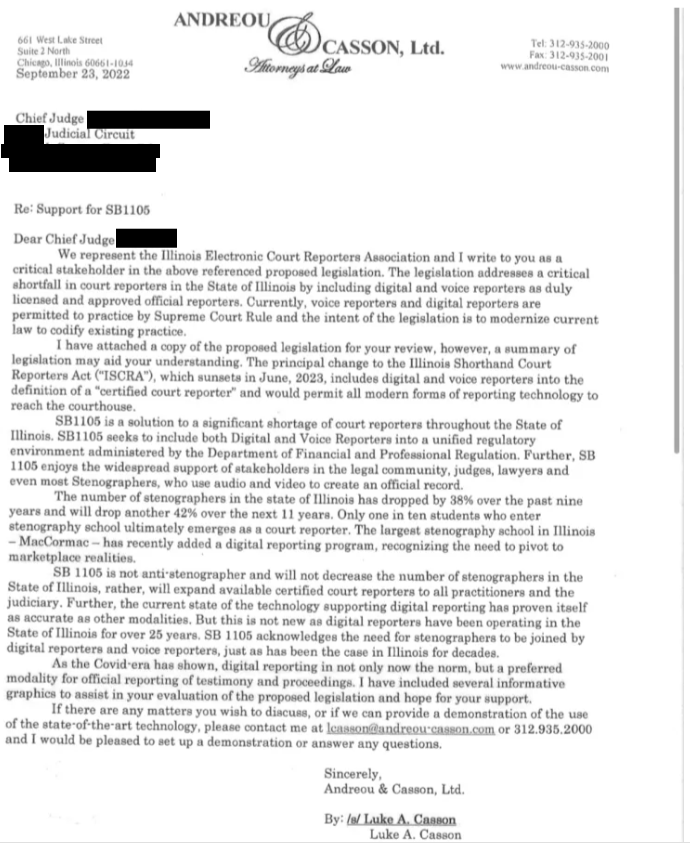
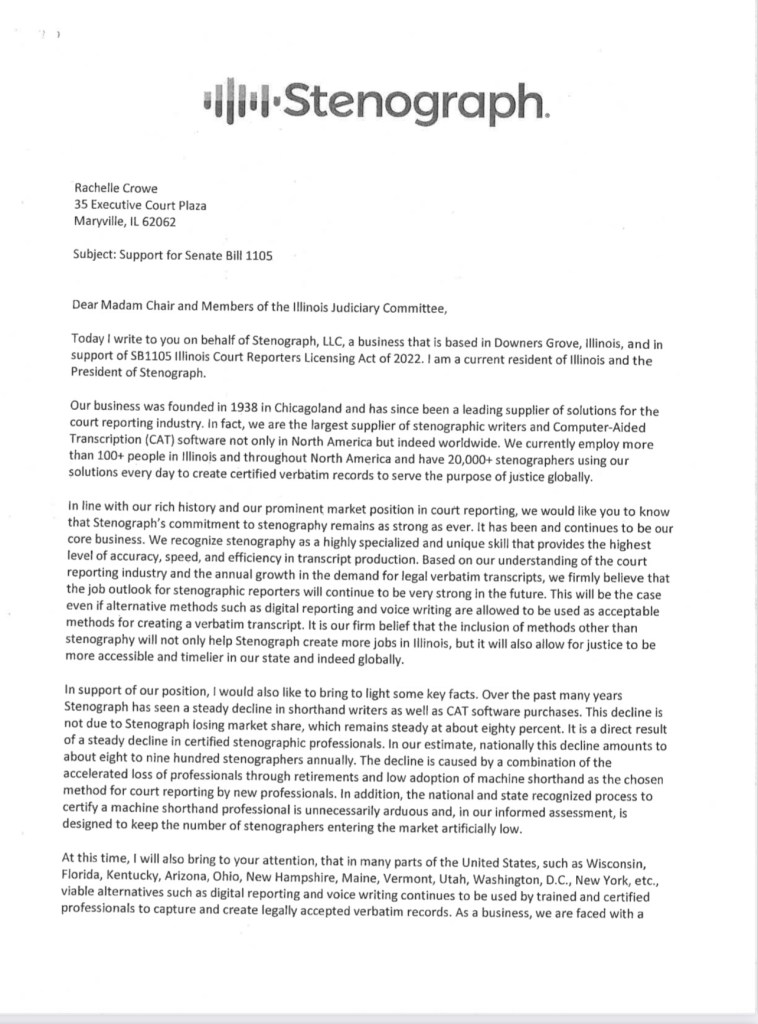
I’ve obtained a letter from Luke Casson of the Illinois Electronic Court Reporters Association and Anir Dutta from Stenograph. Along with these materials came some Speech-to-Text Institute materials.

Speech-to-Text Institute, as we know, is the nonprofit that lied when it said the court reporter shortage was irreversible. It used an outdated report to make its case, and its frontman, Jim Cudahy, left the field after I called him out on his fraud. STTI has several companies represented in its leadership, including The RecordXchange, Stenograph, Trans-Atlantic International Depositions, Planet Depos, Veritext, U.S. Legal Support, Neal R. Gross and Company, vTestify, Verbit, Kentuckiana, Tri-C Community College, RevolutionaryText, and For the Record. When I refer to the STTI Bloc, this is what I’m talking about. They used STTI to pump the market with misinformation, and as you’re about to see, they ride off those lies to push digital court reporting to policy makers and fellow court reporters.

If you look at those links above you’ll see that I’ve been on this since day 1. Court reporters can trust me to fight for them.

On that note, I think the best way to do this is to present each piece and then present my take on it. I’ll try not to nitpick too much and just bring out primary points.

I’ll be really fair here. He’s got a mission and he’s sticking to it, and that’s fair game. But I would say the idea that adding digital to the pool will not decrease the number of stenographer jobs is a lie. There is a total market. More of that market being covered by digital necessitates fewer available stenographic jobs. The idea that digital reporting is the preferred modality is also heavily in dispute. We literally call stenography the gold standard and even ChatGPT knows it.

Lies spread by the Speech-to-Text Institute used to support digital in Illinois

For the STTI materials, it’s 100% certain to exacerbate because the STTI Bloc has used all of its money and influence to grow digital over steno while lying to court reporters and the public. The number of stenographers shrinking in Illinois is pulled straight from Ducker’s “70% will retire before 2033” statement. There is basically zero chance that the report, which is a decade old, reliably predicted the future with 100% accuracy. Fewer than 1 in 10 become court reporters. I’ll concede that we say this a lot, but has anybody run the actual numbers with any consistency, or is it kind of like Ducker where we got some information once and then trusted that forever and ever? I have the same issue with stating the number of stenography students. It completely discounts the self-taught — and I personally know self-taught court reporters. It’s all fluff to suit an agenda. I no longer feel bad about calling it what it is. Nobody from that side of the equation has ever defended their inexcusable antisocial behavior. They simply pretend I don’t exist, because my existence is inconvenient to their agenda.

Stenograph supporting digital in Illinois

Stenograph claims to have 80% market share, and then claims that at least 20,000 use their software. That would put the number of stenographers at at least 25,000. That means Stenograph knows for a fact that STTI was wrong, since there were only supposed to be 23,000 of us as of 2023. Again, the idea that this will add additional jobs is laughable, it will only move market share to digital, which Stenograph has positioned itself to profit from. They also lie about New York, where voice writing is not accepted for civil service positions. Neither is digital. Anir writes well, and I admire his ability to stick to a story. Perhaps seeing this in print will lead people to realize why I was so down on Stenograph as an entity, but not its employees or trainers. As a company, they’re not doing right by us. Everybody else is just caught in the crossfire of that. But the company relies on you being the bigger person and letting it go. “It’s just business,” they say, as they twist the knife just a few more times.

Speech-to-Text Institute Propaganda that the shortage was impossible to solve with stenography only. Stenograph’s admission to 80% market share invalidates this number (2023)
Stenograph ad proclaiming support for stenographers.
Stenonymous remarking that Stenograph is part of the STTI Bloc, a group of corporations that got together to sell digital using misleading arguments and bad statistics.

The math from my last ad report was very clear. Using my current media knowledge, we could probably reach/engage over a million people for about $30,000. I can’t lay that out by myself right now, but it should put into perspective why I keep asking for money. It makes a difference.

Stenonymous advertisement warning consumers that the government is not protecting them when it comes to court reporting.
Stenonymous ad costs $0.04 per engagement, down from $1.00 per engagement on some old projects.

But as always, I leave it in the hands of my colleagues. Do we continue to wait and see what happens, or do we get serious about funding the only industry blog dedicated to purging corruption from the field? Regardless of the choice, reporters can count on me to continue being truthful.

And to give some good entertainment in the process.

Stenonymous poked fun at the STTI Bloc’s persistence with regard to digital court reporting v steno.